
ACCESSIONING MUSEUM COLLECTIONS An Overview Accessioning What is











- Slides: 63
ACCESSIONING MUSEUM COLLECTIONS An Overview
Accessioning What is an Accession? An accession is one or more objects acquired at one time from one source, constituting a single transaction between the museum and a source (Burcaw 1997). Accession numbers are assigned sequentially by the order in which objects enter the museum's collection.
Accessioning Accession numbers are assigned to objects for various purposes: • Record-keeping • Storage and Retrieval • Tracking • Security These numbers are physically labelled on or attached to the objects as well as on all related paperwork.
Accessioning Numbering systems can be structured in different ways and can vary from museum to museum. Often these differences can lead to confusion not only within a museum but also for outside users of the collection.
Accessioning A good numbering system should be: • Easy to understand • Flexible • Expandable A standard numbering system will improve access to collections and encourage the sharing of information between museums.
Accession Numbers The three-part numbering system meets all of these requirements and is standard in the museum field. MN. 2008. 032. 02 On PEI we are also adding a prefix to identify the individual museum. This will cut down on confusion and even open up the possibility of creating an Island wide museum database.
Accession Numbers The accession number is made up of the following information: The 4 digit year the acquisition was accessioned And a 2 or 3 digit object ID MN. 2008. 032. 02 A 2 or 3 character prefix representing the museum The 3 digit lot number representing the accession’s sequence for the year
Prefix MN. 2008. 032. 02 Each museum should choose a 2 or 3 character code that can be used to easily identify itself. This prefix must not already be in use by another Island museum. Check with the Community Museums Association. Some examples are: OM – O’Leary Museum AM – Alberton Museum BPM – Bideford Parsonage Museum WP – West Point Lighthouse
Year MN. 2008. 032. 02 This is recorded as 4 digits and represents the year which the lot was officially accessioned (acquired/accepted into the collection. ) Using a 4 digit year prevents confusion in the future.
Lot MN. 2008. 032. 02 This three digit number is assigned to acquisitions in the order in which they were acquired. At the beginning of each new year this number is reset to zero; thus the first acquisition in January of every year will receive the number 001. Resetting the lot number each year prevents it from growing too large.
Object ID MN. 2008. 032. 02 The goal is to assign a unique accession number to every object within a Lot. The Object ID increases by one for each object within the Lot.
Accession Numbers By looking at an accession number we can learn a lot about the acquistion. We know that this object was acquired in 2008 And we know that there at least 2 objects in this lot of which this is the second MN. 2008. 032. 02 We know that the museum is prefixed MN We know that this lot was the 32 rd to be accessioned in this year
Accession Numbers an Example 3 books are donated by the same person at the same time. MN. 2008. 032. 01 Each would receive the same Accession Number… …but each would be given a unique Object ID MN. 2008. 032. 02 This numbering system will cut down on confusion and reduce the overall amount of paperwork. MN. 2008. 032. 03
Accession Numbers Simply by looking at the numbers we can tell a lot about these objects. We can see that: • they are all owned by the same museum • they were all acquired in the same year • they were all acquired at the same time as a lot or group from the same source • and this accession has three objects MN. 2008. 032. 01 MN. 2008. 032. 02 MN. 2008. 032. 03
Accession Numbers The benefit of this type of system becomes more apparent as the groups of acquisitions and objects become more complex.
Component Parts Often an object will have more than one part or component. Component parts are normally pieces that fit together and that can also be easily separated from the whole. We number them so that they will not be lost over time. It is important to number component parts to make it clear that they all comprise one object. We use letters (a, b, c, etc. ) to denote component parts.
Component Parts The way you assign numbers to an object depends a lot on how it was made and how the parts function together. This sugar dish has two components: the bowl and the lid MN. 2008. 032. 01 b MN. 2008. 032. 01 a
Component Parts Looking at the accession number alone we can tell a lot about this object. MN. 2008. 032. 01 a-b We can tell: • what museum owns it • what year it was acquired • what lot it was acquire with • and that this object has two component parts
Component Parts We can also use letters when numbering artifacts such as a pair of shoes or a pair of gloves. MN. 2008. 032. 02 a MN. 2008. 032. 02 b Even though these items do not join together in anyway, they can only function properly if used together.
The concludes the accession number overview The following slides contain nine examples of various types of acquisitions and explains how to number them Finally there is a practice example to test your accessioning skills
Example 1 A candlestick with a candle still in it The first question to answer is: How many objects are there? At first glance it may appear as though there is only one object but in reality there are two objects in this accession; the candle and the candlestick. What makes this accession different from the sugar bowl is that these two objects can function separately from each other. They were not specifically made to function together. The candlestick can hold any candle not only this one and the candle can be placed in any other holder or used without one.
Example 1 They should also be treated as two objects and numbered in this way: Candlestick: MN. 2008. 033. 01 Candle: MN. 2008. 033. 02
Example 2 Two candlesticks both with candles How many objects are there? How would we represent that the two candlesticks and the two candles are both matching pairs, while still expressing that they are not component parts of one object in the same way that each shoe in a pair would be? In order to accession this lot it is necessary to add an additional set of digits to the Object ID
Example 2 This accession should also be treated as four objects and numbered in this way: Candlestick 1: MN. 2008. 033. 01 Candlestick 2: MN. 2008. 033. 01. 02 Candle 1: MN. 2008. 033. 02. 01 Candle 2: MN. 2008. 033. 02 By adding an additional set of numbers to the Object ID we can maintain the physical groupings within the number itself. This allows us to recreate the intellectual order of the collection.
Example 2 It may be easier to see as a tree graph MN. 2008. 033. 01. 02 MN. 2008. 033. 02. 01 MN. 2008. 033. 02 We can see that in this accession there are two distinct groupings of objects MN 2008 033 02 01 01 The candlesticks and the candles 02 01 02
Example 3 Two candlesticks, two candles and a book How would we represent that all these items came from the same source, but that the candlesticks and the candles are both matching pairs whereas the book is separate?
Example 3 This accession should be treated as five separate objects and numbered in this way: Candlestick 1: MN. 2008. 034. 01 Candlestick 2: MN. 2008. 034. 01. 02 Candle 1: MN. 2008. 034. 02. 01 Candle 2: MN. 2008. 034. 02 Book: MN. 2008. 034. 03
Example 3 MN. 2008. 034. 01. 02 MN. 2008. 034. 02. 01 MN. 2008. 034. 02 MN. 2008. 034. 03 MN 2008 034 02 01 01 02 01 03 02 The Candlesticks, the Candles, and the Book
Example 3 MN. 2008. 034. 01. 02 MN. 2008. 034. 02. 01 MN. 2008. 034. 02 MN. 2008. 034. 03 By numbering the accession in this fashion it is clear at a glance that MN. 2008. 036. 01 and MN. 2008. 036. 01. 02 are grouped together is some fashion as are MN. 2008. 036. 02. 01 and MN. 2008. 036. 02 while MN. 2008. 034. 03 is separate though is still part of the same accession.
Example 3 MN. 2008. 034. 01. 02 MN. 2008. 034. 02. 01 MN. 2008. 034. 02 MN. 2008. 034. 03 We would lose that information if we numbered the same donation in this way: MN. 2008. 034. 01 MN. 2008. 034. 02 MN. 2008. 034. 03 MN. 2008. 034. 04 MN. 2008. 034. 05 This numbers do not tell us anything about the characteristics of the objects
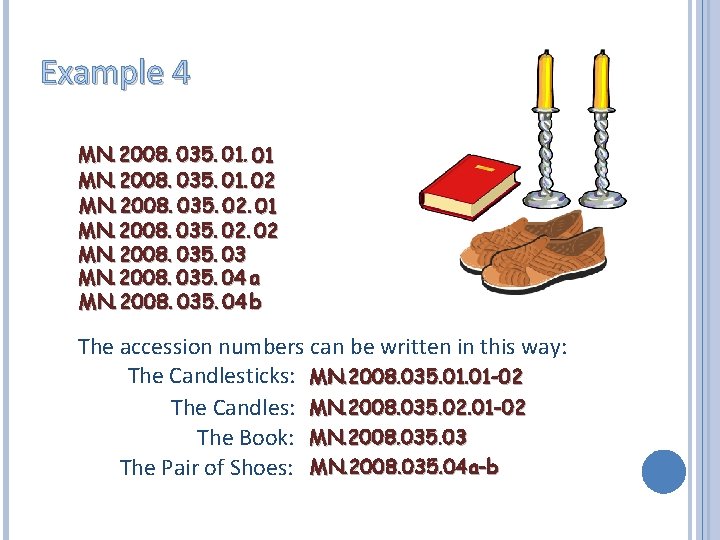
Example 4 Two candlesticks, two candles, a book, and a pair of shoes How do we represent at each shoe is a component of the larger pair and still differentiate the pair of shoes from the pair of candlesticks? Candlestick 1: MN. 2008. 035. 01 Candlestick 2: MN. 2008. 035. 01. 02 Candle 1: MN. 2008. 035. 02. 01 Candle 2: MN. 2008. 035. 02 Book: MN. 2008. 035. 03 Right Shoe : MN. 2008. 035. 04 a Left Shoe: MN. 2008. 035. 04 b
Example 4 MN. 2008. 035. 01. 02 MN. 2008. 035. 02. 01 MN. 2008. 035. 02 MN. 2008. 035. 03 MN. 2008. 035. 04 a MN. 2008. 035. 04 b 2008 035 02 01 01 MN 02 01 04 03 02 a b The Candlesticks, the Candles, the Book, the Pair of Shoes
Example 4 MN. 2008. 035. 01. 02 MN. 2008. 035. 02. 01 MN. 2008. 035. 02 MN. 2008. 035. 03 MN. 2008. 035. 04 a MN. 2008. 035. 04 b The accession numbers can be written in this way: The Candlesticks: MN. 2008. 035. 01 -02 The Candles: MN. 2008. 035. 02. 01 -02 The Book: MN. 2008. 035. 03 The Pair of Shoes: MN. 2008. 035. 04 a-b
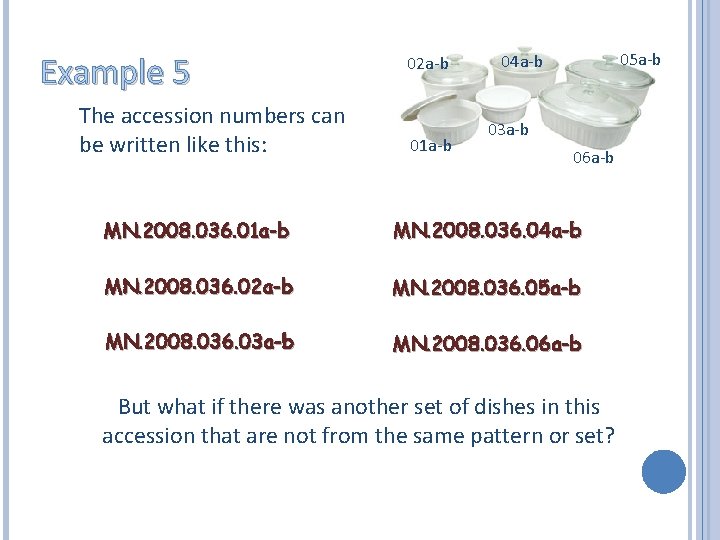
Example 5 02 b 02 a 01 b 01 a 04 b 03 b 04 a 06 b Consider this set of dishes. 03 a 06 a We want to number all the pieces so that it remains clear in the future which lid goes with which base. Dish 1: Lid 1: Dish 2: Lid 2: Dish 3: Lid 3: MN. 2008. 036. 01 a MN. 2008. 036. 01 b MN. 2008. 036. 02 a MN. 2008. 036. 02 b MN. 2008. 036. 03 a MN. 2008. 036. 03 b Dish 4: Lid 4: Dish 5: Lid 5: Dish 6: Lid 6: MN. 2008. 036. 04 a MN. 2008. 036. 04 b MN. 2008. 036. 05 a MN. 2008. 036. 05 b MN. 2008. 036. 06 a MN. 2008. 036. 06 b 05 a
Example 5 The accession numbers can be written like this: 02 a-b 01 a-b 05 a-b 04 a-b 03 a-b 06 a-b MN. 2008. 036. 01 a-b MN. 2008. 036. 04 a-b MN. 2008. 036. 02 a-b MN. 2008. 036. 05 a-b MN. 2008. 036. 03 a-b MN. 2008. 036. 06 a-b But what if there was another set of dishes in this accession that are not from the same pattern or set?
02. 01 02. 02 01. 02 a-b Example 6 Clearly there are two different sets of dishes and our numbering should reflect this. Dish 1: Lid 1: Dish 2: Lid 2: Dish 3: Lid 3: MN. 2008. 037. 01 a MN. 2008. 037. 01 b MN. 2008. 037. 01. 02 a MN. 2008. 037. 01. 02 b MN. 2008. 037. 01. 03 a MN. 2008. 037. 01. 03 b 01. 04 a-b 01. 05 a-b 01. 03 a-b 01. 01 a-b Dish 4: Lid 4: Dish 5: Lid 5: Dish 6: Lid 6: 01. 06 a-b MN. 2008. 037. 01. 04 a MN. 2008. 037. 01. 04 b MN. 2008. 037. 01. 05 a MN. 2008. 037. 01. 04 b MN. 2008. 037. 01. 06 a MN. 2008. 037. 01. 06 b Mug 1: MN. 2008. 037. 02. 01 Mug 2: MN. 2008. 037. 02
Example 6 MN. 2008. 037. 01. a -b MN. 2008. 037. 01. 02. a -b MN. 2008. 037. 01. 03. a -b MN. 2008. 037. 01. 04. a -b MN. 2008. 037. 01. 05. a -b MN. 2008. 037. 01. 06. a -b MN. 2008. 037. 02. 01 MN. 2008. 037. 02 MN 2008 037 01 a 03 02 01 b a 02 b a 04 b a 05 b a 06 b a 01 b 02
Example 7 Consider the following accession of a cruet stand two cruet bottles, each with a stopper. How can this accession be numbered? Bottle 1: Stopper 1: MN. 2008. 038. 01 a MN. 2008. 036. 01 b Bottle 2: MN. 2008. 036. 02 a Stopper 2: MN. 2008. 036. 02 b Stand: MN. 2008. 03 1 2
Example 7 MN. 2008. 038. 01 a -b MN. 2008. 038. 02 a -b MN. 2008. 03 1 MN 2008 038 a 03 02 01 b a b 2
Example 8 What if the accession contained a complete cruet set, two loose cruet bottles from a different set and a bottle stopper from a third cruet set? Stand: Bottle 1: Stopper 1: Bottle 2: Stopper 2: MN. 2008. 039. 01. 02 a MN. 2008. 039. 01. 02 b MN. 2008. 039. 01. 03 a MN. 2008. 039. 01. 03 b Bottle 3: Stopper 3: Bottle 4: Stopper 4: MN. 2008. 039. 02. 01 a MN. 2008. 039. 02. 01 b MN. 2008. 039. 02 a MN. 2008. 039. 02 b Stopper 5: MN. 2008. 039. 03 1 3 2 4 5
Example 8 MN. 2008. 038. 01. 02 a -b MN. 2008. 038. 01. 03 a -b MN. 2008. 038. 02. 01 a -b MN. 2008. 038. 02 a -b MN. 2008. 03 1 MN 2008 03 02 a 3 b a a 5 02 01 b 4 03 02 01 01 2 b a b
. 01 b Example 9 . 01 a Consider a tea set containing a teapot with a lid and two cups. . 02 Teapot: Lid: Cup 1: Cup 2: MN. 2008. 04. 01 a MN. 2008. 04. 01 b MN. 2008. 04. 02 MN. 2008. 04. 03
. 01 b Example 9 . 01 a MN. 2008. 040. 01 a -b MN. 2008. 040. 02 MN. 2008. 040. 03 MN . 02 2008 040 02 01 a b 03
Practice Example It’s March 15, 2010 and a donor has just dropped off several boxes containing various items. These objects fit into our museum’s collecting policy and we wish to accept them into the permanent collection. The first step is to accession the donation before anything gets misplaced.
Practice Example At first glance the following objects do not appear to have much in common and it might seem appropriate to accession them all separately. However, they do have something in common: they all came from a single source at the same time and therefore should be accessioned accordingly.
Numbering the Objects MN. 2010 Step 1: We know that the museum’s prefix is MN Step 2: We know that the year is 2010
Numbering the Objects MN. 2010. 016 Step 3: It is March and this is not the first acquisition we have had this year. To find the right number we look at this year’s accession register and the last acquisition was assigned the number 015 so we will assign this new acquisition the number 016
Numbering the Objects MN. 2010. 016 All the objects in the collection will share this portion of the accession number: MN. 2010. 016
Numbering the Objects MN. 2010. 016 Step 4: It is important to assign an Object ID to each object in the collection while still maintaining a sense of order.
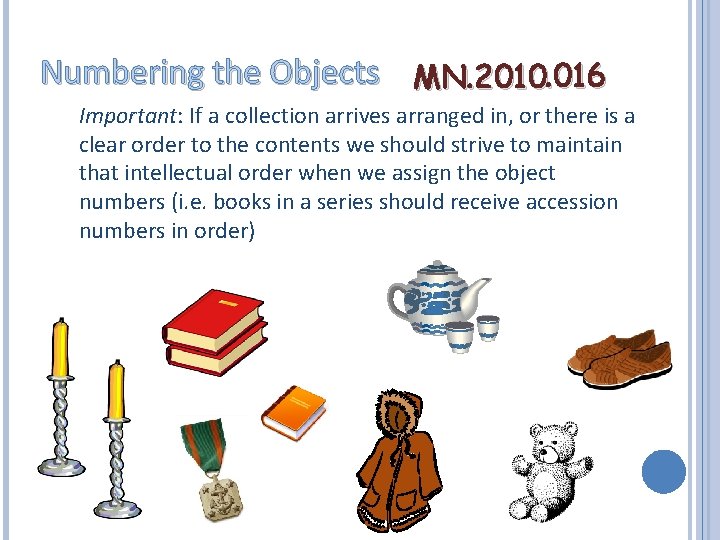
Numbering the Objects MN. 2010. 016 Important: If a collection arrives arranged in, or there is a clear order to the contents we should strive to maintain that intellectual order when we assign the object numbers (i. e. books in a series should receive accession numbers in order)
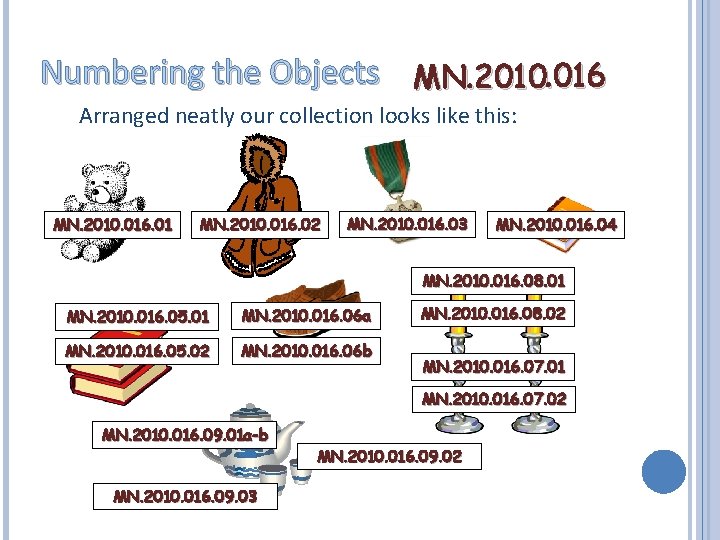
Numbering the Objects MN. 2010. 016 How would you number this collection? It’s always a good idea to start with the most straight forward items.
Numbering the Objects MN. 2010. 016 The teddy bear has no component parts and is not part of any set or series therefore it is fairly simple to number MN. 2010. 016. 01
Numbering the Objects MN. 2010. 016 This is also true of: the jacket naval medal and the small book MN. 2010. 016. 04 MN. 2010. 016. 02 MN. 2010. 016. 03 MN. 2010. 016. 01
Numbering the Objects MN. 2010. 016 The two larger books appear to be two volumes in the same series and should be numbered to represent that fact MN. 2010. 016. 05. 01 MN. 2010. 016. 05. 02 MN. 2010. 016. 04 MN. 2010. 016. 02 MN. 2010. 016. 03 MN. 2010. 016. 01
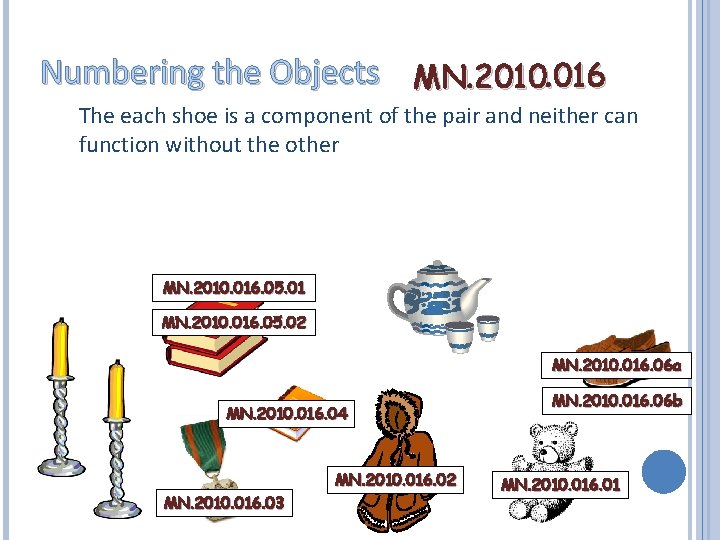
Numbering the Objects MN. 2010. 016 The each shoe is a component of the pair and neither can function without the other MN. 2010. 016. 05. 01 MN. 2010. 016. 05. 02 MN. 2010. 016. 06 a MN. 2010. 016. 04 MN. 2010. 016. 02 MN. 2010. 016. 03 MN. 2010. 016. 06 b MN. 2010. 016. 01
Numbering the Objects MN. 2010. 016 The candlesticks are a matching pair, but are not functionally dependant on each other. We number them as we did the books in the series. MN. 2010. 016. 05. 01 MN. 2010. 016. 05. 02 MN. 2010. 016. 06 a MN. 2010. 016. 04 MN. 2010. 016. 06 b MN. 2010. 016. 07. 01 MN. 2010. 016. 07. 02 MN. 2010. 016. 03 MN. 2010. 016. 02 MN. 2010. 016. 01
Numbering the Objects MN. 2010. 016 The candles are both objects separate from the candlesticks. They are a matching pair, but can be used separately and therefore are not component parts MN. 2010. 016. 05. 01 MN. 2010. 016. 05. 02 MN. 2010. 016. 08. 01 MN. 2010. 016. 06 a MN. 2010. 016. 08. 02 MN. 2010. 016. 04 MN. 2010. 016. 06 b MN. 2010. 016. 07. 01 MN. 2010. 016. 07. 02 MN. 2010. 016. 03 MN. 2010. 016. 02 MN. 2010. 016. 01
Numbering the Objects MN. 2010. 016 The teapot with lid and cups are part of a set. The teapot and its lid are component parts, but can be used without the cups The cups are part of this set, but can be used without the teapot MN. 2010. 016. 09. 01 a-b MN. 2010. 016. 05. 01 MN. 2010. 016. 09. 02 MN. 2010. 016. 05. 02 MN. 2010. 016. 09. 03 MN. 2010. 016. 08. 01 MN. 2010. 016. 08. 02 MN. 2010. 016. 04 MN. 2010. 016. 06 a MN. 2010. 016. 06 b MN. 2010. 016. 07. 01 MN. 2010. 016. 07. 02 MN. 2010. 016. 03 MN. 2010. 016. 02 MN. 2010. 016. 01
Numbering the Objects MN. 2010. 016 Arranged neatly our collection looks like this: MN. 2010. 016. 01 MN. 2010. 016. 02 MN. 2010. 016. 03 MN. 2010. 016. 04 MN. 2010. 016. 08. 01 MN. 2010. 016. 05. 01 MN. 2010. 016. 06 a MN. 2010. 016. 05. 02 MN. 2010. 016. 06 b MN. 2010. 016. 08. 02 MN. 2010. 016. 07. 01 MN. 2010. 016. 07. 02 MN. 2010. 016. 09. 01 a-b MN. 2010. 016. 09. 03 MN. 2010. 016. 09. 02
Numbering the Objects MN. 2010. 016. 01 MN. 2010. 016. 02 MN. 2010. 016. 03 MN. 2010. 016. 04 MN. 2010. 016. 05. 01 -02 MN. 2010. 016. 06 a -b MN. 2010. 016. 07. 01 -02 MN. 2010. 016. 08. 01 -02 MN. 2010. 016. 09. 01 -03 MN 2010 016 01 02 03 04 01 06 05 02 a b 01 02 09 08 07 01 02 02 01 a b 03
The End
Resources Burcaw, Ellis G. , Introduction to Museum Work, 3 rd edition. Walnut Creek, CA: Alta. Mira Press, 1997. Parr, Mary, Richard Hilton, James Danner, Past. Prefect Software for Museum Collections: User’s Guide, Version 4. 0 Pastime Software Company, Inc.
Lisa Hennessey Community Museums Association © 2008