
Accessing Capital in Small Communities Part 1 Equity

- Slides: 39
Accessing Capital in Small Communities Part 1: Equity Capital
Learning Outcomes After this webinar, you’ll be able to: • Summarize the types of capital and forms of financial capital • Describe the types of equity capital that businesses use at different life stages • Identify resources in B. C. that can help businesses in your community attract equity capital • Recognize the barriers that prevent businesses from attracting equity capital
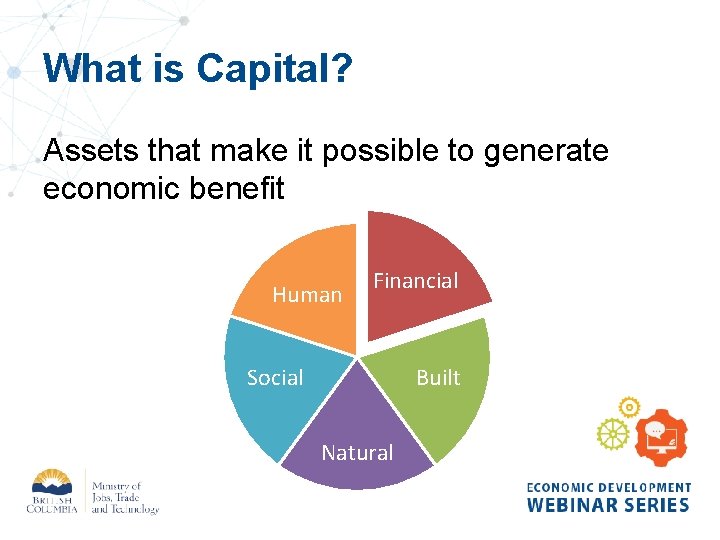
What is Capital? Assets that make it possible to generate economic benefit Human Financial Social Built Natural
Forms of Financial Capital for Economic Development • Equity: money given for shared ownership • Debt: money loaned at a cost, to be repaid • Grants: money provided for specific outcomes, generally not repayable.
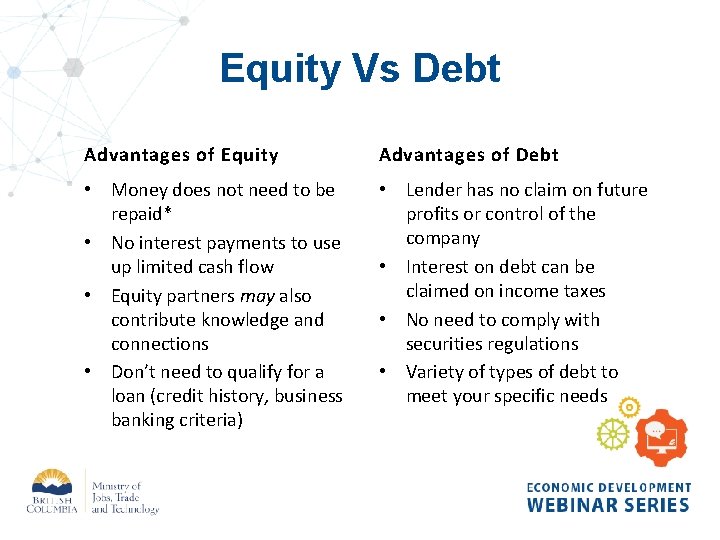
Equity Vs Debt Advantages of Equity Advantages of Debt • Money does not need to be repaid* • No interest payments to use up limited cash flow • Equity partners may also contribute knowledge and connections • Don’t need to qualify for a loan (credit history, business banking criteria) • Lender has no claim on future profits or control of the company • Interest on debt can be claimed on income taxes • No need to comply with securities regulations • Variety of types of debt to meet your specific needs
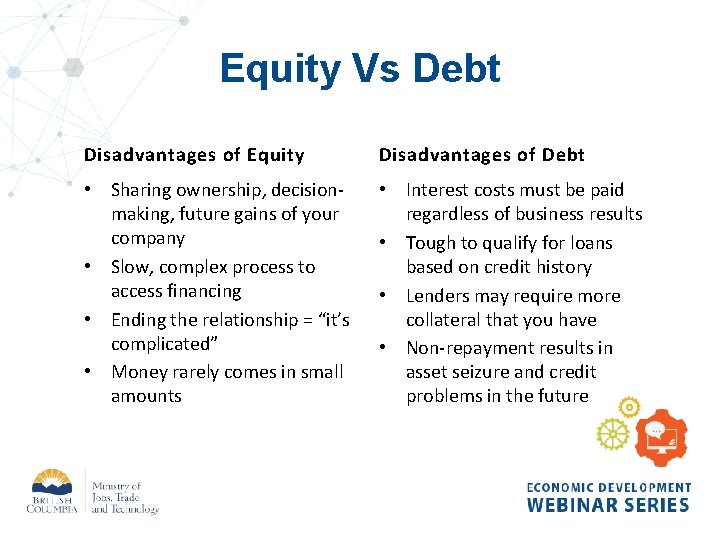
Equity Vs Debt Disadvantages of Equity Disadvantages of Debt • Sharing ownership, decisionmaking, future gains of your company • Slow, complex process to access financing • Ending the relationship = “it’s complicated” • Money rarely comes in small amounts • Interest costs must be paid regardless of business results • Tough to qualify for loans based on credit history • Lenders may require more collateral that you have • Non-repayment results in asset seizure and credit problems in the future
A Deeper Dive into EQUITY
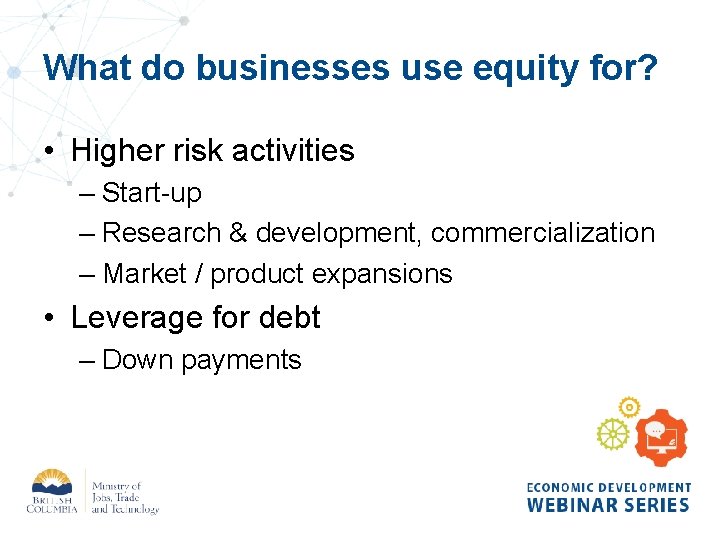
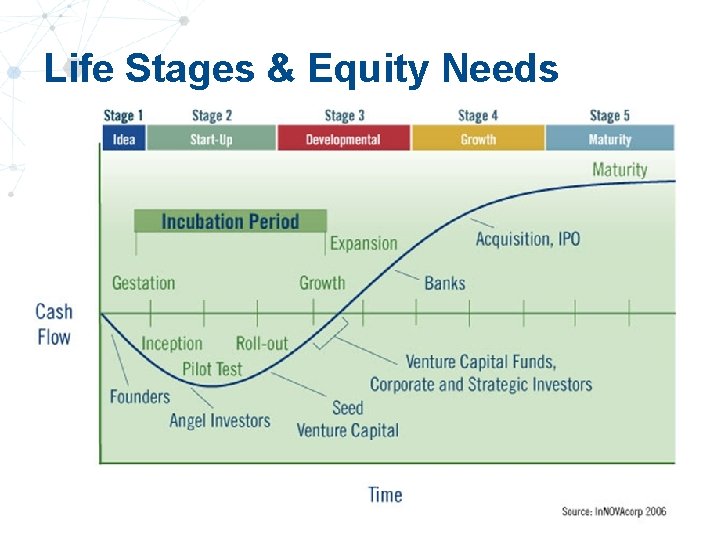
What do businesses use equity for? • Higher risk activities – Start-up – Research & development, commercialization – Market / product expansions • Leverage for debt – Down payments
Life Stages & Equity Needs
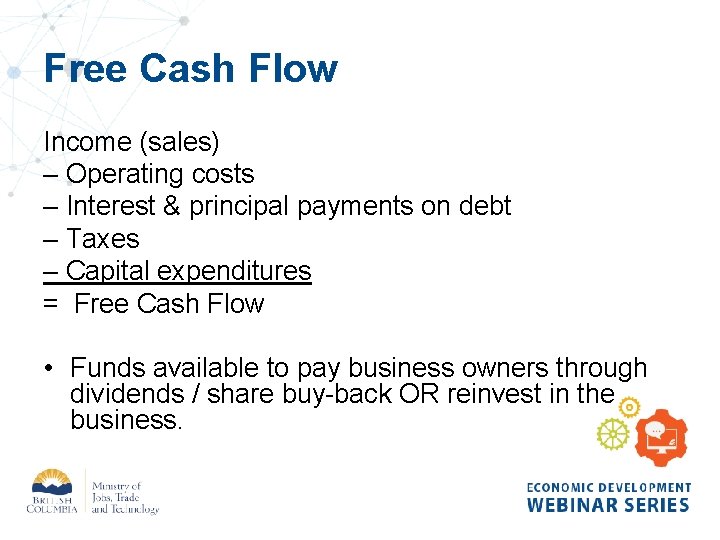
Free Cash Flow Income (sales) – Operating costs – Interest & principal payments on debt – Taxes – Capital expenditures = Free Cash Flow • Funds available to pay business owners through dividends / share buy-back OR reinvest in the business.
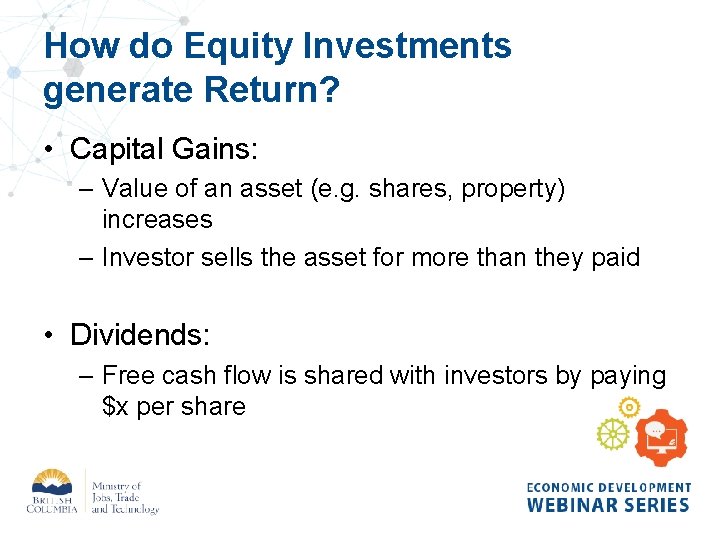
How do Equity Investments generate Return? • Capital Gains: – Value of an asset (e. g. shares, property) increases – Investor sells the asset for more than they paid • Dividends: – Free cash flow is shared with investors by paying $x per share
Investors Consider Risk/Return • • • Investor risk tolerance Investment horizon/timeline Macroeconomic variables Knowledge of the business/industry Influence over management Investment diversification
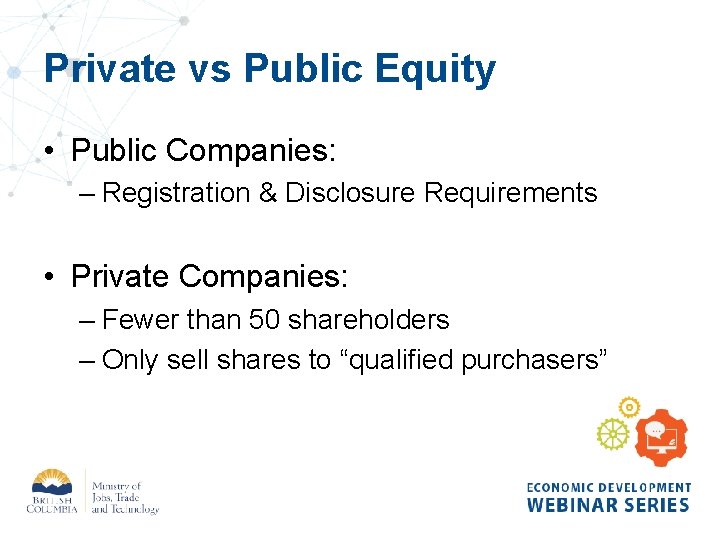
Private vs Public Equity • Public Companies: – Registration & Disclosure Requirements • Private Companies: – Fewer than 50 shareholders – Only sell shares to “qualified purchasers”
Programs to Encourage & Attract Equity Investment
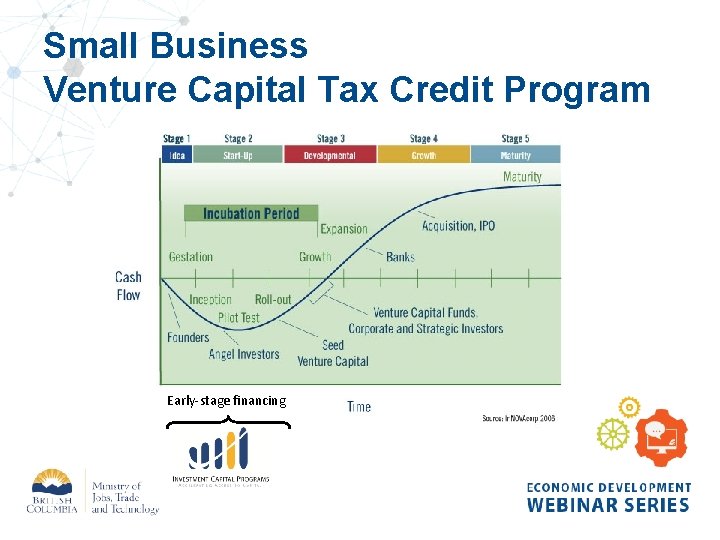
Small Business Venture Capital Tax Credit Program Early-stage financing
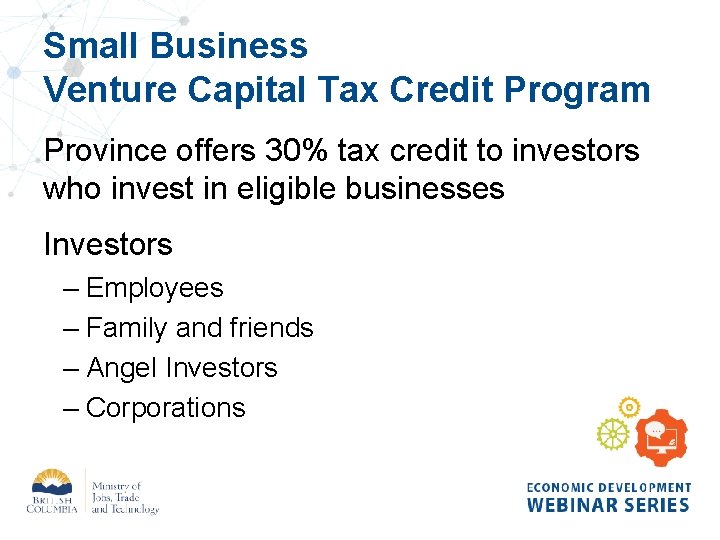
Small Business Venture Capital Tax Credit Program Province offers 30% tax credit to investors who invest in eligible businesses Investors – Employees – Family and friends – Angel Investors – Corporations
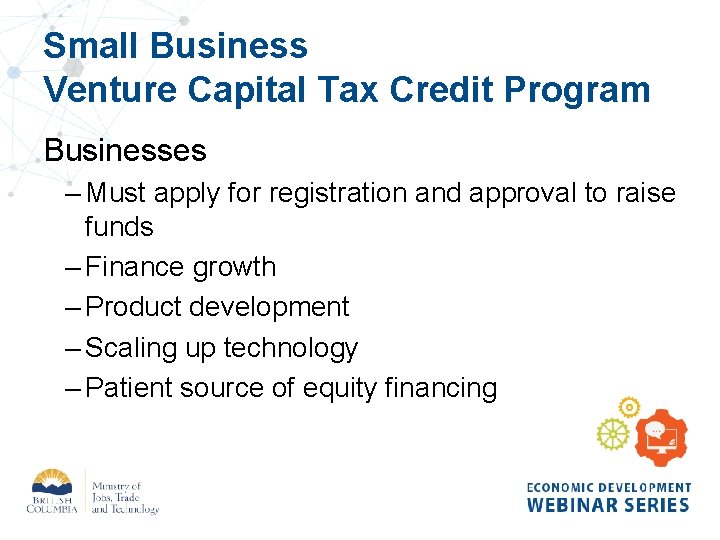
Small Business Venture Capital Tax Credit Program Businesses – Must apply for registration and approval to raise funds – Finance growth – Product development – Scaling up technology – Patient source of equity financing
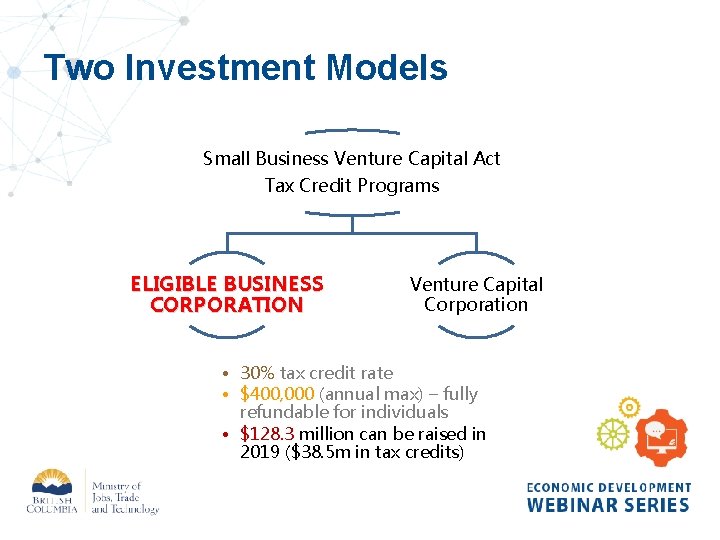
Two Investment Models Small Business Venture Capital Act Tax Credit Programs ELIGIBLE BUSINESS CORPORATION Venture Capital Corporation • 30% tax credit rate • $400, 000 (annual max) – fully refundable for individuals • $128. 3 million can be raised in 2019 ($38. 5 m in tax credits)
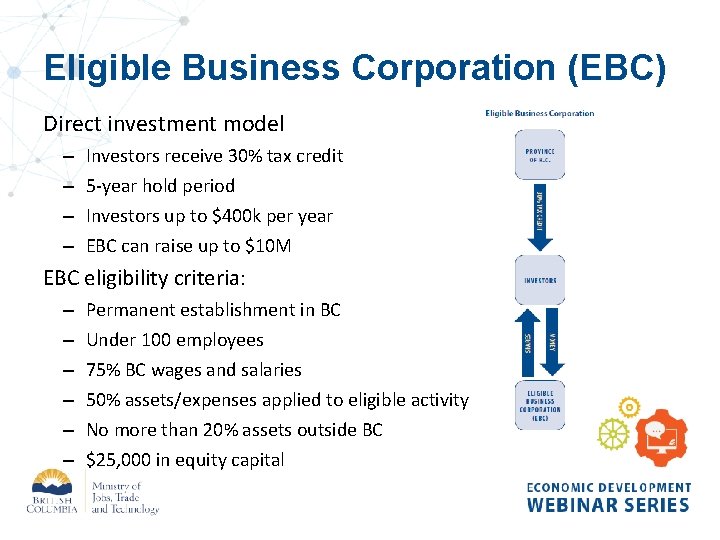
Eligible Business Corporation (EBC) Direct investment model – – Investors receive 30% tax credit 5 -year hold period Investors up to $400 k per year EBC can raise up to $10 M EBC eligibility criteria: – – – Permanent establishment in BC Under 100 employees 75% BC wages and salaries 50% assets/expenses applied to eligible activity No more than 20% assets outside BC $25, 000 in equity capital
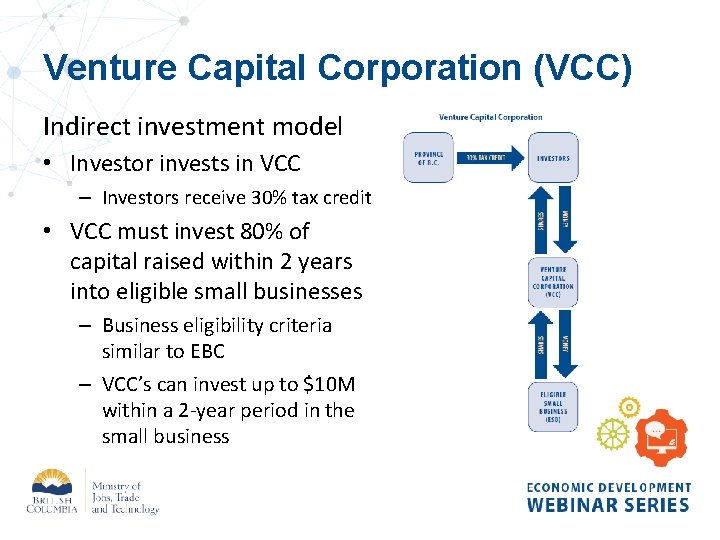
Venture Capital Corporation (VCC) Indirect investment model • Investor invests in VCC – Investors receive 30% tax credit • VCC must invest 80% of capital raised within 2 years into eligible small businesses – Business eligibility criteria similar to EBC – VCC’s can invest up to $10 M within a 2 -year period in the small business
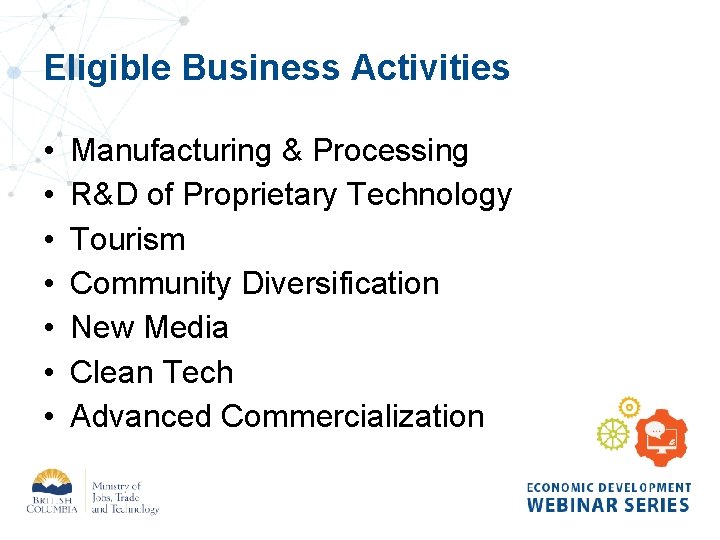
Eligible Business Activities • • Manufacturing & Processing R&D of Proprietary Technology Tourism Community Diversification New Media Clean Tech Advanced Commercialization
A Deeper Dive into Employee Share Ownership Program
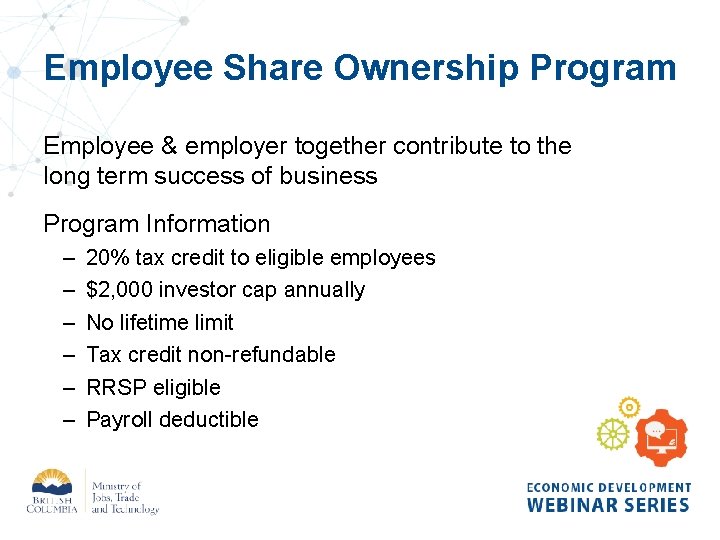
Employee Share Ownership Program Employee & employer together contribute to the long term success of business Program Information – – – 20% tax credit to eligible employees $2, 000 investor cap annually No lifetime limit Tax credit non-refundable RRSP eligible Payroll deductible
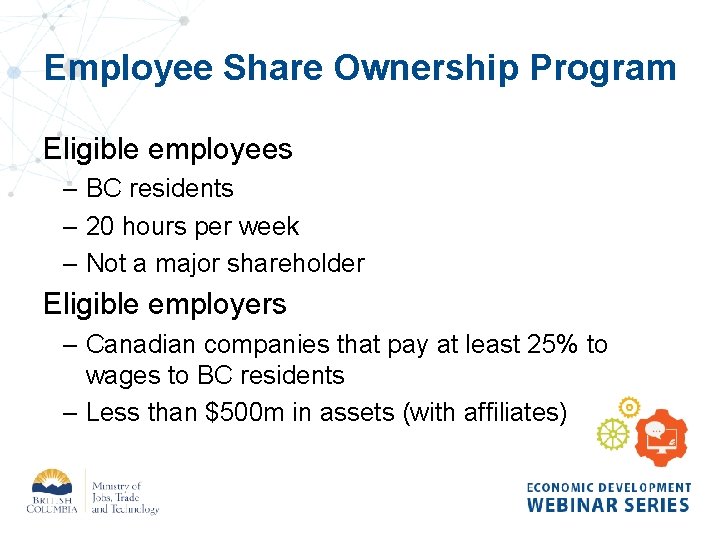
Employee Share Ownership Program Eligible employees – BC residents – 20 hours per week – Not a major shareholder Eligible employers – Canadian companies that pay at least 25% to wages to BC residents – Less than $500 m in assets (with affiliates)
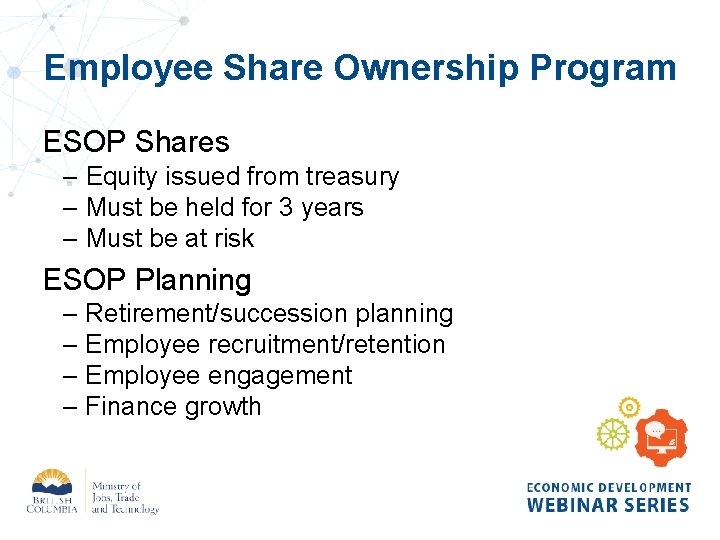
Employee Share Ownership Program ESOP Shares – Equity issued from treasury – Must be held for 3 years – Must be at risk ESOP Planning – Retirement/succession planning – Employee recruitment/retention – Employee engagement – Finance growth
A Deeper Dive into Investment Funds
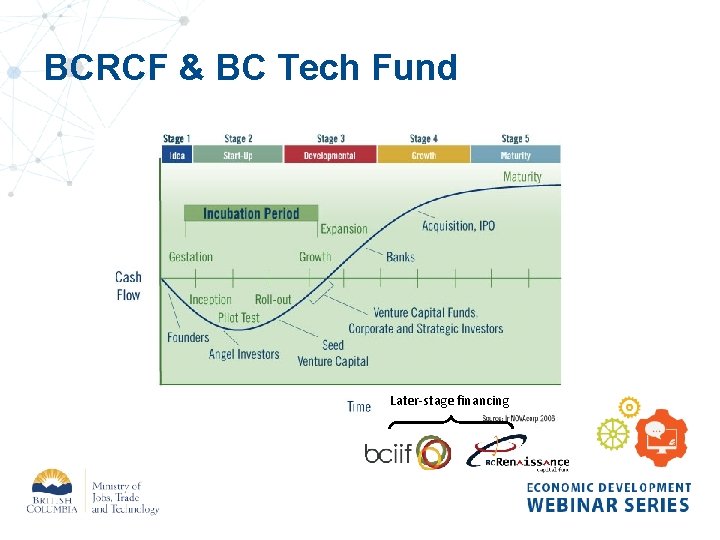
BCRCF & BC Tech Fund Later-stage financing
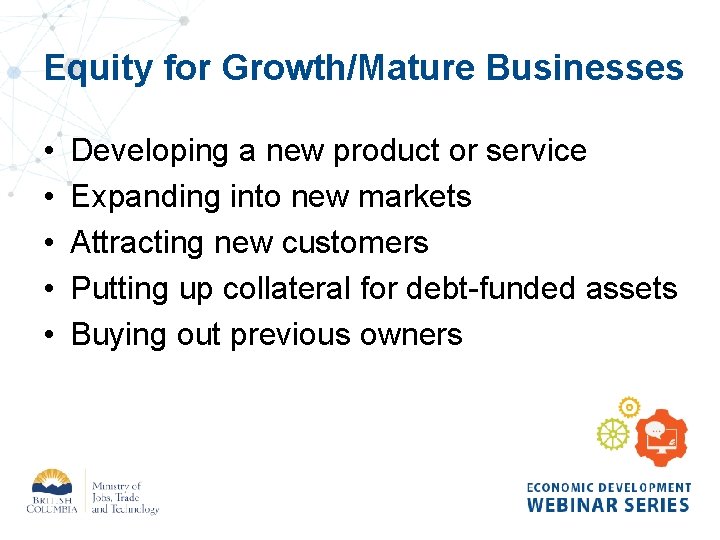
Equity for Growth/Mature Businesses • • • Developing a new product or service Expanding into new markets Attracting new customers Putting up collateral for debt-funded assets Buying out previous owners
BC Renaissance Capital Fund BCRCF $90 M • Created in 2008 • Invested into 9 Funds managed by 8 Fund Managers • Funds are maturing and the BCRCF will be wound up in a few years
BC Tech Fund $100 M • • Created in 2016 75% Funds | 25% Direct Investments Focuses on Early Stage A-Round Investments BC Based Tech Companies: Life Sciences, Digital Media, ICT, Clean Tech
Investment Capital Branch Office: 250 952 -0136 Toll Free: 800 665 -6597 Investment. Capital@gov. bc. ca
Barriers to Attracting Equity Capital Are your local businesses investment-ready?
Attractive Business Opportunity • • • Product or service Size and accessibility of markets Management team skills & qualities Potential revenues & costs Free cash flow Detailed financial reporting
Sharing Ownership • Willingness to share control and decisionmaking over the business • Realism about the value of the business and its potential
Company Structure & Systems • Sole Proprietorship/Partnership – no shares • Incorporation – share classes • Other shareholders • Financial systems & reporting
Isolation • Lack of potential investors • Lack of legal/accounting/technical supports • Lack of peer supports
How Can You Help Businesses? • Provide/arrange business planning supports • Referrals to legal/accounting support • Build peer networks (in & out of town) • Make connections to provincial programs • Work regionally!
Resources for Support
Be a Connector!