
Accessible Incontinence Control Device 1 Hawkins Biomedical Engineering
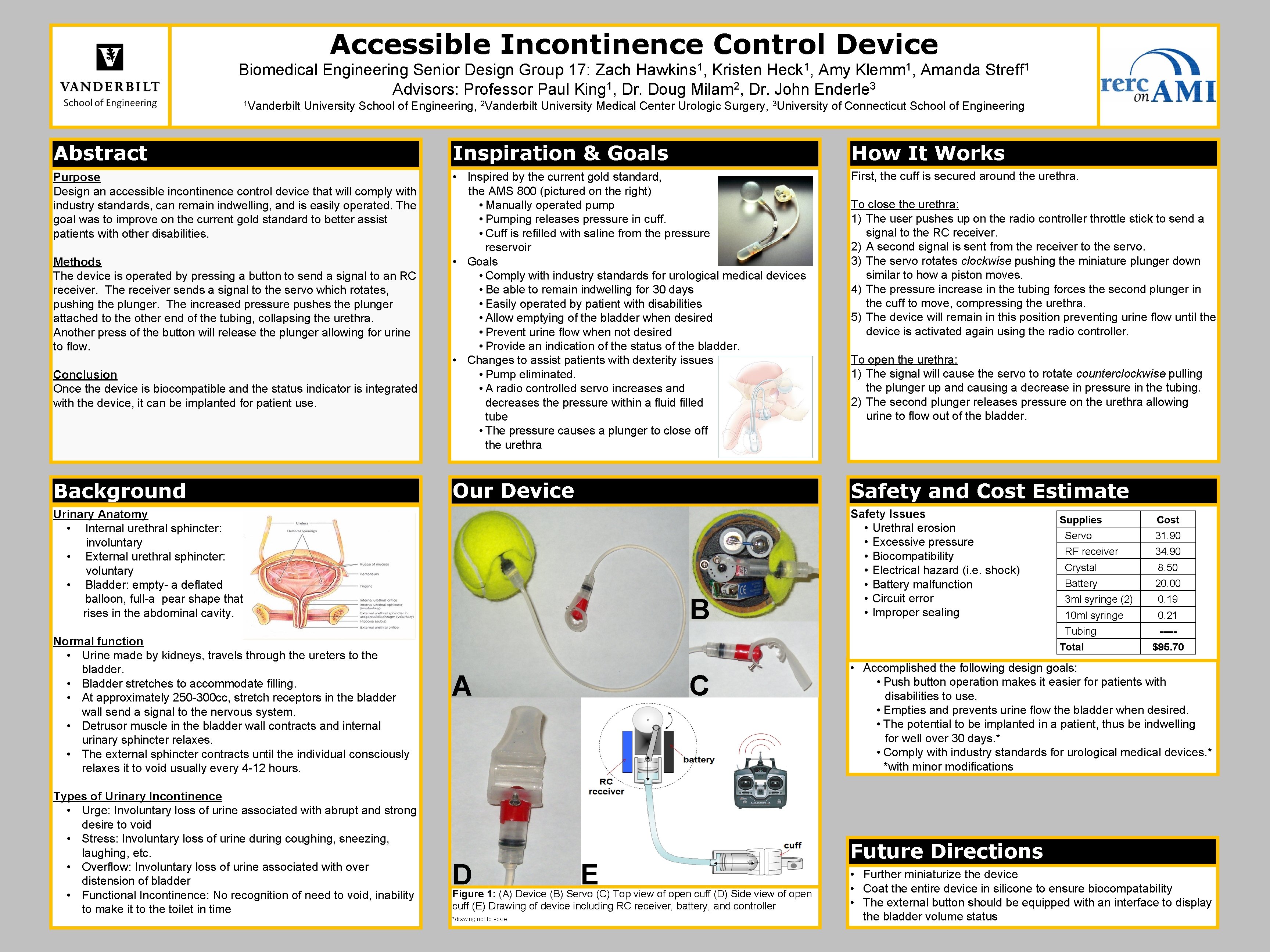
Accessible Incontinence Control Device 1 Hawkins , Biomedical Engineering Senior Design Group 17: Zach Kristen Amy Advisors: Professor Paul King 1, Dr. Doug Milam 2, Dr. John Enderle 3 1 Vanderbilt 1 Heck , 1 Klemm , Amanda 1 Streff University School of Engineering, 2 Vanderbilt University Medical Center Urologic Surgery, 3 University of Connecticut School of Engineering Abstract Inspiration & Goals How It Works Purpose Design an accessible incontinence control device that will comply with industry standards, can remain indwelling, and is easily operated. The goal was to improve on the current gold standard to better assist patients with other disabilities. • Inspired by the current gold standard, the AMS 800 (pictured on the right) • Manually operated pump • Pumping releases pressure in cuff. • Cuff is refilled with saline from the pressure reservoir • Goals • Comply with industry standards for urological medical devices • Be able to remain indwelling for 30 days • Easily operated by patient with disabilities • Allow emptying of the bladder when desired • Prevent urine flow when not desired • Provide an indication of the status of the bladder. • Changes to assist patients with dexterity issues • Pump eliminated. • A radio controlled servo increases and decreases the pressure within a fluid filled tube • The pressure causes a plunger to close off the urethra First, the cuff is secured around the urethra. Our Device Safety and Cost Estimate Methods The device is operated by pressing a button to send a signal to an RC receiver. The receiver sends a signal to the servo which rotates, pushing the plunger. The increased pressure pushes the plunger attached to the other end of the tubing, collapsing the urethra. Another press of the button will release the plunger allowing for urine to flow. Conclusion Once the device is biocompatible and the status indicator is integrated with the device, it can be implanted for patient use. Background Urinary Anatomy • Internal urethral sphincter: involuntary • External urethral sphincter: voluntary • Bladder: empty- a deflated balloon, full-a pear shape that rises in the abdominal cavity. Normal function • Urine made by kidneys, travels through the ureters to the bladder. • Bladder stretches to accommodate filling. • At approximately 250 -300 cc, stretch receptors in the bladder wall send a signal to the nervous system. • Detrusor muscle in the bladder wall contracts and internal urinary sphincter relaxes. • The external sphincter contracts until the individual consciously relaxes it to void usually every 4 -12 hours. Types of Urinary Incontinence • Urge: Involuntary loss of urine associated with abrupt and strong desire to void • Stress: Involuntary loss of urine during coughing, sneezing, laughing, etc. • Overflow: Involuntary loss of urine associated with over distension of bladder • Functional Incontinence: No recognition of need to void, inability to make it to the toilet in time B To close the urethra: 1) The user pushes up on the radio controller throttle stick to send a signal to the RC receiver. 2) A second signal is sent from the receiver to the servo. 3) The servo rotates clockwise pushing the miniature plunger down similar to how a piston moves. 4) The pressure increase in the tubing forces the second plunger in the cuff to move, compressing the urethra. 5) The device will remain in this position preventing urine flow until the device is activated again using the radio controller. To open the urethra: 1) The signal will cause the servo to rotate counterclockwise pulling the plunger up and causing a decrease in pressure in the tubing. 2) The second plunger releases pressure on the urethra allowing urine to flow out of the bladder. Safety Issues • Urethral erosion • Excessive pressure • Biocompatibility • Electrical hazard (i. e. shock) • Battery malfunction • Circuit error • Improper sealing Supplies Cost Servo 31. 90 RF receiver 34. 90 Crystal 8. 50 Battery 20. 00 3 ml syringe (2) 0. 19 10 ml syringe 0. 21 Tubing ----- Total A D C E Figure 1: (A) Device (B) Servo (C) Top view of open cuff (D) Side view of open cuff (E) Drawing of device including RC receiver, battery, and controller *drawing not to scale $95. 70 • Accomplished the following design goals: • Push button operation makes it easier for patients with disabilities to use. • Empties and prevents urine flow the bladder when desired. • The potential to be implanted in a patient, thus be indwelling for well over 30 days. * • Comply with industry standards for urological medical devices. * *with minor modifications Conclusions Future Directions • Further miniaturize the device • Coat the entire device in silicone to ensure biocompatability • The external button should be equipped with an interface to display the bladder volume status
- Slides: 1