
Accessible and acceptable care and support Baber Malik
Accessible and acceptable care and support Baber Malik Professor Annalena Venneri Professor Markus Reuber
Understanding Dementia What is Dementia? Dementia is an umbrella term for progressive disorder of cognition Dementia is characterised by a decline of information processing abilities accompanied by changes in personality and behaviour When translated into several different South Asian languages, it can sometimes translate to words such as madness or crazy Age is the strongest risk factor South Asians are the largest BME group and the least studied when it comes to mental health research. They are considered to be at an age now where they are most at risk for dementia.
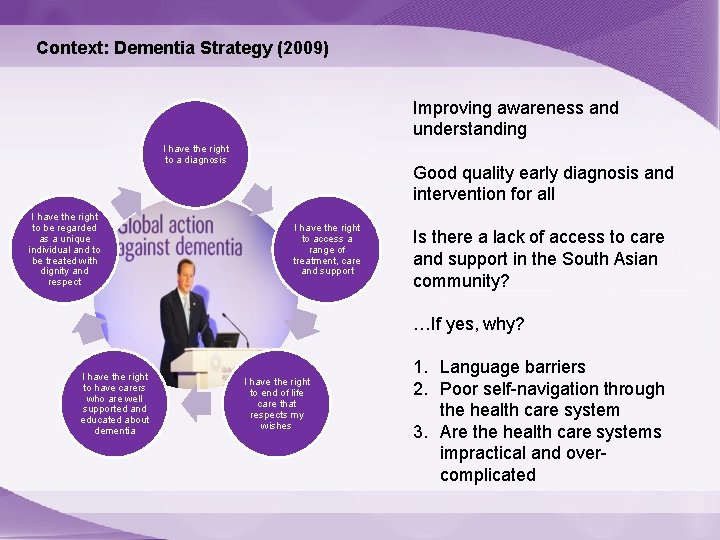
Context: Dementia Strategy (2009) Improving awareness and understanding I have the right to a diagnosis I have the right to be regarded as a unique individual and to be treated with dignity and respect Good quality early diagnosis and intervention for all I have the right to access a range of treatment, care and support Is there a lack of access to care and support in the South Asian community? …If yes, why? I have the right to have carers who are well supported and educated about dementia I have the right to end of life care that respects my wishes 1. Language barriers 2. Poor self-navigation through the health care system 3. Are the health care systems impractical and overcomplicated
Clinical pathway: Dementia diagnosis Identify impact of demographic GP Consultation: Patient complains about memory variables (age, gender, education, related problems ethnicity) on test scores- facilitates more accurate interpretation Neurologist/Psychiatrist: MRI scan, possible diagnosis reached at this stage The purpose of the Ph. D was to identify cultural differences that Neuropsychologist: Extensive assessment – may effect performance on cognitive tests and to modify clinical history taking, memory, language, attention assessment in order to aid a better clinical diagnosis of dementia for the Pakistani community.
What are standardised tests? Standardised tests are those for which normative values are available from a representative sample of normal individuals Ideally this sample should come from the same sociocultural background as the patient The availability of normative values is a problematic issue in neuropsychology: Most neuropsychological tests are not standardised on large cross-cultural samples
Cultural diversity and assessment of neurodegenerative disorders What is the problem? Diagnosis is difficult especially given the increasing number of diverse populations Cross-cultural research is rapidly gaining prominence as a means of enabling cross country comparisons and in response to increasing ethnic diversity Great variability confronting testing as many demographic variables have a differential impact on test scores Validity critical to accurate assessment and diagnosis depends on use of tests in populations on which they have been normed
Why should standardised tests be preferred? Performance on psychometric tests is affected by several variables, e. g. • sex • age • education • sociocultural background If the effect of these variables are not taken into account, there is a high risk of making interpretative errors It increases the risk of false positives (i. e. considering as pathological a performance which is within normal limits)
Why address multicultural issues? At least 3 reasons: 1. Ethical Research should be representative 2. Inform Theory Add to explanation of behaviour and function 3. Inform Clinical Practice Lead to more valid and accurate assessment, diagnosis and treatment
Three solutions to culture free assessment 1. Novel test construction Creation of new tests specifically designed for use with cultural groups that take into consideration item selection and analysis, normative studies, reliability and validity analyses 2. Modification of existing tests Tests are translated and adapted for different linguistic and socio-cultural groups 3. Development of norms Taking into consideration age and education for different ethnic groups
Study 1: Autobiographical Memory (ABM) What is Autobiographical Memory? Personal experiences and events (includes semantic and episodic elements) - represents who we are today based on who we were in the past and what we want to become in the future ‘SELF’ representations: it is often termed as ‘mental time travel’, (Tulving, 2002) HOWEVER, ‘SELF’ representations differ: General difference between Independent vs. Interdependent cultures Why is it important? Autobiographical memory is affected early in patients with Alzheimer’s Disease and Amnestic Mild Cognitive Impairment and it also forms the basis to clinical interviews, person-centred care pathways, making it a good research starting point (Wang, 2001; Wang & Brockmeier, 2002; Markus & Kitayama, 1991)
Methodology: Autobiographical tests There are several ABM tests used in practice, however, they are based on western norms. Ivanoiu et al. , 2006 ABM questionnaire A. Childhood (6 -16 yrs) 1. Semantic 2. Episodic B. Early adulthood (17 -39 yrs) 1. Semantic 2. Episodic C. Late adulthood (40 -55 yrs) 1. Semantic 2. Episodic D. Recent (last 5 yrs) 1. Semantic 2. Episodic
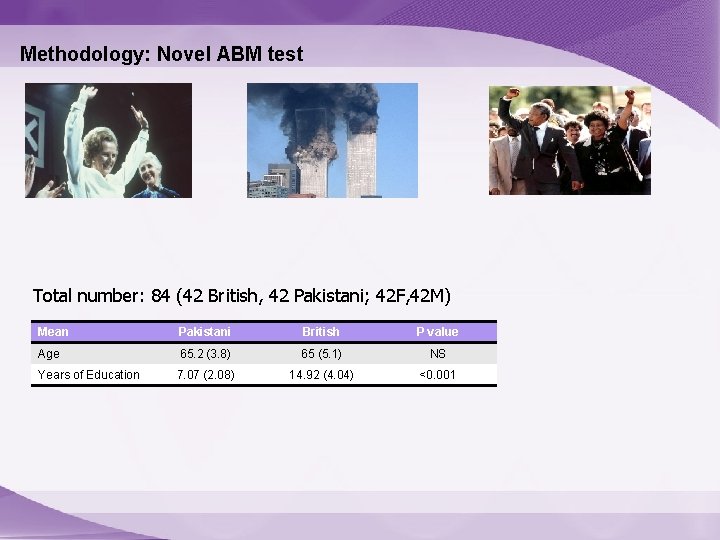
Methodology: Novel ABM test Total number: 84 (42 British, 42 Pakistani; 42 F, 42 M) Mean Pakistani British P value Age 65. 2 (3. 8) 65 (5. 1) NS Years of Education 7. 07 (2. 08) 14. 92 (4. 04) <0. 001
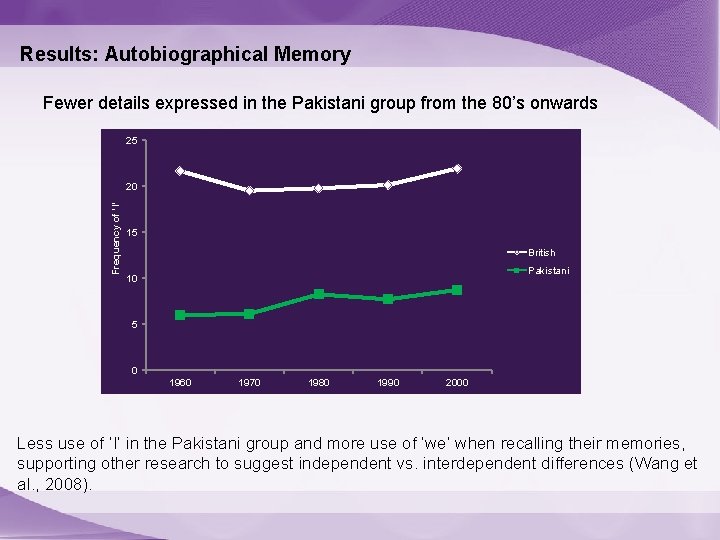
Results: Autobiographical Memory Fewer details expressed in the Pakistani group from the 80’s onwards 25 90 * Frequency of 'I' 20 15 10 Total episodic score 80 * * 70 60 50 40 white British 30 Pakistani 20 10 5 0 1960 1970 1980 Decades 1990 2000 0 1960 1970 1980 1990 2000 Less use of ‘I’ in the Pakistani group and more use of ‘we’ when recalling their memories, supporting other research to suggest independent vs. interdependent differences (Wang et al. , 2008).
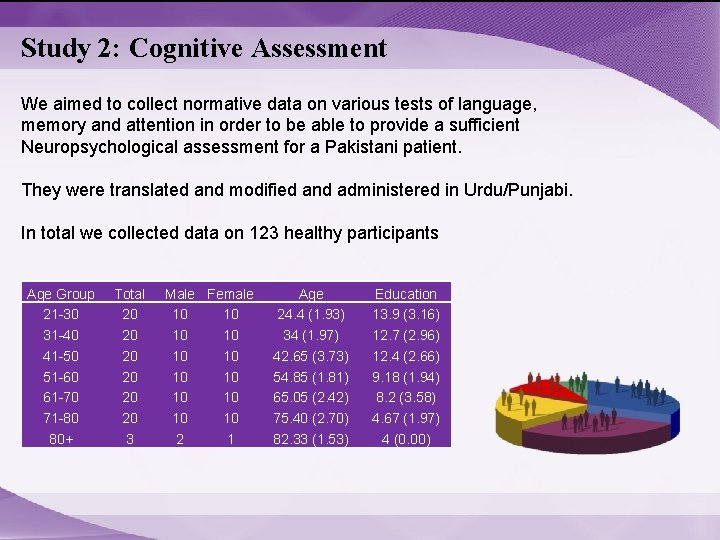
Study 2: Cognitive Assessment We aimed to collect normative data on various tests of language, memory and attention in order to be able to provide a sufficient Neuropsychological assessment for a Pakistani patient. They were translated and modified and administered in Urdu/Punjabi. In total we collected data on 123 healthy participants Age Group 21 -30 31 -40 41 -50 51 -60 61 -70 71 -80 80+ Total 20 20 20 3 Male Female 10 10 10 2 1 Age 24. 4 (1. 93) 34 (1. 97) 42. 65 (3. 73) 54. 85 (1. 81) 65. 05 (2. 42) 75. 40 (2. 70) 82. 33 (1. 53) Education 13. 9 (3. 16) 12. 7 (2. 96) 12. 4 (2. 66) 9. 18 (1. 94) 8. 2 (3. 58) 4. 67 (1. 97) 4 (0. 00)
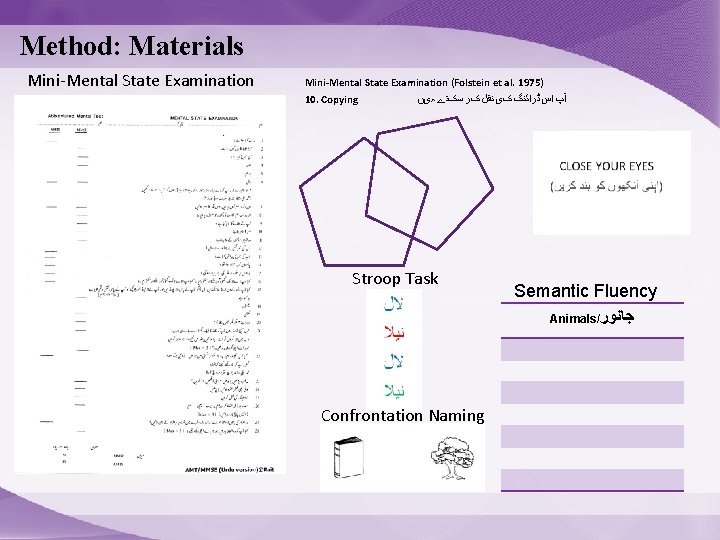
Method: Materials Mini-Mental State Examination (Folstein et al. 1975) 10. Copying آپ ﺍﺱ ڈﺮﺍﺋﻨگ کی ﻧﻘﻞ کﺮ ﺳکﺘے ہیں Stroop Task Semantic Fluency Animals/ ﺟﺎﻧﻮﺭ Confrontation Naming
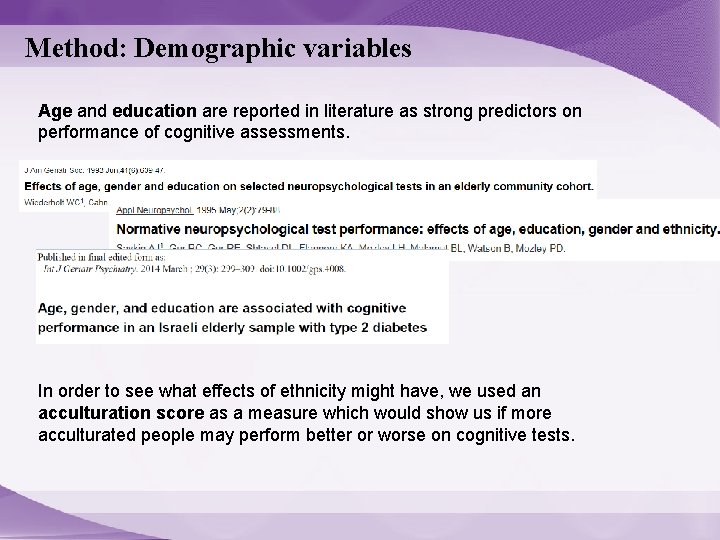
Method: Demographic variables Age and education are reported in literature as strong predictors on performance of cognitive assessments. In order to see what effects of ethnicity might have, we used an acculturation score as a measure which would show us if more acculturated people may perform better or worse on cognitive tests.
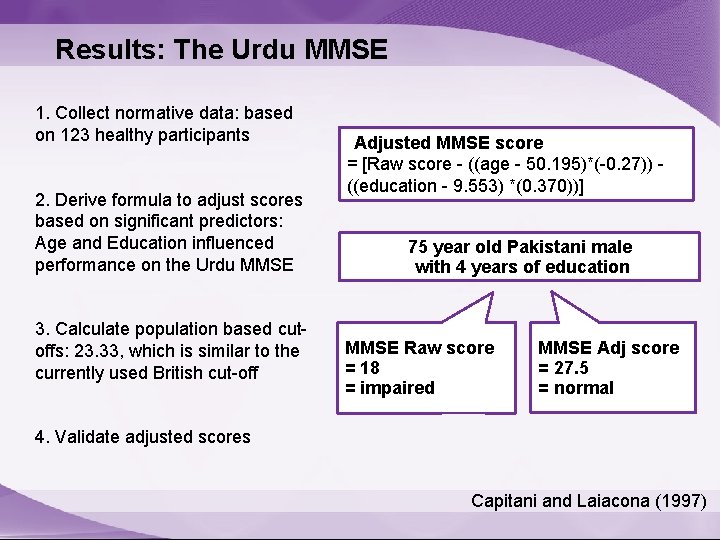
Results: The Urdu MMSE 1. Collect normative data: based on 123 healthy participants 2. Derive formula to adjust scores based on significant predictors: Age and Education influenced performance on the Urdu MMSE 3. Calculate population based cutoffs: 23. 33, which is similar to the currently used British cut-off Adjusted MMSE score = [Raw score - ((age - 50. 195)*(-0. 27)) ((education - 9. 553) *(0. 370))] 75 year old Pakistani male with 4 years of education MMSE Raw score = 18 = impaired MMSE Adj score = 27. 5 = normal 4. Validate adjusted scores Capitani and Laiacona (1997)
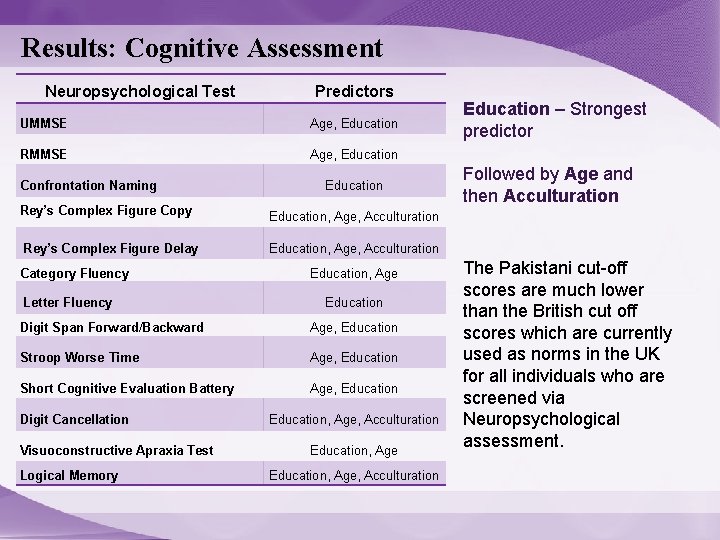
Results: Cognitive Assessment Neuropsychological Test Predictors UMMSE Age, Education RMMSE Age, Education Confrontation Naming Education Rey’s Complex Figure Copy Education, Age, Acculturation Rey’s Complex Figure Delay Education, Age, Acculturation Category Fluency Letter Fluency Education, Age Education Digit Span Forward/Backward Age, Education Stroop Worse Time Age, Education Short Cognitive Evaluation Battery Age, Education Digit Cancellation Visuoconstructive Apraxia Test Logical Memory Education, Age, Acculturation Education – Strongest predictor Followed by Age and then Acculturation The Pakistani cut-off scores are much lower than the British cut off scores which are currently used as norms in the UK for all individuals who are screened via Neuropsychological assessment.
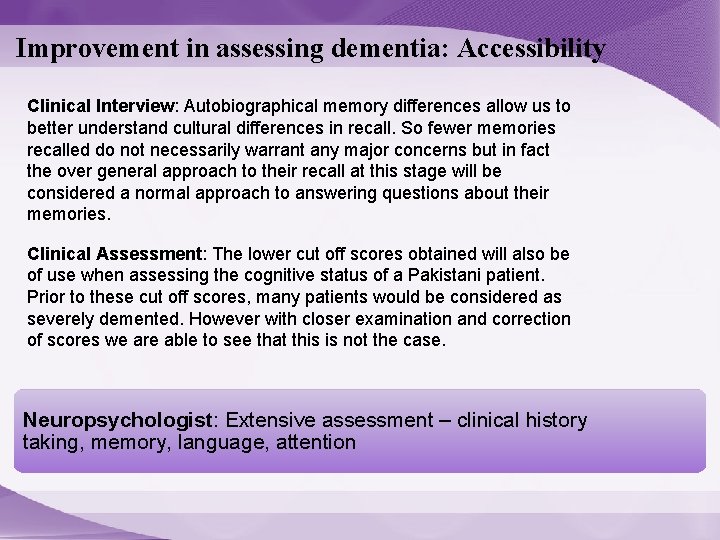
Improvement in assessing dementia: Accessibility Clinical Interview: Autobiographical memory differences allow us to better understand cultural differences in recall. So fewer memories recalled do not necessarily warrant any major concerns but in fact the over general approach to their recall at this stage will be considered a normal approach to answering questions about their memories. Clinical Assessment: The lower cut off scores obtained will also be of use when assessing the cognitive status of a Pakistani patient. Prior to these cut off scores, many patients would be considered as severely demented. However with closer examination and correction of scores we are able to see that this is not the case. Neuropsychologist: Extensive assessment – clinical history taking, memory, language, attention
- Slides: 20