
Access to Knowledge and Creativity IP and Strategies
- Slides: 41
Access to Knowledge and Creativity, IP and Strategies for the Creative Industries Shirley Leung The Chinese University of Hong Kong Library International Federation of Library Associations and Institutions (IFLA) Committee on Copyright & other Legal Matters
IFLA Core Values p Freedom of access to information, ideas and works of imagination and freedom of expression p People, communities and organizations need universal and equitable access to information, ideas and works of imagination for their social, educational, cultural, democratic and economic well-being
Fair and Balanced Intellectual Property Frameworks p Authors’ rights - basic element of the copyright régime p Limitations and exceptions to copyright - equally important in the régime
Balancing Authors’ IP Rights with the Needs of Users p Essential for improving access to copyright-protected works for information users p Safeguarding and providing access to products of the mind are fundamental to the growth of knowledge
Creative Industries p Creativity can be promoted if people can be exposed to a broad spectrum of ideas and have the opportunities to exchange their ideas with others p IP strategies should foster the flow of ideas and collaboration, rather than imposing barriers to authors, artists and inventors for follow-on innovation
Creative Industries Many people think that economic growth can benefit from ever stronger intellectual property rights while concession on copyright exceptions is purely for social reasons. p In fact, many industries require access to copyright material for the purposes of research and development. Concentrated ownership and control of knowledge harm diversity and development. A lack of reasonable access actually hurts economic growth. p
Creative Industries p A rich public domain and fair access to copyright protected material enhances creativity and the production of new works.
Public Domain p Works that either have never been copyrighted or that are no longer within the term of protection under the applicable intellectual property laws
Public Domain p Part of the common cultural and intellectual heritage of humanity p Major source of inspiration, imagination and discovery for creators p Not subject to any restrictions and may be freely used without permission for commercial and noncommercial purposes
Public Domain p May be used without expending resources and cost in tracing rightholders to obtain permission or purchasing licences p Its access fosters learning, innovation and creation of new works p Must be accessible for the benefit of creators, inventors, educational establishments and research institutions
Public Domain p Crucial in preserving our knowledge, technology, inventions, and cultural heritage for present and future generations
What are threats to the public domain and fair access to copyrighted material? Threats to Access to Knowledge for the Creative Industries
Extending Terms of Copyright Protection p During the 1990's, the European Union (1993) and the United States (1998) extended the term of protection for general copyright by a further 20 years to life plus 70 years.
Extending Terms of Copyright Protection p Copyright is within the realm of free trade agreements (FTAs), which, if with the EU or US, typically require the partner country to extend the copyright term to at least match. p Certain developing and transition countries have also extended the period of copyright protection e. g. Mexico (life + 100 years), Côte d'Ivoire (life + 99 years), and Ghana (life + 70 years).
Shrinking Public Domain p For developing and transition countries, where access to knowledge being a key for their development , term extensions remove information traditionally belonged to everybody from their collective ownership, leads to very negative impact for education and innovation.
Shrinking Public Domain p Extending the term disproportionately benefits rights owners in developed nations, at the expense of users of information and potential new creators in developing countries, leading to the digital divide.
Shrinking Public Domain p With less content for creators to build upon and less content for the benefit of the society, pioneering projects such as those providing digital learning materials to the poorest children suffer because they can only be allowed to use more out-dated out -of-copyright materials, which seriously hinder their academic development.
Shrinking Public Domain Longer terms of copyright protection worsen the problem of orphaned works - copyright works whose owners are difficult or impossible to trace. p Rights clearance becomes more difficult and expensive. p Particularly significant when libraries need to get permission to include works in digitization projects for preserving cultural heritage. p
Shrinking Public Domain p Academic, scholarly material or less known works of no commercial value but important to researchers, historians, architects, artists and other specialists is being disproportionately affected.
Technical Protection Measures p IP exceptions cannot survive when technical protection measures are imposed by right holders. p When the material is digital, mere technical devices can remove the exceptions and the much-needed balance in copyright law is removed.
Technical Protection Measures p Last on average for 2 -5 years. If the product is no longer made, there will be no new TPM compatible with new operating systems and no key available to allow users to migrate the content to new platforms, rendering the product orphaned.
Technical Protection Measures p Do not expire when the term of copyright protection expires, thus locking up the content in perpetuity. The digital content in the public domain becomes inaccessible to future generations, leaving damaging gaps in the cultural and scientific record.
Licensing Contracts eliminate the benefit of exceptions. p Digital copyright material is supplied under contract in general. p If the supplier has a strict monopoly, the contract is almost non-negotiable. p It should not be left to the interested parties, e. g. libraries, to negotiate licence agreements to compensate for legal exceptions. p
Licensing p In order to prevent right holders from unduly taking advantage of their monopoly, there should be a general provision in all copyright legislation - any term of a licence agreement which purports to contradict exceptions and limitations to copyright, should be null and void.
Exhaustive Exceptions p A list of exhaustive exceptions only keeps the exceptions firmly in the twentieth century by limiting to provisions that have been found useful in the past but not the future.
Imbalanced Copyright Laws p Successive changes to copyright law by strengthening authors’ rights without proportionate treatment of the limitations and exceptions p Authors’ rights have lengthened in duration, and if they are supported by technical measures, they can operate without any effective exceptions at all
What are all these leading to? The Digital Divide
The Digital Divide p If access to knowledge is dependent upon an individual’s capacity to pay, the less privileged will be placed at a significant disadvantage, leading to perpetuating poverty and the lack of educational opportunities.
The Digital Divide p With the increasing availability of digitised information resources, there is a growing imbalance of intellectual property laws in favour of rights holders and to the detriment of users. p The lack of review of exceptions and limitations to take into account changes in format is resulting in their constant erosion.
The Digital Divide p The gap is widening between the digitally advanced and the digitally deprived, and that current copyright rules foster the dependence of developing countries on developed countries. p Fair access to material in copyright is a crucial factor in narrowing the digital divide.
Minimum Limitations & Exceptions p Copyright term - Should be the life of the author + 50 years, consistent with the Berne Convention p Contracts, statutory exceptions, and trade agreements – Should not be permitted to override limitations and exceptions
Minimum Limitations & Exceptions Technological protection measures that prevent lawful uses - Educational establishments and libraries should be able to circumvent such measures to make a non-infringing use of a work p Orphan works – Researchers and libraries need an exception to make copies of protected works whose owner cannot reasonably be found p
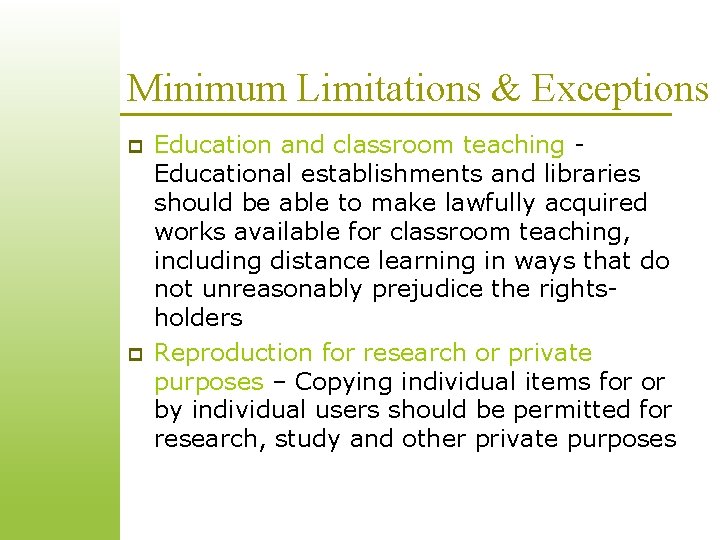
Minimum Limitations & Exceptions p p Education and classroom teaching Educational establishments and libraries should be able to make lawfully acquired works available for classroom teaching, including distance learning in ways that do not unreasonably prejudice the rightsholders Reproduction for research or private purposes – Copying individual items for or by individual users should be permitted for research, study and other private purposes
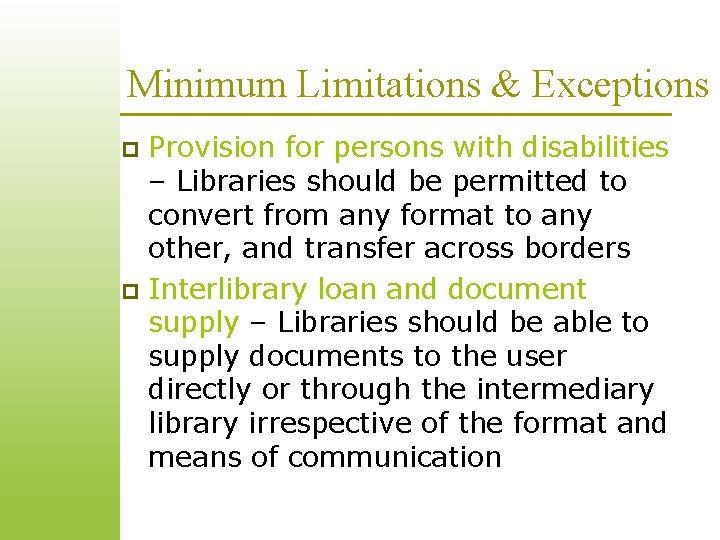
Minimum Limitations & Exceptions Provision for persons with disabilities – Libraries should be permitted to convert from any format to any other, and transfer across borders p Interlibrary loan and document supply – Libraries should be able to supply documents to the user directly or through the intermediary library irrespective of the format and means of communication p
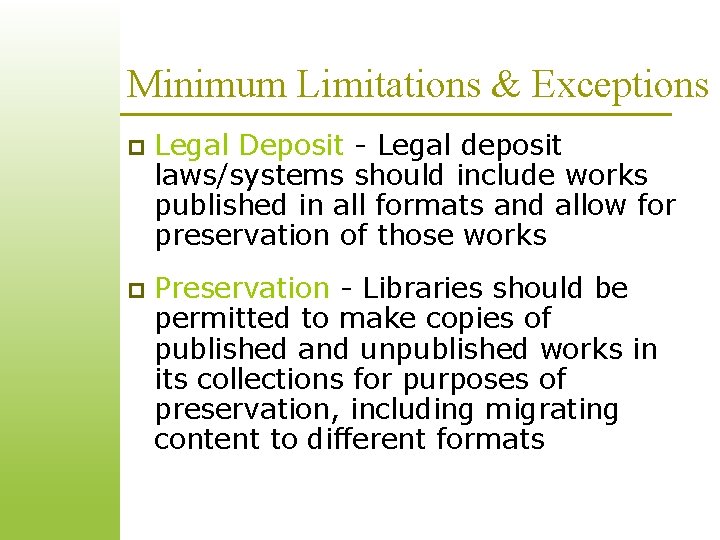
Minimum Limitations & Exceptions p Legal Deposit - Legal deposit laws/systems should include works published in all formats and allow for preservation of those works p Preservation - Libraries should be permitted to make copies of published and unpublished works in its collections for purposes of preservation, including migrating content to different formats
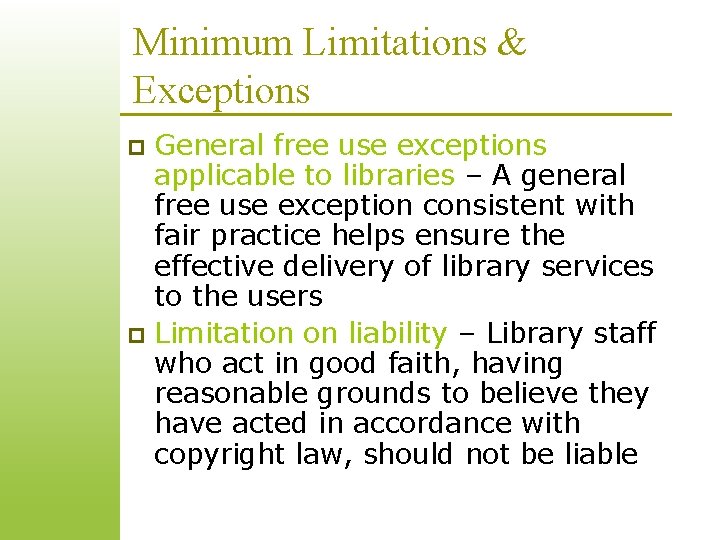
Minimum Limitations & Exceptions General free use exceptions applicable to libraries – A general free use exception consistent with fair practice helps ensure the effective delivery of library services to the users p Limitation on liability – Library staff who act in good faith, having reasonable grounds to believe they have acted in accordance with copyright law, should not be liable p
Public Goals of Copyright, Patent and Trademark Laws The WIPO Copyright Treaty recognizes copyright law serves “to maintain a balance between the interests of authors and the larger public interest, particularly education, research, and access to information”. Access to knowledge and information sharing are fundamental to fostering innovation and creativity.
Public Goals of Copyright, Patent and Trademark Laws TRIPS Agreement states: “The protection and enforcement of intellectual property rights should contribute to the promotion of technological innovation and to the transfer and dissemination of technology, to the mutual advantage of producers and users of technological knowledge and in a manner conducive to social and economic welfare, and to a balance of rights and obligations. ”
Access to Knowledge (A 2 K) Treaty Set out user freedoms by addressing the need to maintain a balance between the rights of authors and the larger public interest, particularly education, research and access to information. p A crucial element in policy interventions is to enhance the overall socio-economic and political development of a country, especially the disadvantaged countries. p
More Flexibility IP laws must reflect each country's development needs to better facilitate access to information and knowledge throughout the world. p Lift the “one size fits all” approach that imposes the highest levels of intellectual property protection for every country which leads to unjust outcomes for the developing countries struggling to meet the most basic needs of their people. p
Intellectual property is the means for innovation and creativity, not an end. Thank you.