
ACCESS TO JUSTICE OF NGOS IN IPPC CASES
- Slides: 13
ACCESS TO JUSTICE OF NGO’S IN IPPC CASES IN BELGIUM Prof. Dr. Luc LAVRYSEN Judge in the Belgian Constitutional Court Director Environmental Law Centre Ghent University EUFJE Conference - Stockholm 17. 10. 2009 p. 1
INTRODUCTION · Different courts may be involved in IPPC cases - Council of State - President of Court of First Instance - Criminal Court · Different requirements on NGO’s may be applicable EUFJE Conference - Stockholm 17. 10. 2009 p. 2
COUNCIL OF STATE · After exhaustion of administrative appeal - In Flanders and Wallonia one can appeal to a higher political or administrative authority * Regional environmental minister or regional government - In Brussels: Environmental Appeal Board (a kind of Environmental Administrative Court – composed of lawyers and environmental experts) * Decision can be appealed with the Regional EUFJE Conference - Stockholm 17. 10. 2009 Government p. 3
COUNCIL OF STATE · Demand for annulment - Review of legality of the decision * Procedure and substance * Including compliance with higher standards (e. g. Aarhus Convention, IPPC-Directive, EIA-Directive, Acts of parliament, regulations, principles of good governance, duty to give reason) · Interim proceedings (suspension of challenged decision) - Serious legal arguments - Risk of difficult to rectify serious adverse effects EUFJE Conference - Stockholm 17. 10. 2009 p. 4
COUNCIL OF STATE · Standing requirements: - The applicant must demonstrate a “prejudice or interest” - Including those who suffer a nuisance of the operation of the plant · NGO’s – no specific legal provision - Since mid eighties: recognition that environmental NGO’s have standing under certain conditions EUFJE Conference - Stockholm 17. 10. 2009 p. 5
COUNCIL OF STATE · Legal personality - 3 persons can set up a non profit organisation – drafting statutes – registration in registry of Commercial Court – publication in annexes of Official Journal (website) · Own interest - e. g. nuisance for a nature reserve that is property of an NGO or that is under its management EUFJE Conference - Stockholm 17. 10. 2009 p. 6
COUNCIL OF STATE · Collective environmental interest, but: - NGO must be “representative” of group of people whose collective interest are threatened – level of support - Clear match between geographical scope of NGO and the challenged project (decision) * Umbrella organisations have no standing for local projects * Local organisations have no standing for regional projects or are not sufficient representative EUFJE Conference - Stockholm 17. 10. 2009 p. 7
COUNCIL OF STATE * Differences between different chambers – Environmental Chambers more open than Land Use Planning Chambers – Always to big or to small ? – No legal certainty (take for safety reasons an individual of the neighbourhood with you) * Evolution in case law – Aarhus Convention and Directives ? (Compliance Committee) – Inspiration of the case law of the Constitutional Court EUFJE Conference - Stockholm 17. 10. 2009 p. 8
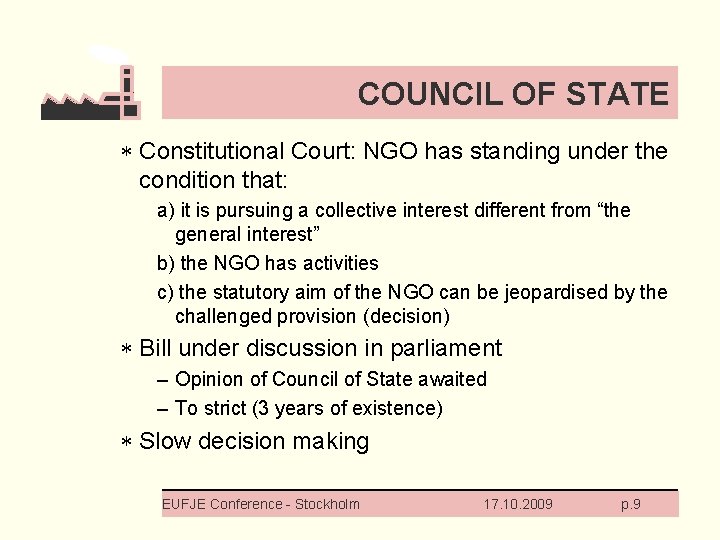
COUNCIL OF STATE * Constitutional Court: NGO has standing under the condition that: a) it is pursuing a collective interest different from “the general interest” b) the NGO has activities c) the statutory aim of the NGO can be jeopardised by the challenged provision (decision) * Bill under discussion in parliament – Opinion of Council of State awaited – To strict (3 years of existence) * Slow decision making EUFJE Conference - Stockholm 17. 10. 2009 p. 9
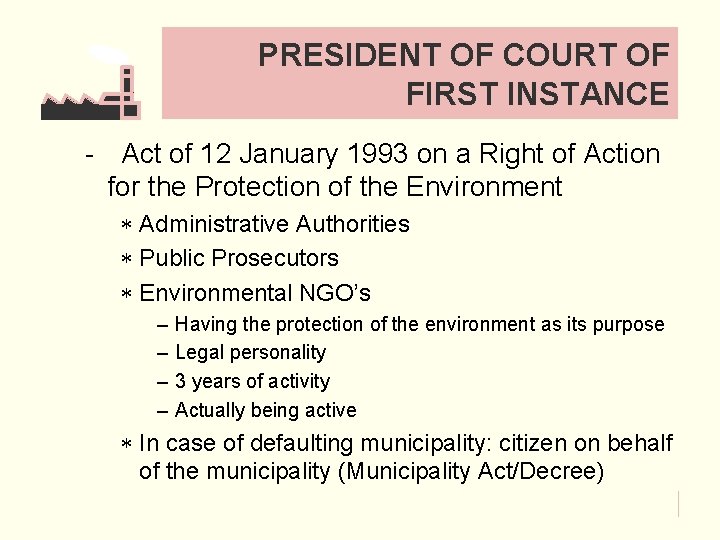
PRESIDENT OF COURT OF FIRST INSTANCE - Act of 12 January 1993 on a Right of Action for the Protection of the Environment * Administrative Authorities * Public Prosecutors * Environmental NGO’s – – Having the protection of the environment as its purpose Legal personality 3 years of activity Actually being active * In case of defaulting municipality: citizen on behalf of the municipality (Municipality Act/Decree) EUFJE Conference - Stockholm 17. 10. 2009 p. 10
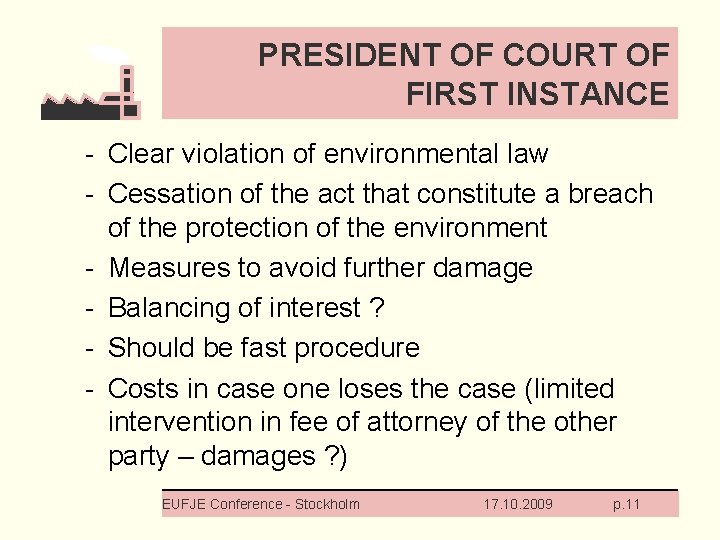
PRESIDENT OF COURT OF FIRST INSTANCE - Clear violation of environmental law - Cessation of the act that constitute a breach of the protection of the environment - Measures to avoid further damage - Balancing of interest ? - Should be fast procedure - Costs in case one loses the case (limited intervention in fee of attorney of the other party – damages ? ) EUFJE Conference - Stockholm 17. 10. 2009 p. 11
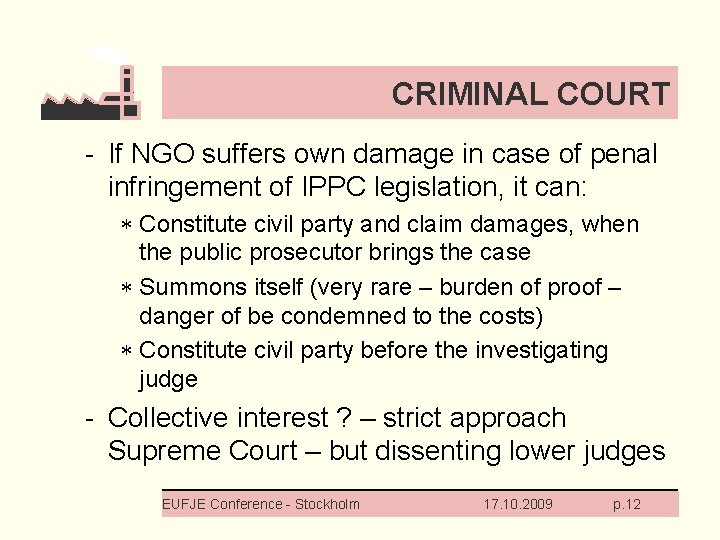
CRIMINAL COURT - If NGO suffers own damage in case of penal infringement of IPPC legislation, it can: * Constitute civil party and claim damages, when the public prosecutor brings the case * Summons itself (very rare – burden of proof – danger of be condemned to the costs) * Constitute civil party before the investigating judge - Collective interest ? – strict approach Supreme Court – but dissenting lower judges EUFJE Conference - Stockholm 17. 10. 2009 p. 12
CRIMINAL COURT - Also the Criminal Court has to check legality of an IPPC permit – Art. 159 of the Constitution · CONCLUSION - Judiciary reform – Environmental Sections to Courts ? EUFJE Conference - Stockholm 17. 10. 2009 p. 13