
ACCESS for ELLs Teacher Reports What do they
- Slides: 19
ACCESS for ELLs Teacher Reports What do they mean to the SLP? Heather Villalobos Pavia Fran Hernandez Herbert January 31, 2015
Outcomes § Interpret and understand ACCESS teacher reports § Learn about the teacher report as a tool to guide conversations and questions as a means to determine if a referral to Special Education maybe warranted 2
Purpose of ACCESS for ELLs § Assess CELP (Colorado English Language Proficiency Standards) § WIDA Standards § Language of Language Arts § Language of Math § Language of Science § Language of Social Studies § Language of Social and Instruction § Crosswalk connection to CAS, instruct with both standards 3
Purpose of ACCESS for ELLs § Assesses each language domain § Listening § Speaking § Reading § Writing § Annually § Progress to language proficiency 4
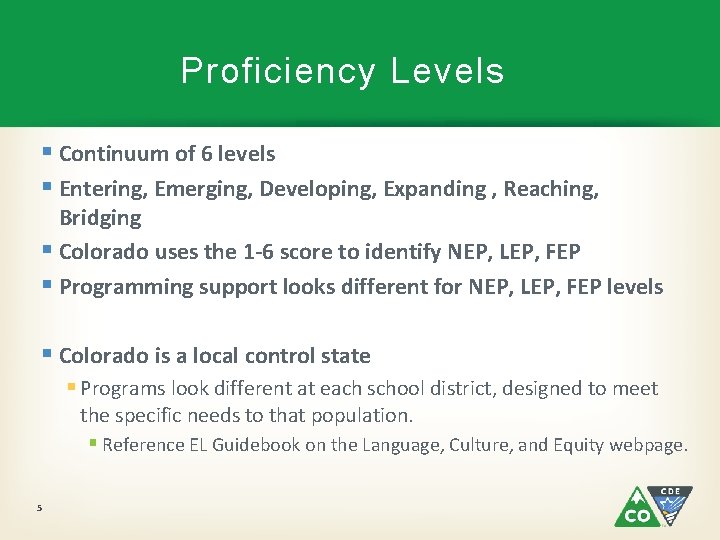
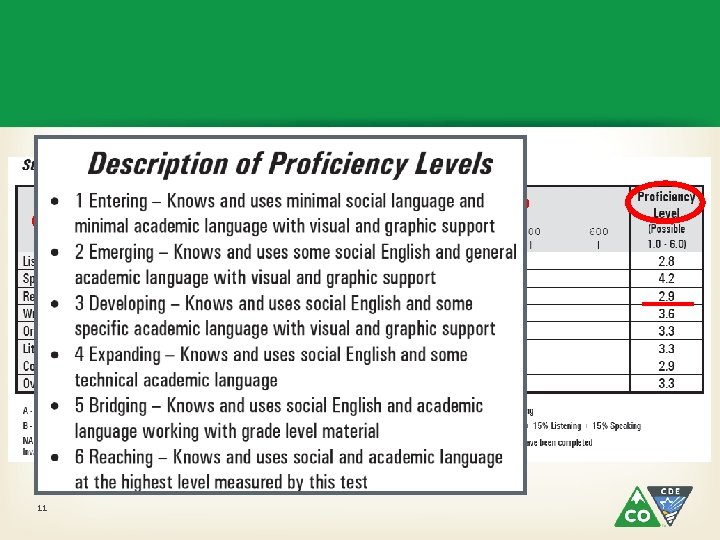
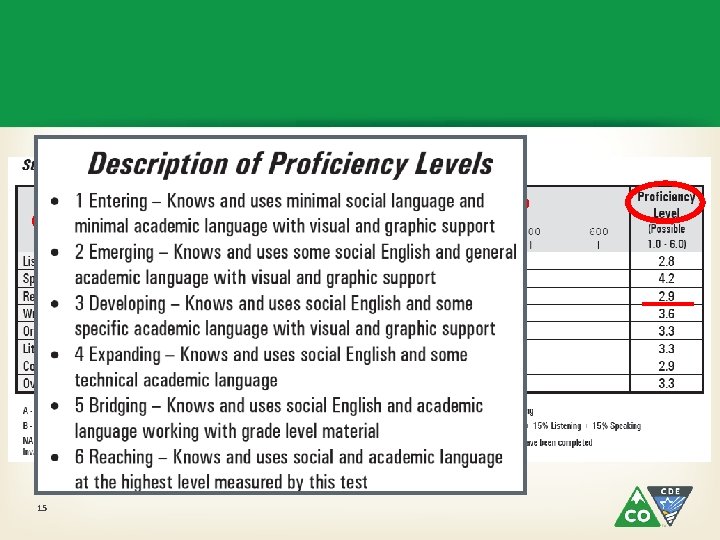
Proficiency Levels § Continuum of 6 levels § Entering, Emerging, Developing, Expanding , Reaching, Bridging § Colorado uses the 1 -6 score to identify NEP, LEP, FEP § Programming support looks different for NEP, LEP, FEP levels § Colorado is a local control state § Programs look different at each school district, designed to meet the specific needs to that population. § Reference EL Guidebook on the Language, Culture, and Equity webpage. 5
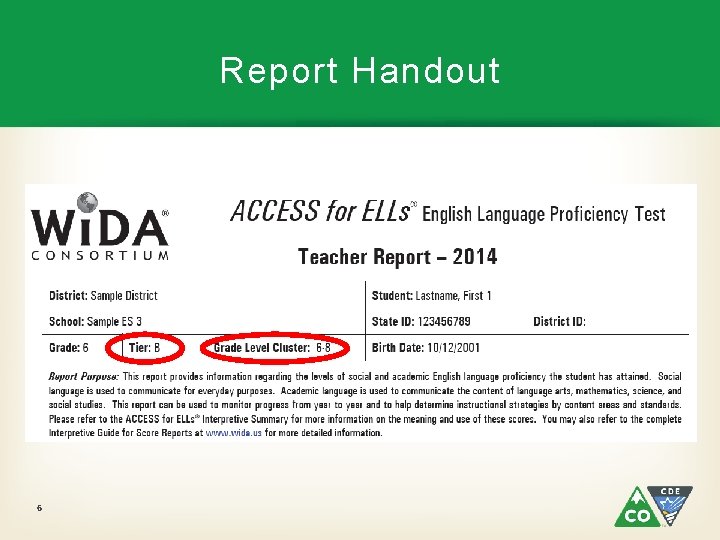
Report Handout 6
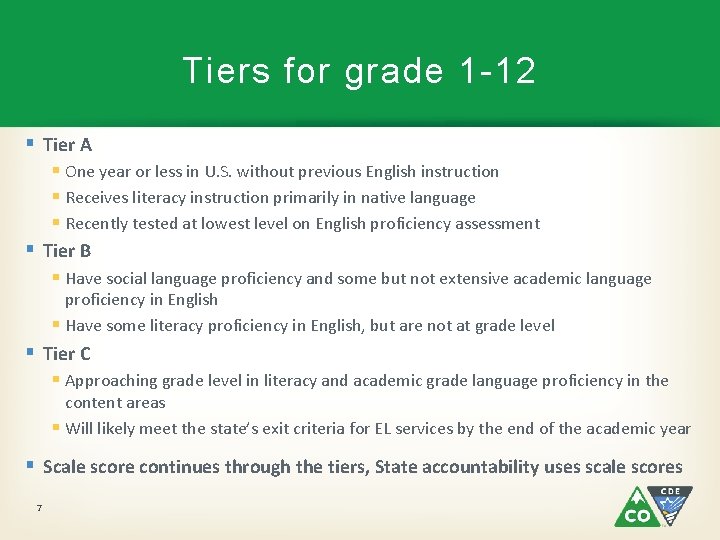
Tiers for grade 1 -12 § Tier A § One year or less in U. S. without previous English instruction § Receives literacy instruction primarily in native language § Recently tested at lowest level on English proficiency assessment § Tier B § Have social language proficiency and some but not extensive academic language proficiency in English § Have some literacy proficiency in English, but are not at grade level § Tier C § Approaching grade level in literacy and academic grade language proficiency in the content areas § Will likely meet the state’s exit criteria for EL services by the end of the academic year § Scale score continues through the tiers, State accountability uses scale scores 7
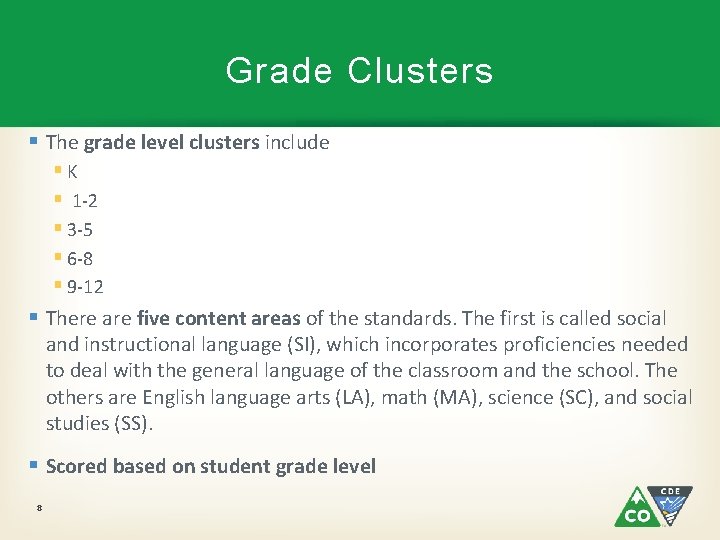
Grade Clusters § The grade level clusters include §K § 1 -2 § 3 -5 § 6 -8 § 9 -12 § There are five content areas of the standards. The first is called social and instructional language (SI), which incorporates proficiencies needed to deal with the general language of the classroom and the school. The others are English language arts (LA), math (MA), science (SC), and social studies (SS). § Scored based on student grade level 8
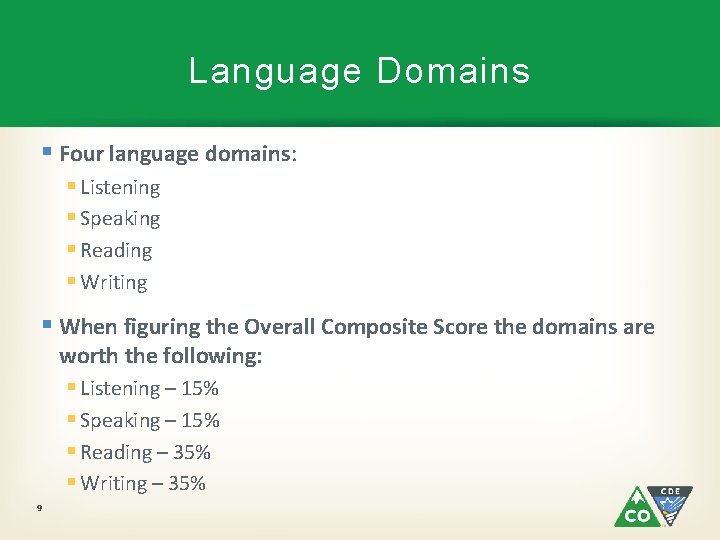
Language Domains § Four language domains: § Listening § Speaking § Reading § Writing § When figuring the Overall Composite Score the domains are worth the following: § Listening – 15% § Speaking – 15% § Reading – 35% § Writing – 35% 9
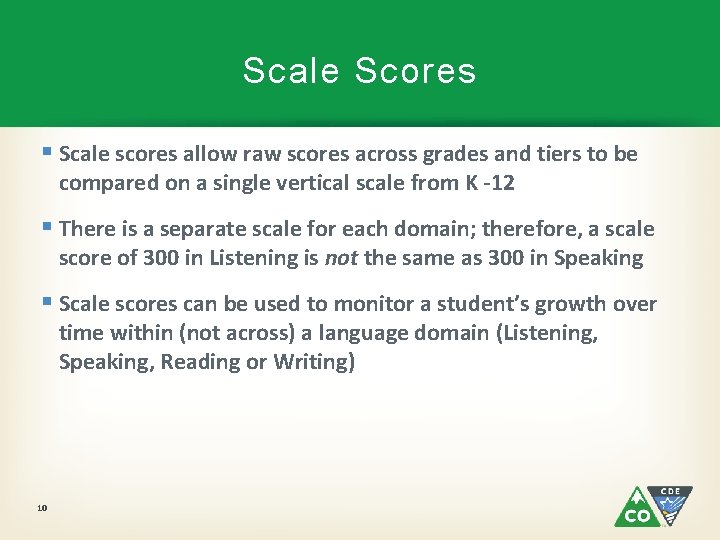
Scale Scores § Scale scores allow raw scores across grades and tiers to be compared on a single vertical scale from K -12 § There is a separate scale for each domain; therefore, a scale score of 300 in Listening is not the same as 300 in Speaking § Scale scores can be used to monitor a student’s growth over time within (not across) a language domain (Listening, Speaking, Reading or Writing) 10
11
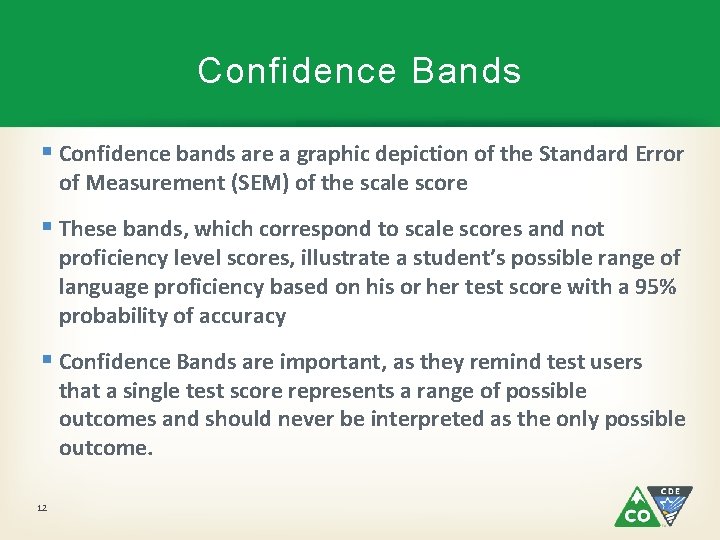
Confidence Bands § Confidence bands are a graphic depiction of the Standard Error of Measurement (SEM) of the scale score § These bands, which correspond to scale scores and not proficiency level scores, illustrate a student’s possible range of language proficiency based on his or her test score with a 95% probability of accuracy § Confidence Bands are important, as they remind test users that a single test score represents a range of possible outcomes and should never be interpreted as the only possible outcome. 12
13
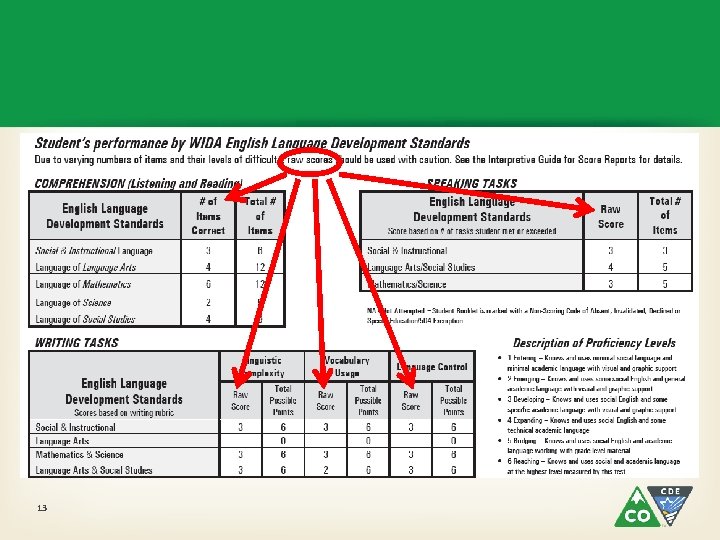
Raw Scores § Raw scores indicate the actual number of items or tasks to which the student responded correctly out of the total number of items or tasks § Raw score data does not represent item difficulty levels § Raw scores should be used with caution and are not appropriate to track students’ progress between school years or compare different students on different tiers or grade clusters of ACCESS for ELLs. 14
15
Connecting to State Requirements § 6 Levels of Proficiency § 1 - Entering § 2 -Emerging § 3 -Developing § 4 -Expanding § 5 -Bridging § 6 -Reaching § Once a student reaches level 5, on both their composite 16 overall score and their literacy score they are eligible for redesignation to Full-English Proficient Monitor Year 1 (FEP M 1)
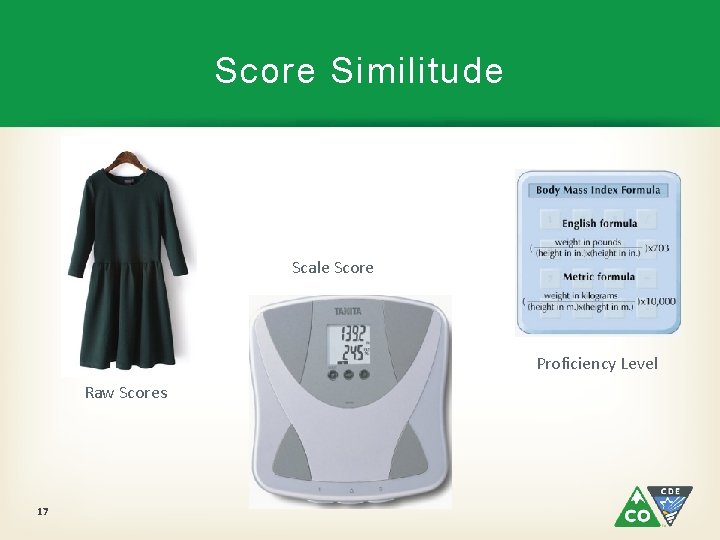
Score Similitude Scale Score Proficiency Level Raw Scores 17
Case Study Activity § Count off into groups § Independently read the student profile and ACCESS Teacher Report § In your group, analyze and discuss: § What is your interpretation of information give? § What additional information do you need? § Would you refer the student to special education, why or why not? Assessment Instrument Descriptors http: //www. cde. state. co. us/uip/assessment_instrument_descriptions 18
Contact Information § Fran Herbert: herbert_f@cde. state. co. us, 303 -866 -6604 § Heather Villalobos: villalobos-pavia_h@cde. state. co. us, 303866 -6118 19