
Access California New Regulations for Electric Vehicle Charging
- Slides: 38
Access California New Regulations for Electric Vehicle Charging Stations Dennis J. Corelis Deputy State Architect, Access Code and Policy 9 March 2016
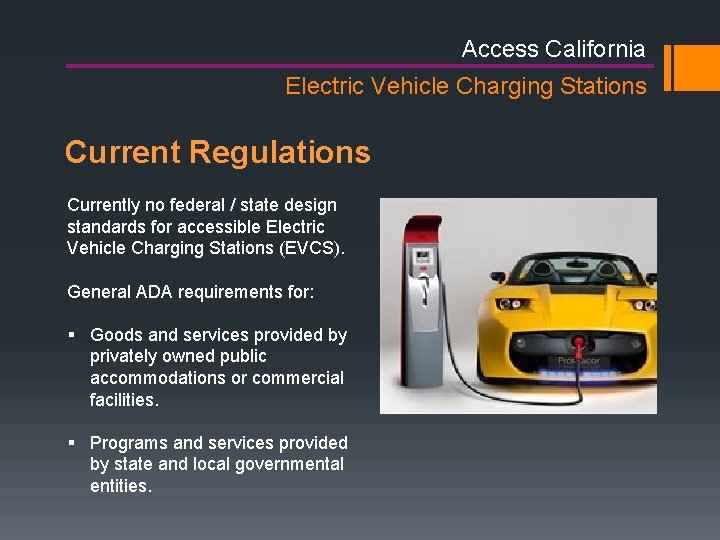
Access California Electric Vehicle Charging Stations Current Regulations Currently no federal / state design standards for accessible Electric Vehicle Charging Stations (EVCS). General ADA requirements for: § Goods and services provided by privately owned public accommodations or commercial facilities. § Programs and services provided by state and local governmental entities.
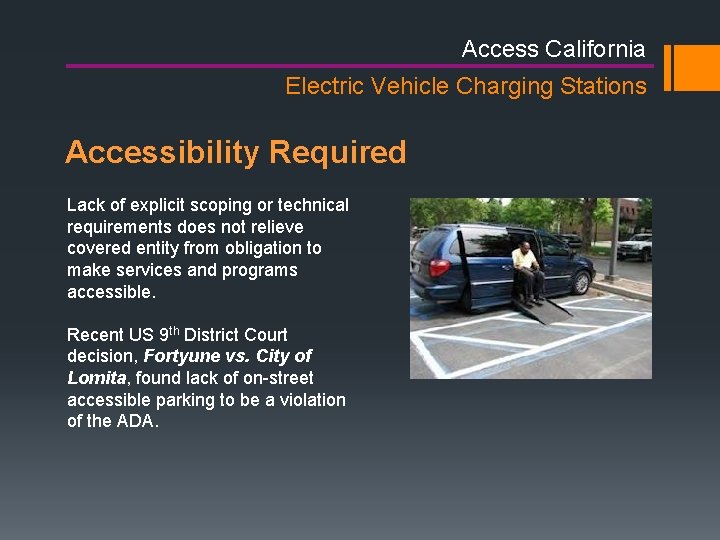
Access California Electric Vehicle Charging Stations Accessibility Required Lack of explicit scoping or technical requirements does not relieve covered entity from obligation to make services and programs accessible. Recent US 9 th District Court decision, Fortyune vs. City of Lomita, found lack of on-street accessible parking to be a violation of the ADA.
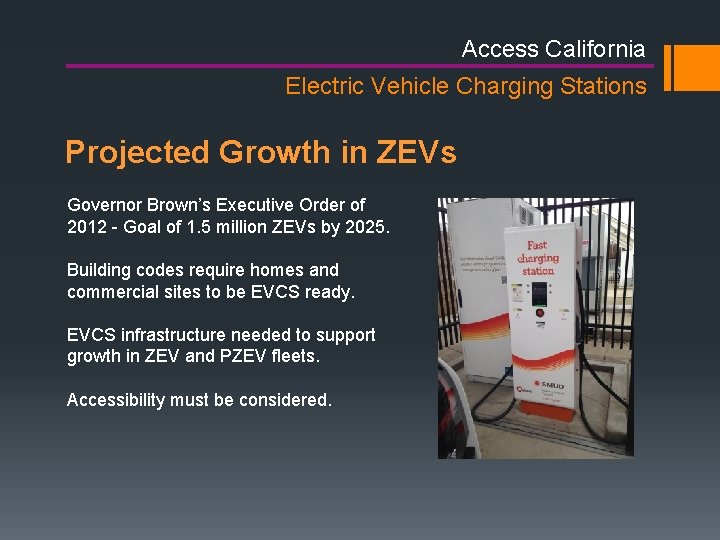
Access California Electric Vehicle Charging Stations Projected Growth in ZEVs Governor Brown’s Executive Order of 2012 - Goal of 1. 5 million ZEVs by 2025. Building codes require homes and commercial sites to be EVCS ready. EVCS infrastructure needed to support growth in ZEV and PZEV fleets. Accessibility must be considered.
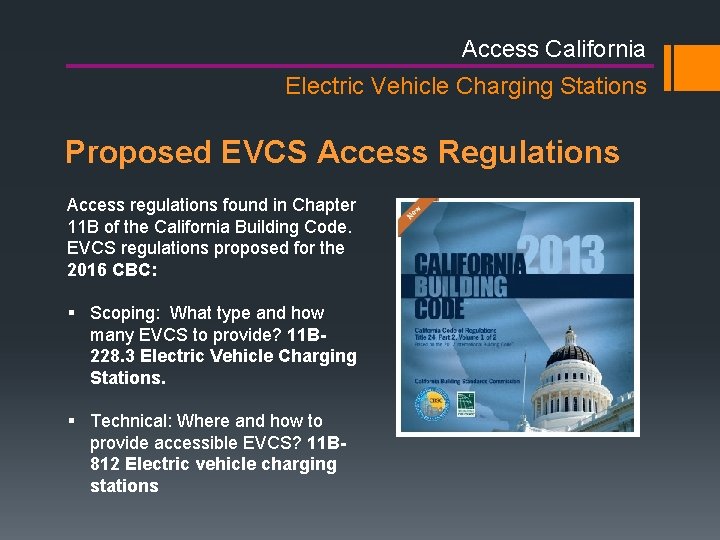
Access California Electric Vehicle Charging Stations Proposed EVCS Access Regulations Access regulations found in Chapter 11 B of the California Building Code. EVCS regulations proposed for the 2016 CBC: § Scoping: What type and how many EVCS to provide? 11 B 228. 3 Electric Vehicle Charging Stations. § Technical: Where and how to provide accessible EVCS? 11 B 812 Electric vehicle charging stations
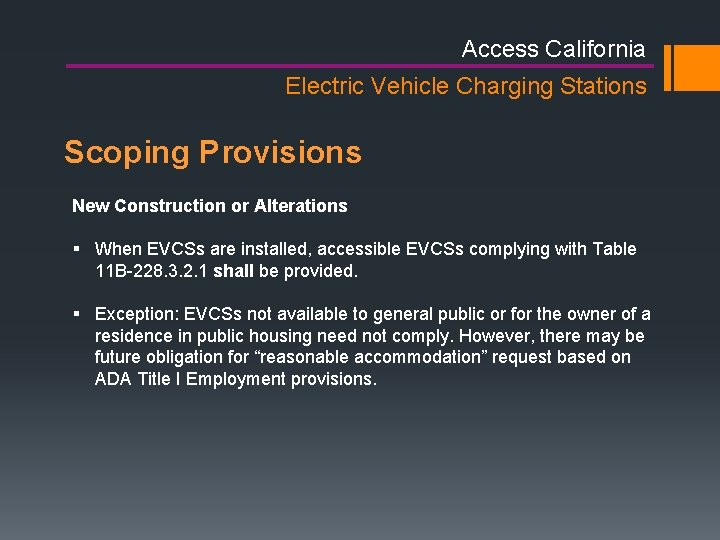
Access California Electric Vehicle Charging Stations Scoping Provisions New Construction or Alterations § When EVCSs are installed, accessible EVCSs complying with Table 11 B-228. 3. 2. 1 shall be provided. § Exception: EVCSs not available to general public or for the owner of a residence in public housing need not comply. However, there may be future obligation for “reasonable accommodation” request based on ADA Title I Employment provisions.
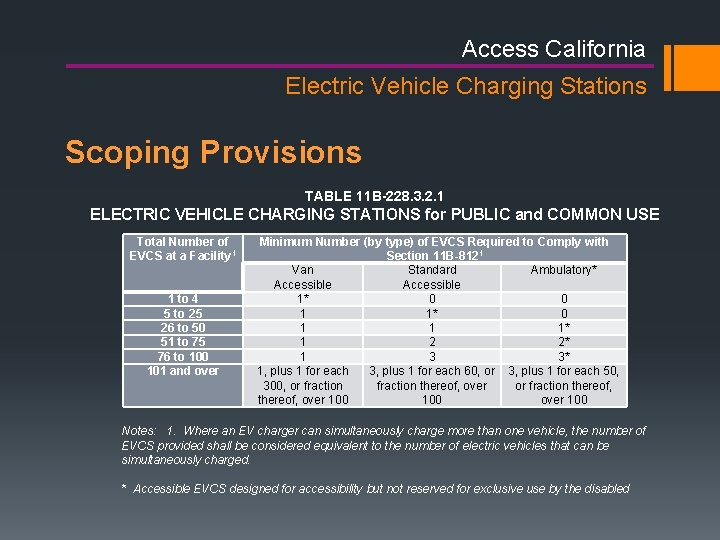
Access California Electric Vehicle Charging Stations Scoping Provisions TABLE 11 B-228. 3. 2. 1 ELECTRIC VEHICLE CHARGING STATIONS for PUBLIC and COMMON USE Total Number of EVCS at a Facility 1 1 to 4 5 to 25 26 to 50 51 to 75 76 to 100 101 and over Minimum Number (by type) of EVCS Required to Comply with Section 11 B-8121 Van Standard Ambulatory* Accessible 1* 0 0 1 1* 0 1 1 1* 1 2 2* 1 3 3* 1, plus 1 for each 3, plus 1 for each 60, or 3, plus 1 for each 50, 300, or fraction thereof, over 100 over 100 Notes: 1. Where an EV charger can simultaneously charge more than one vehicle, the number of EVCS provided shall be considered equivalent to the number of electric vehicles that can be simultaneously charged. * Accessible EVCS designed for accessibility but not reserved for exclusive use by the disabled
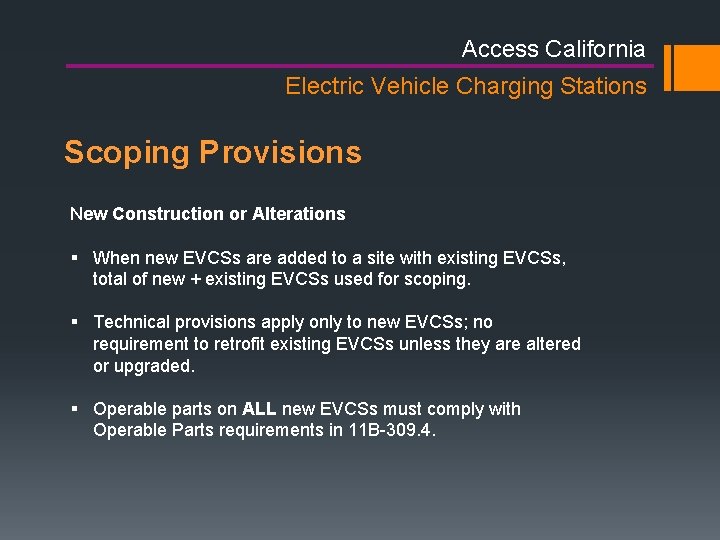
Access California Electric Vehicle Charging Stations Scoping Provisions New Construction or Alterations § When new EVCSs are added to a site with existing EVCSs, total of new + existing EVCSs used for scoping. § Technical provisions apply only to new EVCSs; no requirement to retrofit existing EVCSs unless they are altered or upgraded. § Operable parts on ALL new EVCSs must comply with Operable Parts requirements in 11 B-309. 4.
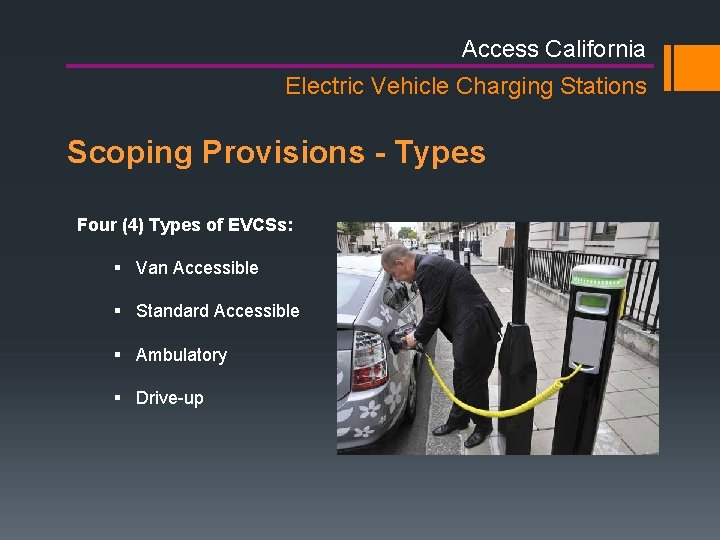
Access California Electric Vehicle Charging Stations Scoping Provisions - Types Four (4) Types of EVCSs: § Van Accessible § Standard Accessible § Ambulatory § Drive-up
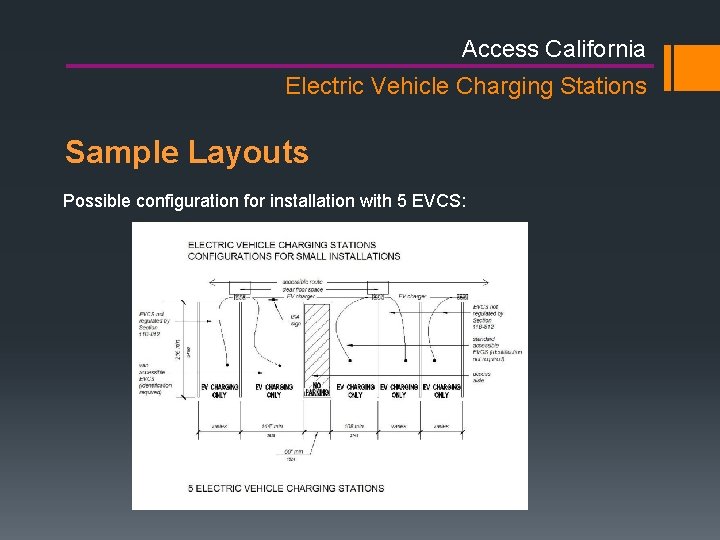
Access California Electric Vehicle Charging Stations Van Accessible EVCS Similar to van accessible parking. § 12 feet (144 inches) minimum width § 18 feet (216 inches) minimum length § Access aisle 5 foot (60 inches) minimum width located on passenger side with head-in parking, may be shared with another EVCS vehicle space § Accessible route requirements to EVSE and areas served by EVCS
Access California Electric Vehicle Charging Stations Standard Accessible EVCS Similar to standard accessible parking. § 9 feet (108 inches) minimum width § 18 feet (216 inches) minimum length § Access aisle 5 foot (60 inches) minimum width either side of space, can be shared with another EVCS space § Accessible route requirements to EVSE and areas served by EVCS
Access California Electric Vehicle Charging Stations Ambulatory EVCS No comparable requirement in accessible parking. § 10 feet (108 inches) minimum width § 18 feet (216 inches) minimum length § No access aisle required; additional width of space provides increased access for individuals with limited or temporary mobility challenges § Accessible route requirements to EVSE, facility entrance or site arrival point
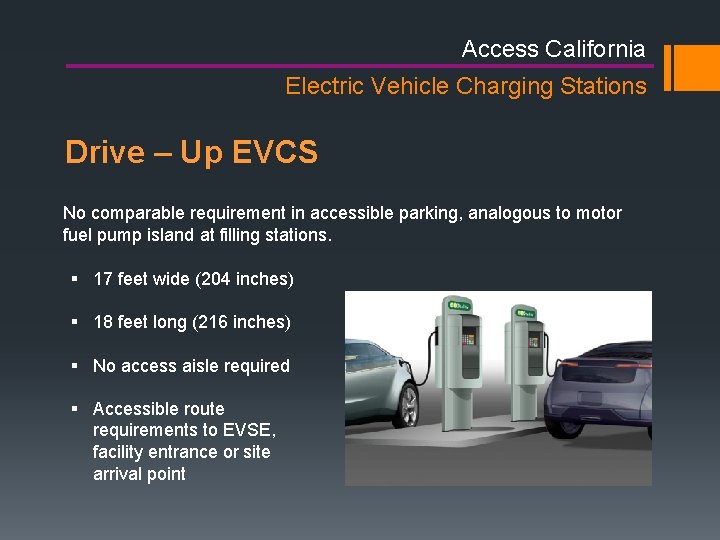
Access California Electric Vehicle Charging Stations Drive – Up EVCS No comparable requirement in accessible parking, analogous to motor fuel pump island at filling stations. § 17 feet wide (204 inches) § 18 feet long (216 inches) § No access aisle required § Accessible route requirements to EVSE, facility entrance or site arrival point
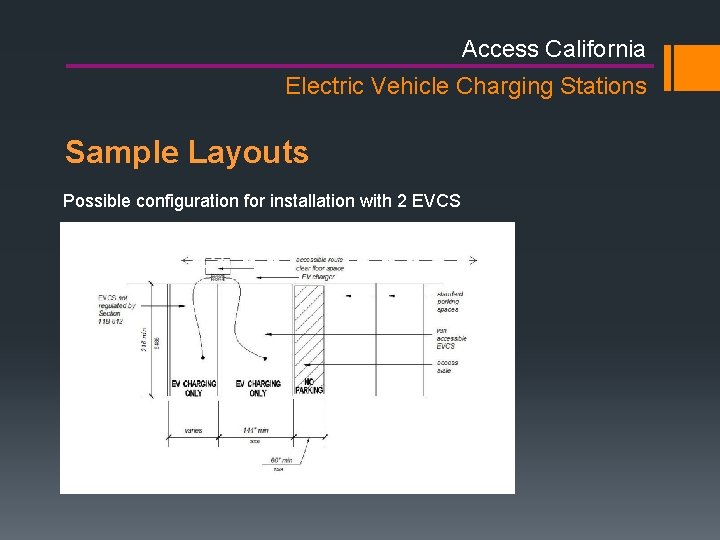
Access California Electric Vehicle Charging Stations Sample Layouts Possible configuration for installation with 2 EVCS
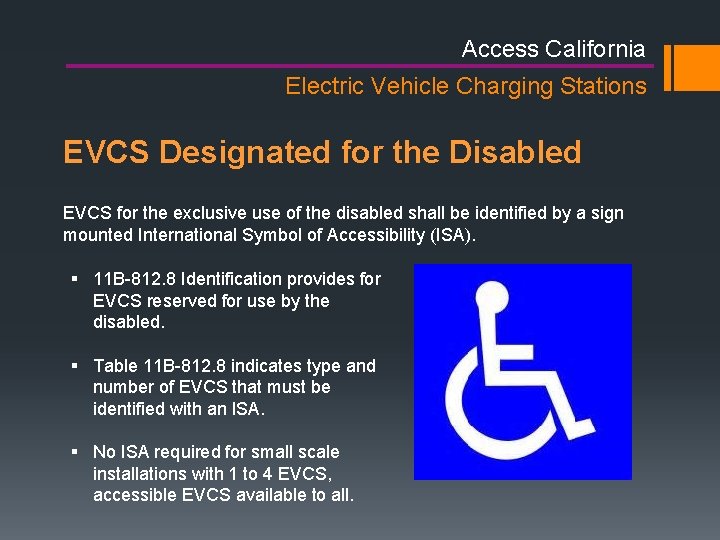
Access California Electric Vehicle Charging Stations EVCS Designated for the Disabled EVCS for the exclusive use of the disabled shall be identified by a sign mounted International Symbol of Accessibility (ISA). § 11 B-812. 8 Identification provides for EVCS reserved for use by the disabled. § Table 11 B-812. 8 indicates type and number of EVCS that must be identified with an ISA. § No ISA required for small scale installations with 1 to 4 EVCS, accessible EVCS available to all.
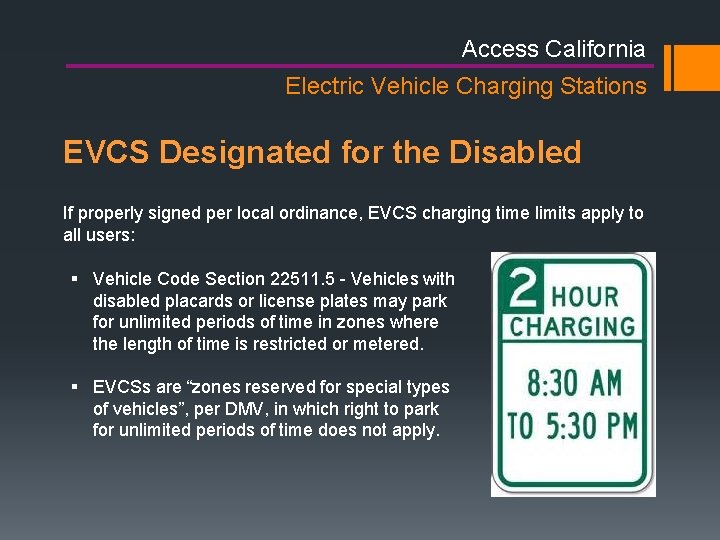
Access California Electric Vehicle Charging Stations EVCS Designated for the Disabled If properly signed per local ordinance, EVCS charging time limits apply to all users: § Vehicle Code Section 22511. 5 - Vehicles with disabled placards or license plates may park for unlimited periods of time in zones where the length of time is restricted or metered. § EVCSs are “zones reserved for special types of vehicles”, per DMV, in which right to park for unlimited periods of time does not apply.
Access California Electric Vehicle Charging Stations Sample Layouts Possible configuration for installation with 5 EVCS:
Access California Electric Vehicle Charging Stations Infrastructure Requirements California Green Building Standards Code Requirements have changed: • 2016 Code Amendments • Scoping Thresholds Lowered • Number of EVCS as a Percent of Parking Spaces Increased
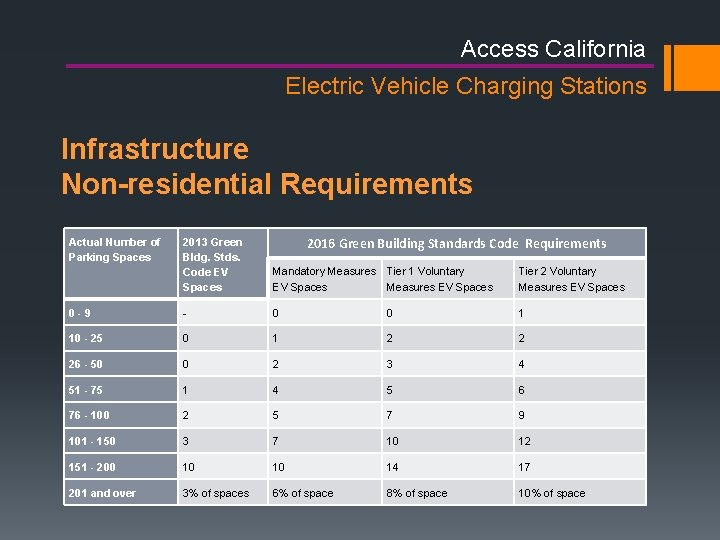
Access California Electric Vehicle Charging Stations Infrastructure Non-residential Requirements Actual Number of Parking Spaces 2016 Green Building Standards Code Requirements 2013 Green Bldg. Stds. Code EV Spaces Mandatory Measures Tier 1 Voluntary EV Spaces Measures EV Spaces Tier 2 Voluntary Measures EV Spaces 0 -9 - 0 0 1 10 - 25 0 1 2 2 26 - 50 0 2 3 4 51 - 75 1 4 5 6 76 - 100 2 5 7 9 101 - 150 3 7 10 12 151 - 200 10 10 14 17 201 and over 3% of spaces 6% of space 8% of space 10% of space
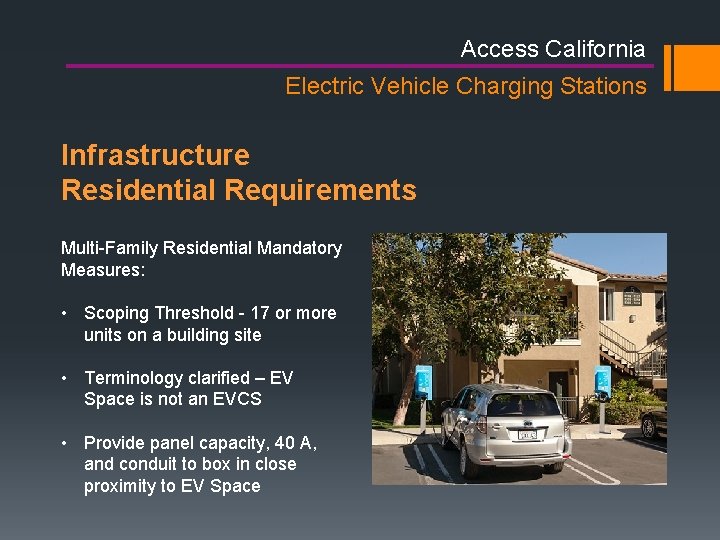
Access California Electric Vehicle Charging Stations Infrastructure Residential Requirements Multi-Family Residential Mandatory Measures: • Scoping Threshold - 17 or more units on a building site • Terminology clarified – EV Space is not an EVCS • Provide panel capacity, 40 A, and conduit to box in close proximity to EV Space
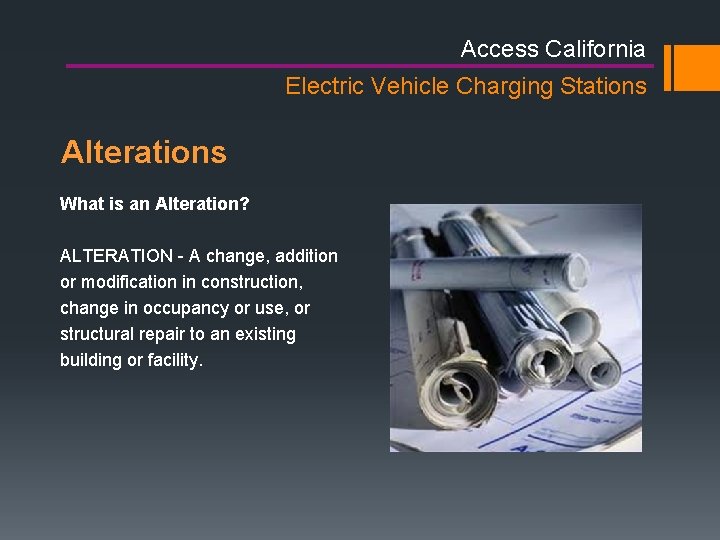
Access California Electric Vehicle Charging Stations Alterations What is an Alteration? ALTERATION - A change, addition or modification in construction, change in occupancy or use, or structural repair to an existing building or facility.
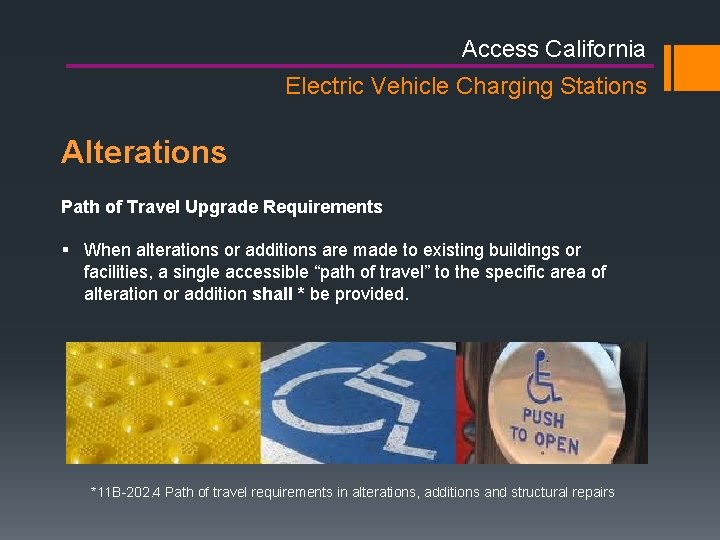
Access California Electric Vehicle Charging Stations Alterations Path of Travel Upgrade Requirements § When alterations or additions are made to existing buildings or facilities, a single accessible “path of travel” to the specific area of alteration or addition shall * be provided. *11 B-202. 4 Path of travel requirements in alterations, additions and structural repairs
Access California Electric Vehicle Charging Stations Path of Travel Elements The Path of Travel (POT) includes the following elements serving the area of alteration: § A primary entrance to the building or facility from site arrival points § Toilet and bathing facilities § Drinking fountains § Public telephones § Signs (California requirement) If POT elements fully compliant, no additional work required.
Access California Electric Vehicle Charging Stations Path of Travel Upgrades Existing elements on a single POT serving the area of alteration: § Must be brought into compliance with current requirements when the cost to do so is not disproportionate to the construction cost. § “Disproportionate” = not exceeding 20% of the adjusted construction cost. § ADA applies 20% limit without regard to size of adjusted construction cost.
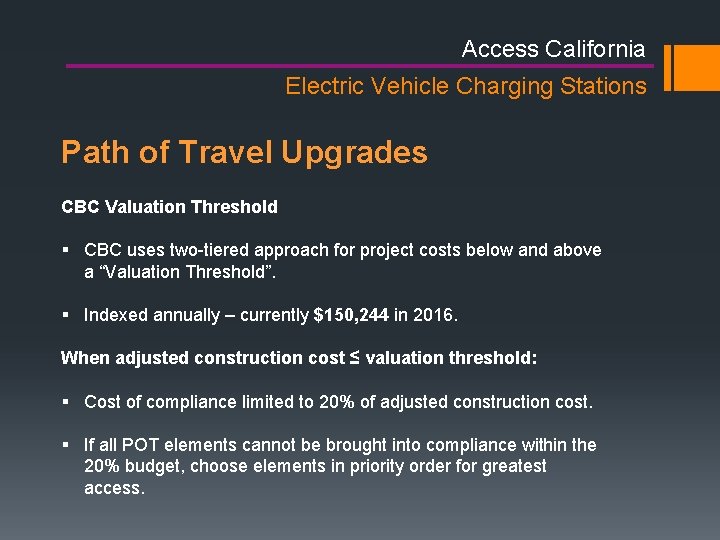
Access California Electric Vehicle Charging Stations Path of Travel Upgrades CBC Valuation Threshold § CBC uses two-tiered approach for project costs below and above a “Valuation Threshold”. § Indexed annually – currently $150, 244 in 2016. When adjusted construction cost ≤ valuation threshold: § Cost of compliance limited to 20% of adjusted construction cost. § If all POT elements cannot be brought into compliance within the 20% budget, choose elements in priority order for greatest access.
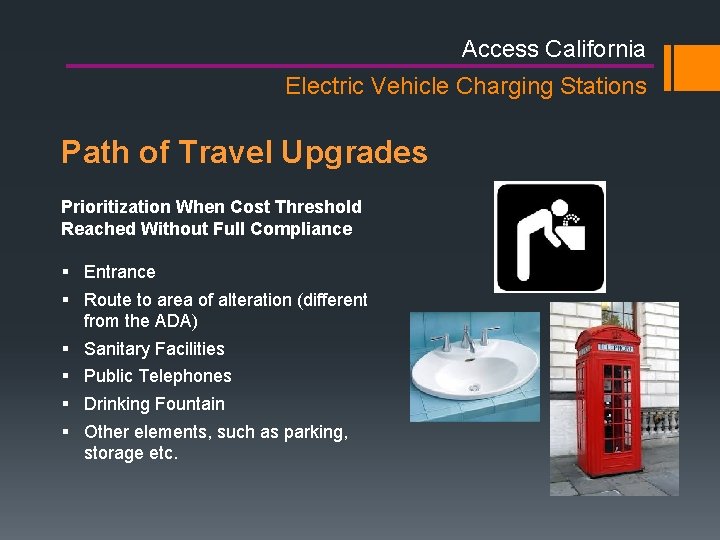
Access California Electric Vehicle Charging Stations Path of Travel Upgrades Prioritization When Cost Threshold Reached Without Full Compliance § Entrance § Route to area of alteration (different from the ADA) § Sanitary Facilities § Public Telephones § Drinking Fountain § Other elements, such as parking, storage etc.
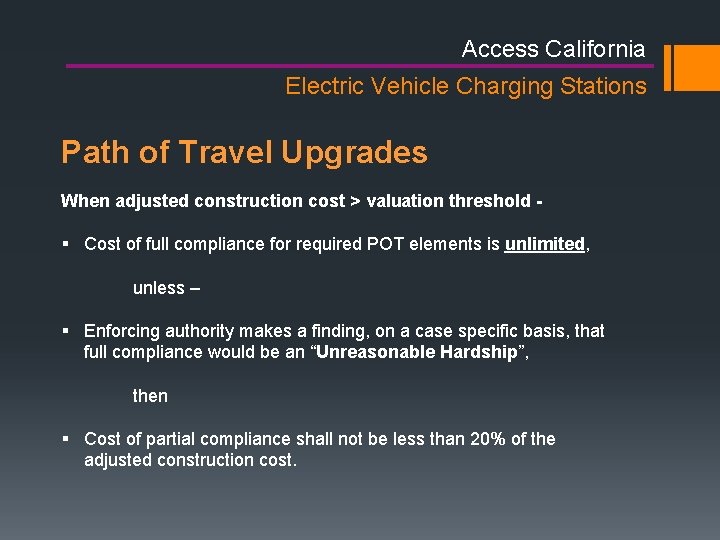
Access California Electric Vehicle Charging Stations Path of Travel Upgrades When adjusted construction cost > valuation threshold - § Cost of full compliance for required POT elements is unlimited, unless – § Enforcing authority makes a finding, on a case specific basis, that full compliance would be an “Unreasonable Hardship”, then § Cost of partial compliance shall not be less than 20% of the adjusted construction cost.
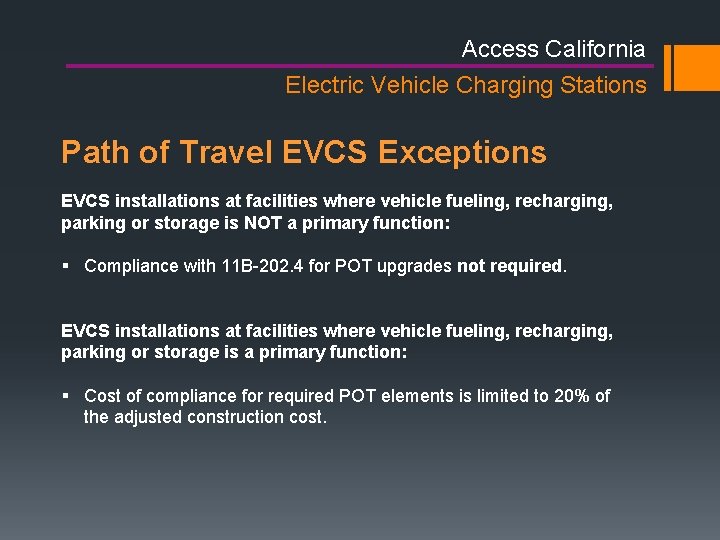
Access California Electric Vehicle Charging Stations Path of Travel EVCS Exceptions EVCS installations at facilities where vehicle fueling, recharging, parking or storage is NOT a primary function: § Compliance with 11 B-202. 4 for POT upgrades not required. EVCS installations at facilities where vehicle fueling, recharging, parking or storage is a primary function: § Cost of compliance for required POT elements is limited to 20% of the adjusted construction cost.
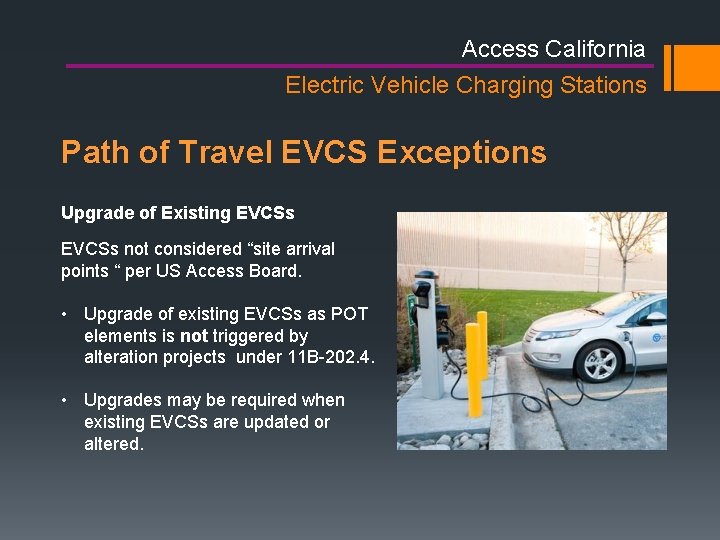
Access California Electric Vehicle Charging Stations Path of Travel EVCS Exceptions Upgrade of Existing EVCSs not considered “site arrival points “ per US Access Board. • Upgrade of existing EVCSs as POT elements is not triggered by alteration projects under 11 B-202. 4. • Upgrades may be required when existing EVCSs are updated or altered.
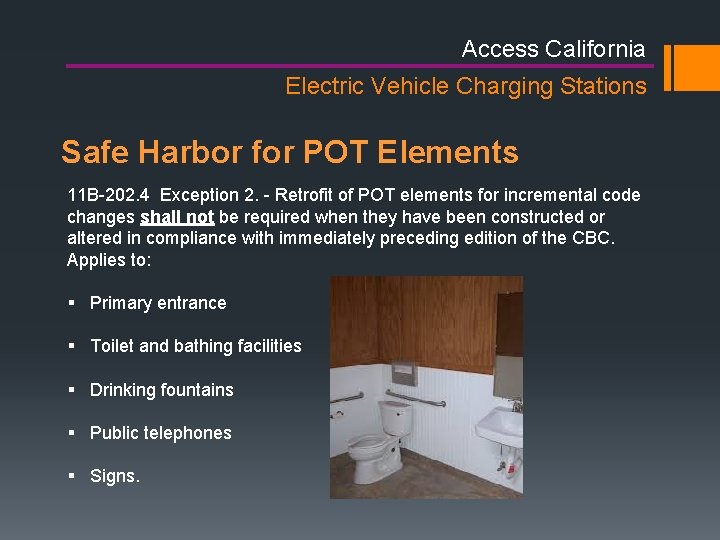
Access California Electric Vehicle Charging Stations Safe Harbor for POT Elements 11 B-202. 4 Exception 2. - Retrofit of POT elements for incremental code changes shall not be required when they have been constructed or altered in compliance with immediately preceding edition of the CBC. Applies to: § Primary entrance § Toilet and bathing facilities § Drinking fountains § Public telephones § Signs.
Access California Electric Vehicle Charging Stations Unreasonable Hardship Full POT upgrade may not be required when compliance would make the project infeasible : § Case-by-case determination § Based on existing constraints / conditions and the scope of work § Compliance required to the “maximum extent feasible” Details of any finding of unreasonable hardship shall be recorded and entered into the files of the enforcing agency.
Access California Electric Vehicle Charging Stations Unreasonable Hardship Criteria for Making a Finding of Unreasonable Hardship § § § The cost of providing access The cost of all proposed construction The impact of compliance on the financial feasibility of the project The nature of accessibility that would be gained or lost The nature of the use of the facility and its availability to persons with disabilities See CBC Chapter 2, Section 202 Definitions
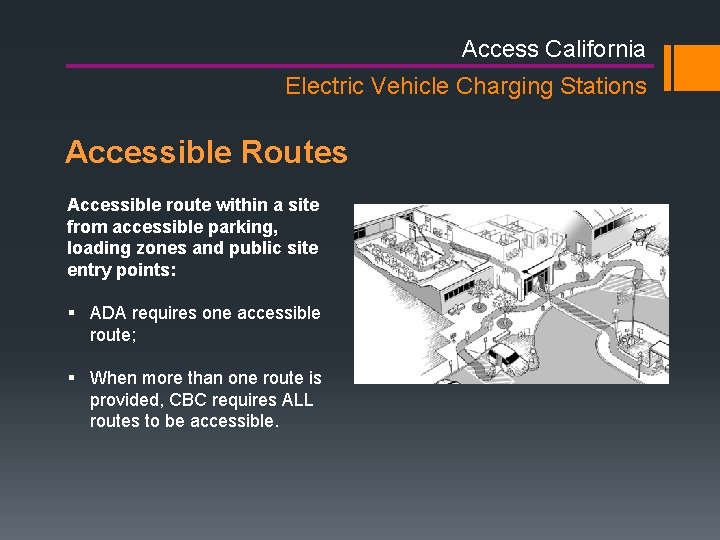
Access California Electric Vehicle Charging Stations Accessible Routes Accessible route within a site from accessible parking, loading zones and public site entry points: § ADA requires one accessible route; § When more than one route is provided, CBC requires ALL routes to be accessible.
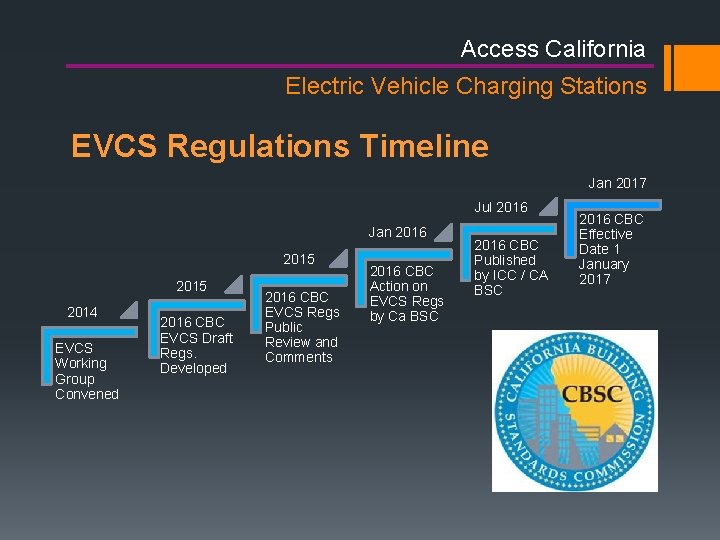
Access California Electric Vehicle Charging Stations EVCS Regulations Timeline Jan 2017 Jul 2016 Jan 2016 2015 2014 EVCS Working Group Convened 2016 CBC EVCS Draft Regs. Developed 2016 CBC EVCS Regs Public Review and Comments 2016 CBC Action on EVCS Regs by Ca BSC 2016 CBC Published by ICC / CA BSC 2016 CBC Effective Date 1 January 2017
Access California Electric Vehicle Charging Stations Regulations as Adopted The text of the proposed regulations may be accessed on the California Building Standards Commission web site, see the Express Terms Item 11 B. 51 and Related Items 11 B. 51. 01 through 11 B. 51. 06, pages 76 through 83. Hyperlinks to the Express Terms and related documents are below: DSA-AC 01/15: California Building Code, Part 2, Title 24 Updated Notice of Proposed Action (NOPA): (PDF) (DOC) Initial Statement of Reasons (ISOR): (PDF) (DOC) Express Terms (ET): (PDF) (DOC) (SRV-DOC)
Access California Electric Vehicle Charging Stations Available Access Code Resources The following materials are available on DSA’s California Access Compliance Reference Materials web page: § 2010 CBC-2013 CBC Cross Reference Matrix (PDF – 1. 20 MB) | (Word – 1. 46 MB) § 2013 CBC Expanded Table of Contents for Chapter 11 B (PDF – 165 KB) | (Word – 77 KB) § 2013 CBC Advisory Manual (PDF – 12. 2 MB) | (Word – 15. 9 MB) Copies of all California codes available online at: § https: //law. resource. org/pub/us/code/bsc. ca. gov/
Access California Electric Vehicle Charging Stations Contact Information Please direct questions to the Division of the State Architect at: DENNIS J. CORELIS, Deputy State Architect § Email at Dennis. corelis@dgs. ca. gov § Telephone: 916 445 -4167
Access California Electric Vehicle Charging Stations Thank you for participating in today’s presentation