
Acceptance of Both U S EUUN ECE Certified
Acceptance of Both U. S. & EU/UN ECE Certified Vehicles American National Standards Institute Meeting With Colombian Delegation December 1, 2015
Motor Vehicle Regulations & Certification Ø Regulations – the technical requirements that must be met to the satisfaction of the regulator that a vehicle, system or component is fit for purpose. • Safety or Environmental. • Regulations are generally ECE or Federal Motor Vehicle Safety Standard (FMVSS). Ø Certification – The process by which the Manufacturer demonstrates compliance to the required regulations to the designated Government Regulator. 2
The World Without Regulatory Borders Ø We live in an increasingly interrelated and integrated world Ø Global automakers build and sell in markets across the world, promoting trade and investment Ø The ideal is to test once and sell anywhere, maintaining high levels of safety and environmental protection Part 1 -Regulations 3
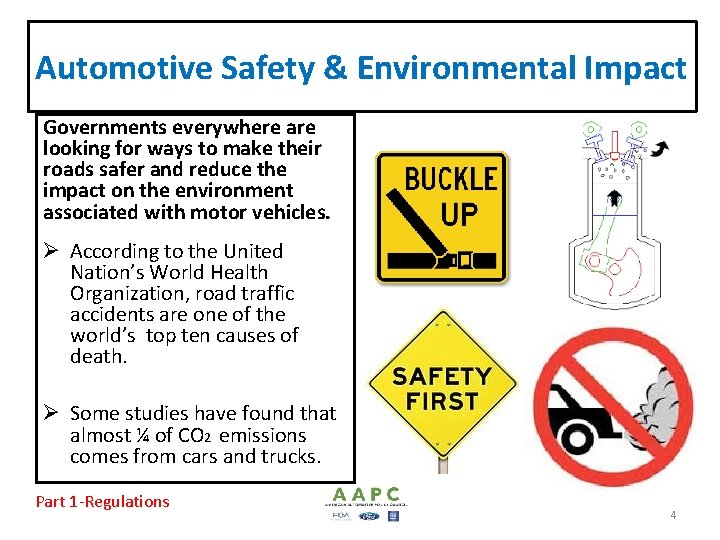
Automotive Safety & Environmental Impact Governments everywhere are looking for ways to make their roads safer and reduce the impact on the environment associated with motor vehicles. Ø According to the United Nation’s World Health Organization, road traffic accidents are one of the world’s top ten causes of death. Ø Some studies have found that almost ¼ of CO 2 emissions comes from cars and trucks. Part 1 -Regulations 4
How to Address These Societal Challenges There are two major - equally robust sets of existing vehicle safety and environmental regulations Ø US Federal Motor Vehicle Safety Standards (FMVSS) and Environmental Protection Agency (EPA) rules and, Ø UN Economic Commission for Europe (ECE) standards, now referred to as UN regulations Part 1 -Regulations 5
U. S. Regulations U. S. safety and environmental regulations are comprehensive, rigorous and robust: Ø There is a robust legal framework and data driven process U. S. regulators use to develop technical regulations for motor vehicles. Ø Methods are used to verify that vehicles certified to these technical requirements are in fact manufactured in full compliance with these requirements. Ø In the case of EPA rules, there also in-use verification requirements. Ø There are 65 motor vehicle and motor vehicle equipment safety standards in the U. S. Covering pre-crash (active), crash (passive) safety, post-crash safety, and additional ‘special’ safety standards Ø Anyone with experience in designing and developing a motor vehicle in conformity to U. S. safety and environmental regulations can attest to the stringency of this certification and validation process- and post market verification. Part 1 -Regulations 6
ECE Regulations ECE safety and environmental regulations are equally comprehenisve rigorous and robust: Ø The 1958 Agreement, administered by UN Working Party 29, has been the principle standard setting body from which Contracting Parties (countries) adopt and apply technical requirements into their national law. Ø There are 62 contracting parties to the ‘ 58 Agreement (34 if the EU and members are counted as one. ) Ø There are 128 regulations that cover active, passive safety & theft as well as environmental requirements for the construction of motor vehicles and motor vehicle equipment. Under the ‘ 58 Agreement vehicles are type approved by a certified third party and, like in the U. S. , (although not a rigidly as the US) production vehicles and components are tested to assure ongoing Conformity of Production (Co. P) to the regulations. Part 1 -Regulations 7
Why Accept U. S. & ECE/EU Certified Vehicles? FOUR PRIMARY REASONS: 1. Both are Robust, Long-standing & Tested Ø Both regulatory regimes have been developing safety and environmental regulations for nearly 50 years. Ø Both systems use technical assessment of real-world data as the basis for regulatory development. Ø Both sets of regulations comprehensively cover active and passive safety along, with environmental emission control, which lead to state-of-the-art technology to meet their mandated levels of performance. Part 1 -Regulations 8
Why Accept Both… Comparable Performance 2. Both Have Comparable Performance & Outcomes For each comparable FMVSS and ECE auto regulation, some technical differences are certain but that should NOT be the focus. Part 1 -Regulations Instead, we should be aware that there are far more similarities in the objectives and outcomes for both regulatory schemes. 9
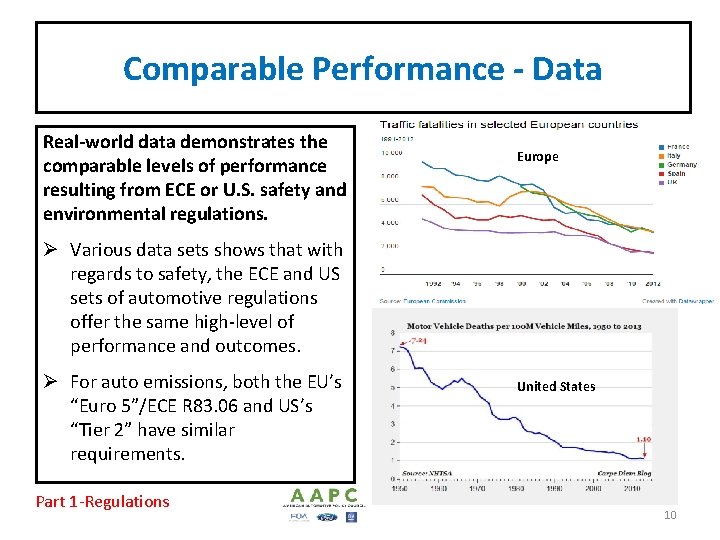
Comparable Performance - Data Real-world data demonstrates the comparable levels of performance resulting from ECE or U. S. safety and environmental regulations. Europe Ø Various data sets shows that with regards to safety, the ECE and US sets of automotive regulations offer the same high-level of performance and outcomes. Ø For auto emissions, both the EU’s “Euro 5”/ECE R 83. 06 and US’s “Tier 2” have similar requirements. Part 1 -Regulations United States 10
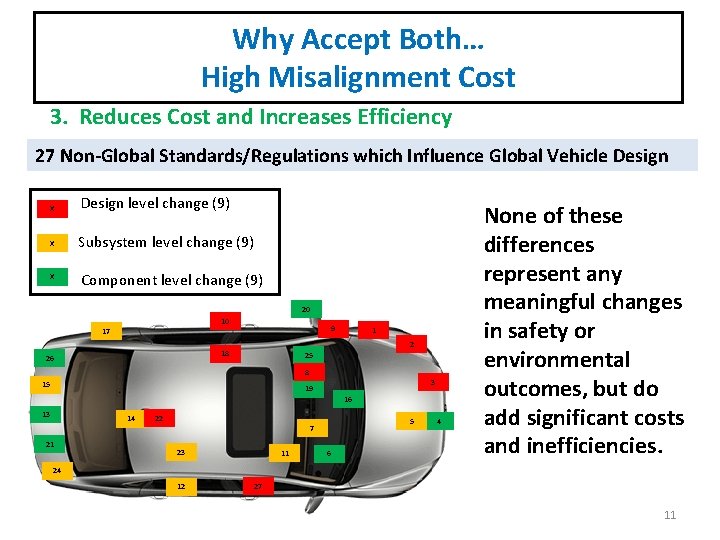
Why Accept Both… High Misalignment Cost 3. Reduces Cost and Increases Efficiency 27 Non-Global Standards/Regulations which Influence Global Vehicle Design X CX X Design level change (9) Subsystem level change (9) Component level change (9) 20 10 9 17 1 2 18 26 25 8 15 3 19 16 13 14 21 22 5 7 23 11 6 4 None of these differences represent any meaningful changes in safety or environmental outcomes, but do add significant costs and inefficiencies. 24 12 27 11
Why Accept Both… Consumer Benefits 4. Brings Consumer Benefits Ø Increased choices for consumers. Ø Cost savings & efficiencies that can be passed on to consumers. ADVANCED TECHNOLOGY Ø Proliferation of new technologies- more kinds and more rapid uptake. 12
Acceptance of Existing U. S. & ECE Vehicles Conclusion Part 1 Ø Automakers offer a diversity of automotive products and technologies, from around the world. Ø As we move toward a globally harmonized vehicle regulatory process, we recommend countries facilitating acceptance of both ECE and FMVSS/EPA compliant vehicles. Ø A regulatory policy that accepts vehicles for sale in the region that meets both sets of safety and environmental regulations offers many benefits: Ø Ø Such a policy will meet the highest safety and environmental standards. Offers state-of-the-art technologies from around the world. Provides consumers with a greater variety of products at a lower cost. Avoids disruption of significant automotive trade patters and relationships. Part 1 -Regulations 13
Type Approval Certification & Self-Certification Ø As described above, accepting both FMVSS/EPA and ECE safety and environmental standards maintains a high level of safety and environmental performance and outcomes, while reaping the economic, trade and consumer benefits as well. Ø There, however, remains the difference in the type approval and self certification processes. Ø So, how would a manufacturer’s self-certification to an accepted U. S. regulation be recognized in a jurisdiction that requires type approval and vice versa? Ø The principle difference between the two is the requirement that for type approval the “certification” tests are witnessed by a government authority, and for self-certification these same types of tests are conducted by the vehicle manufacturer. Ø In both cases data is generated to support the claim that a product meets or exceeds the technical performance requirements of any regulation. Part 2 -Certification 14
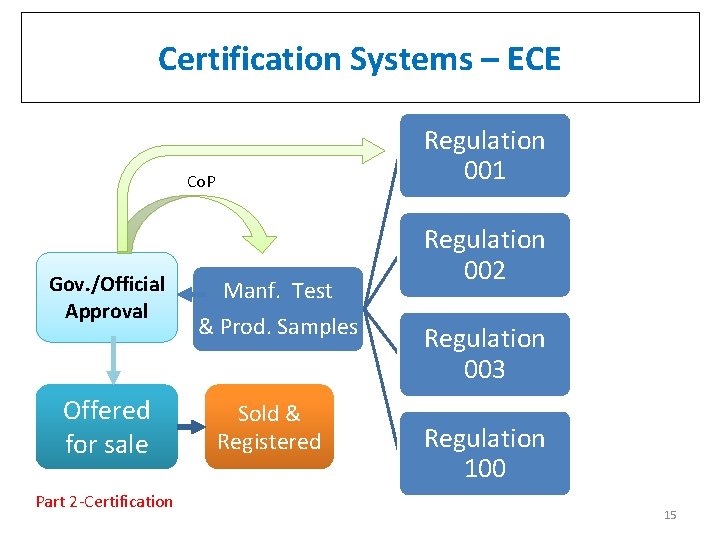
Certification Systems – ECE Regulation 001 Co. P Gov. /Official Approval Offered for sale Part 2 -Certification Manf. Test & Prod. Samples Sold & Registered Regulation 002 Regulation 003 Regulation 100 15
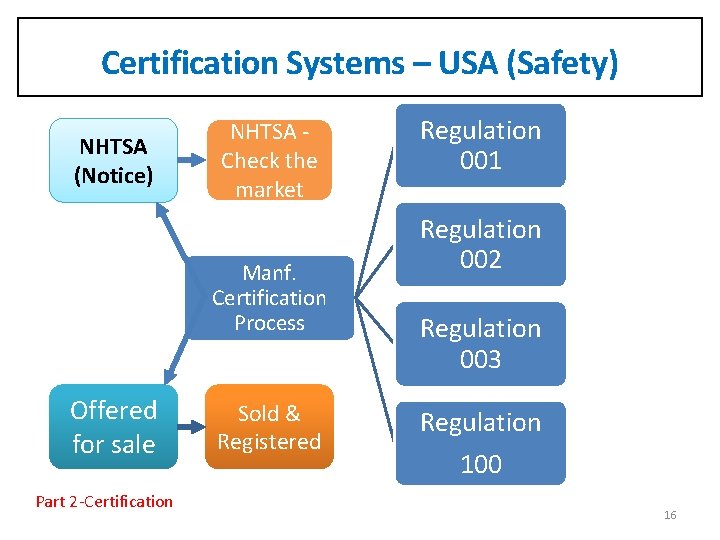
Certification Systems – USA (Safety) NHTSA (Notice) NHTSA Check the market Manf. Certification Process Offered for sale Part 2 -Certification Sold & Registered Regulation 001 Regulation 002 Regulation 003 Regulation 100 16
Recognition of Type Approval & Self Certification Ø When standards/regulations are considered equivalent, then governments should accept assurances/evidence from both type approval and selfcertification sources, and if necessary a summary of the data, demonstrating that. For example: Ø If an automaker has type approval for a specific regulation that is accepted as equivalent to a U. S. regulation, that manufacturer could use the test data that supported the type approval as a basis for self-certification. Ø If an automaker has self-certified to a regulation that is equivalent to a regulation being applied in an economy that uses type approval, the data used to support the self-certification could be accepted as sufficient. Ø This type of system is successfully administered in other countries- e. g. , South Africa, New Zealand Australia. Ø If accepting industry assurances/evidence without another government’s reassurance is of concern, there are ways to provide that. For example: In the U. S. there are programs and regulator-to-regulator agreements (e. g. , “blue ribbon letter”, and government-to-government MOUs). Part 2 -Certification 17
Certification Systems Conclusion Part 2 Ø Countries can maintain flexible certification systems that: Ø Allow for different but equally robust regulations/standards; Ø Allows for evidence/data of compliance with those requirements to come from Type Approval and Self-Certification sources; Ø Maintains a world-class safety performance & outcome for consumers, and; Ø Provides appropriate government oversight. Ø This type of system is currently used in South Africa, Australia, and New Zealand. Ø As with limiting acceptance to one set of standards, limiting acceptance of vehicles from one certification system would limit choice, lower price competiveness, decrease new technology exposure and uptake, and disrupt trade patters/relations. Part 2 -Certification 18
Acceptance of Both U. S. & EU/UN ECE Certified Vehicles RECOMMENDATIONS Ø Accepting both FMVSS/EPA and ECE safety and environmental standards/regulations. Ø Developing and maintaining a flexible certification system that allows for different but equally robust regulations/standards and evidence/data of compliance with those requirements from Type Approval and Self. Certification sources. Ø These can both be accomplished while maintaining high safety performance & outcomes for consumers and providing appropriate government oversight. Ø In this way countries and their consumers can gain from more choice and competitive prices while enabling local production to serve both domestic and foreign markets as global standards/regulation harmonization work continues. 19
Thank You 20
- Slides: 20