Acceptance Commitment Therapy Applications with IDDD Clients Judith

- Slides: 14
Acceptance & Commitment Therapy: Applications with ID/DD Clients Judith Hill-Weld, M. S. , LMFT NADD Annual Conference 2018
Acceptance & Commitment Therapy: Concepts ACT is based on Relational Frame Theory (RFT): “Human behavior is governed largely through networks of mutual relations called relational frames. ” (Hayes & Smith, Get Out of Your Mind and Into Your Life, 2005) J. Hill-Weld, NADD 2018 2
Acceptance & Commitment Therapy: Concepts “The aim of ACT, in lay terms, is to create a rich, full, and meaningful life while accepting the pain that inevitably goes with it. ” (Harris, ACT Made Simple, 2009) J. Hill-Weld, NADD 2018 3
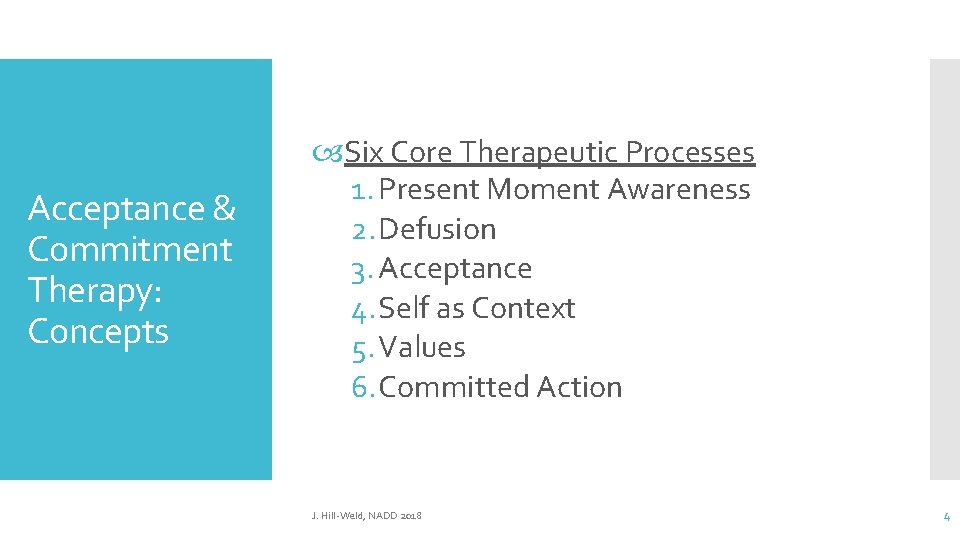
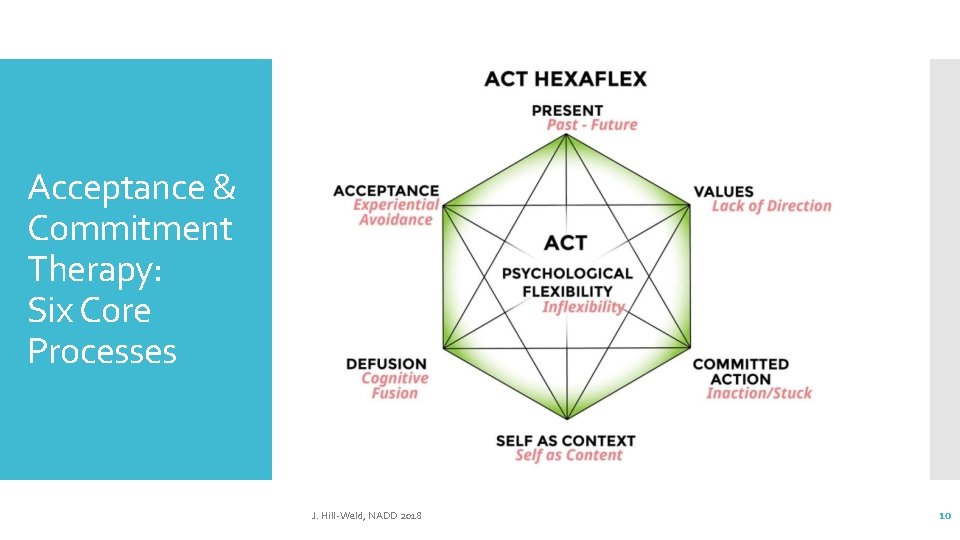
Acceptance & Commitment Therapy: Concepts Six Core Therapeutic Processes 1. Present Moment Awareness 2. Defusion 3. Acceptance 4. Self as Context 5. Values 6. Committed Action J. Hill-Weld, NADD 2018 4
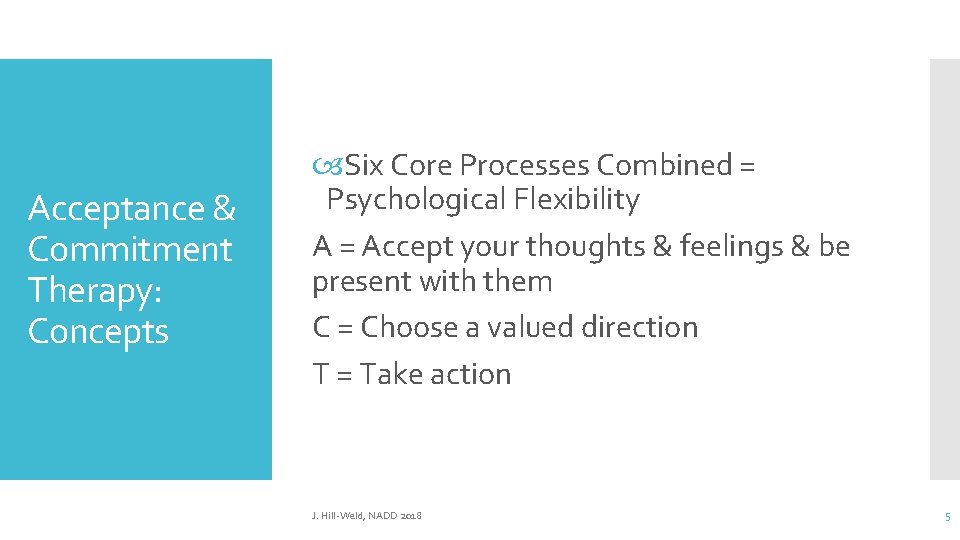
Acceptance & Commitment Therapy: Concepts Six Core Processes Combined = Psychological Flexibility A = Accept your thoughts & feelings & be present with them C = Choose a valued direction T = Take action J. Hill-Weld, NADD 2018 5
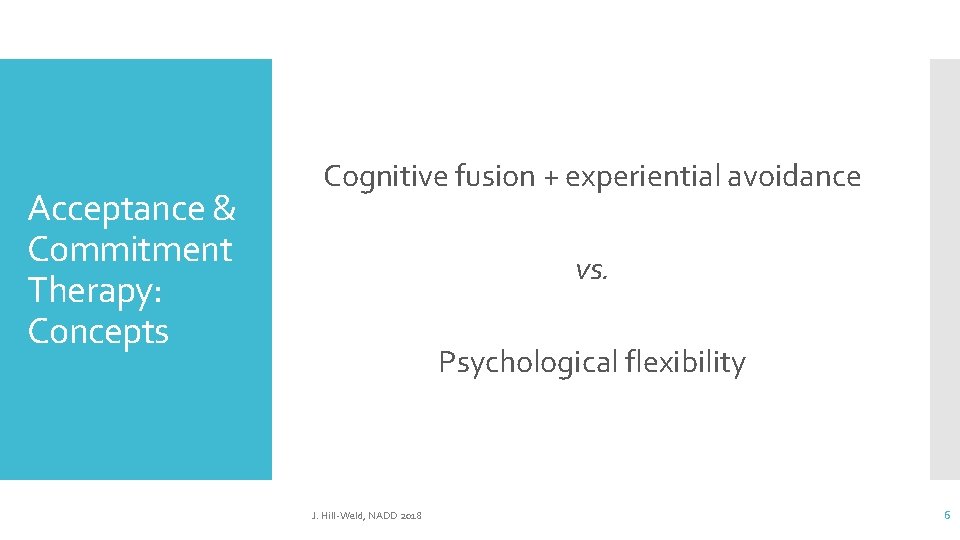
Acceptance & Commitment Therapy: Concepts Cognitive fusion + experiential avoidance vs. Psychological flexibility J. Hill-Weld, NADD 2018 6
Acceptance & Commitment Therapy: Research Not much research available on ACT in ID/DD populations for dual diagnosis tx More research focused on parents or support staff participating in ACT therapy or psychotherapeutic education Or, on ACT targeting core disability regardless of dual diagnosis status J. Hill-Weld, NADD 2018 7
Acceptance and Commitment Therapy with Dually Diagnosed Individuals Acceptance & Commitment Therapy: Research Dissertation by Julieann Pankey at University of Nevada, Reno, 2008 She developed a 4 session ACT protocol for people with Borderline Intellectual Functioning, Mild Intellectual Disability, and Moderate Intellectual Disability J. Hill-Weld, NADD 2018 8
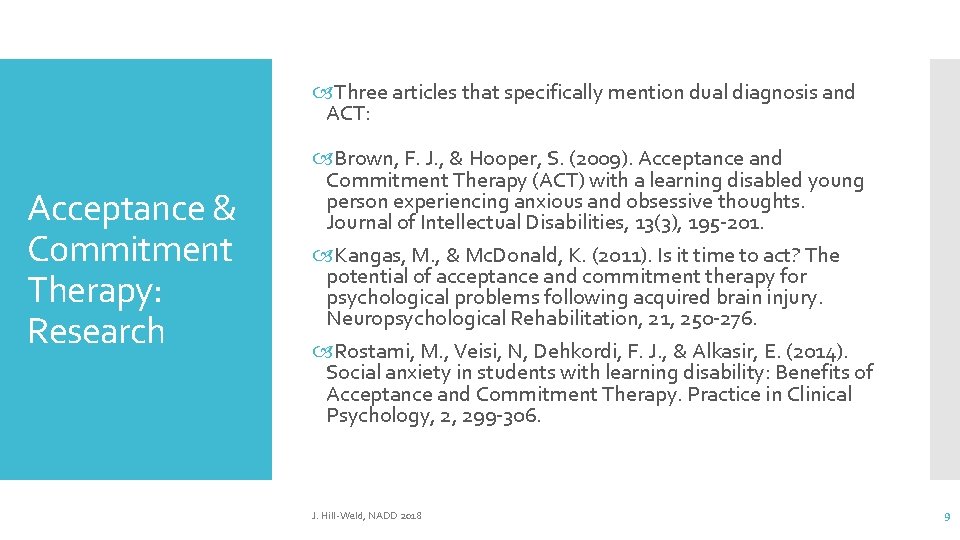
Three articles that specifically mention dual diagnosis and ACT: Acceptance & Commitment Therapy: Research Brown, F. J. , & Hooper, S. (2009). Acceptance and Commitment Therapy (ACT) with a learning disabled young person experiencing anxious and obsessive thoughts. Journal of Intellectual Disabilities, 13(3), 195 -201. Kangas, M. , & Mc. Donald, K. (2011). Is it time to act? The potential of acceptance and commitment therapy for psychological problems following acquired brain injury. Neuropsychological Rehabilitation, 21, 250 -276. Rostami, M. , Veisi, N, Dehkordi, F. J. , & Alkasir, E. (2014). Social anxiety in students with learning disability: Benefits of Acceptance and Commitment Therapy. Practice in Clinical Psychology, 2, 299 -306. J. Hill-Weld, NADD 2018 9
Acceptance & Commitment Therapy: Six Core Processes J. Hill-Weld, NADD 2018 10
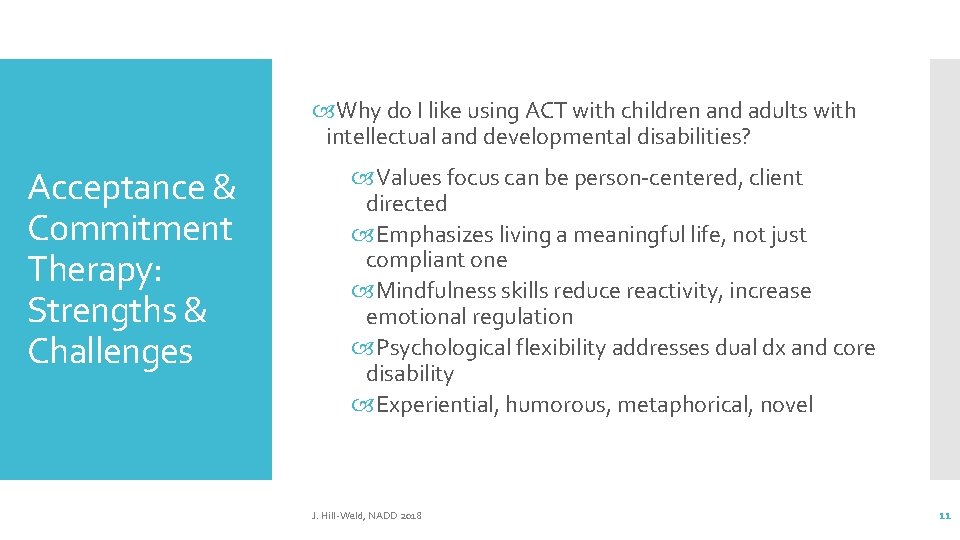
Why do I like using ACT with children and adults with intellectual and developmental disabilities? Acceptance & Commitment Therapy: Strengths & Challenges Values focus can be person-centered, client directed Emphasizes living a meaningful life, not just compliant one Mindfulness skills reduce reactivity, increase emotional regulation Psychological flexibility addresses dual dx and core disability Experiential, humorous, metaphorical, novel J. Hill-Weld, NADD 2018 11
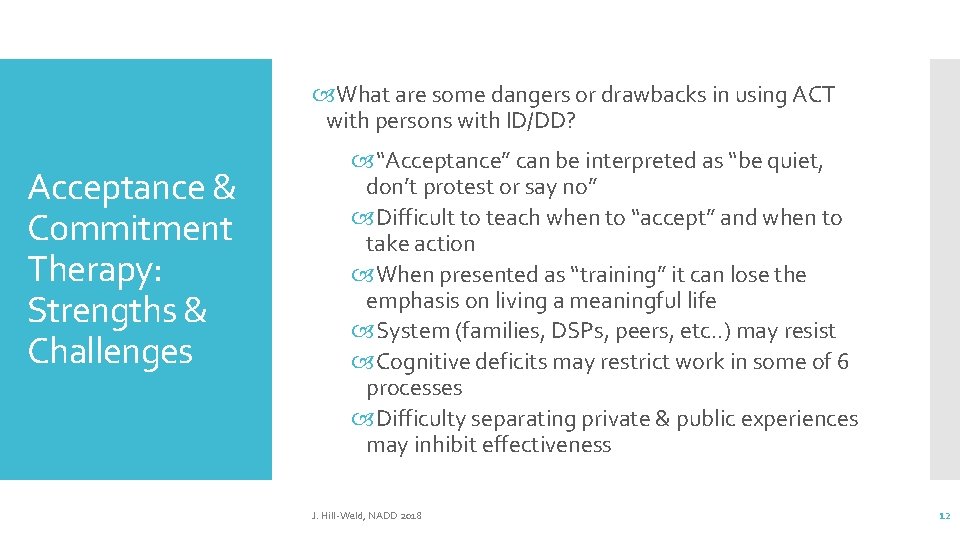
What are some dangers or drawbacks in using ACT with persons with ID/DD? Acceptance & Commitment Therapy: Strengths & Challenges “Acceptance” can be interpreted as “be quiet, don’t protest or say no” Difficult to teach when to “accept” and when to take action When presented as “training” it can lose the emphasis on living a meaningful life System (families, DSPs, peers, etc. . ) may resist Cognitive deficits may restrict work in some of 6 processes Difficulty separating private & public experiences may inhibit effectiveness J. Hill-Weld, NADD 2018 12
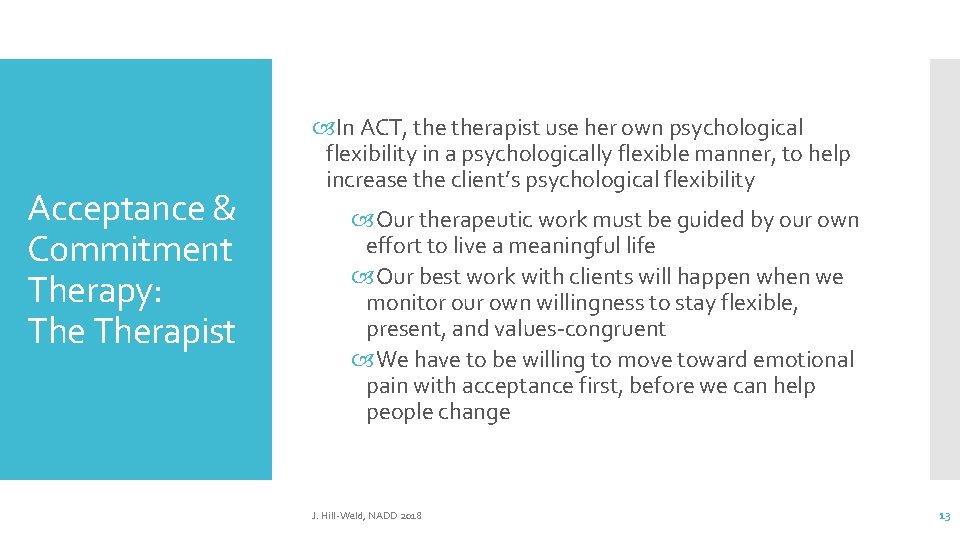
Acceptance & Commitment Therapy: Therapist In ACT, therapist use her own psychological flexibility in a psychologically flexible manner, to help increase the client’s psychological flexibility Our therapeutic work must be guided by our own effort to live a meaningful life Our best work with clients will happen when we monitor our own willingness to stay flexible, present, and values-congruent We have to be willing to move toward emotional pain with acceptance first, before we can help people change J. Hill-Weld, NADD 2018 13
Judith Hill-Weld, M. S. Licensed Marriage & Family Therapist Contact Information PO Box 1891 Nevada City, CA 95959 530 -265 -9450 judithhw@gv. net J. Hill-Weld, NADD 2018 14