
Acceptance and Diffusion of Hybrid Corn Seed in
Acceptance and Diffusion of Hybrid Corn Seed in Two Iowa Communities BRYCE RYAN AND NEAL C. GROSS (1943)
Introduction Bryce Ryan and Neal C. Gross (1943) investigated the diffusion of hybrid seed corn among Iowa farmers. This research constituted an analysis of the conditions and processes under which an important technical innovation, hybrid corn, was adopted in two prosperous agricultural communities in Iowa. The development and diffusion of hybrid corn is already an impressive in the history of scientific agriculture. Emerging from the experimental stages about 1927, this new seed was in practically universal use among Iowa farmers a little over 10 years later. Compared with many other scientifically approved practices its acceptance has been extremely rapid and complete.
An attempt is made to describe the cultural conditions under which this new technique rose to phenomenal success, and to ascertain, if possible, conditions under which farm operators in two Corn Belt communities in central Iowa accepted readily or resisted the innovation. Hybrid corn Prior to the development of hybrid corn seed, corn in Iowa was open pollinated. This means that pollination occurred in a random manner, making it impossible to identify the male parent plant.
OBJECTIVES OF THE STUDY To determine the time sequence hybrid seed diffusion in the two communities To determine the patterns of acceptance of individual farmers To determine the functions and importance of its diffusion agencies or media by which the seed spread To determine whether rapidity of acceptance was related to certain personal, economic and social characteristics of the operators
HYPOTHESES OF THE STUDY 1. That the temporal diffusion pattern of the adoption of hybrid seed was characterized by three distinctive sequential periods namely, slow initial growth, followed by a rapid rise in the rate of adoption and a final short period of decline 2. That farm operators in general did not accept technological innovations immediately, but rather delayed acceptance for a considerable 'time after initial contact with the innovation 3. That earlier adopters, however, waited a shorter period after initial contact with the innovation before acceptance than later adopters
4. That earlier adopters performed a special function for the community in their roles as "experimenters" in technological innovation 5. That diffusion agencies varied in importance over different periods of the diffusion process 6. That diffusion agencies had different functions in the diffusion process 7. That rapidity of adoption of the innovation was related to certain personal, economic and social participation characteristics of the farm operator 8. That "leadership" in the adoption of farm practices was not related to other leadership roles in the community-in short, that leadership was situational.

THE DATA FOR THE STUDY This study rests largely upon the results of a field inquiry made in the summer of 1941 An extensive schedule of questions was used to obtain the required data from practically every farm operator in two central Iowa communities. Schedules were analyzed for 331 Farms operators. secondary materials such as census materials and township assessor records have been used in order to understand the environment within which this local diffusion took place.

Findings of the study 1. During practically one decade hybrid corn came to be accepted by all farm operators in the areas studied. The diffusion pattern was made up of three periods: a long period of slow initial growth, rapid rise in adoption and a brief decline as the most resistant adopters accepted the technique. Hybrid corn was most rapidly adopted by operators in the eastern area of the state, and most tardily by those in the southern and western portions, of the state. The communities under observation, located in the central cash grain area, were somewhat ahead of the state as a whole, and were highly representative of the area of which they are a part.
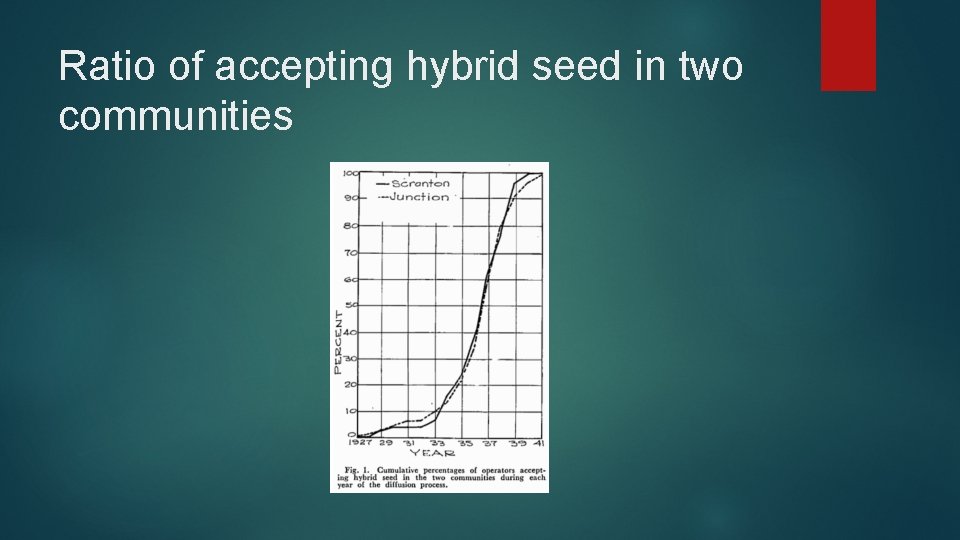
Ratio of accepting hybrid seed in two communities
2. THE DIFFUSION PROCESS One of the major objectives of this research was to study the diffusion process of hybrid corn in the communities. Attention was directed not only to the time pattern of adoption for the farm operators individually and collectively but also to the spread of knowledge about hybrid corn. In addition, the important diffusion media were systematically studied. This section is concerned with four major problems. These are: The time pattern of the spread of knowledge about hybrid corn as well as the time pattern of adoption of the innovation; The interrelationships between these two sequential sets of data; The adoption pattern of farm operators who had only recently begun to farm in the two communities; The functional importance and the relative significance of the various diffusion mechanisms.

Eight observations may be made regarding the process of hybrid corn diffusion (1) The majority of farmers first became informed of the seed within a very short time span. (2) Following a long period of growth, the use of hybrid corn swelled rapidly, and hybrid practically swept the area in the space of 4 years. (3) Lags between knowledge of the seed and its adoption were greater for those who resisted adoption longer.
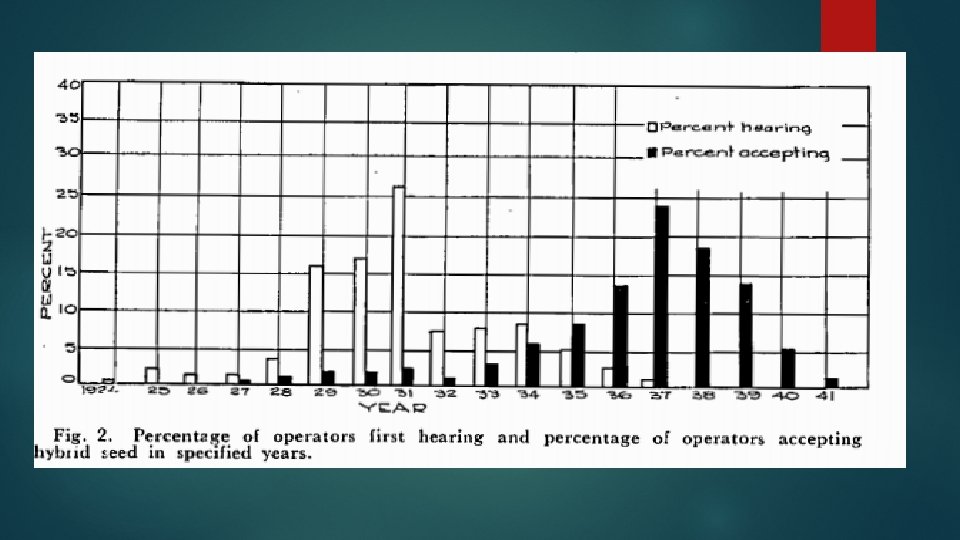
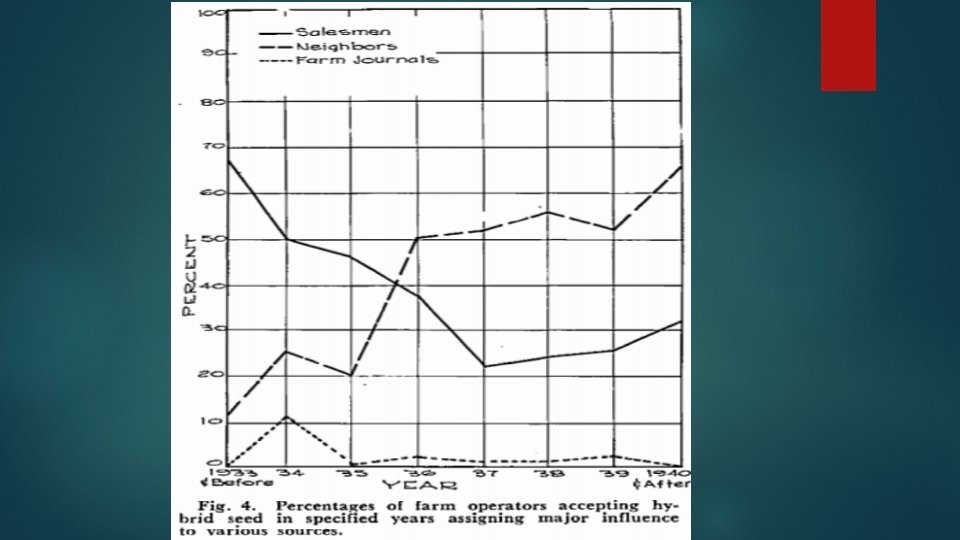
The early acceptors provided a community laboratory in which their neighbors gained experience concerning hybrid corn. The principal immediate sources of first knowledge were salesmen and neighbors. Salesmen were important during those years in which the majority of farmers were learning of the new seed, whereas the later acceptors relied mainly upon neighbors as a source.

Sources influencing operators to ward adoption were believed by them to be more personal than the sources of information; neighbors were most influential, while sales· men were most widely informative. The diffusion agencies may, therefore, be classified into two functional types, introductory and activating.
THE RELATIONSHIP' OF CERTAIN VARIABLES TO TIME OF ADOPTION The search for the answer to the question of why some farmers adopted hybrid seed very early in the diffusion process and others very late permitted no simple or direct approach A direct questioning approach to the farmers themselves led as one might expect, to largely tautological replies. Analysis of their responses simply reveals that early adopters were "less conservative, " "more open minded" and "less bound by traditional patterns. " These data may be broadly classified into three types:
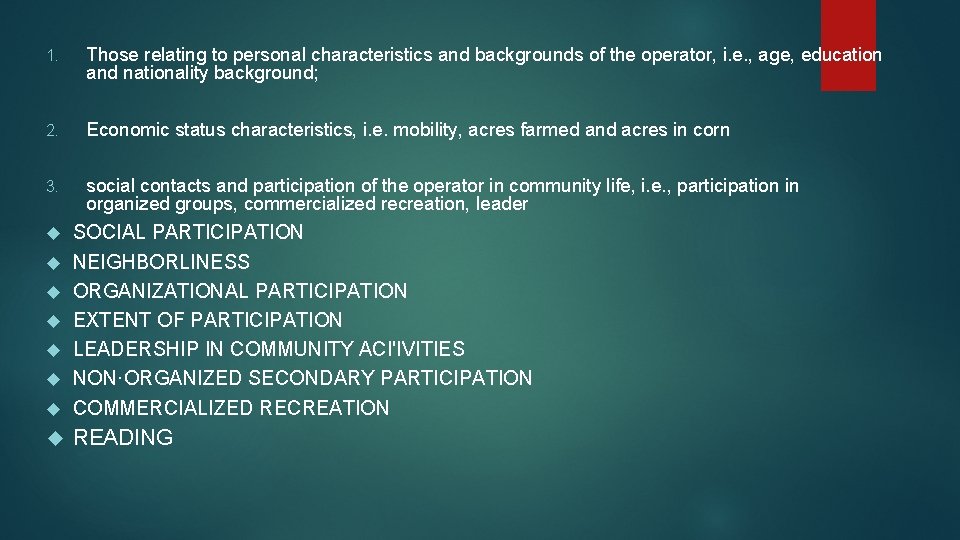
1. Those relating to personal characteristics and backgrounds of the operator, i. e. , age, education and nationality background; 2. Economic status characteristics, i. e. mobility, acres farmed and acres in corn 3. social contacts and participation of the operator in community life, i. e. , participation in organized groups, commercialized recreation, leader SOCIAL PARTICIPATION NEIGHBORLINESS ORGANIZATIONAL PARTICIPATION EXTENT OF PARTICIPATION LEADERSHIP IN COMMUNITY ACI'IVITIES NON·ORGANIZED SECONDARY PARTICIPATION COMMERCIALIZED RECREATION READING
Conclusion As noted above, the hybrid seed corn had many advantages compared to traditional seed, such as the hybrid seed's vigor and resistance to drought and disease. However, there were some barriers to prevent Iowa farmers from adopting the hybrid seed corn. Ryan and Gross sought to explain how the hybrid seed corn came to attention and which of two channels (i. e. , mass communication and interpersonal communication with peers) led farmers to adopt the new innovation. They found that each channel has different functions. Mass communication functioned as the source of initial information, while interpersonal networks functioned as the influence over the farmers’ decisions to adopt
One of the most important findings in this study is that the adoption of innovation depends on some combination of well-established interpersonal ties and habitual exposure to mass communication. Ryan and Gross also found that the rate of adoption of hybrid seed corn followed an S-shaped curve, and that there were four different types of adopters Study made a contribution by identifying the five major stages in the adoption process, which were awareness, interest, evaluation, trial, and adoption.
- Slides: 20