
Accelerometer Measurements of a Disc in Flight Peter
- Slides: 1
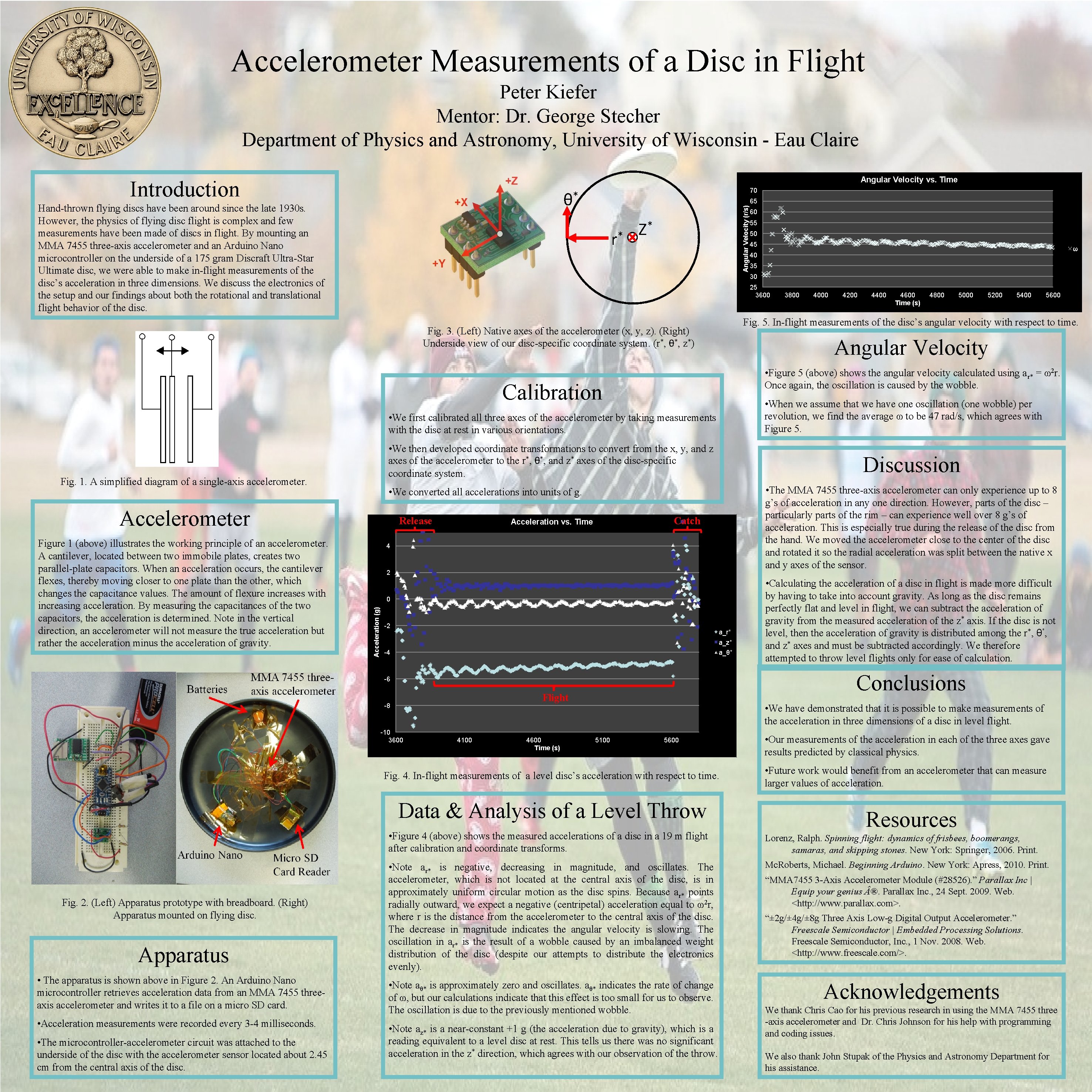
Accelerometer Measurements of a Disc in Flight Peter Kiefer Mentor: Dr. George Stecher Department of Physics and Astronomy, University of Wisconsin - Eau Claire Angular Velocity vs. Time Introduction 70 θ* * r Angular Velocity (r/s) Hand-thrown flying discs have been around since the late 1930 s. However, the physics of flying disc flight is complex and few measurements have been made of discs in flight. By mounting an MMA 7455 three-axis accelerometer and an Arduino Nano microcontroller on the underside of a 175 gram Discraft Ultra-Star Ultimate disc, we were able to make in-flight measurements of the disc’s acceleration in three dimensions. We discuss the electronics of the setup and our findings about both the rotational and translational flight behavior of the disc. 65 Z* 55 50 45 ω 40 35 30 25 3600 Catch 2 Acceleration (g) 0 -2 a_r* a_z* -4 a_θ* Flight 4100 4600 Time (s) 5000 5200 5400 5600 • Calculating the acceleration of a disc in flight is made more difficult by having to take into account gravity. As long as the disc remains perfectly flat and level in flight, we can subtract the acceleration of gravity from the measured acceleration of the z* axis. If the disc is not level, then the acceleration of gravity is distributed among the r*, θ*, and z* axes and must be subtracted accordingly. We therefore attempted to throw level flights only for ease of calculation. Conclusions -6 -10 3600 4800 • The MMA 7455 three-axis accelerometer can only experience up to 8 g’s of acceleration in any one direction. However, parts of the disc – particularly parts of the rim – can experience well over 8 g’s of acceleration. This is especially true during the release of the disc from the hand. We moved the accelerometer close to the center of the disc and rotated it so the radial acceleration was split between the native x and y axes of the sensor. 4 -8 4600 Time (s) Discussion • We converted all accelerations into units of g. Acceleration vs. Time 4400 • When we assume that we have one oscillation (one wobble) per revolution, we find the average ω to be 47 rad/s, which agrees with Figure 5. • We then developed coordinate transformations to convert from the x, y, and z axes of the accelerometer to the r*, θ*, and z* axes of the disc-specific coordinate system. Release 4200 • Figure 5 (above) shows the angular velocity calculated using ar* = ω2 r. Once again, the oscillation is caused by the wobble. • We first calibrated all three axes of the accelerometer by taking measurements with the disc at rest in various orientations. Accelerometer 4000 Angular Velocity Calibration Fig. 1. A simplified diagram of a single-axis accelerometer. 3800 Fig. 5. In-flight measurements of the disc’s angular velocity with respect to time. Fig. 3. (Left) Native axes of the accelerometer (x, y, z). (Right) Underside view of our disc-specific coordinate system. (r*, θ*, z*) Figure 1 (above) illustrates the working principle of an accelerometer. A cantilever, located between two immobile plates, creates two parallel-plate capacitors. When an acceleration occurs, the cantilever flexes, thereby moving closer to one plate than the other, which changes the capacitance values. The amount of flexure increases with increasing acceleration. By measuring the capacitances of the two capacitors, the acceleration is determined. Note in the vertical direction, an accelerometer will not measure the true acceleration but rather the acceleration minus the acceleration of gravity. 60 • We have demonstrated that it is possible to make measurements of the acceleration in three dimensions of a disc in level flight. 5100 5600 Fig. 4. In-flight measurements of a level disc’s acceleration with respect to time. Data & Analysis of a Level Throw • Our measurements of the acceleration in each of the three axes gave results predicted by classical physics. • Future work would benefit from an accelerometer that can measure larger values of acceleration. Resources • Figure 4 (above) shows the measured accelerations of a disc in a 19 m flight after calibration and coordinate transforms. Lorenz, Ralph. Spinning flight: dynamics of frisbees, boomerangs, samaras, and skipping stones. New York: Springer, 2006. Print. Mc. Roberts, Michael. Beginning Arduino. New York: Apress, 2010. Print. Apparatus • Note ar* is negative, decreasing in magnitude, and oscillates. The accelerometer, which is not located at the central axis of the disc, is in approximately uniform circular motion as the disc spins. Because ar* points radially outward, we expect a negative (centripetal) acceleration equal to ω2 r, where r is the distance from the accelerometer to the central axis of the disc. The decrease in magnitude indicates the angular velocity is slowing. The oscillation in ar* is the result of a wobble caused by an imbalanced weight distribution of the disc (despite our attempts to distribute the electronics evenly). • The apparatus is shown above in Figure 2. An Arduino Nano microcontroller retrieves acceleration data from an MMA 7455 threeaxis accelerometer and writes it to a file on a micro SD card. • Note aθ* is approximately zero and oscillates. aθ* indicates the rate of change of ω, but our calculations indicate that this effect is too small for us to observe. The oscillation is due to the previously mentioned wobble. • Acceleration measurements were recorded every 3 -4 milliseconds. • Note az* is a near-constant +1 g (the acceleration due to gravity), which is a reading equivalent to a level disc at rest. This tells us there was no significant acceleration in the z* direction, which agrees with our observation of the throw. Fig. 2. (Left) Apparatus prototype with breadboard. (Right) Apparatus mounted on flying disc. • The microcontroller-accelerometer circuit was attached to the underside of the disc with the accelerometer sensor located about 2. 45 cm from the central axis of the disc. “MMA 7455 3 -Axis Accelerometer Module (#28526). ” Parallax Inc | Equip your genius ®. Parallax Inc. , 24 Sept. 2009. Web. <http: //www. parallax. com>. “± 2 g/± 4 g/± 8 g Three Axis Low-g Digital Output Accelerometer. ” Freescale Semiconductor | Embedded Processing Solutions. Freescale Semiconductor, Inc. , 1 Nov. 2008. Web. <http: //www. freescale. com/>. Acknowledgements We thank Chris Cao for his previous research in using the MMA 7455 three -axis accelerometer and Dr. Chris Johnson for his help with programming and coding issues. We also thank John Stupak of the Physics and Astronomy Department for his assistance.