
Accelerators We want to study submicroscopic structure of
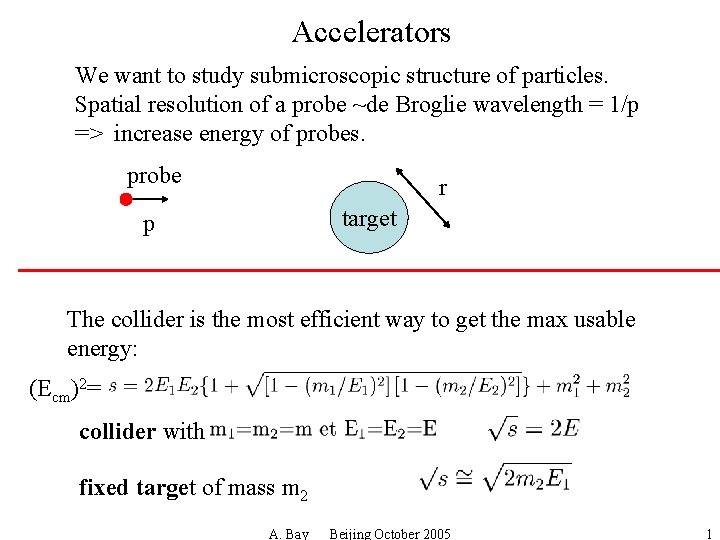
Accelerators We want to study submicroscopic structure of particles. Spatial resolution of a probe ~de Broglie wavelength = 1/p => increase energy of probes. probe r target p The collider is the most efficient way to get the max usable energy: (Ecm)2= collider with fixed target of mass m 2 A. Bay Beijing October 2005 1
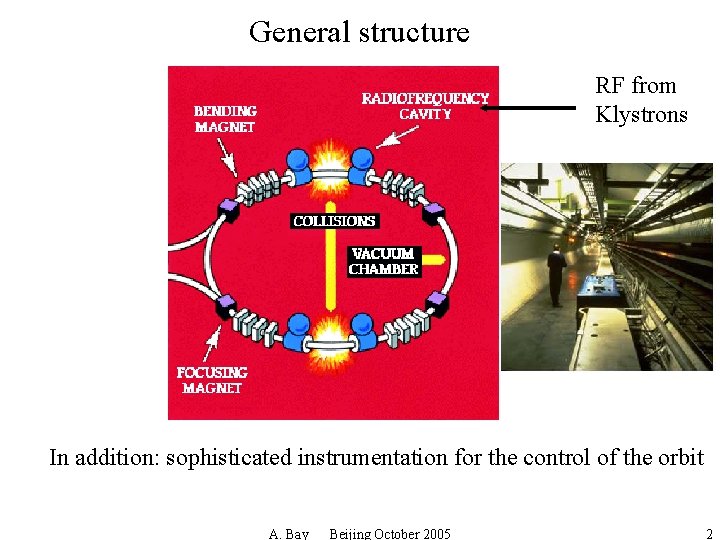
General structure RF from Klystrons In addition: sophisticated instrumentation for the control of the orbit A. Bay Beijing October 2005 2
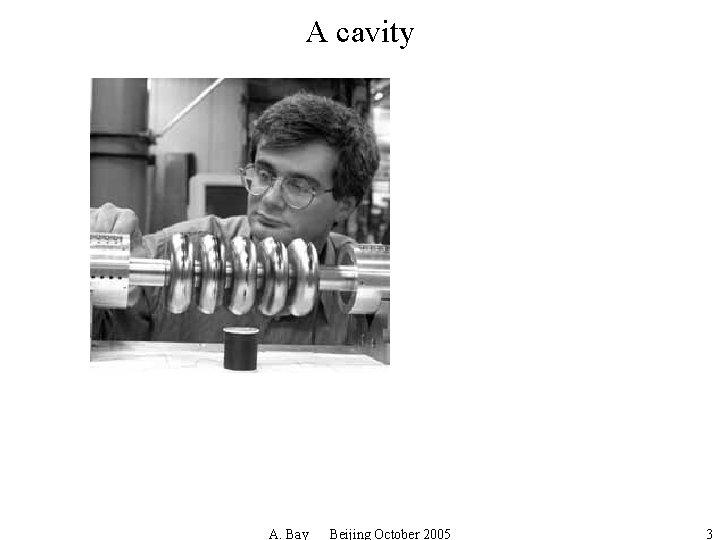
A cavity A. Bay Beijing October 2005 3
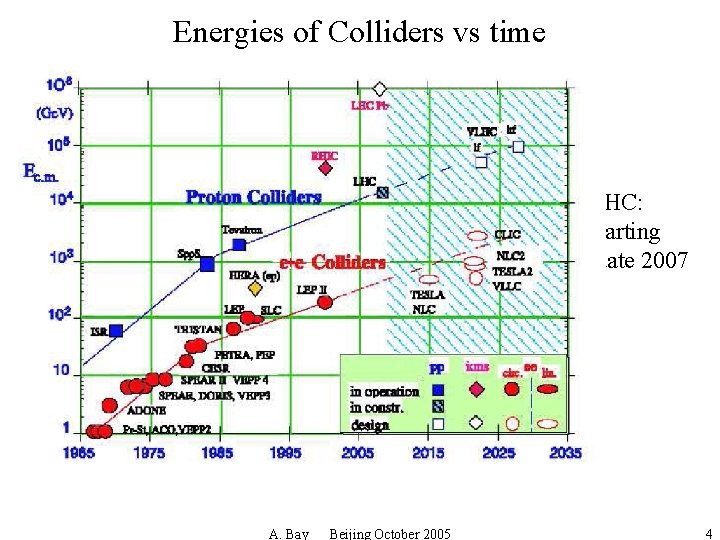
Energies of Colliders vs time LHC: starting date 2007 A. Bay Beijing October 2005 4
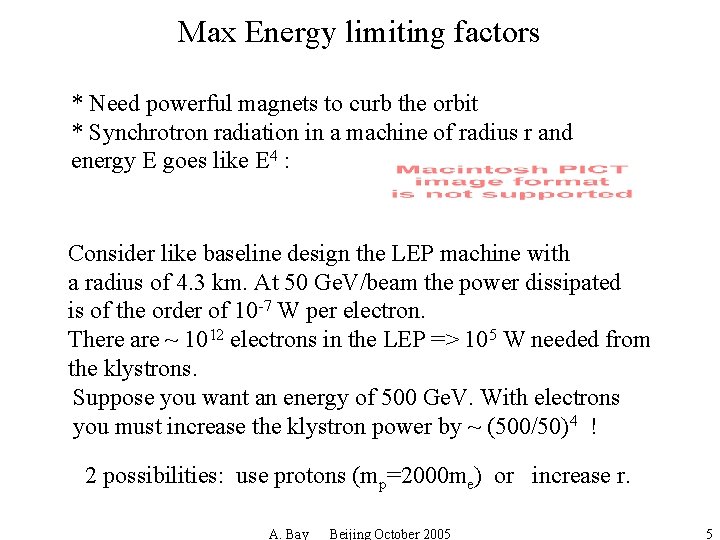
Max Energy limiting factors * Need powerful magnets to curb the orbit * Synchrotron radiation in a machine of radius r and energy E goes like E 4 : Consider like baseline design the LEP machine with a radius of 4. 3 km. At 50 Ge. V/beam the power dissipated is of the order of 10 -7 W per electron. There are ~ 1012 electrons in the LEP => 105 W needed from the klystrons. Suppose you want an energy of 500 Ge. V. With electrons you must increase the klystron power by ~ (500/50)4 ! 2 possibilities: use protons (mp=2000 me) or increase r. A. Bay Beijing October 2005 5
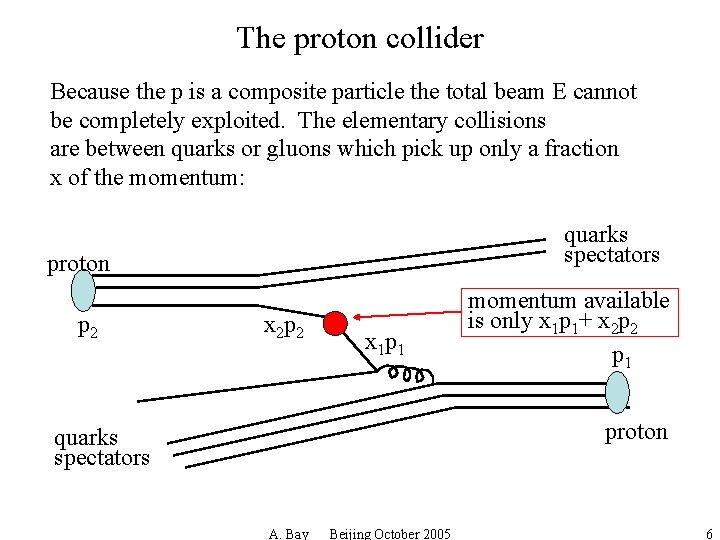
The proton collider Because the p is a composite particle the total beam E cannot be completely exploited. The elementary collisions are between quarks or gluons which pick up only a fraction x of the momentum: quarks spectators proton p 2 x 2 p 2 x 1 p 1 momentum available is only x 1 p 1+ x 2 p 2 p 1 proton quarks spectators A. Bay Beijing October 2005 6
![Luminosity Interaction rate for a process of cross-section s rate [s-1] = s. L](http://slidetodoc.com/presentation_image_h2/6ba7e7ddbd2886b8e67d6fd61f592f20/image-7.jpg "Luminosity Interaction rate for a process of cross-section s rate [s-1] = s. L")
Luminosity Interaction rate for a process of cross-section s rate [s-1] = s. L The luminosity of a collider is proportional to the currents of the 2 beams I 1, I 2, and inversely proportional to their section A, ni are the number of particles per bunch, b the number of bunches, f the frequency of the orbit. For gaussian bunch profiles: A. Bay Beijing October 2005 sx sy 7
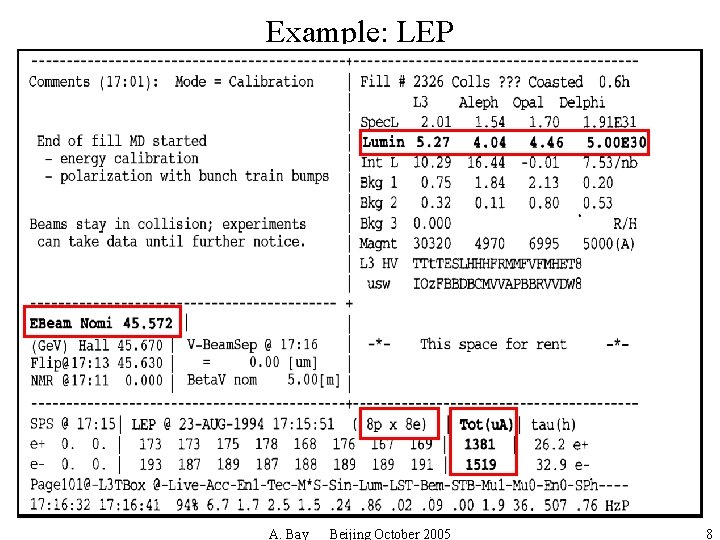
Example: LEP A. Bay Beijing October 2005 8
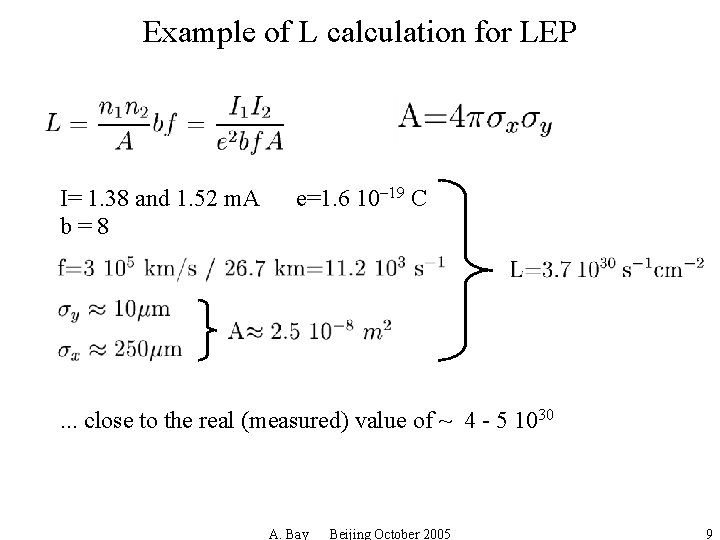
Example of L calculation for LEP I= 1. 38 and 1. 52 m. A b=8 e=1. 6 10 -19 C . . . close to the real (measured) value of ~ 4 - 5 1030 A. Bay Beijing October 2005 9
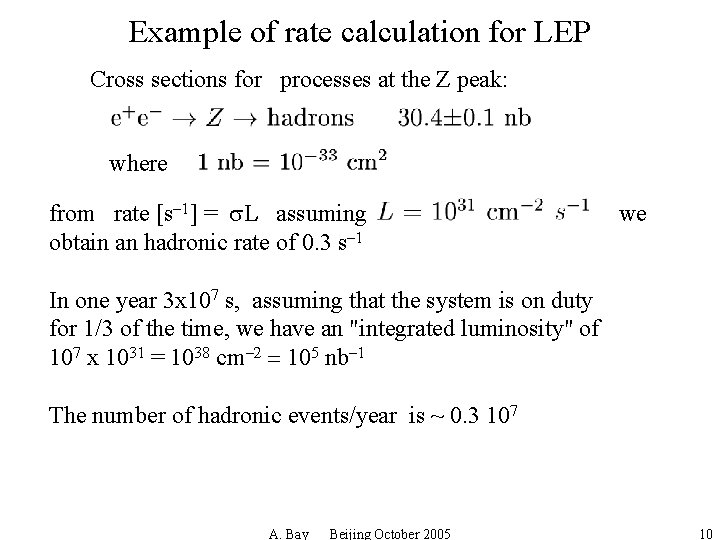
Example of rate calculation for LEP Cross sections for processes at the Z peak: where from rate [s-1] = s. L assuming obtain an hadronic rate of 0. 3 s-1 we In one year 3 x 10⁷ s, assuming that the system is on duty for 1/3 of the time, we have an "integrated luminosity" of 107 x 1031 = 1038 cm-2 = 105 nb-1 The number of hadronic events/year is ~ 0. 3 107 A. Bay Beijing October 2005 10
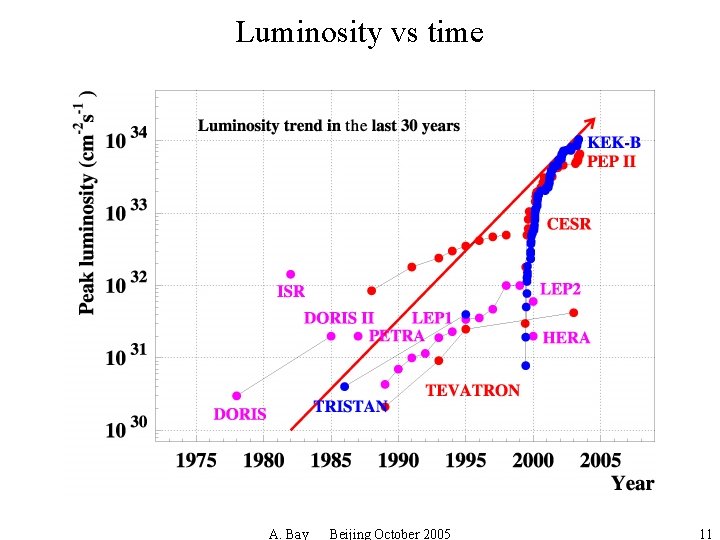
Luminosity vs time A. Bay Beijing October 2005 11
The Large Hadron Collider Build a 7 Ge. V/beam machine in the LEP tunnel. A. Bay Beijing October 2005 12
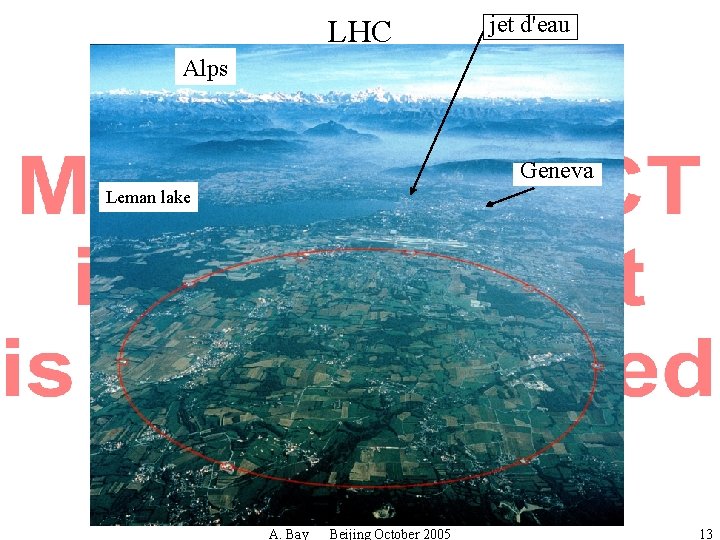
jet d'eau LHC Alps LHC Pb Pb Leman lake Geneva LHCb point 8 LHCb A. Bay Beijing October 2005 13
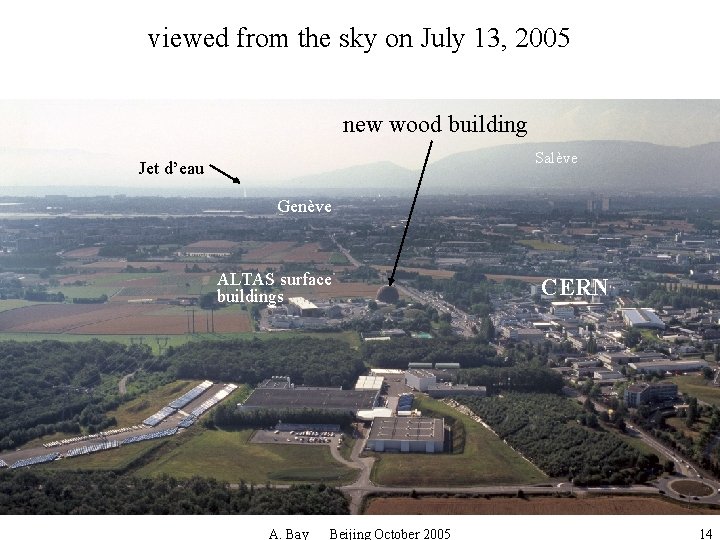
viewed from the sky on July 13, 2005 new wood building Salève Jet d’eau Genève ALTAS surface buildings A. Bay Beijing October 2005 CERN 14
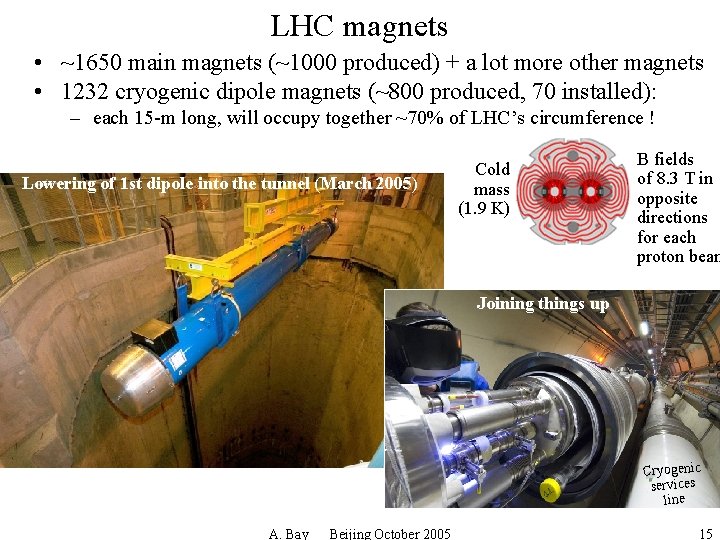
LHC magnets • ~1650 main magnets (~1000 produced) + a lot more other magnets • 1232 cryogenic dipole magnets (~800 produced, 70 installed): – each 15 -m long, will occupy together ~70% of LHC’s circumference ! Lowering of 1 st dipole into the tunnel (March 2005) Cold mass (1. 9 K) B fields of 8. 3 T in opposite directions for each proton beam Joining things up Cryogenic services line A. Bay Beijing October 2005 15
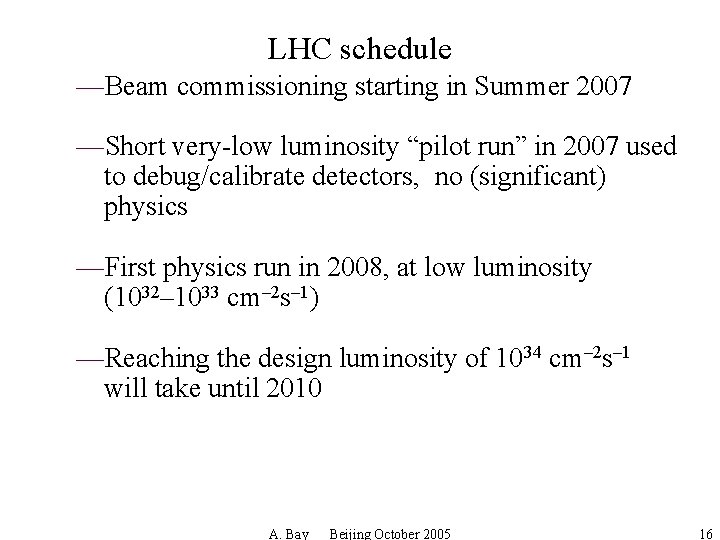
LHC schedule —Beam commissioning starting in Summer 2007 —Short very-low luminosity “pilot run” in 2007 used to debug/calibrate detectors, no (significant) physics —First physics run in 2008, at low luminosity (1032– 1033 cm– 2 s– 1) —Reaching the design luminosity of 1034 cm– 2 s– 1 will take until 2010 A. Bay Beijing October 2005 16
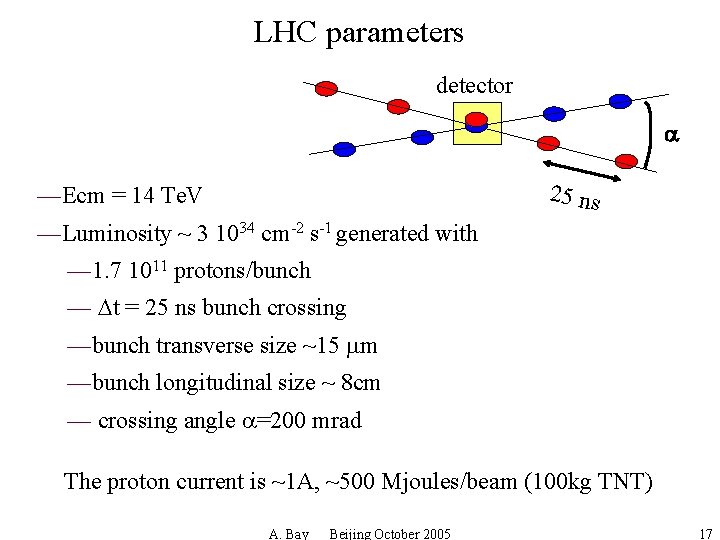
LHC parameters detector a 25 ns —Ecm = 14 Te. V —Luminosity ~ 3 1034 cm-2 s-1 generated with — 1. 7 1011 protons/bunch — Dt = 25 ns bunch crossing —bunch transverse size ~15 mm —bunch longitudinal size ~ 8 cm — crossing angle a=200 mrad The proton current is ~1 A, ~500 Mjoules/beam (100 kg TNT) A. Bay Beijing October 2005 17
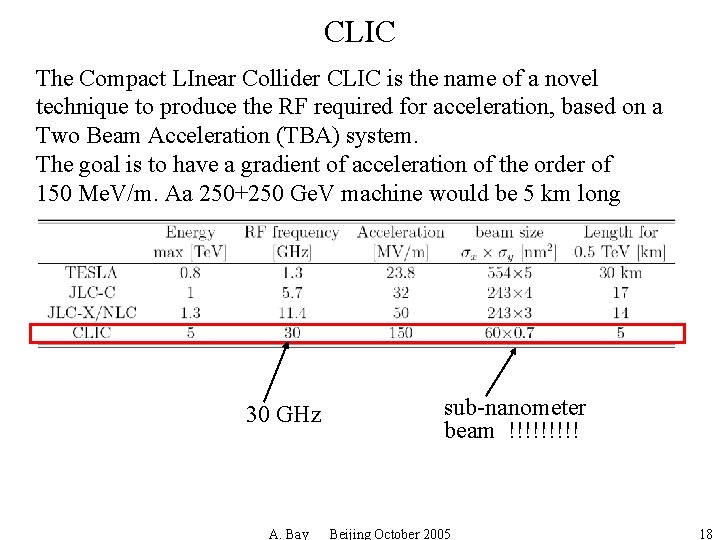
CLIC The Compact LInear Collider CLIC is the name of a novel technique to produce the RF required for acceleration, based on a Two Beam Acceleration (TBA) system. The goal is to have a gradient of acceleration of the order of 150 Me. V/m. Aa 250+250 Ge. V machine would be 5 km long 30 GHz A. Bay sub-nanometer beam !!!!! Beijing October 2005 18
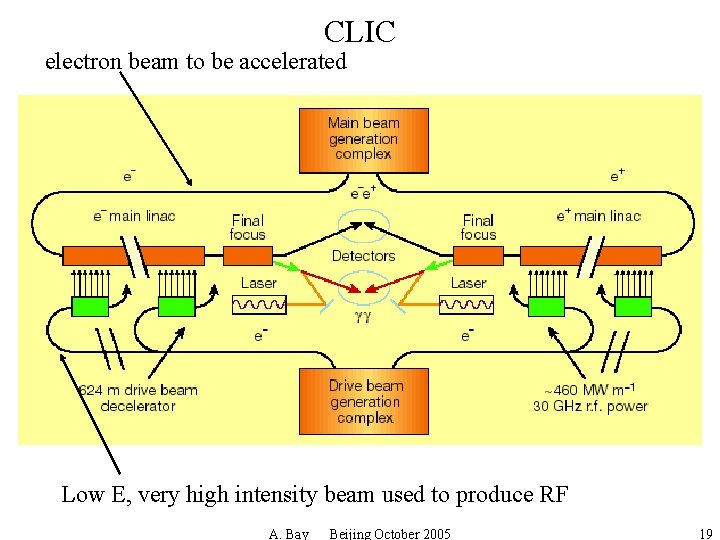
CLIC electron beam to be accelerated Low E, very high intensity beam used to produce RF A. Bay Beijing October 2005 19
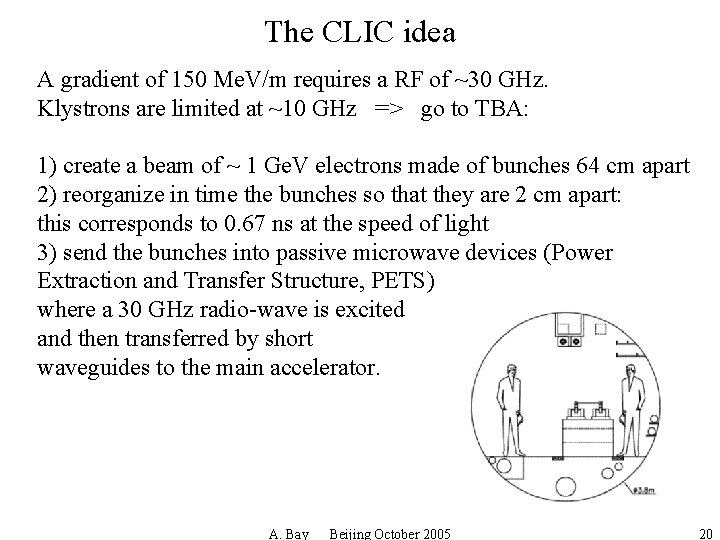
The CLIC idea A gradient of 150 Me. V/m requires a RF of ~30 GHz. Klystrons are limited at ~10 GHz => go to TBA: 1) create a beam of ~ 1 Ge. V electrons made of bunches 64 cm apart 2) reorganize in time the bunches so that they are 2 cm apart: this corresponds to 0. 67 ns at the speed of light 3) send the bunches into passive microwave devices (Power Extraction and Transfer Structure, PETS) where a 30 GHz radio-wave is excited and then transferred by short waveguides to the main accelerator. A. Bay Beijing October 2005 20
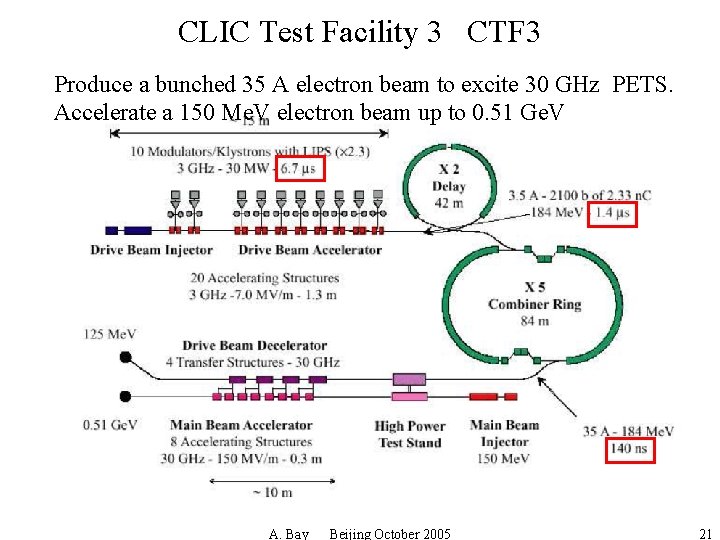
CLIC Test Facility 3 CTF 3 Produce a bunched 35 A electron beam to excite 30 GHz PETS. Accelerate a 150 Me. V electron beam up to 0. 51 Ge. V A. Bay Beijing October 2005 21
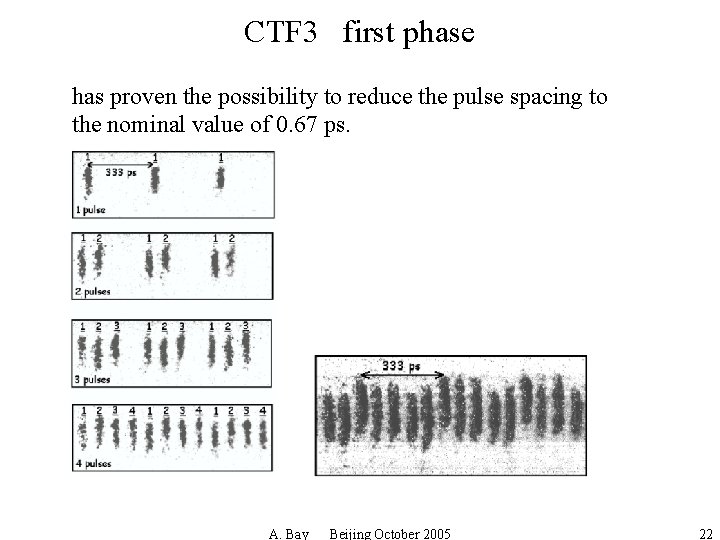
CTF 3 first phase has proven the possibility to reduce the pulse spacing to the nominal value of 0. 67 ps. A. Bay Beijing October 2005 22
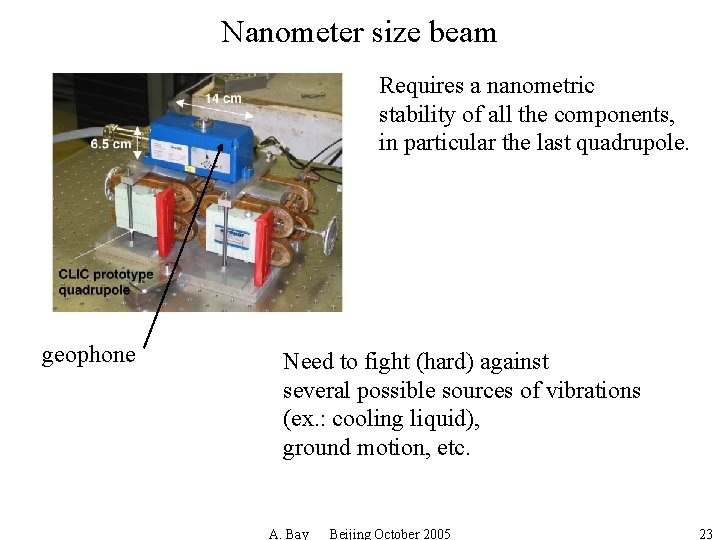
Nanometer size beam Requires a nanometric stability of all the components, in particular the last quadrupole. geophone Need to fight (hard) against several possible sources of vibrations (ex. : cooling liquid), ground motion, etc. A. Bay Beijing October 2005 23
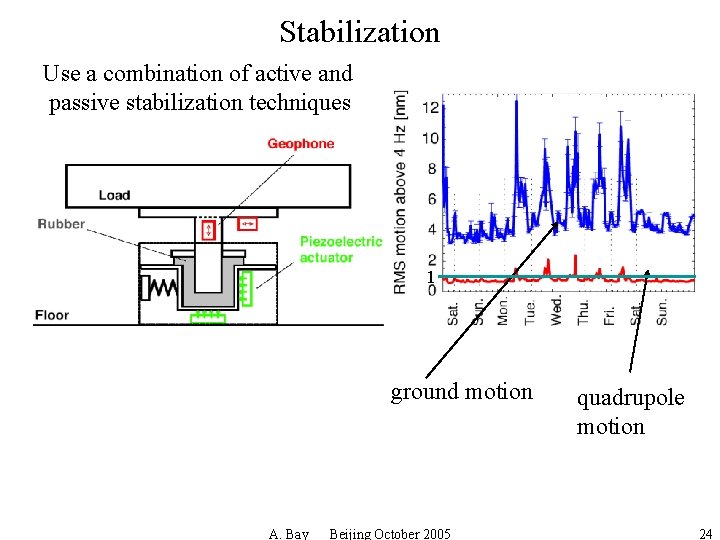
Stabilization Use a combination of active and passive stabilization techniques 1 ground motion A. Bay Beijing October 2005 quadrupole motion 24
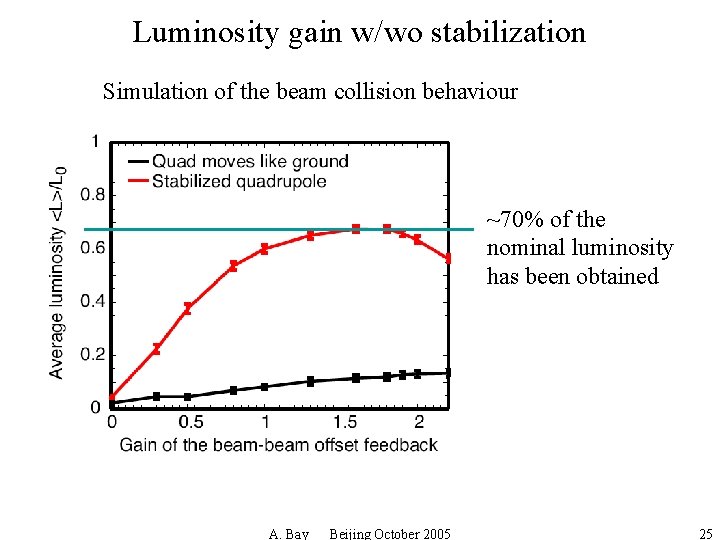
Luminosity gain w/wo stabilization Simulation of the beam collision behaviour ~70% of the nominal luminosity has been obtained A. Bay Beijing October 2005 25
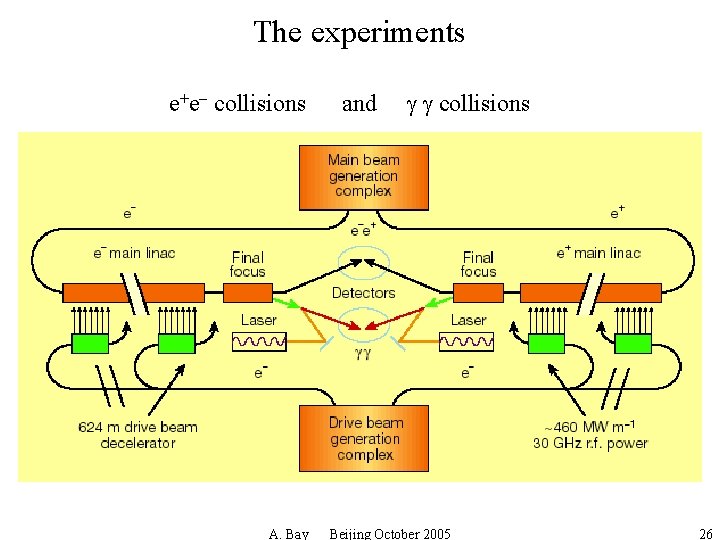
The experiments e+e- collisions A. Bay and g g collisions Beijing October 2005 26
- Slides: 26