
ACCELERATORS B Eric Prebys UC Davis HCPSS Fermilab
ACCELERATORS B Eric Prebys, UC Davis
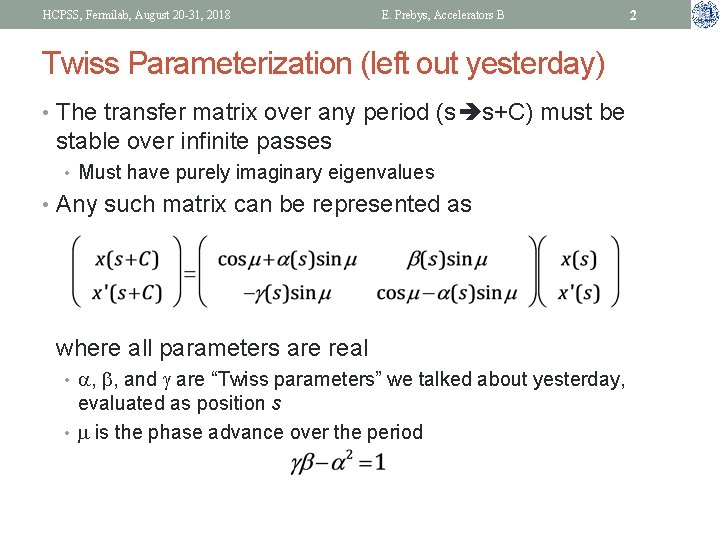
HCPSS, Fermilab, August 20 -31, 2018 E. Prebys, Accelerators B Twiss Parameterization (left out yesterday) • The transfer matrix over any period (s s+C) must be stable over infinite passes • Must have purely imaginary eigenvalues • Any such matrix can be represented as where all parameters are real • a, b, and g are “Twiss parameters” we talked about yesterday, evaluated as position s • m is the phase advance over the period 2
HCPSS, Fermilab, August 20 -31, 2018 E. Prebys, Accelerators B 3 Further Reading • You can check out the material from the USPAS course “Accelerator Physics Fundamentals” from June, 2018 at • http: //home. fnal. gov/~prebys/misc/uspas_2018/ • In particular, see “Tricks of the Trade”, wich has a lot of miscellaneous info about accelerators
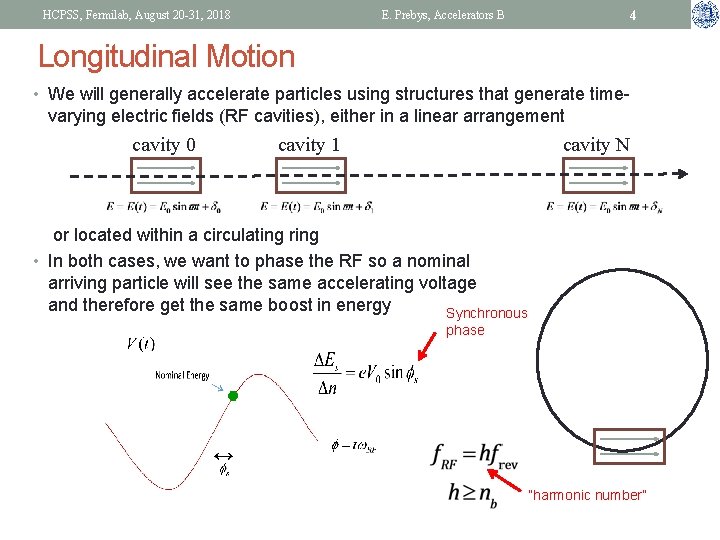
HCPSS, Fermilab, August 20 -31, 2018 4 E. Prebys, Accelerators B Longitudinal Motion • We will generally accelerate particles using structures that generate time- varying electric fields (RF cavities), either in a linear arrangement cavity 0 cavity 1 cavity N or located within a circulating ring • In both cases, we want to phase the RF so a nominal arriving particle will see the same accelerating voltage and therefore get the same boost in energy Synchronous phase “harmonic number”
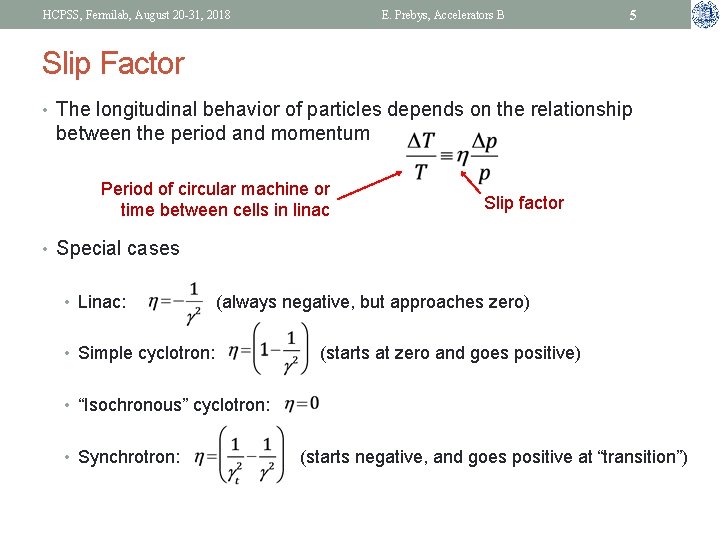
HCPSS, Fermilab, August 20 -31, 2018 E. Prebys, Accelerators B 5 Slip Factor • The longitudinal behavior of particles depends on the relationship between the period and momentum Period of circular machine or time between cells in linac Slip factor • Special cases • Linac: (always negative, but approaches zero) • Simple cyclotron: (starts at zero and goes positive) • “Isochronous” cyclotron: • Synchrotron: (starts negative, and goes positive at “transition”)
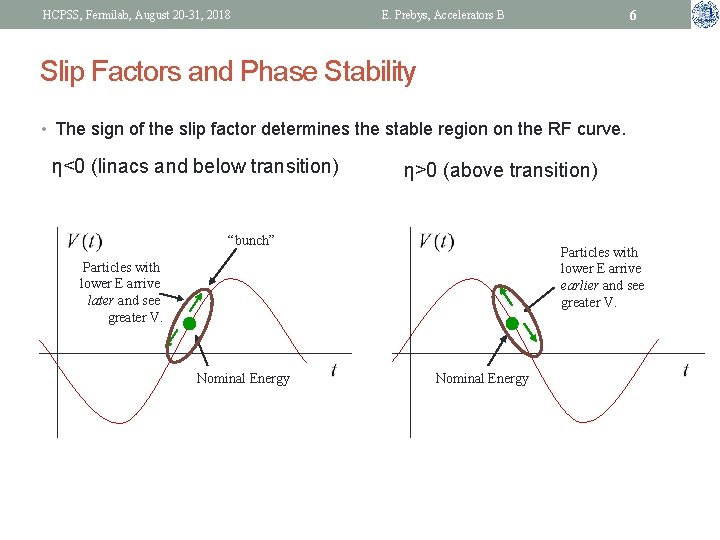
HCPSS, Fermilab, August 20 -31, 2018 6 E. Prebys, Accelerators B Slip Factors and Phase Stability • The sign of the slip factor determines the stable region on the RF curve. η<0 (linacs and below transition) η>0 (above transition) “bunch” Particles with lower E arrive earlier and see greater V. Particles with lower E arrive later and see greater V. Nominal Energy
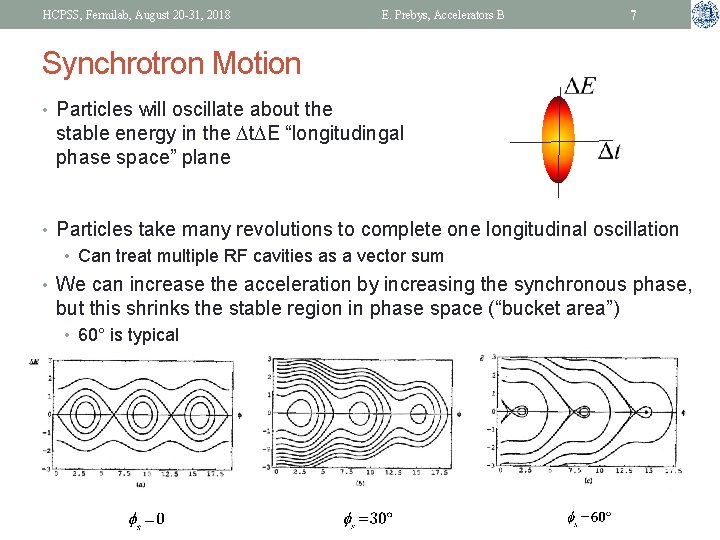
HCPSS, Fermilab, August 20 -31, 2018 E. Prebys, Accelerators B 7 Synchrotron Motion • Particles will oscillate about the stable energy in the Dt. DE “longitudingal phase space” plane • Particles take many revolutions to complete one longitudinal oscillation • Can treat multiple RF cavities as a vector sum • We can increase the acceleration by increasing the synchronous phase, but this shrinks the stable region in phase space (“bucket area”) • 60° is typical
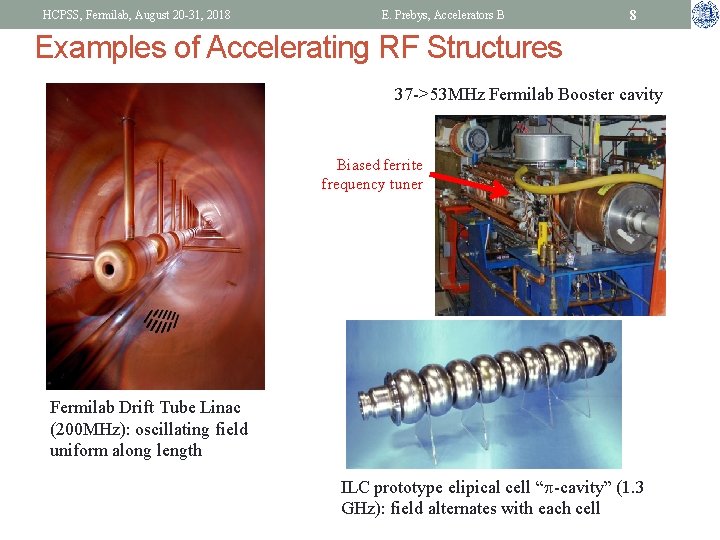
HCPSS, Fermilab, August 20 -31, 2018 E. Prebys, Accelerators B 8 Examples of Accelerating RF Structures 37 ->53 MHz Fermilab Booster cavity Biased ferrite frequency tuner Fermilab Drift Tube Linac (200 MHz): oscillating field uniform along length ILC prototype elipical cell “p-cavity” (1. 3 GHz): field alternates with each cell
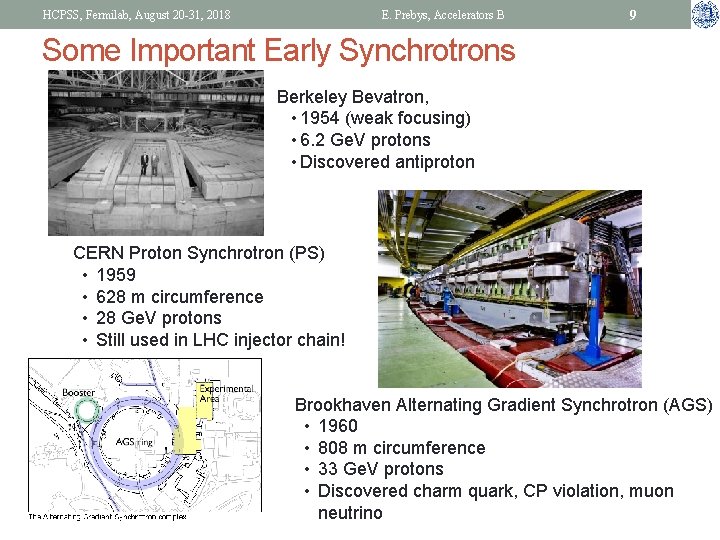
HCPSS, Fermilab, August 20 -31, 2018 E. Prebys, Accelerators B 9 Some Important Early Synchrotrons Berkeley Bevatron, • 1954 (weak focusing) • 6. 2 Ge. V protons • Discovered antiproton CERN Proton Synchrotron (PS) • 1959 • 628 m circumference • 28 Ge. V protons • Still used in LHC injector chain! Brookhaven Alternating Gradient Synchrotron (AGS) • 1960 • 808 m circumference • 33 Ge. V protons • Discovered charm quark, CP violation, muon neutrino
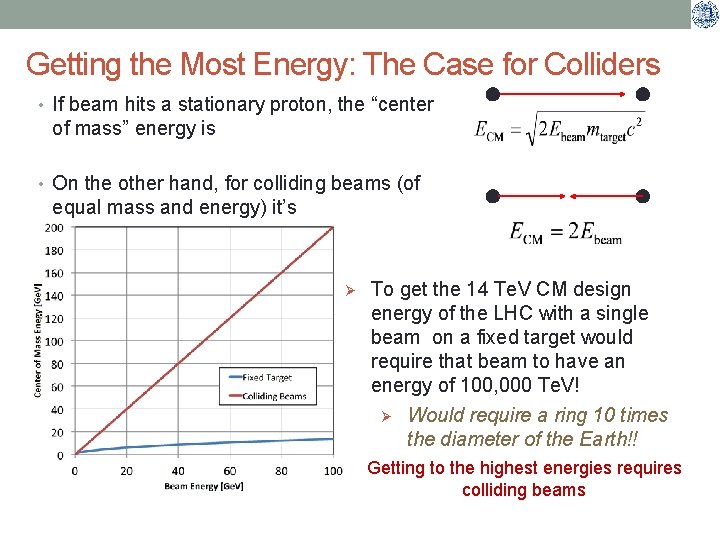
Getting the Most Energy: The Case for Colliders • If beam hits a stationary proton, the “center of mass” energy is • On the other hand, for colliding beams (of equal mass and energy) it’s Ø To get the 14 Te. V CM design energy of the LHC with a single beam on a fixed target would require that beam to have an energy of 100, 000 Te. V! Ø Would require a ring 10 times the diameter of the Earth!! Getting to the highest energies requires colliding beams E. Prebys, Accelerators B 10 20 -31, 2018 HCPSS, Fermilab, August
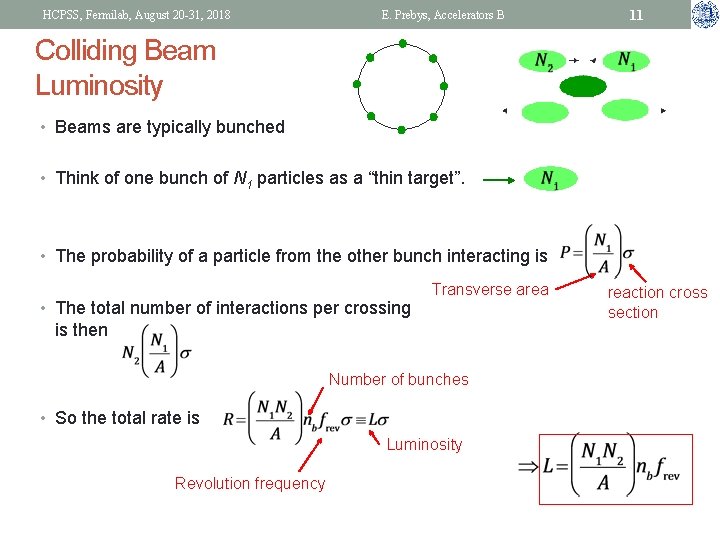
HCPSS, Fermilab, August 20 -31, 2018 E. Prebys, Accelerators B 11 Colliding Beam Luminosity • Beams are typically bunched • Think of one bunch of N 1 particles as a “thin target”. • The probability of a particle from the other bunch interacting is • The total number of interactions per crossing Transverse area is then Number of bunches • So the total rate is Luminosity Revolution frequency reaction cross section
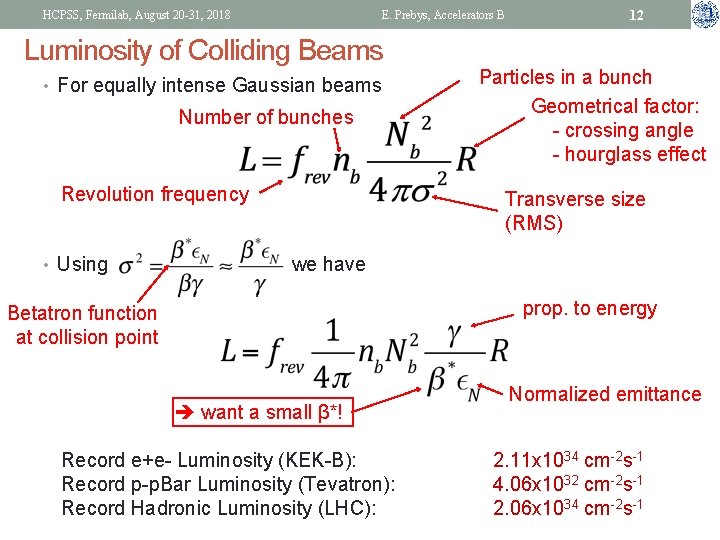
HCPSS, Fermilab, August 20 -31, 2018 E. Prebys, Accelerators B Luminosity of Colliding Beams • For equally intense Gaussian beams Number of bunches Revolution frequency • Using 12 Particles in a bunch Geometrical factor: - crossing angle - hourglass effect Transverse size (RMS) we have prop. to energy Betatron function at collision point want a small β*! Record e+e- Luminosity (KEK-B): Record p-p. Bar Luminosity (Tevatron): Record Hadronic Luminosity (LHC): Normalized emittance 2. 11 x 1034 cm-2 s-1 4. 06 x 1032 cm-2 s-1 2. 06 x 1034 cm-2 s-1
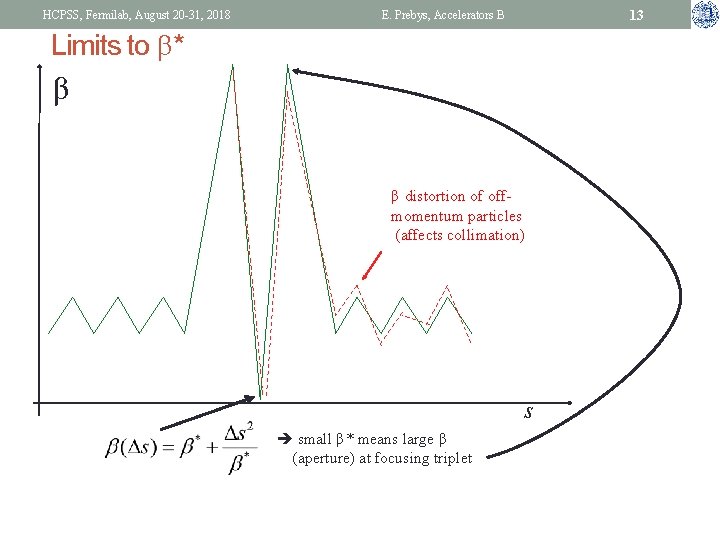
HCPSS, Fermilab, August 20 -31, 2018 13 E. Prebys, Accelerators B Limits to β* β β distortion of offmomentum particles (affects collimation) s small β* means large β (aperture) at focusing triplet
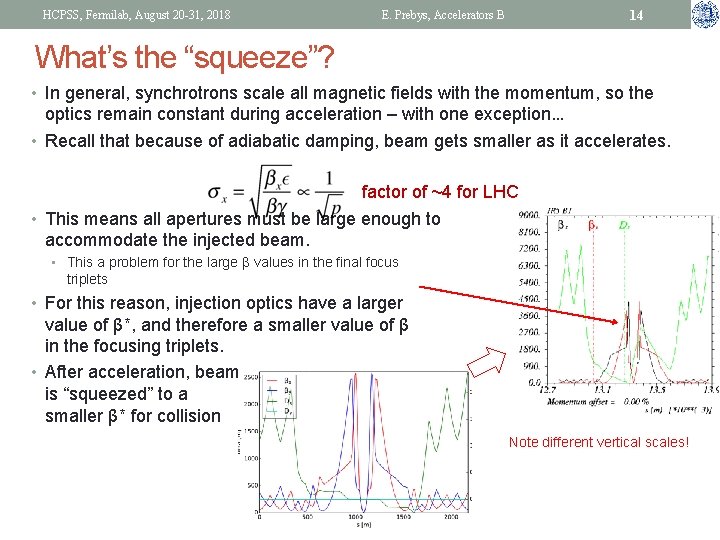
HCPSS, Fermilab, August 20 -31, 2018 14 E. Prebys, Accelerators B What’s the “squeeze”? • In general, synchrotrons scale all magnetic fields with the momentum, so the optics remain constant during acceleration – with one exception… • Recall that because of adiabatic damping, beam gets smaller as it accelerates. factor of ~4 for LHC • This means all apertures must be large enough to accommodate the injected beam. • This a problem for the large β values in the final focus triplets • For this reason, injection optics have a larger value of β*, and therefore a smaller value of β in the focusing triplets. • After acceleration, beam is “squeezed” to a smaller β* for collision Note different vertical scales!
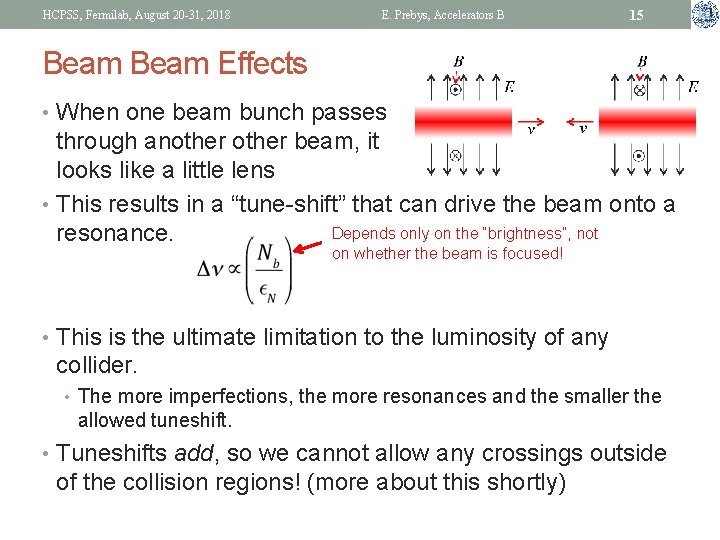
HCPSS, Fermilab, August 20 -31, 2018 E. Prebys, Accelerators B 15 Beam Effects • When one beam bunch passes through another beam, it looks like a little lens • This results in a “tune-shift” that can drive the beam onto a Depends only on the “brightness”, not resonance. on whether the beam is focused! • This is the ultimate limitation to the luminosity of any collider. • The more imperfections, the more resonances and the smaller the allowed tuneshift. • Tuneshifts add, so we cannot allow any crossings outside of the collision regions! (more about this shortly)
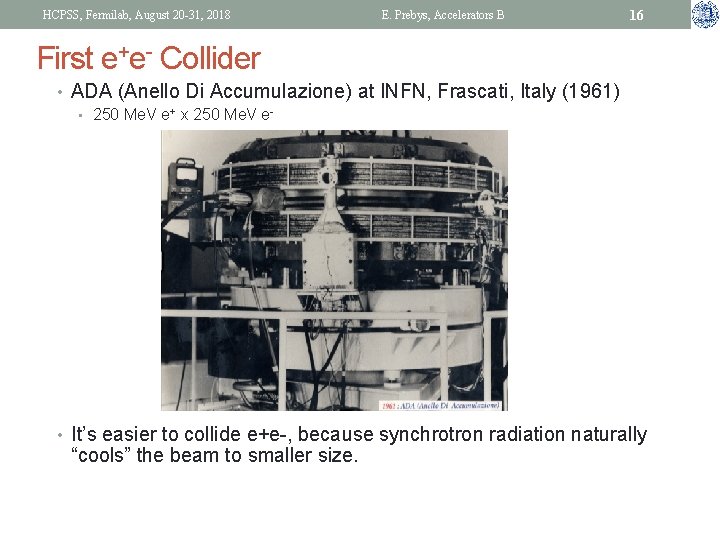
HCPSS, Fermilab, August 20 -31, 2018 E. Prebys, Accelerators B 16 First e+e- Collider • ADA (Anello Di Accumulazione) at INFN, Frascati, Italy (1961) • 250 Me. V e+ x 250 Me. V e- • It’s easier to collide e+e-, because synchrotron radiation naturally “cools” the beam to smaller size.
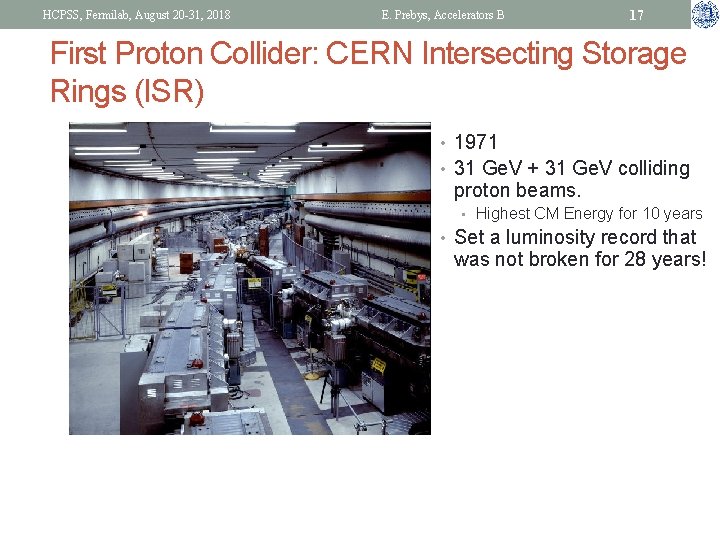
HCPSS, Fermilab, August 20 -31, 2018 E. Prebys, Accelerators B 17 First Proton Collider: CERN Intersecting Storage Rings (ISR) • 1971 • 31 Ge. V + 31 Ge. V colliding proton beams. • Highest CM Energy for 10 years • Set a luminosity record that was not broken for 28 years!
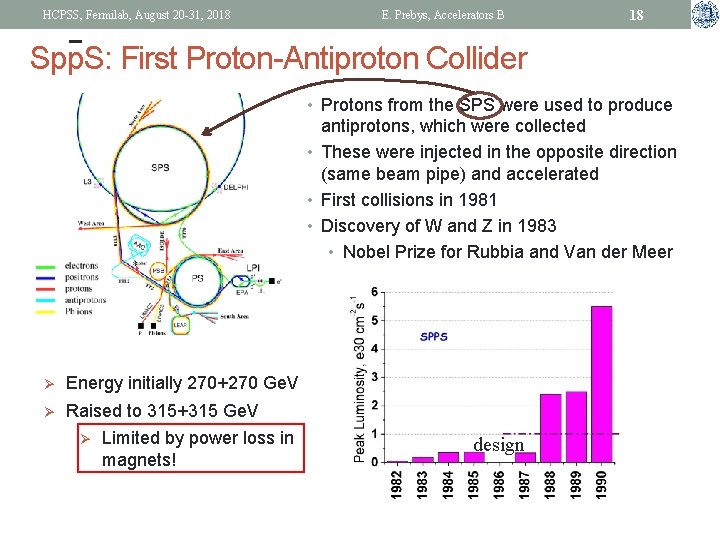
HCPSS, Fermilab, August 20 -31, 2018 E. Prebys, Accelerators B 18 Spp. S: First Proton-Antiproton Collider • Protons from the SPS were used to produce antiprotons, which were collected • These were injected in the opposite direction (same beam pipe) and accelerated • First collisions in 1981 • Discovery of W and Z in 1983 • Nobel Prize for Rubbia and Van der Meer Ø Energy initially 270+270 Ge. V Ø Raised to 315+315 Ge. V Ø Limited by power loss in magnets! design
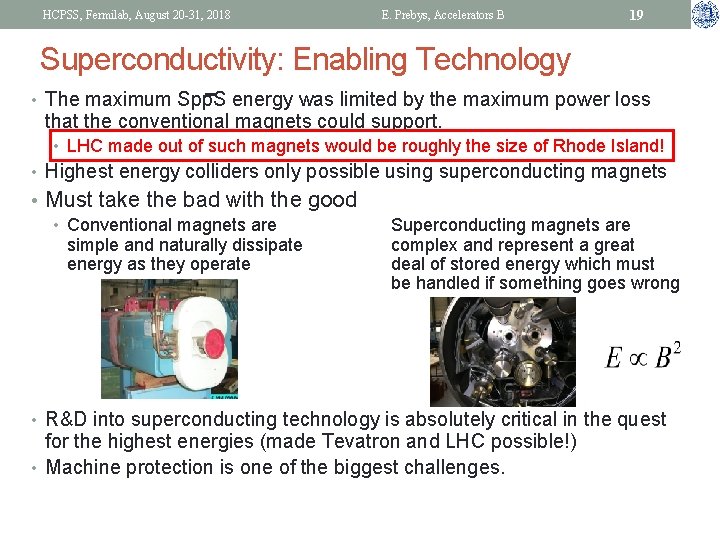
HCPSS, Fermilab, August 20 -31, 2018 E. Prebys, Accelerators B 19 Superconductivity: Enabling Technology • The maximum Spp. S energy was limited by the maximum power loss that the conventional magnets could support. • LHC made out of such magnets would be roughly the size of Rhode Island! • Highest energy colliders only possible using superconducting magnets • Must take the bad with the good • Conventional magnets are simple and naturally dissipate energy as they operate Superconducting magnets are complex and represent a great deal of stored energy which must be handled if something goes wrong • R&D into superconducting technology is absolutely critical in the quest for the highest energies (made Tevatron and LHC possible!) • Machine protection is one of the biggest challenges.
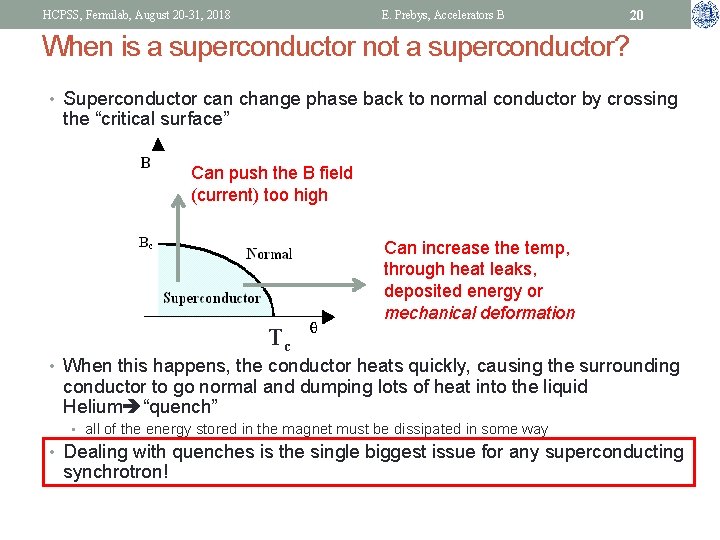
HCPSS, Fermilab, August 20 -31, 2018 E. Prebys, Accelerators B 20 When is a superconductor not a superconductor? • Superconductor can change phase back to normal conductor by crossing the “critical surface” Can push the B field (current) too high Can increase the temp, through heat leaks, deposited energy or mechanical deformation Tc • When this happens, the conductor heats quickly, causing the surrounding conductor to go normal and dumping lots of heat into the liquid Helium “quench” • all of the energy stored in the magnet must be dissipated in some way • Dealing with quenches is the single biggest issue for any superconducting synchrotron!
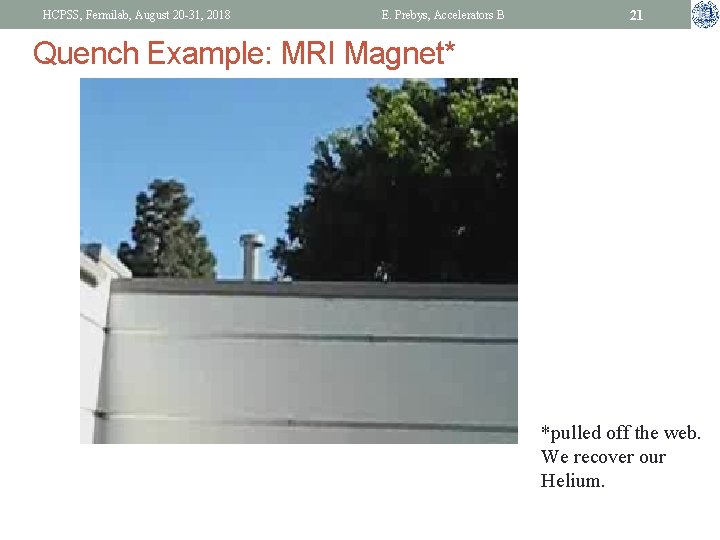
HCPSS, Fermilab, August 20 -31, 2018 E. Prebys, Accelerators B 21 Quench Example: MRI Magnet* *pulled off the web. We recover our Helium.
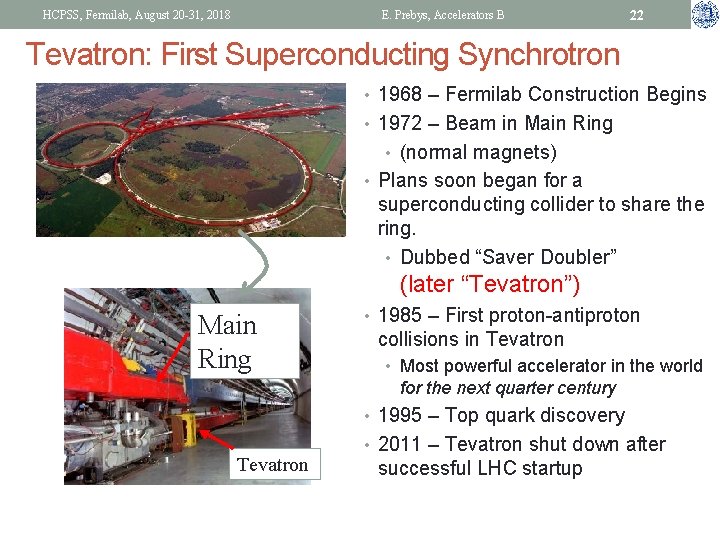
HCPSS, Fermilab, August 20 -31, 2018 E. Prebys, Accelerators B 22 Tevatron: First Superconducting Synchrotron • 1968 – Fermilab Construction Begins • 1972 – Beam in Main Ring • (normal magnets) • Plans soon began for a superconducting collider to share the ring. • Dubbed “Saver Doubler” (later “Tevatron”) Main Ring • 1985 – First proton-antiproton collisions in Tevatron • Most powerful accelerator in the world for the next quarter century • 1995 – Top quark discovery Tevatron • 2011 – Tevatron shut down after successful LHC startup
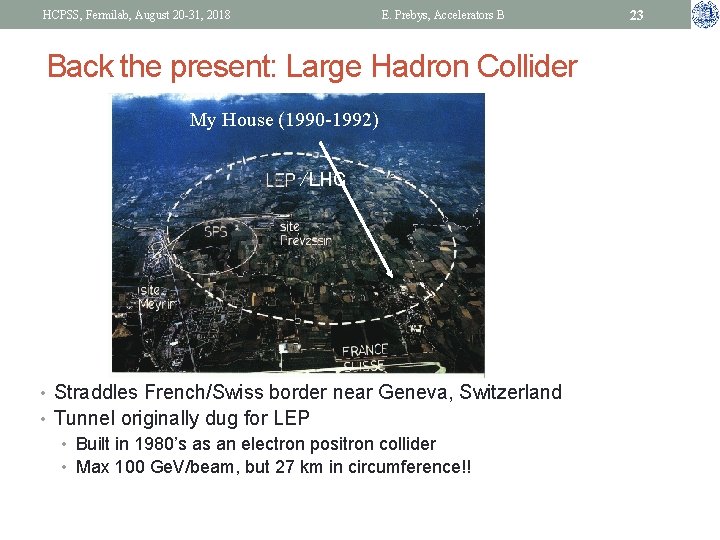
HCPSS, Fermilab, August 20 -31, 2018 E. Prebys, Accelerators B Back the present: Large Hadron Collider My House (1990 -1992) /LHC • Straddles French/Swiss border near Geneva, Switzerland • Tunnel originally dug for LEP • Built in 1980’s as an electron positron collider • Max 100 Ge. V/beam, but 27 km in circumference!! 23
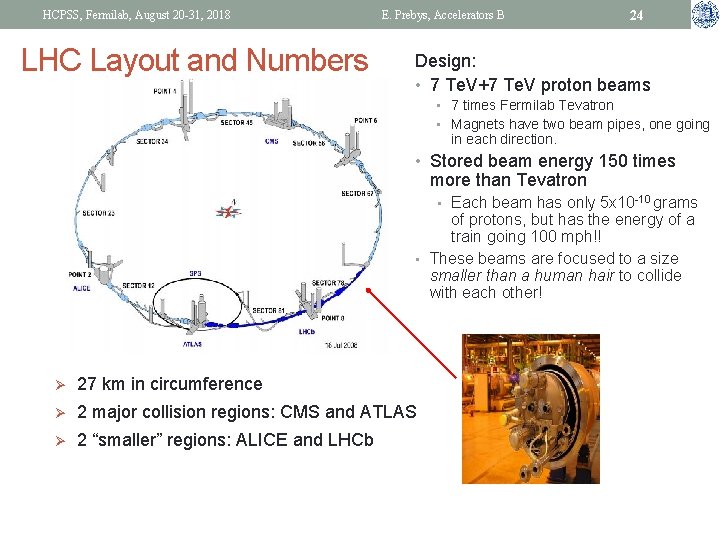
HCPSS, Fermilab, August 20 -31, 2018 LHC Layout and Numbers E. Prebys, Accelerators B 24 Design: • 7 Te. V+7 Te. V proton beams • 7 times Fermilab Tevatron • Magnets have two beam pipes, one going in each direction. • Stored beam energy 150 times more than Tevatron • Each beam has only 5 x 10 -10 grams of protons, but has the energy of a train going 100 mph!! • These beams are focused to a size smaller than a human hair to collide with each other! Ø 27 km in circumference Ø 2 major collision regions: CMS and ATLAS Ø 2 “smaller” regions: ALICE and LHCb
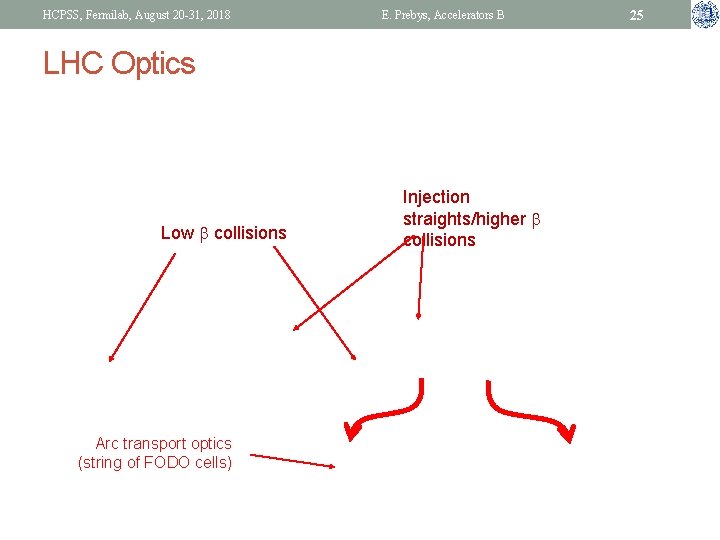
HCPSS, Fermilab, August 20 -31, 2018 E. Prebys, Accelerators B LHC Optics Low b collisions Arc transport optics (string of FODO cells) Injection straights/higher b collisions 25
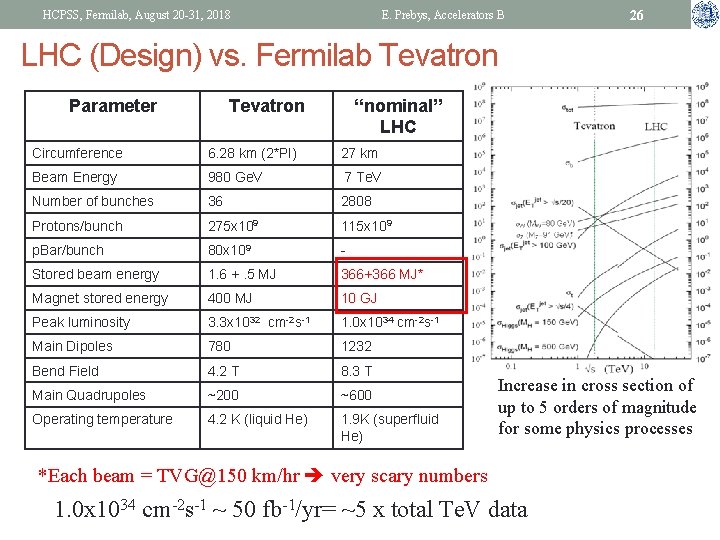
HCPSS, Fermilab, August 20 -31, 2018 E. Prebys, Accelerators B 26 LHC (Design) vs. Fermilab Tevatron Parameter Tevatron “nominal” LHC Circumference 6. 28 km (2*PI) 27 km Beam Energy 980 Ge. V 7 Te. V Number of bunches 36 2808 Protons/bunch 275 x 109 115 x 109 p. Bar/bunch 80 x 109 - Stored beam energy 1. 6 +. 5 MJ 366+366 MJ* Magnet stored energy 400 MJ 10 GJ Peak luminosity 3. 3 x 1032 cm-2 s-1 1. 0 x 1034 cm-2 s-1 Main Dipoles 780 1232 Bend Field 4. 2 T 8. 3 T Main Quadrupoles ~200 ~600 Operating temperature 4. 2 K (liquid He) 1. 9 K (superfluid He) Increase in cross section of up to 5 orders of magnitude for some physics processes *Each beam = TVG@150 km/hr very scary numbers 1. 0 x 1034 cm-2 s-1 ~ 50 fb-1/yr= ~5 x total Te. V data
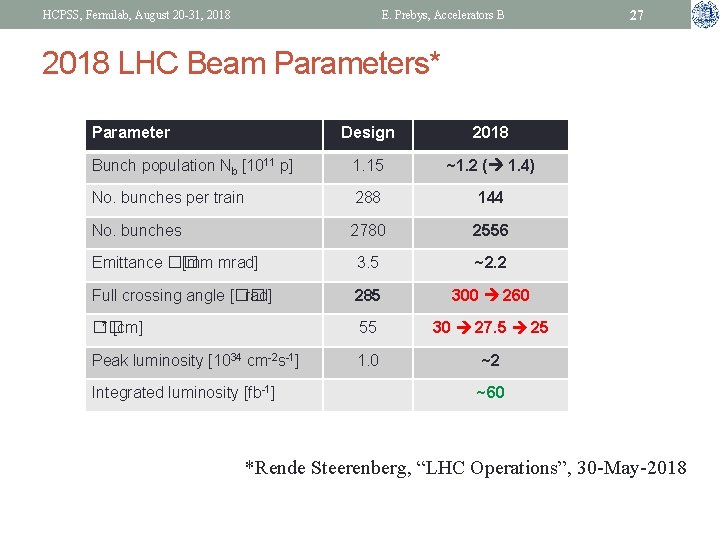
HCPSS, Fermilab, August 20 -31, 2018 E. Prebys, Accelerators B 27 2018 LHC Beam Parameters* Parameter Design 2018 Bunch population Nb [1011 p] 1. 15 ~1. 2 ( 1. 4) No. bunches per train 288 144 No. bunches 2780 2556 Emittance �� [mm mrad] 3. 5 ~2. 2 Full crossing angle [�� rad] 285 300 260 �� * [cm] 55 30 27. 5 25 Peak luminosity [1034 cm-2 s-1] 1. 0 ~2 Integrated luminosity [fb-1] ~60 *Rende Steerenberg, “LHC Operations”, 30 -May-2018
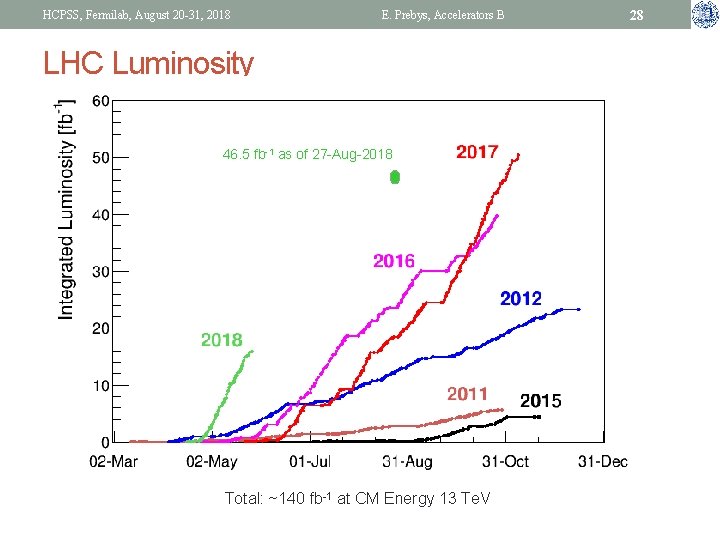
HCPSS, Fermilab, August 20 -31, 2018 E. Prebys, Accelerators B LHC Luminosity 46. 5 fb-1 as of 27 -Aug-2018 Total: ~140 fb-1 at CM Energy 13 Te. V 28
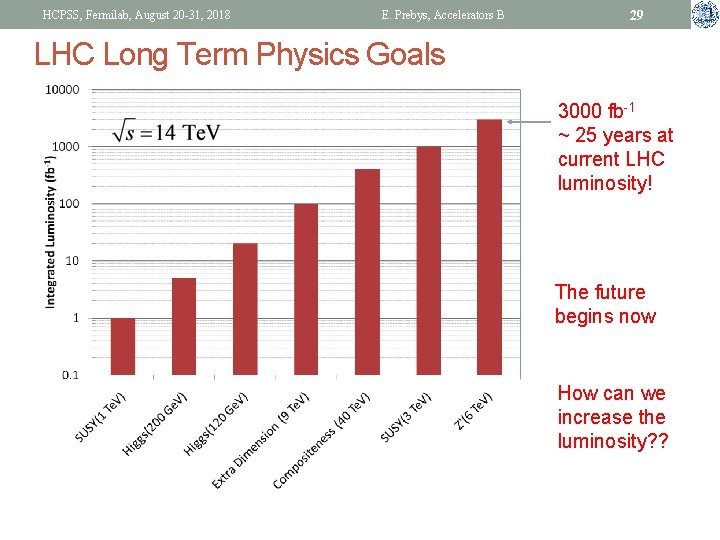
HCPSS, Fermilab, August 20 -31, 2018 E. Prebys, Accelerators B 29 LHC Long Term Physics Goals 3000 fb-1 ~ 25 years at current LHC luminosity! The future begins now How can we increase the luminosity? ?
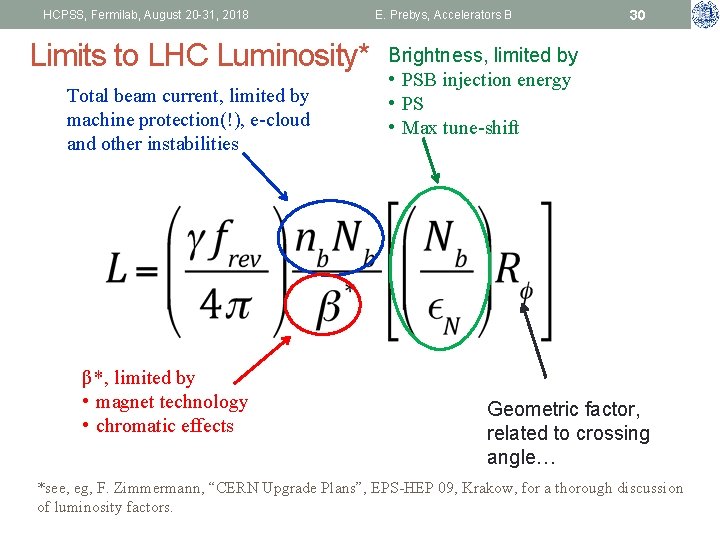
HCPSS, Fermilab, August 20 -31, 2018 Limits to LHC Luminosity* Total beam current, limited by machine protection(!), e-cloud and other instabilities β*, limited by • magnet technology • chromatic effects E. Prebys, Accelerators B 30 Brightness, limited by • PSB injection energy • PS • Max tune-shift Geometric factor, related to crossing angle… *see, eg, F. Zimmermann, “CERN Upgrade Plans”, EPS-HEP 09, Krakow, for a thorough discussion of luminosity factors.
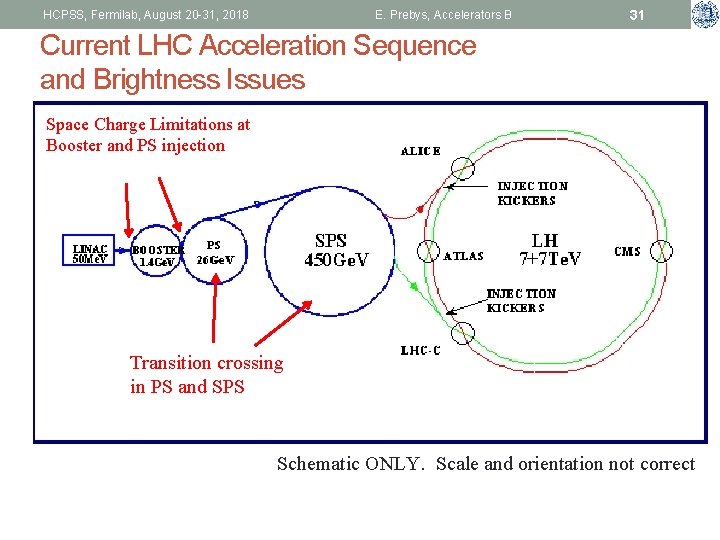
HCPSS, Fermilab, August 20 -31, 2018 E. Prebys, Accelerators B 31 Current LHC Acceleration Sequence and Brightness Issues Space Charge Limitations at Booster and PS injection Transition crossing in PS and SPS Schematic ONLY. Scale and orientation not correct
HCPSS, Fermilab, August 20 -31, 2018 E. Prebys, Accelerators B 32 Addressing brightness issues • There are plans to address two of the major sources of emittance blowup in the injector chain • Injection from the LINAC into the PS Booster • The current linac uses proton painting at 50 Me. V • New LINAC 4 will use ion injection at 160 Me. V • Space charge at injection into PS • Extraction energy of the PS Booster will be increased from 1. 4 to 2. 0 Ge. V • These upgrades are scheduled to take place during the next long shutdown.
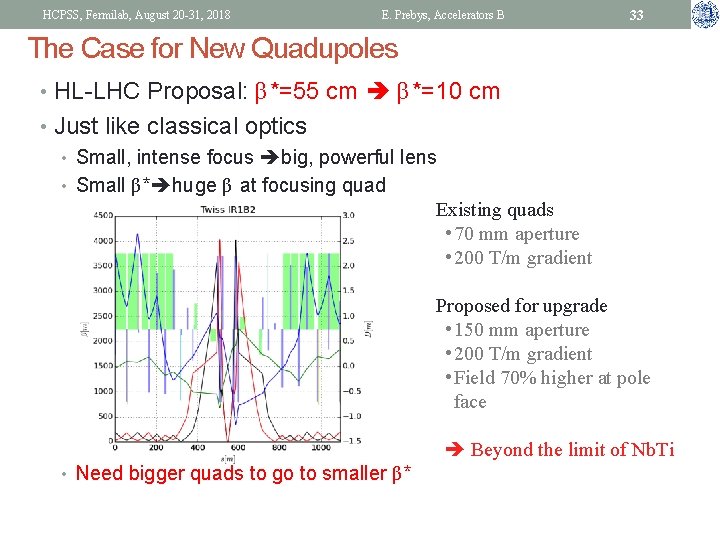
HCPSS, Fermilab, August 20 -31, 2018 E. Prebys, Accelerators B 33 The Case for New Quadupoles • HL-LHC Proposal: β*=55 cm β*=10 cm • Just like classical optics • Small, intense focus big, powerful lens • Small β* huge β at focusing quad Existing quads • 70 mm aperture • 200 T/m gradient Proposed for upgrade • 150 mm aperture • 200 T/m gradient • Field 70% higher at pole face Beyond the limit of Nb. Ti • Need bigger quads to go to smaller β*
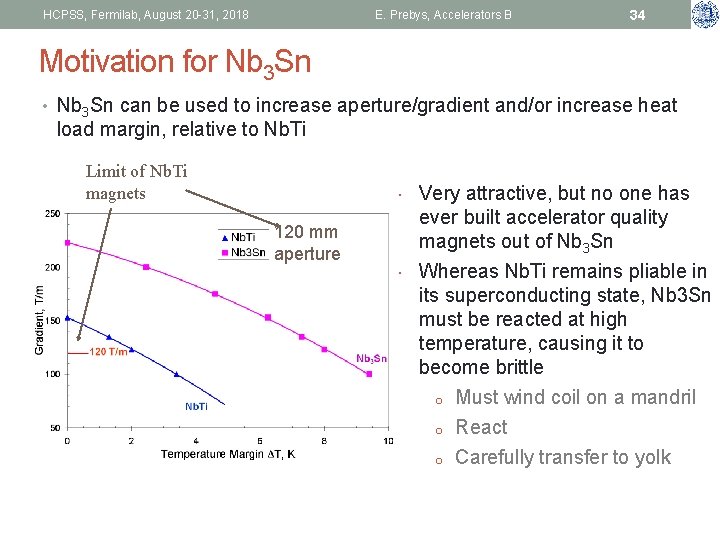
HCPSS, Fermilab, August 20 -31, 2018 E. Prebys, Accelerators B 34 Motivation for Nb 3 Sn • Nb 3 Sn can be used to increase aperture/gradient and/or increase heat load margin, relative to Nb. Ti Limit of Nb. Ti magnets 120 mm aperture Very attractive, but no one has ever built accelerator quality magnets out of Nb 3 Sn Whereas Nb. Ti remains pliable in its superconducting state, Nb 3 Sn must be reacted at high temperature, causing it to become brittle o Must wind coil on a mandril o React o Carefully transfer to yolk
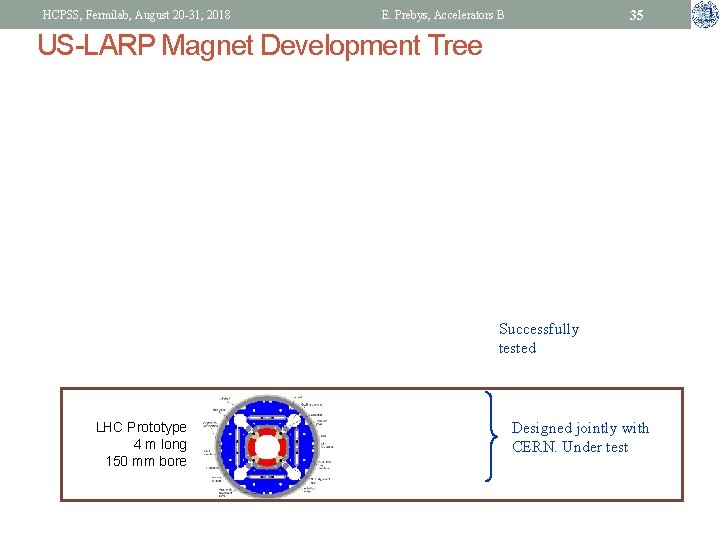
HCPSS, Fermilab, August 20 -31, 2018 35 E. Prebys, Accelerators B US-LARP Magnet Development Tree Successfully tested LHC Prototype 4 m long 150 mm bore Designed jointly with CERN. Under test
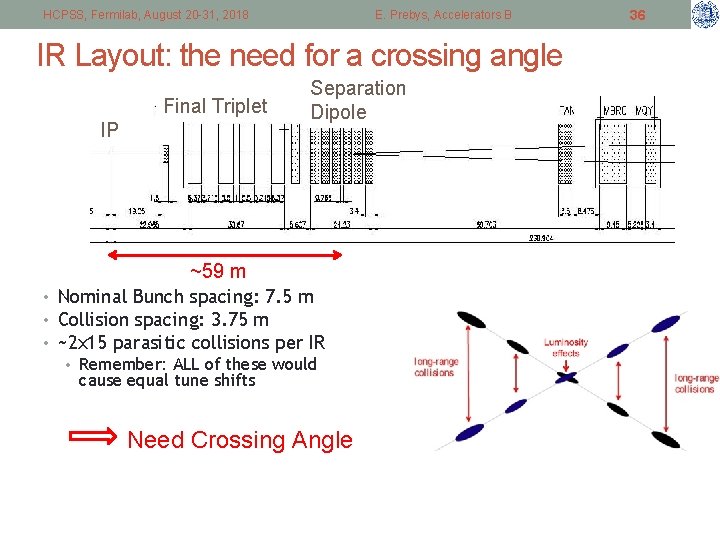
HCPSS, Fermilab, August 20 -31, 2018 E. Prebys, Accelerators B IR Layout: the need for a crossing angle Final Triplet IP Separation Dipole ~59 m • Nominal Bunch spacing: 7. 5 m • Collision spacing: 3. 75 m • ~2 x 15 parasitic collisions per IR • Remember: ALL of these would cause equal tune shifts Need Crossing Angle 36
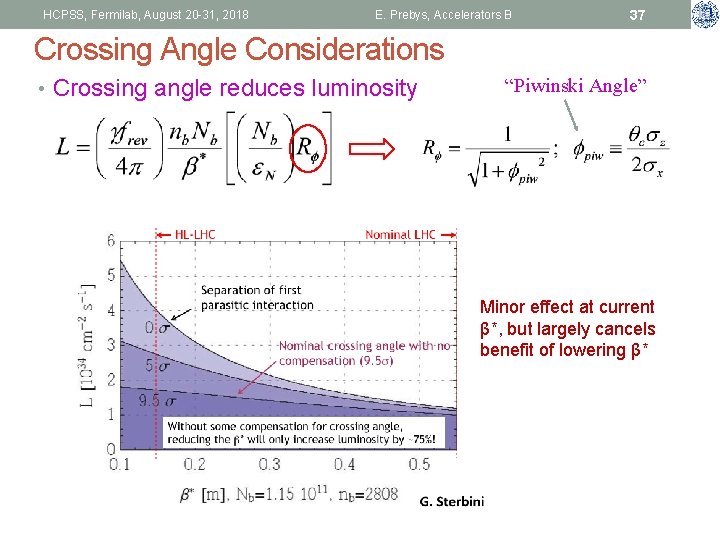
HCPSS, Fermilab, August 20 -31, 2018 E. Prebys, Accelerators B 37 Crossing Angle Considerations • Crossing angle reduces luminosity “Piwinski Angle” Minor effect at current β*, but largely cancels benefit of lowering β*
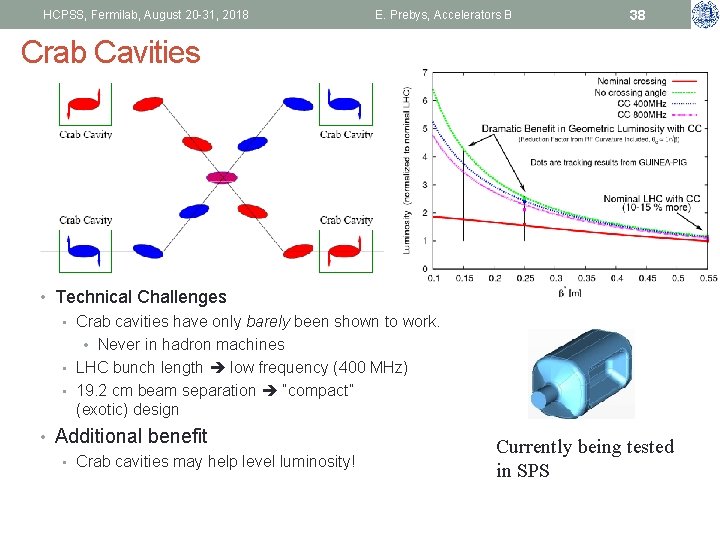
HCPSS, Fermilab, August 20 -31, 2018 E. Prebys, Accelerators B 38 Crab Cavities • Technical Challenges • Crab cavities have only barely been shown to work. • Never in hadron machines • LHC bunch length low frequency (400 MHz) • 19. 2 cm beam separation “compact” (exotic) design • Additional benefit • Crab cavities may help level luminosity! Currently being tested in SPS
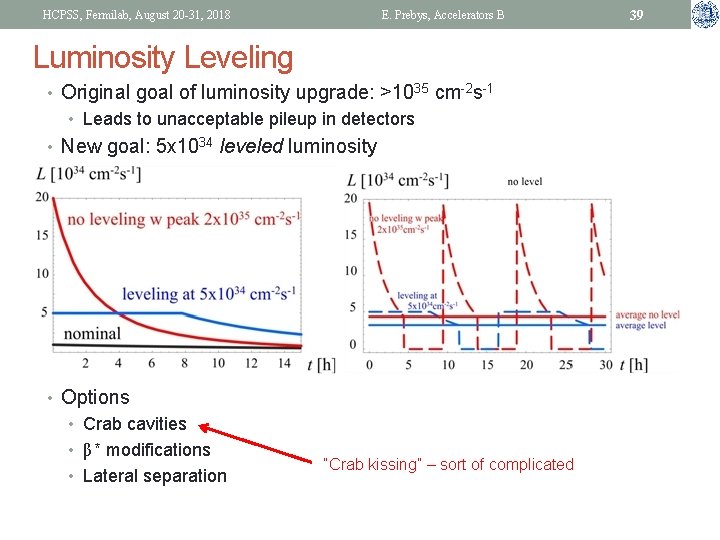
HCPSS, Fermilab, August 20 -31, 2018 E. Prebys, Accelerators B Luminosity Leveling • Original goal of luminosity upgrade: >1035 cm-2 s-1 • Leads to unacceptable pileup in detectors • New goal: 5 x 1034 leveled luminosity • Options • Crab cavities • β* modifications • Lateral separation “Crab kissing” – sort of complicated 39
HCPSS, Fermilab, August 20 -31, 2018 E. Prebys, Accelerators B 40
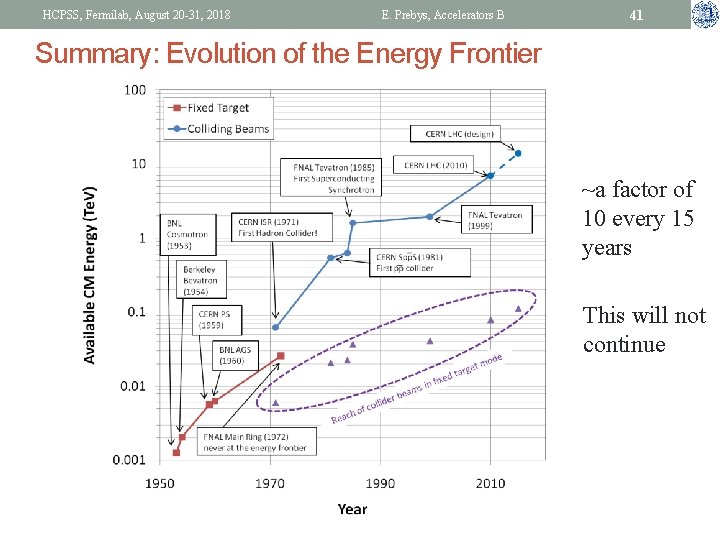
HCPSS, Fermilab, August 20 -31, 2018 E. Prebys, Accelerators B 41 Summary: Evolution of the Energy Frontier ~a factor of 10 every 15 years This will not continue
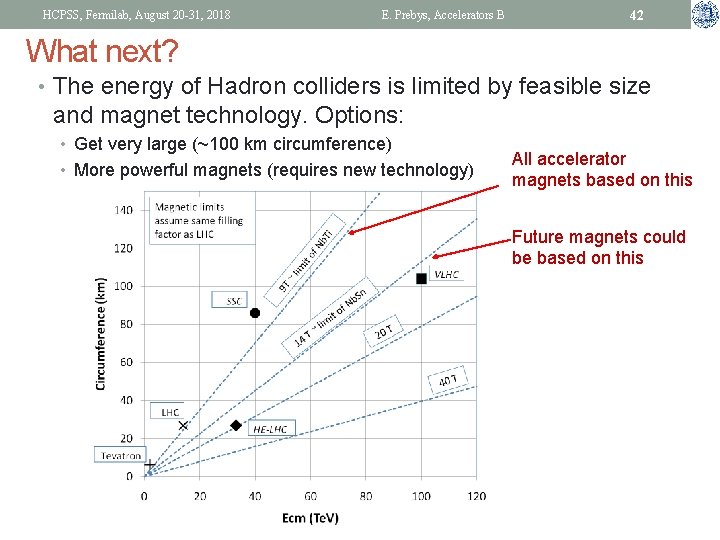
HCPSS, Fermilab, August 20 -31, 2018 E. Prebys, Accelerators B 42 What next? • The energy of Hadron colliders is limited by feasible size and magnet technology. Options: • Get very large (~100 km circumference) • More powerful magnets (requires new technology) All accelerator magnets based on this Future magnets could be based on this
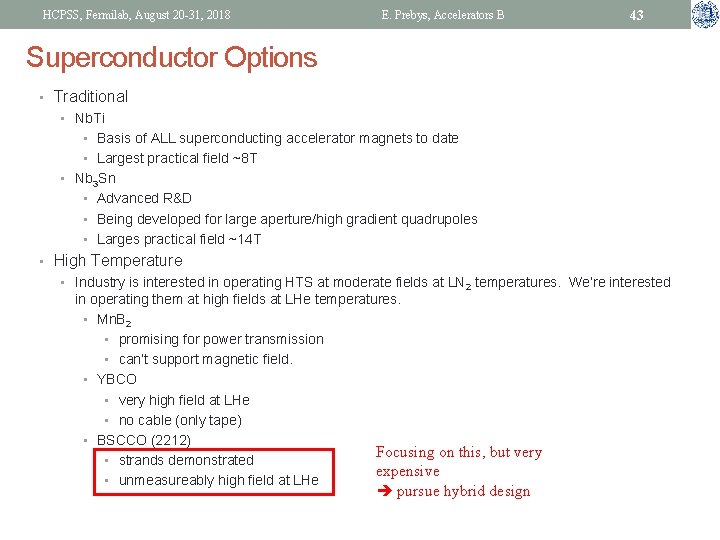
HCPSS, Fermilab, August 20 -31, 2018 E. Prebys, Accelerators B 43 Superconductor Options • Traditional • Nb. Ti • Basis of ALL superconducting accelerator magnets to date • Largest practical field ~8 T • Nb 3 Sn • Advanced R&D • Being developed for large aperture/high gradient quadrupoles • Larges practical field ~14 T • High Temperature • Industry is interested in operating HTS at moderate fields at LN 2 temperatures. We’re interested in operating them at high fields at LHe temperatures. • Mn. B 2 • promising for power transmission • can’t support magnetic field. • YBCO • very high field at LHe • no cable (only tape) • BSCCO (2212) Focusing on this, but very • strands demonstrated expensive • unmeasureably high field at LHe pursue hybrid design
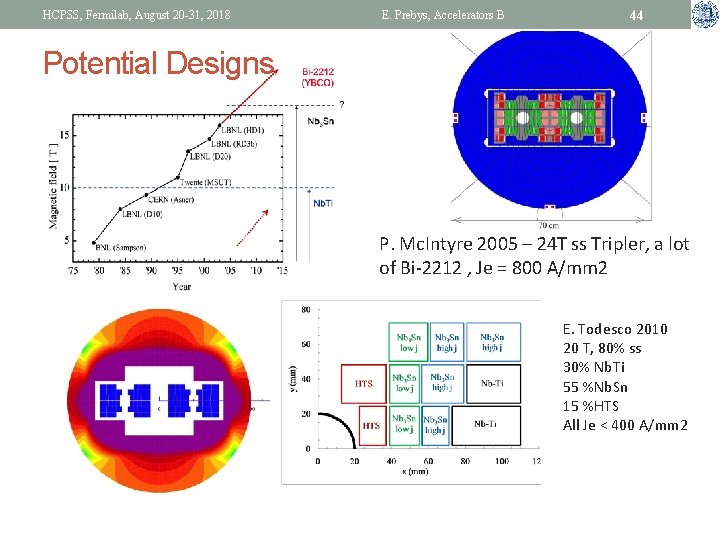
HCPSS, Fermilab, August 20 -31, 2018 E. Prebys, Accelerators B 44 Potential Designs P. Mc. Intyre 2005 – 24 T ss Tripler, a lot of Bi-2212 , Je = 800 A/mm 2 E. Todesco 2010 20 T, 80% ss 30% Nb. Ti 55 %Nb. Sn 15 %HTS All Je < 400 A/mm 2
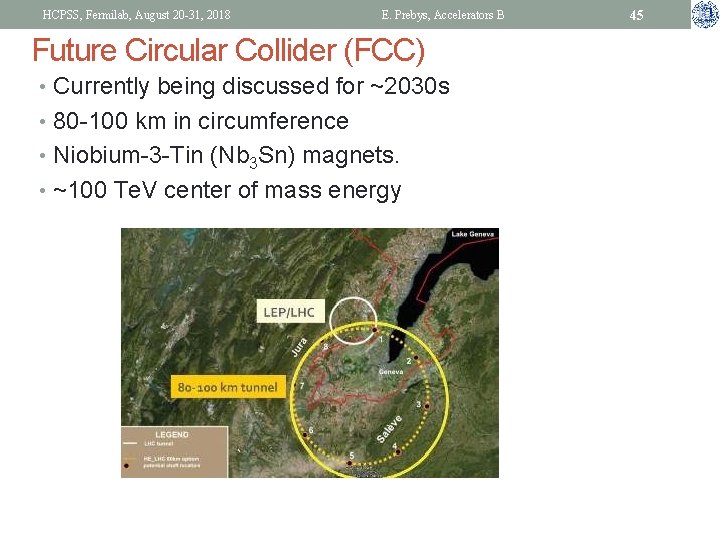
HCPSS, Fermilab, August 20 -31, 2018 E. Prebys, Accelerators B Future Circular Collider (FCC) • Currently being discussed for ~2030 s • 80 -100 km in circumference • Niobium-3 -Tin (Nb 3 Sn) magnets. • ~100 Te. V center of mass energy 45
HCPSS, Fermilab, August 20 -31, 2018 E. Prebys, Accelerators B 46 Other Paths to the Energy Frontier • Leptons vs. Hadrons revisited • Because 100% of the beam energy is available to the reaction, a lepton collider is competitive with a hadron collider of ~5 -10 times the beam energy (depending on the physics). • A lepton collider of >1 Te. V/beam could compete with the discovery potential of the LHC • A lower energy lepton collider could be very useful for precision tests, but I’m talking about direct energy frontier discoveries. • Unfortunately, building such a collider is VERY, VERY hard • Eventually, circular e+e- colliders will radiate away all of their energy each turn • LEP reached 100 Ge. V/beam with a 27 km circuference synchrotron! Next e+e- collider will be linear
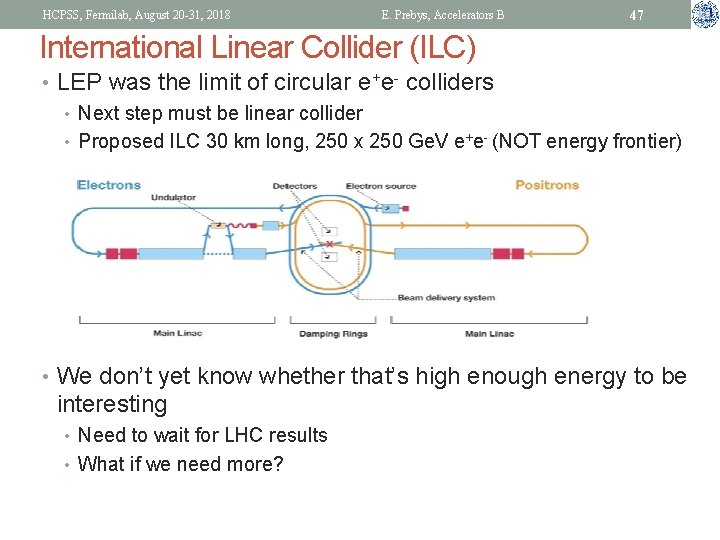
HCPSS, Fermilab, August 20 -31, 2018 E. Prebys, Accelerators B 47 International Linear Collider (ILC) • LEP was the limit of circular e+e- colliders • Next step must be linear collider • Proposed ILC 30 km long, 250 x 250 Ge. V e+e- (NOT energy frontier) • We don’t yet know whether that’s high enough energy to be interesting • Need to wait for LHC results • What if we need more?
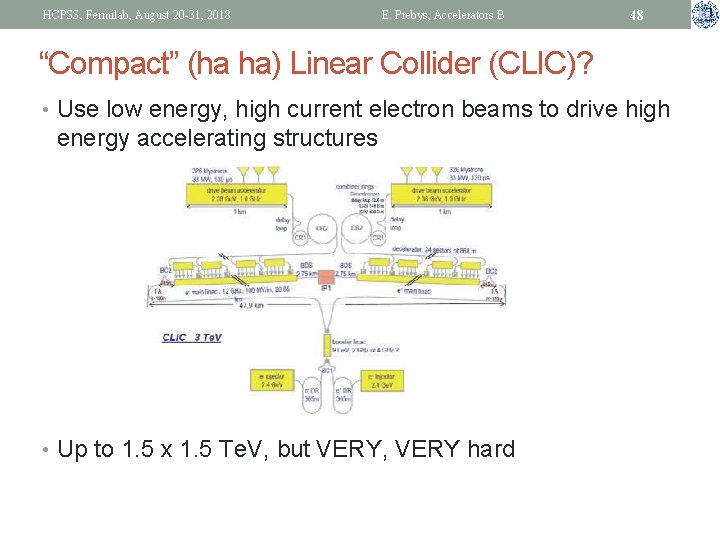
HCPSS, Fermilab, August 20 -31, 2018 E. Prebys, Accelerators B 48 “Compact” (ha ha) Linear Collider (CLIC)? • Use low energy, high current electron beams to drive high energy accelerating structures • Up to 1. 5 x 1. 5 Te. V, but VERY, VERY hard
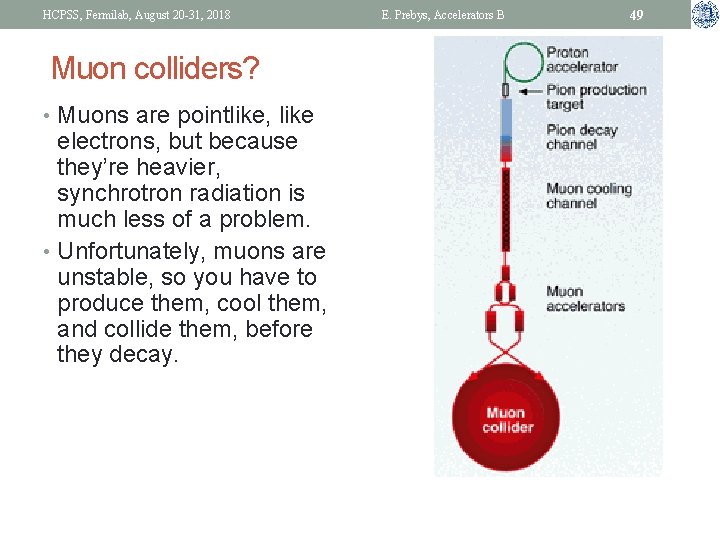
HCPSS, Fermilab, August 20 -31, 2018 Muon colliders? • Muons are pointlike, like electrons, but because they’re heavier, synchrotron radiation is much less of a problem. • Unfortunately, muons are unstable, so you have to produce them, cool them, and collide them, before they decay. E. Prebys, Accelerators B 49
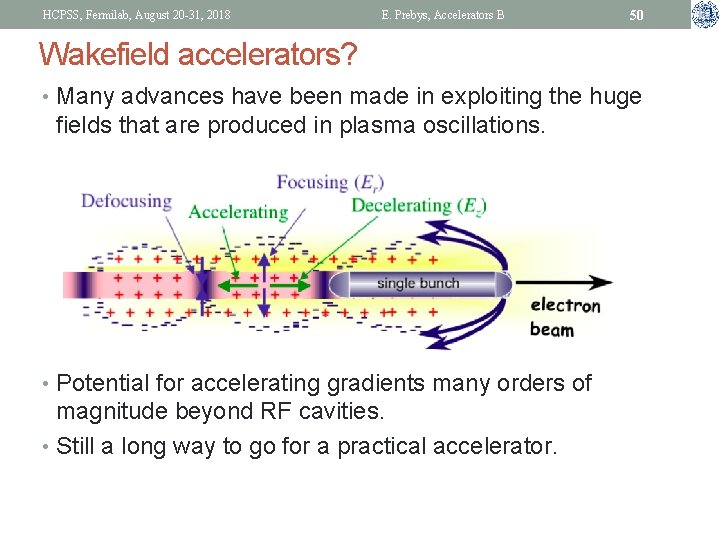
HCPSS, Fermilab, August 20 -31, 2018 E. Prebys, Accelerators B 50 Wakefield accelerators? • Many advances have been made in exploiting the huge fields that are produced in plasma oscillations. • Potential for accelerating gradients many orders of magnitude beyond RF cavities. • Still a long way to go for a practical accelerator.
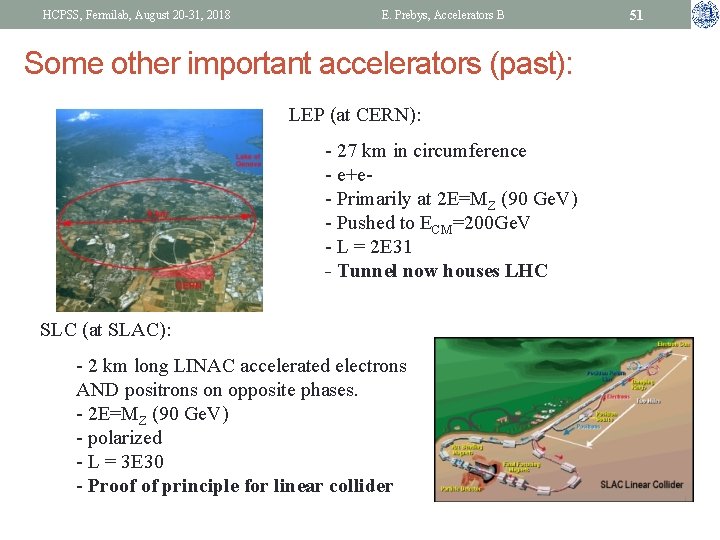
HCPSS, Fermilab, August 20 -31, 2018 E. Prebys, Accelerators B Some other important accelerators (past): LEP (at CERN): - 27 km in circumference - e+e- Primarily at 2 E=MZ (90 Ge. V) - Pushed to ECM=200 Ge. V - L = 2 E 31 - Tunnel now houses LHC SLC (at SLAC): - 2 km long LINAC accelerated electrons AND positrons on opposite phases. - 2 E=MZ (90 Ge. V) - polarized - L = 3 E 30 - Proof of principle for linear collider 51
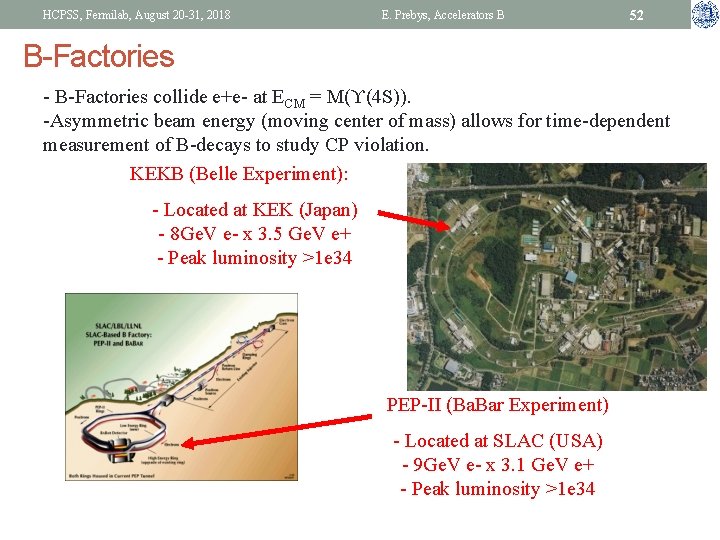
HCPSS, Fermilab, August 20 -31, 2018 E. Prebys, Accelerators B 52 B-Factories - B-Factories collide e+e- at ECM = M(ϒ(4 S)). -Asymmetric beam energy (moving center of mass) allows for time-dependent measurement of B-decays to study CP violation. KEKB (Belle Experiment): - Located at KEK (Japan) - 8 Ge. V e- x 3. 5 Ge. V e+ - Peak luminosity >1 e 34 PEP-II (Ba. Bar Experiment) - Located at SLAC (USA) - 9 Ge. V e- x 3. 1 Ge. V e+ - Peak luminosity >1 e 34
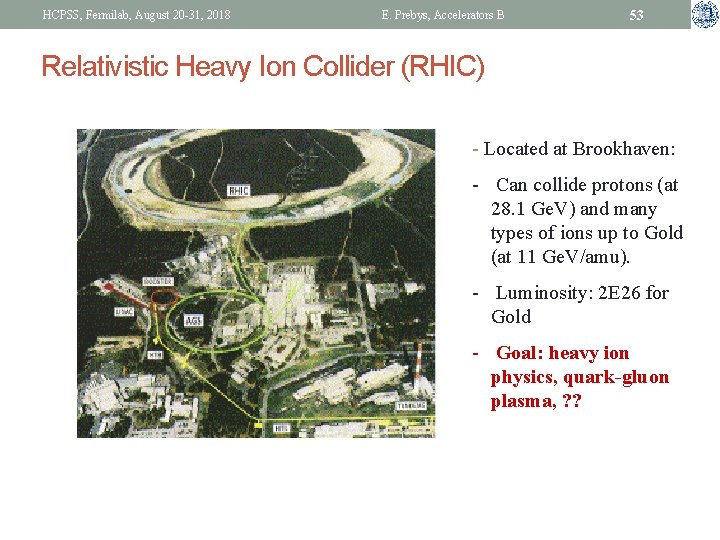
HCPSS, Fermilab, August 20 -31, 2018 E. Prebys, Accelerators B 53 Relativistic Heavy Ion Collider (RHIC) - Located at Brookhaven: - Can collide protons (at 28. 1 Ge. V) and many types of ions up to Gold (at 11 Ge. V/amu). - Luminosity: 2 E 26 for Gold - Goal: heavy ion physics, quark-gluon plasma, ? ?
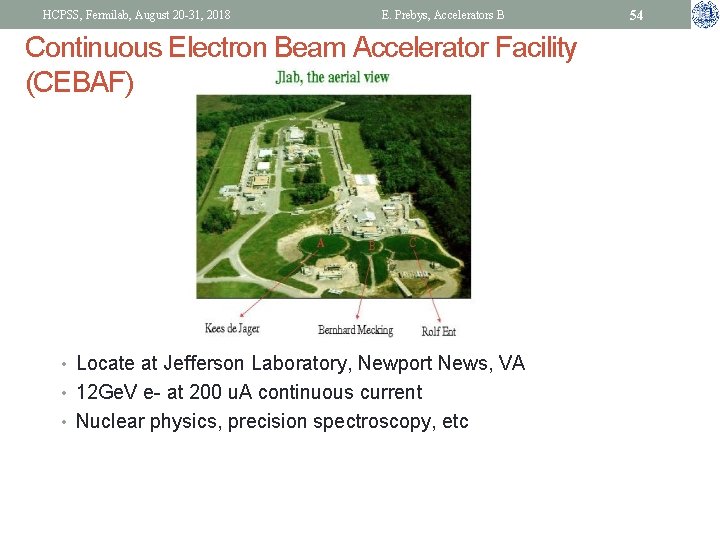
HCPSS, Fermilab, August 20 -31, 2018 E. Prebys, Accelerators B Continuous Electron Beam Accelerator Facility (CEBAF) • Locate at Jefferson Laboratory, Newport News, VA • 12 Ge. V e- at 200 u. A continuous current • Nuclear physics, precision spectroscopy, etc 54
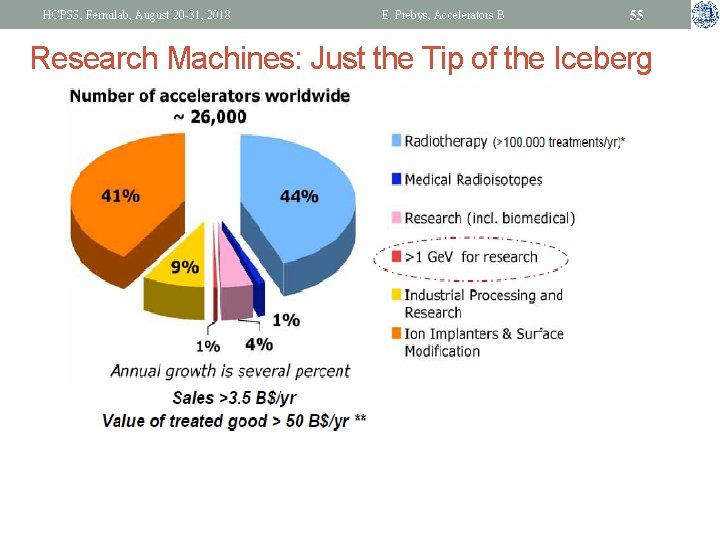
HCPSS, Fermilab, August 20 -31, 2018 E. Prebys, Accelerators B 55 Research Machines: Just the Tip of the Iceberg
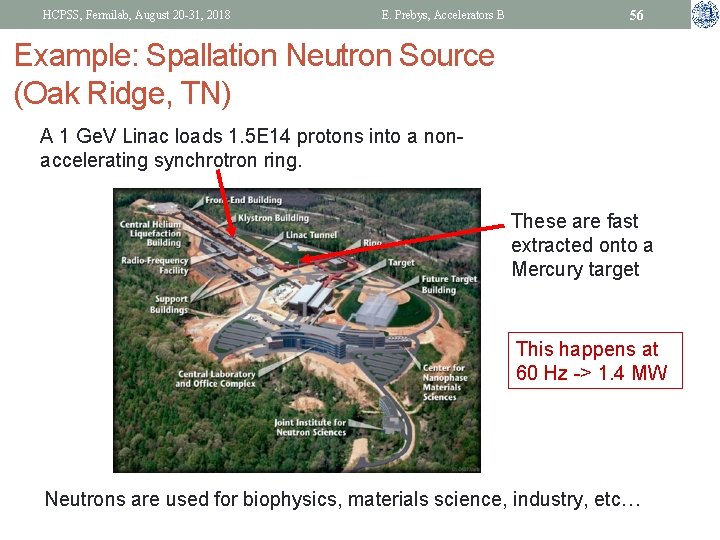
HCPSS, Fermilab, August 20 -31, 2018 E. Prebys, Accelerators B 56 Example: Spallation Neutron Source (Oak Ridge, TN) A 1 Ge. V Linac loads 1. 5 E 14 protons into a nonaccelerating synchrotron ring. These are fast extracted onto a Mercury target This happens at 60 Hz -> 1. 4 MW Neutrons are used for biophysics, materials science, industry, etc…
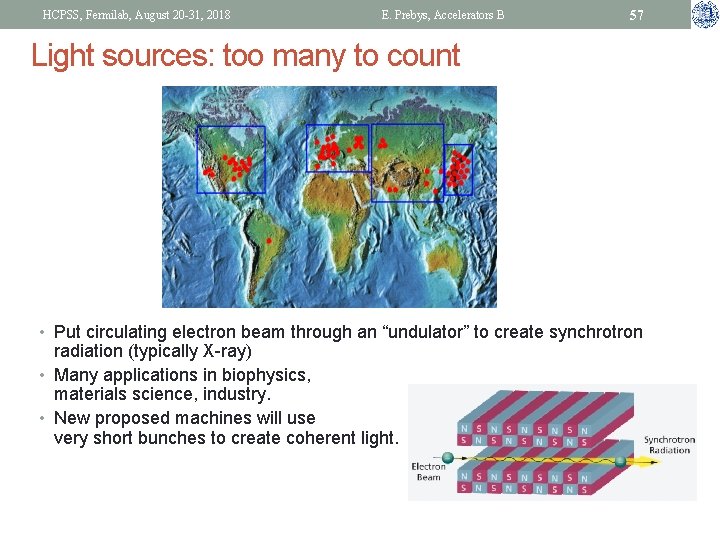
HCPSS, Fermilab, August 20 -31, 2018 E. Prebys, Accelerators B 57 Light sources: too many to count • Put circulating electron beam through an “undulator” to create synchrotron radiation (typically X-ray) • Many applications in biophysics, materials science, industry. • New proposed machines will use very short bunches to create coherent light.
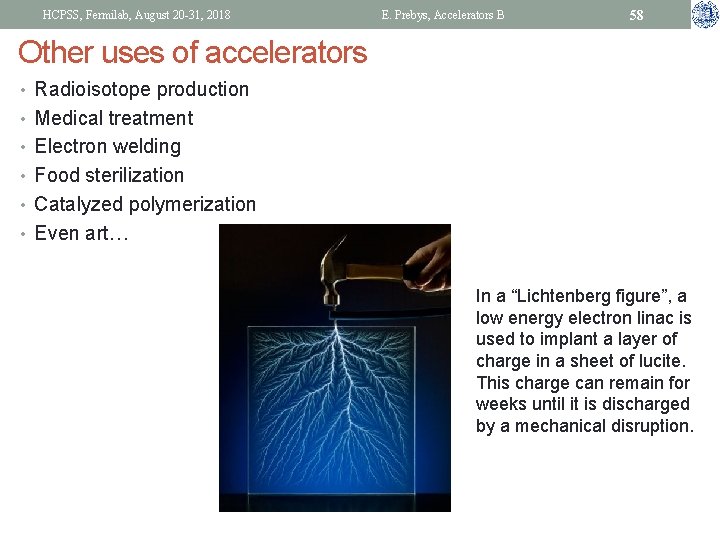
HCPSS, Fermilab, August 20 -31, 2018 E. Prebys, Accelerators B 58 Other uses of accelerators • Radioisotope production • Medical treatment • Electron welding • Food sterilization • Catalyzed polymerization • Even art… In a “Lichtenberg figure”, a low energy electron linac is used to implant a layer of charge in a sheet of lucite. This charge can remain for weeks until it is discharged by a mechanical disruption.
- Slides: 58