
AcceleratorICS collaboration and priorities Henrik Carling Mats Lindroos
Accelerator/ICS collaboration and priorities Henrik Carling / Mats Lindroos Date: 2019 -04 -11
Introduction • Accelerator is the largest stakeholder of ICS during the ESS construction phase – – Control system infrastructure Personnel safety system Machine protection system Accelerator system integration into the ICS 2
Background Integrated Control Systems • Accelerator division constructs the ESS accelerator • ICS division is responsible for the construction of the integrated control system – Both projects are in-kinded in their nature implying a distributed project/activity model • Some activities of the ICS division can work relatively independent of stakeholders, while most of ICS will engage heavily with stakeholders to design and integrate systems • Most significantly, this applies to the protection systems group and hardware and integration group, who will almost exclusively work in close collaboration with stakeholders • The protection systems group can in total distribute about 12 engineers and 4 technicians to work together with stakeholders • – Protection system members attend the accelerator integration meetings and provide pro-active feedback – Protection system work packages arranges meetings with stakeholder for planning and coordination The hardware and integration group can in total distribute about 25 engineers and 5 technicians to work together with stakeholders – The main stakeholders are Accelerator, Target, NSS and CF - each has an ICS integration work package in the ICS construction project – In order for ICS resources to be able to cover stakeholder needs, a systematic allocation of resources needs to be implemented – The hardware and integration group will implement a variant of a classical line/project matrix model in order resolve prioritization and support project planning 3
Line/project matrix - motivation (1) • Since about one year a systematic resource allocation for ICS hardware and integration resources have been applied to stakeholder activities • The process of managing the prioritization/allocation has evolved to – – – • Coordinate ICS and stakeholder project planning Ensure correct prioritization of ICS activities Develop (non-technical) interfaces between ICS and stakeholders Strengthen administrative control of ICS budget compliance Optimize ICS resource competence development There is little support in ESS processes for dealing systematically with the problem of requesting, prioritizing and allocating resources to multiple activities 4

Line/project matrix - motivation • The line/project matrix model solves the problem of running multiple project activities with limited resources, keeping a correct prioritization that supports stakeholders project planning • It also supports the continued development of experience and competence in the line organization Step 1: Collecting requests • Project manager interacts with stakeholders and together defines what needs to be done and when • Project manager and stakeholder defines a resource estimate with a time envelope • Project manager brings the plan back to the ICS allocation board Target WP 5 Acc. WP 8 ESS Bilbao Acc. WP 7 Control system architect 1 1 0. 5 Industrial automation 2 EPICS 0. 5 1 1 0. 5 Data networks 0. 5 Analog electronics Control System Studio 0. 5 Target WP 7 0. 5 FPGA 2 Micro. TCA 2 0. 5 0. 5 1 1 0. 5 Process control 2 0. 5 1 Vacuum controls 0. 5 Control system integration 0. 5 Controls technicians 0. 5 1 0. 5 0. 5 Information/Controls security . . . 1 Timing system Motion controls . . . 0. 5 1 Embedded systems NSS WP 5 1 1 5 . . .
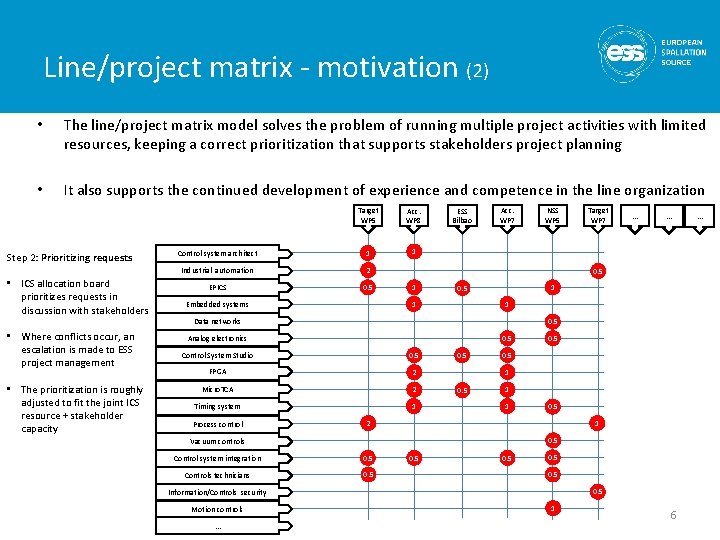
Line/project matrix - motivation (2) • The line/project matrix model solves the problem of running multiple project activities with limited resources, keeping a correct prioritization that supports stakeholders project planning • It also supports the continued development of experience and competence in the line organization Step 2: Prioritizing requests • ICS allocation board prioritizes requests in discussion with stakeholders • Where conflicts occur, an escalation is made to ESS project management • The prioritization is roughly adjusted to fit the joint ICS resource + stakeholder capacity Target WP 5 Acc. WP 8 Control system architect 1 1 Industrial automation 2 EPICS 0. 5 ESS Bilbao 1 . . . 0. 5 Control System Studio 0. 5 FPGA 2 Micro. TCA 2 Timing system 1 0. 5 1 1 0. 5 2 1 0. 5 Vacuum controls Control system integration 0. 5 Controls technicians 0. 5 0. 5 Information/Controls security . . . 1 Analog electronics Motion controls Target WP 7 1 0. 5 Data networks Process control NSS WP 5 0. 5 1 Embedded systems Acc. WP 7 1 6 . . .
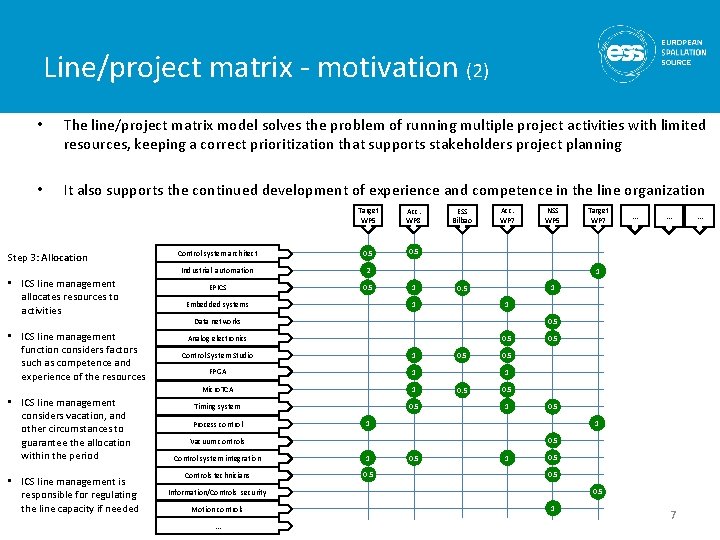
Line/project matrix - motivation (2) • The line/project matrix model solves the problem of running multiple project activities with limited resources, keeping a correct prioritization that supports stakeholders project planning • It also supports the continued development of experience and competence in the line organization Step 3: Allocation • ICS line management allocates resources to activities • ICS line management function considers factors such as competence and experience of the resources • ICS line management considers vacation, and other circumstances to guarantee the allocation within the period • ICS line management is responsible for regulating the line capacity if needed Target WP 5 Acc. WP 8 Control system architect 0. 5 Industrial automation 2 EPICS 0. 5 ESS Bilbao 1 . . . 0. 5 Control System Studio 1 FPGA 1 Micro. TCA 1 Timing system 0. 5 1 0. 5 1 1 0. 5 Vacuum controls Control system integration 1 Controls technicians 0. 5 1 0. 5 Information/Controls security . . . 1 Analog electronics Motion controls Target WP 7 1 0. 5 Data networks Process control NSS WP 5 1 1 Embedded systems Acc. WP 7 1 7 . . .
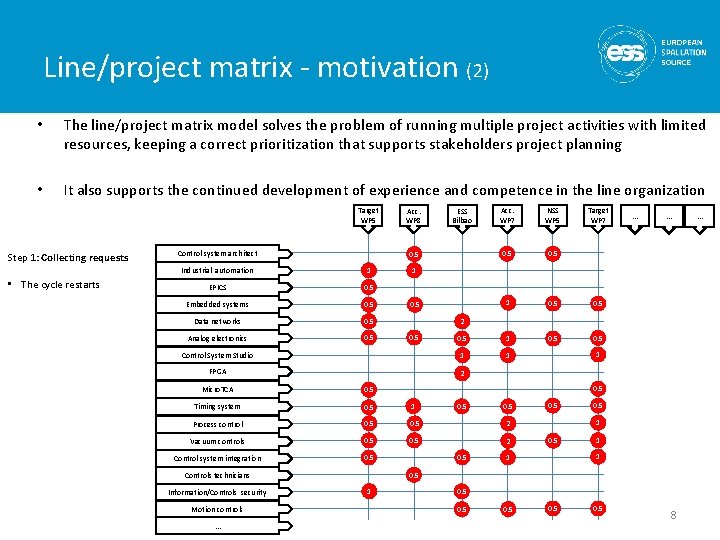
Line/project matrix - motivation (2) • The line/project matrix model solves the problem of running multiple project activities with limited resources, keeping a correct prioritization that supports stakeholders project planning • It also supports the continued development of experience and competence in the line organization Target WP 5 Step 1: Collecting requests • The cycle restarts Acc. WP 7 NSS WP 5 0. 5 1 0. 5 Control System Studio 1 1 FPGA 2 Control system architect Acc. WP 8 ESS Bilbao 0. 5 Industrial automation 1 EPICS 0. 5 Embedded systems 0. 5 Data networks 0. 5 Analog electronics 0. 5 1 0. 5 Timing system 0. 5 1 Process control 0. 5 2 Vacuum controls 0. 5 2 Control system integration 0. 5 0. 5 1 1 1 0. 5 Controls technicians . . . 2 0. 5 Motion controls . . . 1 Micro. TCA Information/Controls security Target WP 7 1 0. 5 0. 5 8 . . .
Line/project matrix - roles • ICS work package managers are ”project managers” in this model – Responsible for interacting with stakeholders to establish what needs to be done and when – Brings requests to the ICS allocation board – Helps prioritizing requests – Checks requested resources are within the work package budget – Coordinates and drives allocated resources’ activities – Reports to ICS management and stakeholders • ICS group leaders are ”line managers” in this model – – – Receives the requests from project managers, decides who and how Helps prioritize and, if needed, escalate conflicts Manages resource availability, providing an optimal resource supply to project activities Manages staff development and alignment to the tasks Responsible for process compliance and deliverable quality 9
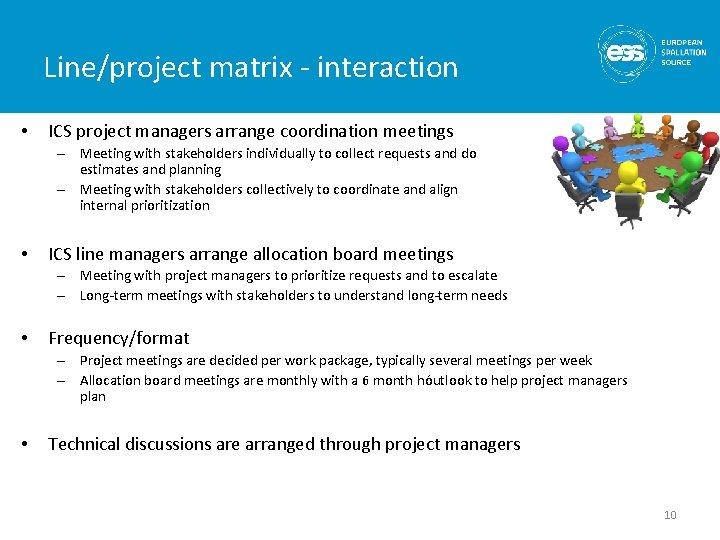
Line/project matrix - interaction • ICS project managers arrange coordination meetings – Meeting with stakeholders individually to collect requests and do estimates and planning – Meeting with stakeholders collectively to coordinate and align internal prioritization • ICS line managers arrange allocation board meetings – Meeting with project managers to prioritize requests and to escalate – Long-term meetings with stakeholders to understand long-term needs • Frequency/format – Project meetings are decided per work package, typically several meetings per week – Allocation board meetings are monthly with a 6 month hóutlook to help project managers plan • Technical discussions are arranged through project managers 10
Managing complex interaction 11
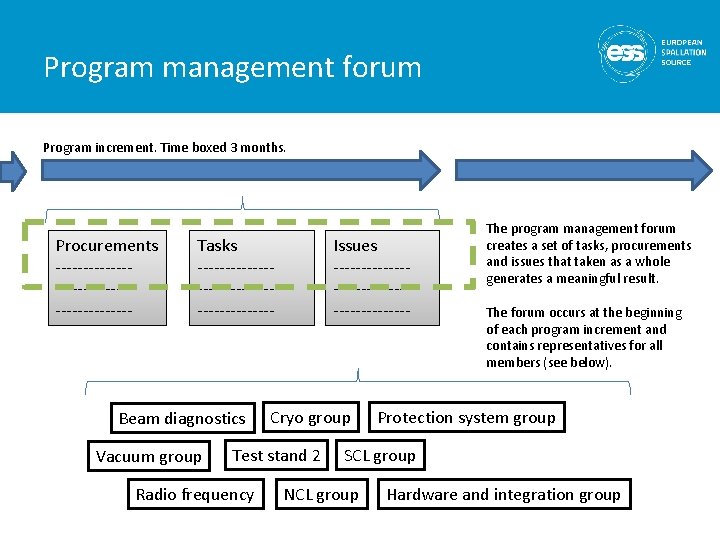
Program management forum Program increment. Time boxed 3 months. Procurements -------------------- Tasks -------------------- Beam diagnostics Vacuum group Issues -------------------- Cryo group Test stand 2 Radio frequency The program management forum creates a set of tasks, procurements and issues that taken as a whole generates a meaningful result. The forum occurs at the beginning of each program increment and contains representatives for all members (see below). Protection system group SCL group NCL group Hardware and integration group
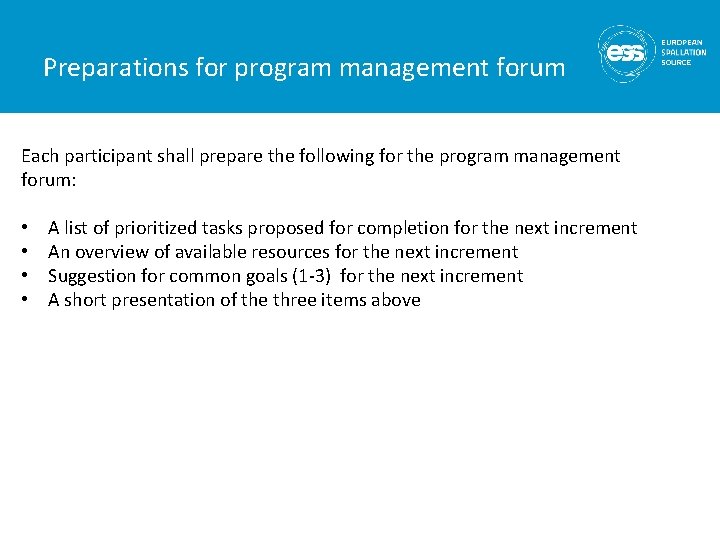
Preparations for program management forum Each participant shall prepare the following for the program management forum: • • A list of prioritized tasks proposed for completion for the next increment An overview of available resources for the next increment Suggestion for common goals (1 -3) for the next increment A short presentation of the three items above
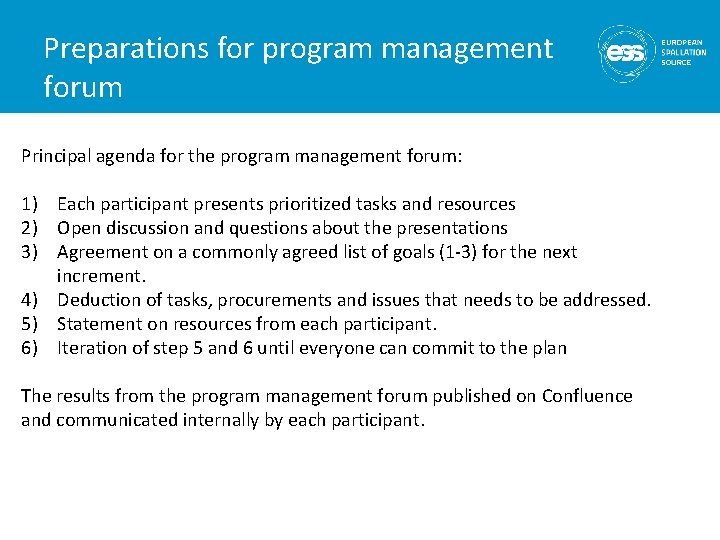
Preparations for program management forum Principal agenda for the program management forum: 1) Each participant presents prioritized tasks and resources 2) Open discussion and questions about the presentations 3) Agreement on a commonly agreed list of goals (1 -3) for the next increment. 4) Deduction of tasks, procurements and issues that needs to be addressed. 5) Statement on resources from each participant. 6) Iteration of step 5 and 6 until everyone can commit to the plan The results from the program management forum published on Confluence and communicated internally by each participant.
- Slides: 14