
Accelerator Research at SLAC for Future HEP Programs
- Slides: 23
Accelerator Research at SLAC for Future HEP Programs Tor Raubenheimer SLUO Annual Meeting September 18, 2008 SLUO Annual Meeting
Introduction * Strong accelerator R&D program aimed at LHC and future HEP accelerators – – LHC and upgrades Super B-factory Project-X (synergistic with ILC and LHC) Linear Collider R&D • ILC • High gradient (X-band CLIC) • Advanced acceleration concepts * Important time to engage community to help set directions for future program – Accelerator R&D is critical to enable future HEP accelerators but it is also costly and must be chosen with care September 18, 2008 SLUO Annual Meeting 2
LHC / LARP Activities * Participate in the LHC accelerator physics program: – Contributing in areas where SLAC has expertise & experience – Enhance SLAC’s areas of core excellence: • Collective effects, RF cavity design, collimation systems, … * Collimation – Rotatable Collimator and crystal collimation * Instrumentation and LLRF diagnostics █ = LARP Approved project – Long-term instrumentation visitor and ongoing work on LLRF system * Accelerator Physics and Design – E-cloud; Beam-Beam Studies; Crab Cavity; PS 2 Studies * Program is synergistic with other SLAC activities – Project-X; Super B-factory; ILC / Linear collider design September 18, 2008 SLUO Annual Meeting 3
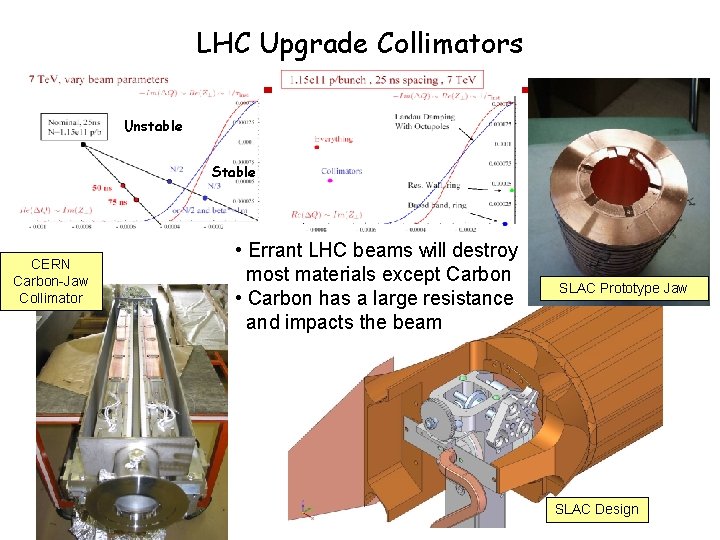
LHC Upgrade Collimators Unstable Stable CERN Carbon-Jaw Collimator • Errant LHC beams will destroy most materials except Carbon • Carbon has a large resistance and impacts the beam SLAC Prototype Jaw SLAC Design
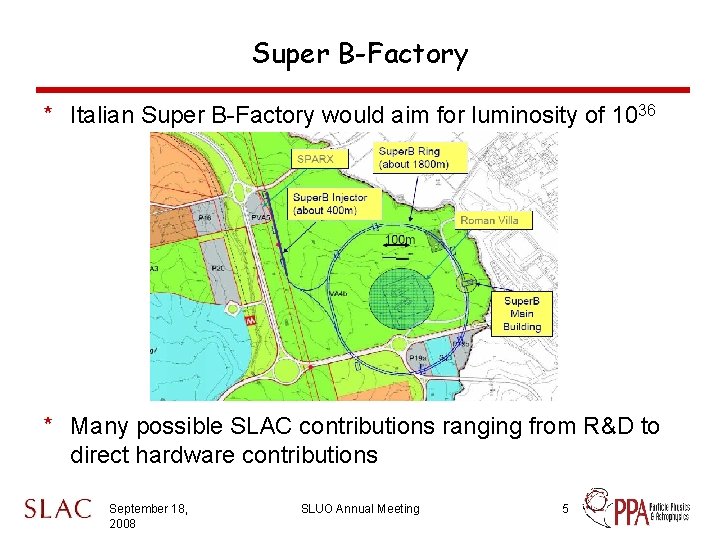
Super B-Factory * Italian Super B-Factory would aim for luminosity of 1036 * Many possible SLAC contributions ranging from R&D to direct hardware contributions September 18, 2008 SLUO Annual Meeting 5
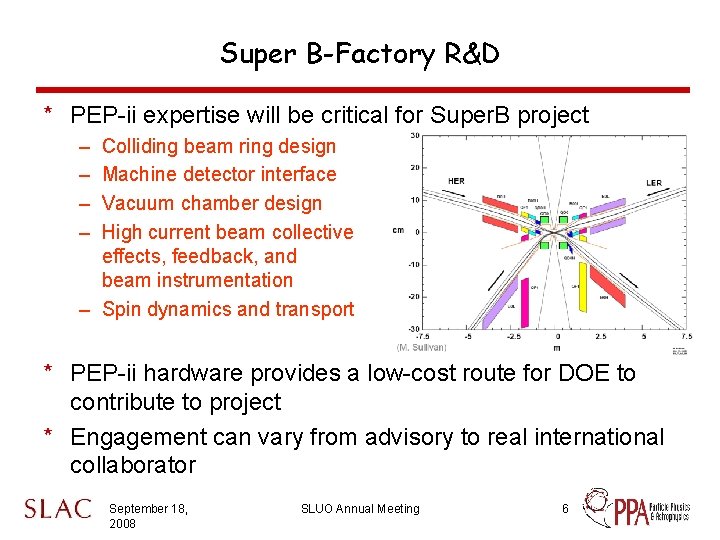
Super B-Factory R&D * PEP-ii expertise will be critical for Super. B project – – Colliding beam ring design Machine detector interface Vacuum chamber design High current beam collective effects, feedback, and beam instrumentation – Spin dynamics and transport * PEP-ii hardware provides a low-cost route for DOE to contribute to project * Engagement can vary from advisory to real international collaborator September 18, 2008 SLUO Annual Meeting 6
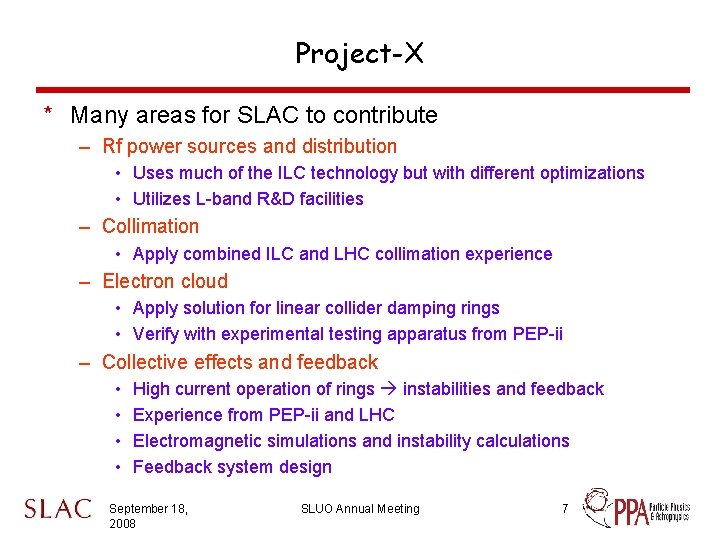
Project-X * Many areas for SLAC to contribute – Rf power sources and distribution • Uses much of the ILC technology but with different optimizations • Utilizes L-band R&D facilities – Collimation • Apply combined ILC and LHC collimation experience – Electron cloud • Apply solution for linear collider damping rings • Verify with experimental testing apparatus from PEP-ii – Collective effects and feedback • • High current operation of rings instabilities and feedback Experience from PEP-ii and LHC Electromagnetic simulations and instability calculations Feedback system design September 18, 2008 SLUO Annual Meeting 7
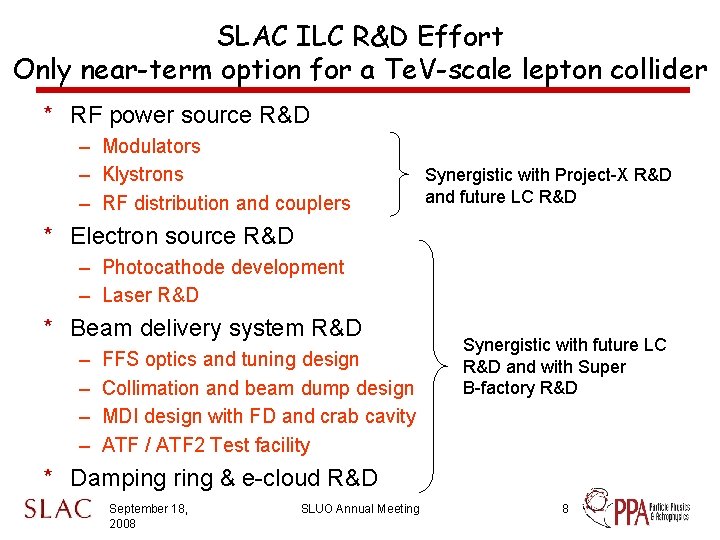
SLAC ILC R&D Effort Only near-term option for a Te. V-scale lepton collider * RF power source R&D – Modulators – Klystrons – RF distribution and couplers Synergistic with Project-X R&D and future LC R&D * Electron source R&D – Photocathode development – Laser R&D * Beam delivery system R&D – – FFS optics and tuning design Collimation and beam dump design MDI design with FD and crab cavity ATF / ATF 2 Test facility Synergistic with future LC R&D and with Super B-factory R&D * Damping ring & e-cloud R&D September 18, 2008 SLUO Annual Meeting 8
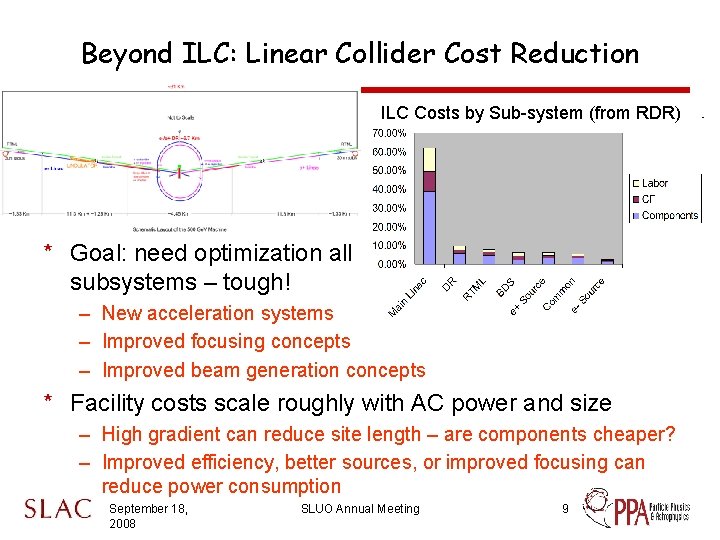
Beyond ILC: Linear Collider Cost Reduction ILC Costs by Sub-system (from RDR) * Goal: need optimization all subsystems – tough! – New acceleration systems – Improved focusing concepts – Improved beam generation concepts * Facility costs scale roughly with AC power and size – High gradient can reduce site length – are components cheaper? – Improved efficiency, better sources, or improved focusing can reduce power consumption September 18, 2008 SLUO Annual Meeting 9
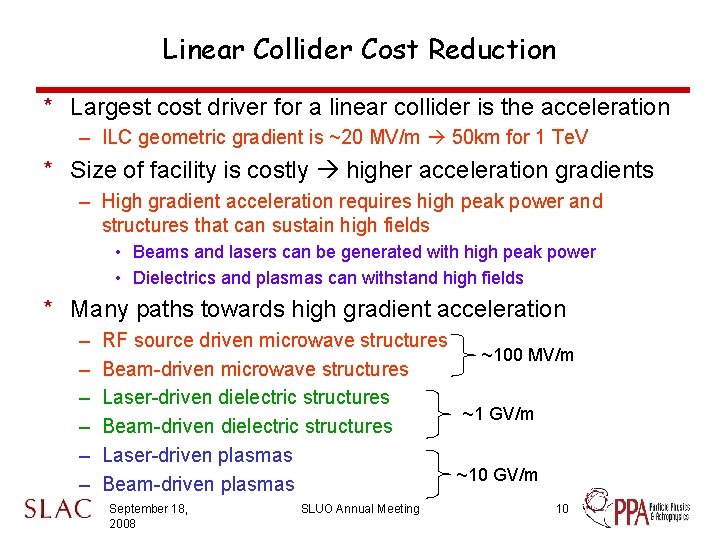
Linear Collider Cost Reduction * Largest cost driver for a linear collider is the acceleration – ILC geometric gradient is ~20 MV/m 50 km for 1 Te. V * Size of facility is costly higher acceleration gradients – High gradient acceleration requires high peak power and structures that can sustain high fields • Beams and lasers can be generated with high peak power • Dielectrics and plasmas can withstand high fields * Many paths towards high gradient acceleration – – – RF source driven microwave structures ~100 MV/m Beam-driven microwave structures Laser-driven dielectric structures ~1 GV/m Beam-driven dielectric structures Laser-driven plasmas ~10 GV/m Beam-driven plasmas September 18, 2008 SLUO Annual Meeting 10
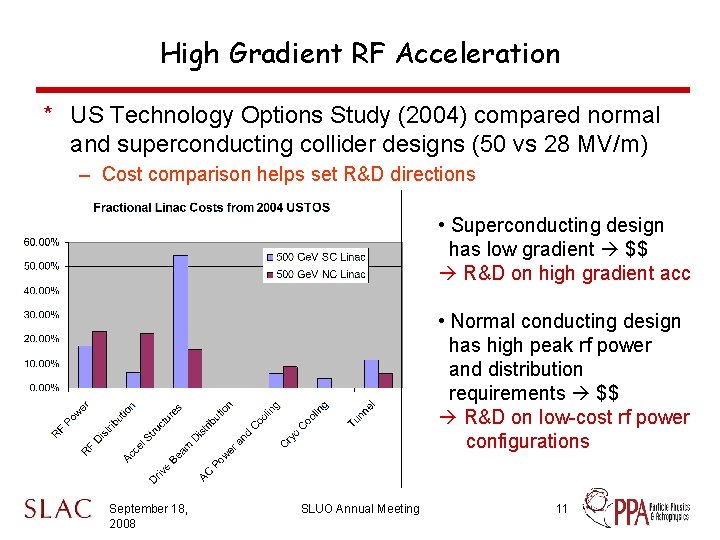
High Gradient RF Acceleration * US Technology Options Study (2004) compared normal and superconducting collider designs (50 vs 28 MV/m) – Cost comparison helps set R&D directions • Superconducting design has low gradient $$ R&D on high gradient acc • Normal conducting design has high peak rf power and distribution requirements $$ R&D on low-cost rf power configurations September 18, 2008 SLUO Annual Meeting 11
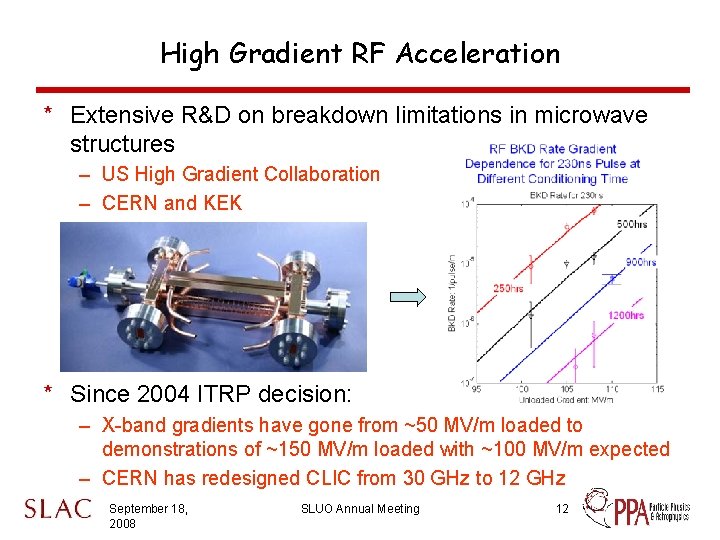
High Gradient RF Acceleration * Extensive R&D on breakdown limitations in microwave structures – US High Gradient Collaboration – CERN and KEK * Since 2004 ITRP decision: – X-band gradients have gone from ~50 MV/m loaded to demonstrations of ~150 MV/m loaded with ~100 MV/m expected – CERN has redesigned CLIC from 30 GHz to 12 GHz September 18, 2008 SLUO Annual Meeting 12
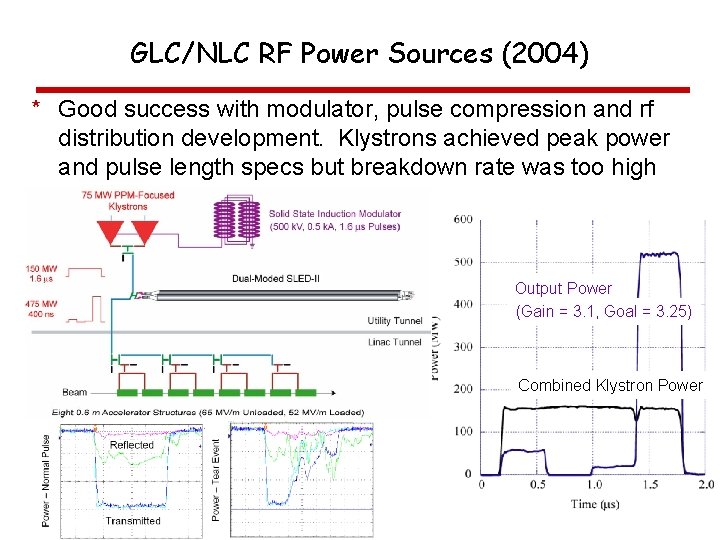
GLC/NLC RF Power Sources (2004) * Good success with modulator, pulse compression and rf distribution development. Klystrons achieved peak power and pulse length specs but breakdown rate was too high Output Power (Gain = 3. 1, Goal = 3. 25) Combined Klystron Power
SLAC RF Power Source R&D * Developing novel rf power sources for ILC / Project-X: – Marx solid state modulator – broad applicability of technology – Sheet beam klystron – broad applicability of SBK concept * Developed rf power source for GLC/NLC: – SLED-II system delivered >500 MW – Two-Pac modulator fabricated but not fully tested – halted in 2004 – X-band klystrons worked at 75 MW / 1. 5 us but many breakdowns →Consider new output structures or reduced power levels using knowledge from high gradient studies * Propose to complete X-band rf source development – Could provide a conservative option for an X-band design – Broad applicability: power sources for compact radiation sources and other compact linacs (complements High Gradient Program) September 18, 2008 SLUO Annual Meeting 14
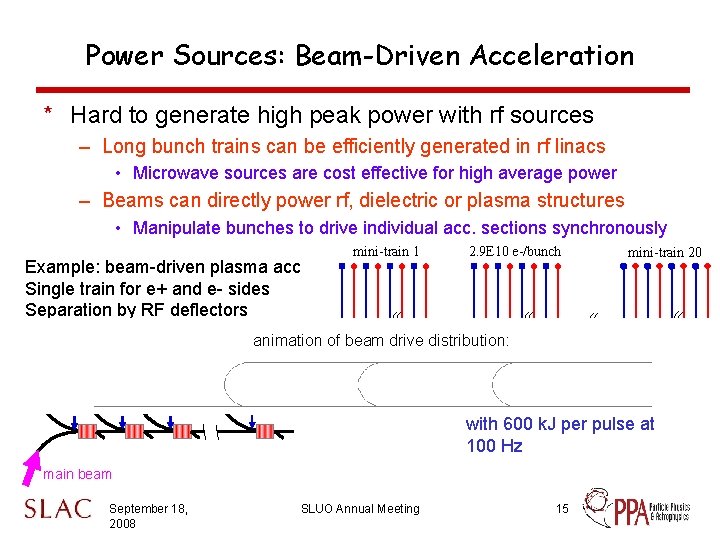
Power Sources: Beam-Driven Acceleration * Hard to generate high peak power with rf sources – Long bunch trains can be efficiently generated in rf linacs • Microwave sources are cost effective for high average power – Beams can directly power rf, dielectric or plasma structures • Manipulate bunches to drive individual acc. sections synchronously Example: beam-driven plasma acc Single train for e+ and e- sides Separation by RF deflectors Kickers mini-train 1 2. 9 E 10 e-/bunch animation of beam drive distribution: 500 ns 100 ns feedforward 2*125 bunches 12 ms train kicker gap 25 Ge. V linac train of 5000 PW bunches with 600 k. J per pulse at 100 Hz main beam September 18, 2008 mini-train 20 SLUO Annual Meeting 15
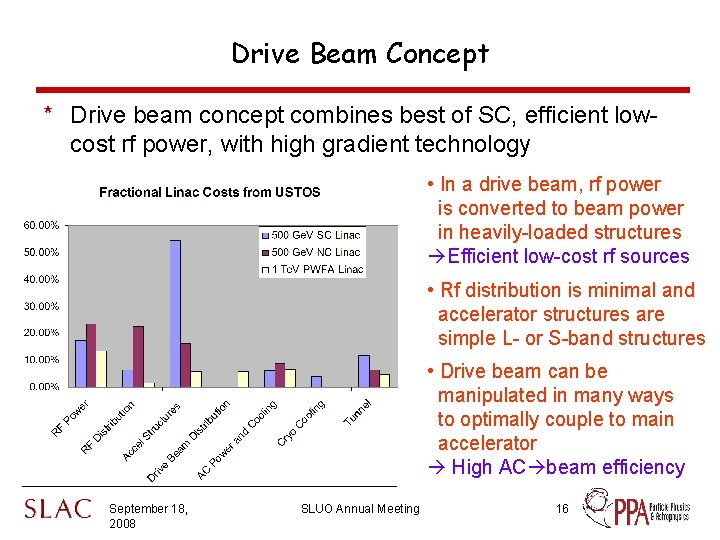
Drive Beam Concept * Drive beam concept combines best of SC, efficient lowcost rf power, with high gradient technology • In a drive beam, rf power is converted to beam power in heavily-loaded structures Efficient low-cost rf sources • Rf distribution is minimal and accelerator structures are simple L- or S-band structures • Drive beam can be manipulated in many ways to optimally couple to main accelerator High AC beam efficiency September 18, 2008 SLUO Annual Meeting 16
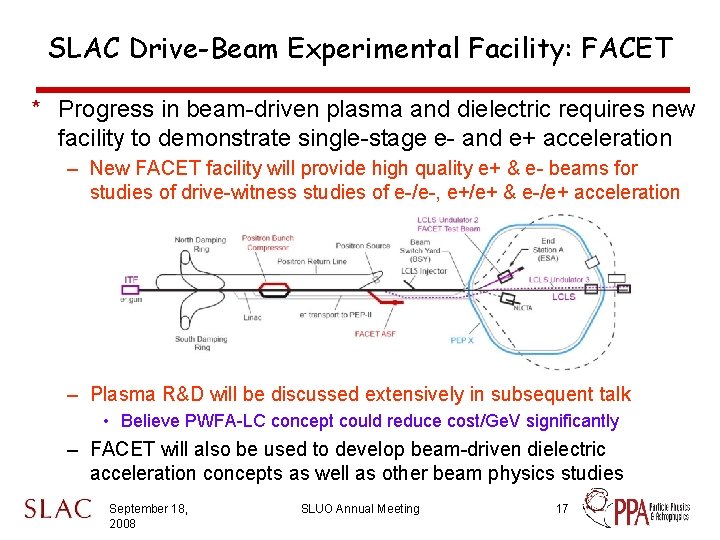
SLAC Drive-Beam Experimental Facility: FACET * Progress in beam-driven plasma and dielectric requires new facility to demonstrate single-stage e- and e+ acceleration – New FACET facility will provide high quality e+ & e- beams for studies of drive-witness studies of e-/e-, e+/e+ & e-/e+ acceleration – Plasma R&D will be discussed extensively in subsequent talk • Believe PWFA-LC concept could reduce cost/Ge. V significantly – FACET will also be used to develop beam-driven dielectric acceleration concepts as well as other beam physics studies September 18, 2008 SLUO Annual Meeting 17
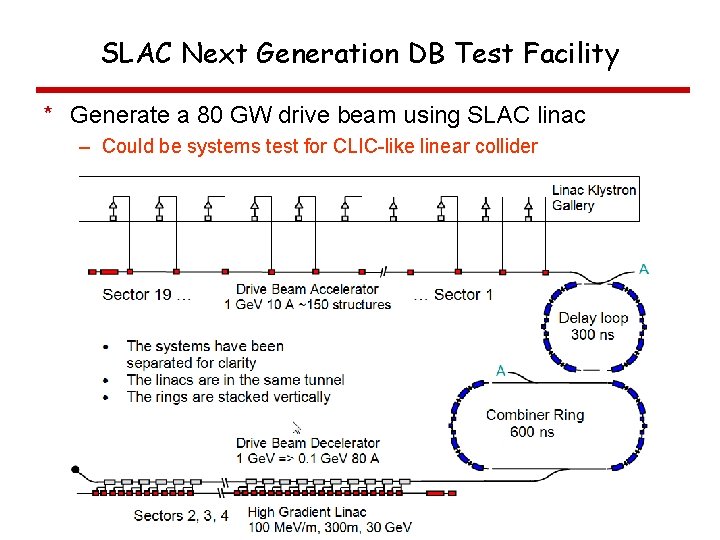
SLAC Next Generation DB Test Facility * Generate a 80 GW drive beam using SLAC linac – Could be systems test for CLIC-like linear collider
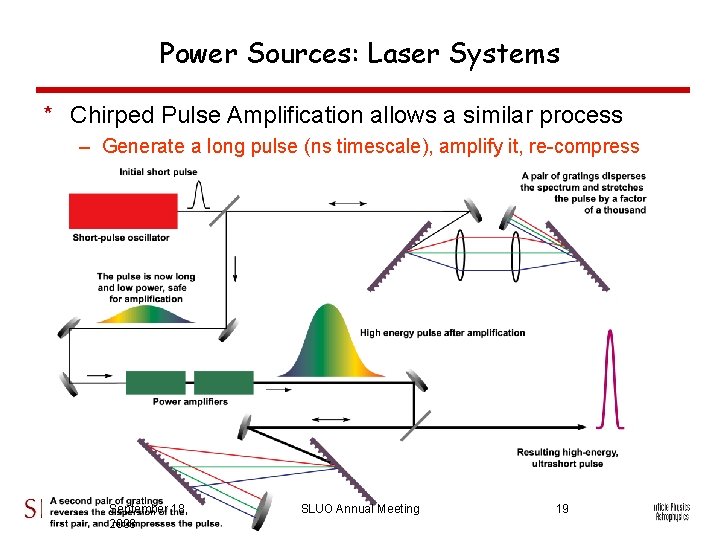
Power Sources: Laser Systems * Chirped Pulse Amplification allows a similar process – Generate a long pulse (ns timescale), amplify it, re-compress September 18, 2008 SLUO Annual Meeting 19
Power Systems: Lasers * Present high power laser systems are too inefficient and too expensive – Billion $ industrial effort working on both issues * Two approaches: – Laser wakefield (plasma) acceleration – Direct laser (dielectric) acceleration (10 GV/m) (1 GV/m) * Very different laser requirements – Both require high average power must generate beam power – Lasers are most efficient and cost effective near CW operation • Best use of expensive amplification medium Pursuing direct laser acceleration with ~10, 000 times lower peak power requirements than laser-driven plasma acceleration and more favorable cost scaling September 18, 2008 SLUO Annual Meeting 20
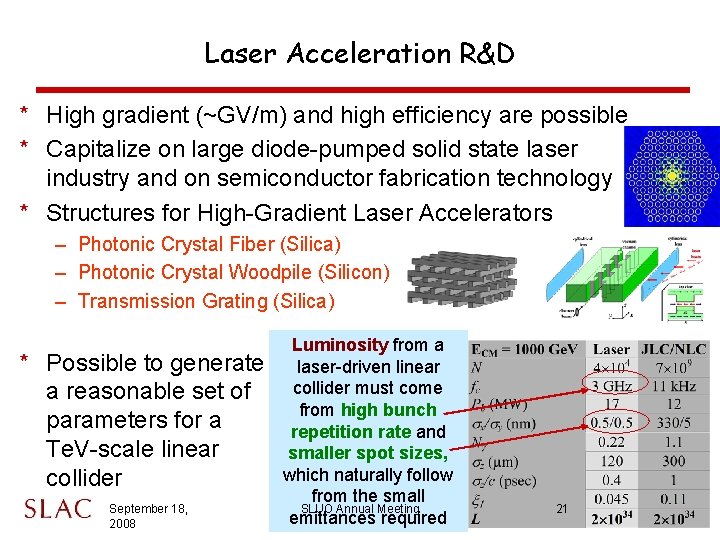
Laser Acceleration R&D * High gradient (~GV/m) and high efficiency are possible * Capitalize on large diode-pumped solid state laser industry and on semiconductor fabrication technology * Structures for High-Gradient Laser Accelerators – Photonic Crystal Fiber (Silica) – Photonic Crystal Woodpile (Silicon) – Transmission Grating (Silica) * Possible to generate a reasonable set of parameters for a Te. V-scale linear collider September 18, 2008 Luminosity from a laser-driven linear collider must come from high bunch repetition rate and smaller spot sizes, which naturally follow from the small SLUO Annual Meeting emittances required 21
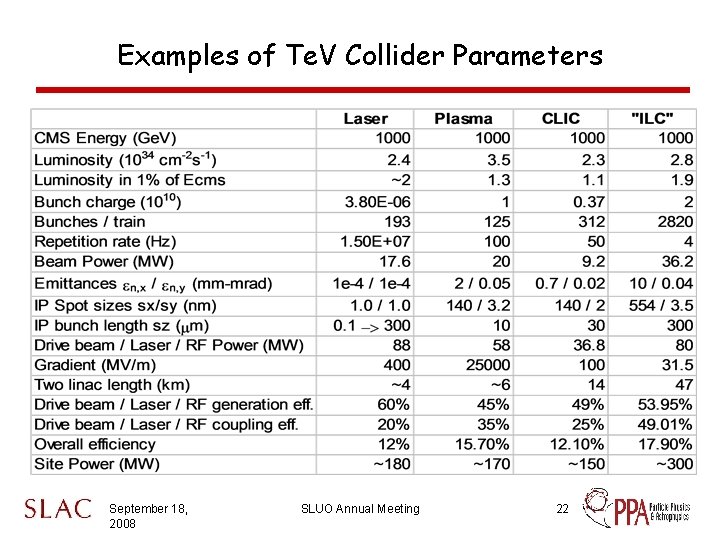
Examples of Te. V Collider Parameters September 18, 2008 SLUO Annual Meeting 22
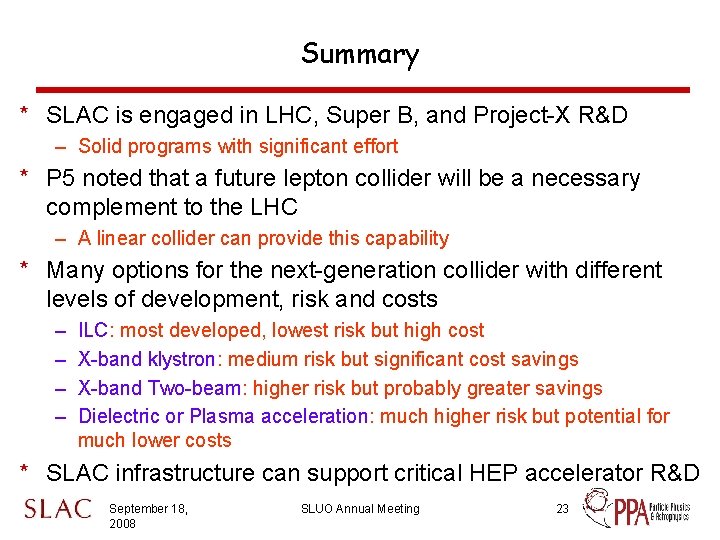
Summary * SLAC is engaged in LHC, Super B, and Project-X R&D – Solid programs with significant effort * P 5 noted that a future lepton collider will be a necessary complement to the LHC – A linear collider can provide this capability * Many options for the next-generation collider with different levels of development, risk and costs – – ILC: most developed, lowest risk but high cost X-band klystron: medium risk but significant cost savings X-band Two-beam: higher risk but probably greater savings Dielectric or Plasma acceleration: much higher risk but potential for much lower costs * SLAC infrastructure can support critical HEP accelerator R&D September 18, 2008 SLUO Annual Meeting 23