
Accelerator Production of Medical Radioisotopes Rob Edgecock History
Accelerator Production of Medical Radioisotopes Rob Edgecock • History • Current status • Future problems with availability • Our solution • Conclusions
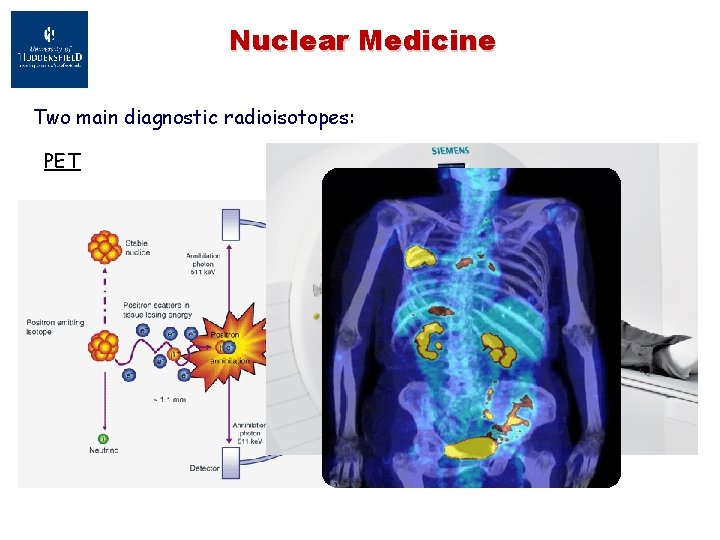
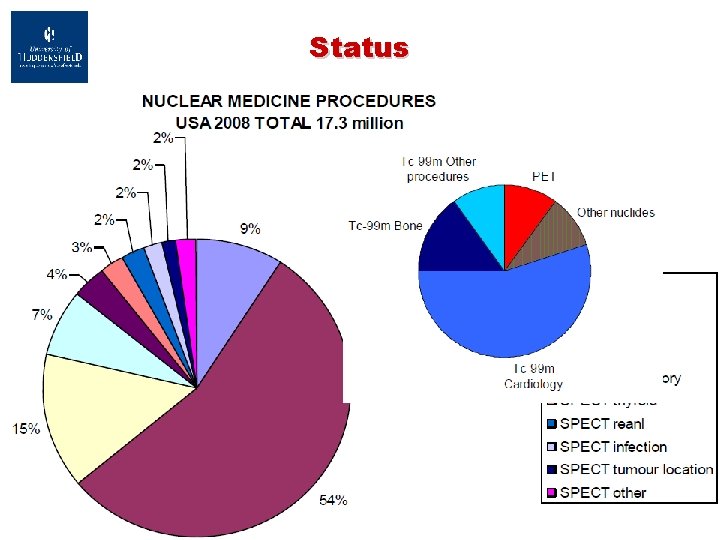
Nuclear Medicine Two main diagnostic radioisotopes: PET

Nuclear Medicine Two main diagnostic radioisotopes: Single photon emitters - SPECT

History First cyclotron built by Ernest O. Lawrence & Stanley Livingston at Berkeley in 1932. Energy = 80 ke. V, Diameter = 13 cm
History - Timeline 1932 Invention of cyclotron 1937 Hamilton & Stone use radioactive sodium clinically 1938 Hertz, Roberts & Evans use radioactive iodine to study thyroid 1939 Lawrence, Scott & Tuttle study leukemia with radioactive phosphorus 1940 Hamilton & Soley study iodine metabolism of thyroid 1941 First medical cyclotron in Washington University for phosphorus, iron, arsenic and sulphur production After WWII After development of fission process, most radioisotopes produced in nuclear reactors 1951 Cassen et al developed rectilinear scanner 1957 99 Mo/99 m. Tc 1958 First gamma camera produced by Anger generator system developed by BNL
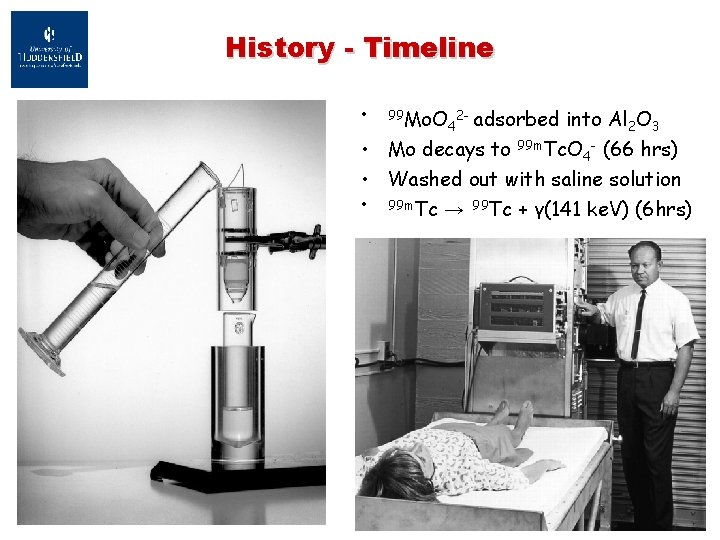
History - Timeline • 99 Mo. O 2 - adsorbed into Al O 4 2 3 Mo decays to 99 m. Tc. O 4 - (66 hrs) • • Washed out with saline solution • 99 m. Tc → 99 Tc + γ(141 ke. V) (6 hrs)
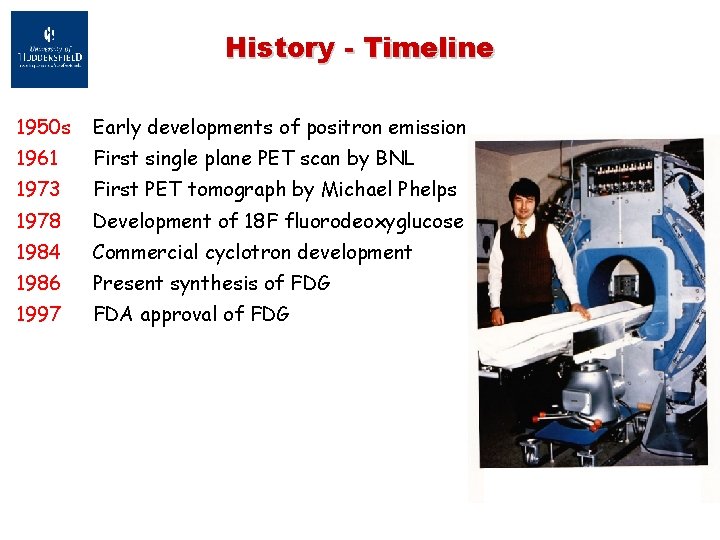
History - Timeline 1950 s Early developments of positron emission 1961 First single plane PET scan by BNL 1973 First PET tomograph by Michael Phelps 1978 Development of 18 F fluorodeoxyglucose 1984 Commercial cyclotron development 1986 Present synthesis of FDG 1997 FDA approval of FDG
Status
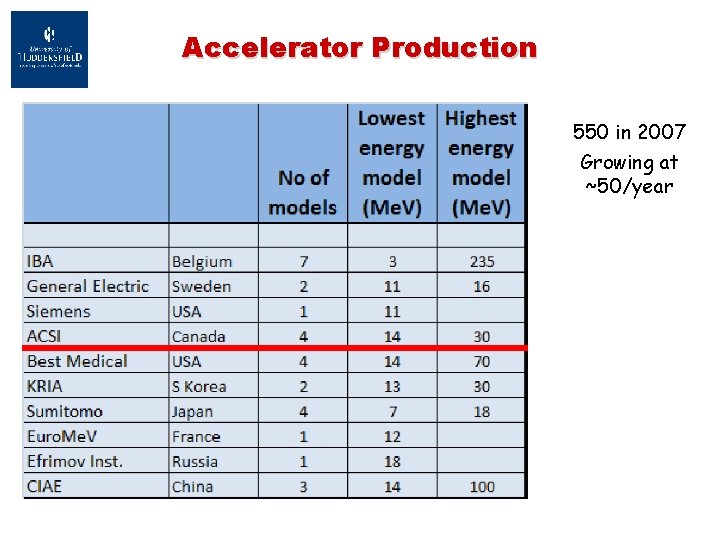
Accelerator Production 550 in 2007 Growing at ~50/year
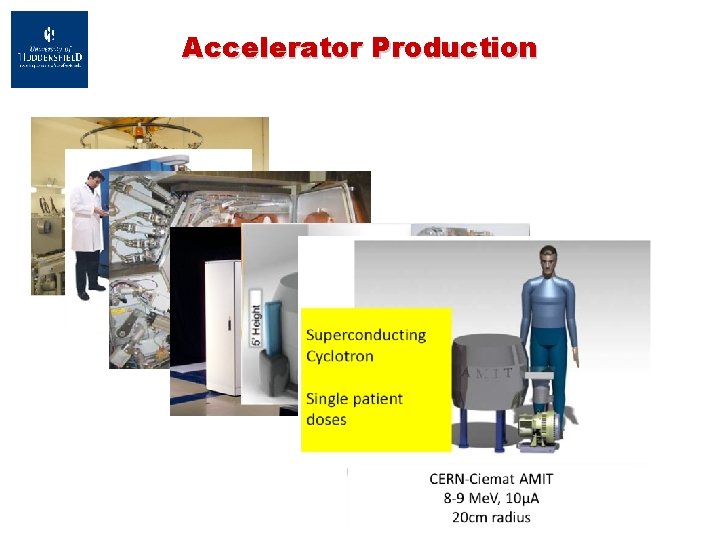
Accelerator Production
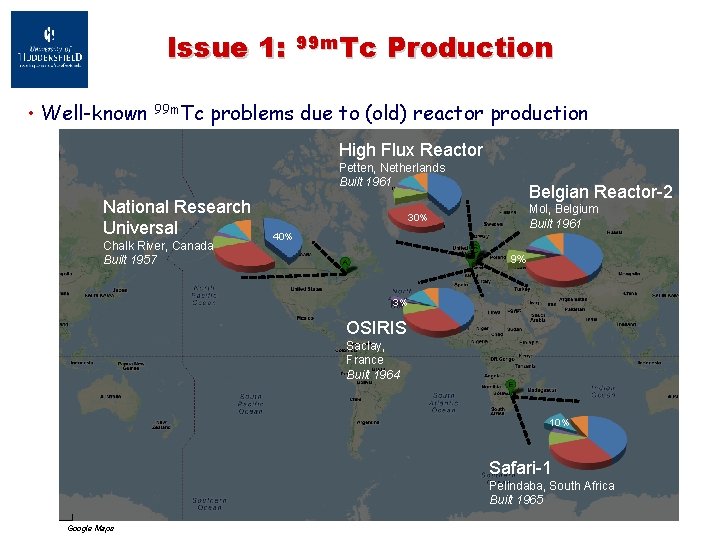
Issue 1: 99 m. Tc Production • Well-known 99 m. Tc problems due to (old) reactor production High Flux Reactor Petten, Netherlands Built 1961 National Research Universal Chalk River, Canada Built 1957 Belgian Reactor-2 Mol, Belgium Built 1961 30% 40% 9% 3% OSIRIS Saclay, France Built 1964 10% Safari-1 Pelindaba, South Africa Built 1965 Google Maps
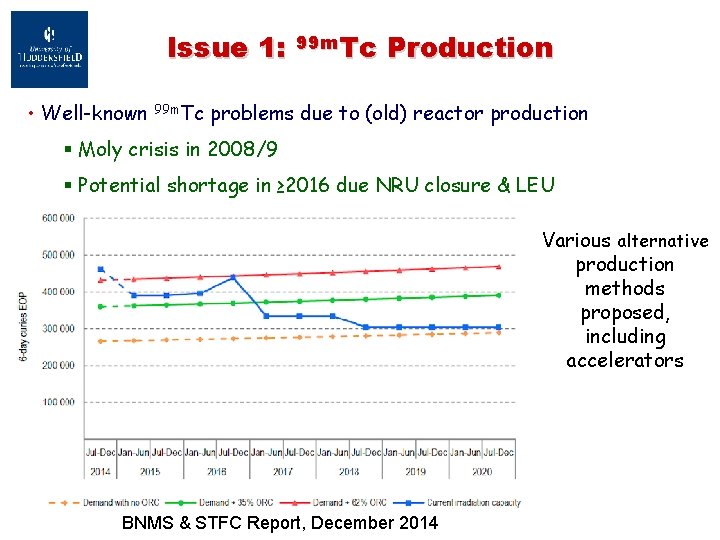
Issue 1: 99 m. Tc Production • Well-known 99 m. Tc problems due to (old) reactor production § Moly crisis in 2008/9 § Potential shortage in ≥ 2016 due NRU closure & LEU Various alternative production methods proposed, including accelerators BNMS & STFC Report, December 2014

Accelerator Production 100 Mo Reaction: target 100 Mo(p, 2 n)99 m. Tc Proton accelerators 98 Mo Heavy nucleus target Reaction: target n 98 Mo(n, γ)99 Mo 235 U Reaction: target Particle accelerators 235 U(n, f)99 Mo 238 U Electron accelerators Deuteron accelerators Bremsstrahlung target Carbon target Primary particle Nuclear Energy Agency: direct production Reaction: 238 U(γ, f)99 Mo target γ n 100 Mo target Secondary particle 100 Mo(p, 2 n)99 m. Tc Reaction: 100 Mo(γ, n)99 Mo Reaction: 100 Mo(n, 2 n)99 Mo Short term: <2017 Med term: 2017 -2025 Long term: >2025
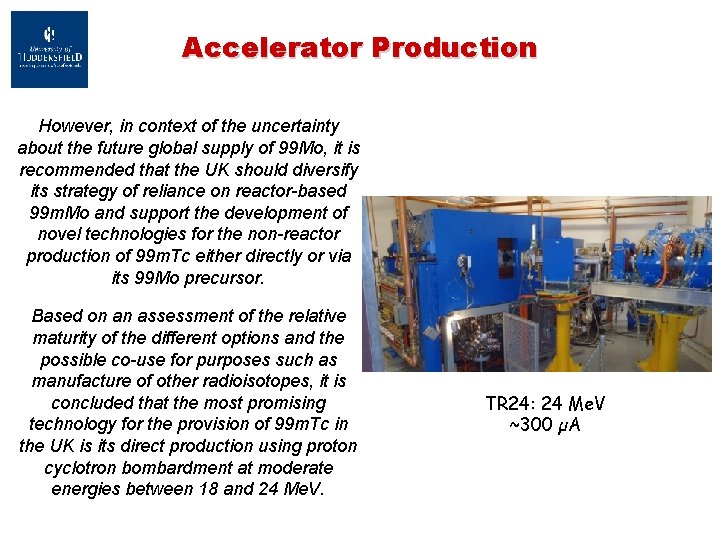
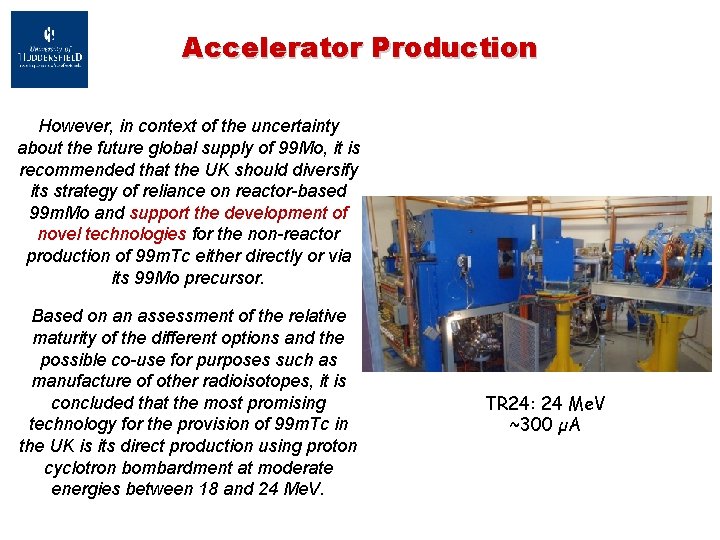
Accelerator Production However, in context of the uncertainty about the future global supply of 99 Mo, it is recommended that the UK should diversify its strategy of reliance on reactor-based 99 m. Mo and support the development of novel technologies for the non-reactor production of 99 m. Tc either directly or via its 99 Mo precursor. Based on an assessment of the relative maturity of the different options and the possible co-use for purposes such as manufacture of other radioisotopes, it is concluded that the most promising technology for the provision of 99 m. Tc in the UK is its direct production using proton cyclotron bombardment at moderate energies between 18 and 24 Me. V. TR 24: 24 Me. V ~300 µA
Accelerator Production However, in context of the uncertainty about the future global supply of 99 Mo, it is recommended that the UK should diversify its strategy of reliance on reactor-based 99 m. Mo and support the development of novel technologies for the non-reactor production of 99 m. Tc either directly or via its 99 Mo precursor. Based on an assessment of the relative maturity of the different options and the possible co-use for purposes such as manufacture of other radioisotopes, it is concluded that the most promising technology for the provision of 99 m. Tc in the UK is its direct production using proton cyclotron bombardment at moderate energies between 18 and 24 Me. V. TR 24: 24 Me. V ~300 µA
Issue 2: Alternative isotopes • Replace 99 m. Tc with other radioisotopes • PET, e. g. 18 F, 82 Rb, 68 Ga, 11 C, ? • Other SPECT isotopes, e. g. 123 I, 87 m. Sr, 113 m. In, 81 m. Kr, etc • Potential problem: increased production costs • Needs more cost effective accelerator production
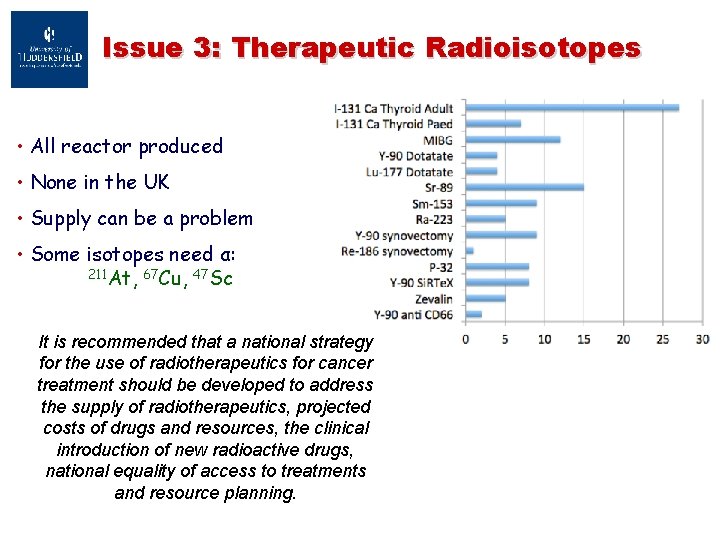
Issue 3: Therapeutic Radioisotopes • All reactor produced • None in the UK • Supply can be a problem • Some isotopes need α: 211 At, 67 Cu, 47 Sc It is recommended that a national strategy for the use of radiotherapeutics for cancer treatment should be developed to address the supply of radiotherapeutics, projected costs of drugs and resources, the clinical introduction of new radioactive drugs, national equality of access to treatments and resource planning.
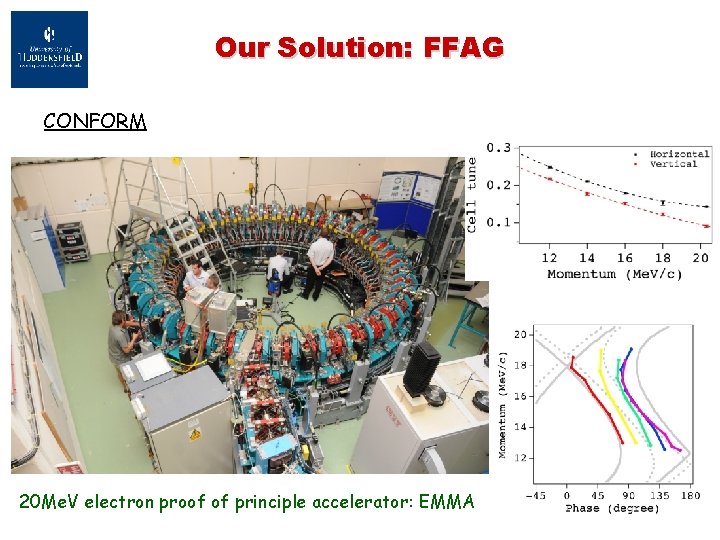
Our Solution: FFAG CONFORM 20 Me. V electron proof of principle accelerator: EMMA
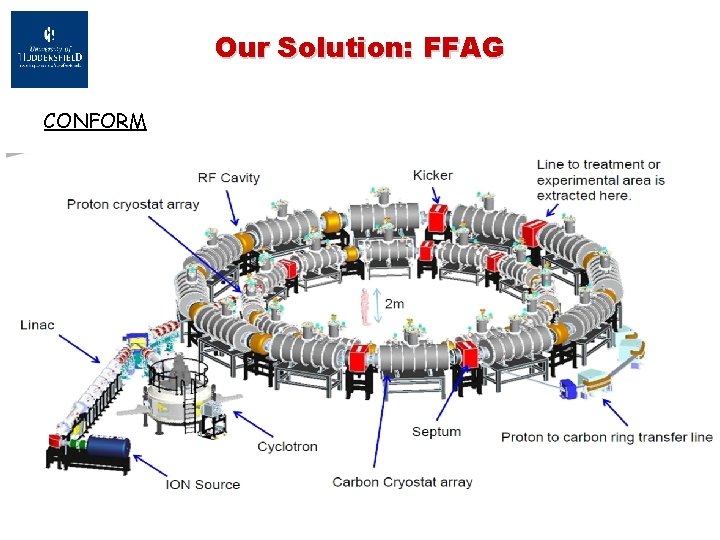
Our Solution: FFAG CONFORM
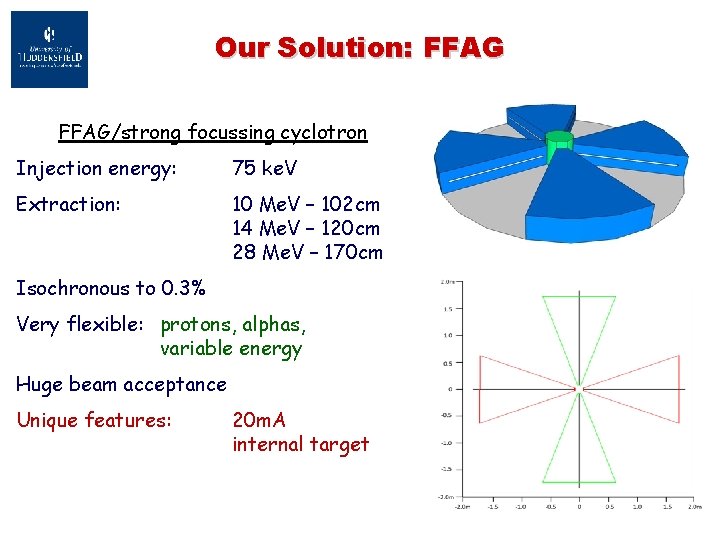
Our Solution: FFAG/strong focussing cyclotron Injection energy: 75 ke. V Extraction: 10 Me. V – 102 cm 14 Me. V – 120 cm 28 Me. V – 170 cm Isochronous to 0. 3% Very flexible: protons, alphas, variable energy Huge beam acceptance Unique features: 20 m. A internal target
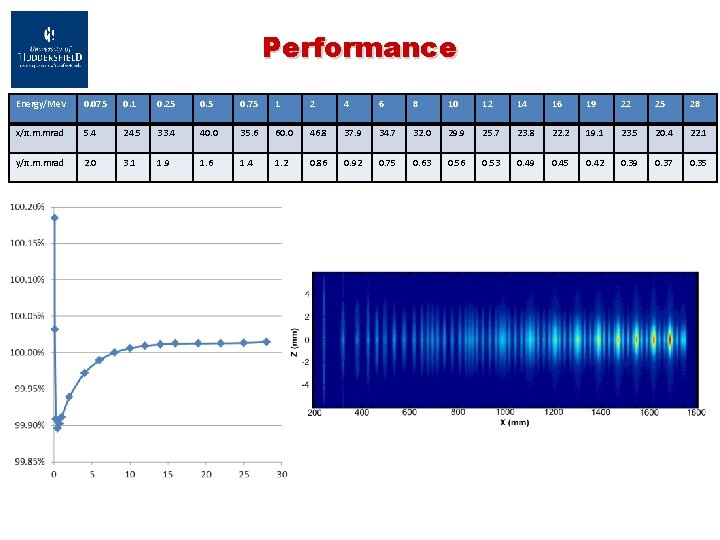
Performance Energy/Me. V 0. 075 0. 1 0. 25 0. 75 1 2 4 6 8 10 12 14 16 19 22 25 28 x/π. m. mrad 5. 4 24. 5 33. 4 40. 0 35. 6 60. 0 46. 8 37. 9 34. 7 32. 0 29. 9 25. 7 23. 8 22. 2 19. 1 23. 5 20. 4 22. 1 y/π. m. mrad 2. 0 3. 1 1. 9 1. 6 1. 4 1. 2 0. 86 0. 92 0. 75 0. 63 0. 56 0. 53 0. 49 0. 45 0. 42 0. 39 0. 37 0. 35
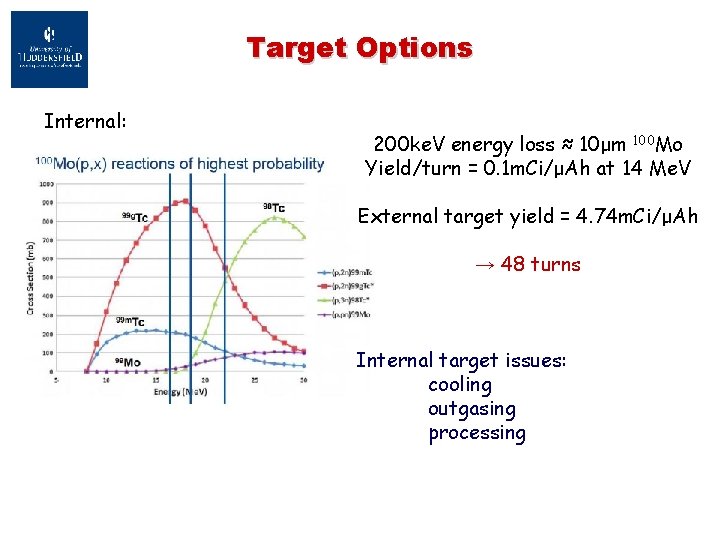
Target Options Internal: 200 ke. V energy loss ≈ 10μm 100 Mo Yield/turn = 0. 1 m. Ci/μAh at 14 Me. V External target yield = 4. 74 m. Ci/μAh → 48 turns Internal target issues: cooling outgasing processing
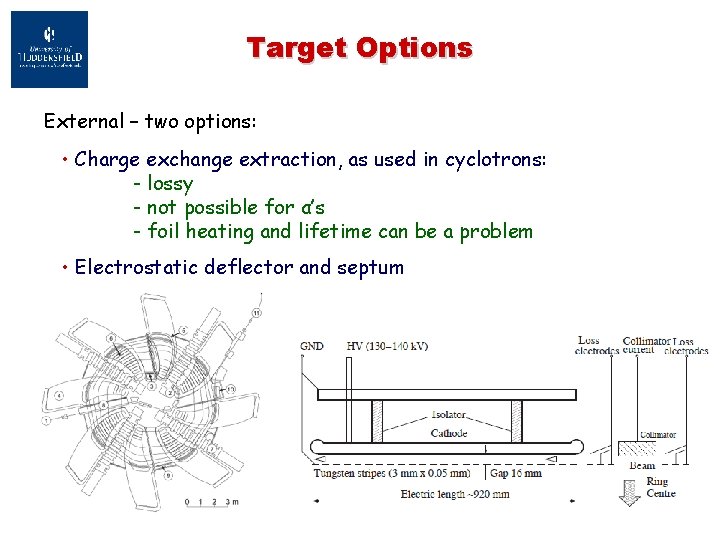
Target Options External – two options: • Charge exchange extraction, as used in cyclotrons: - lossy - not possible for α’s - foil heating and lifetime can be a problem • Electrostatic deflector and septum
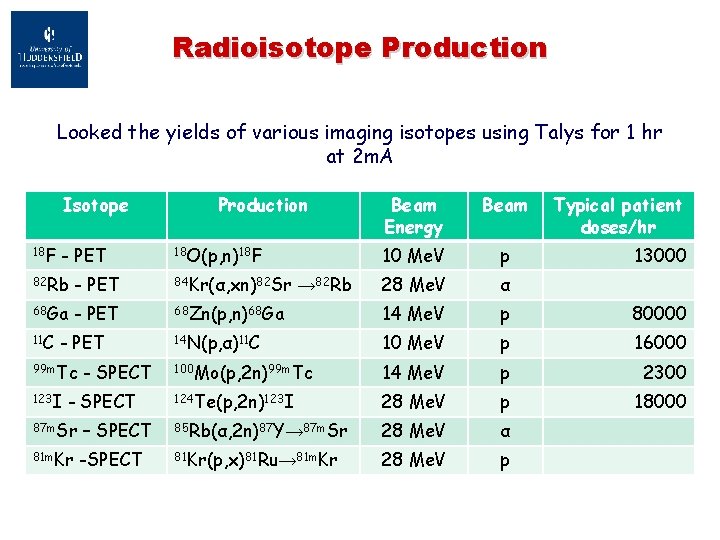
Radioisotope Production Looked the yields of various imaging isotopes using Talys for 1 hr at 2 m. A Isotope 18 F - PET Production 18 O(p, n)18 F Beam 10 Me. V p 28 Me. V α Typical patient doses/hr 13000 82 Rb - PET 84 Kr(α, xn)82 Sr 68 Ga - PET 68 Zn(p, n)68 Ga 14 Me. V p 80000 14 N(p, α)11 C 10 Me. V p 16000 100 Mo(p, 2 n)99 m. Tc 14 Me. V p 2300 124 Te(p, 2 n)123 I 28 Me. V p 18000 11 C - PET 99 m. Tc 123 I - SPECT → 82 Rb Beam Energy 87 m. Sr – SPECT 85 Rb(α, 2 n)87 Y→ 87 m. Sr 28 Me. V α 81 m. Kr -SPECT 81 Kr(p, x)81 Ru→ 81 m. Kr 28 Me. V p
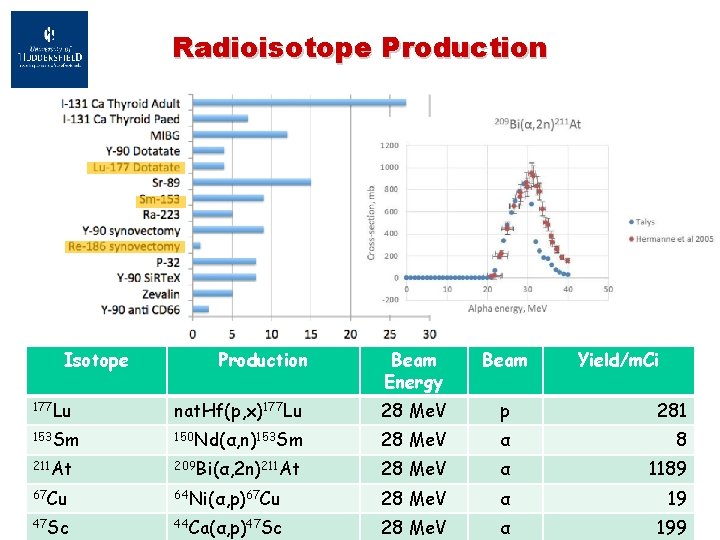
Radioisotope Production Isotope Production Beam Energy Beam Yield/m. Ci 177 Lu nat. Hf(p, x)177 Lu 28 Me. V p 281 153 Sm 150 Nd(α, n)153 Sm 28 Me. V α 8 211 At 209 Bi(α, 2 n)211 At 28 Me. V α 1189 67 Cu 64 Ni(α, p)67 Cu 28 Me. V α 19 47 Sc 44 Ca(α, p)47 Sc 28 Me. V α 199
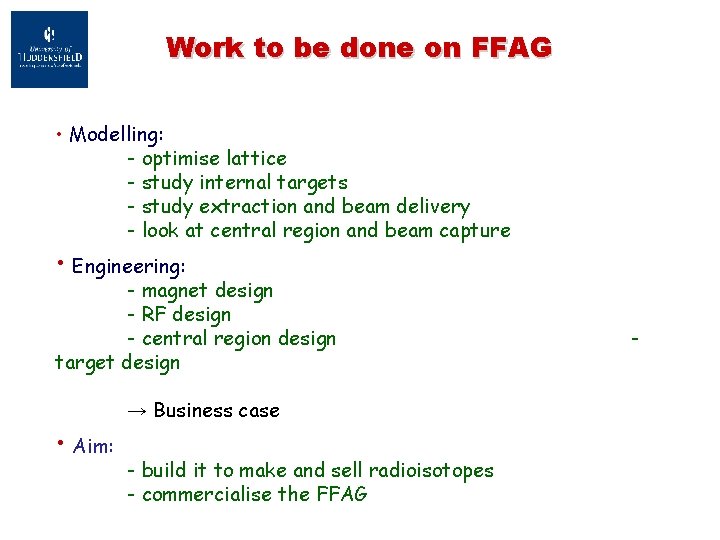
Work to be done on FFAG • Modelling: - optimise lattice - study internal targets - study extraction and beam delivery - look at central region and beam capture • Engineering: - magnet design - RF design - central region design target design • Aim: → Business case - build it to make and sell radioisotopes - commercialise the FFAG -
Work to be done on FFAG • Modelling: - optimise lattice - study internal targets - study extraction and beam delivery - look at central region and beam capture • Engineering: - magnet design - RF design - central region design target design • Aim: → Business case - build it to make and sell radioisotopes - commercialise the FFAG -
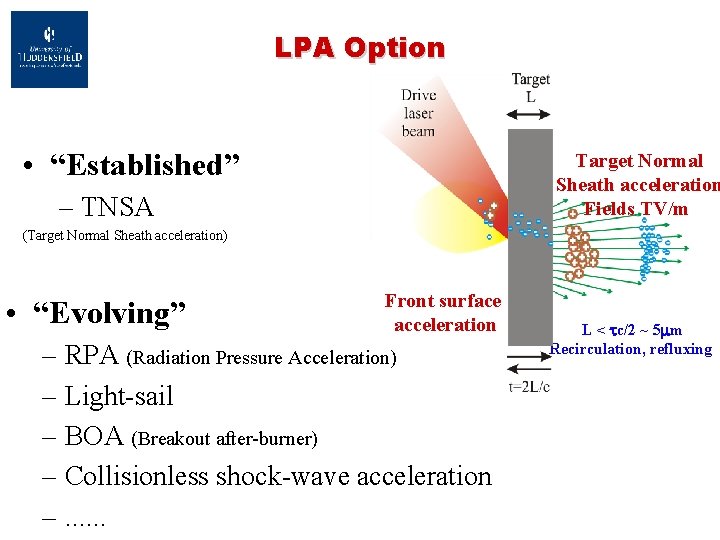
LPA Option • “Established” Target Normal Sheath acceleration Fields TV/m – TNSA (Target Normal Sheath acceleration) • “Evolving” Front surface acceleration – RPA (Radiation Pressure Acceleration) – Light-sail – BOA (Breakout after-burner) – Collisionless shock-wave acceleration –. . . L < tc/2 ~ 5 mm Recirculation, refluxing
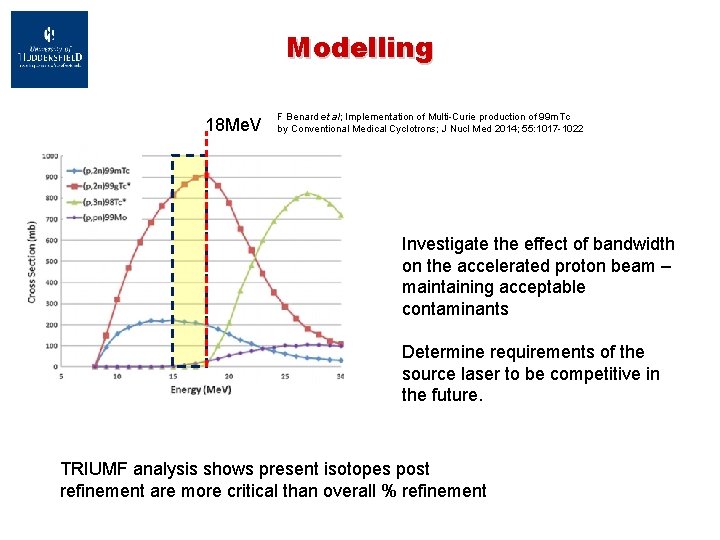
Modelling 18 Me. V F Benard et al; Implementation of Multi-Curie production of 99 m. Tc by Conventional Medical Cyclotrons; J Nucl Med 2014; 55: 1017 -1022 Investigate the effect of bandwidth on the accelerated proton beam – maintaining acceptable contaminants Determine requirements of the source laser to be competitive in the future. TRIUMF analysis shows present isotopes post refinement are more critical than overall % refinement
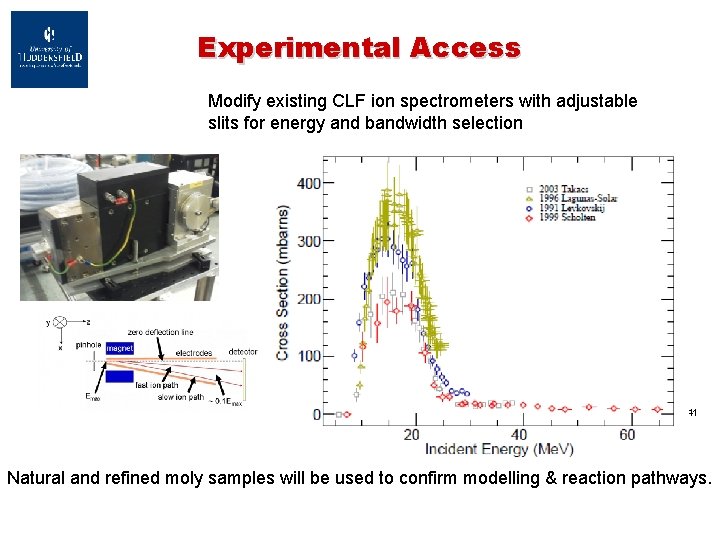
Experimental Access Modify existing CLF ion spectrometers with adjustable slits for energy and bandwidth selection K. Leddingham et al 2004 J. Phys. D: Appl. Phys. 37 2341 Natural and refined moly samples will be used to confirm modelling & reaction pathways.
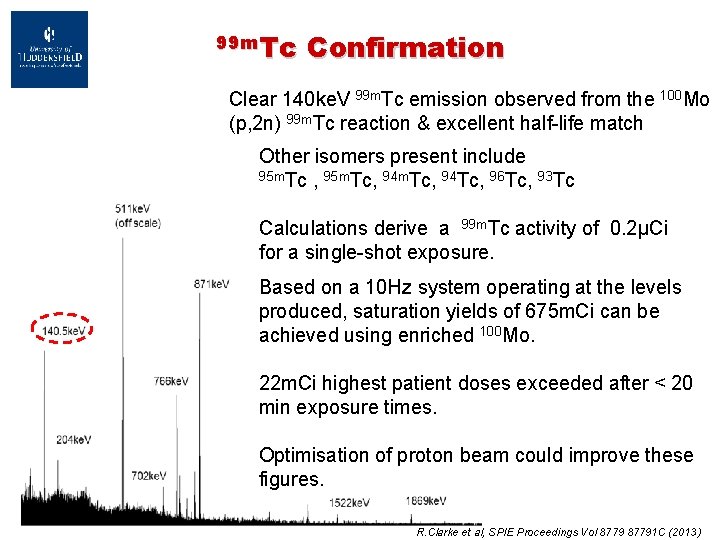
99 m. Tc Confirmation Clear 140 ke. V 99 m. Tc emission observed from the 100 Mo (p, 2 n) 99 m. Tc reaction & excellent half-life match Other isomers present include 95 m. Tc , 95 m. Tc, 94 Tc, 96 Tc, 93 Tc Calculations derive a 99 m. Tc activity of 0. 2μCi for a single-shot exposure. Based on a 10 Hz system operating at the levels produced, saturation yields of 675 m. Ci can be achieved using enriched 100 Mo. 22 m. Ci highest patient doses exceeded after < 20 min exposure times. Optimisation of proton beam could improve these figures. R. Clarke et al, SPIE Proceedings Vol 87791 C (2013)
Conclusions • Problems with future radioisotope supply: - 99 m. Tc availability - cost effective production of PET and SPECT alternatives - Therapeutic radioisotope availability • Proposing a solution to all of these • Struggling to get funding to pursue it (as usual)
- Slides: 32