
Accelerator Physics Luminosity G A Krafft Old Dominion

- Slides: 20
Accelerator Physics Luminosity G. A. Krafft Old Dominion University Jefferson Lab Lecture 26 Graduate Accelerator Physics Fall 2017
Luminosity and Beam-Beam Effect • Luminosity Defined • Beam-Beam Tune Shift • Luminosity Tune-shift Relationship (Krafft-Ziemann Thm. ) • Beam-Beam Effect Graduate Accelerator Physics Fall 2017
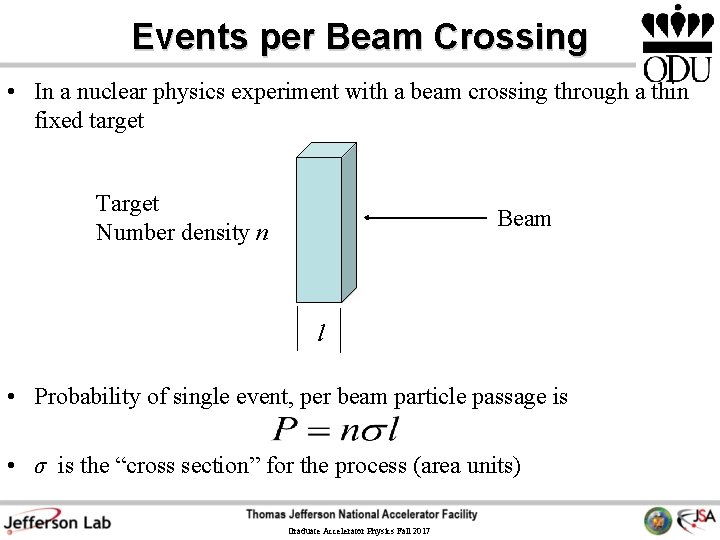
Events per Beam Crossing • In a nuclear physics experiment with a beam crossing through a thin fixed target Target Number density n Beam l • Probability of single event, per beam particle passage is • σ is the “cross section” for the process (area units) Graduate Accelerator Physics Fall 2017
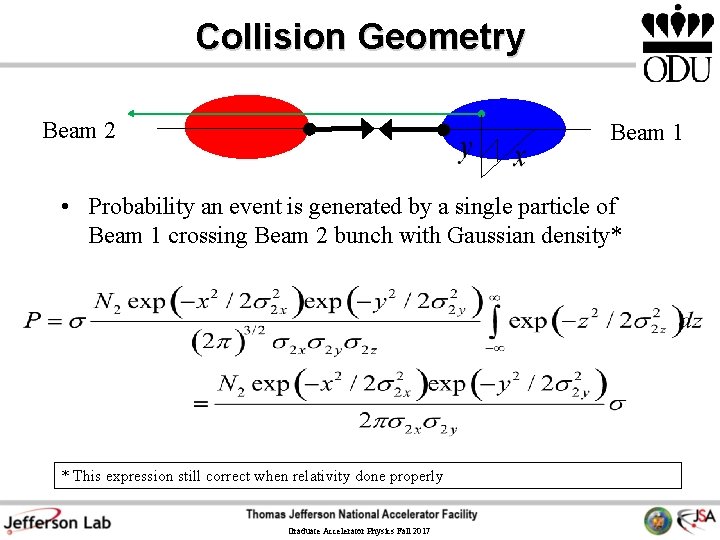
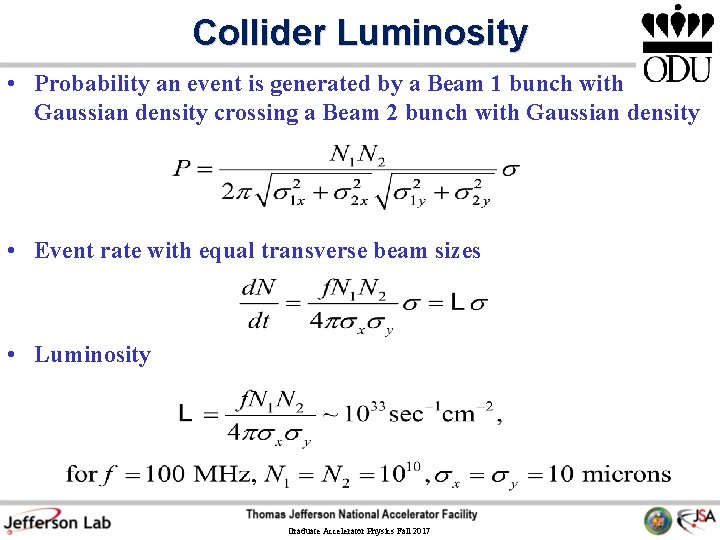
Collision Geometry Beam 2 Beam 1 • Probability an event is generated by a single particle of Beam 1 crossing Beam 2 bunch with Gaussian density* * This expression still correct when relativity done properly Graduate Accelerator Physics Fall 2017
Collider Luminosity • Probability an event is generated by a Beam 1 bunch with Gaussian density crossing a Beam 2 bunch with Gaussian density • Event rate with equal transverse beam sizes • Luminosity Graduate Accelerator Physics Fall 2017
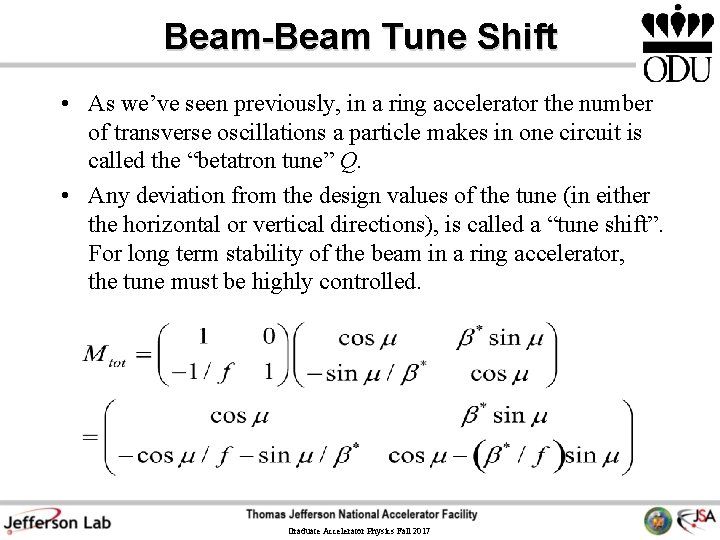
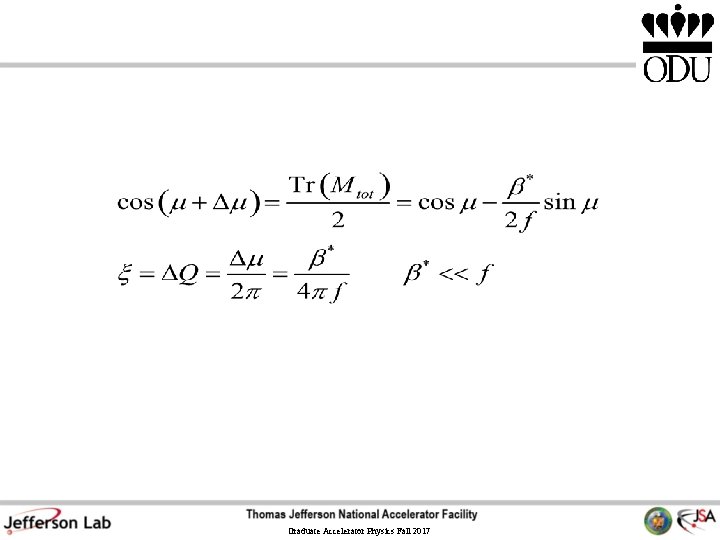
Beam-Beam Tune Shift • As we’ve seen previously, in a ring accelerator the number of transverse oscillations a particle makes in one circuit is called the “betatron tune” Q. • Any deviation from the design values of the tune (in either the horizontal or vertical directions), is called a “tune shift”. For long term stability of the beam in a ring accelerator, the tune must be highly controlled. Graduate Accelerator Physics Fall 2017
Graduate Accelerator Physics Fall 2017
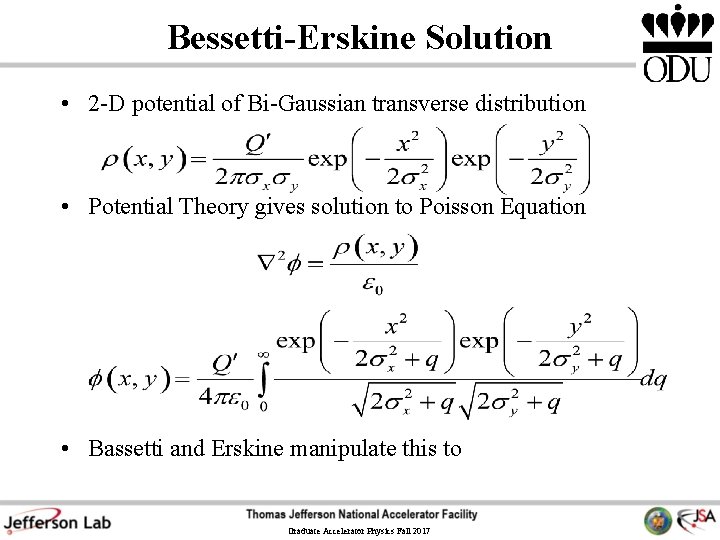
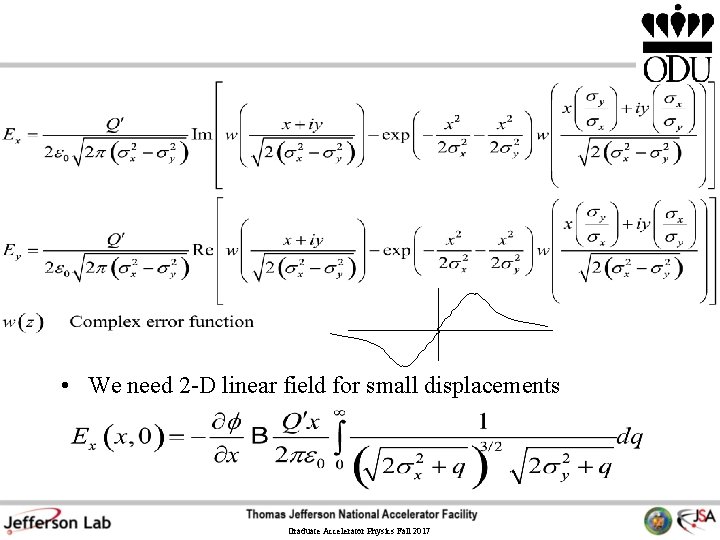
Bessetti-Erskine Solution • 2 -D potential of Bi-Gaussian transverse distribution • Potential Theory gives solution to Poisson Equation • Bassetti and Erskine manipulate this to Graduate Accelerator Physics Fall 2017
• We need 2 -D linear field for small displacements Graduate Accelerator Physics Fall 2017
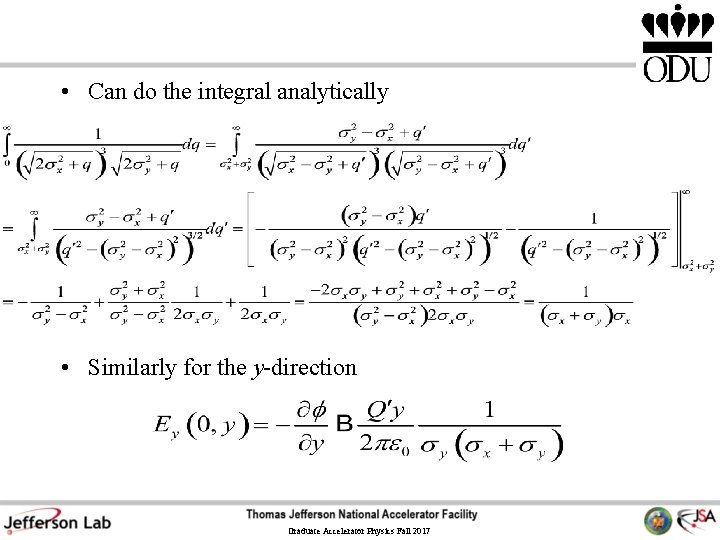
• Can do the integral analytically • Similarly for the y-direction Graduate Accelerator Physics Fall 2017
Linear Beam-Beam Kick • Linear kick received after interaction with bunch Graduate Accelerator Physics Fall 2017
Linear Beam-Beam Tune Shift Graduate Accelerator Physics Fall 2017
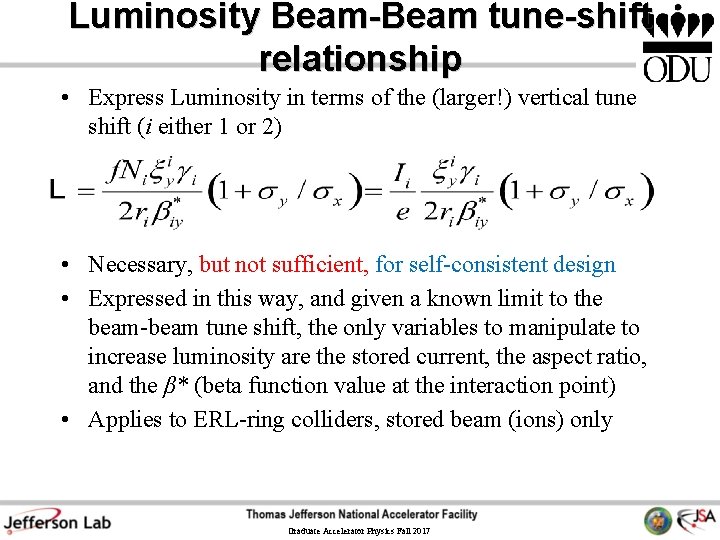
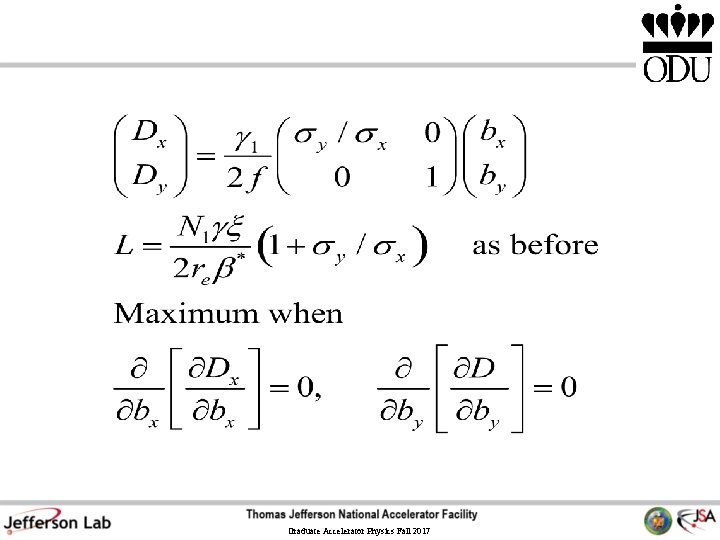
Luminosity Beam-Beam tune-shift relationship • Express Luminosity in terms of the (larger!) vertical tune shift (i either 1 or 2) • Necessary, but not sufficient, for self-consistent design • Expressed in this way, and given a known limit to the beam-beam tune shift, the only variables to manipulate to increase luminosity are the stored current, the aspect ratio, and the β* (beta function value at the interaction point) • Applies to ERL-ring colliders, stored beam (ions) only Graduate Accelerator Physics Fall 2017
Luminosity-Deflection Theorem • Luminosity-tune shift formula is linearized version of a much more general formula discovered by Krafft and generalized by V. Ziemann. • Relates easy calculation (luminosity) to a hard calculation (beam-beam force), and contains all the standard results in beam-beam interaction theory. • Based on the fact that the relativistic beam-beam force is almost entirely transverse, i. e. , 2 -D electrostatics applies. Graduate Accelerator Physics Fall 2017
2 -D Electrostatics Theorem Graduate Accelerator Physics Fall 2017
Graduate Accelerator Physics Fall 2017
Graduate Accelerator Physics Fall 2017
Graduate Accelerator Physics Fall 2017
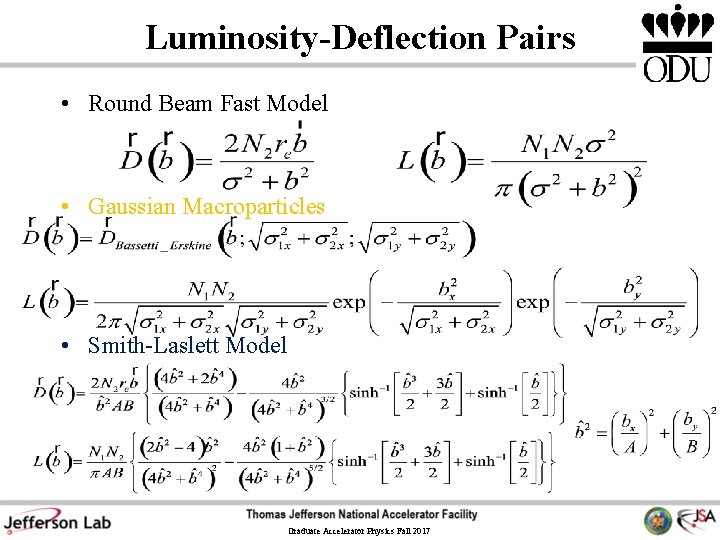
Luminosity-Deflection Pairs • Round Beam Fast Model • Gaussian Macroparticles • Smith-Laslett Model Graduate Accelerator Physics Fall 2017
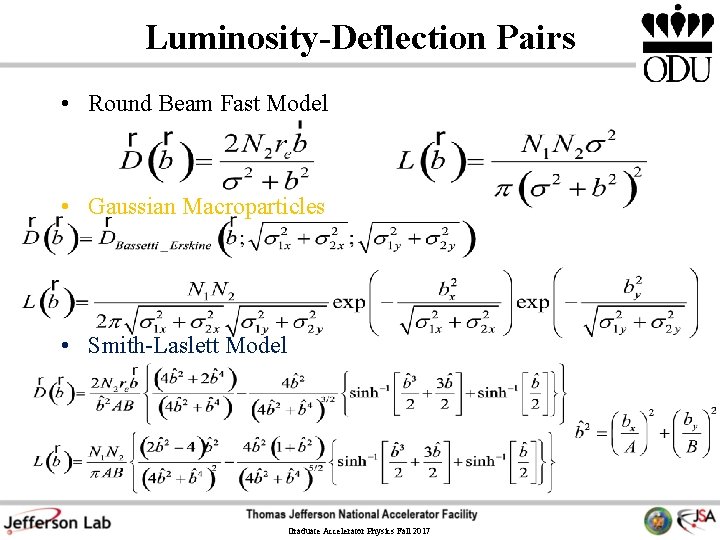
Luminosity-Deflection Pairs • Round Beam Fast Model • Gaussian Macroparticles • Smith-Laslett Model Graduate Accelerator Physics Fall 2017