
Accelerator layout 1000 components almost 300 magnets and



- Slides: 21
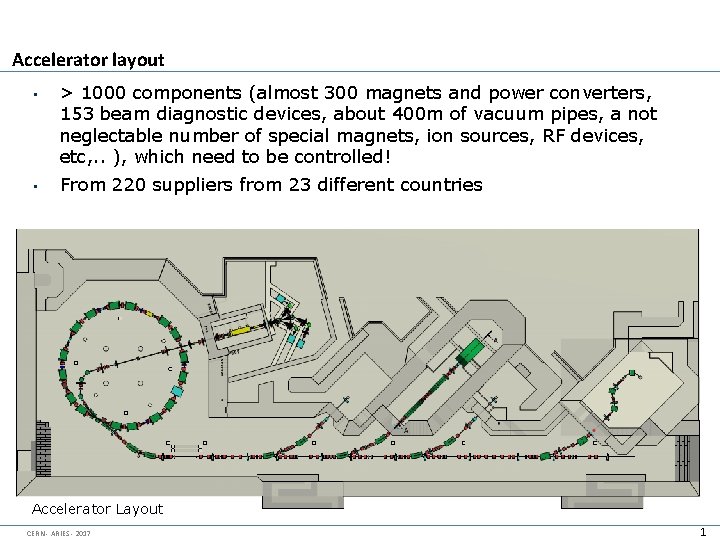
Accelerator layout • > 1000 components (almost 300 magnets and power converters, 153 beam diagnostic devices, about 400 m of vacuum pipes, a not neglectable number of special magnets, ion sources, RF devices, etc, . . ), which need to be controlled! • From 220 suppliers from 23 different countries Accelerator Layout CERN - ARIES - 2017 1
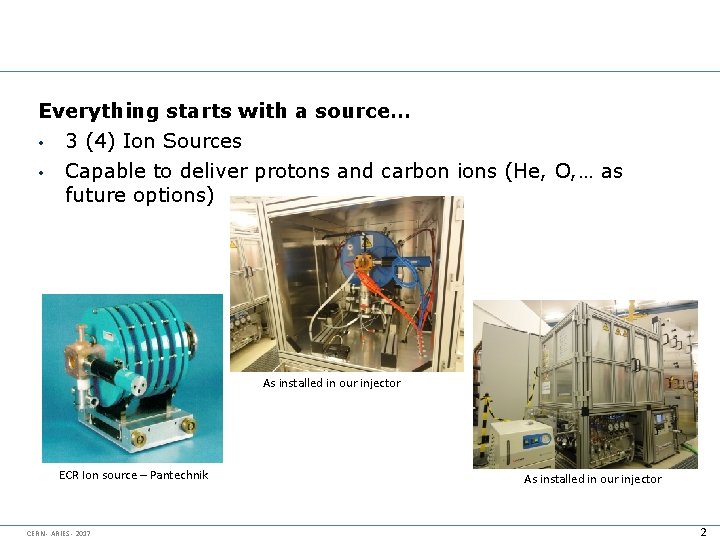
Everything starts with a source… • 3 (4) Ion Sources • Capable to deliver protons and carbon ions (He, O, … as future options) As installed in our injector ECR Ion source – Pantechnik CERN - ARIES - 2017 As installed in our injector 2
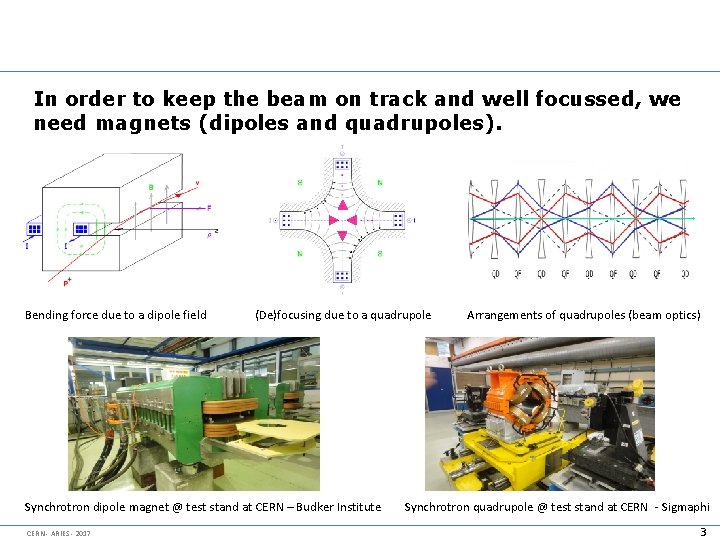
In order to keep the beam on track and well focussed, we need magnets (dipoles and quadrupoles). Bending force due to a dipole field (De)focusing due to a quadrupole Synchrotron dipole magnet @ test stand at CERN – Budker Institute CERN - ARIES - 2017 Arrangements of quadrupoles (beam optics) Synchrotron quadrupole @ test stand at CERN - Sigmaphi 3
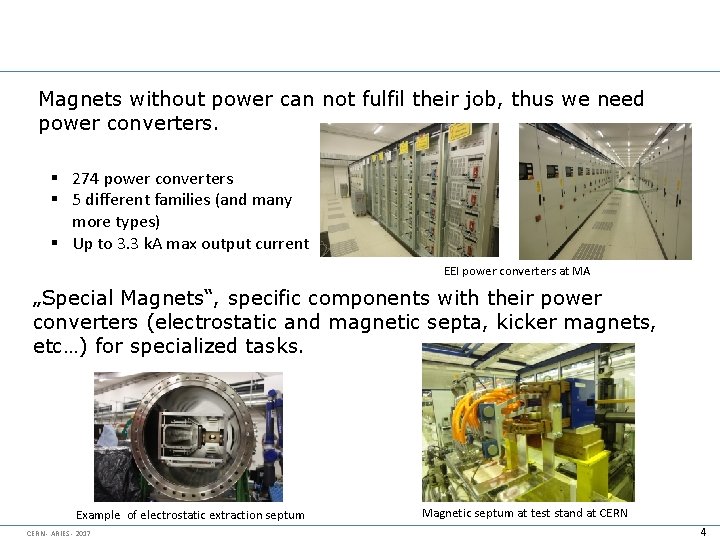
Magnets without power can not fulfil their job, thus we need power converters. § 274 power converters § 5 different families (and many more types) § Up to 3. 3 k. A max output current EEI power converters at MA „Special Magnets“, specific components with their power converters (electrostatic and magnetic septa, kicker magnets, etc…) for specialized tasks. Example of electrostatic extraction septum CERN - ARIES - 2017 Magnetic septum at test stand at CERN 4
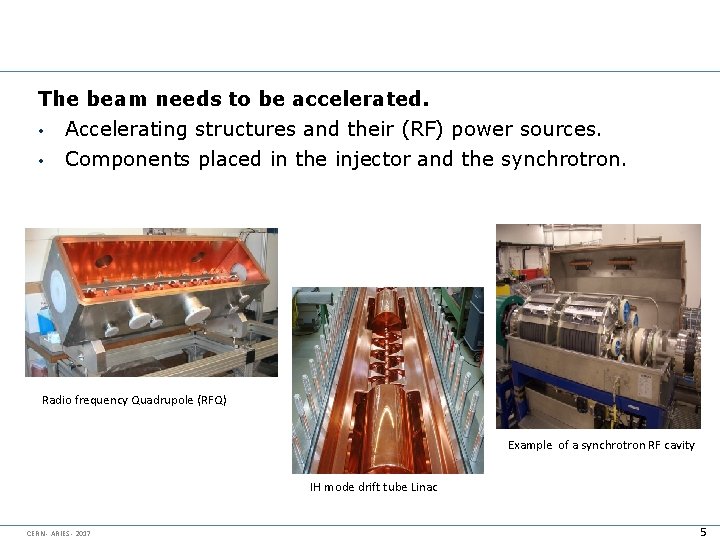
The beam needs to be accelerated. • Accelerating structures and their (RF) power sources. • Components placed in the injector and the synchrotron. Radio frequency Quadrupole (RFQ) Example of a synchrotron RF cavity IH mode drift tube Linac CERN - ARIES - 2017 5
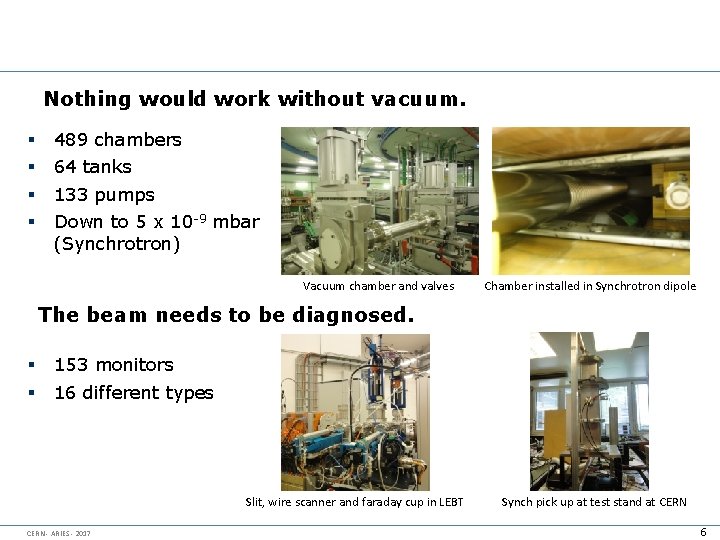
Nothing would work without vacuum. § § 489 chambers 64 tanks 133 pumps Down to 5 x 10 -9 mbar (Synchrotron) Vacuum chamber and valves Chamber installed in Synchrotron dipole The beam needs to be diagnosed. § § 153 monitors 16 different types Slit, wire scanner and faraday cup in LEBT CERN - ARIES - 2017 Synch pick up at test stand at CERN 6
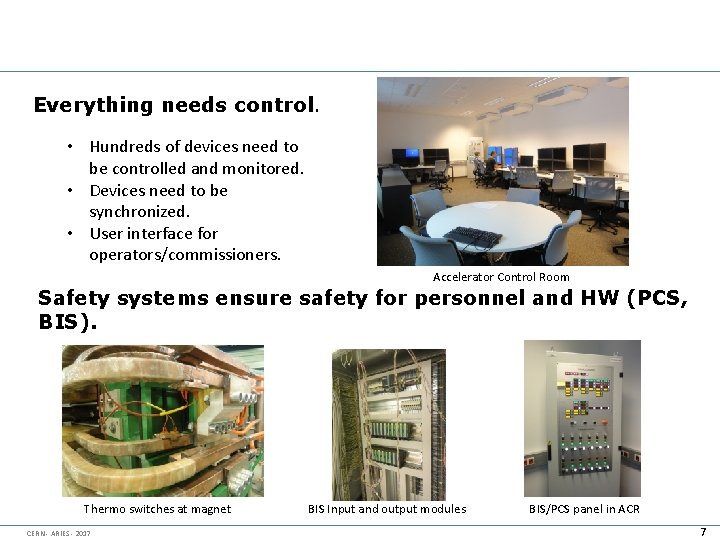
Everything needs control. • Hundreds of devices need to be controlled and monitored. • Devices need to be synchronized. • User interface for operators/commissioners. Accelerator Control Room Safety systems ensure safety for personnel and HW (PCS, BIS). Thermo switches at magnet CERN - ARIES - 2017 BIS Input and output modules BIS/PCS panel in ACR 7
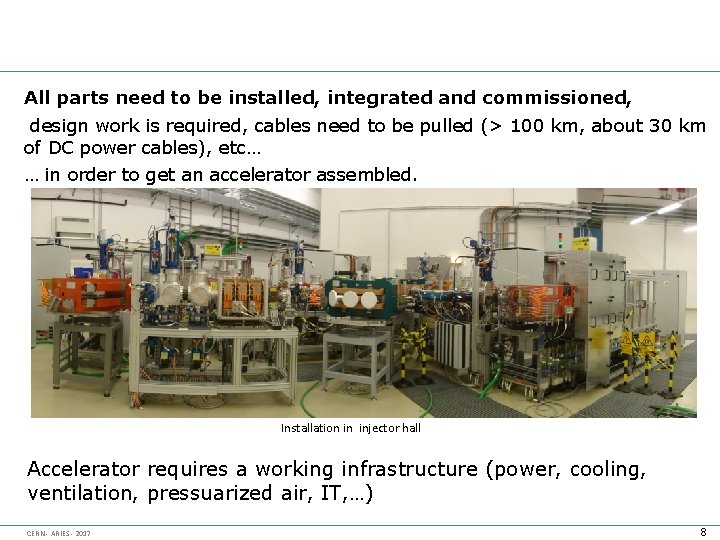
All parts need to be installed, integrated and commissioned, design work is required, cables need to be pulled (> 100 km, about 30 km of DC power cables), etc… … in order to get an accelerator assembled. Installation in injector hall Accelerator requires a working infrastructure (power, cooling, ventilation, pressuarized air, IT, …) CERN - ARIES - 2017 8
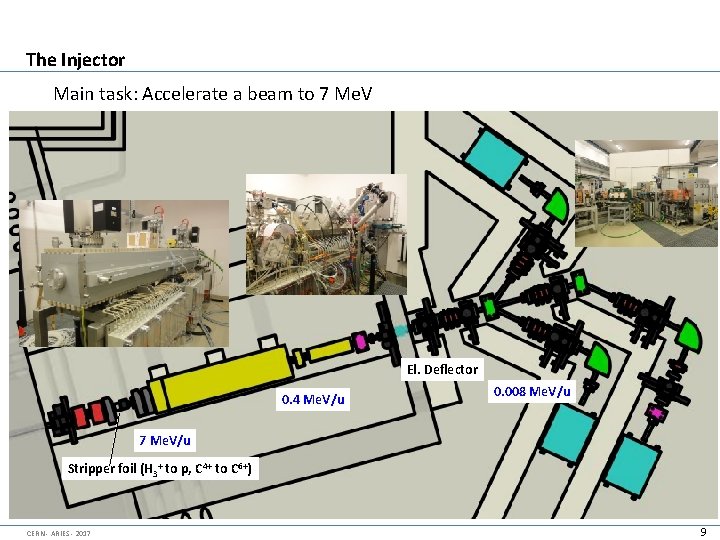
The Injector Main task: Accelerate a beam to 7 Me. V El. Deflector 0. 4 Me. V/u 0. 008 Me. V/u 7 Me. V/u Stripper foil (H 3+ to p, C 4+ to C 6+) CERN - ARIES - 2017 9
The Synchrotron Main task: Accelerate a 7 Me. V/u beam to the desired extraction energy From Injector (7 Me. V/u) Synchrotron – key parameters: app rox . 25 m § Active energy selection, 255 energy steps/ion species § Energy: 120 - 400 Me. V/u (C 6+), 60 – 800 Me. V (p) § Ramp speed: 0. 5 s (to highest carbon extraction energy) § Extraction time: 1 - 10 s To Patient CERN - ARIES - 2017 10
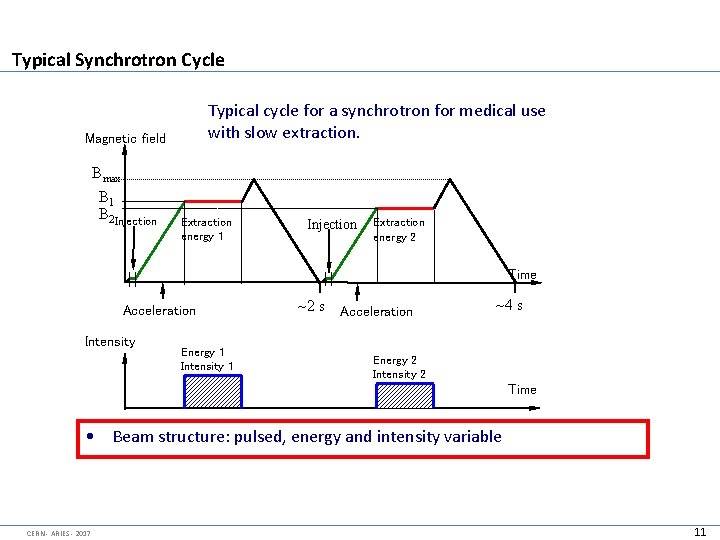
Typical Synchrotron Cycle Typical cycle for a synchrotron for medical use with slow extraction. Magnetic field Bmax B 1 B 2 Injection Extraction energy 1 Injection Extraction energy 2 Time Acceleration Intensity Energy 1 Intensity 1 2 s Acceleration 4 s Energy 2 Intensity 2 Time • Beam structure: pulsed, energy and intensity variable CERN - ARIES - 2017 11
Multi Turn Injection and Slow extraction MTI: ) 5 m) 2μs (or 7 5 m 2μs (or 7 the m o r f e s l eam pu …… s) μ 0 3 h t g ctor (len inje B Extraction: Time for 1 turn in Synchrotron @ injection level: about 2 μs Beam pulse from injector of about 30 μs (remember the electrostatic deflector) Ø Injection over 15 turns (multi-turn) Ø Special, synchronized equipment needed for this operation (injection kickers) Terms as “resonance tune”, “triangular phase space”, “Steinbach diagram”, etc… …are related to resonance or slow extraction. Imagine an onion which you peel off layer by layer. Beam: Particles at the border are separated from the core of the beam (duration 1 – 10 s) Devices needed: Sextupoles, betatron core, electrostatic and magnetic septa (special magnets). CERN - ARIES - 2017 12
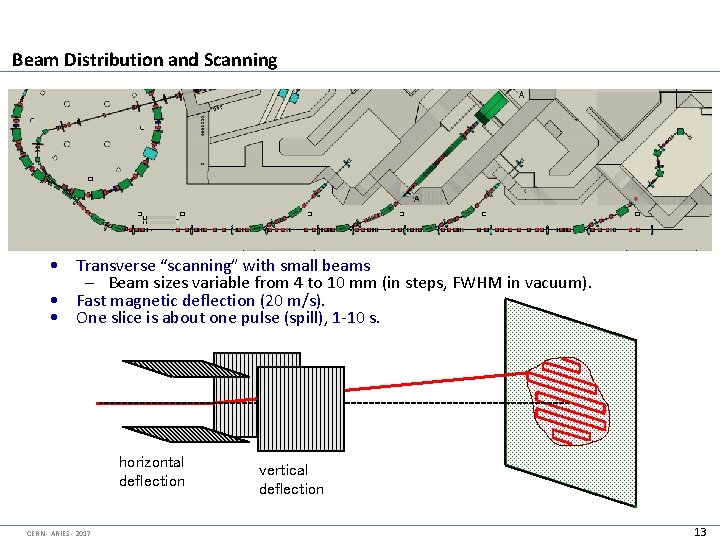
Beam Distribution and Scanning • Transverse “scanning” with small beams – Beam sizes variable from 4 to 10 mm (in steps, FWHM in vacuum). • Fast magnetic deflection (20 m/s). • One slice is about one pulse (spill), 1 -10 s. horizontal deflection CERN - ARIES - 2017 vertical deflection 13
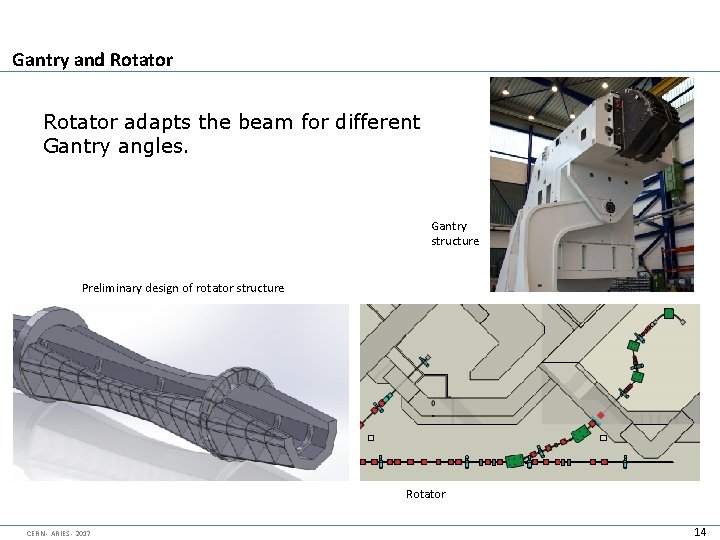
Gantry and Rotator adapts the beam for different Gantry angles. Gantry structure Preliminary design of rotator structure Rotator CERN - ARIES - 2017 14
A million of beam combinations… Accelerator is able to generate: • Number of ion species: 2 • Number of different energies: 255 • Number of beam sizes: 5 • Number of intensities: 4 • Number of extraction times: 8 Ø Beam combinations per beam line: 81600 Ø Gantry: different angles needs to be considered Ø None clinical research: extended energy range Ø Requires a huge amount of commissioning work. Ø Most of the combinations obtained by interpolation. Ø Stepwise release for medical use. CERN - ARIES - 2017 Example for table to select a beam combination 15
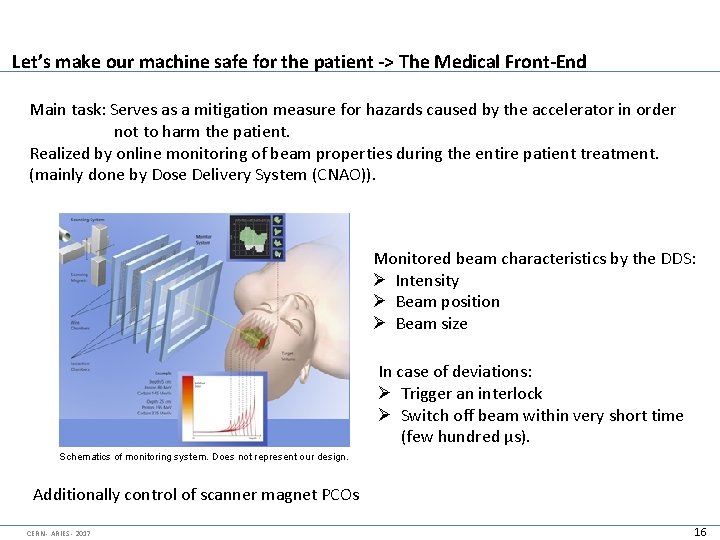
Let’s make our machine safe for the patient -> The Medical Front-End Main task: Serves as a mitigation measure for hazards caused by the accelerator in order not to harm the patient. Realized by online monitoring of beam properties during the entire patient treatment. (mainly done by Dose Delivery System (CNAO)). Monitored beam characteristics by the DDS: Ø Intensity Ø Beam position Ø Beam size In case of deviations: Ø Trigger an interlock Ø Switch off beam within very short time (few hundred μs). Schematics of monitoring system. Does not represent our design. Additionally control of scanner magnet PCOs CERN - ARIES - 2017 16
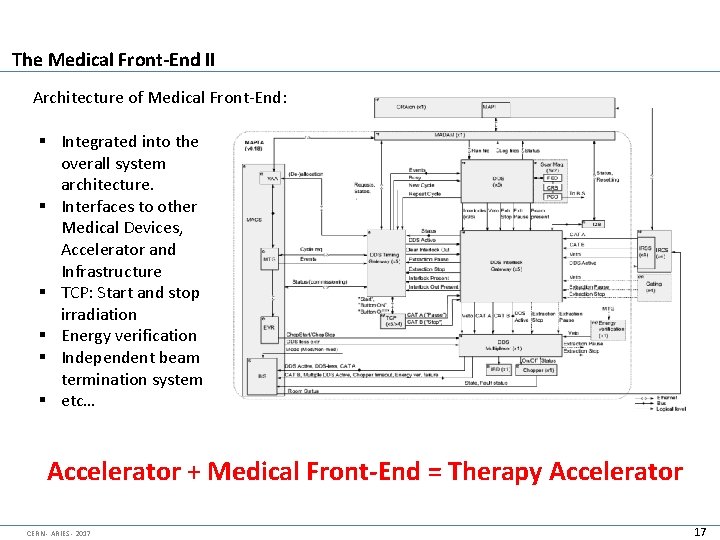
The Medical Front-End II Architecture of Medical Front-End: § Integrated into the overall system architecture. § Interfaces to other Medical Devices, Accelerator and Infrastructure § TCP: Start and stop irradiation § Energy verification § Independent beam termination system § etc… Accelerator + Medical Front-End = Therapy Accelerator CERN - ARIES - 2017 17
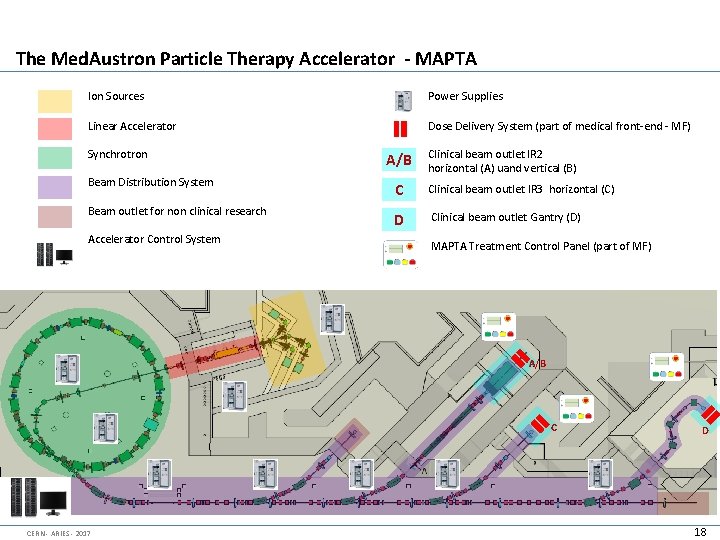
The Med. Austron Particle Therapy Accelerator - MAPTA Ion Sources Power Supplies Linear Accelerator Dose Delivery System (part of medical front-end - MF) Synchrotron Beam Distribution System Beam outlet for non clinical research Accelerator Control System A/B Clinical beam outlet IR 2 horizontal (A) uand vertical (B) C Clinical beam outlet IR 3 horizontal (C) D Clinical beam outlet Gantry (D) MAPTA Treatment Control Panel (part of MF) A/B C CERN - ARIES - 2017 D 18
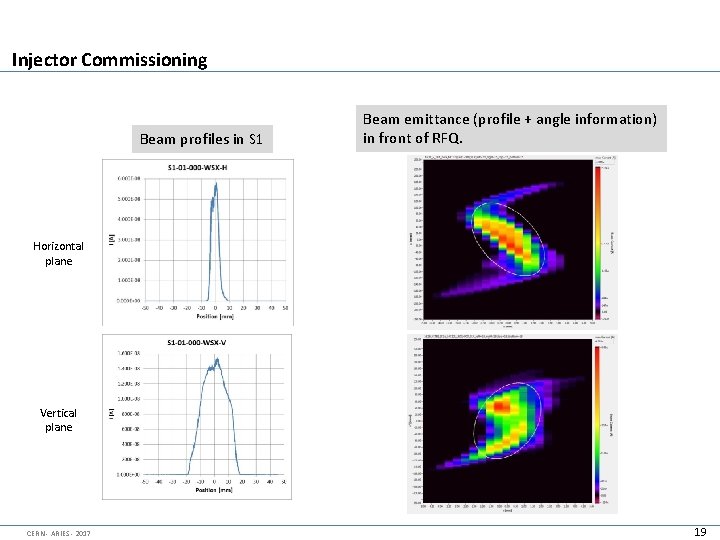
Injector Commissioning Beam profiles in S 1 Beam emittance (profile + angle information) in front of RFQ. Horizontal plane Vertical plane CERN - ARIES - 2017 19
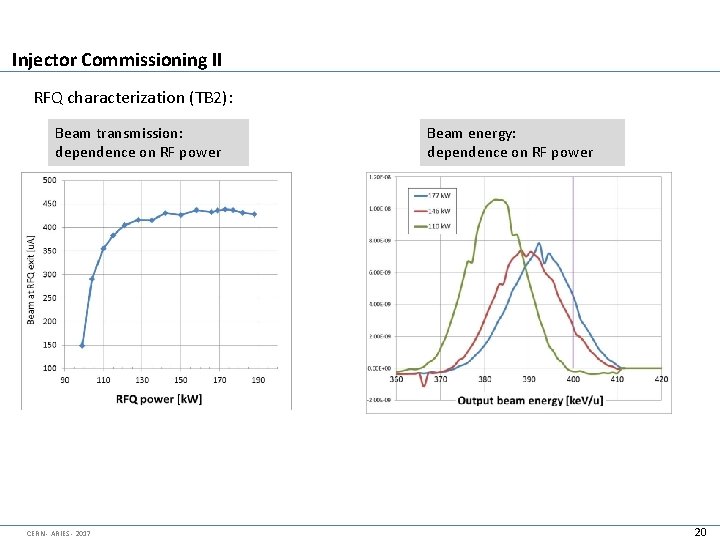
Injector Commissioning II RFQ characterization (TB 2): Beam transmission: dependence on RF power CERN - ARIES - 2017 Beam energy: dependence on RF power 20
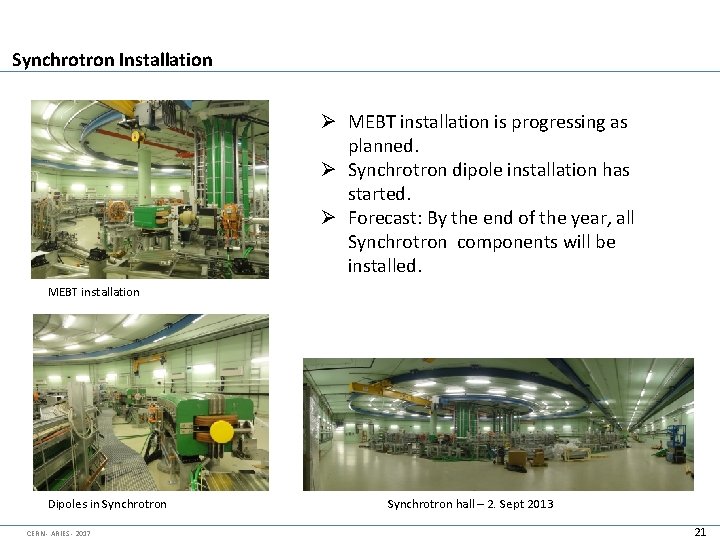
Synchrotron Installation Ø MEBT installation is progressing as planned. Ø Synchrotron dipole installation has started. Ø Forecast: By the end of the year, all Synchrotron components will be installed. MEBT installation Dipoles in Synchrotron CERN - ARIES - 2017 Synchrotron hall – 2. Sept 2013 21