
Accelerator Lab of Tsinghua University Chokemode Progress and
Accelerator Lab of Tsinghua University Choke-mode Progress and High-power Test Summary Xiaowei Wu, Tsinghua University 8 -Dec-2016 LCWS 16, Morioka, Japan
Accelerator Lab of Tsinghua University Outline • Choke-mode single-cell SW cavity test • Observation at Nextef • Summary LCWS 16: Xiaowei Wu, Choke-mode Progress and High-power Test Summary
Accelerator Lab of Tsinghua University Outline • Choke-mode single-cell SW cavity test – Players – RF design and Preparation work – Test stand Installation – High power test status • Observation at Nextef and relative analysis • Summary LCWS 16: Xiaowei Wu, Choke-mode Progress and High-power Test Summary
Accelerator Lab of Tsinghua University Players • Tsinghua University – Xiaowei Wu, Jiaru Shi, Huaibi Chen, et al. • CERN – Walter Wuensch, et al. • KEK – – Linac shift leaders and Mitsubishi operators Karube, Kawabata, Asai from Carrier. Com Matsui, et al from Plus. Work Tetsuo Abe, Toshikazu Takatomi, Shuji Matsumoto, Yoshio Arakida, Toshiyasu Higo LCWS 16: Xiaowei Wu, Choke-mode Progress and High-power Test Summary
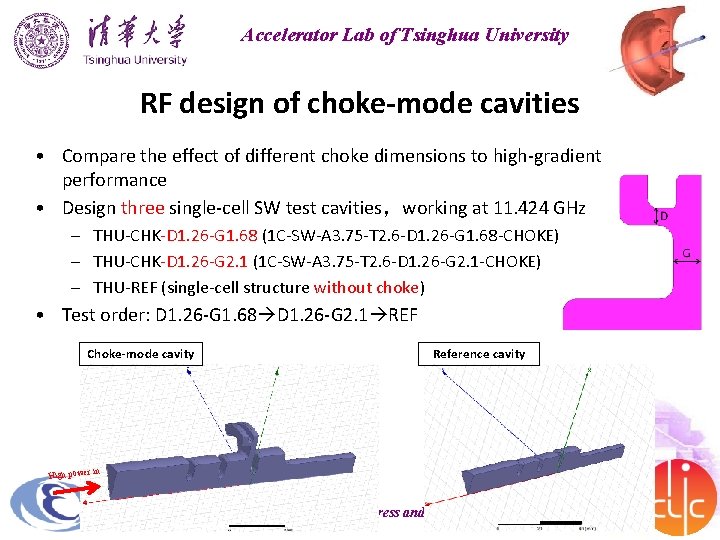
Accelerator Lab of Tsinghua University RF design of choke-mode cavities • Compare the effect of different choke dimensions to high-gradient performance • Design three single-cell SW test cavities,working at 11. 424 GHz – THU-CHK-D 1. 26 -G 1. 68 (1 C-SW-A 3. 75 -T 2. 6 -D 1. 26 -G 1. 68 -CHOKE) – THU-CHK-D 1. 26 -G 2. 1 (1 C-SW-A 3. 75 -T 2. 6 -D 1. 26 -G 2. 1 -CHOKE) – THU-REF (single-cell structure without choke) • Test order: D 1. 26 -G 1. 68 D 1. 26 -G 2. 1 REF Choke-mode cavity High power Reference cavity in LCWS 16: Xiaowei Wu, Choke-mode Progress and High-power Test Summary
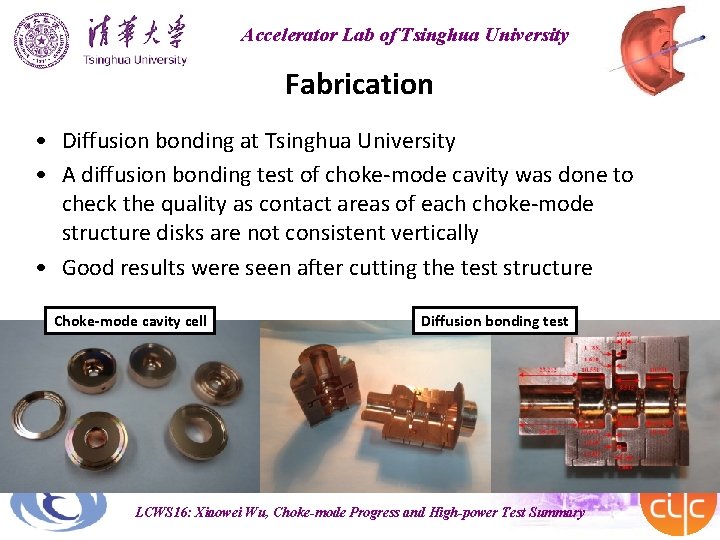
Accelerator Lab of Tsinghua University Fabrication • Diffusion bonding at Tsinghua University • A diffusion bonding test of choke-mode cavity was done to check the quality as contact areas of each choke-mode structure disks are not consistent vertically • Good results were seen after cutting the test structure Choke-mode cavity cell Diffusion bonding test LCWS 16: Xiaowei Wu, Choke-mode Progress and High-power Test Summary
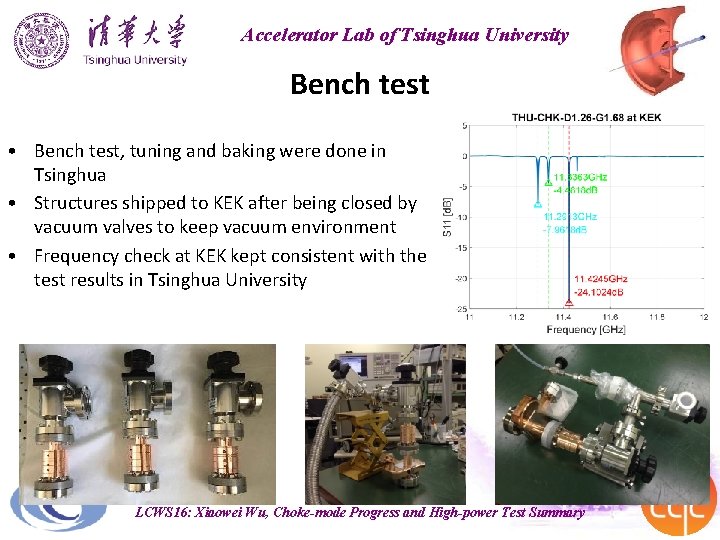
Accelerator Lab of Tsinghua University Bench test • Bench test, tuning and baking were done in Tsinghua • Structures shipped to KEK after being closed by vacuum valves to keep vacuum environment • Frequency check at KEK kept consistent with the test results in Tsinghua University LCWS 16: Xiaowei Wu, Choke-mode Progress and High-power Test Summary
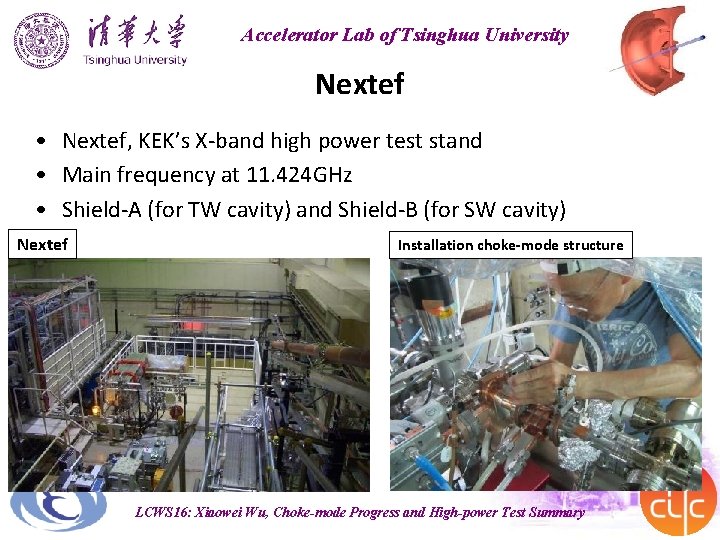
Accelerator Lab of Tsinghua University Nextef • Nextef, KEK’s X-band high power test stand • Main frequency at 11. 424 GHz • Shield-A (for TW cavity) and Shield-B (for SW cavity) Nextef Installation choke-mode structure LCWS 16: Xiaowei Wu, Choke-mode Progress and High-power Test Summary
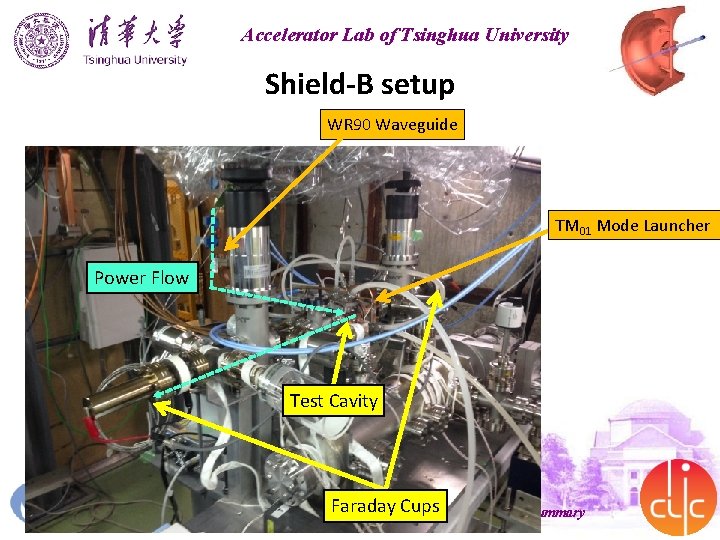
Accelerator Lab of Tsinghua University Shield-B setup WR 90 Waveguide TM 01 Mode Launcher Power Flow Test Cavity Faraday LCWS 16: Xiaowei Wu, Choke-mode Progress Cups and High-power Test Summary
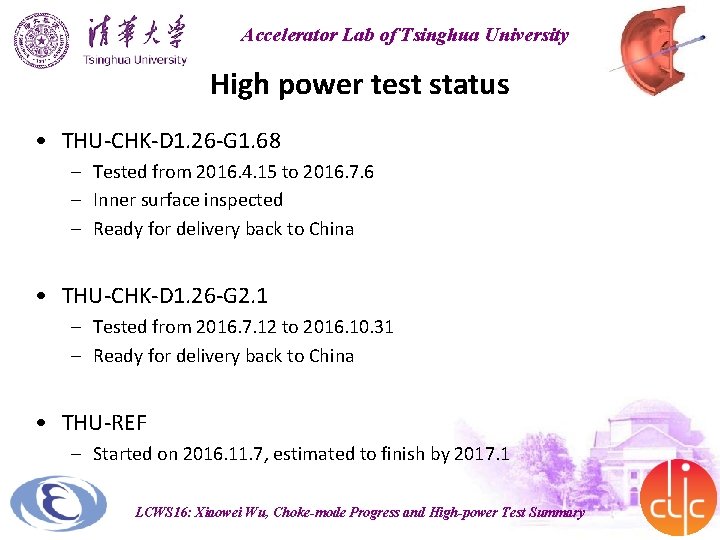
Accelerator Lab of Tsinghua University High power test status • THU-CHK-D 1. 26 -G 1. 68 – Tested from 2016. 4. 15 to 2016. 7. 6 – Inner surface inspected – Ready for delivery back to China • THU-CHK-D 1. 26 -G 2. 1 – Tested from 2016. 7. 12 to 2016. 10. 31 – Ready for delivery back to China • THU-REF – Started on 2016. 11. 7, estimated to finish by 2017. 1 LCWS 16: Xiaowei Wu, Choke-mode Progress and High-power Test Summary
Accelerator Lab of Tsinghua University Outline • Choke-mode single-cell SW cavity test • Observation at Nextef and relative analysis – Test results – Other measurements – Postmortem – New chokes • Summary LCWS 16: Xiaowei Wu, Choke-mode Progress and High-power Test Summary
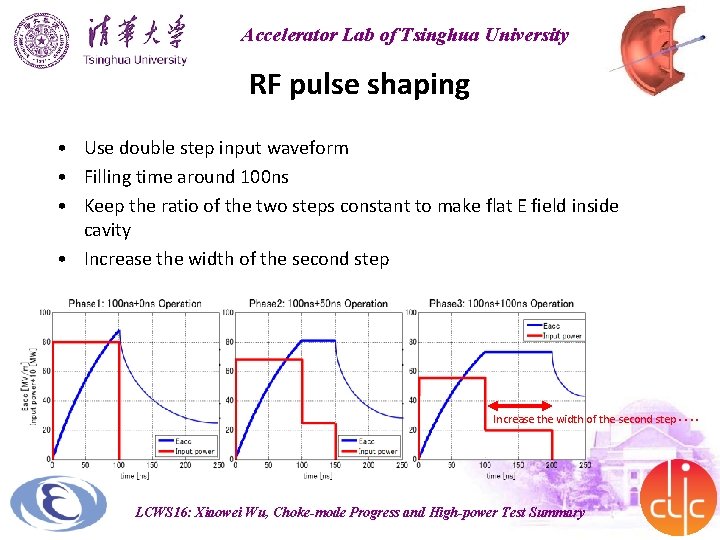
Accelerator Lab of Tsinghua University RF pulse shaping • Use double step input waveform • Filling time around 100 ns • Keep the ratio of the two steps constant to make flat E field inside cavity • Increase the width of the second step …. LCWS 16: Xiaowei Wu, Choke-mode Progress and High-power Test Summary
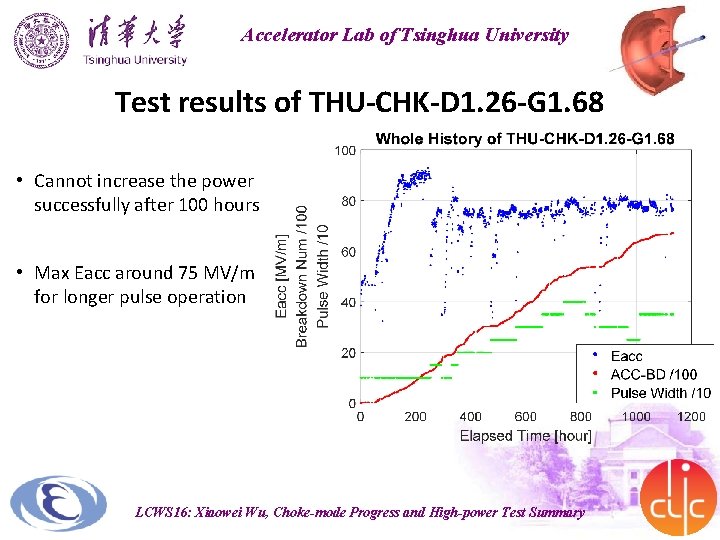
Accelerator Lab of Tsinghua University Test results of THU-CHK-D 1. 26 -G 1. 68 • Cannot increase the power successfully after 100 hours • Max Eacc around 75 MV/m for longer pulse operation LCWS 16: Xiaowei Wu, Choke-mode Progress and High-power Test Summary
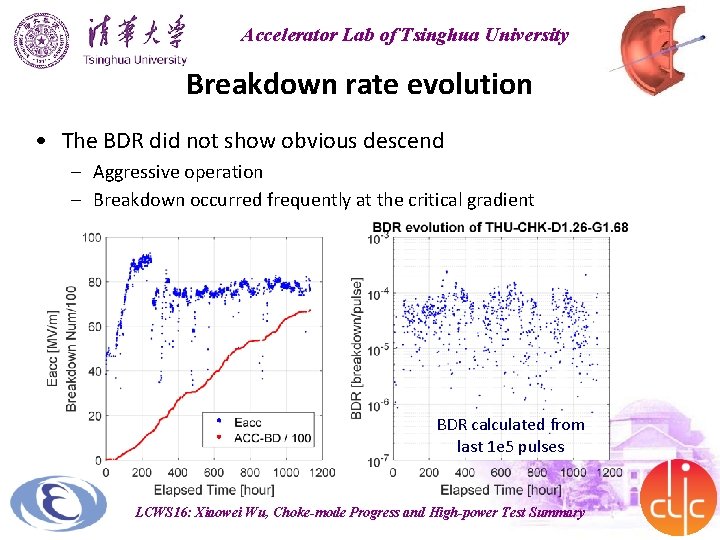
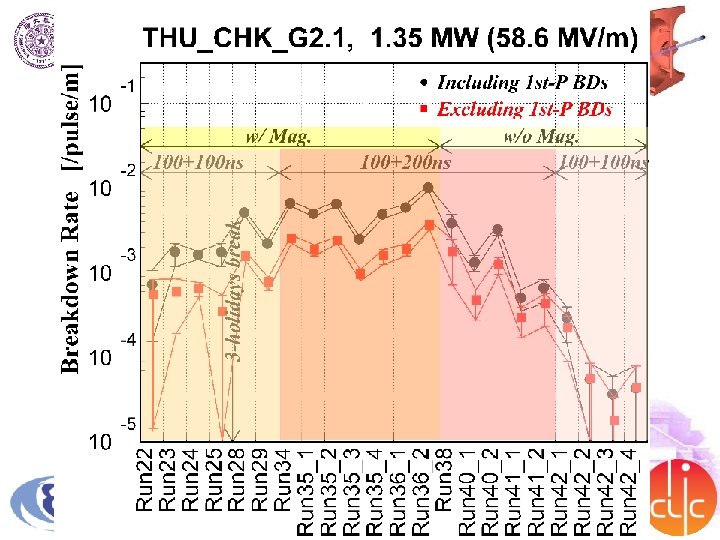
Accelerator Lab of Tsinghua University Breakdown rate evolution • The BDR did not show obvious descend – Aggressive operation – Breakdown occurred frequently at the critical gradient BDR calculated from last 1 e 5 pulses LCWS 16: Xiaowei Wu, Choke-mode Progress and High-power Test Summary
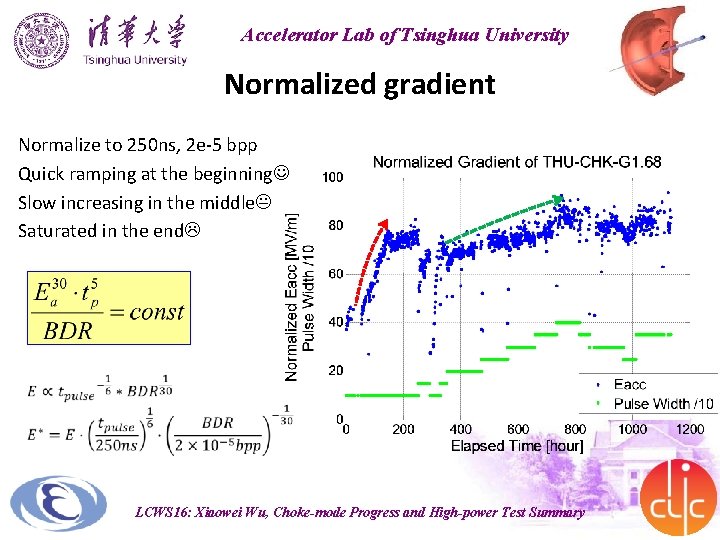
Accelerator Lab of Tsinghua University Normalized gradient Normalize to 250 ns, 2 e-5 bpp Quick ramping at the beginning Slow increasing in the middle Saturated in the end LCWS 16: Xiaowei Wu, Choke-mode Progress and High-power Test Summary
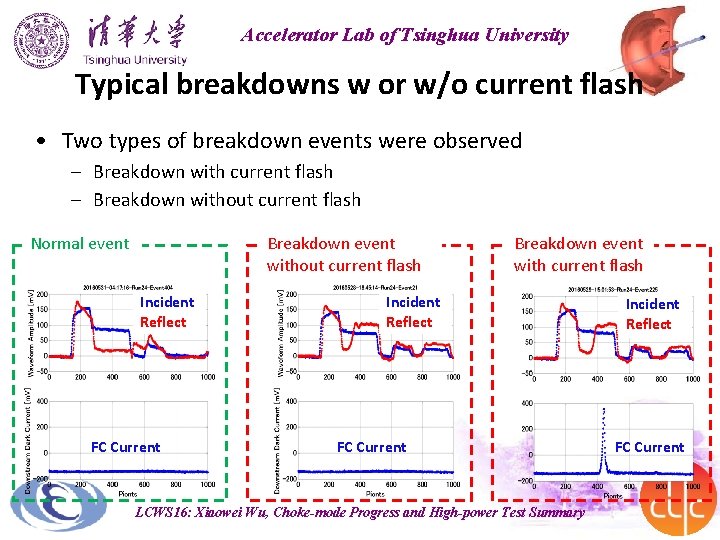
Accelerator Lab of Tsinghua University Typical breakdowns w or w/o current flash • Two types of breakdown events were observed – Breakdown with current flash – Breakdown without current flash Normal event Breakdown event without current flash Incident Reflect FC Current Breakdown event with current flash Incident Reflect FC Current LCWS 16: Xiaowei Wu, Choke-mode Progress and High-power Test Summary Incident Reflect FC Current
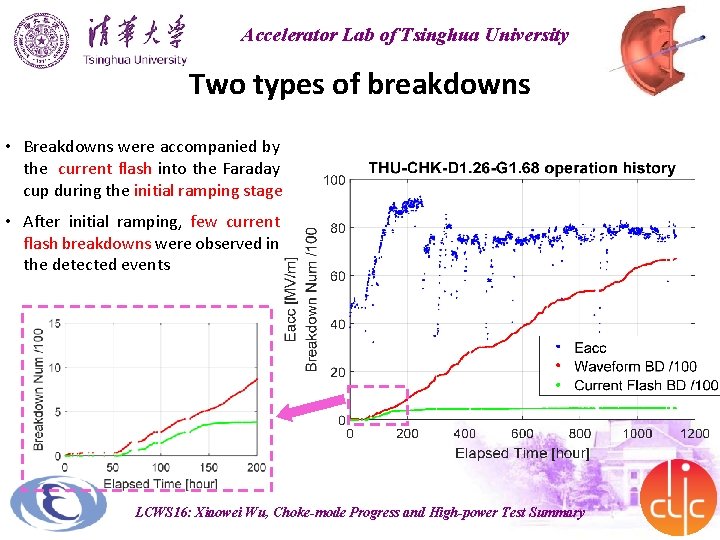
Accelerator Lab of Tsinghua University Two types of breakdowns • Breakdowns were accompanied by the current flash into the Faraday cup during the initial ramping stage • After initial ramping, few current flash breakdowns were observed in the detected events LCWS 16: Xiaowei Wu, Choke-mode Progress and High-power Test Summary
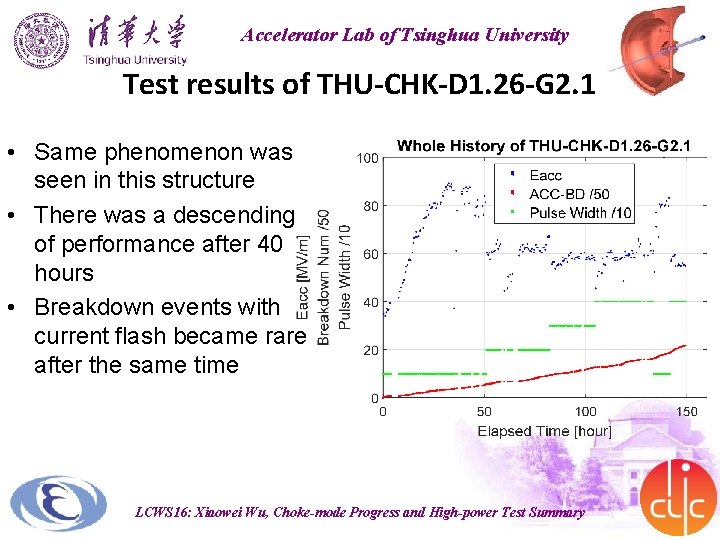
Accelerator Lab of Tsinghua University Test results of THU-CHK-D 1. 26 -G 2. 1 • Same phenomenon was seen in this structure • There was a descending of performance after 40 hours • Breakdown events with current flash became rare after the same time LCWS 16: Xiaowei Wu, Choke-mode Progress and High-power Test Summary
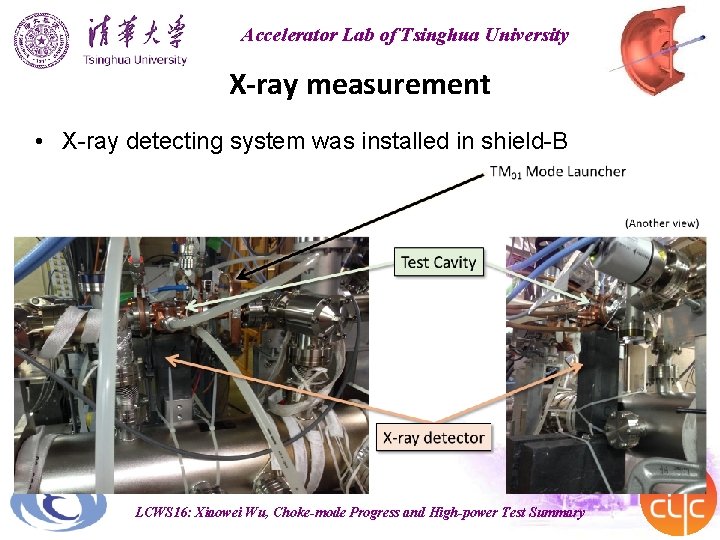
Accelerator Lab of Tsinghua University X-ray measurement • X-ray detecting system was installed in shield-B LCWS 16: Xiaowei Wu, Choke-mode Progress and High-power Test Summary
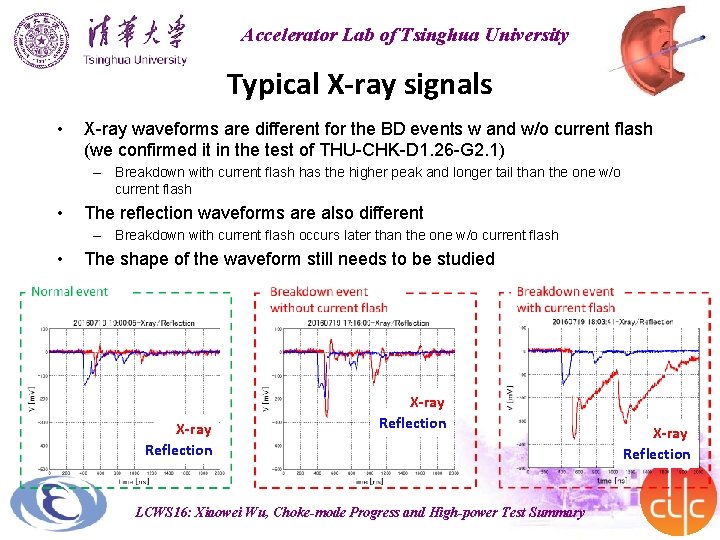
Accelerator Lab of Tsinghua University Typical X-ray signals • X-ray waveforms are different for the BD events w and w/o current flash (we confirmed it in the test of THU-CHK-D 1. 26 -G 2. 1) – Breakdown with current flash has the higher peak and longer tail than the one w/o current flash • The reflection waveforms are also different – Breakdown with current flash occurs later than the one w/o current flash • The shape of the waveform still needs to be studied X-ray Reflection LCWS 16: Xiaowei Wu, Choke-mode Progress and High-power Test Summary X-ray Reflection
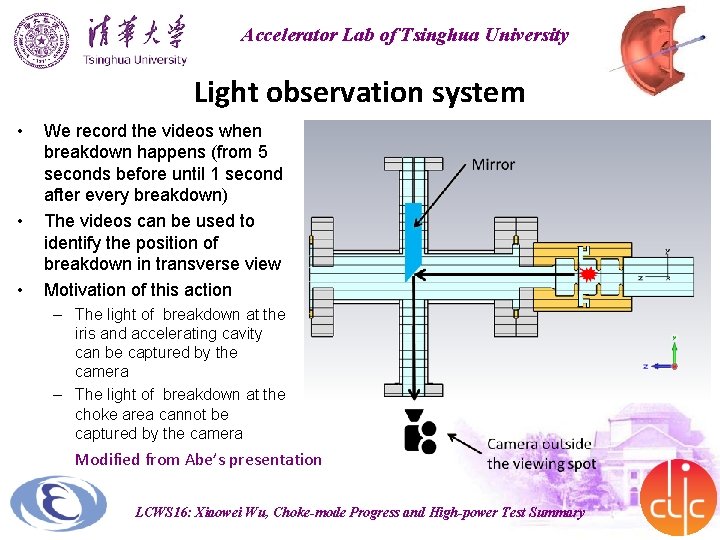
Accelerator Lab of Tsinghua University Light observation system • • • We record the videos when breakdown happens (from 5 seconds before until 1 second after every breakdown) The videos can be used to identify the position of breakdown in transverse view Motivation of this action – The light of breakdown at the iris and accelerating cavity can be captured by the camera – The light of breakdown at the choke area cannot be captured by the camera Modified from Abe’s presentation LCWS 16: Xiaowei Wu, Choke-mode Progress and High-power Test Summary
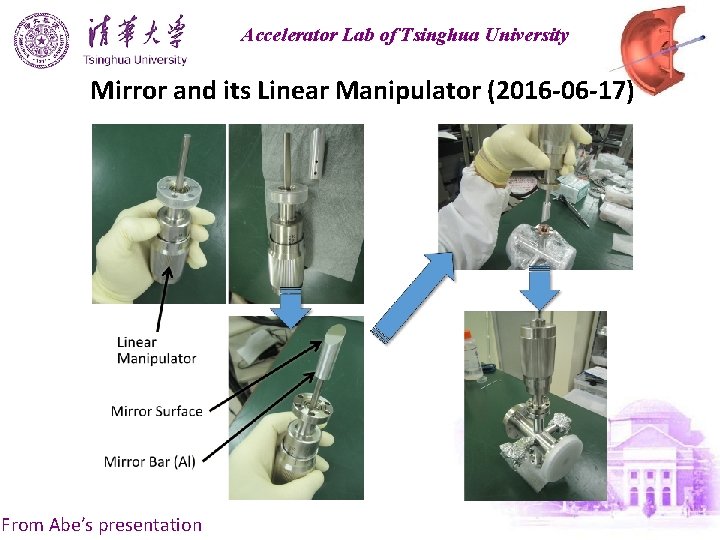
Accelerator Lab of Tsinghua University Mirror and its Linear Manipulator (2016 -06 -17) From Abe’s presentation
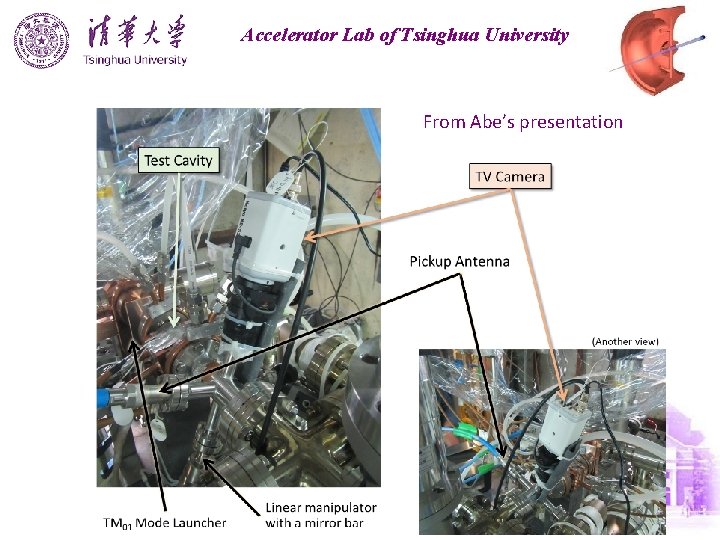
Accelerator Lab of Tsinghua University From Abe’s presentation
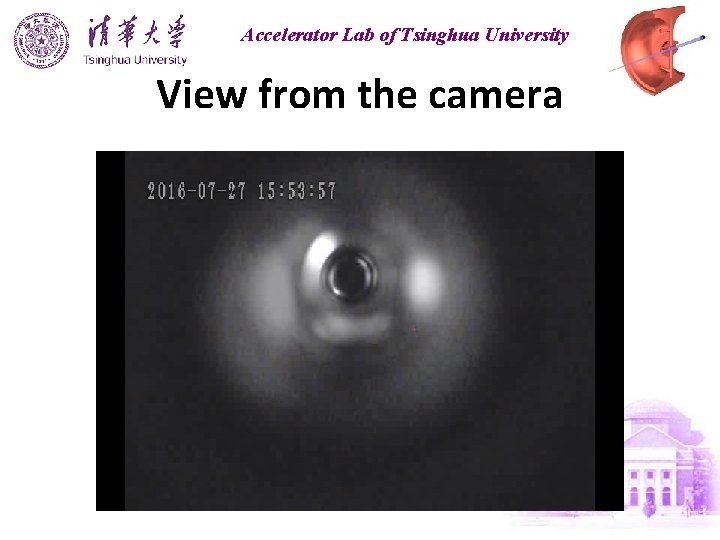
Accelerator Lab of Tsinghua University View from the camera
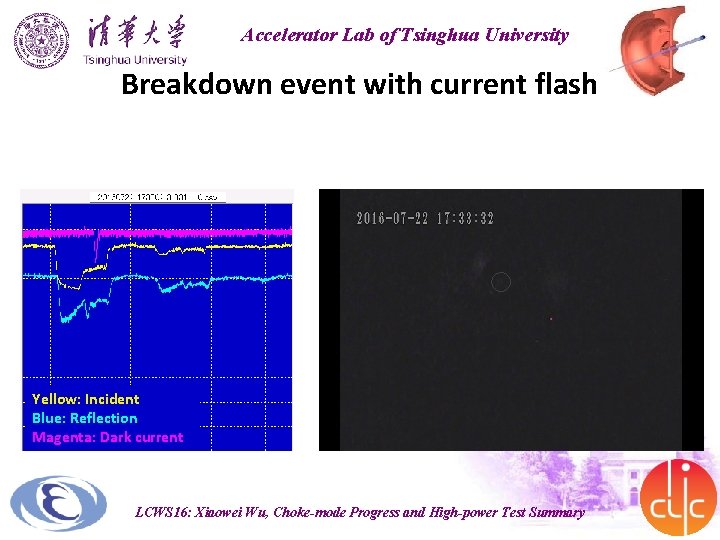
Accelerator Lab of Tsinghua University Breakdown event with current flash Yellow: Incident Blue: Reflection Magenta: Dark current LCWS 16: Xiaowei Wu, Choke-mode Progress and High-power Test Summary
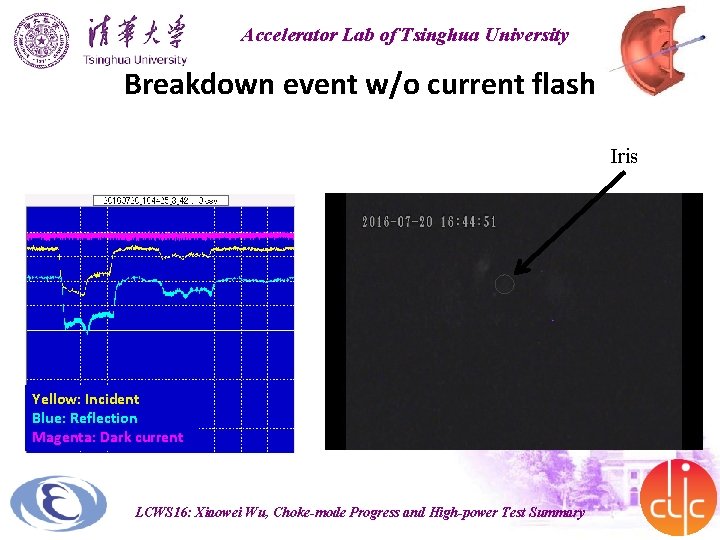
Accelerator Lab of Tsinghua University Breakdown event w/o current flash Iris Yellow: Incident Blue: Reflection Magenta: Dark current LCWS 16: Xiaowei Wu, Choke-mode Progress and High-power Test Summary
Accelerator Lab of Tsinghua University Preliminary results of light observation • For the breakdown events w/o current flash, some were accompanied with light seen by the camera – Not as what we expected • Needs further analysis with consideration of waveform changing and X-ray signals LCWS 16: Xiaowei Wu, Choke-mode Progress and High-power Test Summary
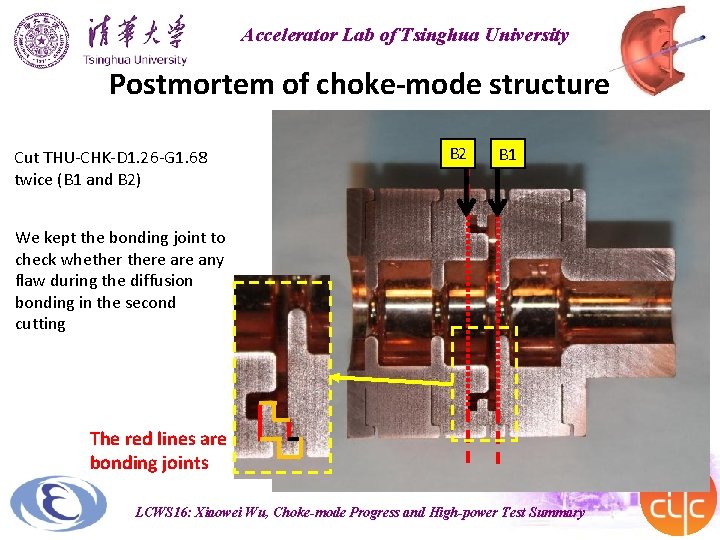
Accelerator Lab of Tsinghua University Postmortem of choke-mode structure Cut THU-CHK-D 1. 26 -G 1. 68 twice (B 1 and B 2) B 2 B 1 We kept the bonding joint to check whethere any flaw during the diffusion bonding in the second cutting The red lines are bonding joints LCWS 16: Xiaowei Wu, Choke-mode Progress and High-power Test Summary
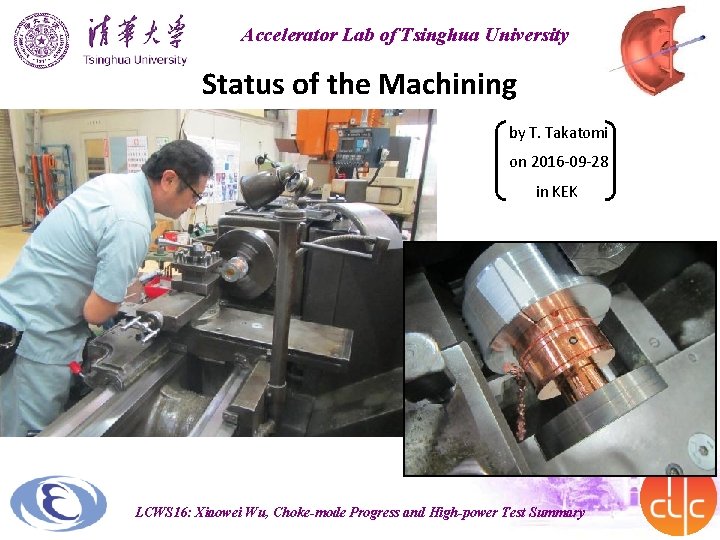
Accelerator Lab of Tsinghua University Status of the Machining by T. Takatomi on 2016 -09 -28 in KEK LCWS 16: Xiaowei Wu, Choke-mode Progress and High-power Test Summary
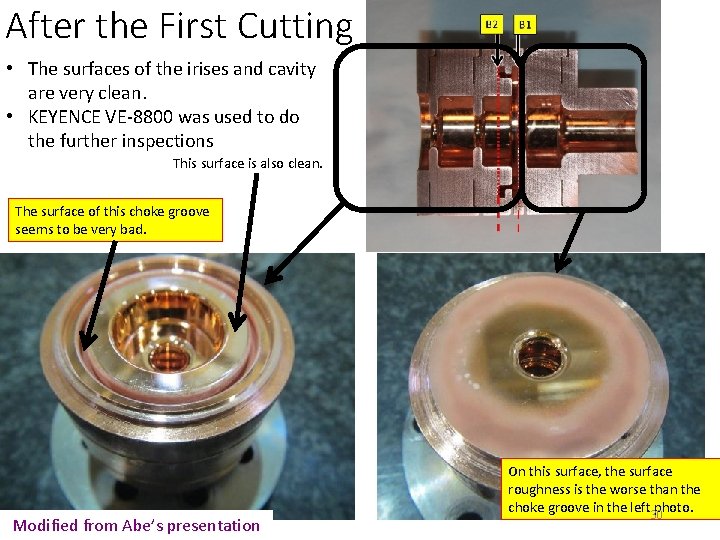
After the First Cutting • The surfaces of the irises and cavity are very clean. • KEYENCE VE-8800 was used to do the further inspections This surface is also clean. The surface of this choke groove seems to be very bad. Modified from Abe’s presentation On this surface, the surface roughness is the worse than the choke groove in the left photo. 30
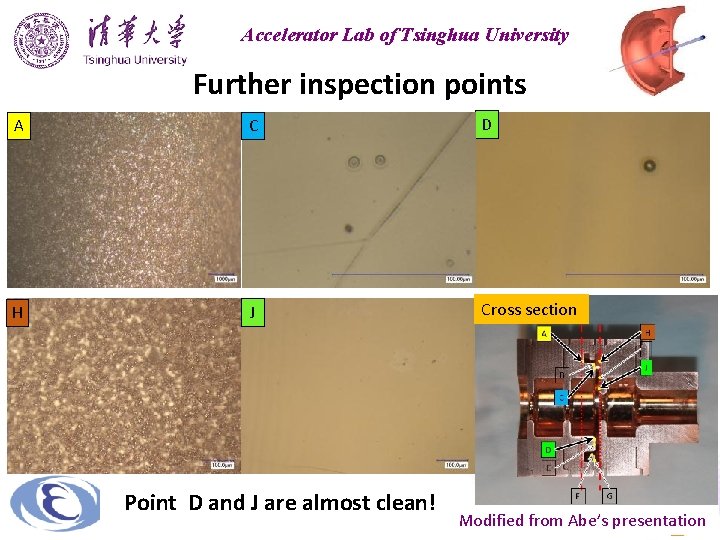
Accelerator Lab of Tsinghua University Further inspection points A C D H J Cross section Point D and J are almost clean! LCWS 16: Xiaowei Wu, Choke-mode Progress and High-power Test Summary Modified from Abe’s presentation
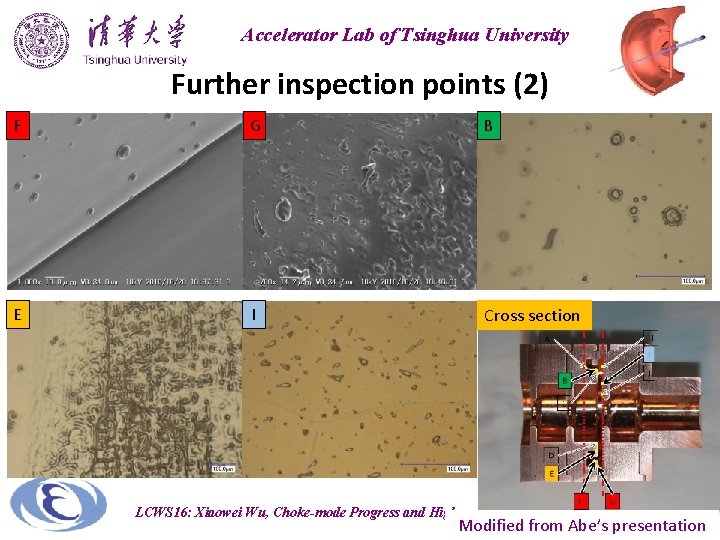
Accelerator Lab of Tsinghua University Further inspection points (2) F G B E I Cross section LCWS 16: Xiaowei Wu, Choke-mode Progress and High-power Test Summary 32 Modified from Abe’s presentation
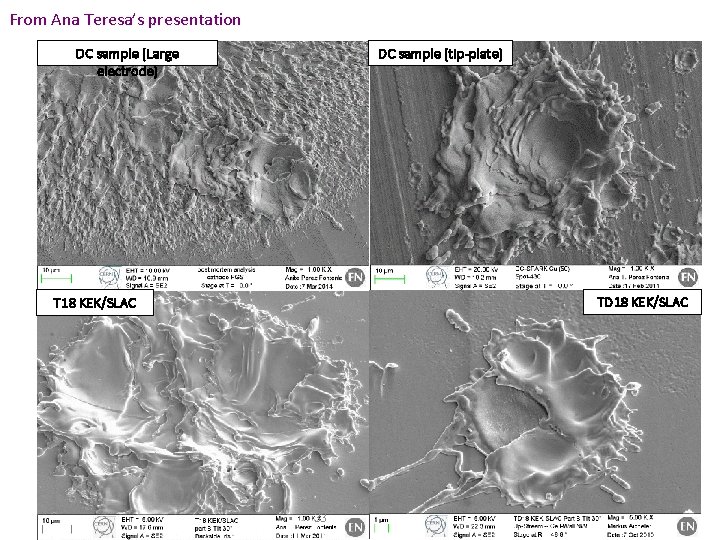
From Ana Teresa’s presentation DC sample (Large electrode) DC sample (tip-plate) TD 18 KEK/SLAC T 18 KEK/SLAC 33
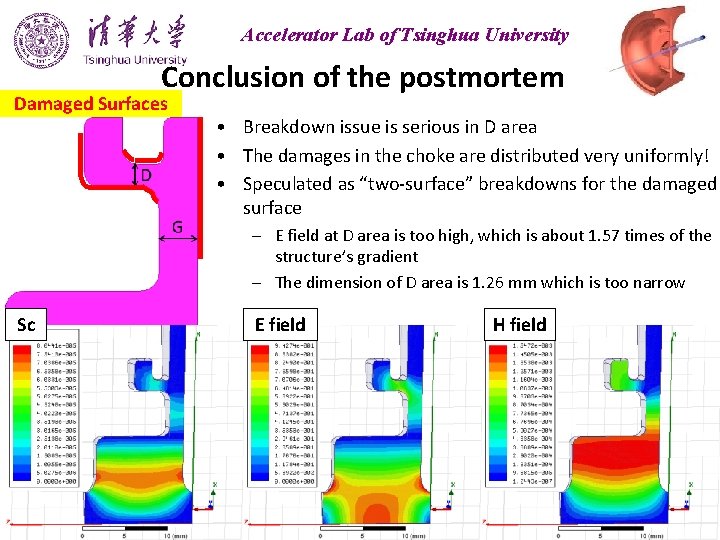
Accelerator Lab of Tsinghua University Conclusion of the postmortem Damaged Surfaces • Breakdown issue is serious in D area • The damages in the choke are distributed very uniformly! • Speculated as “two-surface” breakdowns for the damaged surface – E field at D area is too high, which is about 1. 57 times of the structure’s gradient – The dimension of D area is 1. 26 mm which is too narrow Sc E field H field LCWS 16: Xiaowei Wu, Choke-mode Progress and High-power Test Summary
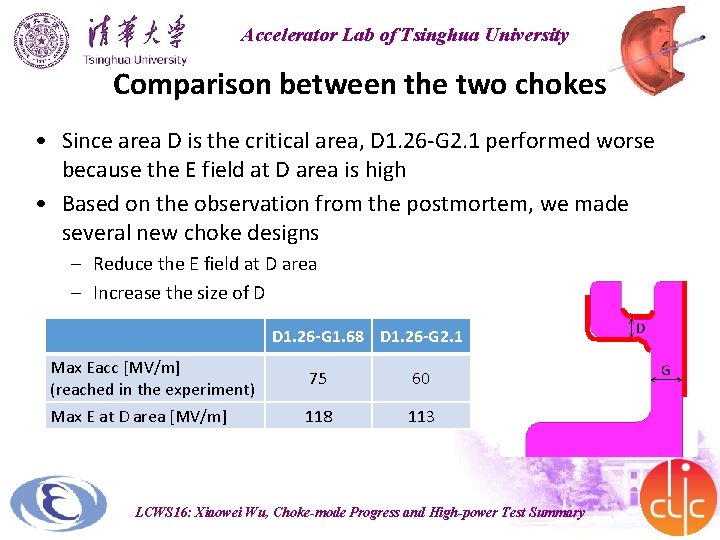
Accelerator Lab of Tsinghua University Comparison between the two chokes • Since area D is the critical area, D 1. 26 -G 2. 1 performed worse because the E field at D area is high • Based on the observation from the postmortem, we made several new choke designs – Reduce the E field at D area – Increase the size of D D 1. 26 -G 1. 68 D 1. 26 -G 2. 1 Max Eacc [MV/m] (reached in the experiment) 75 60 Max E at D area [MV/m] 118 113 LCWS 16: Xiaowei Wu, Choke-mode Progress and High-power Test Summary
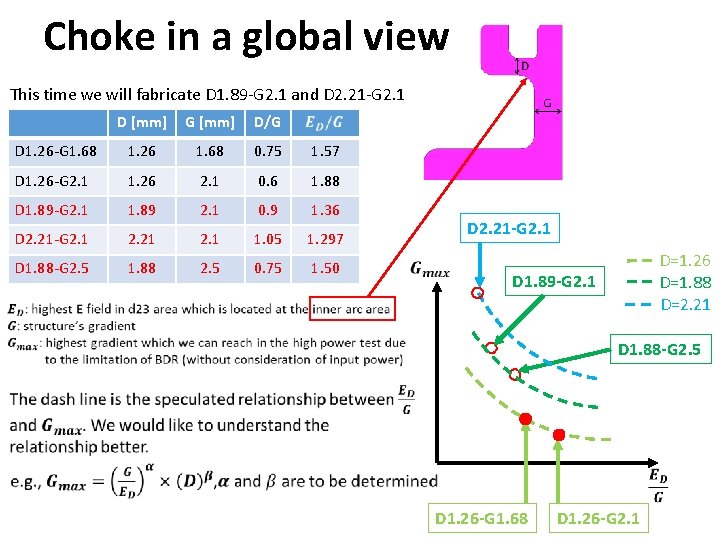
Choke in a global view This time we will fabricate D 1. 89 -G 2. 1 and D 2. 21 -G 2. 1 D [mm] G [mm] D/G D 1. 26 -G 1. 68 1. 26 1. 68 0. 75 1. 57 D 1. 26 -G 2. 1 1. 26 2. 1 0. 6 1. 88 D 1. 89 -G 2. 1 1. 89 2. 1 0. 9 1. 36 D 2. 21 -G 2. 1 2. 21 2. 1 1. 05 1. 297 D 1. 88 -G 2. 5 1. 88 2. 5 0. 75 1. 50 D 2. 21 -G 2. 1 D=1. 26 D=1. 88 D=2. 21 D 1. 89 -G 2. 1 D 1. 88 -G 2. 5 D 1. 26 -G 1. 68 D 1. 26 -G 2. 1
Accelerator Lab of Tsinghua University Outline • Choke-mode single-cell SW cavity test • Observation at Nextef and relative analysis • Summary LCWS 16: Xiaowei Wu, Choke-mode Progress and High-power Test Summary
Accelerator Lab of Tsinghua University Summary • Three single-cell SW cavities were designed, fabricated, tuned in Tsinghua University • High-gradient test are being carried out in Nextef at KEK • Two types of breakdown events were seen – Current flash, X-ray signals are different • Critical breakdown area was confirmed by postmortem – A new guideline to design choke-mode structure • Relatively high gradient was obtained (~75 MV/m) – Not as high as what we expected • New choke-mode cavity – New designs with larger gap were designed, fabricated LCWS 16: Xiaowei Wu, Choke-mode Progress and High-power Test Summary
Accelerator Lab of Tsinghua University Future plan • Continue the study of existing structures – – X-ray signal, light observation, BDR study, dark current Breakdown timing and current flash timing analysis To understand the choke breakdown features better Keep operating THU-REF (now over 120 MV/m at 100 ns) • Carry out the high power test of new choke-mode structures • Novel choke-mode design – New design by using insulating materials at choke area • TD 24 -CHK – Based on T 24 design and single-cell choke-mode cavities’ experimental results LCWS 16: Xiaowei Wu, Choke-mode Progress and High-power Test Summary
Accelerator Lab of Tsinghua University Thank you!
Accelerator Lab of Tsinghua University BACKUP
Accelerator Lab of Tsinghua University LCWS 16: Xiaowei Wu, Choke-mode Progress and High-power Test Summary
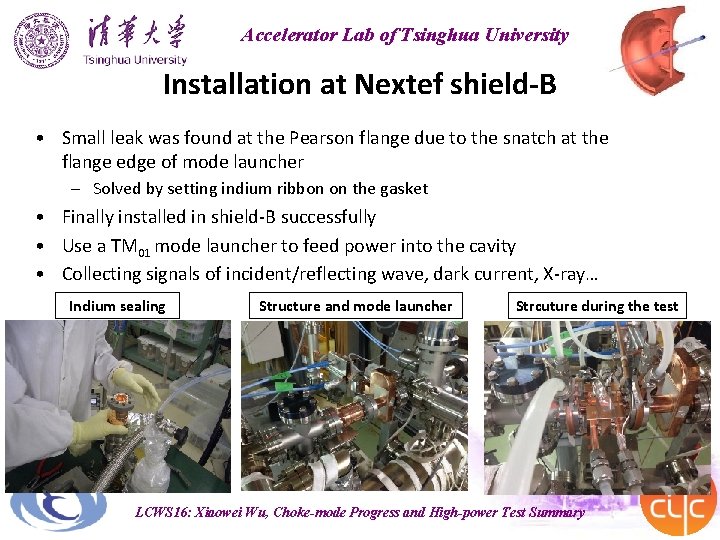
Accelerator Lab of Tsinghua University Installation at Nextef shield-B • Small leak was found at the Pearson flange due to the snatch at the flange edge of mode launcher – Solved by setting indium ribbon on the gasket • Finally installed in shield-B successfully • Use a TM 01 mode launcher to feed power into the cavity • Collecting signals of incident/reflecting wave, dark current, X-ray… Indium sealing Structure and mode launcher Strcuture during the test LCWS 16: Xiaowei Wu, Choke-mode Progress and High-power Test Summary
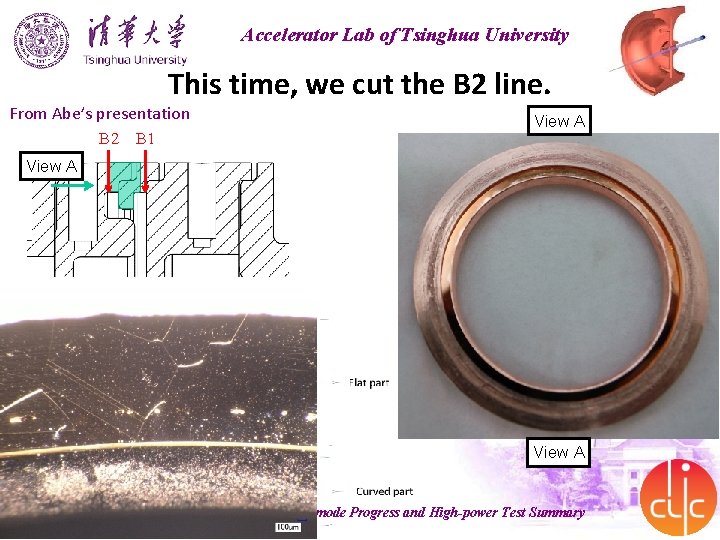
Accelerator Lab of Tsinghua University This time, we cut the B 2 line. From Abe’s presentation B 2 B 1 View A LCWS 16: Xiaowei Wu, Choke-mode Progress and High-power Test Summary
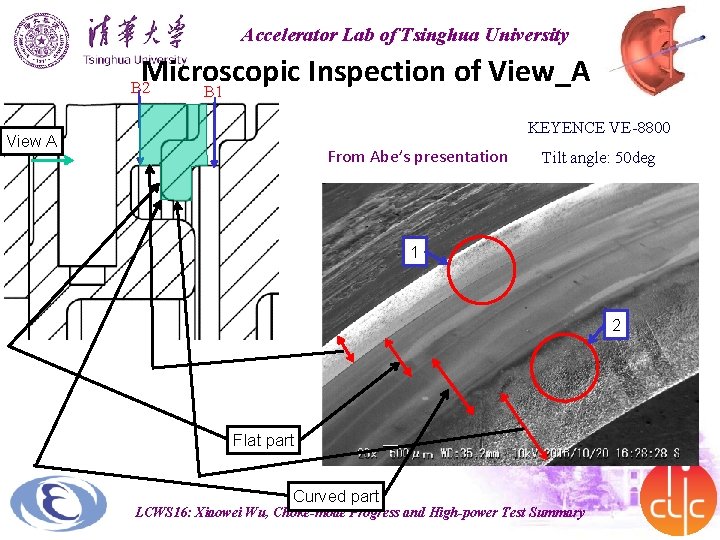
Accelerator Lab of Tsinghua University Microscopic Inspection of View_A B 1 B 2 KEYENCE VE-8800 View A From Abe’s presentation Tilt angle: 50 deg 1 2 Flat part Curved part LCWS 16: Xiaowei Wu, Choke-mode Progress and High-power Test Summary
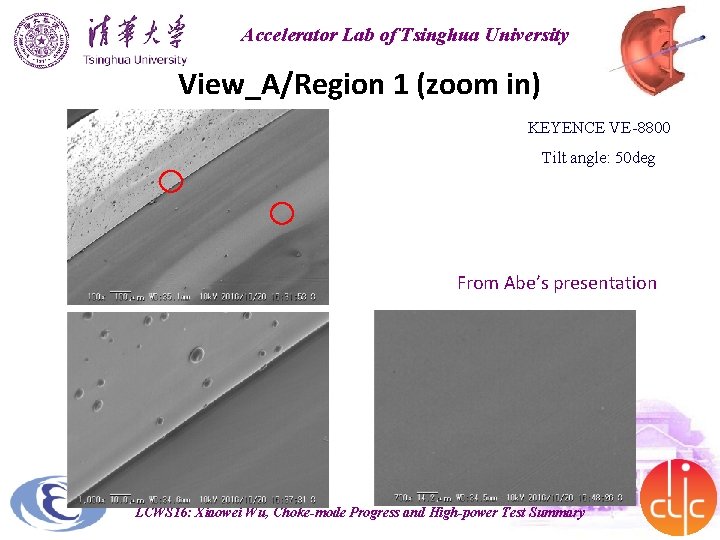
Accelerator Lab of Tsinghua University View_A/Region 1 (zoom in) KEYENCE VE-8800 Tilt angle: 50 deg From Abe’s presentation LCWS 16: Xiaowei Wu, Choke-mode Progress and High-power Test Summary
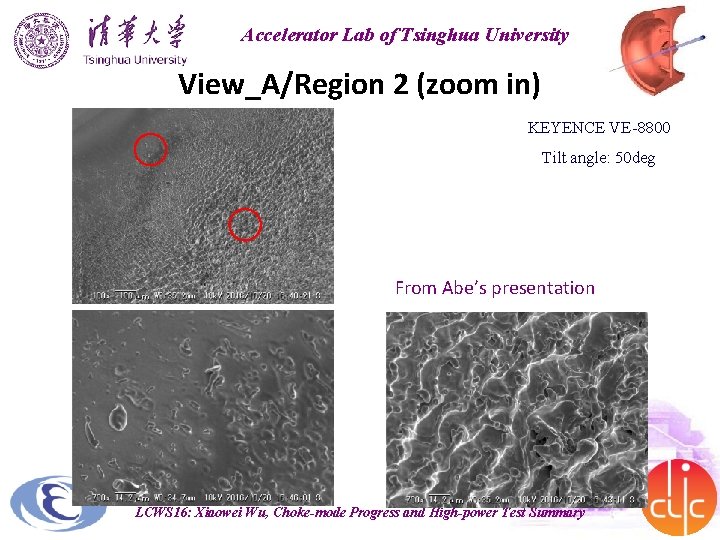
Accelerator Lab of Tsinghua University View_A/Region 2 (zoom in) KEYENCE VE-8800 Tilt angle: 50 deg From Abe’s presentation LCWS 16: Xiaowei Wu, Choke-mode Progress and High-power Test Summary
- Slides: 47