
Accelerator Driven Subcritical Reactors Introduction Fission Conventional reactor
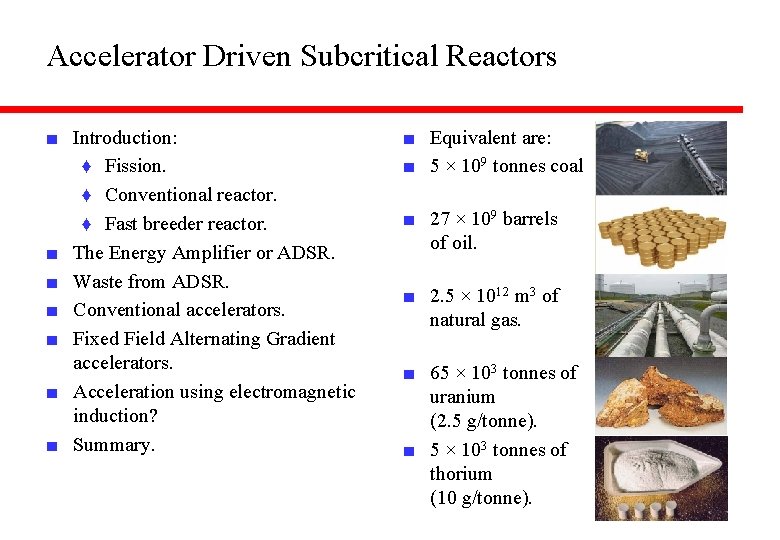
Accelerator Driven Subcritical Reactors ■ Introduction: ♦ Fission. ♦ Conventional reactor. ♦ Fast breeder reactor. ■ The Energy Amplifier or ADSR. ■ Waste from ADSR. ■ Conventional accelerators. ■ Fixed Field Alternating Gradient accelerators. ■ Acceleration using electromagnetic induction? ■ Summary. ■ Equivalent are: ■ 5 × 10⁹ tonnes coal ■ 27 × 109 barrels of oil. ■ 2. 5 × 10¹² m 3 of natural gas. ■ 65 × 103 tonnes of uranium (2. 5 g/tonne). ■ 5 × 10³ tonnes of thorium (10 g/tonne).
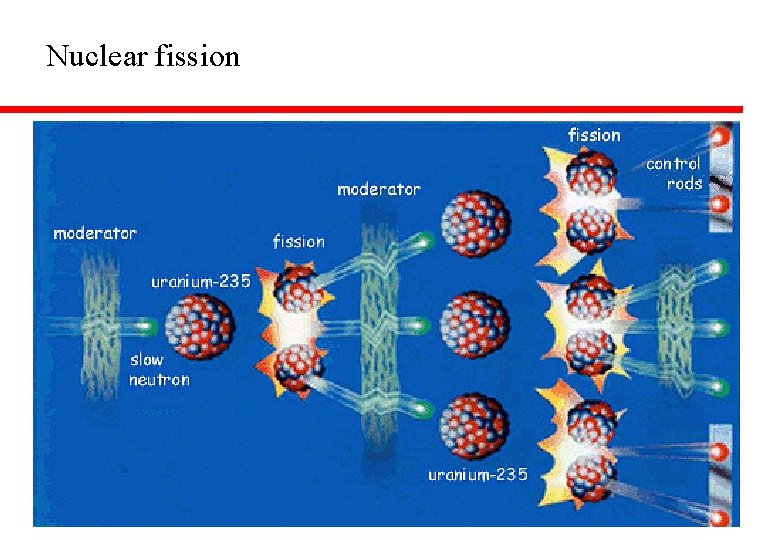
Nuclear fission
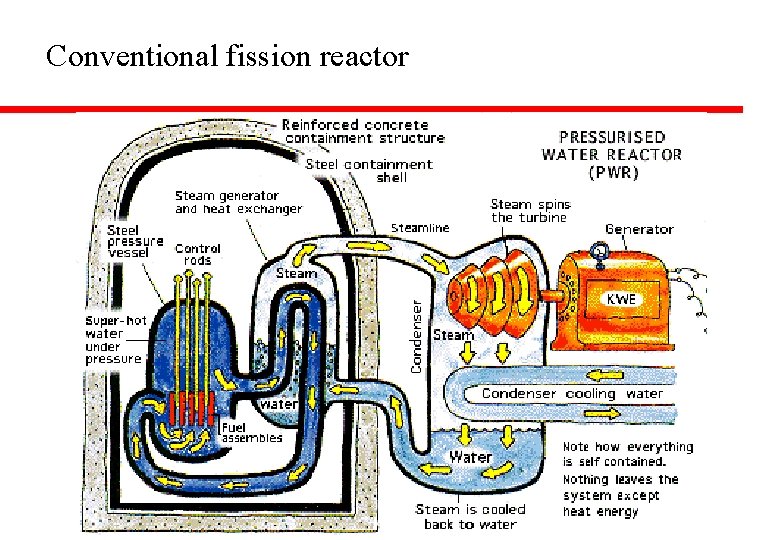
Conventional fission reactor
Features of conventional fission reactor ■ Each fission: ♦ Caused by absorption of 1 neutron. ♦ Produces ~ 2. 5 neutrons. ♦ Some neutrons lost, leaving k to produce k new fission reactions. ■ Conventional reactor: ♦ Require k = 1. ♦ If k < 1 stops working. ♦ If k > 1 explodes. ■ (Perceived) problems: ■ Safety: ♦ Chernobyl. ♦ Three Mile Island. ■ Waste: ♦ Actinides with half lives of kyears to 100 s of kyears. ■ Proliferation. ■ Uranium reserves uncertain. ♦ Extract from oceans? ♦ Use fast breeder reactors?
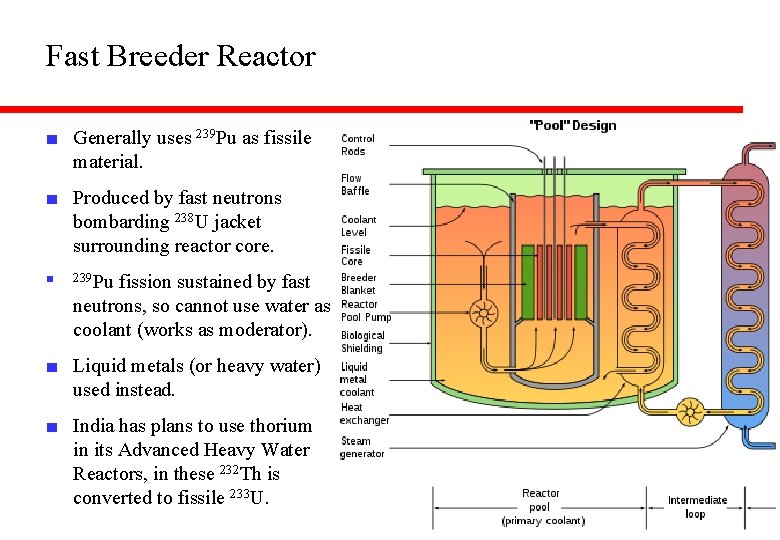
Fast Breeder Reactor ■ Generally uses 239 Pu as fissile material. ■ Produced by fast neutrons bombarding 238 U jacket surrounding reactor core. ■ 239 Pu fission sustained by fast neutrons, so cannot use water as coolant (works as moderator). ■ Liquid metals (or heavy water) used instead. ■ India has plans to use thorium in its Advanced Heavy Water Reactors, in these 232 Th is converted to fissile 233 U.
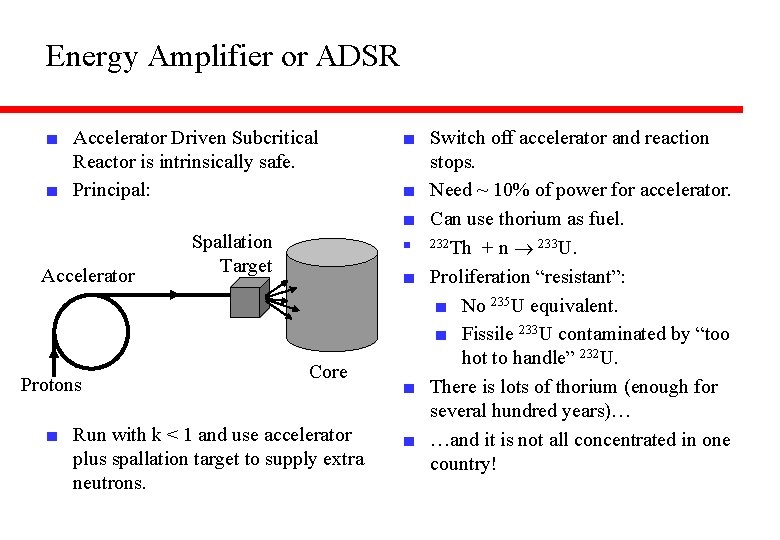
Energy Amplifier or ADSR ■ Accelerator Driven Subcritical Reactor is intrinsically safe. ■ Principal: Accelerator Protons Spallation Target Core ■ Run with k < 1 and use accelerator plus spallation target to supply extra neutrons. ■ Switch off accelerator and reaction stops. ■ Need ~ 10% of power for accelerator. ■ Can use thorium as fuel. ■ 232 Th + n 233 U. ■ Proliferation “resistant”: ■ No 235 U equivalent. ■ Fissile 233 U contaminated by “too hot to handle” 232 U. ■ There is lots of thorium (enough for several hundred years)… ■ …and it is not all concentrated in one country!
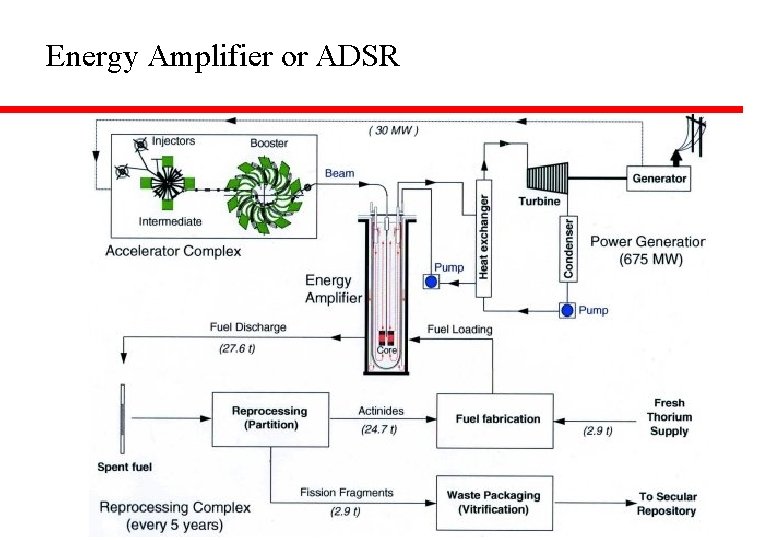
Energy Amplifier or ADSR

Waste from ADSR ■ Actinides produced in fission reactions are “burnt up” in the reactor. ■ Remaining waste has half life of a few hundred rather than many thousands of years. ■ Can use ADSR to burn existing high activity waste so reducing problems associated with storage of waste from conventional fission reactors. ■ So why haven’t these devices already been built?
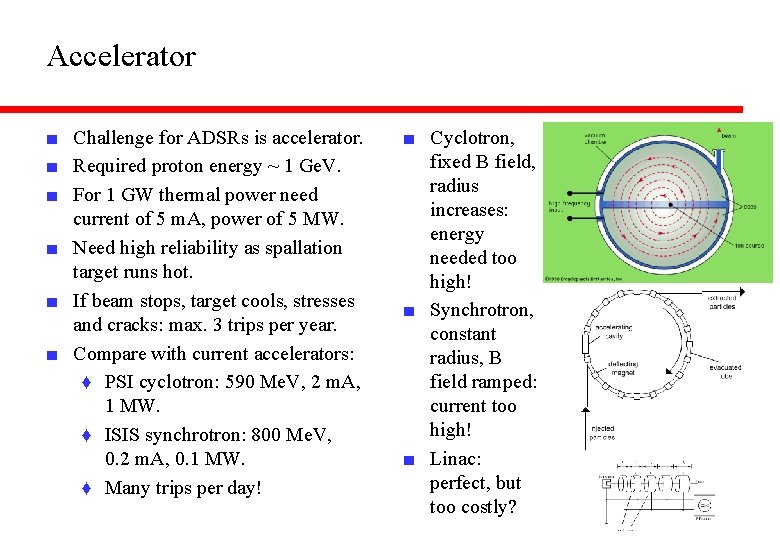
Accelerator ■ Challenge for ADSRs is accelerator. ■ Required proton energy ~ 1 Ge. V. ■ For 1 GW thermal power need current of 5 m. A, power of 5 MW. ■ Need high reliability as spallation target runs hot. ■ If beam stops, target cools, stresses and cracks: max. 3 trips per year. ■ Compare with current accelerators: ♦ PSI cyclotron: 590 Me. V, 2 m. A, 1 MW. ♦ ISIS synchrotron: 800 Me. V, 0. 2 m. A, 0. 1 MW. ♦ Many trips per day! ■ Cyclotron, fixed B field, radius increases: energy needed too high! ■ Synchrotron, constant radius, B field ramped: current too high! ■ Linac: perfect, but too costly?
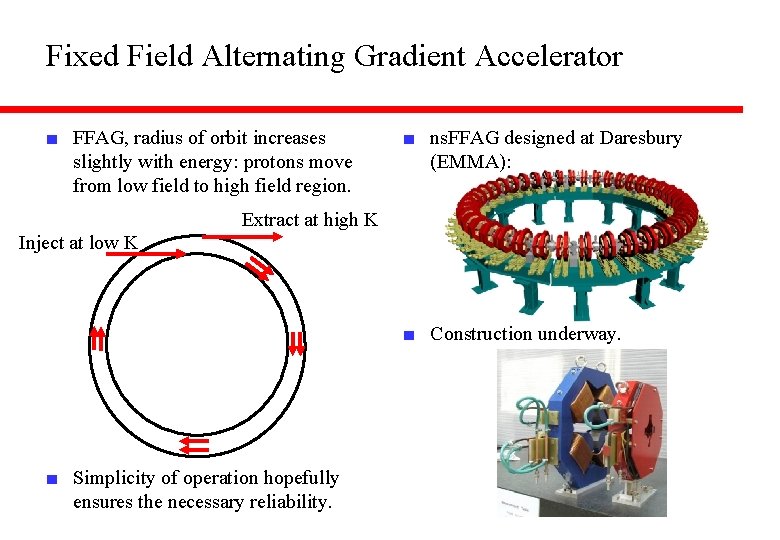
Fixed Field Alternating Gradient Accelerator ■ FFAG, radius of orbit increases slightly with energy: protons move from low field to high field region. ■ ns. FFAG designed at Daresbury (EMMA): Extract at high K Inject at low K ■ Construction underway. ■ Simplicity of operation hopefully ensures the necessary reliability.
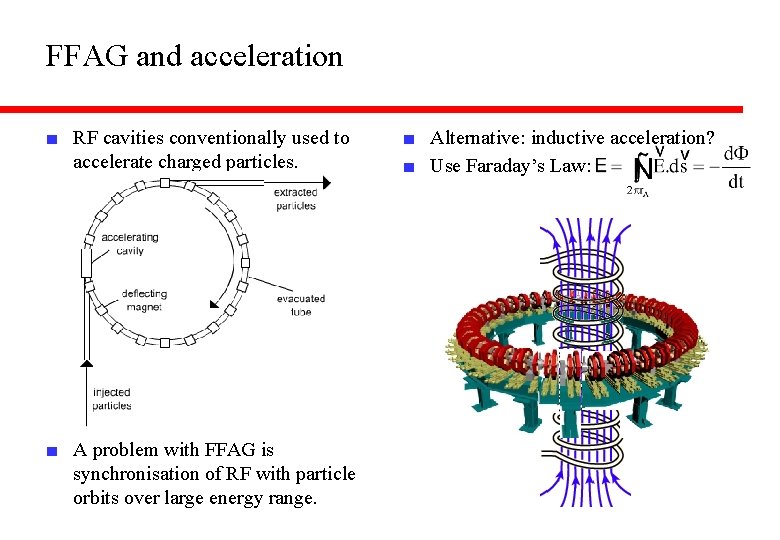
FFAG and acceleration ■ RF cavities conventionally used to accelerate charged particles. ■ A problem with FFAG is synchronisation of RF with particle orbits over large energy range. ■ Alternative: inductive acceleration? ■ Use Faraday’s Law:
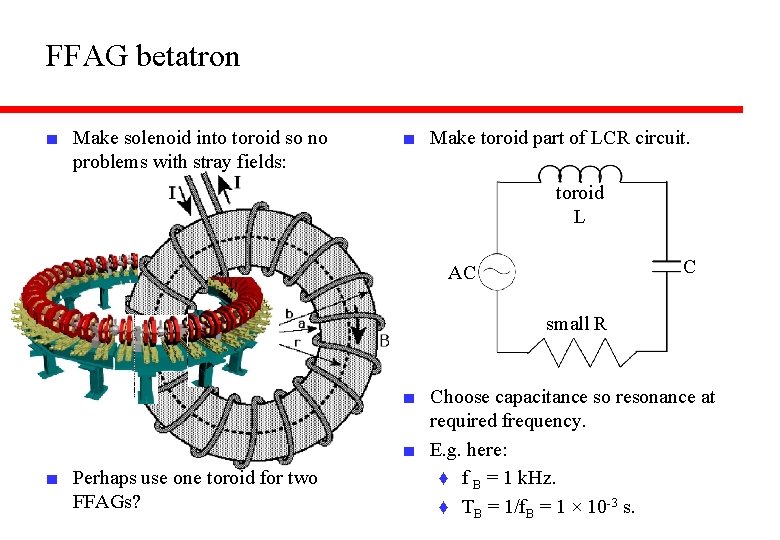
FFAG betatron ■ Make solenoid into toroid so no problems with stray fields: ■ Make toroid part of LCR circuit. toroid L C AC small R ■ Perhaps use one toroid for two FFAGs? ■ Choose capacitance so resonance at required frequency. ■ E. g. here: ♦ f B = 1 k. Hz. ♦ TB = 1/f. B = 1 × 10 -3 s.
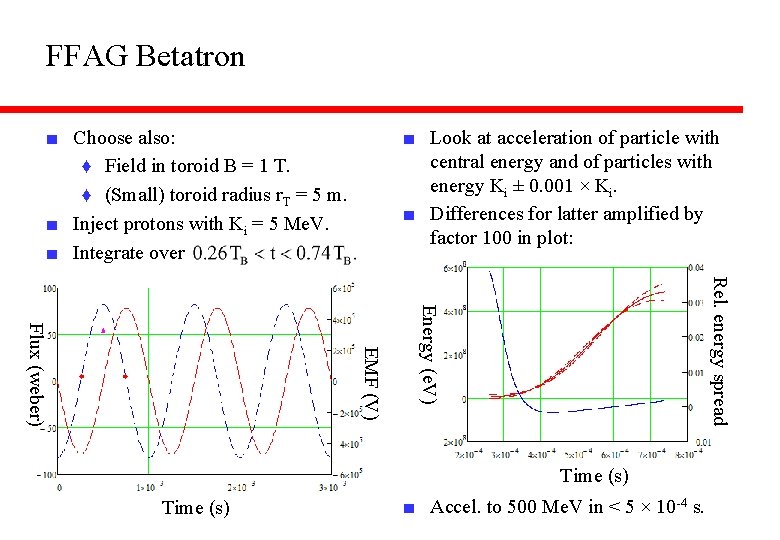
FFAG Betatron ■ Choose also: ♦ Field in toroid B = 1 T. ♦ (Small) toroid radius r. T = 5 m. ■ Inject protons with Ki = 5 Me. V. ■ Integrate over ■ Look at acceleration of particle with central energy and of particles with energy Ki ± 0. 001 × Ki. ■ Differences for latter amplified by factor 100 in plot: Rel. energy spread Energy (e. V) EMF (V) Flux (weber) Time (s) ■ Accel. to 500 Me. V in < 5 × 10 -4 s.
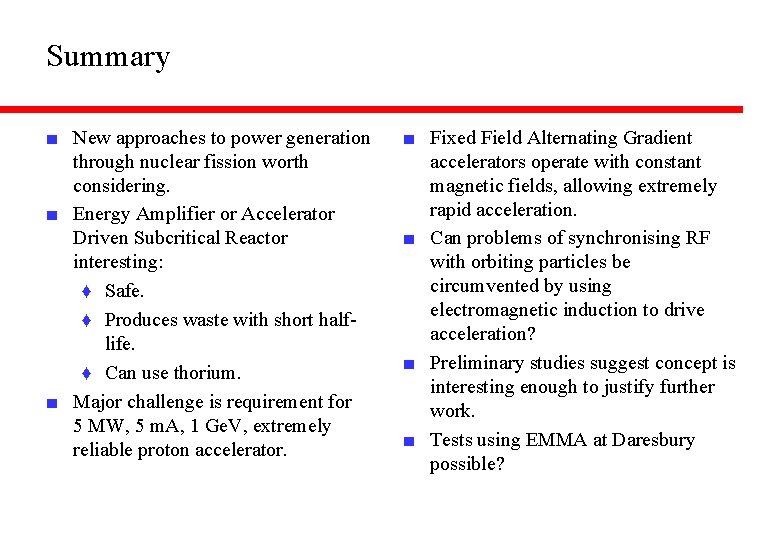
Summary ■ New approaches to power generation through nuclear fission worth considering. ■ Energy Amplifier or Accelerator Driven Subcritical Reactor interesting: ♦ Safe. ♦ Produces waste with short halflife. ♦ Can use thorium. ■ Major challenge is requirement for 5 MW, 5 m. A, 1 Ge. V, extremely reliable proton accelerator. ■ Fixed Field Alternating Gradient accelerators operate with constant magnetic fields, allowing extremely rapid acceleration. ■ Can problems of synchronising RF with orbiting particles be circumvented by using electromagnetic induction to drive acceleration? ■ Preliminary studies suggest concept is interesting enough to justify further work. ■ Tests using EMMA at Daresbury possible?
- Slides: 14