
Accelerator Design for future Hadron Therapy Facilities Maurizio
- Slides: 16
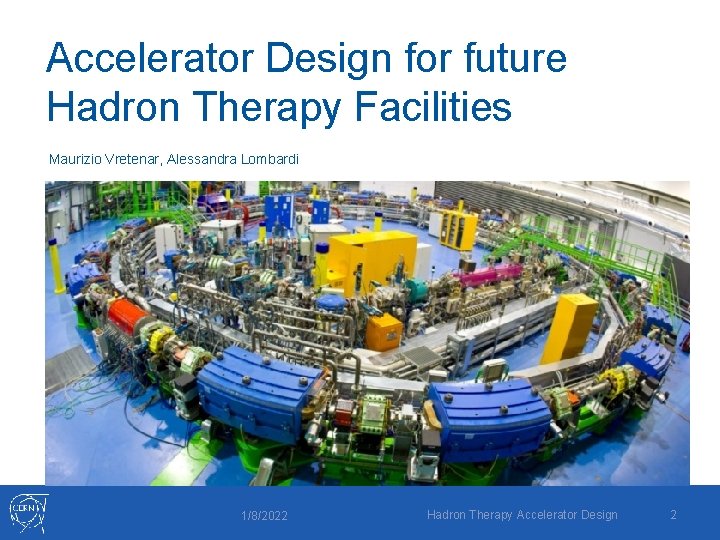
Accelerator Design for future Hadron Therapy Facilities Maurizio Vretenar, Alessandra Lombardi 1/8/2022 Hadron Therapy Accelerator Design 2
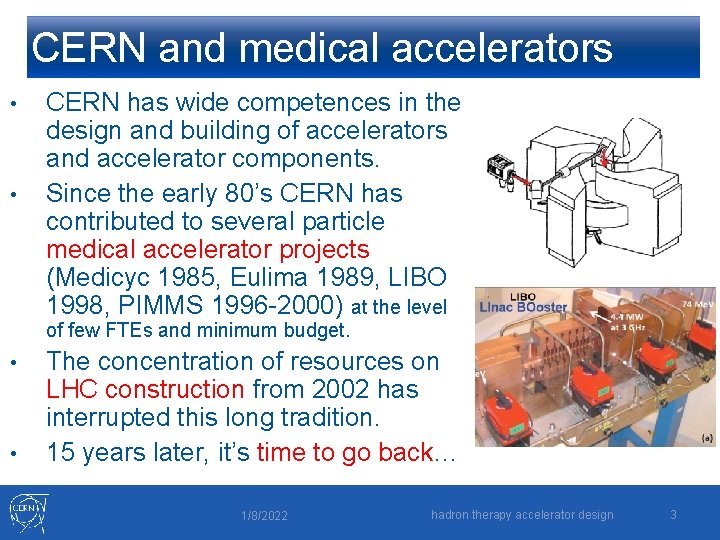
CERN and medical accelerators • • CERN has wide competences in the design and building of accelerators and accelerator components. Since the early 80’s CERN has contributed to several particle medical accelerator projects (Medicyc 1985, Eulima 1989, LIBO 1998, PIMMS 1996 -2000) at the level of few FTEs and minimum budget. • • The concentration of resources on LHC construction from 2002 has interrupted this long tradition. 15 years later, it’s time to go back… 1/8/2022 hadron therapy accelerator design 3
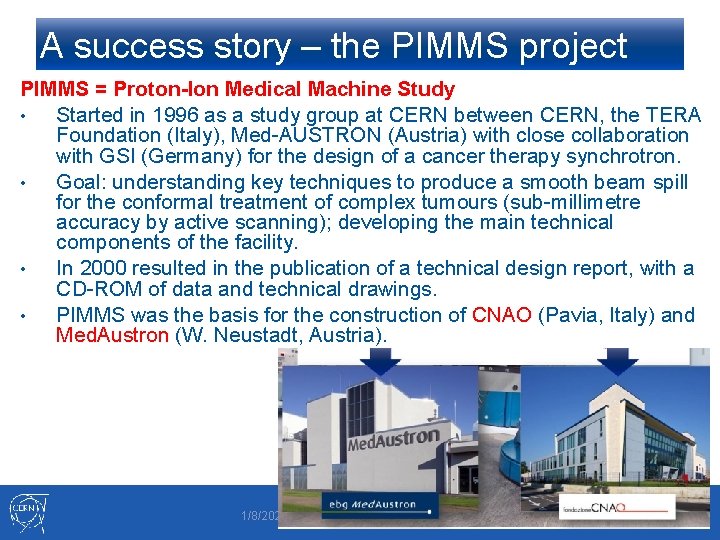
A success story – the PIMMS project PIMMS = Proton-Ion Medical Machine Study • Started in 1996 as a study group at CERN between CERN, the TERA Foundation (Italy), Med-AUSTRON (Austria) with close collaboration with GSI (Germany) for the design of a cancer therapy synchrotron. • Goal: understanding key techniques to produce a smooth beam spill for the conformal treatment of complex tumours (sub-millimetre accuracy by active scanning); developing the main technical components of the facility. • In 2000 resulted in the publication of a technical design report, with a CD-ROM of data and technical drawings. • PIMMS was the basis for the construction of CNAO (Pavia, Italy) and Med. Austron (W. Neustadt, Austria). 1/8/2022 hadron therapy accelerator design 4
Towards a PIMMS 2 ? 20 years after PIMMS, can we imagine another seminal CERN contribution to medical accelerator research? q In this particular moment, it becomes urgent to show to the public examples of the impact of the LHC and of particle physics in addressing societal issues. q There is a (small) window of opportunity within the CERN Medical applications programme (part of MTP). Yes we can, and: Ø The new initiative should replicate the reasons for the success of the original PIMMS: be collaborative, inclusive, innovative, open access. Ø Should not compete with industries and national programmes in the Member States. 1/8/2022 hadron therapy accelerator design 5
Hadron therapy in 2017 • • Proton therapy is rapidly progressing, thanks to commercial availability (3 vendors, cyclotron-based single-room center from 30 -40 M€, still 10 times a conventional X-ray system). Research oriented towards delivery systems and optimizing treatment; nobody questions the accelerator. Lack of experimental data, no evidence for different effectiveness between X-rays and protons, the difference is in quality of life (damage to healthy tissues, secondary cancers). Clear indication that ions (e. g. carbon) have a strong potential. The double-strand damage to DNA cells cannot be repaired; effective with radio-resistant tumors (low oxygen) and have potential to reduce metastasis, main cause of cancer mortality. Strong potential of ions alternative to carbon: He, O, Si. The only ion accelerators are few large Carbon (and proton) synchrotrons, expensive (300 -400 M€), only now being extended to alternative ions, and used most of time for therapy. → PIMMS 2 will focus on ions 1/8/2022 hadron therapy accelerator design 6
What hadron therapy needs today… … and where CERN could contribute 1 A multiple-ion multinational research and therapy facility - Wide range of ions. Synchrotron based (flexibility). More than 50% time research beams. Tests on cells and animals, plus some treatment to patients. 1/8/2022 2 A compact low-cost (<100 M€) carbon treatment facility - Only carbon (experience available). Small footprint, ease of operation. To be industrialized and reproduced. hadron therapy accelerator design 7
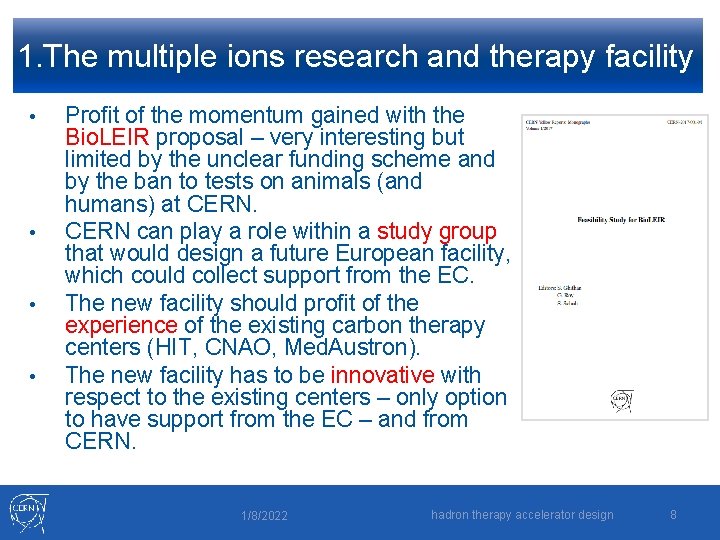
1. The multiple ions research and therapy facility • • Profit of the momentum gained with the Bio. LEIR proposal – very interesting but limited by the unclear funding scheme and by the ban to tests on animals (and humans) at CERN can play a role within a study group that would design a future European facility, which could collect support from the EC. The new facility should profit of the experience of the existing carbon therapy centers (HIT, CNAO, Med. Austron). The new facility has to be innovative with respect to the existing centers – only option to have support from the EC – and from CERN. 1/8/2022 hadron therapy accelerator design 8
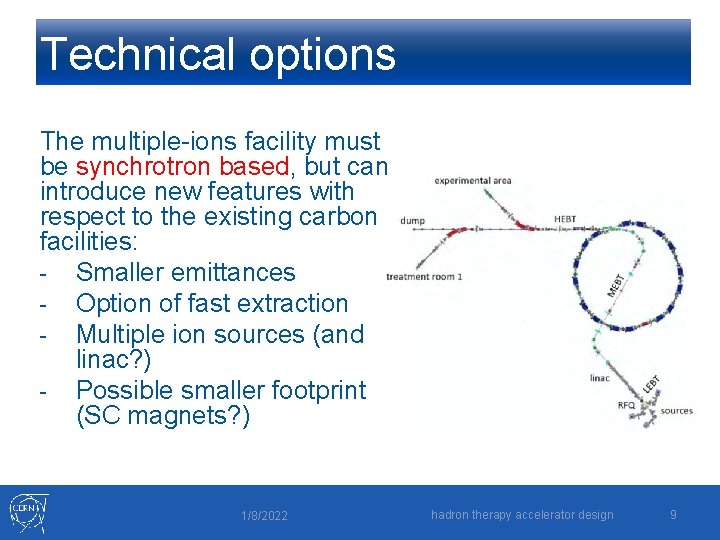
Technical options The multiple-ions facility must be synchrotron based, but can introduce new features with respect to the existing carbon facilities: - Smaller emittances - Option of fast extraction - Multiple ion sources (and linac? ) - Possible smaller footprint (SC magnets? ) 1/8/2022 hadron therapy accelerator design 9
Environment and initial roadmap Collecting interest from the South East Europe Initiative that is aiming at building an accelerator center in the Balkan region to promote cooperation in the area (and to collect EU structural funds) – recently launched by H. Schopper and S. Damjanovic. Parallel interest from India that is strongly moving towards particle therapy. At CERN: seeking the CMASC support for the idea of promoting an International Workshop in March 2018 where the different actors can discuss the options and possibly come out with a collaboration plan and a roadmap for the design of a new facility. The Workshop will address to the usual hadron therapy community (CERN, GSI, TERA, CNAO, HIT, Med. Austron) but will be open to other contributions and to all interested partners. 1/8/2022 hadron therapy accelerator design 10
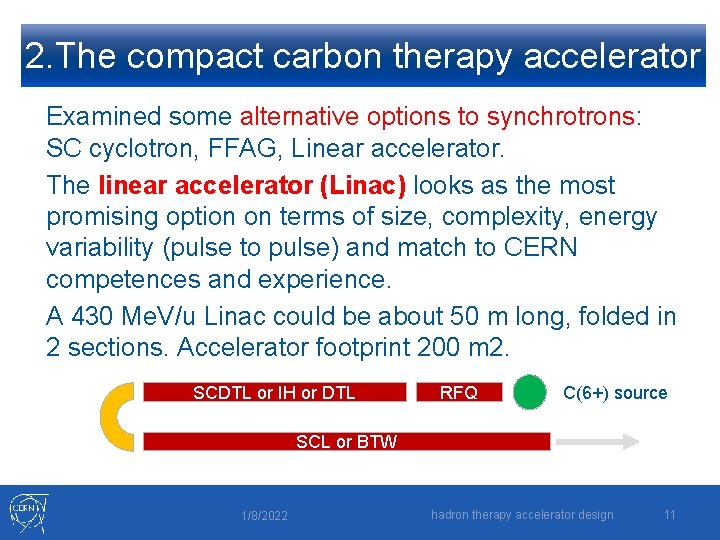
2. The compact carbon therapy accelerator Examined some alternative options to synchrotrons: SC cyclotron, FFAG, Linear accelerator. The linear accelerator (Linac) looks as the most promising option on terms of size, complexity, energy variability (pulse to pulse) and match to CERN competences and experience. A 430 Me. V/u Linac could be about 50 m long, folded in 2 sections. Accelerator footprint 200 m 2. SCDTL or IH or DTL RFQ C(6+) source SCL or BTW 1/8/2022 hadron therapy accelerator design 11
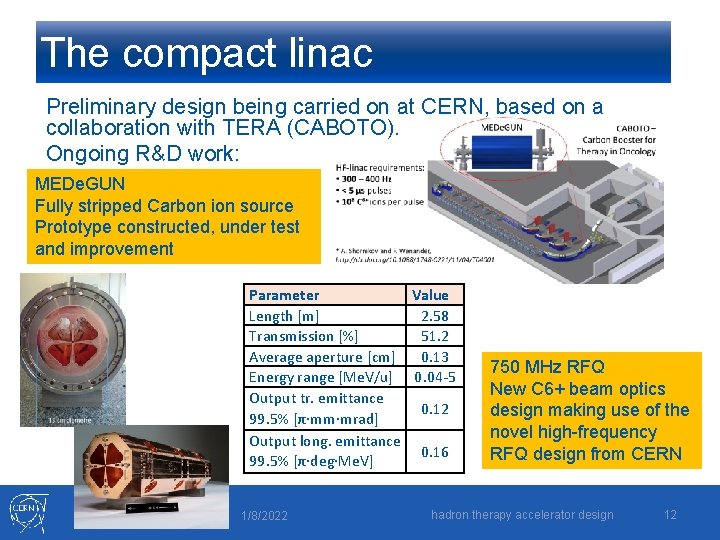
The compact linac Preliminary design being carried on at CERN, based on a collaboration with TERA (CABOTO). Ongoing R&D work: MEDe. GUN Fully stripped Carbon ion source Prototype constructed, under test and improvement Parameter Value Length [m] 2. 58 Transmission [%] 51. 2 Average aperture [cm] 0. 13 Energy range [Me. V/u] 0. 04 -5 Output tr. emittance 0. 12 99. 5% [π∙mm∙mrad] Output long. emittance 0. 16 99. 5% [π∙deg∙Me. V] 1/8/2022 750 MHz RFQ New C 6+ beam optics design making use of the novel high-frequency RFQ design from CERN hadron therapy accelerator design 12
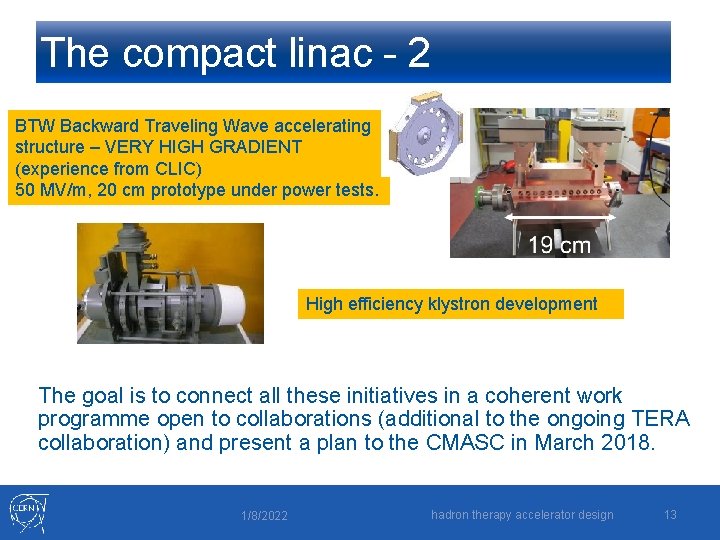
The compact linac - 2 BTW Backward Traveling Wave accelerating structure – VERY HIGH GRADIENT (experience from CLIC) 50 MV/m, 20 cm prototype under power tests. High efficiency klystron development The goal is to connect all these initiatives in a coherent work programme open to collaborations (additional to the ongoing TERA collaboration) and present a plan to the CMASC in March 2018. 1/8/2022 hadron therapy accelerator design 13
Future work and conclusions We are in the process of setting-up a PIMMS 2 strategy that will be submitted in early 2018 to the CERN relevant committees. This is the right moment for interested partners to contact us. The more synergies and collaborations we can find with our Member States the more options we will have for our plans to materialize. 1/8/2022 hadron therapy accelerator design 14
Backup slide 1/8/2022 hadron therapy accelerator design 15
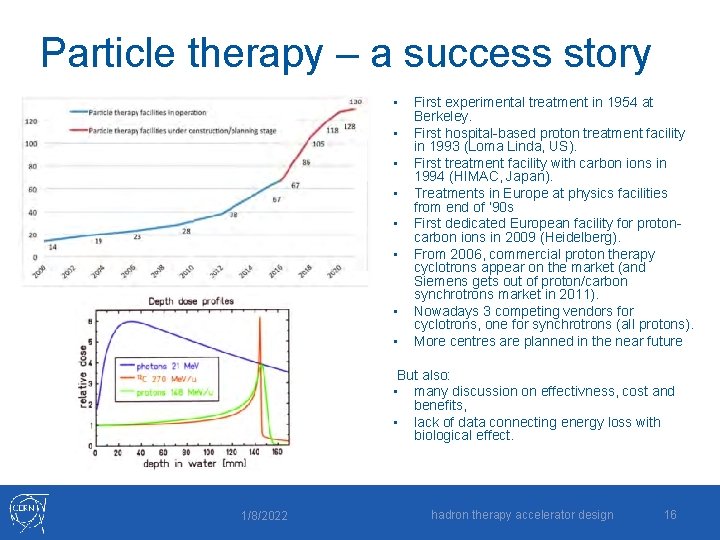
Particle therapy – a success story • • First experimental treatment in 1954 at Berkeley. First hospital-based proton treatment facility in 1993 (Loma Linda, US). First treatment facility with carbon ions in 1994 (HIMAC, Japan). Treatments in Europe at physics facilities from end of ‘ 90 s First dedicated European facility for protoncarbon ions in 2009 (Heidelberg). From 2006, commercial proton therapy cyclotrons appear on the market (and Siemens gets out of proton/carbon synchrotrons market in 2011). Nowadays 3 competing vendors for cyclotrons, one for synchrotrons (all protons). More centres are planned in the near future But also: • many discussion on effectivness, cost and benefits, • lack of data connecting energy loss with biological effect. 1/8/2022 hadron therapy accelerator design 16