
Accelerator and Injector Systems and High Power RF
- Slides: 28
Accelerator and Injector Systems and High Power RF Systems Thrusts --- Non-SRF Activities Robert Webber Fermilab General Accelerator Development Review January 24 -26, 2011
History of Fermilab GAD Accelerator and Injector Systems R&D* • • This thrust began in 2006 with initiation of the High Intensity Neutrino Source (HINS) program to demonstrate technology applications new to the low-energy front-end of a pulsed, highintensity proton/H- Linac The plan was to construct a ten’s of Me. V Linac to demonstrate: § § • Beam acceleration using spoke-type superconducting RF (SRF) cavity structures starting at a beam energy of 10 Me. V High power RF vector modulators controlling multiple RF cavities driven by a single high power klystron for acceleration of a nonrelativistic beam Control of beam halo and emittance growth by the use of solenoid focusing optics Fast, 325 MHz bunch-by-bunch, beam chopping In FY 11, the program separated along SRF and non-SRF lines* § § The SRF line is addressed separately in this review The non-SRF thrust is subsumed by Project X R&D, except for two remaining non-Project-X-specific objectives discussed in this talk * This talk focuses on non-SRF activities, but mentions SRF items in historical perspective 2 Robert Webber, Fermilab – General Accelerator Development Review January 24 -26, 2011
External Review Basis for the HINS Program • The HINS program was first exposed to expert review at the May 10 -12, 2006, Fermilab Accelerator Advisory Committee meeting. The Executive Summary of that meeting report states: “…The committee considers it important that capabilities are developed and R&D carried out to maintain options for an experimental HEP program in U. S. , beyond Run II, based on a strong neutrino program at Fermilab. The committee supports the proposed accelerator developments leading to improved performance using existing accelerator assets, and an R&D program to pursue further enhancements with a new high-power proton injector. ” “…The HINS program includes many R&D topics and there are clear synergies between this R&D and the Radioactive Isotope Accelerator (RIA), as well as more generic accelerator R&D. In some cases, there also clear synergies with the ILC accelerator R&D and possibly the ILC construction project. ” 3 Robert Webber, Fermilab – General Accelerator Development Review January 24 -26, 2011
The HINS Program Scope and Approach • • Design and construction of an accelerator with solenoid focusing to provide 10 Me. V beam for injection into superconducting spoke-type cavities Development of 325 MHz superconducting spoke RF cavities and processing procedures* Development of high power RF vector modulators Installation of a megawatt-class 325 MHz pulsed, RF power source Construction of cavity test facilities, normal and superconducting* Development of a state-of-the-art beam chopper Establishing collaborations with Argonne, Brookhaven, and Lawrence Berkeley National Laboratories in the US, Inter University Accelerator Center in India, and, informally, Imperial College/Rutherford Appleton Laboratory in the UK *SRF 4 Robert Webber, Fermilab – General Accelerator Development Review January 24 -26, 2011
Program Deliverables To Date 1 • In the five years since this program began, it has delivered: § One Ph. D – Wai-Ming Tam, 2009, Indiana University/Fermilab Accel. Physics Ph. D Program, “Characterization of the Proton Ion Source Beam for the High Intensity Neutrino Source at Fermilab” § A radiation-shielded facility for testing normal and superconducting 325 MHz cavities § A RF-shielded facility for high-power testing of non-radiation producing 325 MHz RF power components A radiation-shielded enclosure and utilities infrastructure for the HINS Linac A 2. 5 MW pulsed, 325 MHz RF power system with the flexibility to serve the cavity test facility, the RF power component test facility, or the Linac An operating 50 ke. V proton beam ion source A prototype H- ion source delivering beam suitable for injection into an RFQ A 2. 5 Me. V, 325 MHz RFQ A proton beam accelerated to 2. 5 Me. V through the RFQ § § § 5 Robert Webber, Fermilab – General Accelerator Development Review January 24 -26, 2011
Program Deliverables To Date 2 • In the five years since this program began, it has also delivered: § § § * High-power, 325 MHz RF vector modulators: one designed and tested to 500 k. W and 18 designed and tested to 70 k. W * Sixteen 325 MHz normal-conducting spoke-type accelerating cavities designed to accelerate pulsed beam to 10 Me. V * Nineteen superconducting solenoid magnets, some with integral dipole steering coils, designed for the normal conducting 10 Me. V Linac ** Two 325 MHz, β = 0. 2, superconducting spoke-type RF cavities that have achieved world-class accelerating gradients in RF tests (see SRF activities talk) ** First measurements of the sensitivity of superconducting spoke cavities to on-axis magnetic fields * Unique world-wide ** Unique world-wide covered in SRF presentation 6 Robert Webber, Fermilab – General Accelerator Development Review January 24 -26, 2011
Deliverables Produced through Collaborations • BNL – (paid by Fermilab GAD funds) Laser wire beam diagnostic hardware LBNL – (paid by Fermilab GAD funds) § Design and fabrication of two normal conducting 325 MHz Buncher Cavities ANL – (largely paid by Fermilab GAD funds) § Linac optics designs and particle tracking simulations with TRACK code § Mutual efforts on the TRACK code itself Addition of a comprehensive H- stripping module (magnetic, gas, and blackbody) Extensive benchmarking of TRACK against ASTRA with resulting improvements to each § Superconducting spoke cavity power coupler ports § Spoke cavity processing facilities § • • q q • Imperial College London/Rutherford Lab Front-End Test System – • Visits by several FETS people to participate in hardware commissioning activities Indian Institutions – (niobium and partial M&S paid by Fermilab GAD funds) § Two 325 MHz superconducting spoke cavities currently in fabrication* § • These early collaborative efforts have formed a basis for current Project X collaborations § § 7 With U. S. national labs With India on Ion Source, RFQ, RF power, SRF cavities, and cryomodules Robert Webber, Fermilab – General Accelerator Development Review January 24 -26, 2011
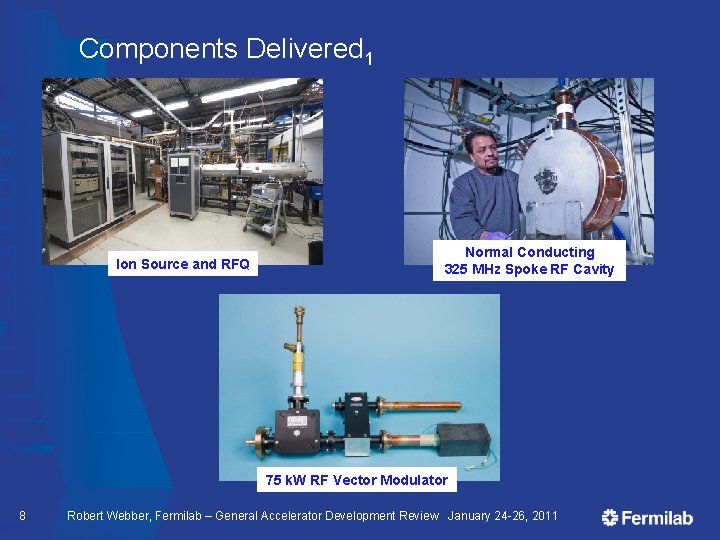
Components Delivered 1 Ion Source and RFQ Normal Conducting 325 MHz Spoke RF Cavity 75 k. W RF Vector Modulator 8 Robert Webber, Fermilab – General Accelerator Development Review January 24 -26, 2011
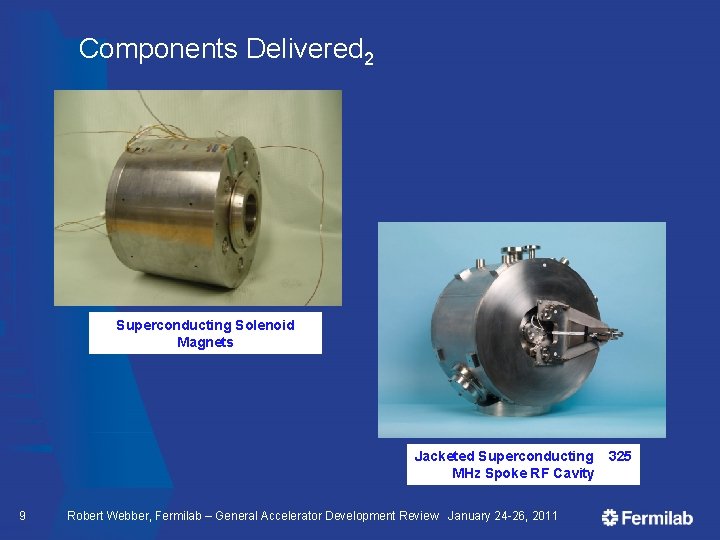
Components Delivered 2 Superconducting Solenoid Magnets Jacketed Superconducting 325 MHz Spoke RF Cavity 9 Robert Webber, Fermilab – General Accelerator Development Review January 24 -26, 2011
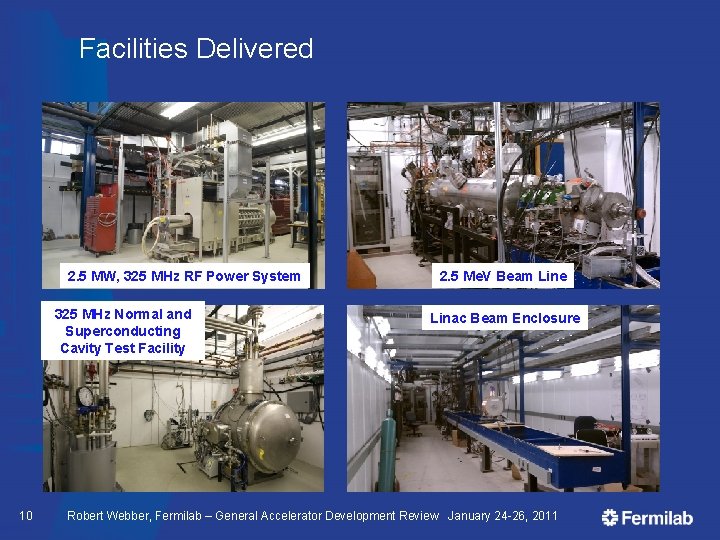
Facilities Delivered 2. 5 MW, 325 MHz RF Power System 325 MHz Normal and Superconducting Cavity Test Facility 10 2. 5 Me. V Beam Line Linac Beam Enclosure Robert Webber, Fermilab – General Accelerator Development Review January 24 -26, 2011
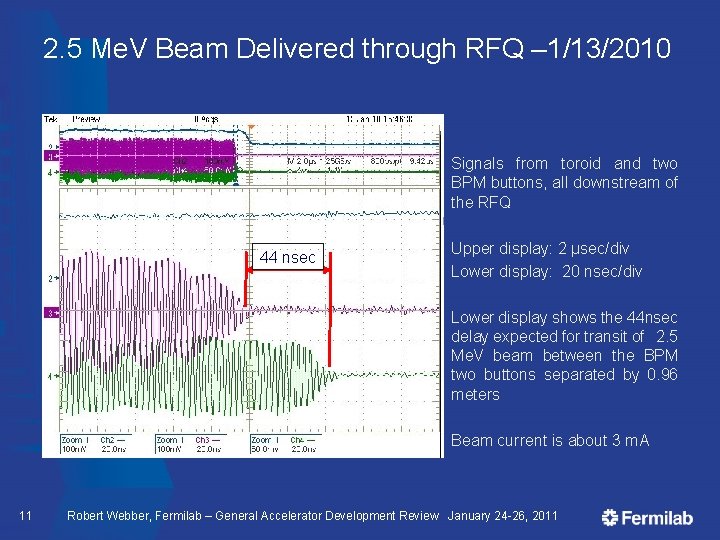
2. 5 Me. V Beam Delivered through RFQ – 1/13/2010 Signals from toroid and two BPM buttons, all downstream of the RFQ 44 nsec Upper display: 2 μsec/div Lower display: 20 nsec/div Lower display shows the 44 nsec delay expected for transit of 2. 5 Me. V beam between the BPM two buttons separated by 0. 96 meters Beam current is about 3 m. A 11 Robert Webber, Fermilab – General Accelerator Development Review January 24 -26, 2011
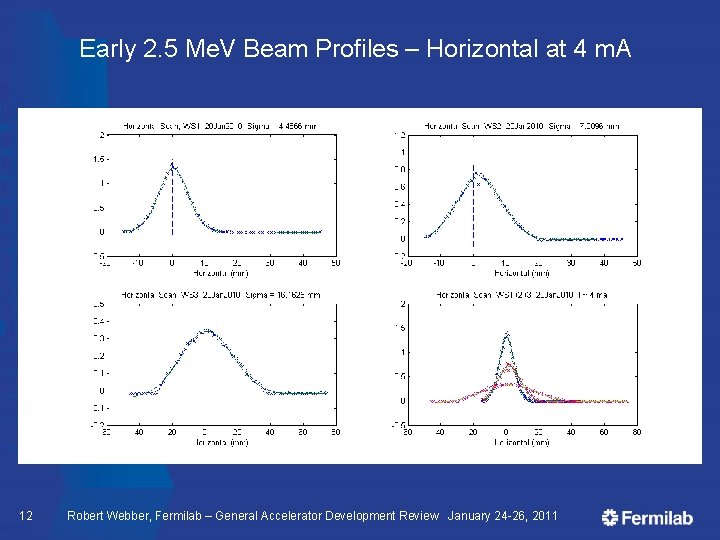
Early 2. 5 Me. V Beam Profiles – Horizontal at 4 m. A 12 Robert Webber, Fermilab – General Accelerator Development Review January 24 -26, 2011
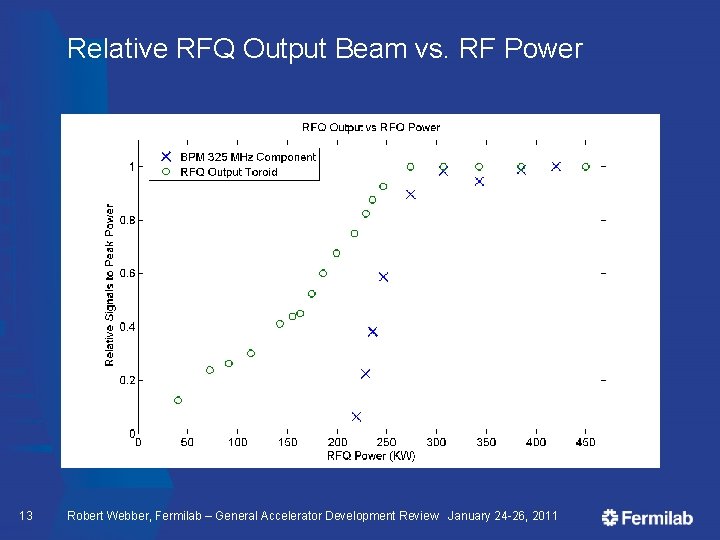
Relative RFQ Output Beam vs. RF Power 13 Robert Webber, Fermilab – General Accelerator Development Review January 24 -26, 2011
HINS Program Technology Transfer Examples • The success, quality, and impact of this GAD research thrust and its relevance to the overall HEP mission is clearly demonstrated by: § § 14 Absorption of the bulk of the non-SRF activities and the HINS Linac facility into the Project X R&D program for fast chopper development and testing and beam instrumentation development An early HINS prototype beam chopper now installed and operational in the Fermilab Linac to reduce beam loss in Booster Incorporation of HINS-driven H- ion source developments into the present Fermilab Linac Front-End Upgrade project Installation of the HINS/BNL laser profile monitor into the Fermilab 400 Me. V beam line Robert Webber, Fermilab – General Accelerator Development Review January 24 -26, 2011
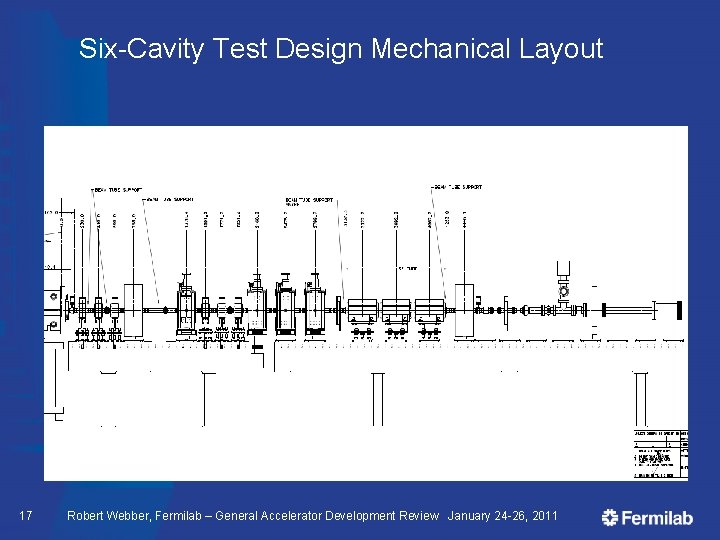
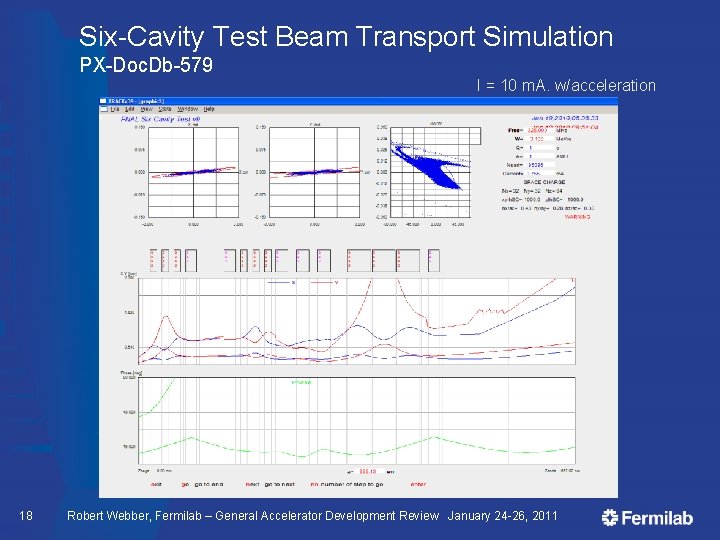
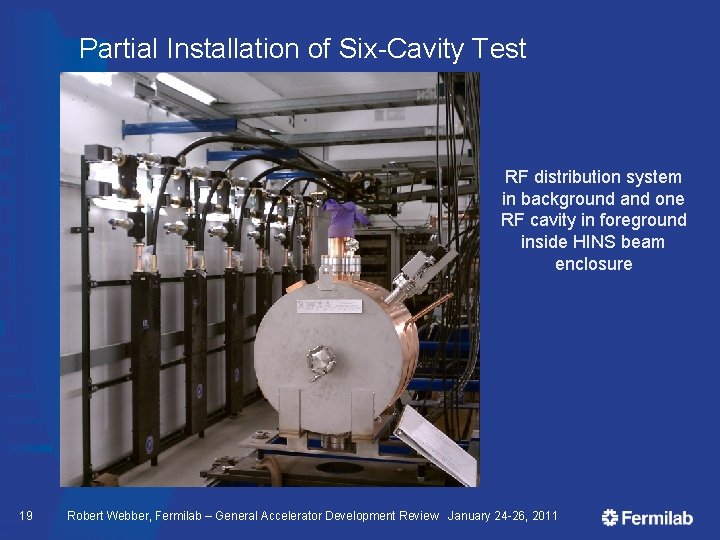
Remaining Deliverables for 2011 -20131 • The primary deliverable of the GAD non-SRF research thrust is the demonstration of controlled acceleration of low-β beam through multiple 325 MHz cavities driven by a single high power klystron through individual RF Vector Modulators – the “Six-Cavity Test” § § Approach: assemble a beam line and RF distribution system in the HINS beam enclosure with six vector modulator controlled normal-conducting multiple-spoke cavities, normal-conducting quadrupoles, diagnostics, and beam absorber and accelerate beam from the RFQ to beyond 3 Me. V Six-Cavity Test definition and goals specifications are available at: http: //projectx-docdb. fnal. gov/cgi-bin/Show. Document? docid=778 § 15 Purpose: proof-of-principal of vector modulator controlled cavities accelerating non-relativistic beam Robert Webber, Fermilab – General Accelerator Development Review January 24 -26, 2011
Remaining Deliverables for 2011 -20132 • The second deliverable is characterization of the construction and alignment procedures for superconducting solenoids, designed for focusing low energy beams § § 16 Approach: assemble four solenoids into their cryostats (all parts in-hand) and test in existing Fermilab cryogenic stand Purpose: understanding how to achieve 300 micron alignment precision and reproducibility required in a high intensity, low-energy Linac front end to maintain an axially symmetric beam to minimize beam halo growth and resulting beam losses Robert Webber, Fermilab – General Accelerator Development Review January 24 -26, 2011
Six-Cavity Test Design Mechanical Layout 17 Robert Webber, Fermilab – General Accelerator Development Review January 24 -26, 2011
Six-Cavity Test Beam Transport Simulation PX-Doc. Db-579 I = 10 m. A. w/acceleration 18 Robert Webber, Fermilab – General Accelerator Development Review January 24 -26, 2011
Partial Installation of Six-Cavity Test RF distribution system in background and one RF cavity in foreground inside HINS beam enclosure 19 Robert Webber, Fermilab – General Accelerator Development Review January 24 -26, 2011
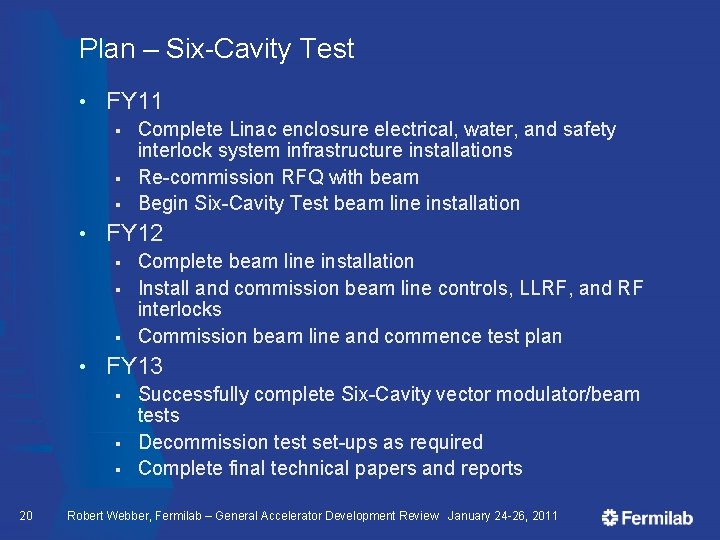
Plan – Six-Cavity Test • FY 11 § § § • FY 12 § § § • Complete beam line installation Install and commission beam line controls, LLRF, and RF interlocks Commission beam line and commence test plan FY 13 § § § 20 Complete Linac enclosure electrical, water, and safety interlock system infrastructure installations Re-commission RFQ with beam Begin Six-Cavity Test beam line installation Successfully complete Six-Cavity vector modulator/beam tests Decommission test set-ups as required Complete final technical papers and reports Robert Webber, Fermilab – General Accelerator Development Review January 24 -26, 2011
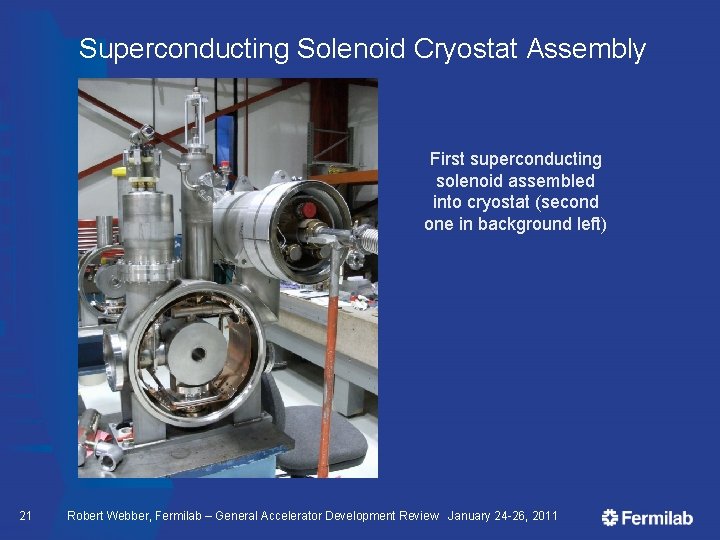
Superconducting Solenoid Cryostat Assembly First superconducting solenoid assembled into cryostat (second one in background left) 21 Robert Webber, Fermilab – General Accelerator Development Review January 24 -26, 2011
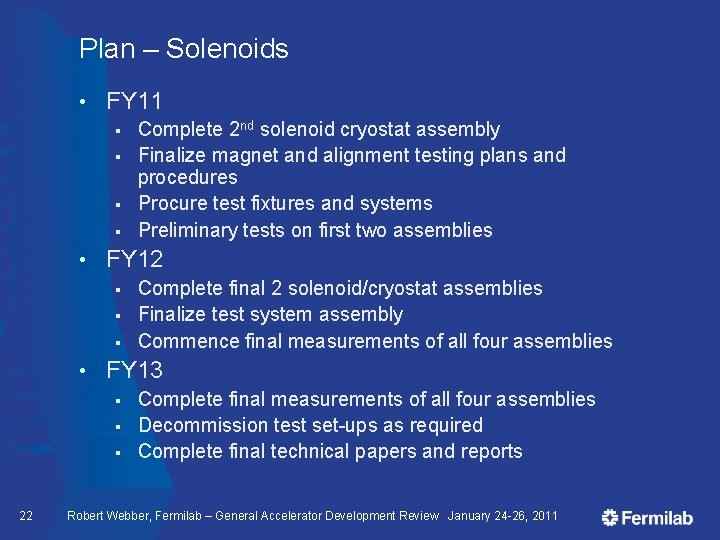
Plan – Solenoids • FY 11 § § • FY 12 § § § • Complete final 2 solenoid/cryostat assemblies Finalize test system assembly Commence final measurements of all four assemblies FY 13 § § § 22 Complete 2 nd solenoid cryostat assembly Finalize magnet and alignment testing plans and procedures Procure test fixtures and systems Preliminary tests on first two assemblies Complete final measurements of all four assemblies Decommission test set-ups as required Complete final technical papers and reports Robert Webber, Fermilab – General Accelerator Development Review January 24 -26, 2011
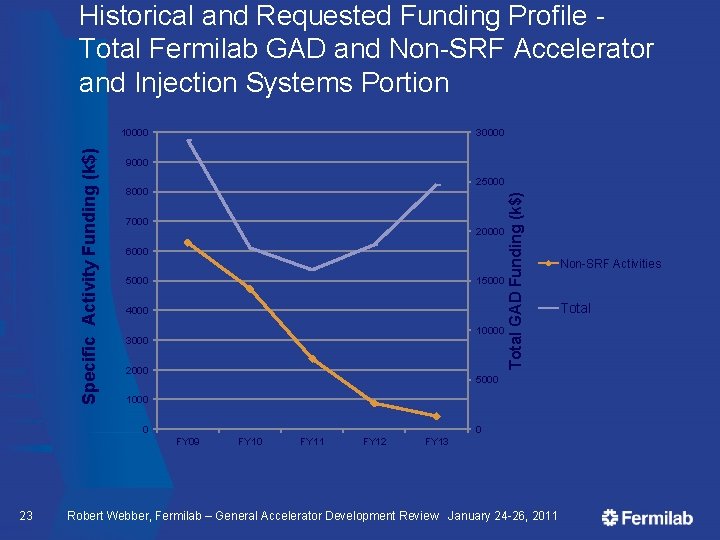
Historical and Requested Funding Profile Total Fermilab GAD and Non-SRF Accelerator and Injection Systems Portion 30000 9000 25000 8000 7000 20000 6000 5000 15000 4000 10000 3000 2000 5000 1000 0 0 FY 09 23 Total GAD Funding (k$) Specific Activity Funding (k$) 10000 FY 11 FY 12 FY 13 Robert Webber, Fermilab – General Accelerator Development Review January 24 -26, 2011 Non-SRF Activities Total
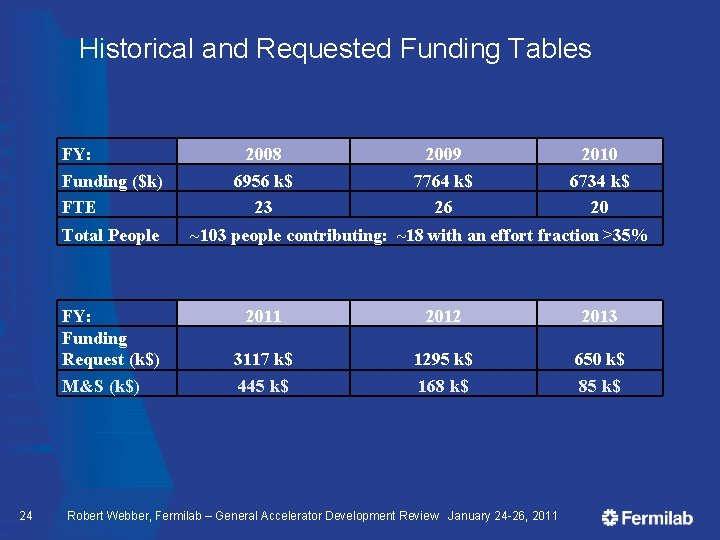
Historical and Requested Funding Tables FY: Funding ($k) FTE Total People FY: Funding Request (k$) M&S (k$) 24 2008 6956 k$ 23 2009 7764 k$ 26 2010 6734 k$ 20 ~103 people contributing: ~18 with an effort fraction >35% 2011 2012 2013 3117 k$ 445 k$ 1295 k$ 168 k$ 650 k$ 85 k$ Robert Webber, Fermilab – General Accelerator Development Review January 24 -26, 2011
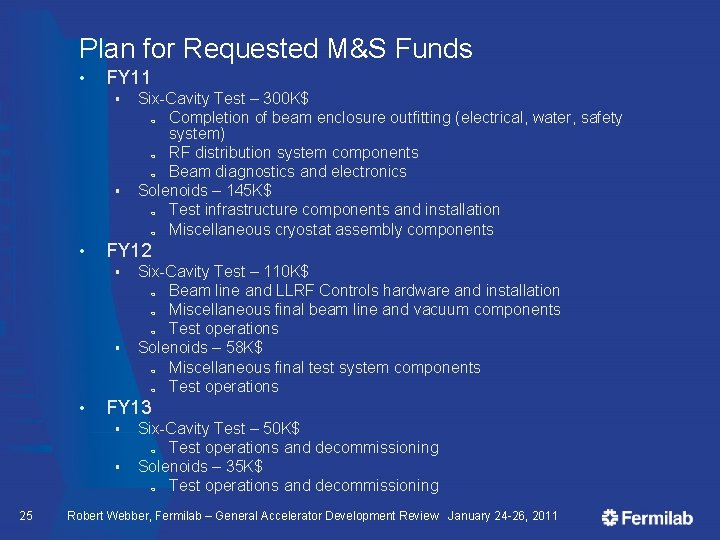
Plan for Requested M&S Funds • FY 11 § Six-Cavity Test – 300 K$ Completion of beam enclosure outfitting (electrical, water, safety system) RF distribution system components Beam diagnostics and electronics Solenoids – 145 K$ Test infrastructure components and installation Miscellaneous cryostat assembly components q q q § q q • FY 12 § Six-Cavity Test – 110 K$ Beam line and LLRF Controls hardware and installation Miscellaneous final beam line and vacuum components Test operations Solenoids – 58 K$ Miscellaneous final test system components Test operations q q q § q q • FY 13 § Six-Cavity Test – 50 K$ Test operations and decommissioning Solenoids – 35 K$ Test operations and decommissioning q § q 25 Robert Webber, Fermilab – General Accelerator Development Review January 24 -26, 2011
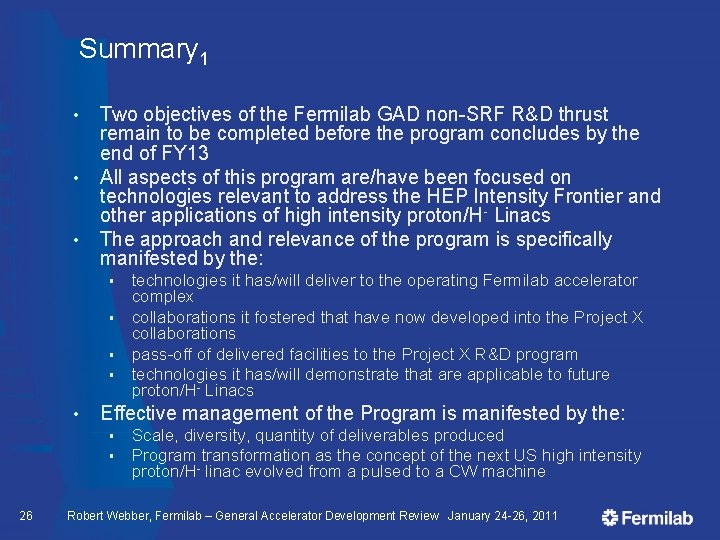
Summary 1 • • • Two objectives of the Fermilab GAD non-SRF R&D thrust remain to be completed before the program concludes by the end of FY 13 All aspects of this program are/have been focused on technologies relevant to address the HEP Intensity Frontier and other applications of high intensity proton/H- Linacs The approach and relevance of the program is specifically manifested by the: § § • Effective management of the Program is manifested by the: § § 26 technologies it has/will deliver to the operating Fermilab accelerator complex collaborations it fostered that have now developed into the Project X collaborations pass-off of delivered facilities to the Project X R&D program technologies it has/will demonstrate that are applicable to future proton/H- Linacs Scale, diversity, quantity of deliverables produced Program transformation as the concept of the next US high intensity proton/H- linac evolved from a pulsed to a CW machine Robert Webber, Fermilab – General Accelerator Development Review January 24 -26, 2011
Summary 2 • The technical accomplishments of the program are: § § § • 27 Diverse Unique Significant in scale and quantity Focused in areas of broad interest to the global hadron accelerator community Managed and delivered effectively in an environment of safety, quality, and adaptivity The program is optimally poised to complete its final two objectives with a competent team in place and necessary facilities and accelerator components almost completely in-hand Robert Webber, Fermilab – General Accelerator Development Review January 24 -26, 2011
The End 28 Robert Webber, Fermilab – General Accelerator Development Review January 24 -26, 2011