
Accelerations in 1 and 2 Dimensions Acceleration in

![Check Your Understanding A racing car accelerates from rest to 96 km/h [W] in](https://slidetodoc.com/presentation_image_h2/4f410d5e9231e1c9d9e67489edf28ec8/image-5.jpg "Check Your Understanding A racing car accelerates from rest to 96 km/h [W] in")







![Check Your Understanding A motorcyclist, travelling initially at 12 m/s [W], changes gears and](https://slidetodoc.com/presentation_image_h2/4f410d5e9231e1c9d9e67489edf28ec8/image-25.jpg "Check Your Understanding A motorcyclist, travelling initially at 12 m/s [W], changes gears and")
![Check Your Understanding A motorcyclist, travelling initially at 12 m/s [W], changes gears and](https://slidetodoc.com/presentation_image_h2/4f410d5e9231e1c9d9e67489edf28ec8/image-26.jpg "Check Your Understanding A motorcyclist, travelling initially at 12 m/s [W], changes gears and")

![Example - Solution A car with a velocity of 25 m/s [E] changes its](https://slidetodoc.com/presentation_image_h2/4f410d5e9231e1c9d9e67489edf28ec8/image-29.jpg "Example - Solution A car with a velocity of 25 m/s [E] changes its")
![Check Your Understanding A watercraft with an initial velocity of 6. 4 m/s [E]](https://slidetodoc.com/presentation_image_h2/4f410d5e9231e1c9d9e67489edf28ec8/image-30.jpg "Check Your Understanding A watercraft with an initial velocity of 6. 4 m/s [E]")
- Slides: 30
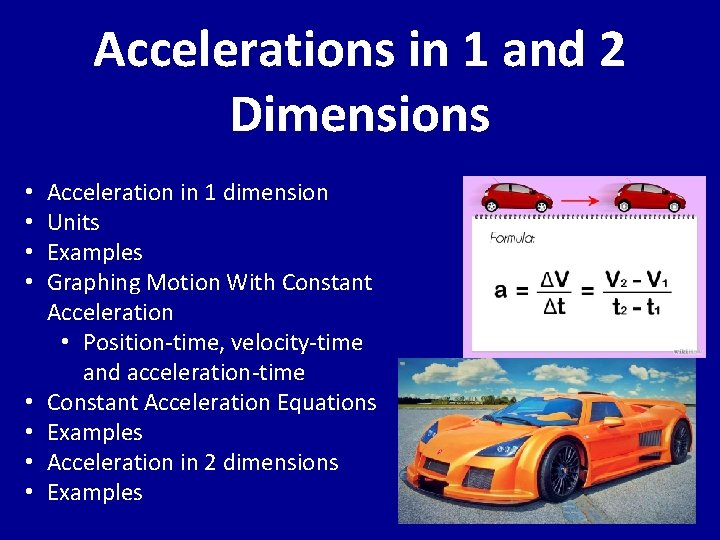
Accelerations in 1 and 2 Dimensions • • Acceleration in 1 dimension Units Examples Graphing Motion With Constant Acceleration • Position-time, velocity-time and acceleration-time Constant Acceleration Equations Examples Acceleration in 2 dimensions Examples
Teach. With. Fergy Preview File If you decide to purchase and the lesson isn't exactly what you need or thought it was, I will refund you 100% via Pay. Pal. - Some slides appear blank because they have been removed. - Other slides may have. . . on them, this represents writing that has been removed. - Please note that the Entire Unit Package can also be purchased at a steep discount from my Store.
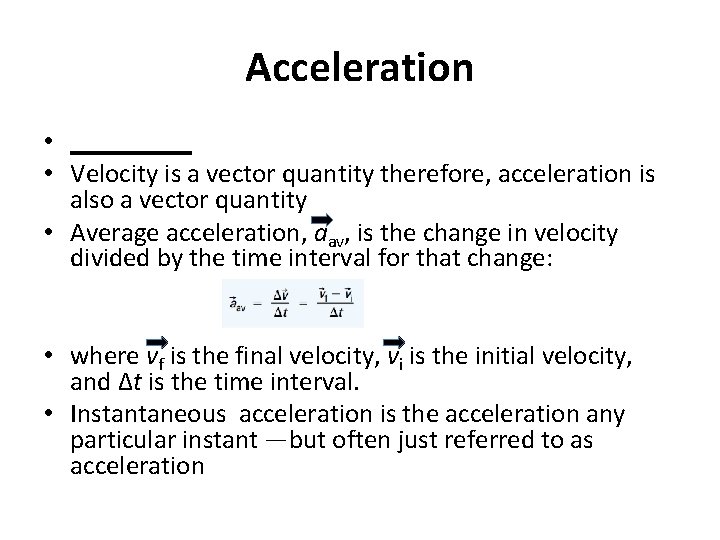
Acceleration • _____ • Velocity is a vector quantity therefore, acceleration is also a vector quantity • Average acceleration, aav, is the change in velocity divided by the time interval for that change: • where vf is the final velocity, vi is the initial velocity, and Δt is the time interval. • Instantaneous acceleration is the acceleration any particular instant —but often just referred to as acceleration
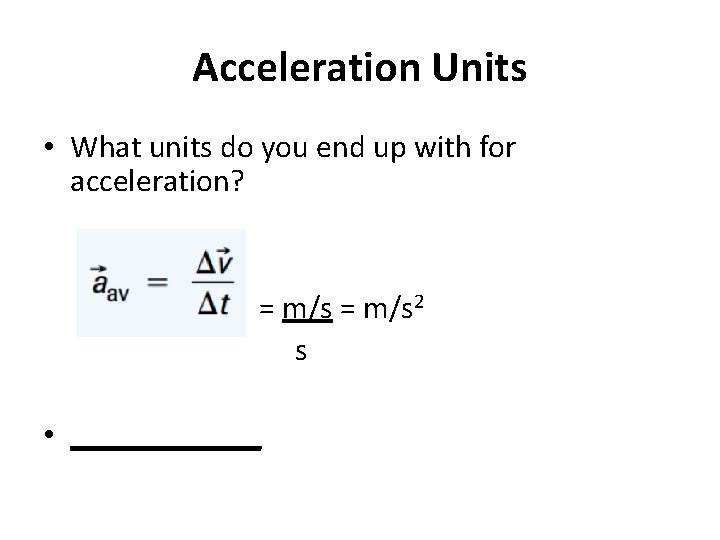
Acceleration Units • What units do you end up with for acceleration? = m/s 2 s • ______
Check Your Understanding A racing car accelerates from rest to 96 km/h [W] in 4. 1 s. Determine the average acceleration of the car.
This Slide Has Been Removed
Check Your Understanding 1. Is it possible to have acceleration when the velocity is zero? If “no, ” explain. 2. Is it possible to have an eastward velocity with a westward acceleration? If “no, ” explain why not. If “yes, ” give an example. 3. A flock of robins is ………………
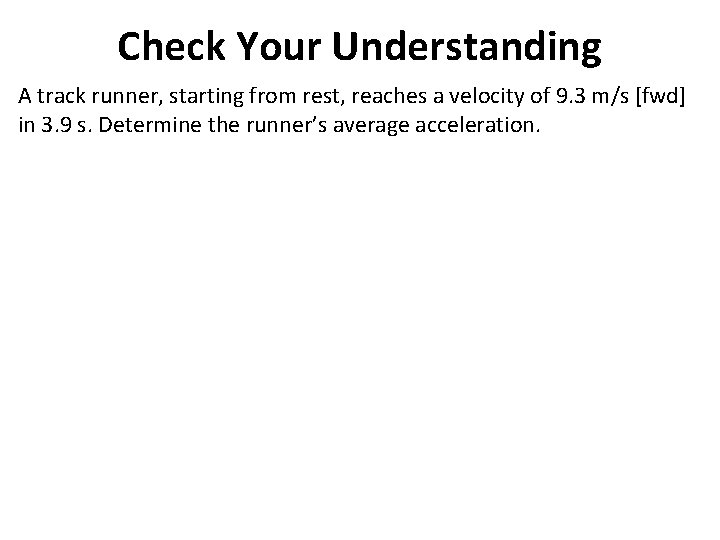
Check Your Understanding A track runner, starting from rest, reaches a velocity of 9. 3 m/s [fwd] in 3. 9 s. Determine the runner’s average acceleration.
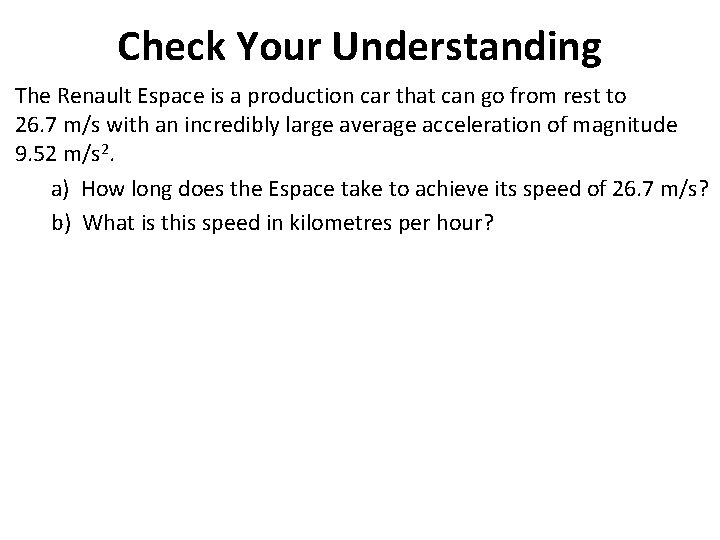
Check Your Understanding The Renault Espace is a production car that can go from rest to 26. 7 m/s with an incredibly large average acceleration of magnitude 9. 52 m/s 2. a) How long does the Espace take to achieve its speed of 26. 7 m/s? b) What is this speed in kilometres per hour?
This Slide Has Been Removed
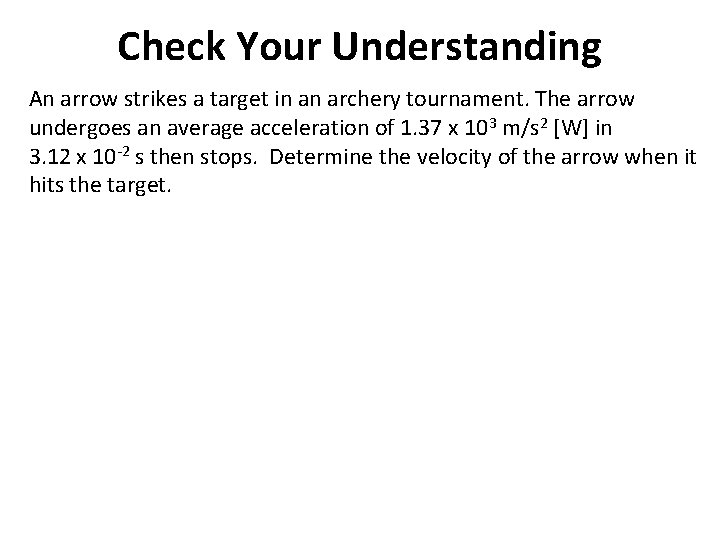
Check Your Understanding An arrow strikes a target in an archery tournament. The arrow undergoes an average acceleration of 1. 37 x 103 m/s 2 [W] in 3. 12 x 10 -2 s then stops. Determine the velocity of the arrow when it hits the target.
What’s the cars average acceleration? In slideshow mode, click on the image to see how videos are embedded into your lesson Lamborghini LP 700 -4 Aventador – Click Image
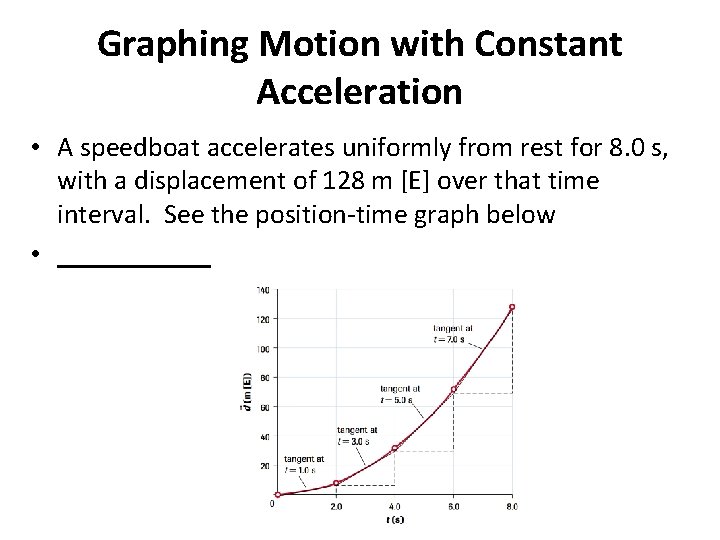
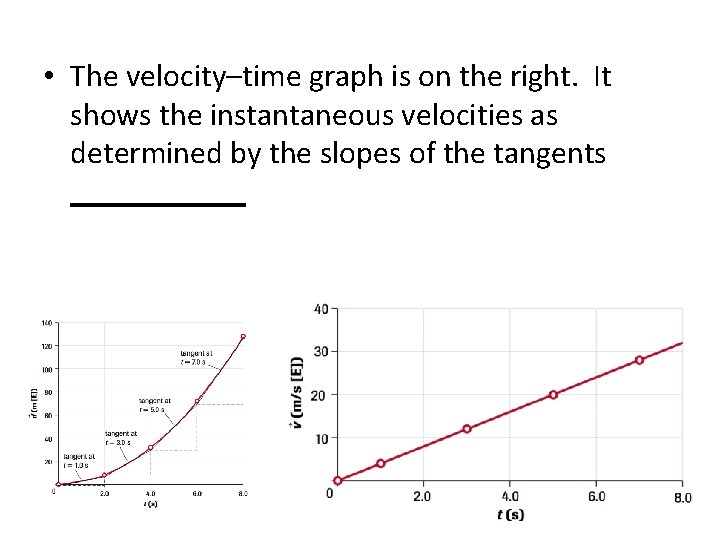
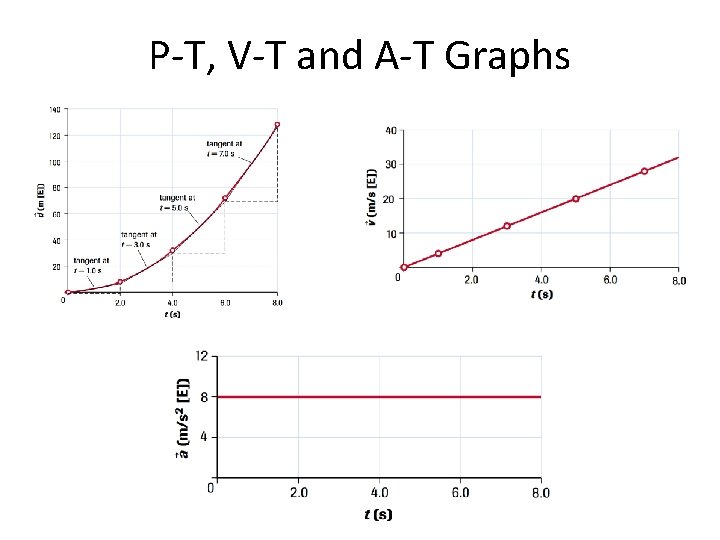
Graphing Motion with Constant Acceleration • A speedboat accelerates uniformly from rest for 8. 0 s, with a displacement of 128 m [E] over that time interval. See the position-time graph below • ______
• The velocity–time graph is on the right. It shows the instantaneous velocities as determined by the slopes of the tangents ______
This Slide Has Been Removed
P-T, V-T and A-T Graphs
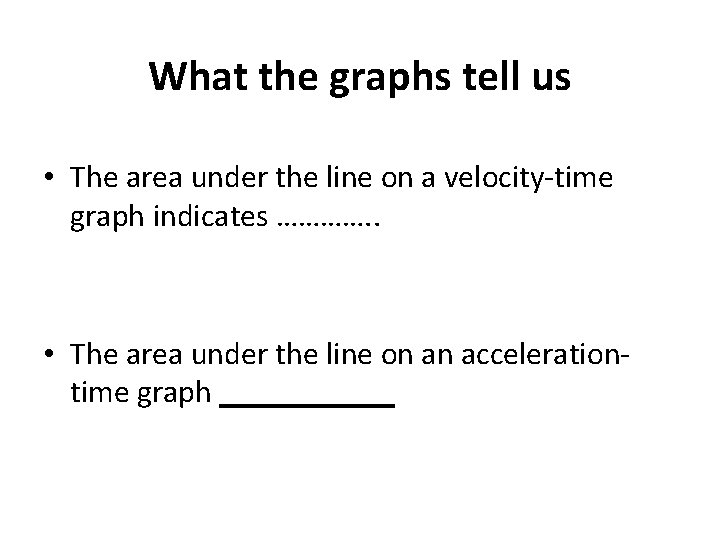
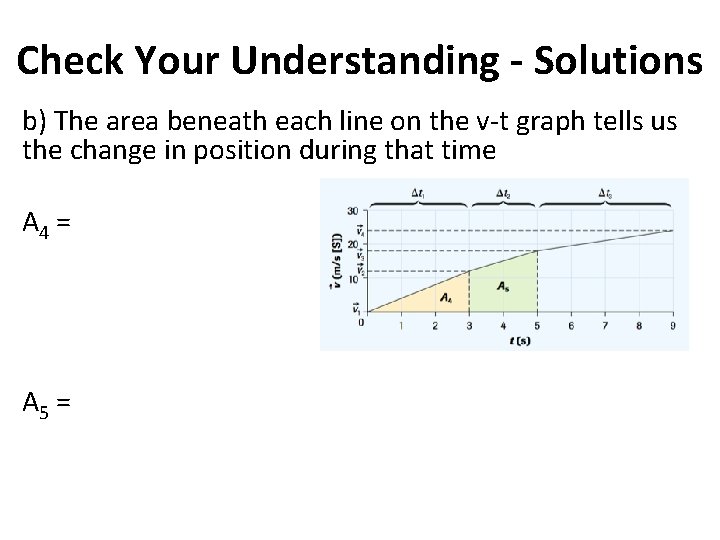
What the graphs tell us • The area under the line on a velocity-time graph indicates …………. . • The area under the line on an accelerationtime graph ______
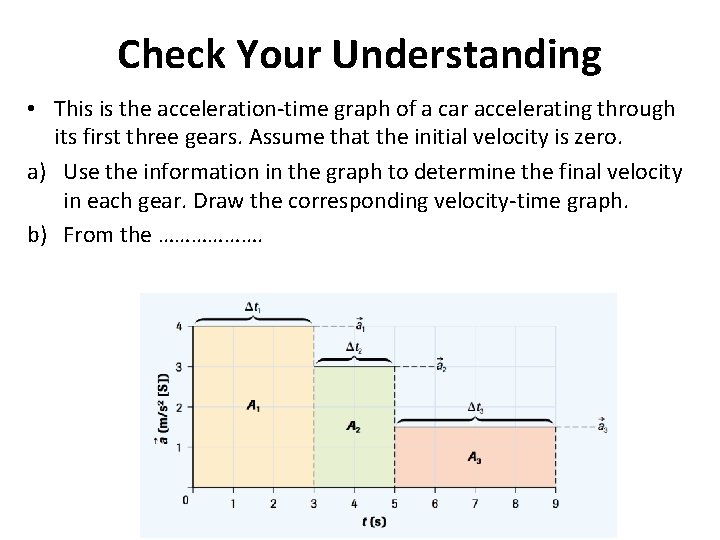
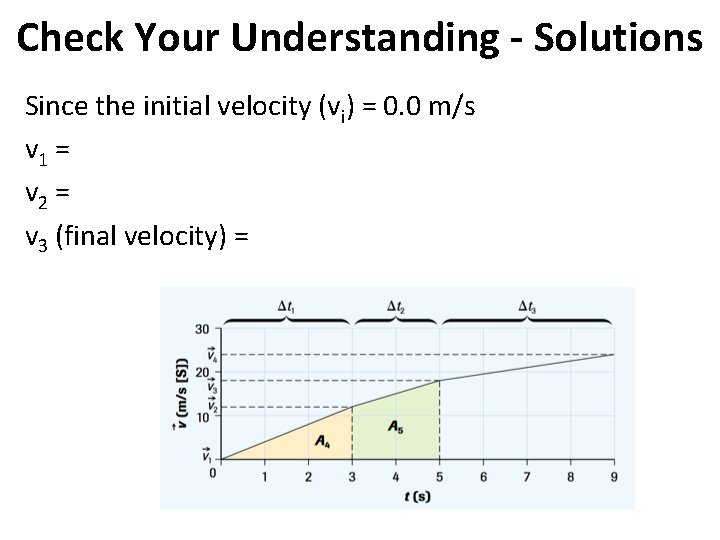
Check Your Understanding • This is the acceleration-time graph of a car accelerating through its first three gears. Assume that the initial velocity is zero. a) Use the information in the graph to determine the final velocity in each gear. Draw the corresponding velocity-time graph. b) From the ……………….
This Slide Has Been Removed
Check Your Understanding - Solutions Since the initial velocity (vi) = 0. 0 m/s v 1 = v 2 = v 3 (final velocity) =
Check Your Understanding - Solutions b) The area beneath each line on the v-t graph tells us the change in position during that time A 4 = A 5 =
End Of Day 1
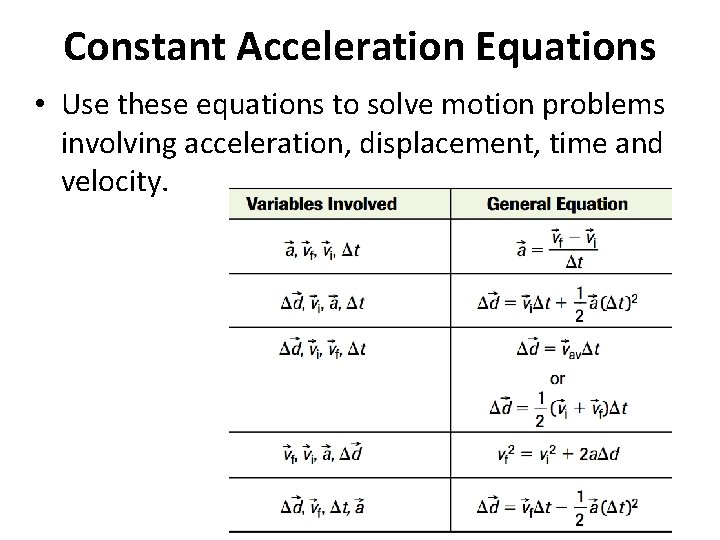
Constant Acceleration Equations • Use these equations to solve motion problems involving acceleration, displacement, time and velocity.
This Slide Has Been Removed
Check Your Understanding A motorcyclist, travelling initially at 12 m/s [W], changes gears and speeds up for 3. 5 s with a …………… 1) Determine your Given(s) and Unknown(s) as well as positive direction +
Check Your Understanding A motorcyclist, travelling initially at 12 m/s [W], changes gears and speeds up for 3. 5 s with a constant acceleration of 5. 1 m/s 2 [W]. What is the motorcyclist’s displacement over this time interval? 2) Choose your equation and solve. Make sure you include your concluding statement
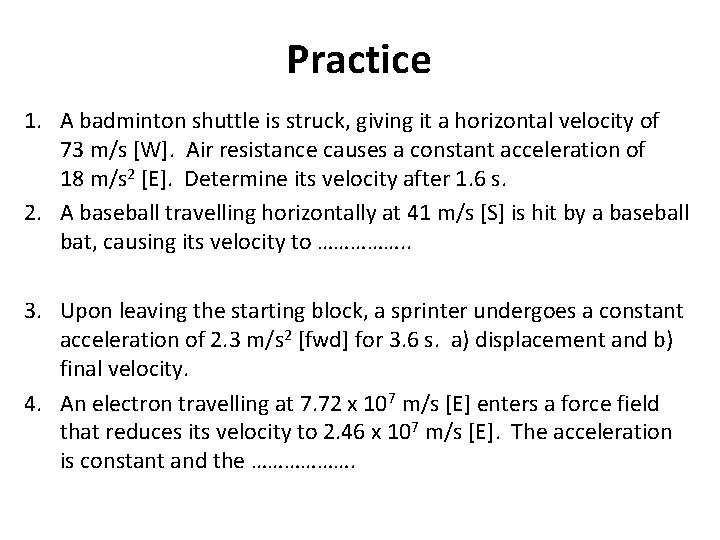
Practice 1. A badminton shuttle is struck, giving it a horizontal velocity of 73 m/s [W]. Air resistance causes a constant acceleration of 18 m/s 2 [E]. Determine its velocity after 1. 6 s. 2. A baseball travelling horizontally at 41 m/s [S] is hit by a baseball bat, causing its velocity to ……………. . 3. Upon leaving the starting block, a sprinter undergoes a constant acceleration of 2. 3 m/s 2 [fwd] for 3. 6 s. a) displacement and b) final velocity. 4. An electron travelling at 7. 72 x 107 m/s [E] enters a force field that reduces its velocity to 2. 46 x 107 m/s [E]. The acceleration is constant and the ……………….
This Slide Has Been Removed
Example - Solution A car with a velocity of 25 m/s [E] changes its velocity to 25 m/s [S] in 15 s. Calculate the car’s average acceleration.
Check Your Understanding A watercraft with an initial velocity of 6. 4 m/s [E] undergoes an average acceleration of 2. 0 m/s 2 [S] for 2. 5 s. What is the final velocity of the watercraft? Step 1 – Find the x and y components of velocity Step 2 – Use the components to find v Step 3 – Find the angle of motion