
Acceleration Where Acceleration is in the same direction
- Slides: 22
Acceleration Where • Acceleration is in the same direction as the object’s change in velocity
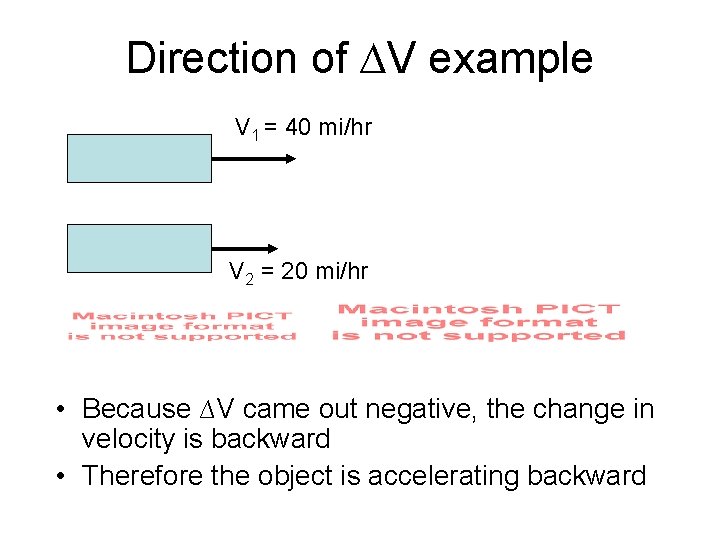
Direction of ∆V example V 1 = 40 mi/hr V 2 = 20 mi/hr • Because ∆V came out negative, the change in velocity is backward • Therefore the object is accelerating backward
Acceleration always has a direction. • We will not use the word decelerate to indicate direction
In what direction does a coin that is tossed straight up accelerate? • It is always accelerating down
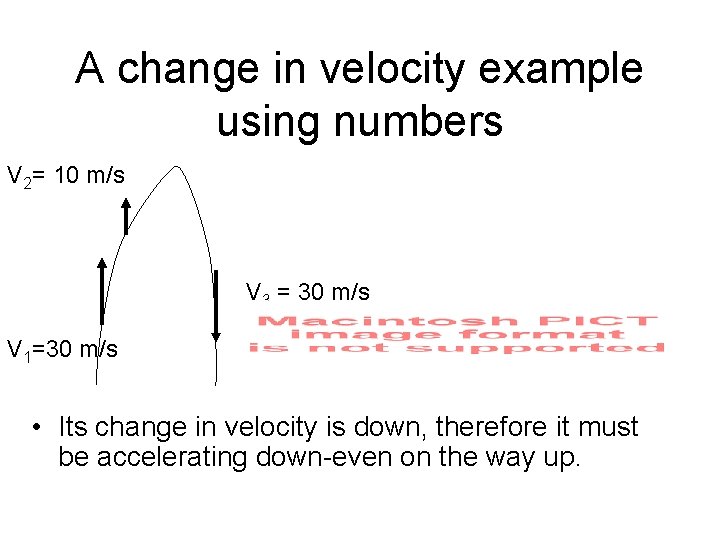
A change in velocity example using numbers V 2= 10 m/s V 3 = 30 m/s V 1=30 m/s • Its change in velocity is down, therefore it must be accelerating down-even on the way up.
All objects in free-fall, near the earth’s surface, accelerate down at 10 m/s/s if we disregard air friction • Free-fall means that the only force acting on the object is gravity
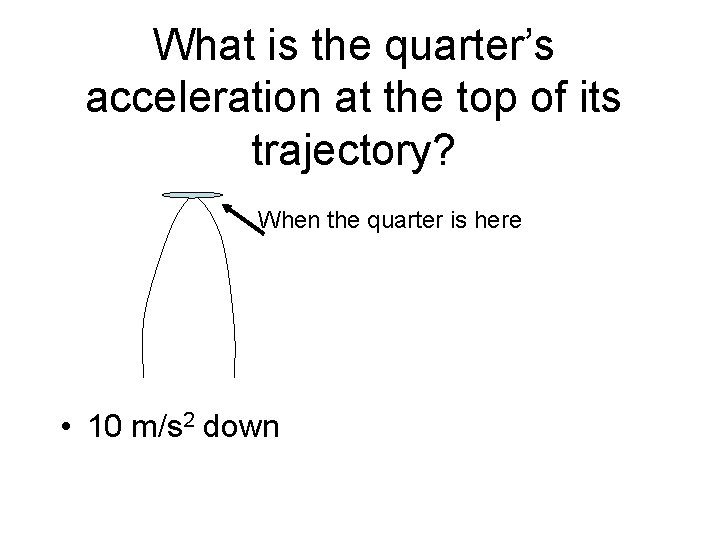
What is the quarter’s acceleration at the top of its trajectory? When the quarter is here • 10 m/s 2 down
Acceleration is the rate at which an object’s velocity changes
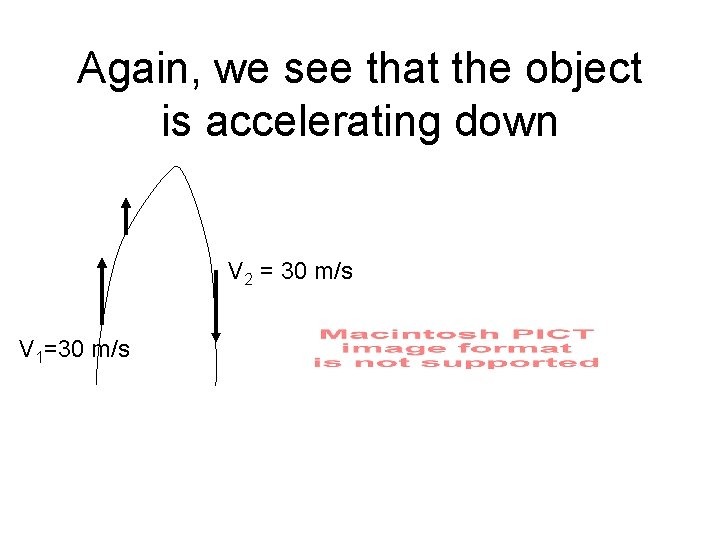
Again, we see that the object is accelerating down V 2 = 30 m/s V 1=30 m/s
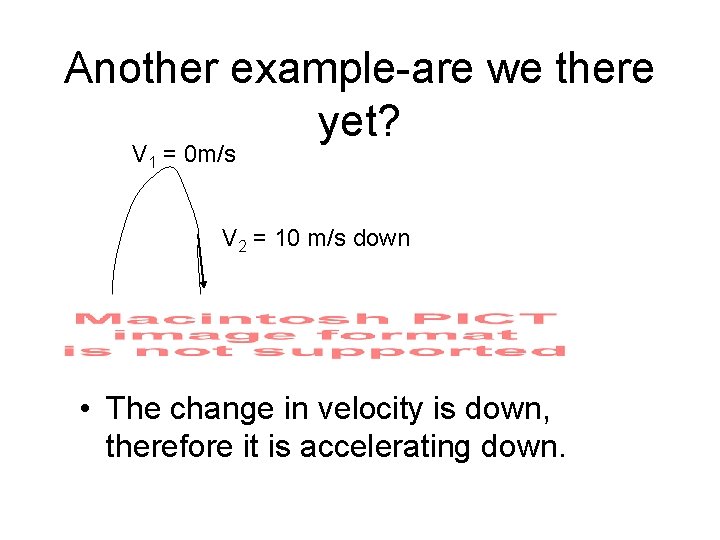
Another example-are we there yet? V 1 = 0 m/s V 2 = 10 m/s down • The change in velocity is down, therefore it is accelerating down.
Acceleration units • Units are extremely important • Memorize the facts on pg 33 and 34 of my solution manual
An example of an object moving at constant speed and changing velocity would be a car rounding a curve at constant speed • There are no examples of an object moving at constant velocity with changing speed • Remember-Velocity is the speed and direction of an object
What is the acceleration of an object that starts off at 0 km/hr and is moving at 100 km/hr 10 seconds later? forward
What is the acceleration of an object moving at a constant velocity of 100 km/hr? Objects moving at constant velocity cannot accelerate!
What is the distance fallen by an object in free-fall, 5 seconds after it is dropped? For free-fall:
If you throw an object down, its acceleration is 10 m/s 2 after it leaves your hand • In this example, it will have an initial velocity greater than 0 m/s
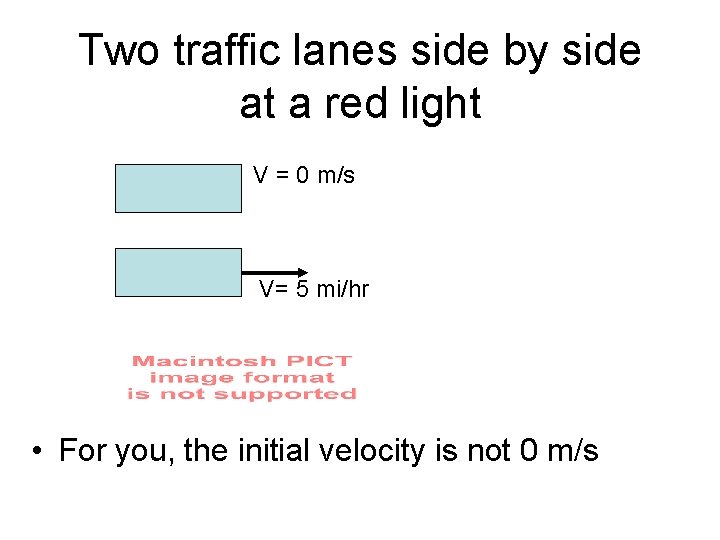
Two traffic lanes side by side at a red light V = 0 m/s V= 5 mi/hr • For you, the initial velocity is not 0 m/s
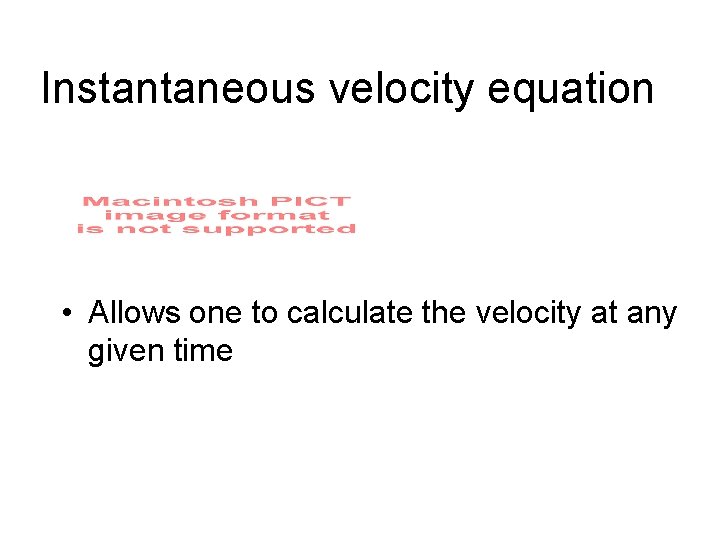
Instantaneous velocity equation • Allows one to calculate the velocity at any given time
Newton’s first law of motion • An object at rest will remain at rest and an object in motion will remain in motion at a constant velocity, unless an unbalance force is applied to it.
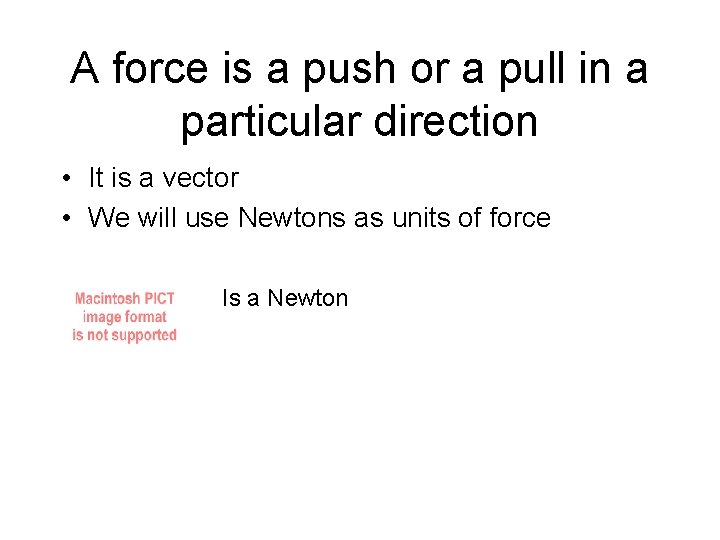
A force is a push or a pull in a particular direction • It is a vector • We will use Newtons as units of force Is a Newton
Add up all the forces acting on an object. If the sum is 0 Newtons, the object cannot accelerate • It will remain at rest or continue to move at constant velocity
If an object accelerates, we know that there must be an unbalanced force applied to it • The moon accelerates as it goes around the earth • The earth accelerates as it goes around the sun