
Acceleration Section 6 1 in your textbook Thinking

Acceleration Section 6. 1 in your textbook.
Thinking questions • Describe the physical sensations (feelings) that you have when you experience these changes in motion: • • • Airplane taking off Car slowing down at a red light Driving along a circular ramp • Why do you think that you feel these things?
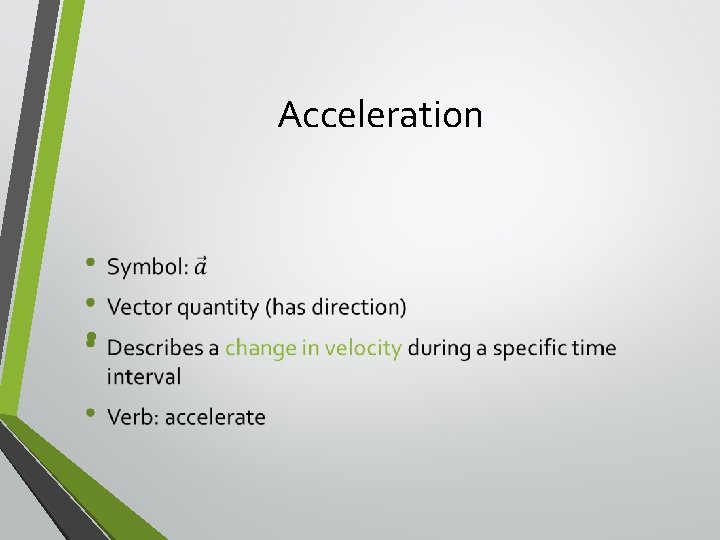
Acceleration •

Acceleration = change in velocity • Object moves faster increase in magnitude (size) of velocity • Object moves slower decrease in magnitude of velocity • Object changes direction
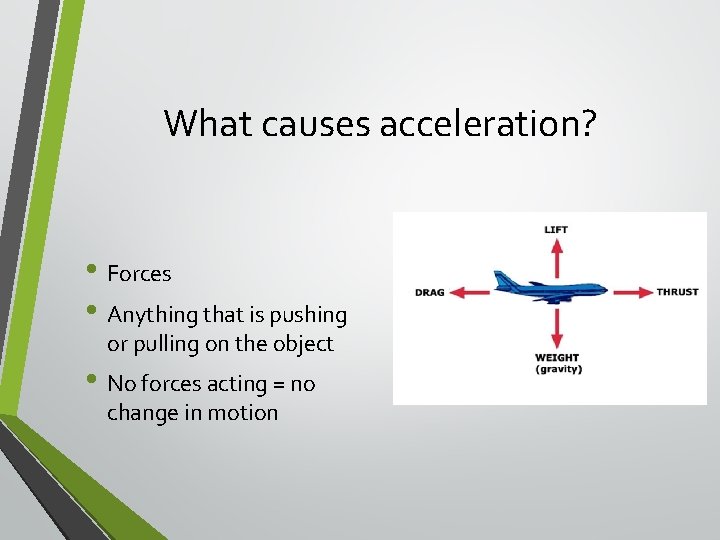
What causes acceleration? • Forces • Anything that is pushing or pulling on the object • No forces acting = no change in motion
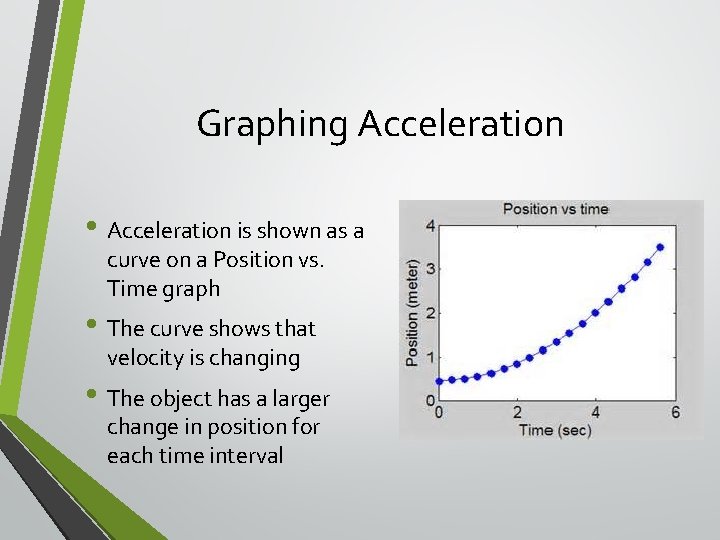
Graphing Acceleration • Acceleration is shown as a curve on a Position vs. Time graph • The curve shows that velocity is changing • The object has a larger change in position for each time interval
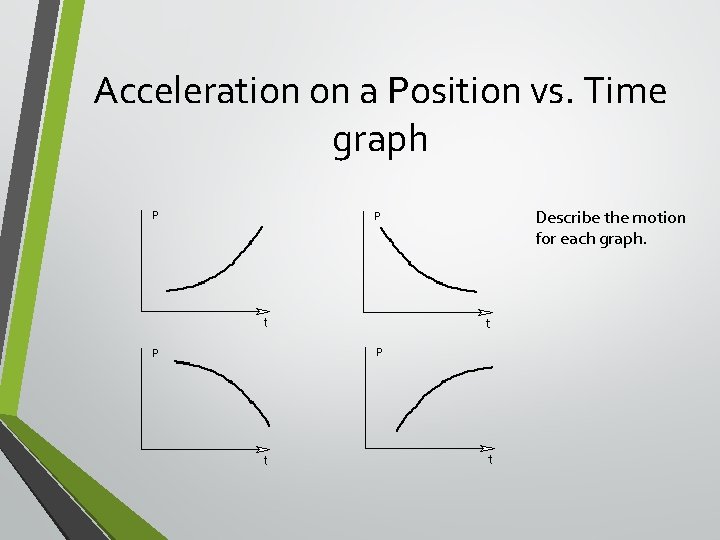
Acceleration on a Position vs. Time graph Describe the motion for each graph.
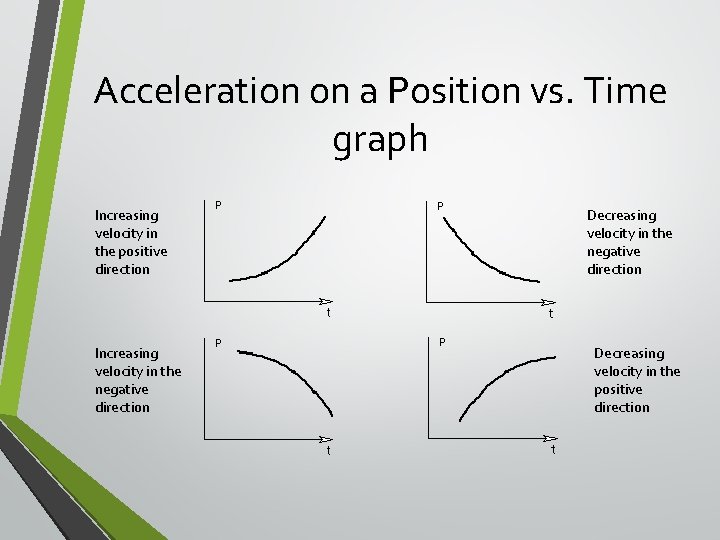
Acceleration on a Position vs. Time graph Increasing velocity in the positive direction Increasing velocity in the negative direction Decreasing velocity in the positive direction
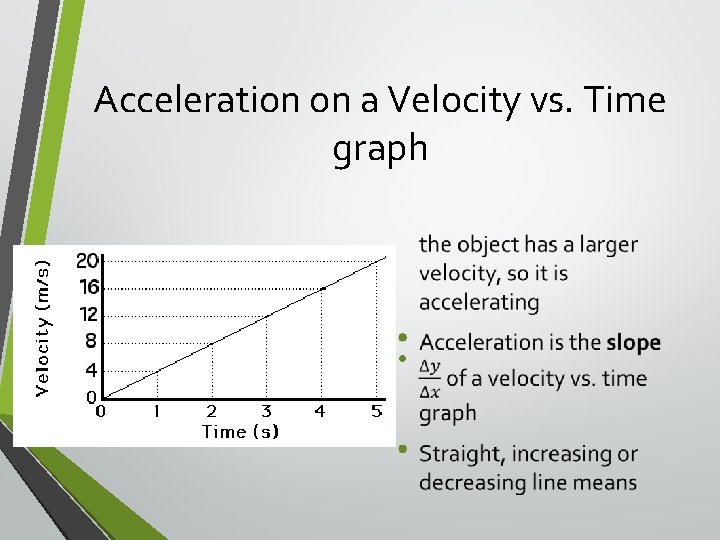
Acceleration on a Velocity vs. Time graph •
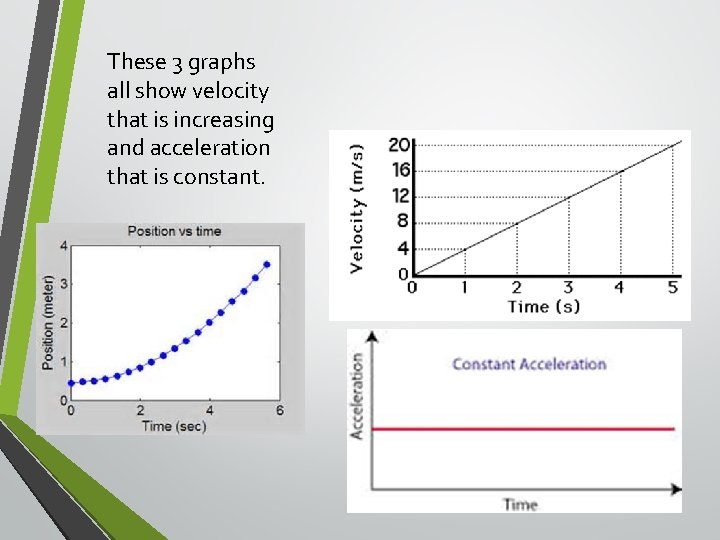
These 3 graphs all show velocity that is increasing and acceleration that is constant.
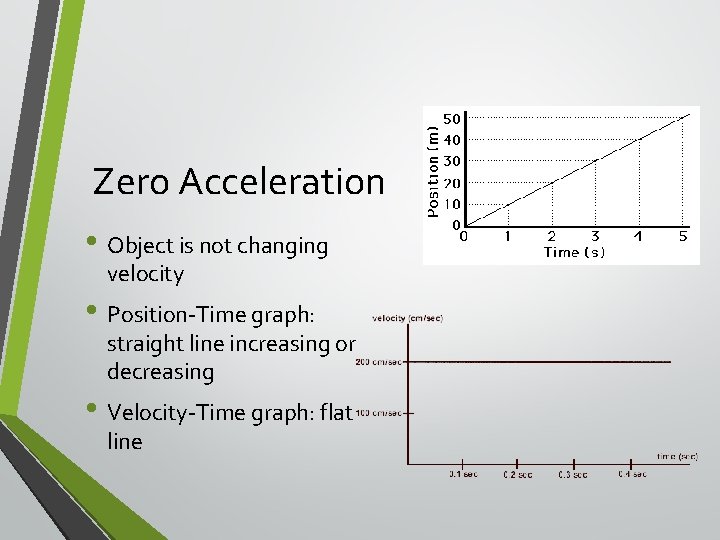
Zero Acceleration • Object is not changing velocity • Position-Time graph: straight line increasing or decreasing • Velocity-Time graph: flat line
Direction of Acceleration • Slope of a Velocity vs. Time graph gives us information about the direction of acceleration • Positive acceleration: slope of a VT graph is + • Negative acceleration: slope of a VT graph is -
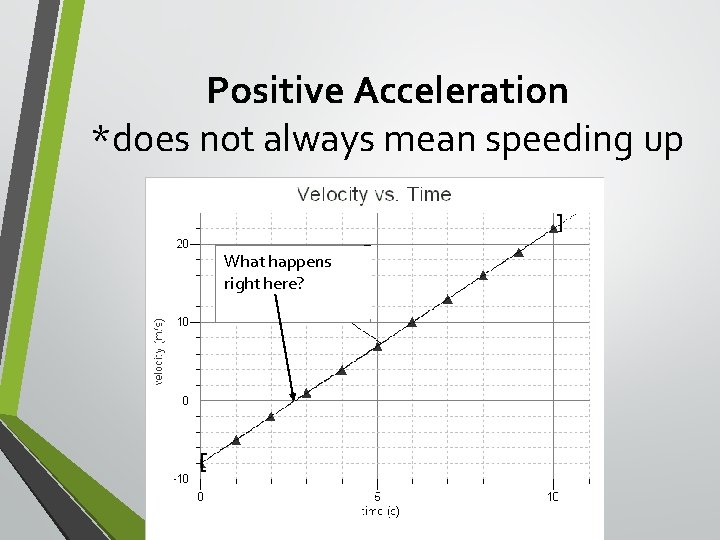
Positive Acceleration *does not always mean speeding up What happens right here?
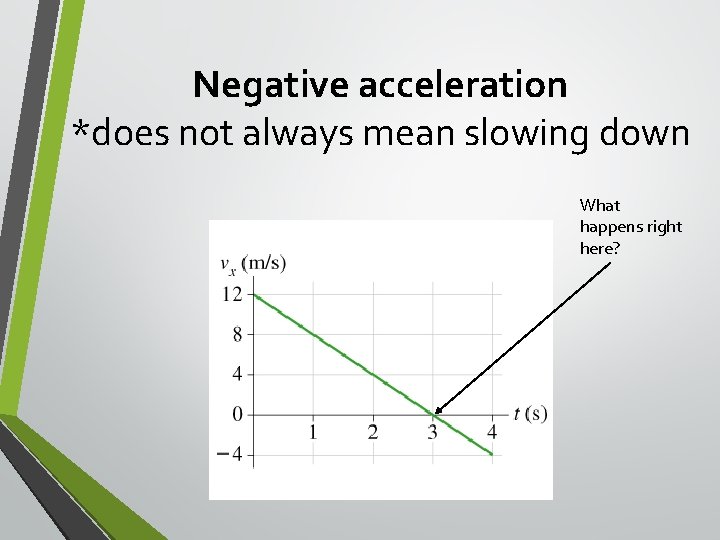
Negative acceleration *does not always mean slowing down What happens right here?
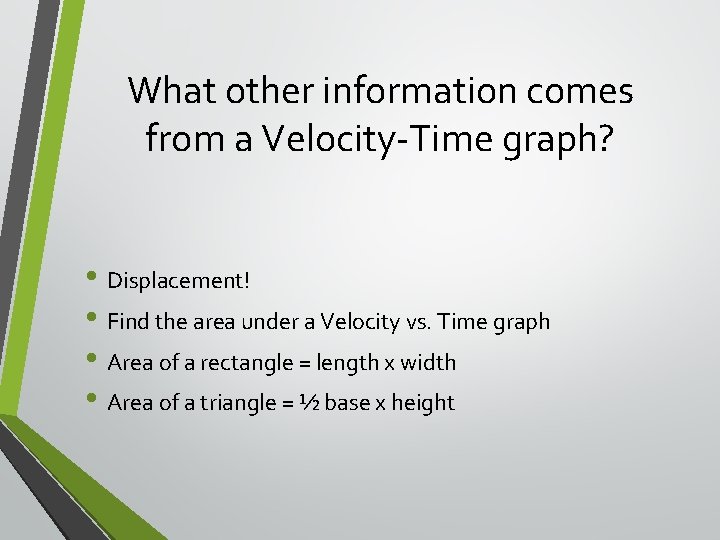
What other information comes from a Velocity-Time graph? • Displacement! • Find the area under a Velocity vs. Time graph • Area of a rectangle = length x width • Area of a triangle = ½ base x height
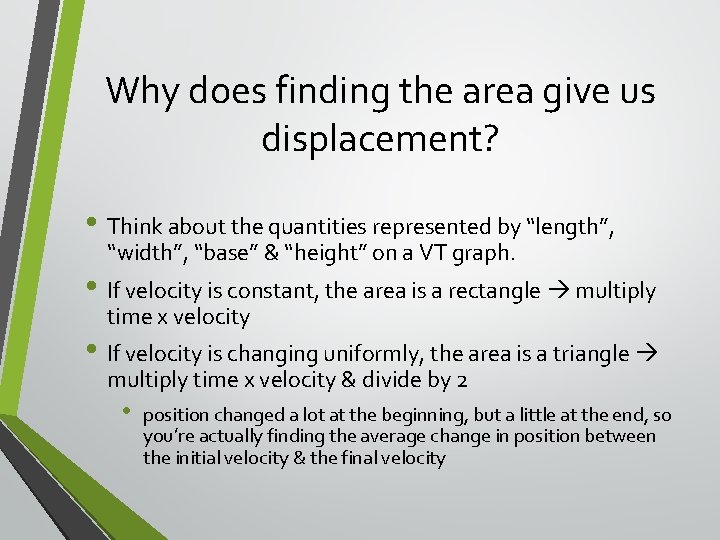
Why does finding the area give us displacement? • Think about the quantities represented by “length”, “width”, “base” & “height” on a VT graph. • If velocity is constant, the area is a rectangle multiply time x velocity • If velocity is changing uniformly, the area is a triangle multiply time x velocity & divide by 2 • position changed a lot at the beginning, but a little at the end, so you’re actually finding the average change in position between the initial velocity & the final velocity
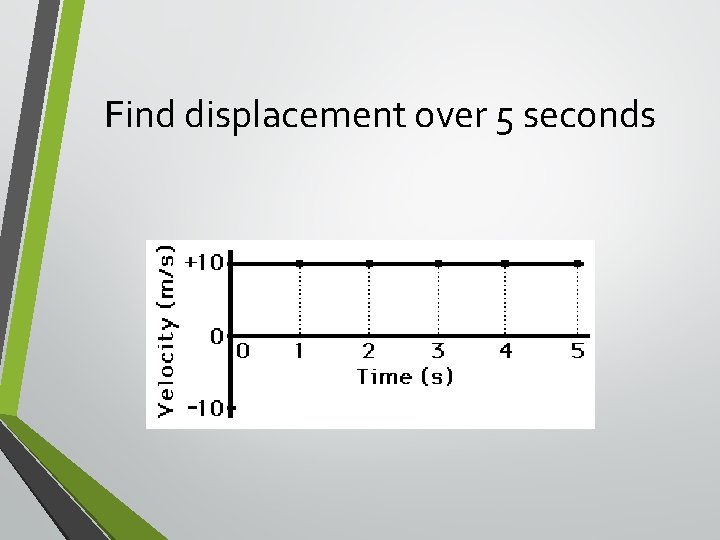
Find displacement over 5 seconds
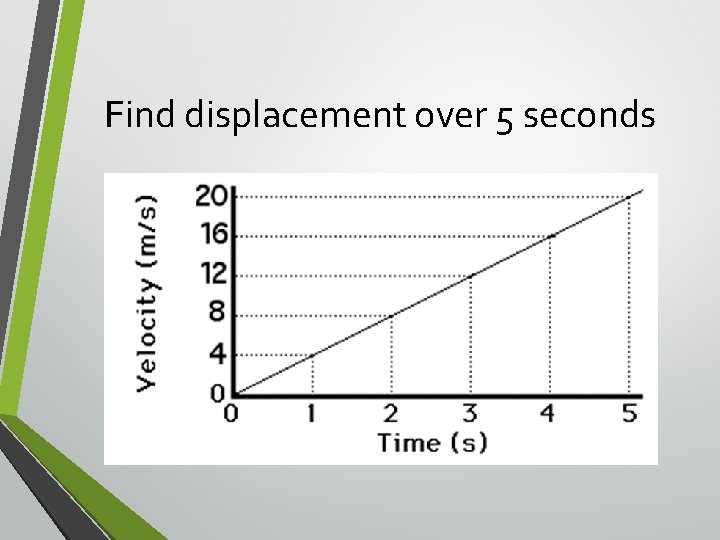
Find displacement over 5 seconds

Homework • Page 247: Section 6. 1 Review • Do questions #1 -4 & #6 -12 in your notebooks • Next class I will check that you started

Next Class • Come prepared to work with your group on the Scavenger Hunt Game • I will be watching and listening to make sure that you are speaking English and working together
- Slides: 21