
Acceleration Lab page 29 Step 1 copy the
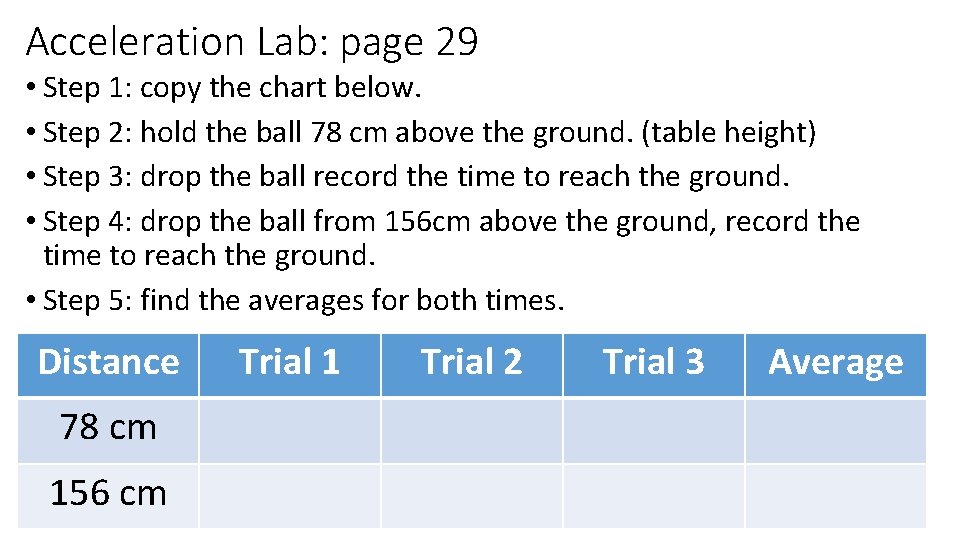
Acceleration Lab: page 29 • Step 1: copy the chart below. • Step 2: hold the ball 78 cm above the ground. (table height) • Step 3: drop the ball record the time to reach the ground. • Step 4: drop the ball from 156 cm above the ground, record the time to reach the ground. • Step 5: find the averages for both times. Distance 78 cm 156 cm Trial 1 Trial 2 Trial 3 Average
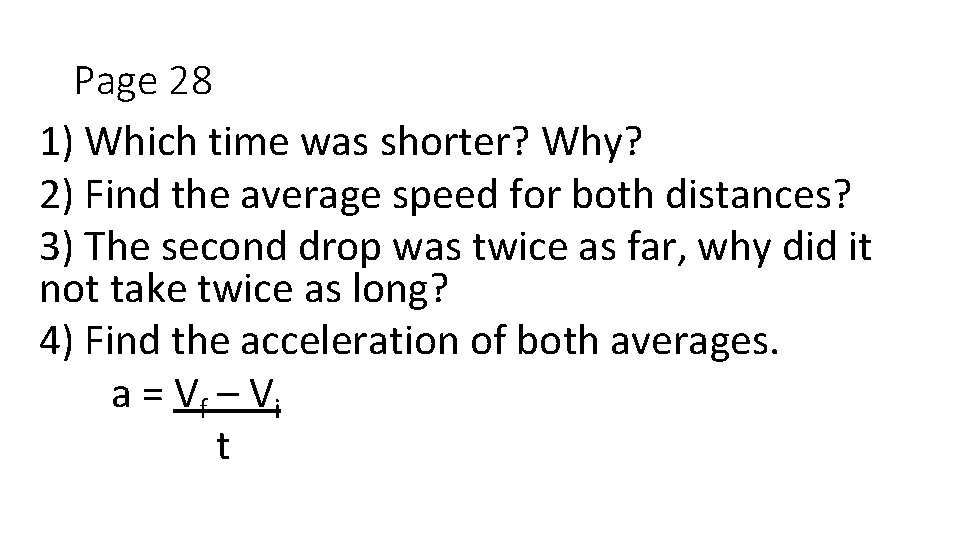
Page 28 1) Which time was shorter? Why? 2) Find the average speed for both distances? 3) The second drop was twice as far, why did it not take twice as long? 4) Find the acceleration of both averages. a = Vf – V i t
Acceleration Page 31
Essential question: • How can an object have acceleration even though its speed is constant?
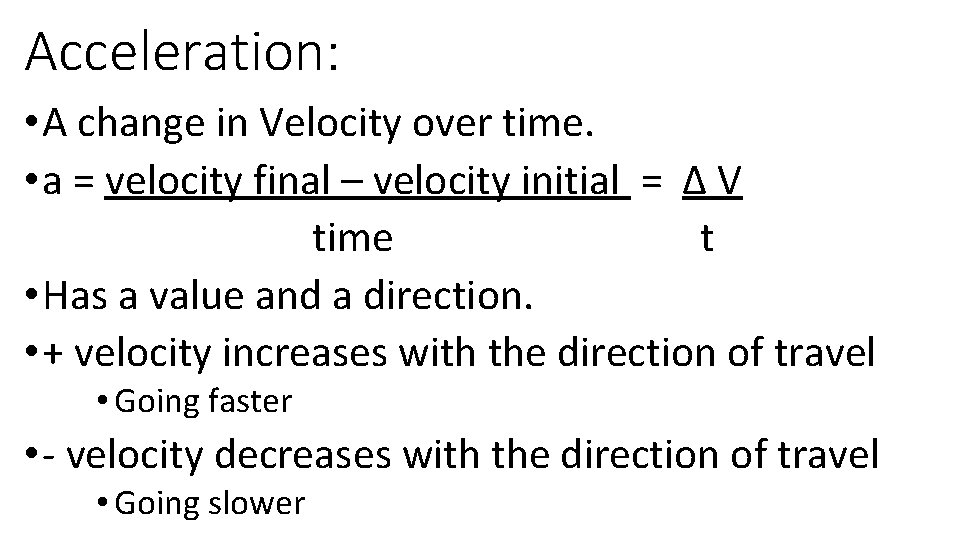
Acceleration: • A change in Velocity over time. • a = velocity final – velocity initial = Δ V time t • Has a value and a direction. • + velocity increases with the direction of travel • Going faster • - velocity decreases with the direction of travel • Going slower
Centripetal acceleration: • If you move at a constant speed, but are moving in a circle, you are accelerating. The direction is always changing. • Examples: moon, wheel, standing on earth, Ferris wheel.
Graphing Acceleration: • Speed vs time graph • Slope of the line equals acceleration • Straight line would be constant acceleration • On a distance vs time graph it will be a curved line.
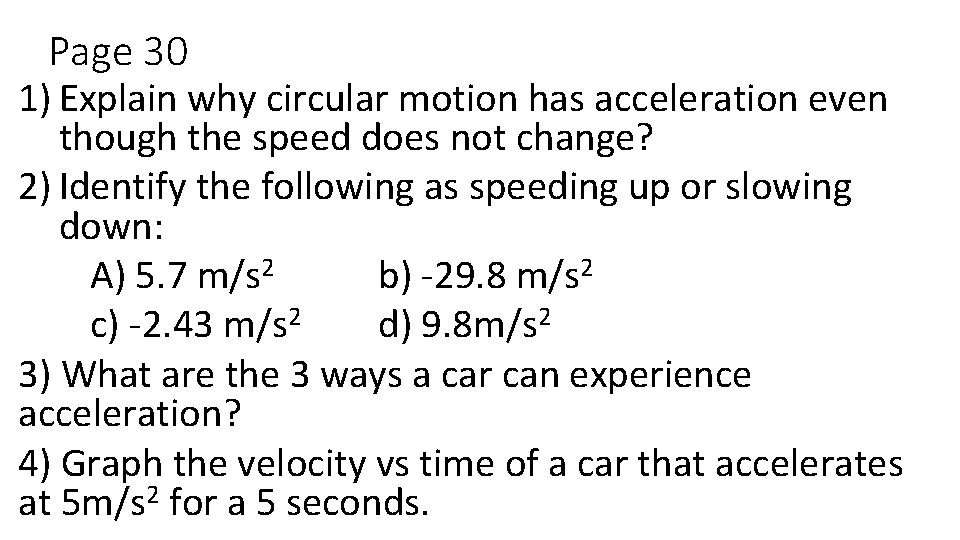
Page 30 1) Explain why circular motion has acceleration even though the speed does not change? 2) Identify the following as speeding up or slowing down: 2 2 A) 5. 7 m/s b) -29. 8 m/s c) -2. 43 m/s 2 d) 9. 8 m/s 2 3) What are the 3 ways a car can experience acceleration? 4) Graph the velocity vs time of a car that accelerates at 5 m/s 2 for a 5 seconds.
- Slides: 8