
Acceleration Field Consider a fluid particle and Newtons
- Slides: 12
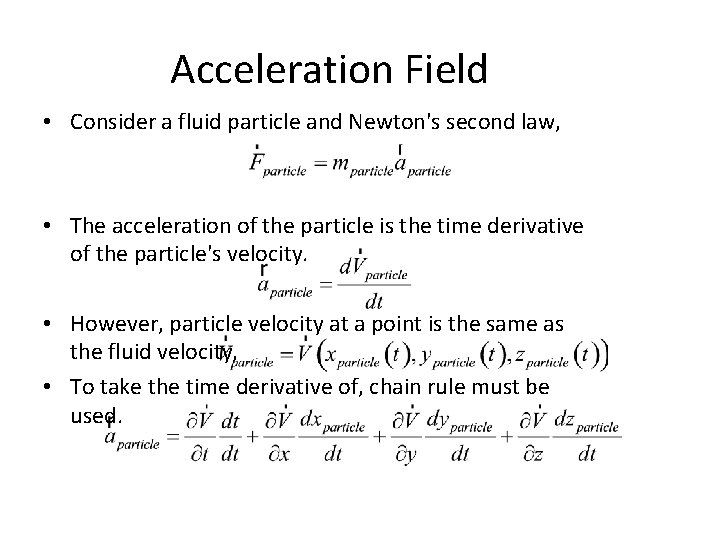
Acceleration Field • Consider a fluid particle and Newton's second law, • The acceleration of the particle is the time derivative of the particle's velocity. • However, particle velocity at a point is the same as the fluid velocity, • To take the time derivative of, chain rule must be used.
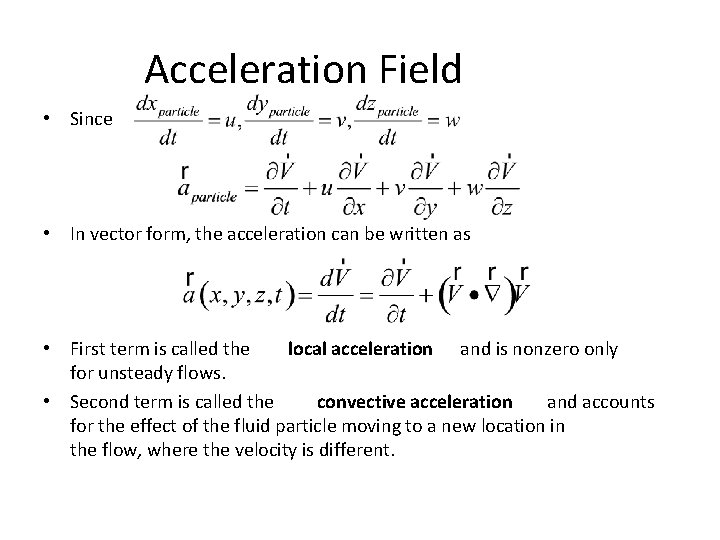
Acceleration Field • Since • In vector form, the acceleration can be written as • First term is called the local acceleration and is nonzero only for unsteady flows. • Second term is called the convective acceleration and accounts for the effect of the fluid particle moving to a new location in the flow, where the velocity is different.
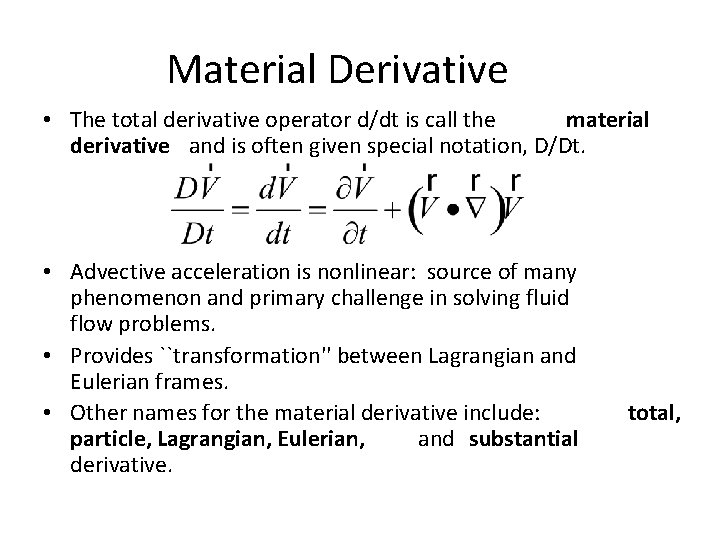
Material Derivative • The total derivative operator d/dt is call the material derivative and is often given special notation, D/Dt. • Advective acceleration is nonlinear: source of many phenomenon and primary challenge in solving fluid flow problems. • Provides ``transformation'' between Lagrangian and Eulerian frames. • Other names for the material derivative include: particle, Lagrangian, Eulerian, and substantial derivative. total,
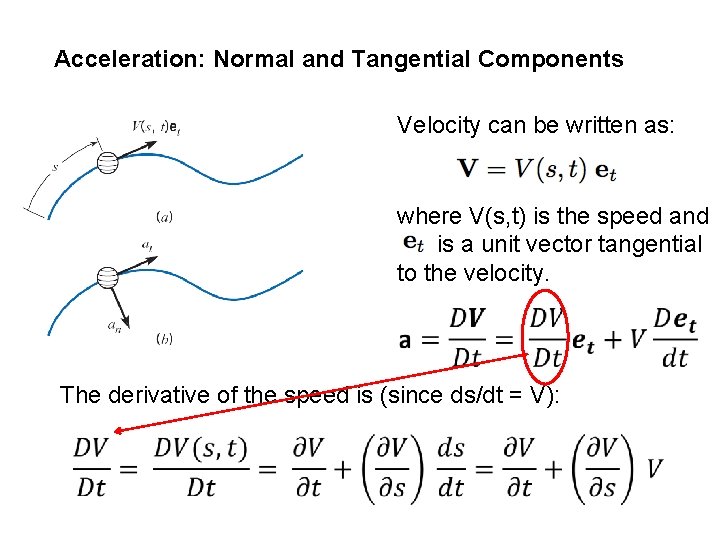
Acceleration: Normal and Tangential Components Velocity can be written as: where V(s, t) is the speed and is a unit vector tangential to the velocity. The derivative of the speed is (since ds/dt = V):
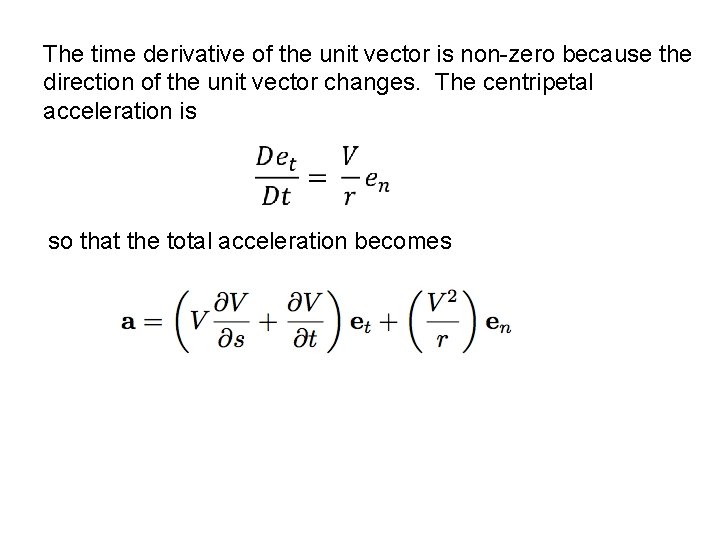
The time derivative of the unit vector is non-zero because the direction of the unit vector changes. The centripetal acceleration is so that the total acceleration becomes
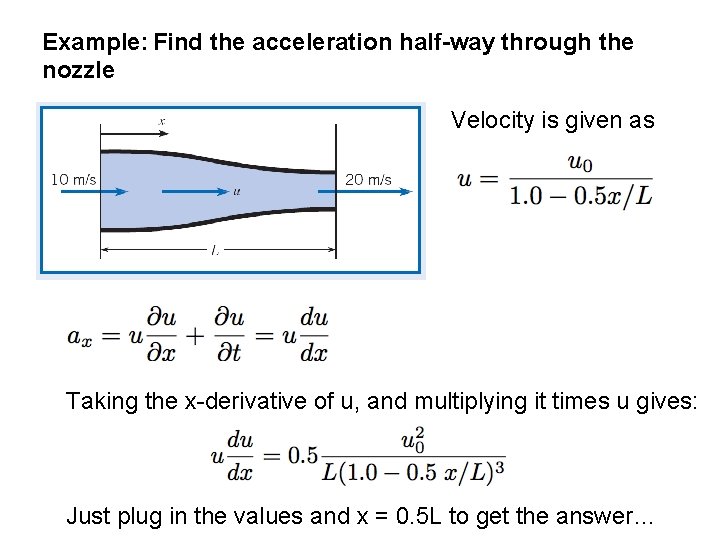
Example: Find the acceleration half-way through the nozzle Velocity is given as Taking the x-derivative of u, and multiplying it times u gives: Just plug in the values and x = 0. 5 L to get the answer…
The Dilemma • The laws of physics in their simplest forms describe systems (the Lagrangian approach) – Conservation of Mass, Momentum, Energy • It is impossible to keep track of the system in many fluids problems • The laws of physics must still hold in a Eulerian world! • We need some tools to bridge the gap
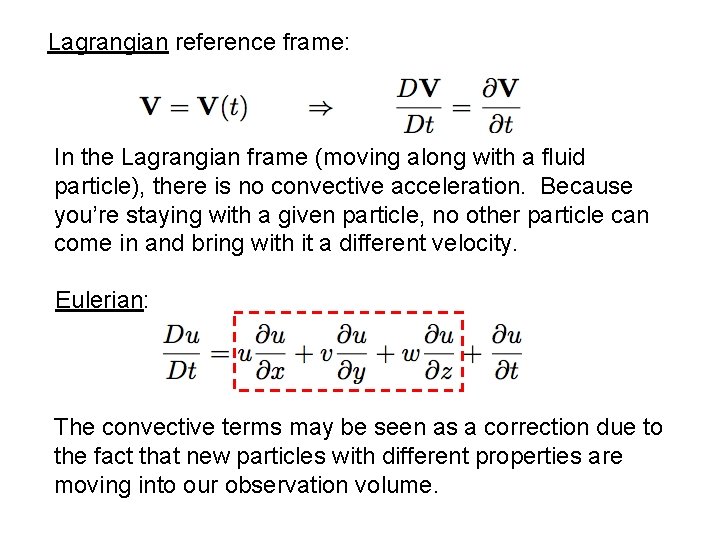
Lagrangian reference frame: In the Lagrangian frame (moving along with a fluid particle), there is no convective acceleration. Because you’re staying with a given particle, no other particle can come in and bring with it a different velocity. Eulerian: The convective terms may be seen as a correction due to the fact that new particles with different properties are moving into our observation volume.
Reynolds—Transport Theorem (RTT) • A system is a quantity of matter of fixed identity. mass can cross a system boundary. • A control volume is a region in space chosen for study. Mass can cross a control surface. • The fundamental conservation laws (conservation of mass, energy, and momentum) apply directly to systems. • However, in most fluid mechanics problems, control volume analysis is preferred over system analysis (for the same reason that the Eulerian description is usually preferred over the Lagrangian description). • Therefore, we need to transform the conservation laws from a system to a control volume. This is accomplished with the Reynolds transport theorem (RTT). • We need a bookkeeping method to keep track of the No
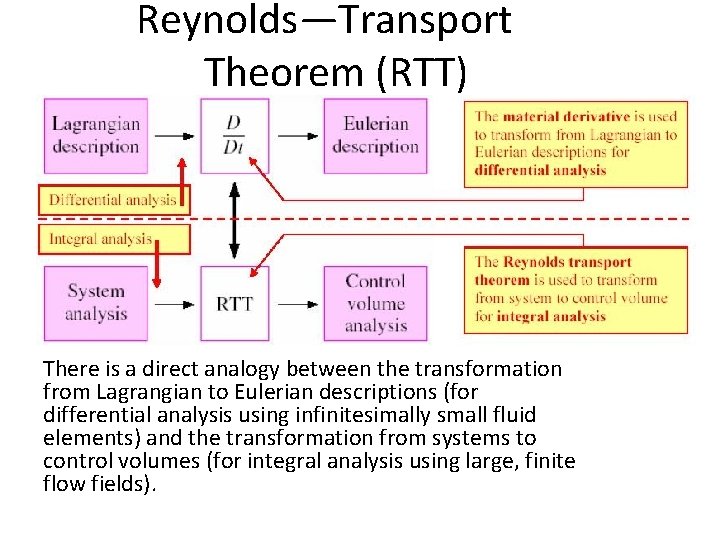
Reynolds—Transport Theorem (RTT) There is a direct analogy between the transformation from Lagrangian to Eulerian descriptions (for differential analysis using infinitesimally small fluid elements) and the transformation from systems to control volumes (for integral analysis using large, finite flow fields).
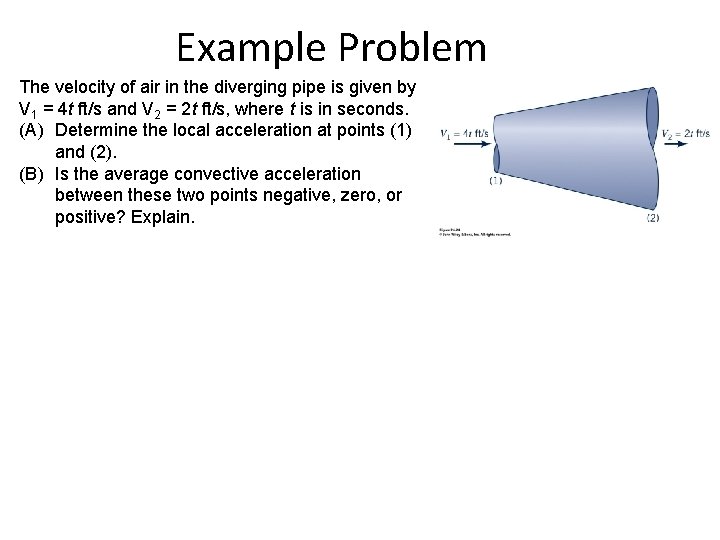
Example Problem The velocity of air in the diverging pipe is given by V 1 = 4 t ft/s and V 2 = 2 t ft/s, where t is in seconds. (A) Determine the local acceleration at points (1) and (2). (B) Is the average convective acceleration between these two points negative, zero, or positive? Explain.
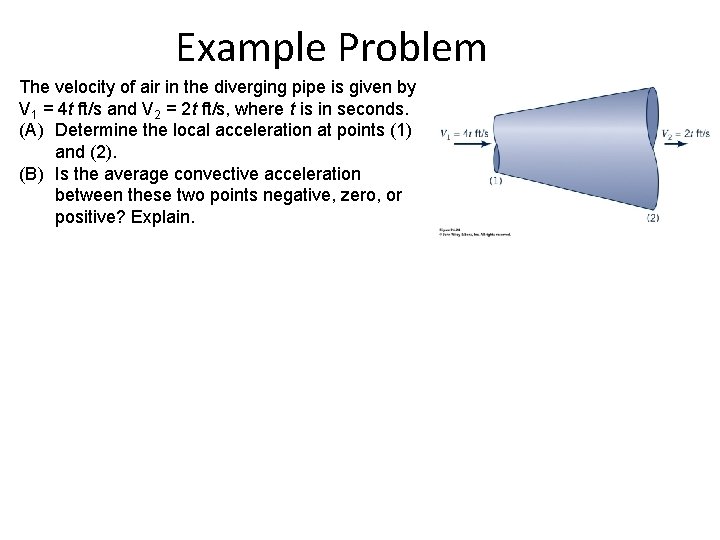
Example Problem The velocity of air in the diverging pipe is given by V 1 = 4 t ft/s and V 2 = 2 t ft/s, where t is in seconds. (A) Determine the local acceleration at points (1) and (2). (B) Is the average convective acceleration between these two points negative, zero, or positive? Explain.