
Accelerating the education sector response to HIVAIDS in

- Slides: 27
Accelerating the education sector response to HIV/AIDS in Africa Projecting the impact of AIDS on the education system Sub-regional seminar on HIV/AIDS education, Mombasa, Kenya 12 November, 2002 Kamal Desai, PCD, Imperial College, London
Overview of this talk § Introduction – – – Population-level effects of HIV/AIDS Impacts of HIV/AIDS on education systems Need for projection models § Situational analysis of HIV/AIDS on the population – example § Education sector analysis of HIV/AIDS – example § Next steps -- refining estimates and sensitivity analysis
Introduction Population level effects of HIV/AIDS: § § § § Decline in fertility rates (20% decline TFR) Decline in life expectancy at birth (up to 15 years) Slower population growth Mother-to-child transmission (30 -40%) Rise in numbers of orphans Shifting paradigms of new HIV infections. . .
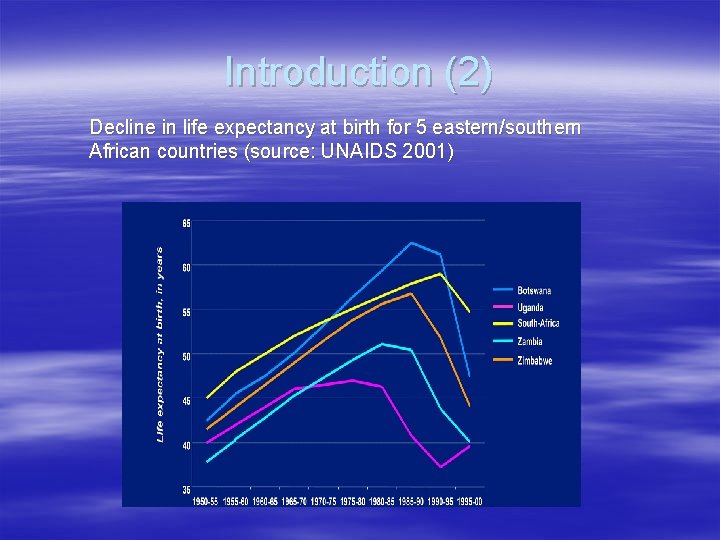
Introduction (2) Decline in life expectancy at birth for 5 eastern/southern African countries (source: UNAIDS 2001)
Introduction (3) The Impact of HIV/AIDS on Education : § Supply: in terms of numbers of teachers and the capacity to train them § Demand: in terms of numbers and characteristics of the school-age population
Introduction (4) Need for models: § Enhance understanding - to understand complex systems by exploring the impact of assumptions which have to be made explicit § Estimate the impact of HIV/AIDS on education (teachers and pupils) - predicting the probable present/future impacts of HIV/AIDS (especially in absence of field studies or other data collection) § Identify data requirements -- for sensible planning in face of HIV/AIDS § Impact of interventions - exploring their potential effectiveness § Assist planners to mitigate impact of HIV/AIDS § Powerful advocacy tools
Introduction (5) Would like to estimate: § For country population – absolute numbers of infecteds, HIV prevalence, incident cases by age/sex, AIDS cases, infants born with HIV § For education sector – HIV prevalence in teachers, AIDS-related attrition, absenteeism, required recruitment, school-aged children orphaned by AIDS
Situational Analysis of HIV/AIDS on populations § based on SPECTRUM model (USAID, Futures Group) § assumes UN Pop Div medium variant demographic assumptions (TFR, countryspecific life tables) § HIV/AIDS epidemiological assumption (vertical transmission, life expectancy, fertility)
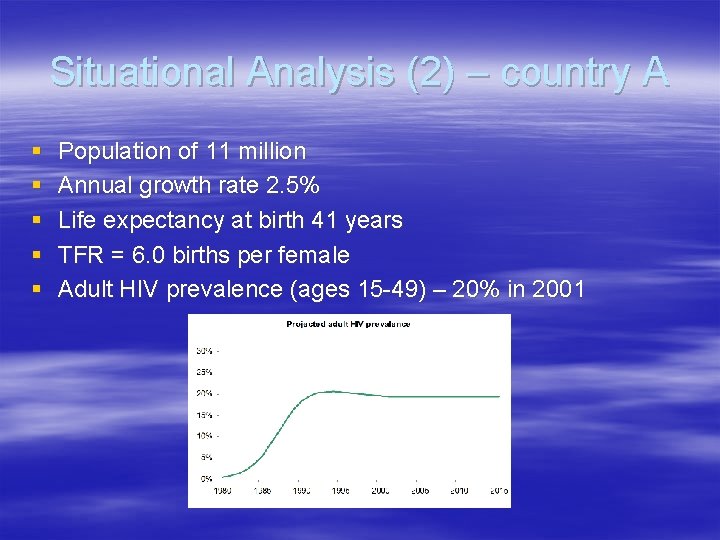
Situational Analysis (2) – country A § § § Population of 11 million Annual growth rate 2. 5% Life expectancy at birth 41 years TFR = 6. 0 births per female Adult HIV prevalence (ages 15 -49) – 20% in 2001
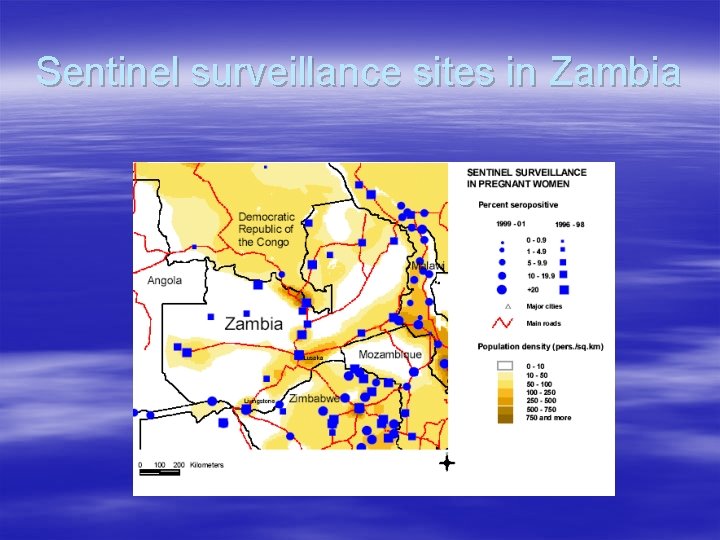
Sentinel surveillance sites in Zambia
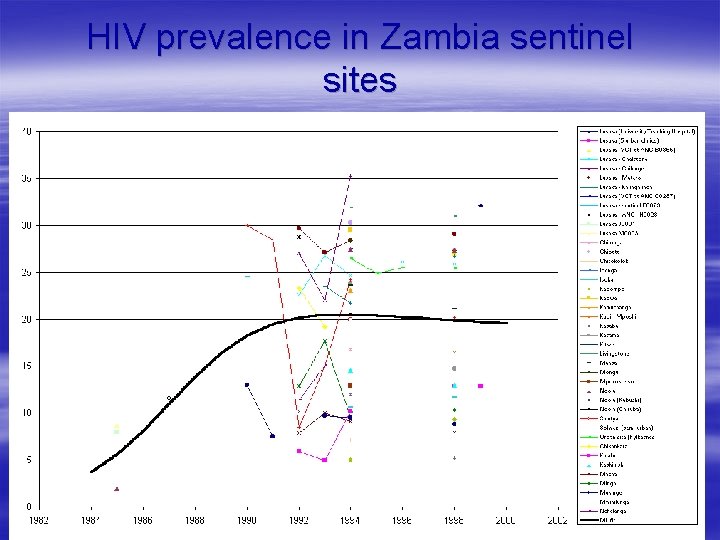
HIV prevalence in Zambia sentinel sites
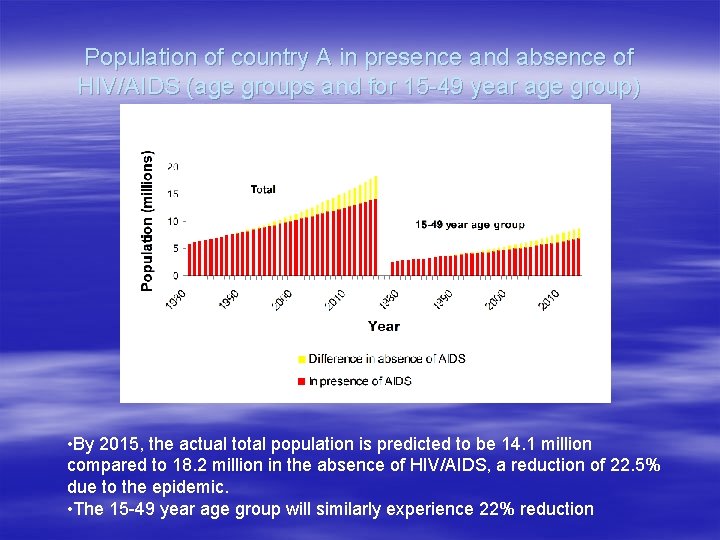
Population of country A in presence and absence of HIV/AIDS (age groups and for 15 -49 year age group) • By 2015, the actual total population is predicted to be 14. 1 million compared to 18. 2 million in the absence of HIV/AIDS, a reduction of 22. 5% due to the epidemic. • The 15 -49 year age group will similarly experience 22% reduction
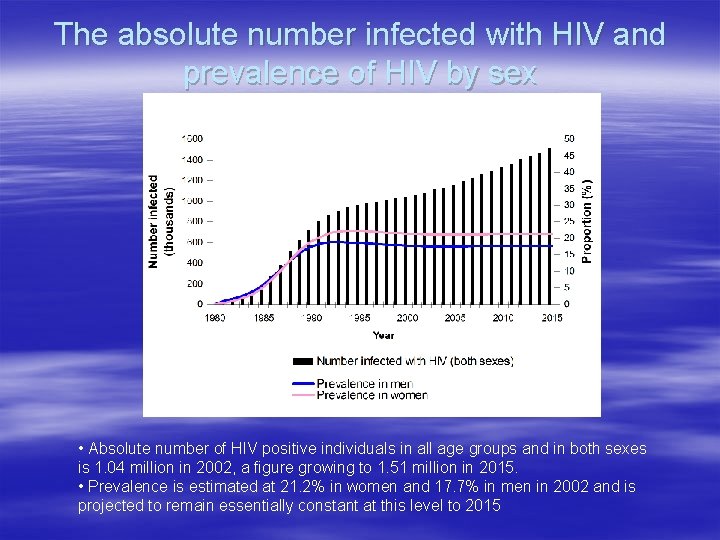
The absolute number infected with HIV and prevalence of HIV by sex • Absolute number of HIV positive individuals in all age groups and in both sexes is 1. 04 million in 2002, a figure growing to 1. 51 million in 2015. • Prevalence is estimated at 21. 2% in women and 17. 7% in men in 2002 and is projected to remain essentially constant at this level to 2015
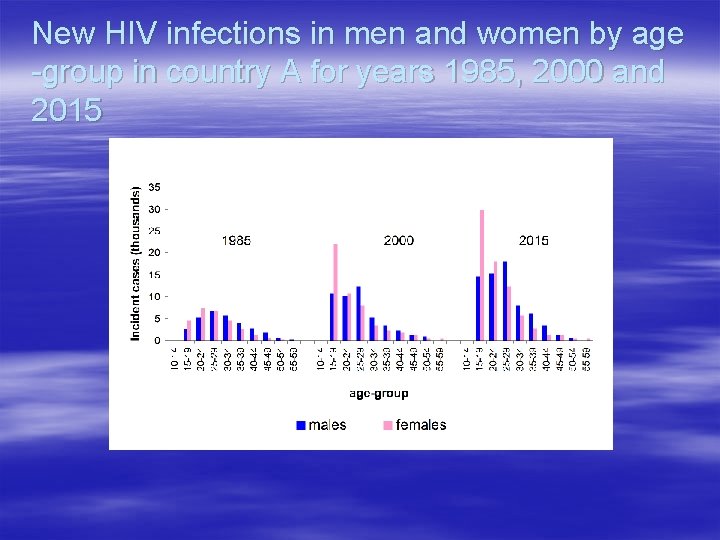
New HIV infections in men and women by age -group in country A for years 1985, 2000 and 2015
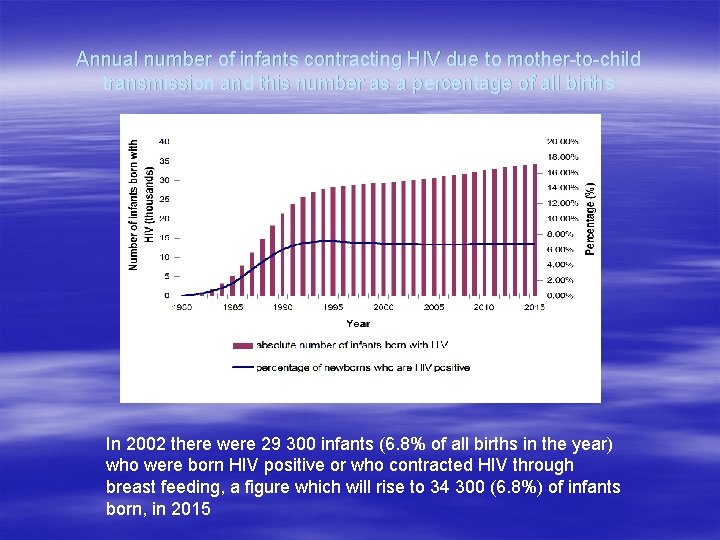
Annual number of infants contracting HIV due to mother-to-child transmission and this number as a percentage of all births In 2002 there were 29 300 infants (6. 8% of all births in the year) who were born HIV positive or who contracted HIV through breast feeding, a figure which will rise to 34 300 (6. 8%) of infants born, in 2015
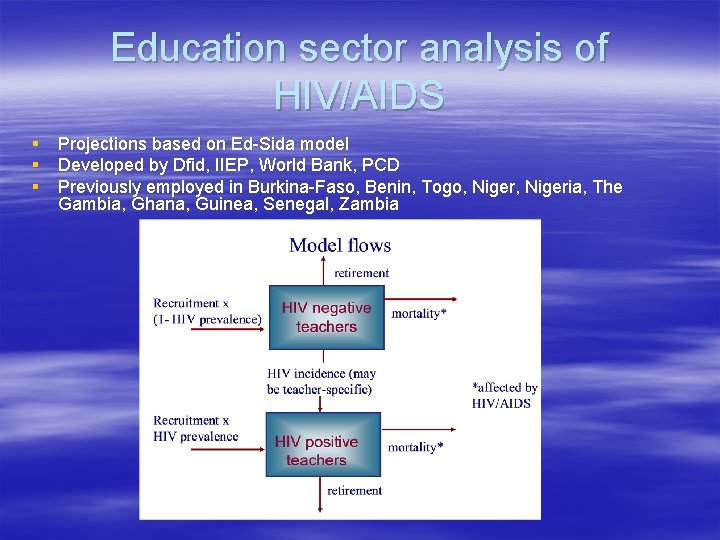
Education sector analysis of HIV/AIDS § Projections based on Ed-Sida model § Developed by Dfid, IIEP, World Bank, PCD § Previously employed in Burkina-Faso, Benin, Togo, Nigeria, The Gambia, Ghana, Guinea, Senegal, Zambia
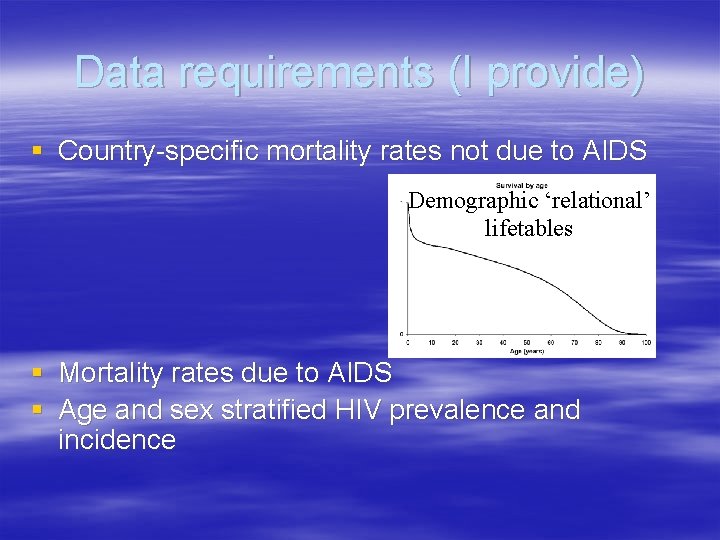
Data requirements (I provide) § Country-specific mortality rates not due to AIDS Demographic ‘relational’ lifetables § Mortality rates due to AIDS § Age and sex stratified HIV prevalence and incidence
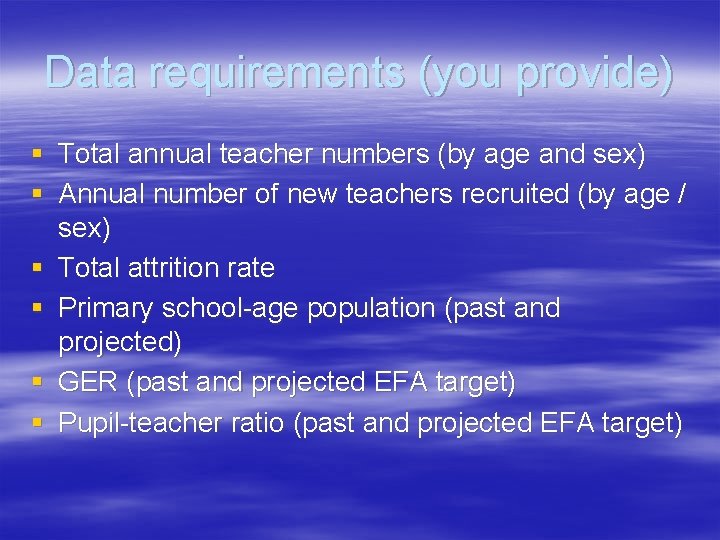
Data requirements (you provide) § Total annual teacher numbers (by age and sex) § Annual number of new teachers recruited (by age / sex) § Total attrition rate § Primary school-age population (past and projected) § GER (past and projected EFA target) § Pupil-teacher ratio (past and projected EFA target)
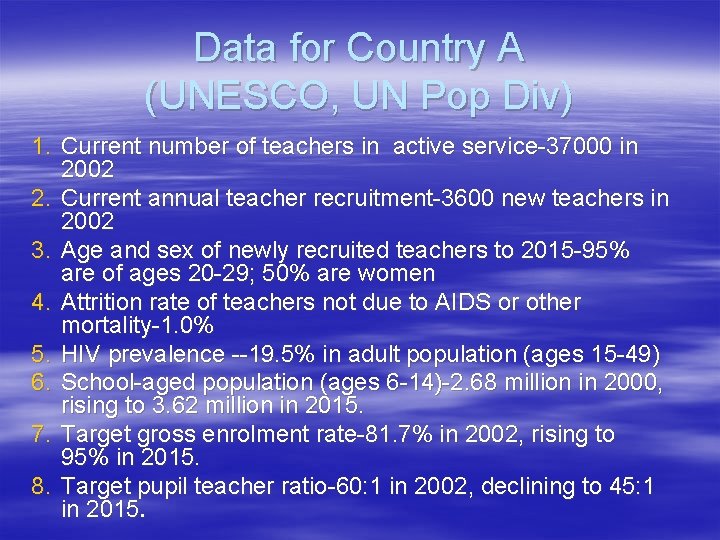
Data for Country A (UNESCO, UN Pop Div) 1. Current number of teachers in active service-37000 in 2002 2. Current annual teacher recruitment-3600 new teachers in 2002 3. Age and sex of newly recruited teachers to 2015 -95% are of ages 20 -29; 50% are women 4. Attrition rate of teachers not due to AIDS or other mortality-1. 0% 5. HIV prevalence --19. 5% in adult population (ages 15 -49) 6. School-aged population (ages 6 -14)-2. 68 million in 2000, rising to 3. 62 million in 2015. 7. Target gross enrolment rate-81. 7% in 2002, rising to 95% in 2015. 8. Target pupil teacher ratio-60: 1 in 2002, declining to 45: 1 in 2015.
Introduction (5) Would like to estimate: § For country population – absolute numbers of infecteds, HIV prevalence, incident cases by age/sex, AIDS cases, infants born with HIV § For education sector – HIV prevalence in teachers, AIDS-related attrition, absenteeism, required recruitment, school-aged children orphaned by AIDS
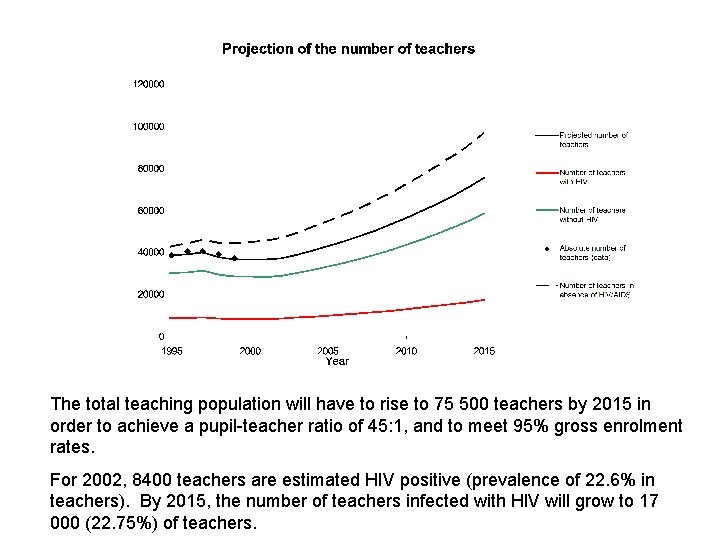
The total teaching population will have to rise to 75 500 teachers by 2015 in order to achieve a pupil-teacher ratio of 45: 1, and to meet 95% gross enrolment rates. For 2002, 8400 teachers are estimated HIV positive (prevalence of 22. 6% in teachers). By 2015, the number of teachers infected with HIV will grow to 17 000 (22. 75%) of teachers.
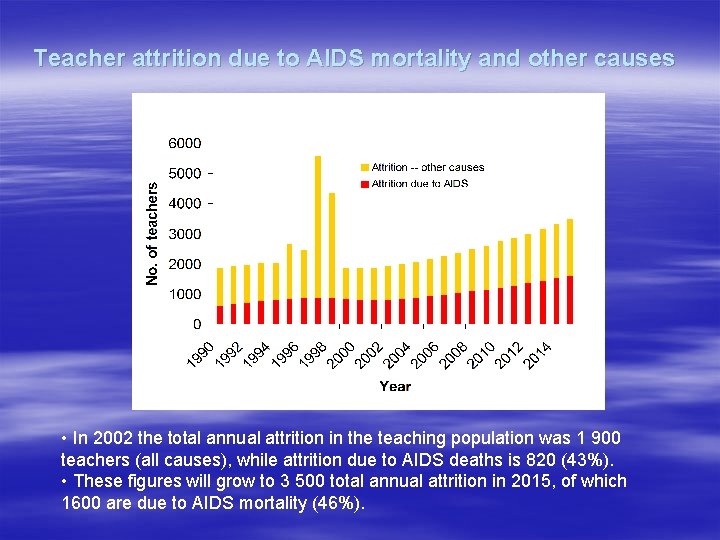
Teacher attrition due to AIDS mortality and other causes • In 2002 the total annual attrition in the teaching population was 1 900 teachers (all causes), while attrition due to AIDS deaths is 820 (43%). • These figures will grow to 3 500 total annual attrition in 2015, of which 1600 are due to AIDS mortality (46%).
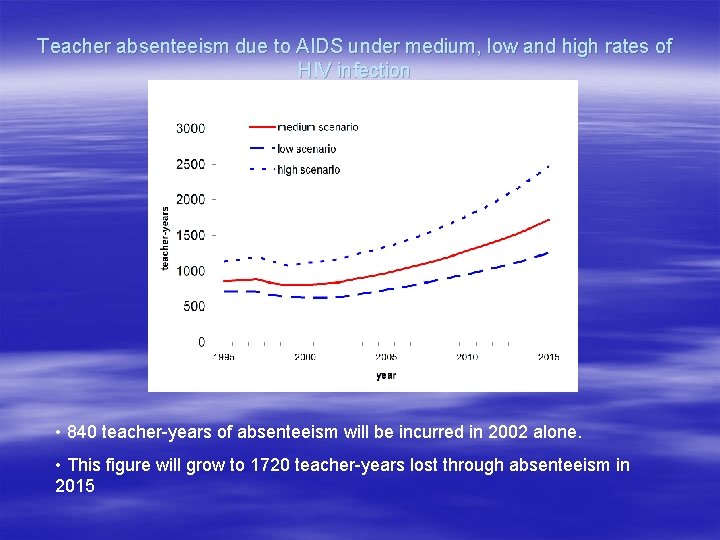
Teacher absenteeism due to AIDS under medium, low and high rates of HIV infection • 840 teacher-years of absenteeism will be incurred in 2002 alone. • This figure will grow to 1720 teacher-years lost through absenteeism in 2015
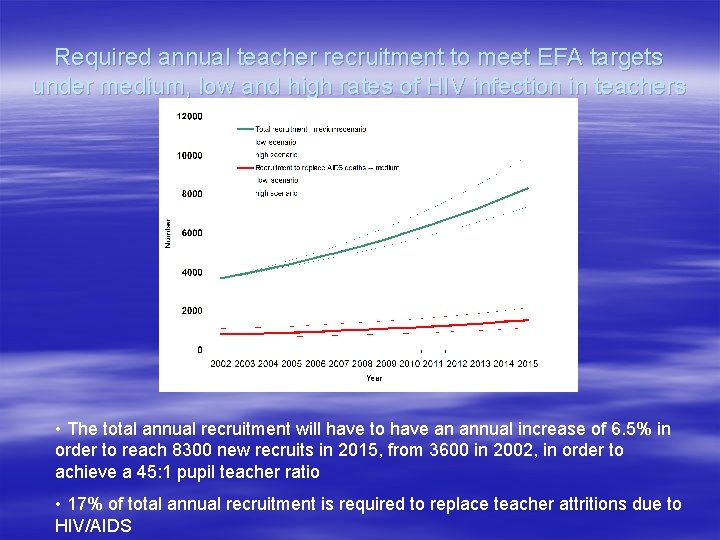
Required annual teacher recruitment to meet EFA targets under medium, low and high rates of HIV infection in teachers • The total annual recruitment will have to have an annual increase of 6. 5% in order to reach 8300 new recruits in 2015, from 3600 in 2002, in order to achieve a 45: 1 pupil teacher ratio • 17% of total annual recruitment is required to replace teacher attritions due to HIV/AIDS
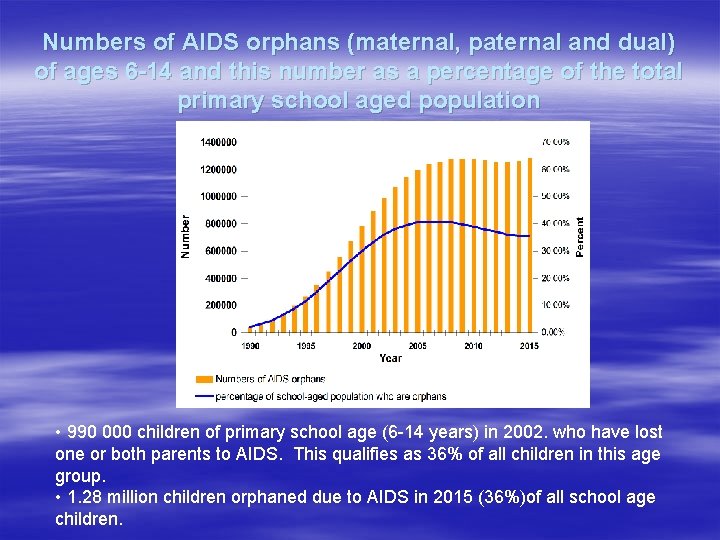
Numbers of AIDS orphans (maternal, paternal and dual) of ages 6 -14 and this number as a percentage of the total primary school aged population • 990 000 children of primary school age (6 -14 years) in 2002. who have lost one or both parents to AIDS. This qualifies as 36% of all children in this age group. • 1. 28 million children orphaned due to AIDS in 2015 (36%)of all school age children.
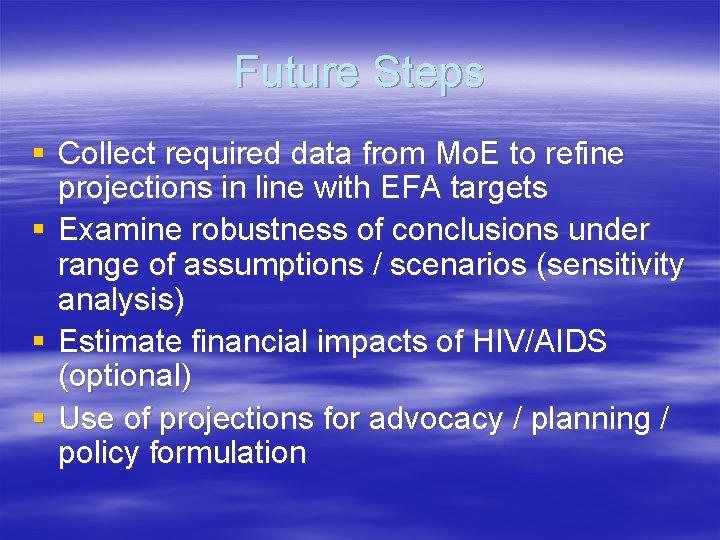
Future Steps § Collect required data from Mo. E to refine projections in line with EFA targets § Examine robustness of conclusions under range of assumptions / scenarios (sensitivity analysis) § Estimate financial impacts of HIV/AIDS (optional) § Use of projections for advocacy / planning / policy formulation
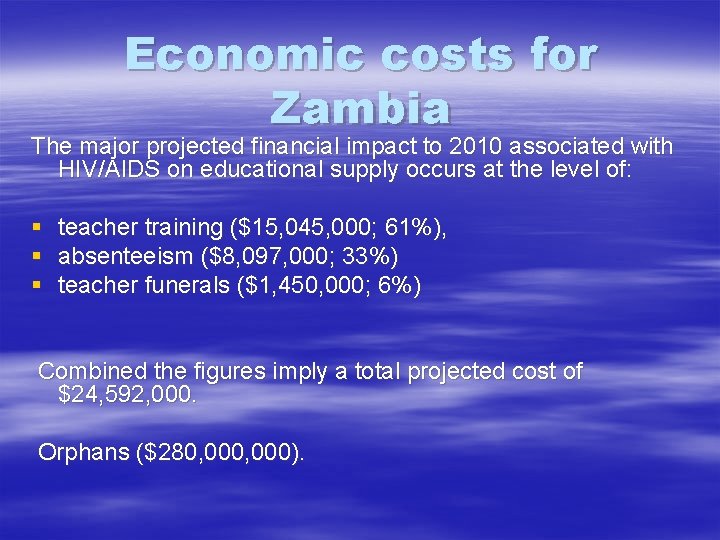
Economic costs for Zambia The major projected financial impact to 2010 associated with HIV/AIDS on educational supply occurs at the level of: § § § teacher training ($15, 045, 000; 61%), absenteeism ($8, 097, 000; 33%) teacher funerals ($1, 450, 000; 6%) Combined the figures imply a total projected cost of $24, 592, 000. Orphans ($280, 000).