
Accelerating the Diffusion of Knowledge to Advance Science
- Slides: 43
Accelerating the Diffusion of Knowledge to Advance Science and Technology United States Department of Energy Office of Scientific and Technical Information Karen J. Spence spencek@osti. gov May 2007
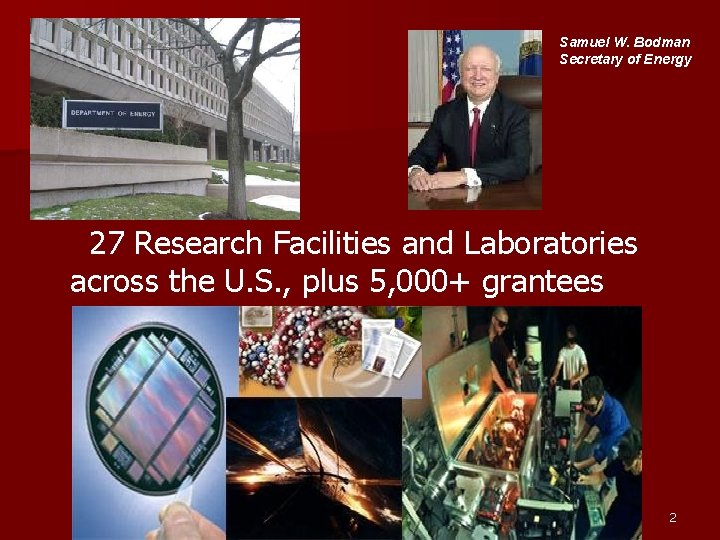
Samuel W. Bodman Secretary of Energy 27 Research Facilities and Laboratories across the U. S. , plus 5, 000+ grantees 2
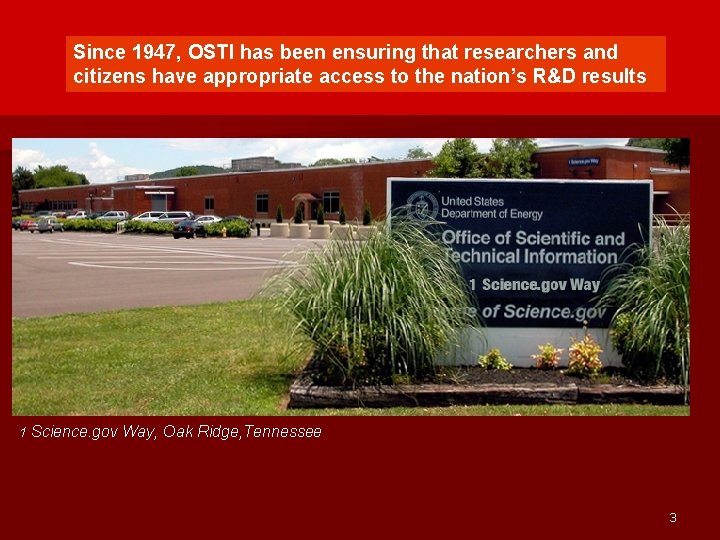
Since 1947, OSTI has been ensuring that researchers and citizens have appropriate access to the nation’s R&D results Walt Warnick, Ph. D. Director, Office of Scientific and Technical Information U. S. Department of Energy 1 Science. gov Way, Oak Ridge, Tennessee 3
OSTI’s Mission is critical to DOE’s Science Mission To advance science and sustain technological creativity by making R&D findings available and useful to DOE researchers and the American people. OSTI’s Creed Knowledge is contagious – it’s our job to make sure everyone “catches” it! 4
Fulfilling the Mission 1. DOE’s STI: Collect and preserve DOE-funded R&D results in a variety of document formats, housed in a central repository of both physical and electronic publications, and disseminate as broadly as possible 2. INNOVATION: Provide access to expanded sources of R&D information to the DOE research community and science-attentive public, using innovative tools such as federated deep Web searching of multiple databases and relevancy ranking to advance awareness of a broad array of scientific information related to DOE missions 5
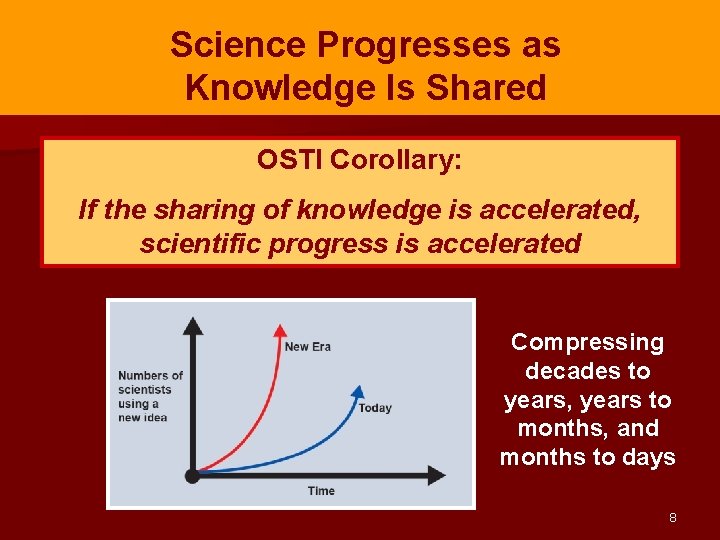
Science Progresses as Knowledge Is Shared OSTI Corollary: If the sharing of knowledge is accelerated, scientific progress is accelerated Compressing decades to years, years to months, and months to days 8
Key DOE/OSTI Information Services and Partnerships n DOE/OSTI Database Products n Interagency Partnerships – Science. gov n International Partnerships – ETDE – Global Science Gateway 9
DOE/OSTI Database Products DOE Information Bridge www. osti. gov/bridge 147, 000+ full text documents of research report literature n Energy Citations Database www. osti. gov/energycitations 2. 3 million citations to report literature, conference papers, journal articles, books, dissertations, and patents of interest to DOE and its predecessor agencies n 10
DOE/OSTI Database Products (Cont. ) n DOE R&D Accomplishments www. osti. gov/accomplishments A central forum for information about the outcomes of past DOE R&D that have had significant economic impact, have improved people’s lives, or have been widely recognized as remarkable advances in science 11
EPrint Network n Started in January 2000, EPN has now become one of OSTI’s primary products n Content encompasses 25, 000+ web sites, provides full text searching on ~ 1 million eprints, accesses over 3 million additional documents from 52 simultaneously searched major databases, and links to 2983 professional societies 12
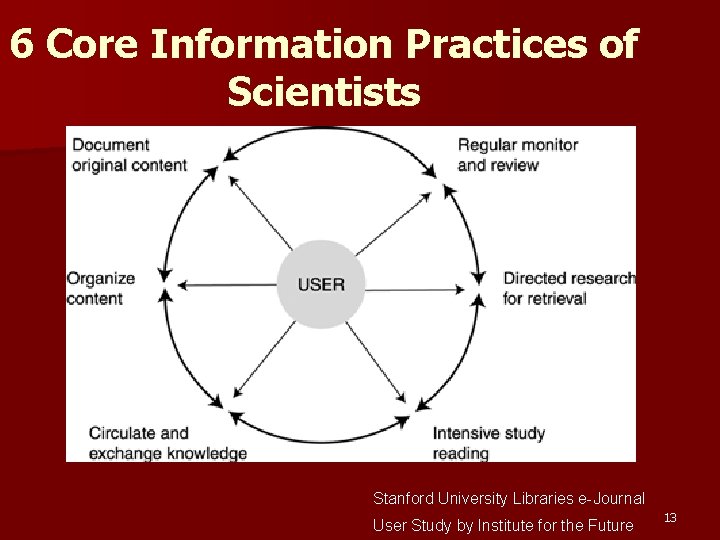
6 Core Information Practices of Scientists Stanford University Libraries e-Journal User Study by Institute for the Future 13
Vision for EPN n OSTI hopes to evolve the EPN from a primarily information search and retrieval product to one that supports the researcher more broadly in all of his/her professional information needs. n Such a product could be used to support parallel information activities such as creating, storing, holding document files; automatically building search strategies using previously successful searches; using knowledge management software tools to manage their professional documents collection; locating experts; finding jobs, fellowships, grants; and so on. 14
Interagency Partnerships Science. gov n Gateway to 1800 scientific websites n 50 million pages of science information n Real time results n Relevancy Ranked results n Voluntary coalition of 12 Federal agencies 15
International Partnerships A Global Science Gateway Vision: A world-class, Web-based facility that lets any scientist and citizen in the world easily discover and use the results from participating nations. n The Global Science Gateway will speed communication and accelerate discovery, thus expediting scientific and economic progress. n 16
Global Science Gateway Strategic Vision The Global Science Gateway will: n Search dispersed, electronic collections in general. subject-specific. and cross-cutting fields of science; n Provide direct and free searching of opensource collections and portals and will also allow patrons with proper access credentials to simultaneously search limited-access systems (e. g. agreements based on country membership); 17
Strategic Vision (Cont. ) n Build upon existing and already successful national models for searching; n Seek to complement existing information collections and systems; and n Maximize the attribution to and recognition of individual sources of information to the patron for the purpose of raising the visibility and usage of individual sources. 18
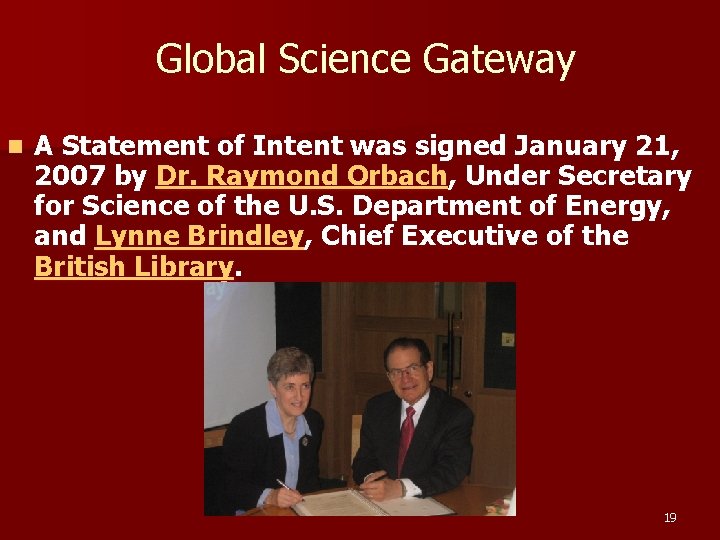
Global Science Gateway n A Statement of Intent was signed January 21, 2007 by Dr. Raymond Orbach, Under Secretary for Science of the U. S. Department of Energy, and Lynne Brindley, Chief Executive of the British Library. 19
International Partnerships ETDE “To provide governments, industry and the research community in the member countries with access to the widest range of information on energy research, science and technology and to increase dissemination of this information to developing countries. ” Ø Mission: 20
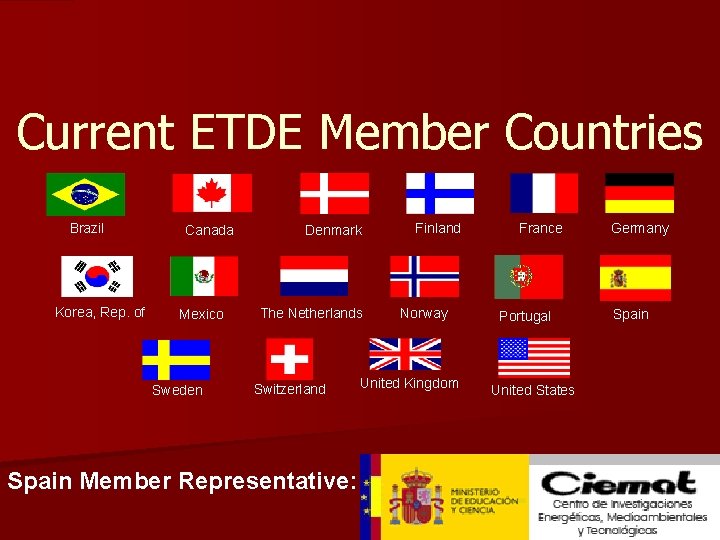
Current ETDE Member Countries Brazil Korea, Rep. of Canada Mexico Sweden Denmark The Netherlands Switzerland Spain Member Representative: Finland Norway United Kingdom France Portugal United States Germany Spain
ETDE’s “Product” – ETDEWEB Ø 3. 8 million citations – the world’s largest database of energy information Ø “ETDEWEB is clearly the information system of reference” (source: European Commission, May 2005) Ø Broad coverage of energy and environmental subjects
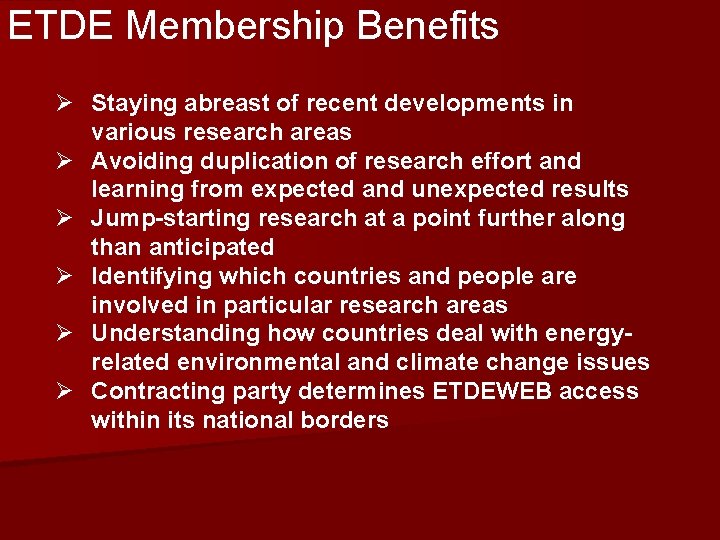
ETDE Membership Benefits Ø Staying abreast of recent developments in various research areas Ø Avoiding duplication of research effort and learning from expected and unexpected results Ø Jump-starting research at a point further along than anticipated Ø Identifying which countries and people are involved in particular research areas Ø Understanding how countries deal with energyrelated environmental and climate change issues Ø Contracting party determines ETDEWEB access within its national borders
Information Access Impediments/Opportunities New Paradigms n Traditional Publishing versus Open Access n Traditional Publishing partnered with Open Access 24
Thinking of Science as a Public Good…an Argument for Open Access Acknowledgment to: R. Stephen Berry, The University of Chicago The Scholarly Publishing & Academic Resources Coalition
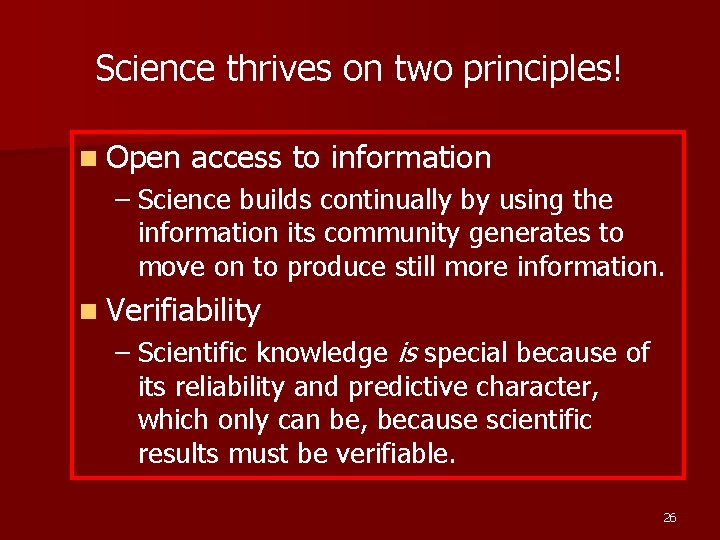
Science thrives on two principles! n Open access to information – Science builds continually by using the information its community generates to move on to produce still more information. n Verifiability – Scientific knowledge is special because of its reliability and predictive character, which only can be, because scientific results must be verifiable. 26
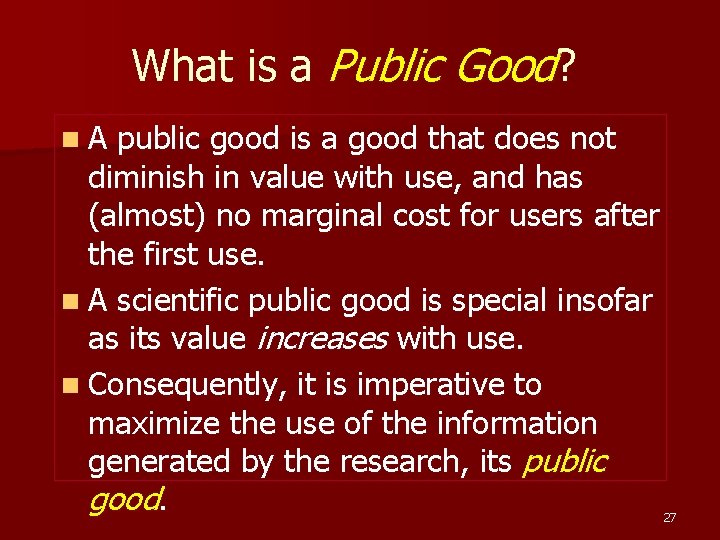
What is a Public Good? n. A public good is a good that does not diminish in value with use, and has (almost) no marginal cost for users after the first use. n A scientific public good is special insofar as its value increases with use. n Consequently, it is imperative to maximize the use of the information generated by the research, its public good. 27
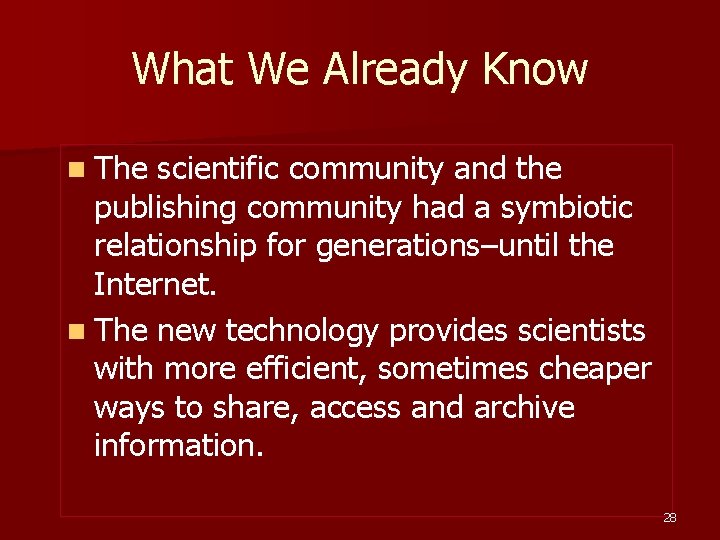
What We Already Know n The scientific community and the publishing community had a symbiotic relationship for generations–until the Internet. n The new technology provides scientists with more efficient, sometimes cheaper ways to share, access and archive information. 28
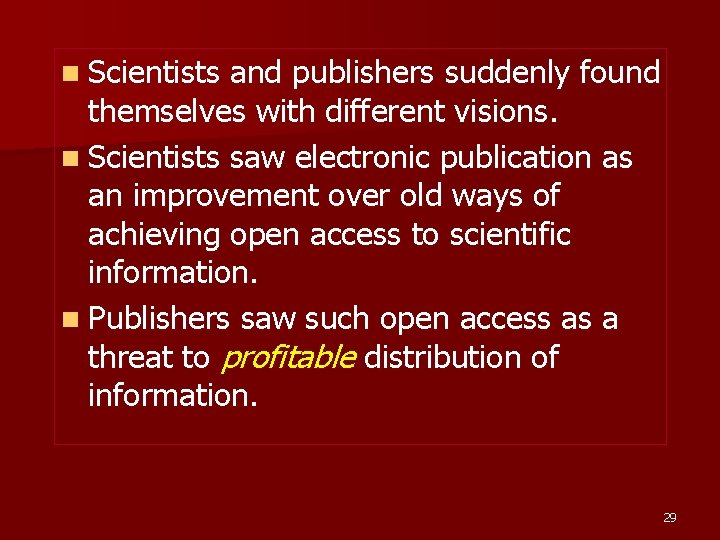
n Scientists and publishers suddenly found themselves with different visions. n Scientists saw electronic publication as an improvement over old ways of achieving open access to scientific information. n Publishers saw such open access as a threat to profitable distribution of information. 29
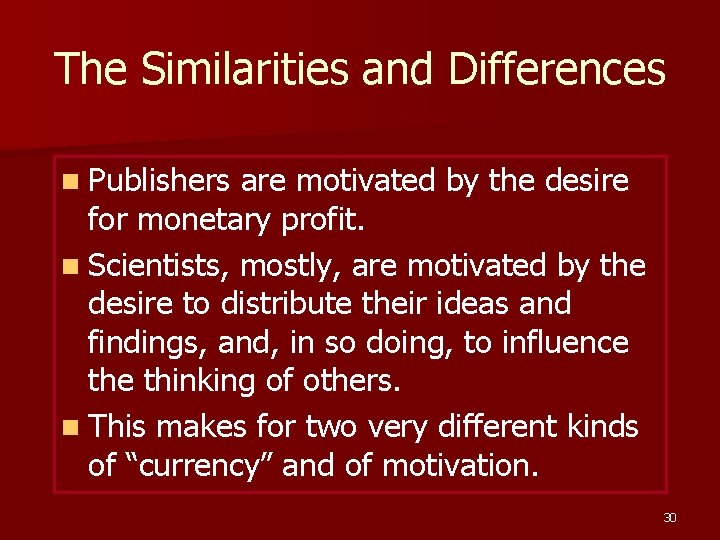
The Similarities and Differences n Publishers are motivated by the desire for monetary profit. n Scientists, mostly, are motivated by the desire to distribute their ideas and findings, and, in so doing, to influence thinking of others. n This makes for two very different kinds of “currency” and of motivation. 30
n Inhibiting the dissemination of scientific information necessarily diminishes its value as a public good, whatever private gains may ensue from such inhibition. n Refer back to accelerating the diffusion of knowledge can lead to acceleration in scientific advancement! 31
But scientists withhold information! n Yes, and this is accepted for periods long enough to allow discoverers to explore consequences of their discoveries. Like protection of small businesses, small research groups may be slower to pursue immediate consequences of research, so such protection is quite acceptable. 32
The Next Steps? n We are going through a period of adaptation. The “best” or even the better courses of action are still unclear. n Acceptable pathways can only be determined by trying and comparing the options. 33
U. S. Government Activities n National Institutes of Health n Department n Legislation of Energy Status 34
National Institutes of Health (NIH) Implemented Public Access Policy May 2, 2005 n Requests and strongly encourages all investigators to make their NIH-funded peerreviewed, author's final manuscript available to other researchers and the public through the NIH National Library of Medicine's (NLM) Pub. Med Central (PMC) immediately after the final date of journal publication. n 35
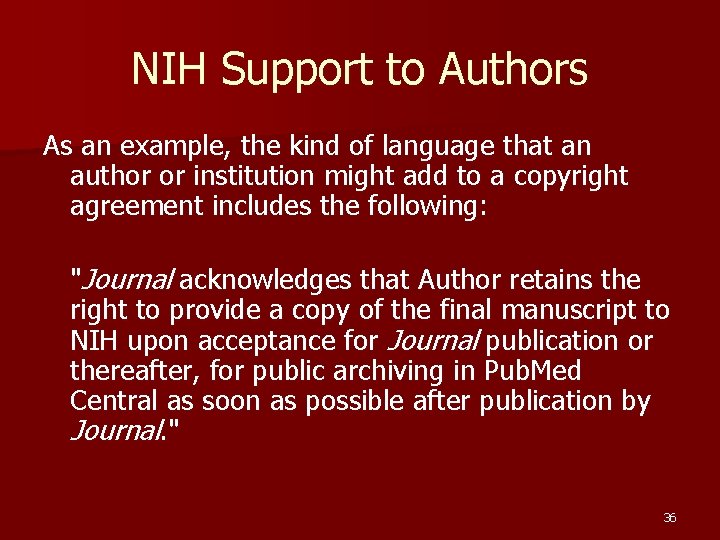
NIH Support to Authors As an example, the kind of language that an author or institution might add to a copyright agreement includes the following: "Journal acknowledges that Author retains the right to provide a copy of the final manuscript to NIH upon acceptance for Journal publication or thereafter, for public archiving in Pub. Med Central as soon as possible after publication by Journal. " 36
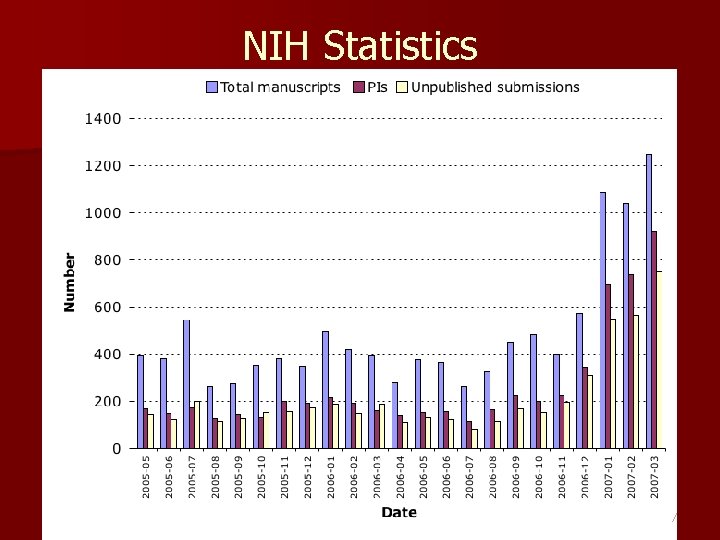
NIH Statistics 37
Department of Energy Workshop Panel Report on Accelerating the Spread of Knowledge About Science and Technology Concluded that “because scientific discovery is a cumulative process, with new knowledge building upon earlier findings, it is imperative that unnecessary barriers to sharing the immediate results of research should be removed. ” The Panel “supports and encourages the principle that publicly funded unclassified research should be deposited in stable, freely accessible public archives and made freely available as soon as possible after acceptance for publication. ” 38
DOE Laboratories and Open Access Los Alamos National Laboratory encourages researchers to consider publishing in an open access publication for these benefits: n Increased dissemination n Articles can be cited sooner n Articles potentially cited more frequently n Institutional costs for scholarly publishing are decreased 39
What next with Open Access in the Department of Energy? n Monitor efforts of NIH n Anticipate n Await individual researcher actions legislative action 40
Legislation Status n Federal Research Public Access Act – Introduced May 2, 2006 – Would require 11 agencies to make manuscripts of journal articles publicly and freely available via a digital archive/repository within 6 months after being published in a peer-reviewed journal – Referred to Senate committee 41
Alliance for Taxpayer Access May 1, 2007 Resolution in support of the Federal Research Public Access Act of 2006 from Trinity University Association of Student Representatives Resolution in support of taxpayer access to federally funded research from the Association of Students of Oberlin College April 27, 2007 Access For All from Harvard University's student newspaper February 21, 2007 Health Groups Urge Senators to Support On-line Access to Taxpayer Funded Medical Research February 6, 2007 Major society publisher announces support for public access to scientific literature February 1, 2007 Students Rally for Access to Publicly Funded Research Campuses declare “National Day of Action” in support of federal legislation January 30, 2007 Soil scientists renew the call for broader access to publicly funded research 42
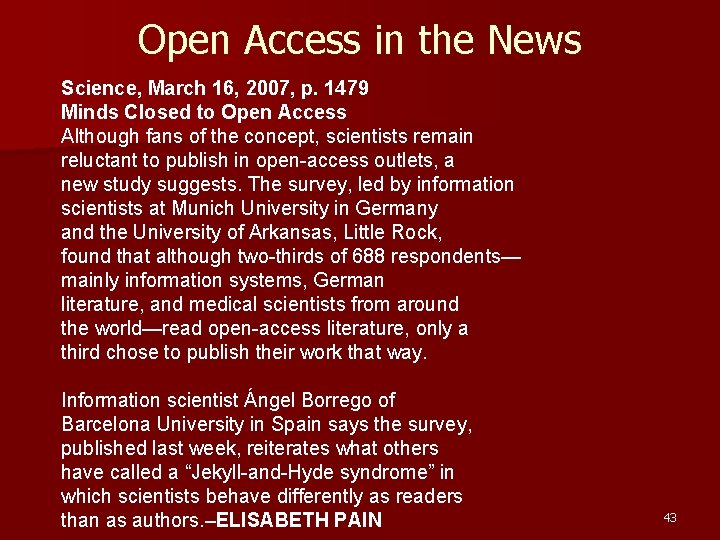
Open Access in the News Science, March 16, 2007, p. 1479 Minds Closed to Open Access Although fans of the concept, scientists remain reluctant to publish in open-access outlets, a new study suggests. The survey, led by information scientists at Munich University in Germany and the University of Arkansas, Little Rock, found that although two-thirds of 688 respondents— mainly information systems, German literature, and medical scientists from around the world—read open-access literature, only a third chose to publish their work that way. Information scientist Ángel Borrego of Barcelona University in Spain says the survey, published last week, reiterates what others have called a “Jekyll-and-Hyde syndrome” in which scientists behave differently as readers than as authors. –ELISABETH PAIN 43
Sampling of Information Sources http: //openaccess. eprints. org/ http: //www. arl. org/sparc/ http: //www. sparceurope. org/ http: //www. plos. org/index. php http: //american-scientist-open-accessforum. amsci. org/archives/American-Scientist. Open-Access-Forum. html 44
Thank you for your time and attention! Contact Information: Karen Spence Assistant Director for Information Systems Office of Scientific and Technical Information U. S. Department of Energy Telephone: 865 -574 -0295 Fax: 865 -576 -9357 Email: spencek@osti. gov Organization Website: www. osti. gov 45