
ACBH QA Train the Trainer Training Mental Health
ACBH QA “Train the Trainer” Training: Mental Health Service Authorization, and Records Auditing Compliance Standards. 1 JEFF SAMMIS, PSY. D CLINICAL REVIEW SPECIALIST SUPERVISOR PHUONG LAI, PSY. D INTERIM CLINICAL REVIEW SPECIALIST SUPERVISOR AMY SAUCIER, LMFT DEANNA KOLDA, LCSW CLINICAL REVIEW SPECIALISTS v. 12. 3. 19
QA Technical Assistance Contacts 2 � Master Contract Providers (CBO’s) and County Clinics/Programs Agency/Clinic Lead QA Contacts may contact: CBO’s by Parent Agency Name, or County Clinic by Program Name QA Technical Support Staff A – I: CBO’s and Phuong Lai, PSY. D. Phuong. Lai@acgov. org All Child County Clinics J - Z: CBO’s and All Adult County Clinics v. 12. 3. 19 Brion Phipps, LCSW Brion. Phipps@acgov. org
Agenda 9: 00 am – 4: 00 pm 3 09: 00 - 09: 15 q Introductions q Timely Access/NOABD 10: 30 - 10: 45 Break q q q Medical & Service Necessity MH Assessment Requirements, including SOGIE Data Collection Client Plan Requirements 12: 15 – 12: 45 Lunch q q q Client Plan Requirements (cont) Progress Notes Procedure Codes – Procedure Code Switching and Bingo 2: 30 - 2: 45 Break q Lock-outs, Claims Disallowances, Minor Consent, Emergency Contact q Post Test/Evaluation for Level I Providers ______________ 3: 00 -3: 45 Guidelines for Master Contract Organizations that also are Mental Health Plan Fee-For-Service Providers (MHP FFS) (formerly “Network” or Level III Providers) q Post Test/Evaluation for MHP FFS (Level III Providers) v. 12. 3. 19
Introductions 4 �Are you a Mental Health Fee for Service (MHP FFS) formerly known as Level III provider? �Safety �Introductions �What was the best thing that happened to you this last week? v. 12. 3. 19
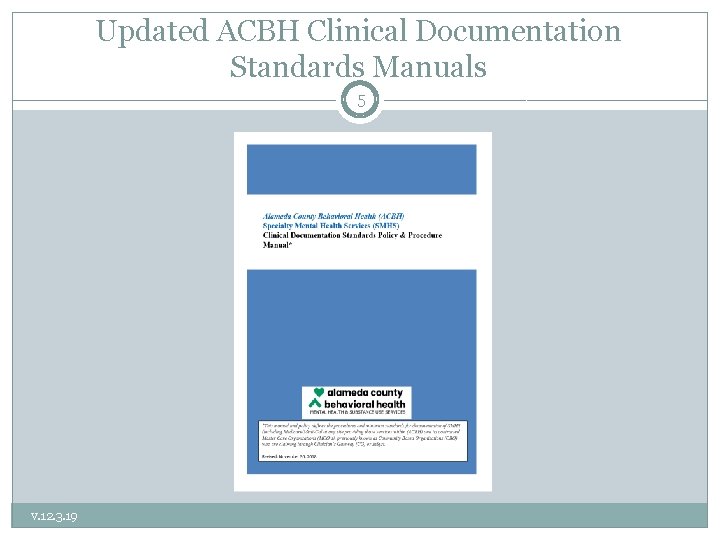
Updated ACBH Clinical Documentation Standards Manuals 5 v. 12. 3. 19

How to Get into Compliance 6 � Please use the information in this presentation to train your staff on proper Medi-Cal Documentation requirements. � Please review Alameda County’s new and updated Documentation Manual. As the manual has been recently updated, please check back routinely to see if the manual gets additional updates. � If your agency has not recently been audited in Alameda County’s System of Care audit, consider running an internal audit using the same audit tools that ACBHCS uses. (See next slide. ) � Conduct regular CQRT chart reviews and back out claims that were claimed in error. Backing out claims that do not meet medical necessity and would be disallowed in an audit is a requirement of agencies once they are aware of the claims/errors and can save your agency (and the whole County Mental Health Program) money in the long run. v. 12. 3. 19
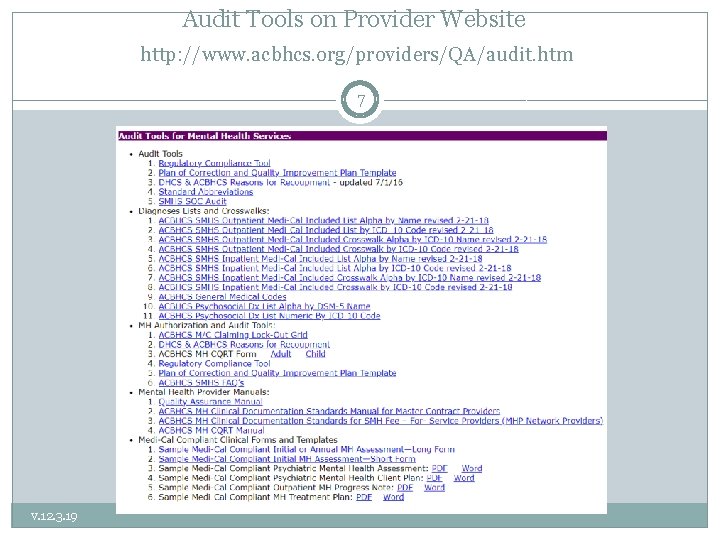
Audit Tools on Provider Website http: //www. acbhcs. org/providers/QA/audit. htm 7 v. 12. 3. 19
Clinical Quality Review Team CQRT 8 All agencies must conduct CQRT � CQRT consists of two essential components Record review to assure clinical documentation meets Medi-Cal requirements v. 12. 3. 19
Chart Auditing 9 For Agency CQRT meetings � Licensed, waivered, or registered LPHAs (Licensed Practitioner of the Healing Arts), and 2 nd year Graduate Trainees with the proper training and experience to Diagnose can participate in chart reviews. v. 12. 3. 19
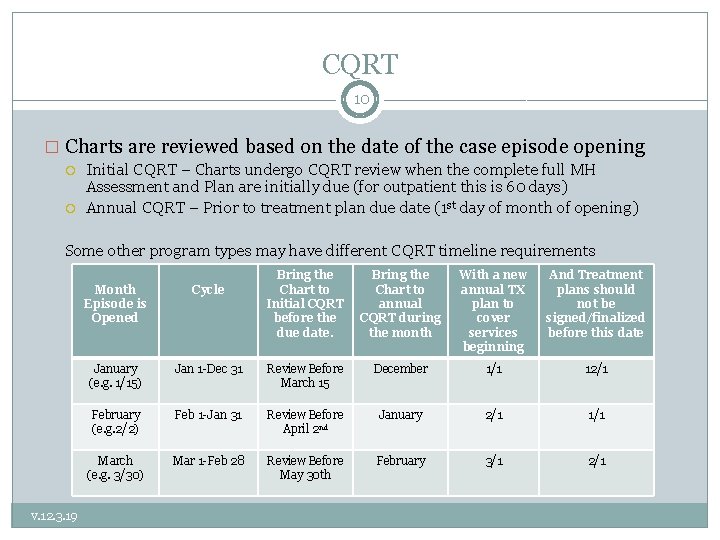
CQRT 10 � Charts are reviewed based on the date of the case episode opening Initial CQRT – Charts undergo CQRT review when the complete full MH Assessment and Plan are initially due (for outpatient this is 60 days) Annual CQRT – Prior to treatment plan due date (1 st day of month of opening) Some other program types may have different CQRT timeline requirements Month Episode is Opened Bring the Chart to annual CQRT during the month With a new annual TX plan to cover services beginning And Treatment plans should not be signed/finalized before this date January (e. g. 1/15) Jan 1 -Dec 31 Review Before March 15 December 1/1 12/1 February (e. g. 2/2) Feb 1 -Jan 31 Review Before April 2 nd January 2/1 1/1 Mar 1 -Feb 28 Review Before May 30 th February 3/1 2/1 March (e. g. 3/30) v. 12. 3. 19 Cycle Bring the Chart to Initial CQRT before the due date.
Additional County CQRT Review 11 �Providers that receive low claims compliance scores in system of care audits will be required (per their Plans of Correction) to submit CQRT forms for the next 6 months. �The QA department will randomly select cases and request a copy of the chart and conduct a 2 nd review of the chart. �This process will be used as ACBH evidence that our county is monitoring that Plans of Corrections are being followed and changes made in our system and that we are providing Technical Assistance to Providers. v. 12. 3. 19
Timely Access to Services Summary 12 • DHCS wants to know does the MHP provide timely appointment offers and ultimately timely access to assessment? And does the MHP provide timely access to treatment? • DHCS wants to determine the number of days from a beneficiary’s request for specialty mental health services to an initial assessment, and the number of days from the initial assessment to the first treatment appointment. • Info. Notice dated March 22, 2019 indicates that MHP’s must begin collecting the timelines data June 20, 2019. v. 12. 3. 19
Timely Access Tracking 13 � Who- All outpatient ACBH county-operated programs and individuals under a contract or subcontract with ACBH who bill Medi-cal for services. (inpatient, Santa Rita, outreach programs do not) � What-Date of first contract to request services, type of service requested, assessment start/end, treatment start/end, medical necessity, � When-New or New returning client who has medi-cal or is medical eligible. � Providers are required to offer an appointment within � Psychiatry 15 business days (urgent 48 hours) � Outpatient prior authorization not required 10 days (48 hours) � Outpatient prior authorization is required 10 days (96 hours) v. 12. 3. 19
Timely Access Forms 14 � 1. Timeliness Reporting Data Collection (Interim) � 2. Timeliness Data Collection Instructions (updating) � 3. Timeliness Data Entry e. Form (IS web portal) �http: //achcsa. org/behavioral-health/forms. aspx �The Timeliness Data should be submitted when the assessment end date and treatment start date is successfully completed or when the client does not complete the assessment process and the case is closed �Complete them on the same cycle as billing v. 12. 3. 19

Notices Of Adverse Benefit Determination (NOABD) 15 A NOABD is written notification of when an adverse benefit determination is made, and the BHP is required to issue to Medi-Cal beneficiaries. Purpose: Provide Medicaid (Medi-Cal) beneficiaries timely and understandable written notification when an adverse benefit determination for specialty mental health (SMHS) or substance use disorder (SUD) services is made; notification inclusive of beneficiary rights, such as the right to appeal. 1. The denial or limited authorization of a requested service, including determinations based on the type or level of service, medical necessity, appropriateness, setting, or effectiveness of a covered benefit; 2. The reduction, suspension, or termination of a previously authorized service; 3. The denial, in whole or in part, of payment for a service; 4. 5. 6. The failure to provide services in a timely manner; The failure to act within the required timeframes for standard resolution of grievances and appeals; or The denial of a beneficiary’s request to dispute financial liability. v. 12. 3. 19
Initial Required Forms 16 �Informing Materials (Reviewing informing materials and obtaining consents with clients as part of the assessment is a billable service. ) �Release of Information- when necessary (Discussing release of information with client as part of the assessment is a billable service. ) v. 12. 3. 19
Brief Screening Tool 17 � Alameda County is required to provide the appropriate type of Mental Health services to Medi-Cal beneficiaries. � Alameda County’s Screening Tool (and imbedded algorithm) is used to determine if a client meets medical necessity for Specialty Mental Health Services (clients with Moderate-to-Severe symptoms) or Mental Health Services from a Primary Care Provider (clients with Mild-to-Moderate symptoms. ) � The Screening tool may be used prior to opening a case to determine if a client is appropriate for specialty mental health services. � � � The Screening tool must be completed at the assessment completion. � Using the screening form prior to opening a case can help assure that clients to the correct mental health provider as soon as possible. Completing the screening from prior to opening a case is a non-billable activity. Exceptions for : Out of County, TBS Workers, Crisis, Conservatorship, & Guidance Clinic, STAT program. May be completed by a Licensed/Waivered/Registered LPHA/ and 2 nd year Graduate Trainee with the proper training and experience to Diagnose (with attestation of this by clinical supervisor). Waivered or Registered LPHA require a Licensed LPHA co-signature. 2 nd Year Trainees and greater also require a Licensed LPHA co-signature. � Use appropriate form based on age (0 -5, 6 -17, Adult) o http: //www. acbhcs. org/providers/Forms. htm v. 12. 3. 19
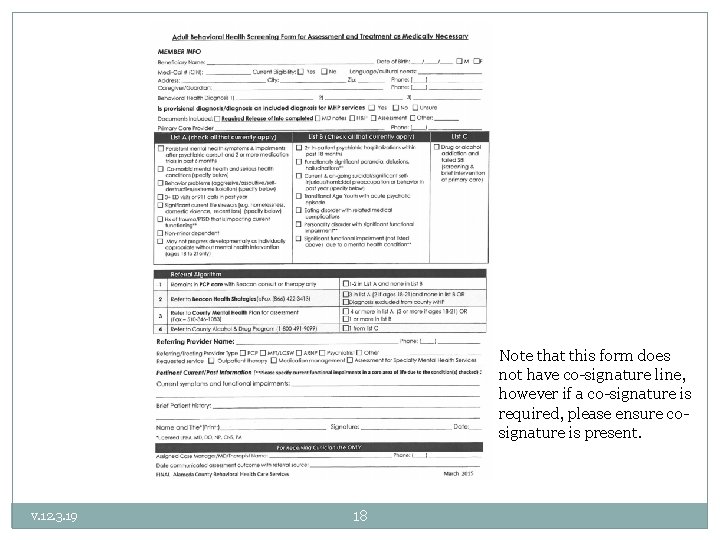
Note that this form does not have co-signature line, however if a co-signature is required, please ensure cosignature is present. v. 12. 3. 19 18
v. 12. 3. 19 19
Informing Materials 20 � Informing Materials required at Initial and Annual Assessments. Recommended at first visit as includes Consent to Treatment May be claimed as part of the MH Assessment � If a client’s primary language is not English, you must review informing materials in the client’s primary language. Alameda County provides translated Informing materials for all threshold languages. These forms must be provided to the client and the signature page present in the client’s medical record. If a client does not speak a threshold language, you can verbally interpret an English packet to the client and place an English signature page in the medical record and indicate that it was verbally reviewed with them in a language they understand. � All elements present in ACBH’s Informing Materials Packet are required. http: //www. acbhcs. org/providers/QA/General/informing. htm Provider may additional forms as needed. � ACBH’s Informing Materials Signature Page is highly recommended to be used and must be maintained in client record. If agency form is used—all county form elements must be present and readily identifiable. Note all boxes must be checked (as addressed) and signed. May utilize form by client initial for four additional occurrences. v. 12. 3. 19
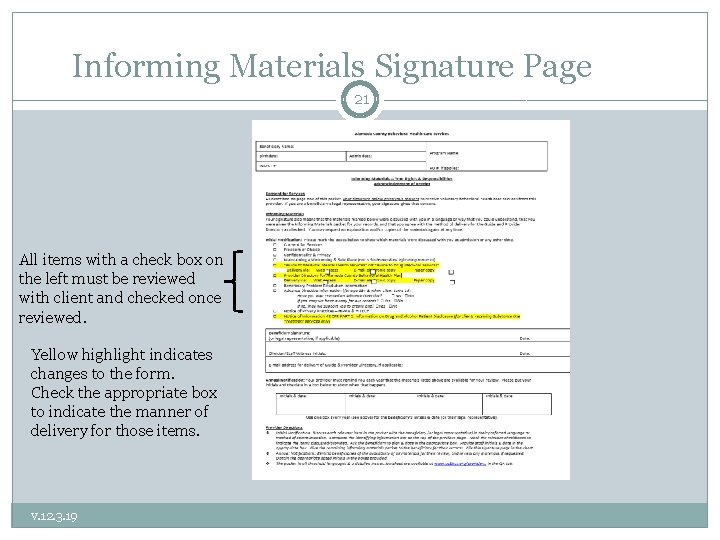
Informing Materials Signature Page 21 All items with a check box on the left must be reviewed with client and checked once reviewed. Yellow highlight indicates changes to the form. Check the appropriate box to indicate the manner of delivery for those items. v. 12. 3. 19
Release of Information 22 Informed Releases of Information (ROI) • • • Must be signed by client or legal representative. Client’s may limit data that will be shared including dates that information can be shared. Not required for Alameda Health Care Services Providers—but recommended Not required to simply facilitate treatment referral to other MH Providers— but highly recommended Releases are valid for as long as the client indicates, if no date indicated, default is 12 months. For a date to be valid, it must be an actual date; “until the end of treatment” is not a valid date. To avoid gaps in consent, obtain signatures on relevant ROIs annually during re-authorization of Assessment & Plan so that they fall in-sync with authorization cycle v. 12. 3. 19
Establishing Medical Necessity 23 THE GOLDEN THREAD v. 12. 3. 19
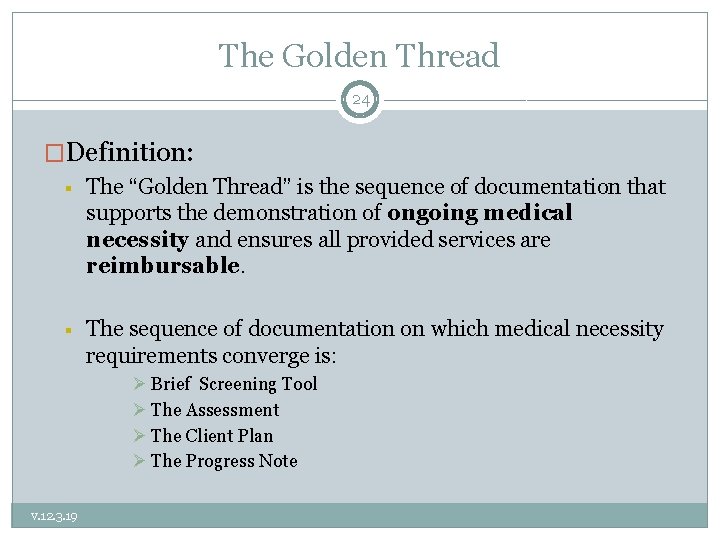
The Golden Thread 24 �Definition: § The “Golden Thread” is the sequence of documentation that supports the demonstration of ongoing medical necessity and ensures all provided services are reimbursable. § The sequence of documentation on which medical necessity requirements converge is: Brief Screening Tool The Assessment The Client Plan The Progress Note v. 12. 3. 19
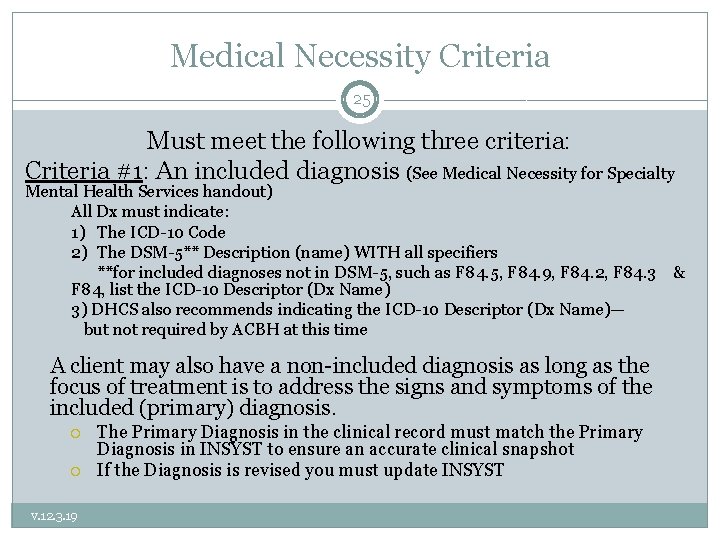
Medical Necessity Criteria 25 Must meet the following three criteria: Criteria #1: An included diagnosis (See Medical Necessity for Specialty Mental Health Services handout) All Dx must indicate: 1) The ICD-10 Code 2) The DSM-5** Description (name) WITH all specifiers **for included diagnoses not in DSM-5, such as F 84. 5, F 84. 9, F 84. 2, F 84. 3 & F 84, list the ICD-10 Descriptor (Dx Name) 3) DHCS also recommends indicating the ICD-10 Descriptor (Dx Name)— but not required by ACBH at this time A client may also have a non-included diagnosis as long as the focus of treatment is to address the signs and symptoms of the included (primary) diagnosis. v. 12. 3. 19 The Primary Diagnosis in the clinical record must match the Primary Diagnosis in INSYST to ensure an accurate clinical snapshot If the Diagnosis is revised you must update INSYST
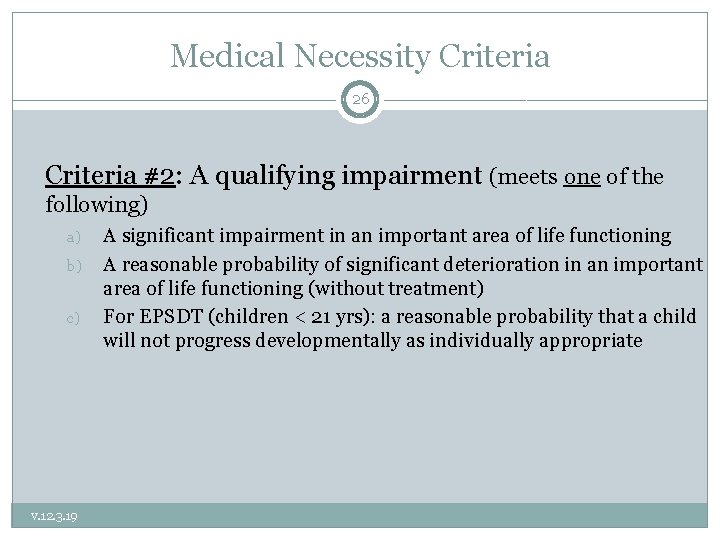
Medical Necessity Criteria 26 Criteria #2: A qualifying impairment (meets one of the following) a) b) c) v. 12. 3. 19 A significant impairment in an important area of life functioning A reasonable probability of significant deterioration in an important area of life functioning (without treatment) For EPSDT (children < 21 yrs): a reasonable probability that a child will not progress developmentally as individually appropriate
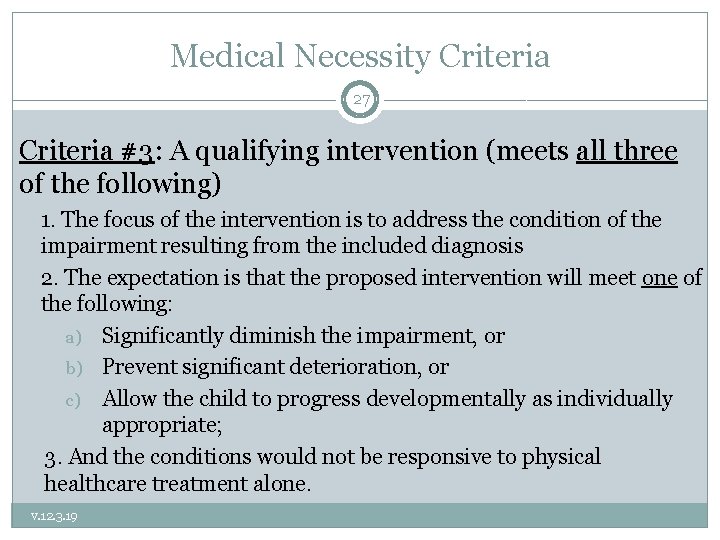
Medical Necessity Criteria 27 Criteria #3: A qualifying intervention (meets all three of the following) 1. The focus of the intervention is to address the condition of the impairment resulting from the included diagnosis 2. The expectation is that the proposed intervention will meet one of the following: a) Significantly diminish the impairment, or b) Prevent significant deterioration, or c) Allow the child to progress developmentally as individually appropriate; 3. And the conditions would not be responsive to physical healthcare treatment alone. v. 12. 3. 19
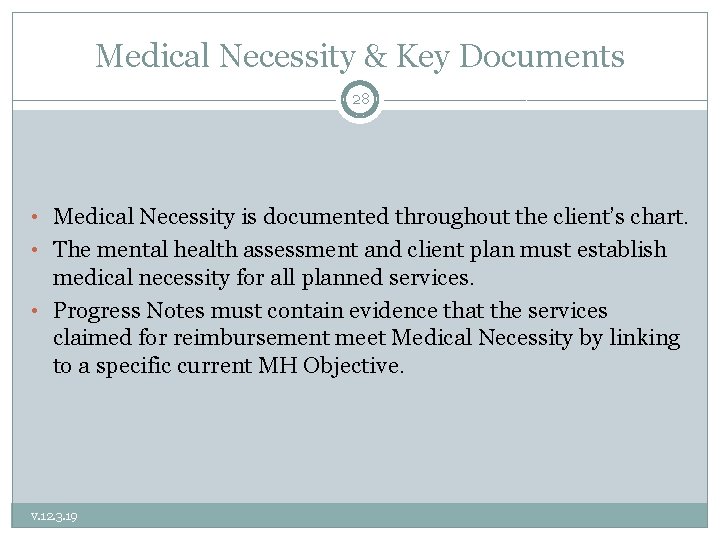
Medical Necessity & Key Documents 28 • Medical Necessity is documented throughout the client’s chart. • The mental health assessment and client plan must establish medical necessity for all planned services. • Progress Notes must contain evidence that the services claimed for reimbursement meet Medical Necessity by linking to a specific current MH Objective. v. 12. 3. 19
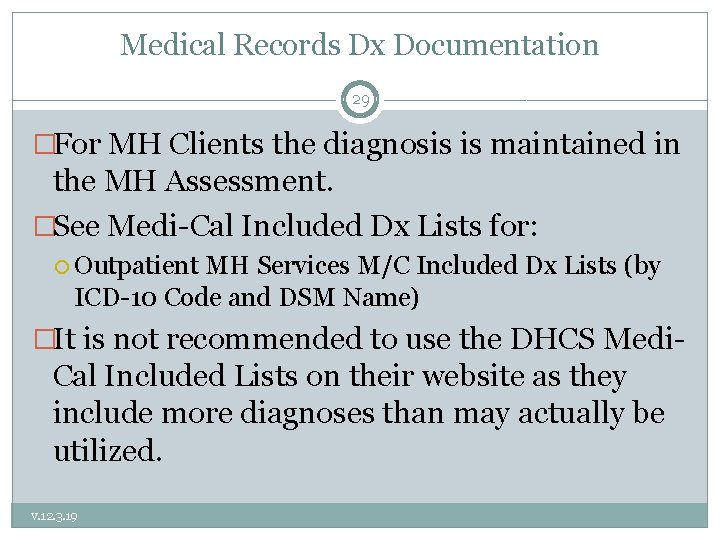
Medical Records Dx Documentation 29 �For MH Clients the diagnosis is maintained in the MH Assessment. �See Medi-Cal Included Dx Lists for: Outpatient MH Services M/C Included Dx Lists (by ICD-10 Code and DSM Name) �It is not recommended to use the DHCS Medi- Cal Included Lists on their website as they include more diagnoses than may actually be utilized. v. 12. 3. 19
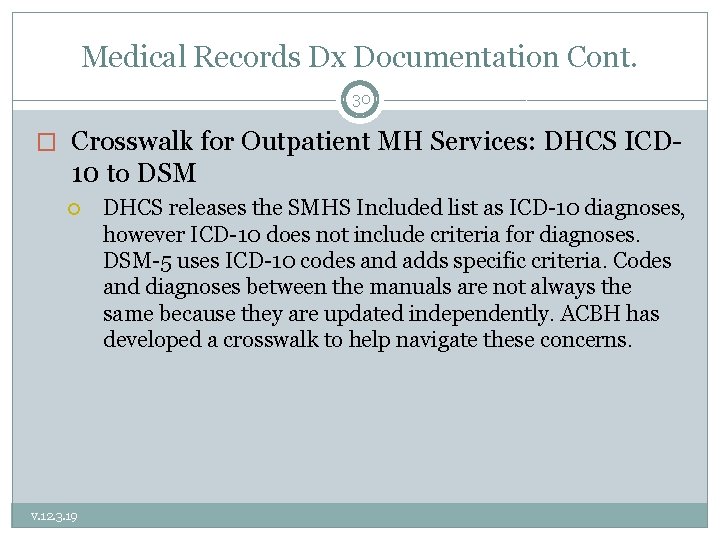
Medical Records Dx Documentation Cont. 30 � Crosswalk for Outpatient MH Services: DHCS ICD- 10 to DSM v. 12. 3. 19 DHCS releases the SMHS Included list as ICD-10 diagnoses, however ICD-10 does not include criteria for diagnoses. DSM-5 uses ICD-10 codes and adds specific criteria. Codes and diagnoses between the manuals are not always the same because they are updated independently. ACBH has developed a crosswalk to help navigate these concerns.
Medical Records Dx Documentation Cont. 31 �When documenting the diagnosis include both the ICD-10 Dx Code and the full DSM Descriptor/Name with Specifiers If there is no DSM-5 descriptor—use the ICD-10 descriptor (name) Do not use the DSM-IV descriptor. �DHCS also recommends additionally including the ICD-10 Description (Dx name). v. 12. 3. 19
Medical Records Dx. Documentation Cont. 32 �The primary diagnosis and focus of treatment can not be a historical diagnosis. The primary diagnosis must be made during the current episode. For example, diagnoses made during recent psychiatric hospitalizations may be used to inform the current diagnosis but may not simply be referenced �Any additional diagnoses that the client has received in the past may be documented without indicating the full criteria. Indicate “by history” and the source of the data. v. 12. 3. 19
Medical Records Dx Documentation Cont. 33 �Each contracted agency is required to have a policy and procedure to resolve discrepant diagnoses. �It is best practice to align diagnoses within an agency. When there is a discrepant diagnoses and it can not be resolved, the client record should indicate what attempts were made to align them and how the decision was reached to keep discrepant diagnoses. �It is best practice for providers to collaborate across agencies regarding conflicting diagnoses. v. 12. 3. 19
IS Help Desk Contact 34 For assistance with entering ICD 10 codes into In. Syst, please contact the Information Systems Help Desk @ 510. 567. 8181 or HIS@acgov. org v. 12. 3. 19
Mental Health Assessment 35 STEP 1 OF THE GOLDEN THREAD v. 12. 3. 19
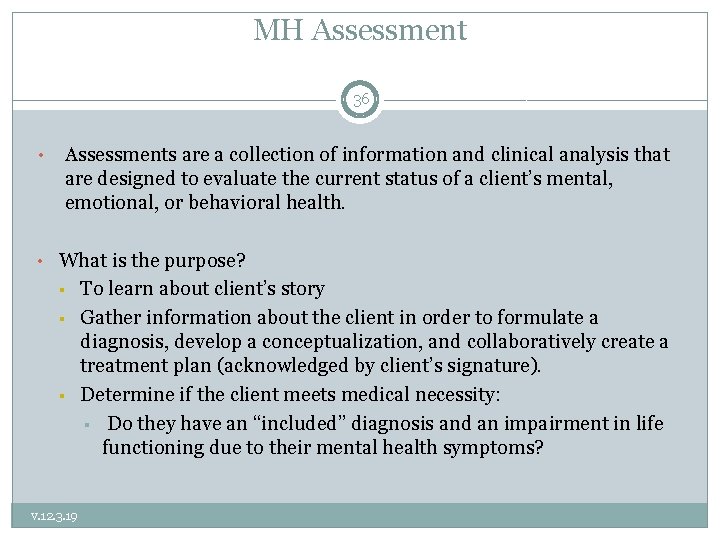
MH Assessment 36 • Assessments are a collection of information and clinical analysis that are designed to evaluate the current status of a client’s mental, emotional, or behavioral health. • What is the purpose? § § § v. 12. 3. 19 To learn about client’s story Gather information about the client in order to formulate a diagnosis, develop a conceptualization, and collaboratively create a treatment plan (acknowledged by client’s signature). Determine if the client meets medical necessity: § Do they have an “included” diagnosis and an impairment in life functioning due to their mental health symptoms?
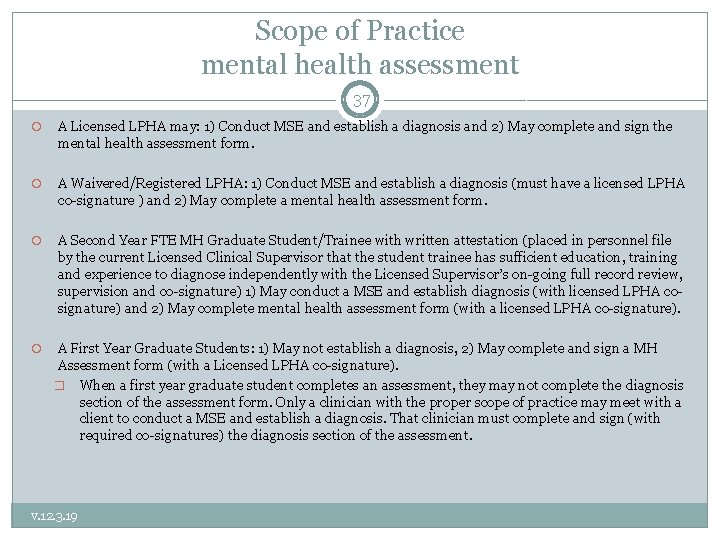
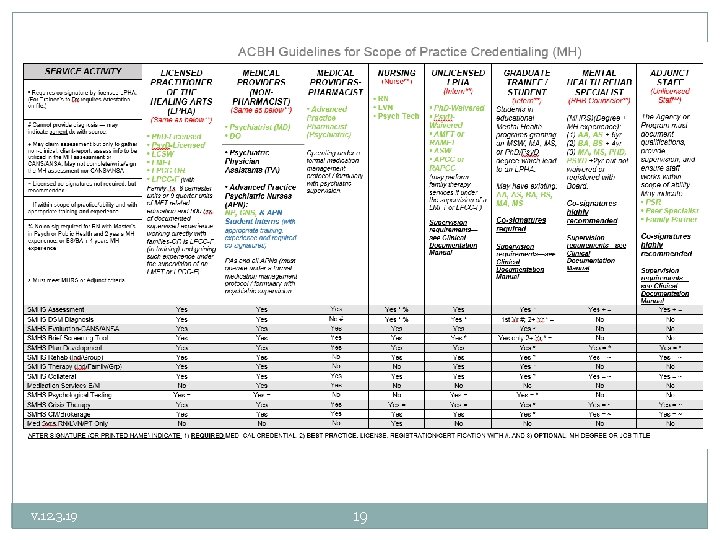
Scope of Practice mental health assessment 37 A Licensed LPHA may: 1) Conduct MSE and establish a diagnosis and 2) May complete and sign the mental health assessment form. A Waivered/Registered LPHA: 1) Conduct MSE and establish a diagnosis (must have a licensed LPHA co-signature ) and 2) May complete a mental health assessment form. A Second Year FTE MH Graduate Student/Trainee with written attestation (placed in personnel file by the current Licensed Clinical Supervisor that the student trainee has sufficient education, training and experience to diagnose independently with the Licensed Supervisor’s on-going full record review, supervision and co-signature) 1) May conduct a MSE and establish diagnosis (with licensed LPHA cosignature) and 2) May complete mental health assessment form (with a licensed LPHA co-signature). A First Year Graduate Students: 1) May not establish a diagnosis, 2) May complete and sign a MH Assessment form (with a Licensed LPHA co-signature). � When a first year graduate student completes an assessment, they may not complete the diagnosis section of the assessment form. Only a clinician with the proper scope of practice may meet with a client to conduct a MSE and establish a diagnosis. That clinician must complete and sign (with required co-signatures) the diagnosis section of the assessment. v. 12. 3. 19
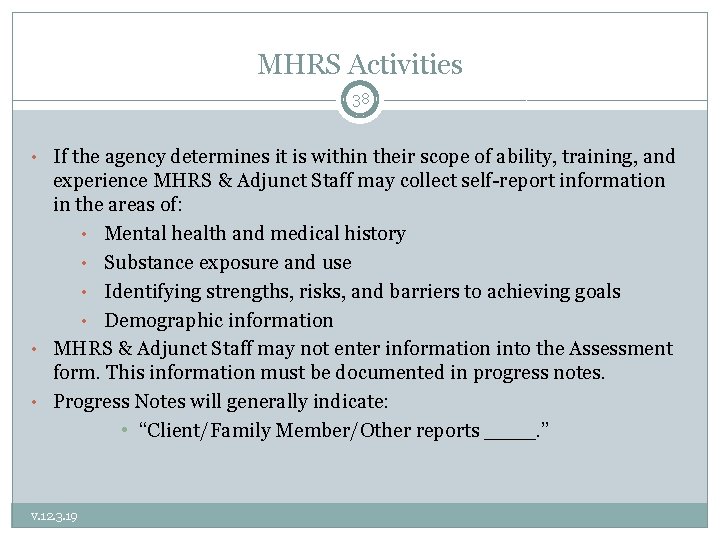
MHRS Activities 38 • If the agency determines it is within their scope of ability, training, and experience MHRS & Adjunct Staff may collect self-report information in the areas of: • Mental health and medical history • Substance exposure and use • Identifying strengths, risks, and barriers to achieving goals • Demographic information • MHRS & Adjunct Staff may not enter information into the Assessment form. This information must be documented in progress notes. • Progress Notes will generally indicate: • “Client/Family Member/Other reports ____. ” v. 12. 3. 19
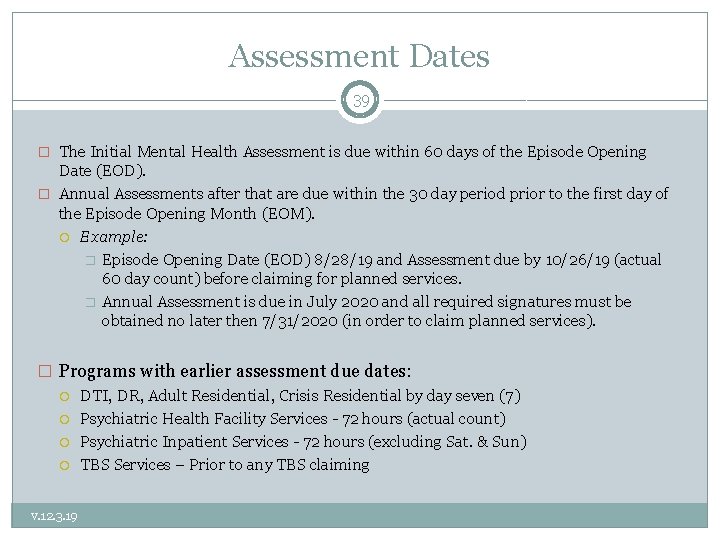
Assessment Dates 39 � The Initial Mental Health Assessment is due within 60 days of the Episode Opening Date (EOD). � Annual Assessments after that are due within the 30 day period prior to the first day of the Episode Opening Month (EOM). Example: � Episode Opening Date (EOD) 8/28/19 and Assessment due by 10/26/19 (actual 60 day count) before claiming for planned services. � Annual Assessment is due in July 2020 and all required signatures must be obtained no later then 7/31/2020 (in order to claim planned services). � Programs with earlier assessment due dates: DTI, DR, Adult Residential, Crisis Residential by day seven (7) Psychiatric Health Facility Services - 72 hours (actual count) Psychiatric Inpatient Services - 72 hours (excluding Sat. & Sun) TBS Services – Prior to any TBS claiming v. 12. 3. 19
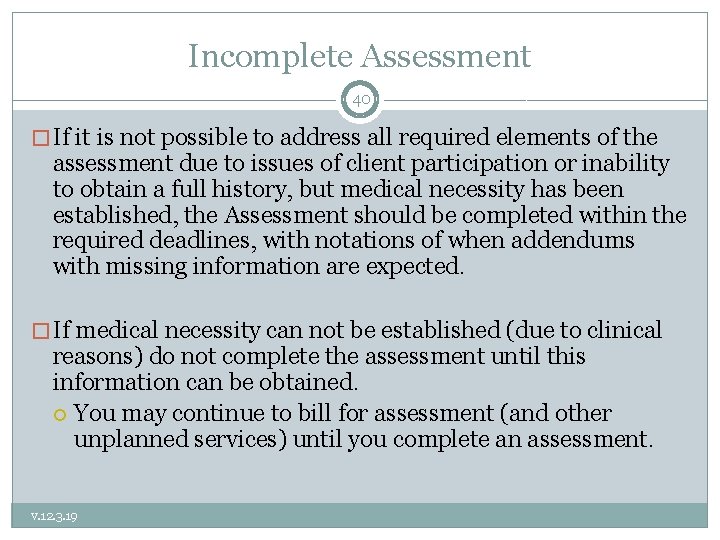
Incomplete Assessment 40 � If it is not possible to address all required elements of the assessment due to issues of client participation or inability to obtain a full history, but medical necessity has been established, the Assessment should be completed within the required deadlines, with notations of when addendums with missing information are expected. � If medical necessity can not be established (due to clinical reasons) do not complete the assessment until this information can be obtained. You may continue to bill for assessment (and other unplanned services) until you complete an assessment. v. 12. 3. 19
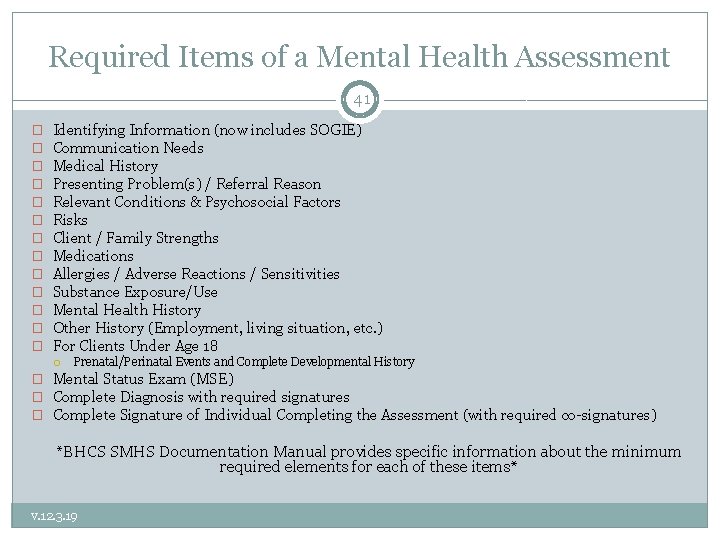
Required Items of a Mental Health Assessment 41 � � � � Identifying Information (now includes SOGIE) Communication Needs Medical History Presenting Problem(s) / Referral Reason Relevant Conditions & Psychosocial Factors Risks Client / Family Strengths Medications Allergies / Adverse Reactions / Sensitivities Substance Exposure/Use Mental Health History Other History (Employment, living situation, etc. ) For Clients Under Age 18 Prenatal/Perinatal Events and Complete Developmental History � Mental Status Exam (MSE) � Complete Diagnosis with required signatures � Complete Signature of Individual Completing the Assessment (with required co-signatures) *BHCS SMHS Documentation Manual provides specific information about the minimum required elements for each of these items* v. 12. 3. 19
Assuring Form Compliance 42 �It remains the responsibility of each agency to follow the current SMHS documentation standards by including the required information into the narrative fields and assuring that all required information is present in a client’s assessment. v. 12. 3. 19
Cultural Considerations 43 • Identified during the Assessment Process and addressed in the plan if appropriate • Language & Physical Limitations • Race, Ethnicity, Socio-Economic Status, Class, Religion, Immigration status/Citizenship, Geography, • CG now includes SOGIE (Sexual Orientation/Gender Identity Expression) v. 12. 3. 19
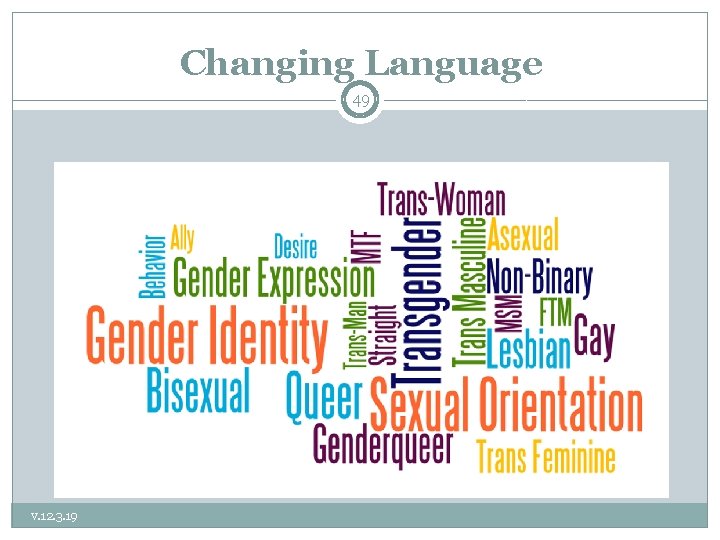
SOGIE Data Collection 44 �Lesbian, gay, bisexual, pansexual and transgender (LGBPT) clients have unique health needs and experience numerous health disparities �Shift from LGBPT language to SOGIE �Everyone has a SOGIE and identity does not always equal behavior. �Routine and standardized collection of Sexual Orientation and Gender Identity Expression (SOGIE) information in medical and EHRs will help assess satisfaction, quality of care and inform the delivery of appropriate health services to address health disparities. v. 12. 3. 19
SOGIE Data 45 � Required at time of MH Assessment � The ACBH EHR (CG) has been modified to include Sexual Orientation and Gender Identity (SOGIE) data collection. � The Data collection will serve to identify LGBPTQQI 2 -S populations which have historically been underserved as well as to assist the provider in providing culturally sensitive & responsive services. � Gathering such data in clinical settings will allow providers to better understand treat their clients, and to compare their clients’ health outcomes with national samples of LGBPT people from health surveys. v. 12. 3. 19
SOGIE STATS 46 � Use of national data, if local does not exist, to identify health inequities: Example HEALTHY PEOPLE 2020: http: //www. healthypeople. gov/2020/topicsobjectives 2020/overview. aspx? topicid=25 • LGBPT youth are 2 to 3 times more likely to attempt suicide. • • LGBPT youth are more likely to be homeless. Transgender individuals have a high prevalence of HIV/STDs, victimization, mental health issues, suicide and are less likely to have health insurance than heterosexual or LGBPT individuals. • 70% report being harassed at school. • 90% report feeling unsafe at school • Elderly LGBPT individuals face additional barriers to health because of isolation and a lack of social services and culturally competent providers. • LGBPT populations have the highest rates of tobacco, alcohol, and other drug use. • National Resource Ctr for Youth Development: Fact Sheet & Healthy People 2020 v. 12. 3. 19
SOGIE RISKS 47 Statewide data: Building Partnerships: Conversations with LGBPTQ Youth About MH Needs and Community Strengths: UC Davis Center for Reducing Health Disparities, 3/2009, cont: � LGBPTQ youth reported being harassed and bullied in their schools, homes, and neighborhoods on an almost-daily basis. � Many youth shared that they had received death threats. � LGBPTQ youth identified social factors as major causes of mental illness in their communities including challenging economic and physical living conditions. � LGBPTQ youth described their struggles with rejection by their families and peers and harassment at school by students, teachers, and administrators, and how it often leads to feelings of isolation, hopelessness, despair, self-destructive behaviors, suicidal thoughts, attempts, and completed suicides. v. 12. 3. 19
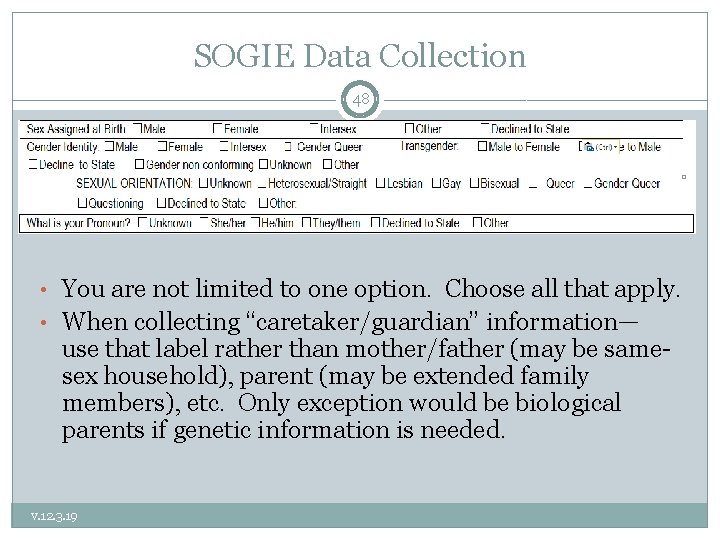
SOGIE Data Collection 48 • You are not limited to one option. Choose all that apply. • When collecting “caretaker/guardian” information— use that label rather than mother/father (may be samesex household), parent (may be extended family members), etc. Only exception would be biological parents if genetic information is needed. v. 12. 3. 19
Changing Language 49 v. 12. 3. 19
Communication Barriers 50 • During provider-client interaction there are several potential barriers to gathering this information: • • Microaggressions Internalized oppression Prejudice Stereotypes • Not all LGBPT clients will disclose their sexual or gender identity v. 12. 3. 19
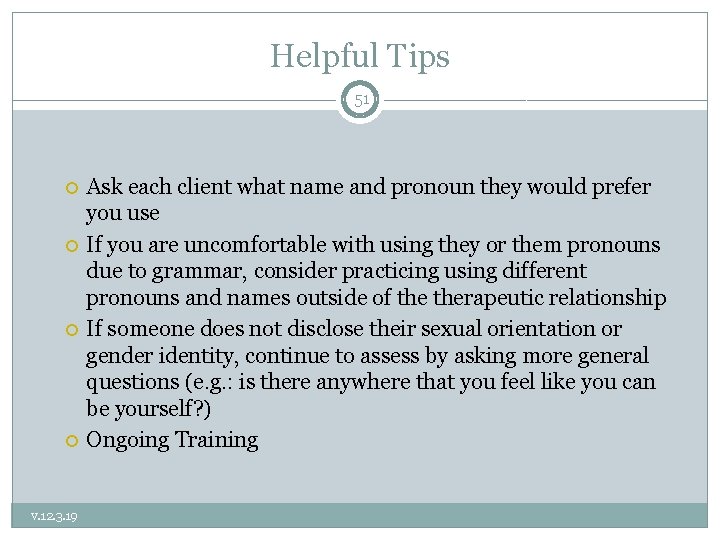
Helpful Tips 51 v. 12. 3. 19 Ask each client what name and pronoun they would prefer you use If you are uncomfortable with using they or them pronouns due to grammar, consider practicing using different pronouns and names outside of therapeutic relationship If someone does not disclose their sexual orientation or gender identity, continue to assess by asking more general questions (e. g. : is there anywhere that you feel like you can be yourself? ) Ongoing Training
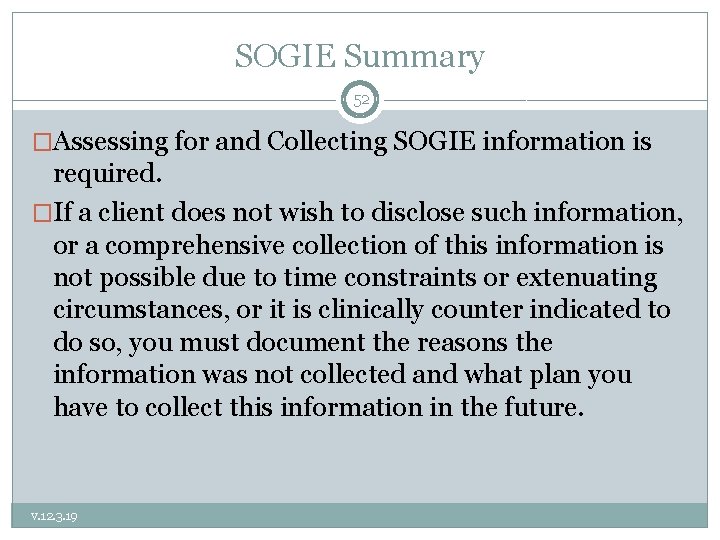
SOGIE Summary 52 �Assessing for and Collecting SOGIE information is required. �If a client does not wish to disclose such information, or a comprehensive collection of this information is not possible due to time constraints or extenuating circumstances, or it is clinically counter indicated to do so, you must document the reasons the information was not collected and what plan you have to collect this information in the future. v. 12. 3. 19
SOGIE 53 All providers should seek ongoing Continuing Education and consultation to gain skills and knowledge to serve this population. v. 12. 3. 19
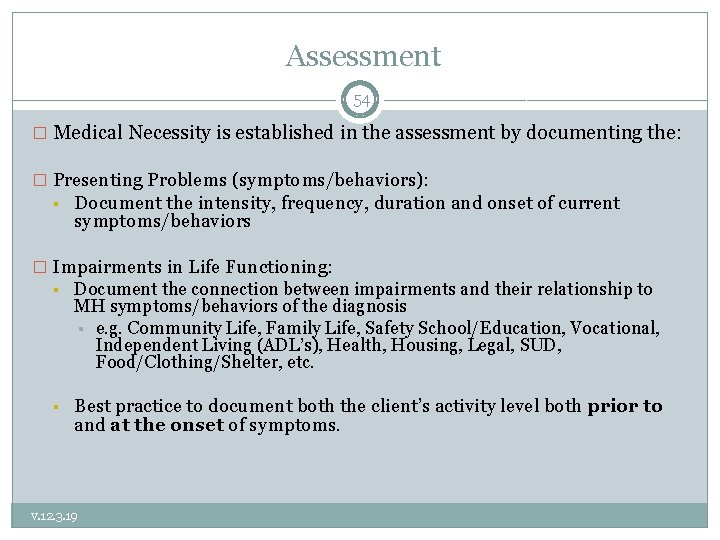
Assessment 54 � Medical Necessity is established in the assessment by documenting the: � Presenting Problems (symptoms/behaviors): § Document the intensity, frequency, duration and onset of current symptoms/behaviors � Impairments in Life Functioning: § Document the connection between impairments and their relationship to MH symptoms/behaviors of the diagnosis § e. g. Community Life, Family Life, Safety School/Education, Vocational, Independent Living (ADL’s), Health, Housing, Legal, SUD, Food/Clothing/Shelter, etc. § Best practice to document both the client’s activity level both prior to and at the onset of symptoms. v. 12. 3. 19
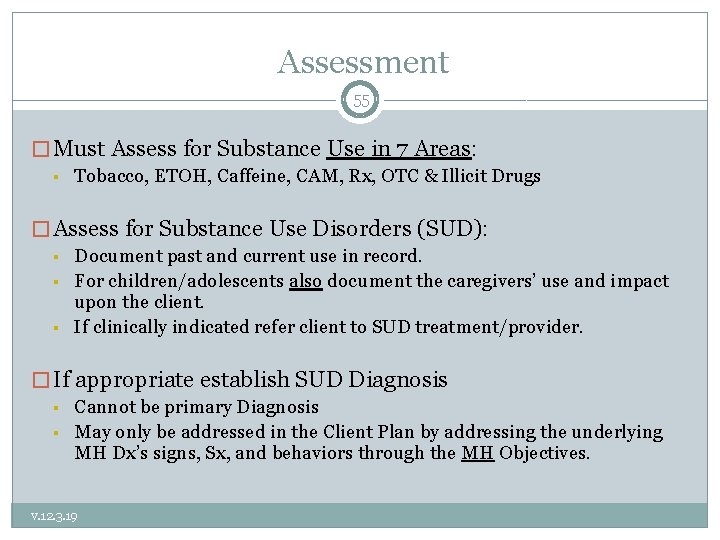
Assessment 55 � Must Assess for Substance Use in 7 Areas: § Tobacco, ETOH, Caffeine, CAM, Rx, OTC & Illicit Drugs � Assess for Substance Use Disorders (SUD): § § § Document past and current use in record. For children/adolescents also document the caregivers’ use and impact upon the client. If clinically indicated refer client to SUD treatment/provider. � If appropriate establish SUD Diagnosis § § Cannot be primary Diagnosis May only be addressed in the Client Plan by addressing the underlying MH Dx’s signs, Sx, and behaviors through the MH Objectives. v. 12. 3. 19
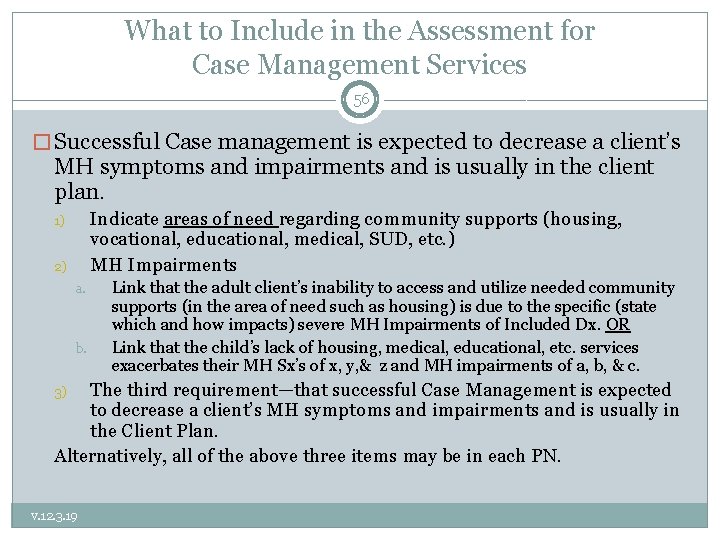
What to Include in the Assessment for Case Management Services 56 � Successful Case management is expected to decrease a client’s MH symptoms and impairments and is usually in the client plan. Indicate areas of need regarding community supports (housing, vocational, educational, medical, SUD, etc. ) MH Impairments 1) 2) a. b. Link that the adult client’s inability to access and utilize needed community supports (in the area of need such as housing) is due to the specific (state which and how impacts) severe MH Impairments of Included Dx. OR Link that the child’s lack of housing, medical, educational, etc. services exacerbates their MH Sx’s of x, y, & z and MH impairments of a, b, & c. The third requirement—that successful Case Management is expected to decrease a client’s MH symptoms and impairments and is usually in the Client Plan. Alternatively, all of the above three items may be in each PN. 3) v. 12. 3. 19
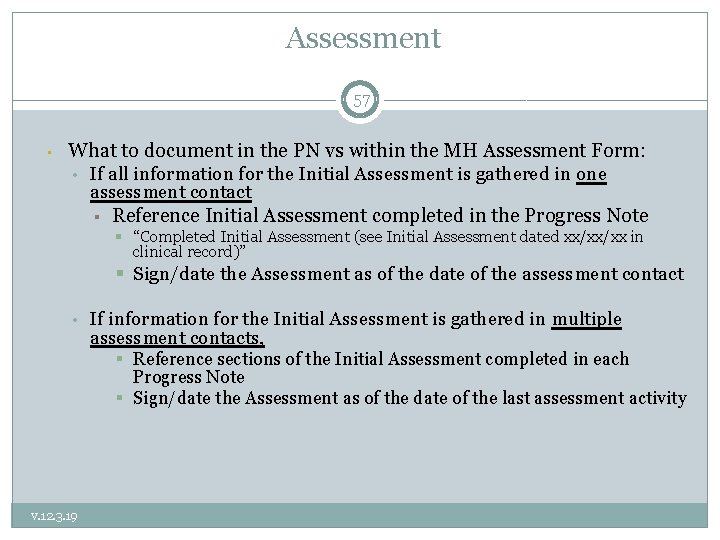
Assessment 57 • What to document in the PN vs within the MH Assessment Form: • If all information for the Initial Assessment is gathered in one assessment contact § Reference Initial Assessment completed in the Progress Note § “Completed Initial Assessment (see Initial Assessment dated xx/xx/xx in clinical record)” § Sign/date the Assessment as of the date of the assessment contact • If information for the Initial Assessment is gathered in multiple assessment contacts, § Reference sections of the Initial Assessment completed in each Progress Note § Sign/date the Assessment as of the date of the last assessment activity v. 12. 3. 19
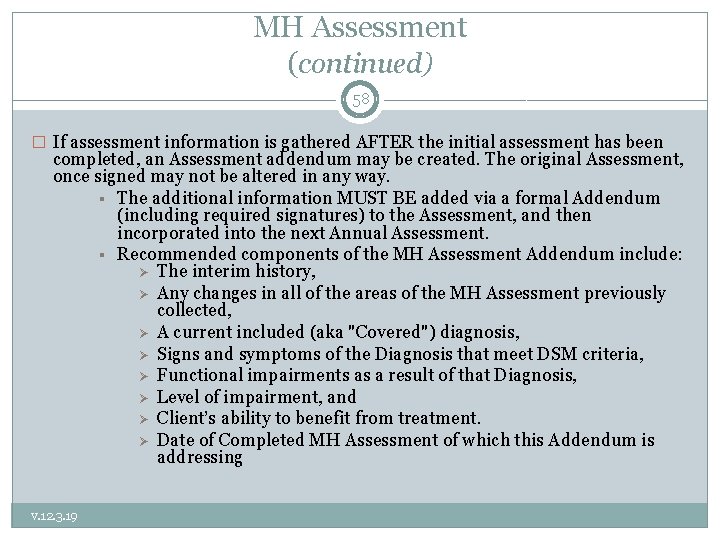
MH Assessment (continued) 58 � If assessment information is gathered AFTER the initial assessment has been completed, an Assessment addendum may be created. The original Assessment, once signed may not be altered in any way. § The additional information MUST BE added via a formal Addendum (including required signatures) to the Assessment, and then incorporated into the next Annual Assessment. § Recommended components of the MH Assessment Addendum include: The interim history, Any changes in all of the areas of the MH Assessment previously collected, A current included (aka "Covered") diagnosis, Signs and symptoms of the Diagnosis that meet DSM criteria, Functional impairments as a result of that Diagnosis, Level of impairment, and Client’s ability to benefit from treatment. Date of Completed MH Assessment of which this Addendum is addressing v. 12. 3. 19
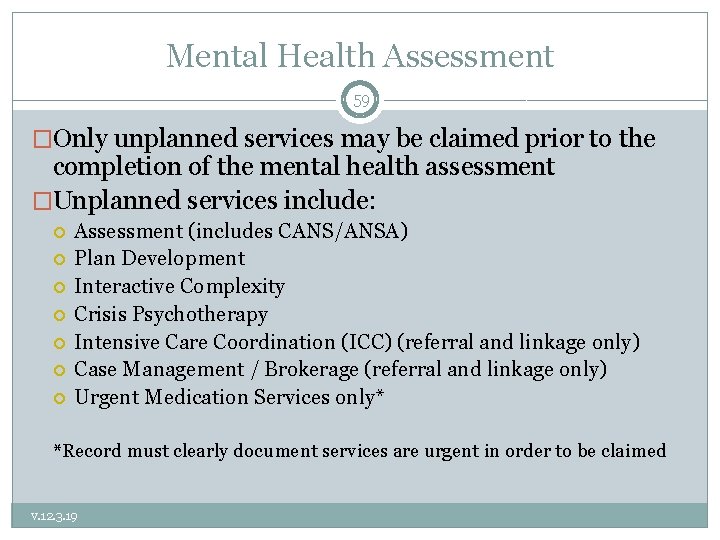
Mental Health Assessment 59 �Only unplanned services may be claimed prior to the completion of the mental health assessment �Unplanned services include: Assessment (includes CANS/ANSA) Plan Development Interactive Complexity Crisis Psychotherapy Intensive Care Coordination (ICC) (referral and linkage only) Case Management / Brokerage (referral and linkage only) Urgent Medication Services only* *Record must clearly document services are urgent in order to be claimed v. 12. 3. 19
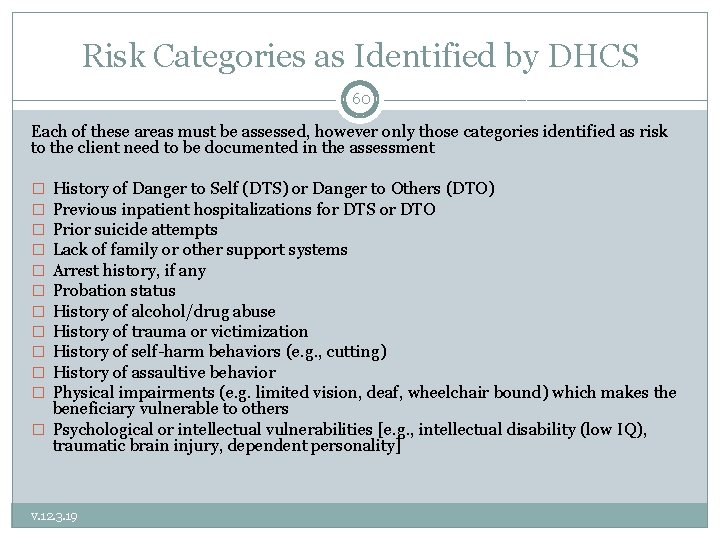
Risk Categories as Identified by DHCS 60 Each of these areas must be assessed, however only those categories identified as risk to the client need to be documented in the assessment History of Danger to Self (DTS) or Danger to Others (DTO) Previous inpatient hospitalizations for DTS or DTO Prior suicide attempts Lack of family or other support systems Arrest history, if any Probation status History of alcohol/drug abuse History of trauma or victimization History of self-harm behaviors (e. g. , cutting) History of assaultive behavior Physical impairments (e. g. limited vision, deaf, wheelchair bound) which makes the beneficiary vulnerable to others � Psychological or intellectual vulnerabilities [e. g. , intellectual disability (low IQ), traumatic brain injury, dependent personality] � � � v. 12. 3. 19
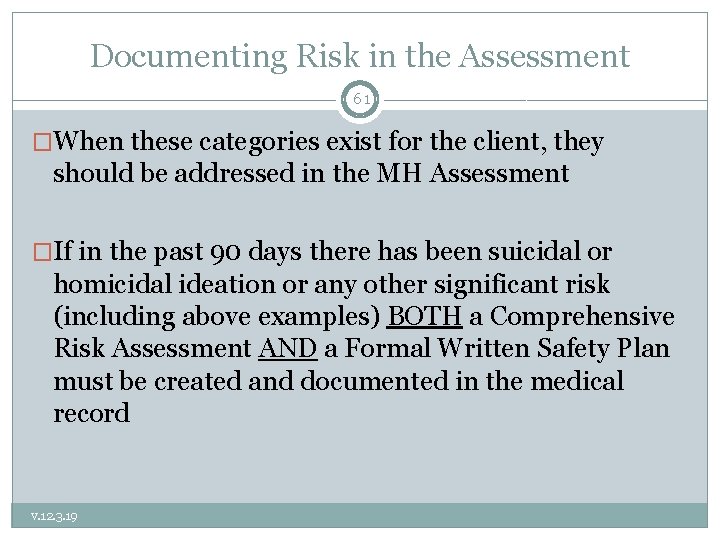
Documenting Risk in the Assessment 61 �When these categories exist for the client, they should be addressed in the MH Assessment �If in the past 90 days there has been suicidal or homicidal ideation or any other significant risk (including above examples) BOTH a Comprehensive Risk Assessment AND a Formal Written Safety Plan must be created and documented in the medical record v. 12. 3. 19
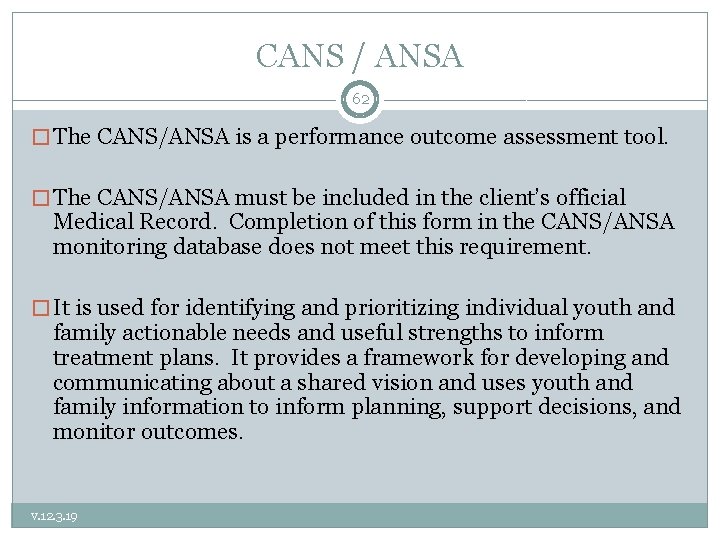
CANS / ANSA 62 � The CANS/ANSA is a performance outcome assessment tool. � The CANS/ANSA must be included in the client’s official Medical Record. Completion of this form in the CANS/ANSA monitoring database does not meet this requirement. � It is used for identifying and prioritizing individual youth and family actionable needs and useful strengths to inform treatment plans. It provides a framework for developing and communicating about a shared vision and uses youth and family information to inform planning, support decisions, and monitor outcomes. v. 12. 3. 19
CANS / ANSA 63 �The current ACBH CANS (96 items) has been modified to come in alignment with the CANS 50 required by the state (areas added but not removed). The changes to the CANS have be made within Objective Arts. �All the CANS/ANSA have been updated to come in alignment with all CANS/ANSA manuals, rating sheets except for the 0 -5 version �The 0 -5 version of the CANS is in the process of getting updated to come in alignment with all CANS/ANSA manuals, rating sheets v. 12. 3. 19
CANS / ANSA 64 �The CANS (0 -5, 6 -17) ANSA (T, 25+) is completed after the MH Assessment and before (informs) the Client Plan. Required timeframes (all based on Episode Opening Date): by 60 days, every 6 months, and at discharge. �For Adults, ANSA Required timeframes (all based on Episode Opening Date): by 60 days, at initial 6 months, at annual authorization and at discharge. �ACBHCS Provider Website/ CANS/ANSA http: //www. acbhcs. org/providers/CANS/cans. htm v. 12. 3. 19
Scope of practice for CANS /ANSA 65 �The CANS and ANSA are Assessment Tools which may only be completed by the following CANS/ANSA certified individuals: Licensed LPHA Waivered or registered LPHA � (if not diagnosing—diagnosis requires Licensed LPHA co-signature). Graduate student/trainee in a recognized MH Master’s or Ph. D program � (if not diagnosing—may only reference Dx established by a Licensed LPHA, unless meets Scope of Practice requirements for diagnosing). v. 12. 3. 19
CANS / ANSA 66 �The only programs which will be exempt from administering the CANS are those providing ancillary services (such as Medication Clinics, Katie A services, and TBS services) where the child has another SMHS provider who is administering the CANS (usually the psychotherapist). �Several Program Types are exempt from administering the ANSA. �Contact ACBH QA department if you have questions about whether your agency/program is exempt from completing the CANS/ANSA. v. 12. 3. 19
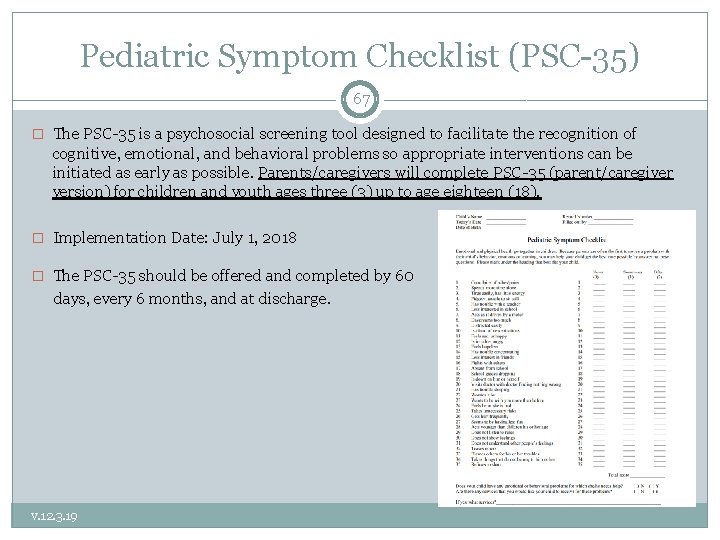
Pediatric Symptom Checklist (PSC-35) 67 � The PSC-35 is a psychosocial screening tool designed to facilitate the recognition of cognitive, emotional, and behavioral problems so appropriate interventions can be initiated as early as possible. Parents/caregivers will complete PSC-35 (parent/caregiver version) for children and youth ages three (3) up to age eighteen (18). � Implementation Date: July 1, 2018 � The PSC-35 should be offered and completed by 60 days, every 6 months, and at discharge. v. 12. 3. 19
PSC-35 68 �The PSC-35 does not require training because it is completed by the parent/caregiver. For more information about the tool, including implementation, scoring and clinical utility, please visit the Pediatric Symptoms Checklist webpage at: http: //www. massgeneral. org/psychiatry/services/ps c_home. aspx v. 12. 3. 19
PSC-35 69 � Once the PSC-35 has been completed by parents/caregivers, the results should be entered into Objective Arts and a copy of the form must be included in the Medical Record. � Time spent inputting the PSC-35 into OA is not a billable activity. � Time spent reviewing the PSC-35 for the first time is a billable assessment activity or as medically necessary. � If client’s caregivers need help completing the PCS-35, time spent reviewing and completing the questions with the client’s caregivers is a billable assessment activity. Indicate in the progress note what barrier prevented the caregivers from completing the PSC-35 on their own and what interventions you did. v. 12. 3. 19
Medical Necessity & Assessment Review 70 What are the only MH services that may be provided before completion of the MH Assessment and Client Plan? MH Assessment (with & w/o medical component, & behavioral eval) Plan Development Crisis Intervention Crisis Stabilization (in CSU only) Case Management and ICC (linkage and referral only) Urgent medication services When must an agency’s chart go to CQRT for Quality Review purposes? Initially and Annually. We recommend that CQRT happen after the Assessment and Plan are completed, but before their due dates. This gives the clinician time to address any concerns identified in the assessment or plan before the CQRT due date. This helps to preserve billings. All Charts must be reviewed before 60 days, and before the annual due date. v. 12. 3. 19
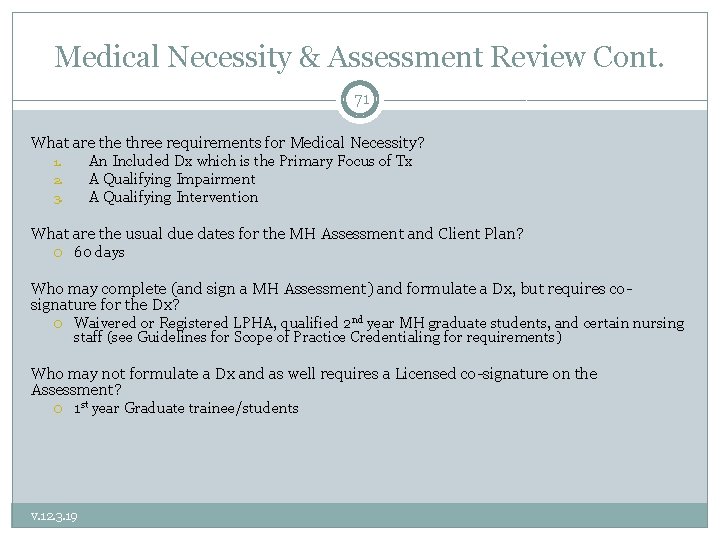
Medical Necessity & Assessment Review Cont. 71 What are three requirements for Medical Necessity? An Included Dx which is the Primary Focus of Tx A Qualifying Impairment A Qualifying Intervention 1. 2. 3. What are the usual due dates for the MH Assessment and Client Plan? 60 days Who may complete (and sign a MH Assessment) and formulate a Dx, but requires cosignature for the Dx? Waivered or Registered LPHA, qualified 2 nd year MH graduate students, and certain nursing staff (see Guidelines for Scope of Practice Credentialing for requirements) Who may not formulate a Dx and as well requires a Licensed co-signature on the Assessment? 1 st year Graduate trainee/students v. 12. 3. 19
Client Plans 72 STEP 2 OF THE GOLDEN THREAD v. 12. 3. 19
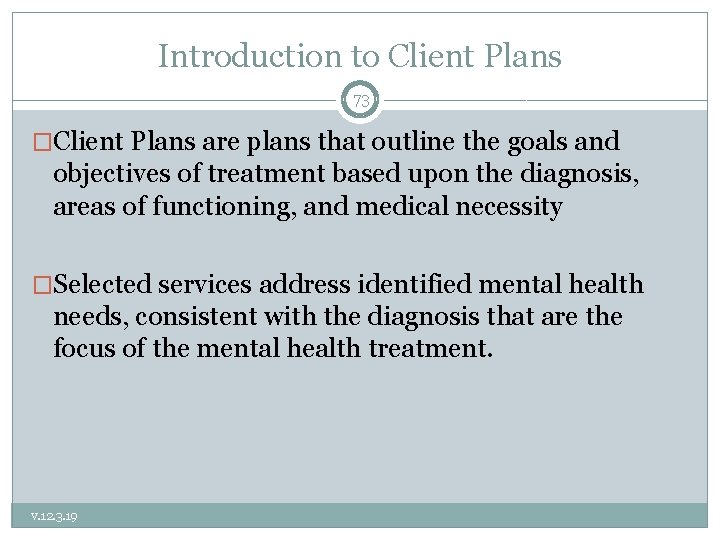
Introduction to Client Plans 73 �Client Plans are plans that outline the goals and objectives of treatment based upon the diagnosis, areas of functioning, and medical necessity �Selected services address identified mental health needs, consistent with the diagnosis that are the focus of the mental health treatment. v. 12. 3. 19
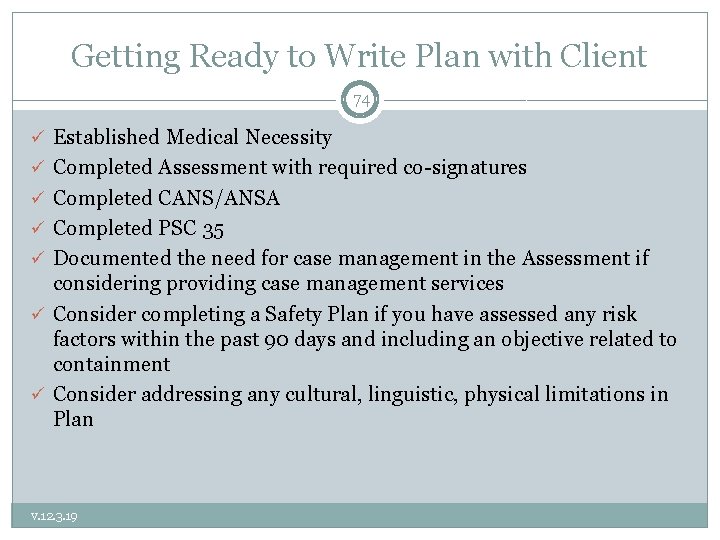
Getting Ready to Write Plan with Client 74 ü Established Medical Necessity ü Completed Assessment with required co-signatures ü Completed CANS/ANSA ü Completed PSC 35 ü Documented the need for case management in the Assessment if considering providing case management services ü Consider completing a Safety Plan if you have assessed any risk factors within the past 90 days and including an objective related to containment ü Consider addressing any cultural, linguistic, physical limitations in Plan v. 12. 3. 19
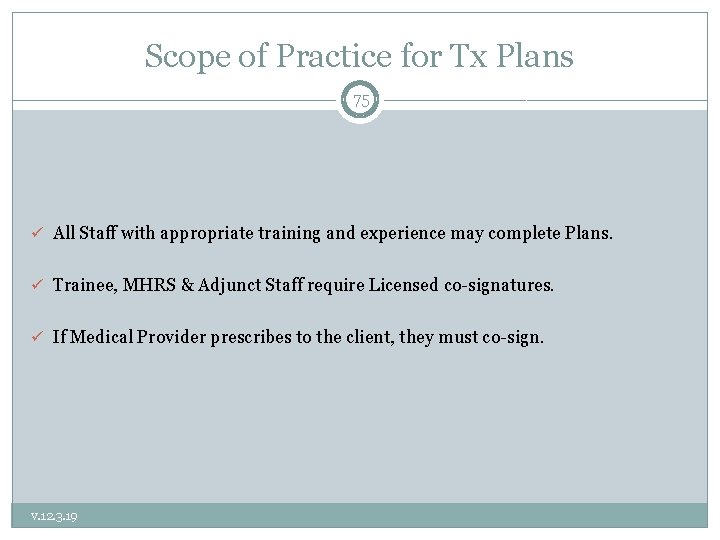
Scope of Practice for Tx Plans 75 ü All Staff with appropriate training and experience may complete Plans. ü Trainee, MHRS & Adjunct Staff require Licensed co-signatures. ü If Medical Provider prescribes to the client, they must co-sign. v. 12. 3. 19
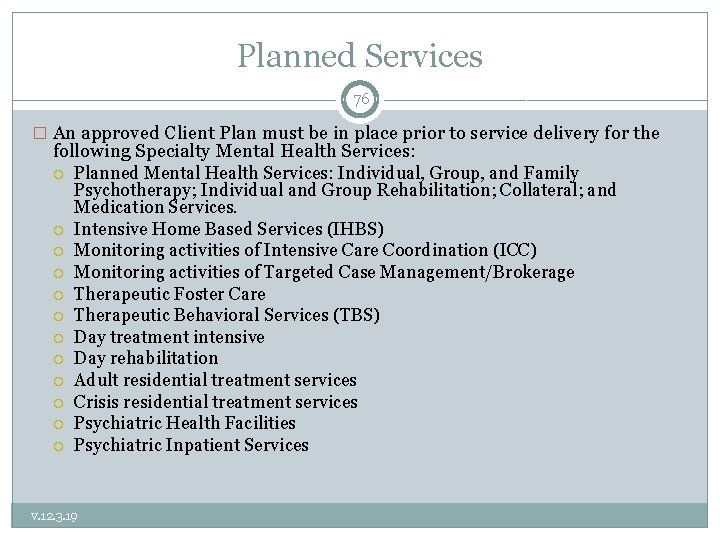
Planned Services 76 � An approved Client Plan must be in place prior to service delivery for the following Specialty Mental Health Services: Planned Mental Health Services: Individual, Group, and Family Psychotherapy; Individual and Group Rehabilitation; Collateral; and Medication Services. Intensive Home Based Services (IHBS) Monitoring activities of Intensive Care Coordination (ICC) Monitoring activities of Targeted Case Management/Brokerage Therapeutic Foster Care Therapeutic Behavioral Services (TBS) Day treatment intensive Day rehabilitation Adult residential treatment services Crisis residential treatment services Psychiatric Health Facilities Psychiatric Inpatient Services v. 12. 3. 19
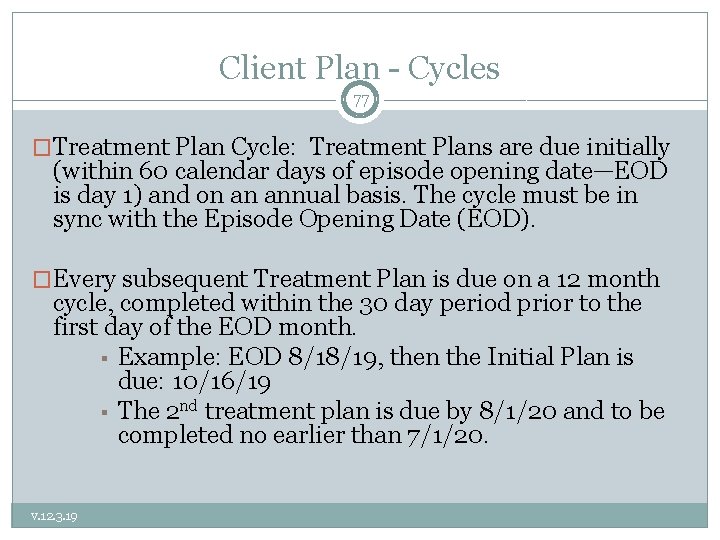
Client Plan - Cycles 77 �Treatment Plan Cycle: Treatment Plans are due initially (within 60 calendar days of episode opening date—EOD is day 1) and on an annual basis. The cycle must be in sync with the Episode Opening Date (EOD). �Every subsequent Treatment Plan is due on a 12 month cycle, completed within the 30 day period prior to the first day of the EOD month. § Example: EOD 8/18/19, then the Initial Plan is due: 10/16/19 § The 2 nd treatment plan is due by 8/1/20 and to be completed no earlier than 7/1/20. v. 12. 3. 19
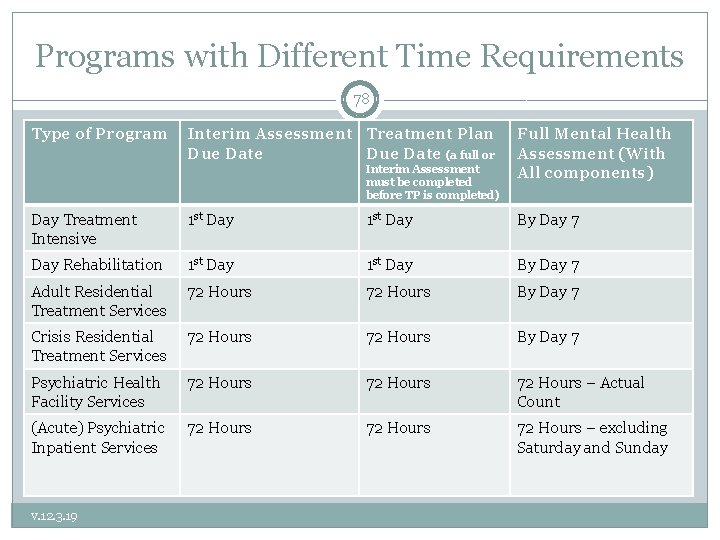
Programs with Different Time Requirements 78 Type of Program Interim Assessment Treatment Plan Due Date (a full or Interim Assessment must be completed before TP is completed) Full Mental Health Assessment (With All components) Day Treatment Intensive 1 st Day By Day 7 Day Rehabilitation 1 st Day By Day 7 Adult Residential Treatment Services 72 Hours By Day 7 Crisis Residential Treatment Services 72 Hours By Day 7 Psychiatric Health Facility Services 72 Hours – Actual Count (Acute) Psychiatric Inpatient Services 72 Hours – excluding Saturday and Sunday v. 12. 3. 19
Interim Assessments to Allow Earlier Development of Treatment Plans 79 � If staff/programs do not have enough time to complete full Mental Health Assessments (with all required elements) before completing a treatment plan, an Interim Assessment can be completed. � An Interim Assessment must include the essential medical necessity components: A current included (“covered”) diagnosis Signs and symptoms of the Diagnosis that meet DSM criteria Functional impairments as a result of that diagnosis Level of impairment Client’s ability to benefit from treatment � An Interim Assessment does not meet Medi-Cal requirements for a full completed assessment. A Full assessment with all required elements must be completed by the due date. v. 12. 3. 19
Interim Assessments and Treatment Plans 80 �Programs that determine it is clinically indicated to provide certain planned services before they are able to complete a full assessment (Example: Want to get client into a group therapy session within the first week), may complete both an interim assessment and treatment plan to allow for those planned services. Any treatment plan must always have the required Medi-Cal documentation components. Any treatment plan that is informed/created by an Interim Assessment will usually need to be rewritten after the full assessment is complete. v. 12. 3. 19
Client Plan - Goals 81 � The Client Goals are the long-term hopes of the consumer and/or caregiver/parent. Goals should focus on their personal vision of recovery, wellness, and the life they envision for themselves. � You may include optional Long Term Mental Health Goals which support the Client Life Goals by linking them to the specific MH Objectives. � Invaluable for client engagement and buy-in to services. � Providers assist the client in developing the short term Mental Health objectives to his/her long term goal which are targets of interventions. v. 12. 3. 19
Impairments/ Area of Challenges 82 Impairments of Functioning in Daily Life � Indicate Area of Challenges: Community Life, Family Life, Safety School/Education, Vocational, Independent Living (ADL’s), Health, Housing, Legal, SUD, Food/Clothing/Shelter, etc. � Indicate Level of Challenges Moderate or Severe (remember to rate accordingly if documenting to a Significant Impairment in an Important Area of Life Functioning for Medical Necessity). � Describe Specific Functional Impairments related to MH Diagnosis’s Signs & Symptoms. For Case Mgt, must indicate need for C/M service, i. e. ct. is homeless. Also, must indicate (1) which severe Symptoms/Impairments resulting from MH Diagnosis that prevent client from accessing/maintaining needed services, or (2) for child that the lack of such services (caretaker not providing) exacerbates child’s MH symptoms/impairments. v. 12. 3. 19
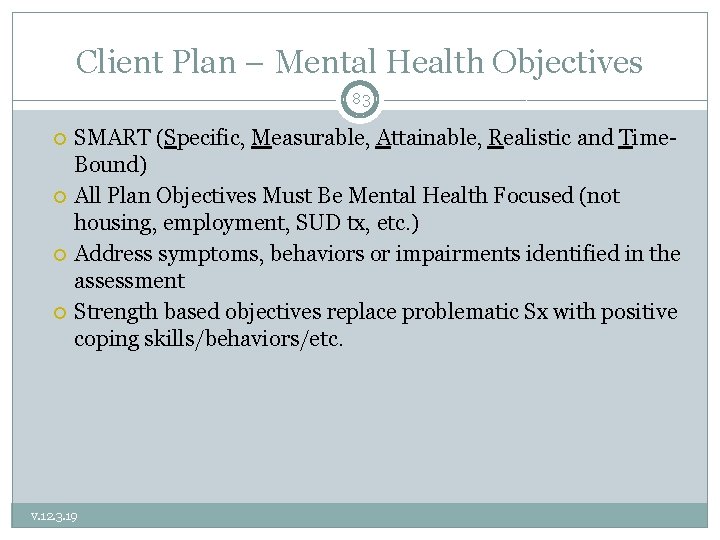
Client Plan – Mental Health Objectives 83 SMART (Specific, Measurable, Attainable, Realistic and Time. Bound) All Plan Objectives Must Be Mental Health Focused (not housing, employment, SUD tx, etc. ) Address symptoms, behaviors or impairments identified in the assessment Strength based objectives replace problematic Sx with positive coping skills/behaviors/etc. v. 12. 3. 19
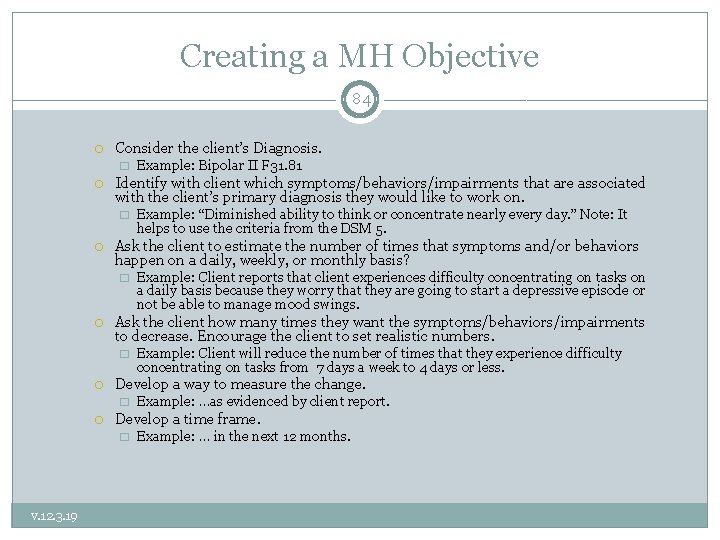
Creating a MH Objective 84 Consider the client’s Diagnosis. � Identify with client which symptoms/behaviors/impairments that are associated with the client’s primary diagnosis they would like to work on. � Example: …as evidenced by client report. Develop a time frame. � v. 12. 3. 19 Example: Client will reduce the number of times that they experience difficulty concentrating on tasks from 7 days a week to 4 days or less. Develop a way to measure the change. � Example: Client reports that client experiences difficulty concentrating on tasks on a daily basis because they worry that they are going to start a depressive episode or not be able to manage mood swings. Ask the client how many times they want the symptoms/behaviors/impairments to decrease. Encourage the client to set realistic numbers. � Example: “Diminished ability to think or concentrate nearly every day. ” Note: It helps to use the criteria from the DSM 5. Ask the client to estimate the number of times that symptoms and/or behaviors happen on a daily, weekly, or monthly basis? � Example: Bipolar II F 31. 81 Example: … in the next 12 months.
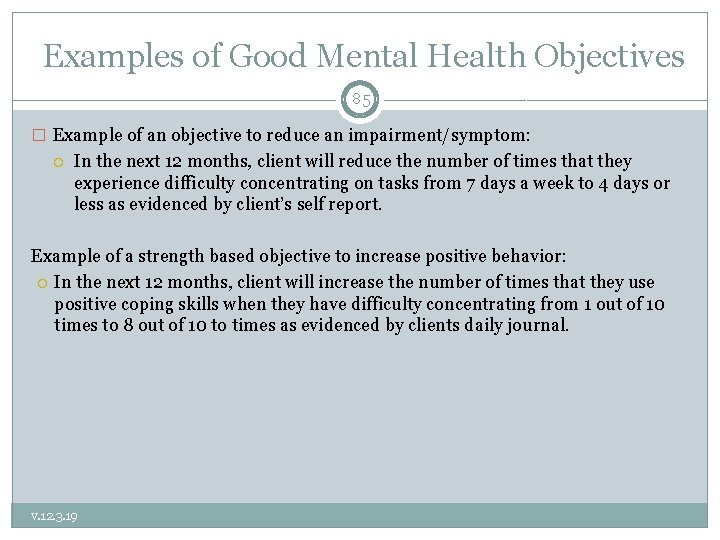
Examples of Good Mental Health Objectives 85 � Example of an objective to reduce an impairment/symptom: In the next 12 months, client will reduce the number of times that they experience difficulty concentrating on tasks from 7 days a week to 4 days or less as evidenced by client’s self report. Example of a strength based objective to increase positive behavior: In the next 12 months, client will increase the number of times that they use positive coping skills when they have difficulty concentrating from 1 out of 10 times to 8 out of 10 to times as evidenced by clients daily journal. v. 12. 3. 19
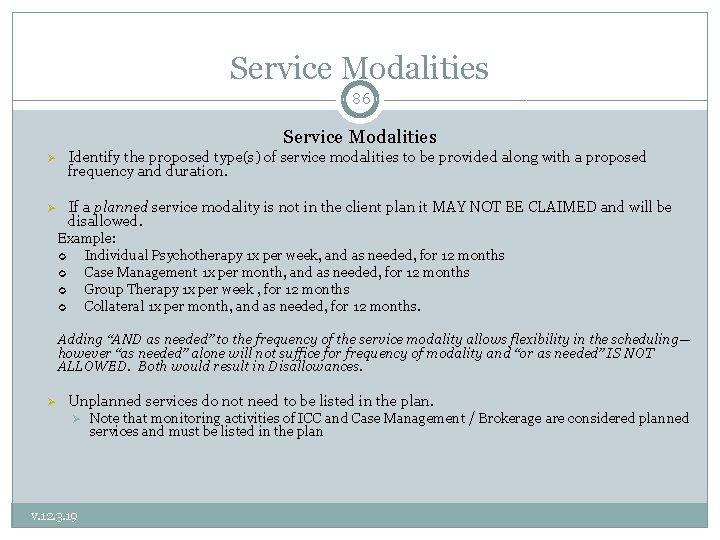
Service Modalities 86 Service Modalities Identify the proposed type(s) of service modalities to be provided along with a proposed frequency and duration. If a planned service modality is not in the client plan it MAY NOT BE CLAIMED and will be disallowed. Example: Individual Psychotherapy 1 x per week, and as needed, for 12 months Case Management 1 x per month, and as needed, for 12 months Group Therapy 1 x per week , for 12 months Collateral 1 x per month, and as needed, for 12 months. Adding “AND as needed” to the frequency of the service modality allows flexibility in the scheduling— however “as needed” alone will not suffice for frequency of modality and “or as needed” IS NOT ALLOWED. Both would result in Disallowances. Unplanned services do not need to be listed in the plan. v. 12. 3. 19 Note that monitoring activities of ICC and Case Management / Brokerage are considered planned services and must be listed in the plan
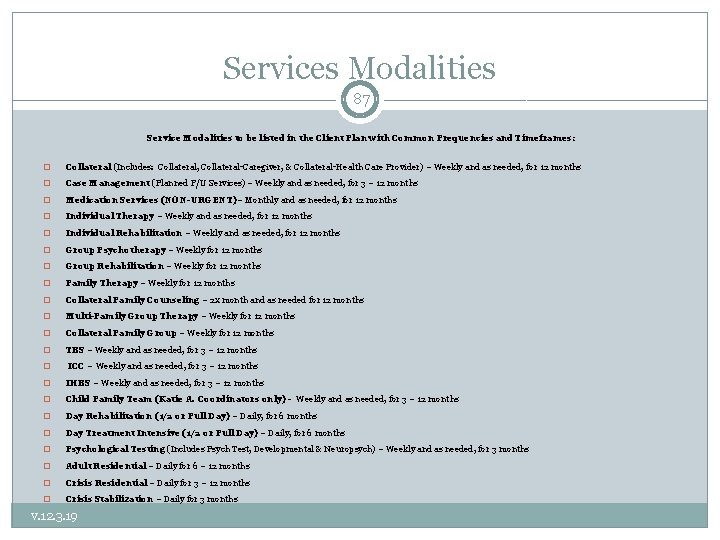
Services Modalities 87 Service Modalities to be listed in the Client Plan with Common Frequencies and Timeframes: � Collateral (Includes: Collateral, Collateral-Caregiver, & Collateral-Health Care Provider) – Weekly and as needed, for 12 months � Case Management (Planned F/U Services) – Weekly and as needed, for 3 – 12 months � Medication Services (NON-URGENT)– Monthly and as needed, for 12 months � Individual Therapy – Weekly and as needed, for 12 months � Individual Rehabilitation – Weekly and as needed, for 12 months � Group Psychotherapy – Weekly for 12 months � Group Rehabilitation – Weekly for 12 months � Family Therapy – Weekly for 12 months � Collateral Family Counseling – 2 x month and as needed for 12 months � Multi-Family Group Therapy – Weekly for 12 months � Collateral Family Group – Weekly for 12 months � TBS – Weekly and as needed, for 3 – 12 months � ICC – Weekly and as needed, for 3 – 12 months � IHBS – Weekly and as needed, for 3 – 12 months � Child Family Team (Katie A. Coordinators only) - Weekly and as needed, for 3 – 12 months � Day Rehabilitation (1/2 or Full Day) – Daily, for 6 months � Day Treatment Intensive (1/2 or Full Day) – Daily, for 6 months � Psychological Testing (Includes Psych Test, Developmental & Neuropsych) – Weekly and as needed, for 3 months � Adult Residential – Daily for 6 – 12 months � Crisis Residential – Daily for 3 – 12 months � Crisis Stabilization – Daily for 3 months v. 12. 3. 19
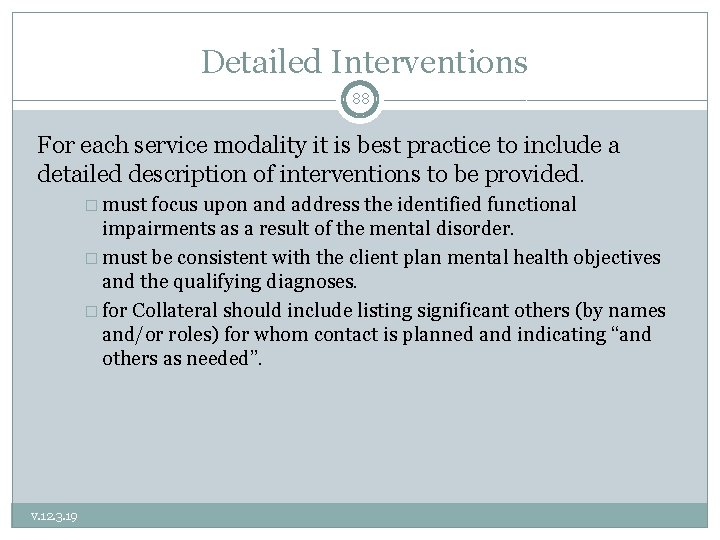
Detailed Interventions 88 For each service modality it is best practice to include a detailed description of interventions to be provided. � must focus upon and address the identified functional impairments as a result of the mental disorder. � must be consistent with the client plan mental health objectives and the qualifying diagnoses. � for Collateral should include listing significant others (by names and/or roles) for whom contact is planned and indicating “and others as needed”. v. 12. 3. 19
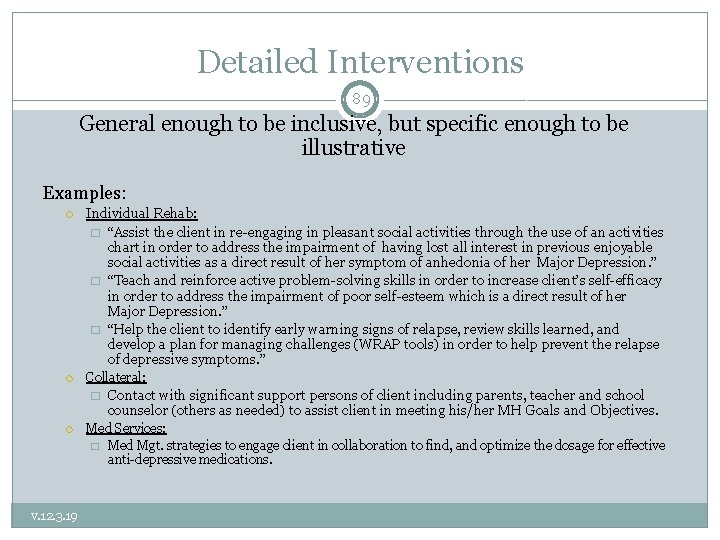
Detailed Interventions 89 General enough to be inclusive, but specific enough to be illustrative Examples: Individual Rehab: � “Assist the client in re-engaging in pleasant social activities through the use of an activities chart in order to address the impairment of having lost all interest in previous enjoyable social activities as a direct result of her symptom of anhedonia of her Major Depression. ” � “Teach and reinforce active problem-solving skills in order to increase client’s self-efficacy in order to address the impairment of poor self-esteem which is a direct result of her Major Depression. ” � “Help the client to identify early warning signs of relapse, review skills learned, and develop a plan for managing challenges (WRAP tools) in order to help prevent the relapse of depressive symptoms. ” Collateral: � v. 12. 3. 19 Contact with significant support persons of client including parents, teacher and school counselor (others as needed) to assist client in meeting his/her MH Goals and Objectives. Med Services: � Med Mgt. strategies to engage client in collaboration to find, and optimize the dosage for effective anti-depressive medications.
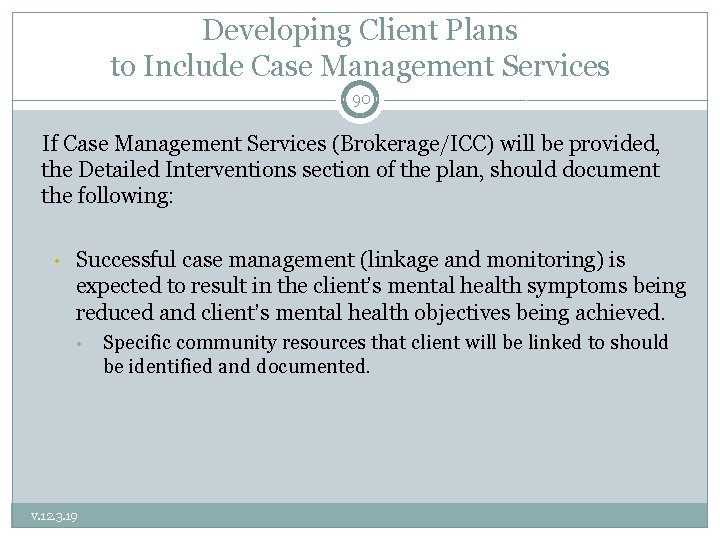
Developing Client Plans to Include Case Management Services 90 If Case Management Services (Brokerage/ICC) will be provided, the Detailed Interventions section of the plan, should document the following: • Successful case management (linkage and monitoring) is expected to result in the client’s mental health symptoms being reduced and client’s mental health objectives being achieved. • v. 12. 3. 19 Specific community resources that client will be linked to should be identified and documented.
Treatment Plan Required Signatures 91 � Treatment Plans must be finalized (unable to be further edited) and signed by all required clinical staff (including supervisor) before it is effective. � All Treatment Plans must also be signed by the client and/or guardian. Clinical judgment should be used to determine if it is appropriate to review treatment plans with young children. If appropriate obtain a client’s signature. If not appropriate obtain a client’s guardian’s signature. v. 12. 3. 19
Treatment Plan Required Signatures 92 � If the client does not sign or refuses to sign the Client Plan, regular efforts must be attempted to obtain the client’s approval. Note the issue on the client signature line in the Client Plan with a reference to a Progress Note. Then elaborate in the Progress Note the rationale or reason why a signature was not obtained, and when the next attempt will occur. � If the client’s mental health symptoms (such as paranoia caused by schizophrenia) prevent client from reviewing and signing the treatment plan and it is determined that ongoing attempts are not clinically appropriate, this must be documented in a progress note and the unsigned treatment plan should reference this note. � If a client does not sign a treatment plan due to unavailability (such as client no-showing to an appointment) future attempts must be made to obtain the client’s signature. Unavailability (without other mental health mitigating factors) is not a reason to stop attempts at obtaining signatures on treatment plans. v. 12. 3. 19
Required Signature Dates on Treatment Plans 93 �All required staff signatures on Treatment plans require dates of signatures. Treatment plans are considered effective once a form is finalized (and can not be altered) and the required staff signatures are present on the document. �Client signatures do not require a date to indicate when it was signed. It is best practice to have clients date their signature If a client does not date their signature, a provider may add the date and include their initials. v. 12. 3. 19
Exceptions to Signature Requirements 94 �A beneficiary’s signature on the treatment plan is not required when: The client is not expected to be in long term treatment (beyond 60 days) Is only receiving one Specialty Mental Health Service (modality) � Currently, the only ACBHCS programs claiming one modality are Medication Services and TBS � Remember that Collateral is considered a modality Note that even if one these exceptions is met, it is highly recommended that the client sign their plan. v. 12. 3. 19
Participation in Creation of Treatment Plan 95 �The clinical record must document the client’s participation in the development of the plan, agreement with the client’s plan, and that the client was offered a copy of their plan. The client’s signature on the plan alone DOES NOT meet these requirements �This information may be documented in progress notes and/or in the body of the treatment plan itself. v. 12. 3. 19
Updating Client Plans 96 �Providers MUST be attentive to the need to update changes in the treatment plan through-out the year. DHCS (and QA) will disallow notes if the treatment plan has not been updated to reflect new client goals, mental health objectives, and events in the client’s life. �Examples of events requiring a change to the Treatment Plan include, but are not limited to: hospitalization, new thoughts or behaviors of self -harm or dangerousness to others, additions of new service modalities (i. e. medication services, case management, group rehab, individual therapy, etc. ) v. 12. 3. 19
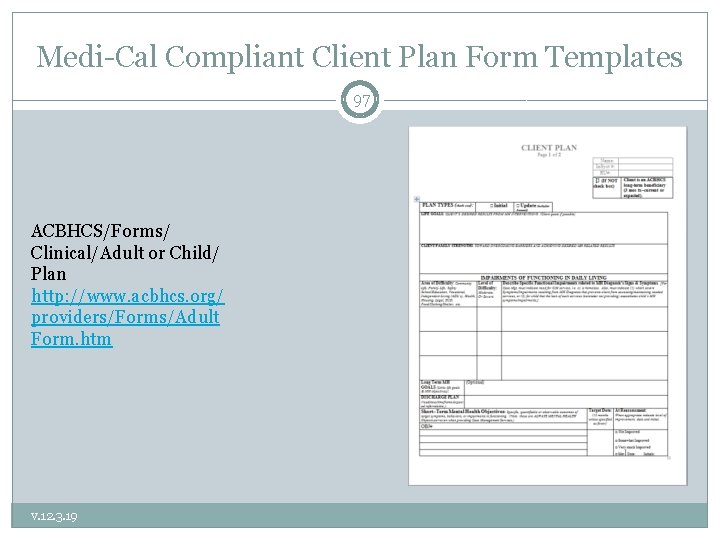
Medi-Cal Compliant Client Plan Form Templates 97 ACBHCS/Forms/ Clinical/Adult or Child/ Plan http: //www. acbhcs. org/ providers/Forms/Adult Form. htm v. 12. 3. 19
MH Plan Example #1: cont. 98 Non-billable example: �Mental Health Objective: Client will obtain stable housing within 6 months; temporarily living with a friend. [Not a MH Objective] �Service Modality: Case management 1 x/week and as needed for 1 year �Detailed Interventions: Case management - Case manager will work with client to apply for housing and assist client in filling out necessary forms. [Case mgt is not acting as a housing support specialist—but is linking to and monitoring client’s participation in such services. ] v. 12. 3. 19
Sharing Assessments and Treatment Plans 99 �Agencies with multiple RUs that share a medical record are allowed to share one mental health assessment and treatment plan for concurrent services. Example: If a client is receiving therapy services in one RU, and begins to receive medication services in a different RU, both RUs/providers may share the Assessment and Treatment Plan. Open each RU with the date the client was first opened at the agency �Any documentation that is in need of updating must be addressed within the agency For example, informed consent must be completed when new modalities are added to the plan Multiple RUs within an agency may decide to share a plan or create separate plans. Adding an additional modality will always require an update to the treatment plan. v. 12. 3. 19
Sharing Assessments and Treatment Plans 100 �If multiple RUs (in one agency) do not share a chart, all shared documentation must be copied into each chart. This includes documents from the initial Episode Opening Date Such as: Screening Form (with associated progress notes. ) Informing Materials (with associate progress notes. ) Mental Health Assessments (with associate progress notes. ) CANS/ANSA (with associate progress notes. ) Client Treatment Plan (with associate progress notes. ) Release of Information (with associate progress notes. ) �For BHCS county owned and operated programs, “one agency” is considered one program which has a unique folder in the Laserfiche database. v. 12. 3. 19
Sharing Assessments and Treatment Plans 101 For Initial Assessments Only If a full assessment has been completed for a client it is possible for providers to use this assessment and update it under the following circumstances: �Full Assessment Completed within the same agency in last 12 months. �Full Assessment Completed by another agency in the last 6 months. v. 12. 3. 19
Sharing Assessments and Treatment Plans 102 �To use a previously completed Assessment, the following should occur: A Copy of the Assessment should be placed into the chart The Assessment should be reviewed with the client to assure accuracy An Assessment Addendum must be completed that includes: � Interim History � Any changes in all of the areas of the MH Assessment Previously collected � A current included diagnosis � Signs and symptoms of the Diagnosis that meet DSM criteria � Functional impairments as a result of the diagnosis � Level of impairment � Client’s ability to benefit from treatment. v. 12. 3. 19
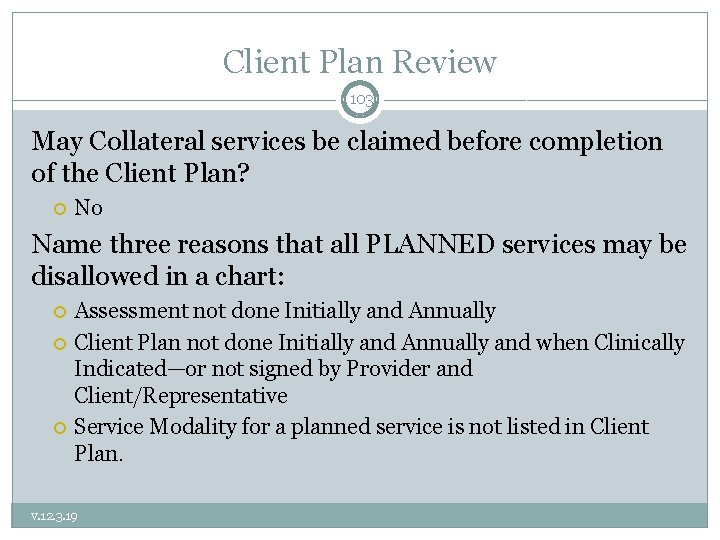
Client Plan Review 103 May Collateral services be claimed before completion of the Client Plan? No Name three reasons that all PLANNED services may be disallowed in a chart: Assessment not done Initially and Annually Client Plan not done Initially and Annually and when Clinically Indicated—or not signed by Provider and Client/Representative Service Modality for a planned service is not listed in Client Plan. v. 12. 3. 19
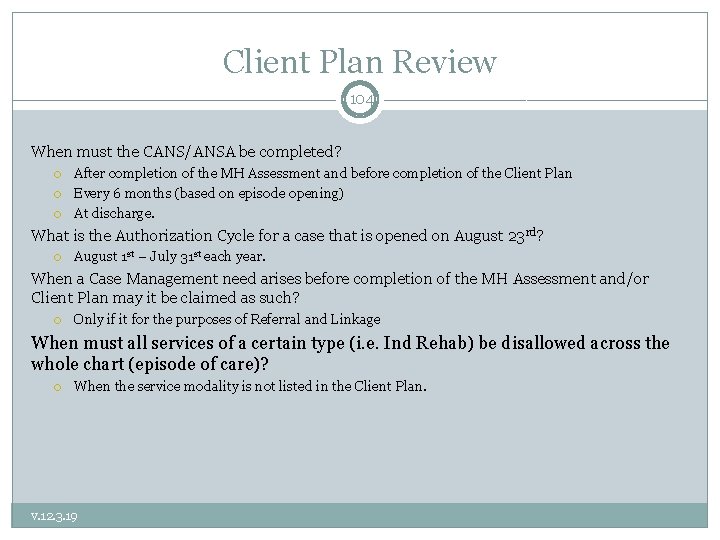
Client Plan Review 104 When must the CANS/ANSA be completed? After completion of the MH Assessment and before completion of the Client Plan Every 6 months (based on episode opening) At discharge. What is the Authorization Cycle for a case that is opened on August 23 rd? August 1 st – July 31 st each year. When a Case Management need arises before completion of the MH Assessment and/or Client Plan may it be claimed as such? Only if it for the purposes of Referral and Linkage When must all services of a certain type (i. e. Ind Rehab) be disallowed across the whole chart (episode of care)? When the service modality is not listed in the Client Plan. v. 12. 3. 19
Progress Notes 105 STEP 3 OF THE GOLDEN THREAD v. 12. 3. 19
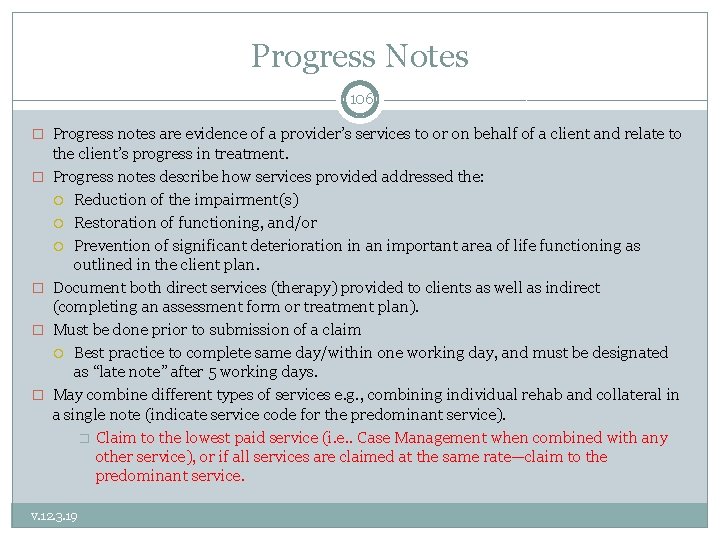
Progress Notes 106 � Progress notes are evidence of a provider’s services to or on behalf of a client and relate to � � the client’s progress in treatment. Progress notes describe how services provided addressed the: Reduction of the impairment(s) Restoration of functioning, and/or Prevention of significant deterioration in an important area of life functioning as outlined in the client plan. Document both direct services (therapy) provided to clients as well as indirect (completing an assessment form or treatment plan). Must be done prior to submission of a claim Best practice to complete same day/within one working day, and must be designated as “late note” after 5 working days. May combine different types of services e. g. , combining individual rehab and collateral in a single note (indicate service code for the predominant service). � Claim to the lowest paid service (i. e. . Case Management when combined with any other service), or if all services are claimed at the same rate—claim to the predominant service. v. 12. 3. 19
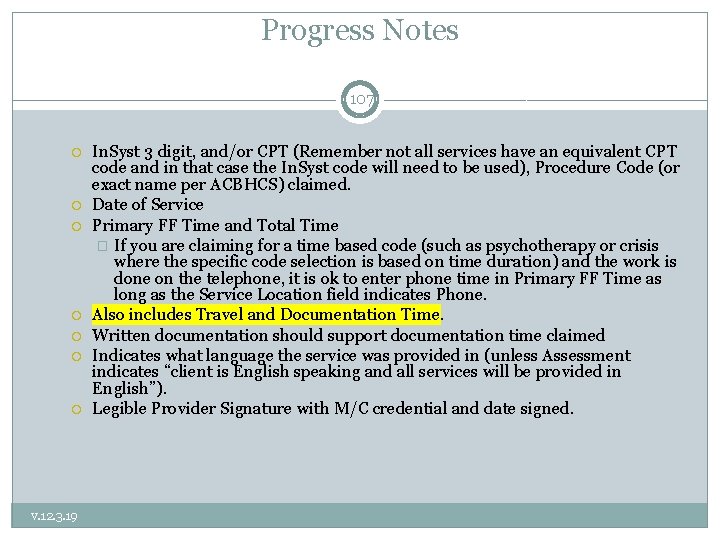
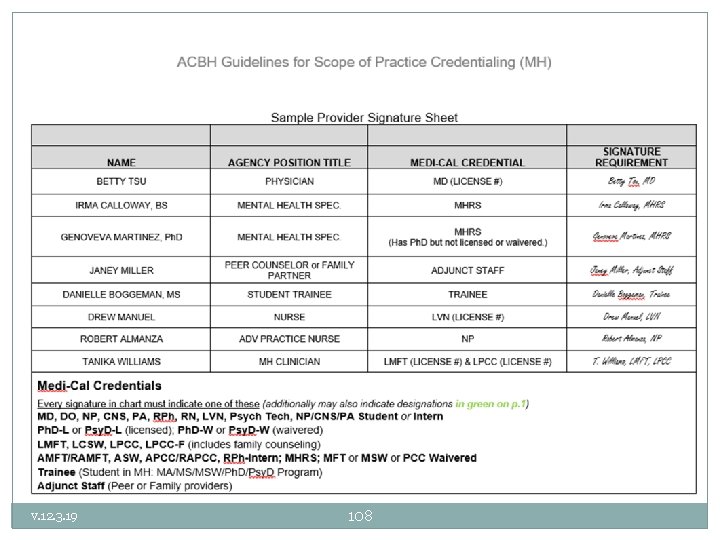
Progress Notes 107 v. 12. 3. 19 In. Syst 3 digit, and/or CPT (Remember not all services have an equivalent CPT code and in that case the In. Syst code will need to be used), Procedure Code (or exact name per ACBHCS) claimed. Date of Service Primary FF Time and Total Time � If you are claiming for a time based code (such as psychotherapy or crisis where the specific code selection is based on time duration) and the work is done on the telephone, it is ok to enter phone time in Primary FF Time as long as the Service Location field indicates Phone. Also includes Travel and Documentation Time. Written documentation should support documentation time claimed Indicates what language the service was provided in (unless Assessment indicates “client is English speaking and all services will be provided in English”). Legible Provider Signature with M/C credential and date signed.
v. 12. 3. 19 108
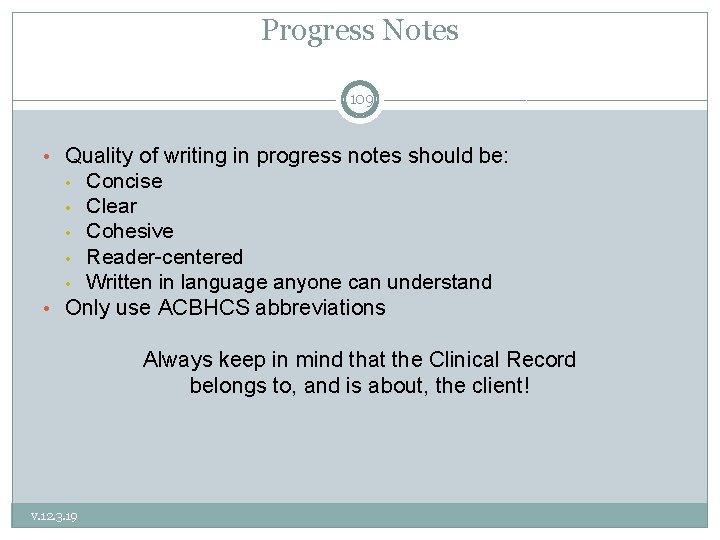
Progress Notes 109 • Quality of writing in progress notes should be: Concise • Clear • Cohesive • Reader-centered • Written in language anyone can understand • Only use ACBHCS abbreviations • Always keep in mind that the Clinical Record belongs to, and is about, the client! v. 12. 3. 19
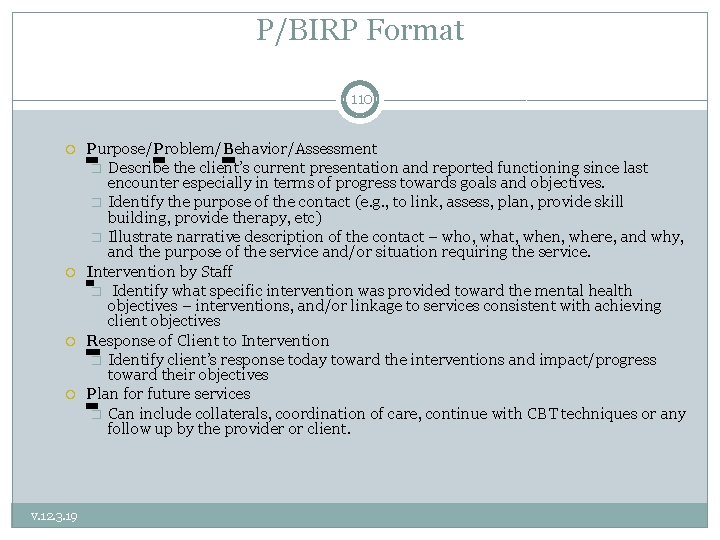
P/BIRP Format 110 v. 12. 3. 19 Purpose/Problem/Behavior/Assessment � Describe the client’s current presentation and reported functioning since last encounter especially in terms of progress towards goals and objectives. � Identify the purpose of the contact (e. g. , to link, assess, plan, provide skill building, provide therapy, etc) � Illustrate narrative description of the contact – who, what, when, where, and why, and the purpose of the service and/or situation requiring the service. Intervention by Staff � Identify what specific intervention was provided toward the mental health objectives – interventions, and/or linkage to services consistent with achieving client objectives Response of Client to Intervention � Identify client’s response today toward the interventions and impact/progress toward their objectives Plan for future services � Can include collaterals, coordination of care, continue with CBT techniques or any follow up by the provider or client.
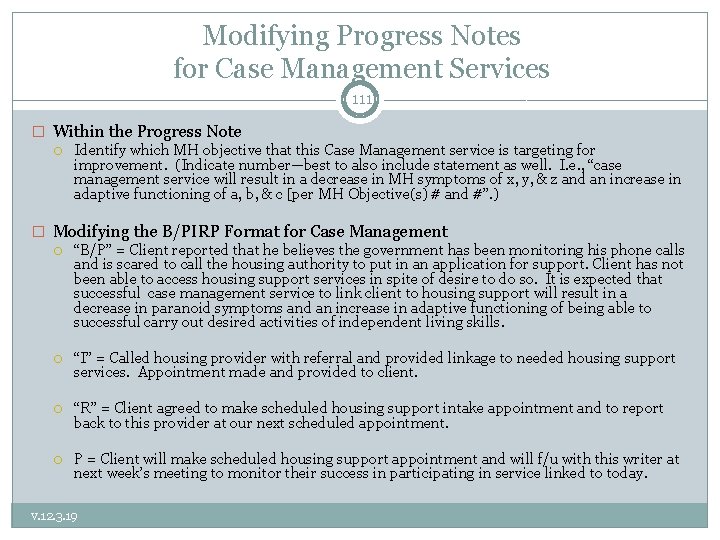
Modifying Progress Notes for Case Management Services 111 � Within the Progress Note Identify which MH objective that this Case Management service is targeting for improvement. (Indicate number—best to also include statement as well. I. e. , “case management service will result in a decrease in MH symptoms of x, y, & z and an increase in adaptive functioning of a, b, & c [per MH Objective(s) # and #”. ) � Modifying the B/PIRP Format for Case Management “B/P” = Client reported that he believes the government has been monitoring his phone calls and is scared to call the housing authority to put in an application for support. Client has not been able to access housing support services in spite of desire to do so. It is expected that successful case management service to link client to housing support will result in a decrease in paranoid symptoms and an increase in adaptive functioning of being able to successful carry out desired activities of independent living skills. “I” = Called housing provider with referral and provided linkage to needed housing support services. Appointment made and provided to client. “R” = Client agreed to make scheduled housing support intake appointment and to report back to this provider at our next scheduled appointment. P = Client will make scheduled housing support appointment and will f/u with this writer at next week’s meeting to monitor their success in participating in service linked to today. v. 12. 3. 19
A word about cloning 112 No, not this kind of cloning v. 12. 3. 19
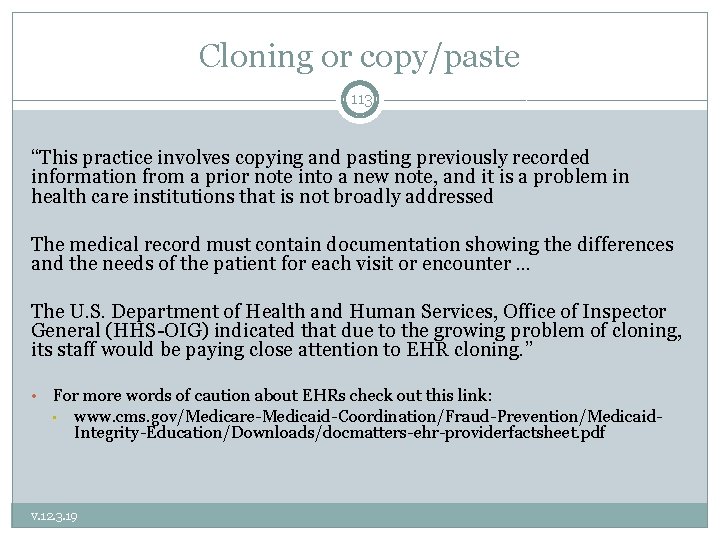
Cloning or copy/paste 113 “This practice involves copying and pasting previously recorded information from a prior note into a new note, and it is a problem in health care institutions that is not broadly addressed The medical record must contain documentation showing the differences and the needs of the patient for each visit or encounter … The U. S. Department of Health and Human Services, Office of Inspector General (HHS-OIG) indicated that due to the growing problem of cloning, its staff would be paying close attention to EHR cloning. ” • For more words of caution about EHRs check out this link: • www. cms. gov/Medicare-Medicaid-Coordination/Fraud-Prevention/Medicaid. Integrity-Education/Downloads/docmatters-ehr-providerfactsheet. pdf v. 12. 3. 19
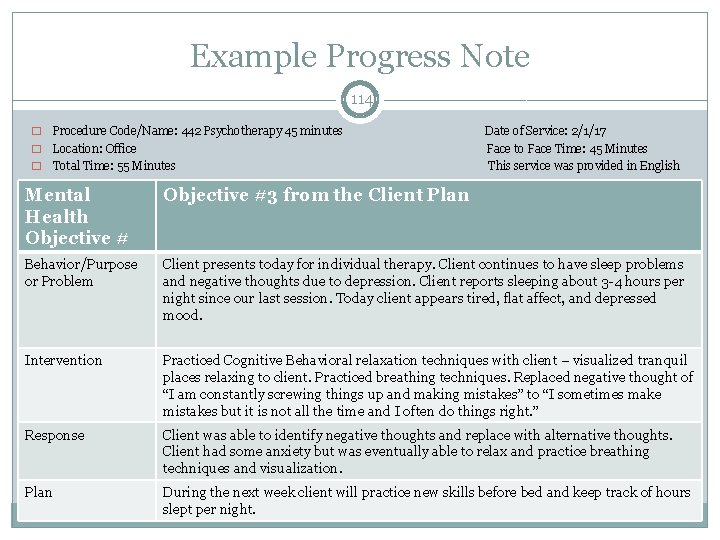
Example Progress Note 114 Procedure Code/Name: 442 Psychotherapy 45 minutes Date of Service: 2/1/17 � Location: Office Face to Face Time: 45 Minutes � Total Time: 55 Minutes This service was provided in English � Mental Health Objective #3 from the Client Plan Behavior/Purpose or Problem Client presents today for individual therapy. Client continues to have sleep problems and negative thoughts due to depression. Client reports sleeping about 3 -4 hours per night since our last session. Today client appears tired, flat affect, and depressed mood. Intervention Practiced Cognitive Behavioral relaxation techniques with client – visualized tranquil places relaxing to client. Practiced breathing techniques. Replaced negative thought of “I am constantly screwing things up and making mistakes” to “I sometimes make mistakes but it is not all the time and I often do things right. ” Response Client was able to identify negative thoughts and replace with alternative thoughts. Client had some anxiety but was eventually able to relax and practice breathing techniques and visualization. Plan During the next week client will practice new skills before bed and keep track of hours slept per night. v. 12. 3. 19
Challenges/Barriers • • • • Not enough time/productivity pressures Crisis situations add more paperwork Technology challenges – slow internet connection, old computers Exhausted, overwhelmed, tired after seeing clients Remembering all the rules of Medi-Cal documentation Case load deadlines– tracking treatment plans, annuals due Lack of training in clinical writing Not a fun part of the job – didn’t become a clinician to do paperwork Can’t bill for a lot of what we actually do or want to do for our clients Writing 1 note can take a long time due to feedback/style/corrections Secondary trauma – writing notes can be triggering Hard to balance “client friendly” vs “professional, clinical” writing Not being in the office because of traveling to meet with clients v. 12. 3. 19 115
Overcoming Barriers/Challenges • • • v. 12. 3. 19 Time management (setting up schedules, reminders, personal “tickler” system) Training, Practice - Reinforcing the right way! Reframing the purpose of documentation – seeing client’s record as part of client care and collaboration, how our agencies get paid, how we get paid means we can continue to provide services Tips and Advice from co-workers Using “tip sheets” (like slides or checklist) Supervision for support 116
Progress Note Review Questions 117 � What are the five components of a Progress Note? Linked to a specific MH Objective (state or indicate #). Today’s Problem/Behavior/Assessment/Evaluation Today’s Staff Intervention Today’s Client’s Response to Intervention Plan for f/u, homework, additional services, etc. � Would an auditor allow a PN that repeated the Staff’s MH Intervention almost verbatim from the previous encounter? No � What are the M/C Credentials that must always be used when signing a PN or other document in the Medical Record? Medical Providers: � Licensed LPHA Clinicians: � Ph. D-W, Psy. D-W, ASW, APCC, AMFT, MSW-W (out of state), PCC-W (out of state) Practicum Students in MH approved programs: � Ph. D-L, Psy. D-L, LCSW, MFT, LPCC-F Waivered/Registered LPHA Clinicians � MD, DO, NP Trainee Others: � v. 12. 3. 19 MHRS, OR Adjunct Staff
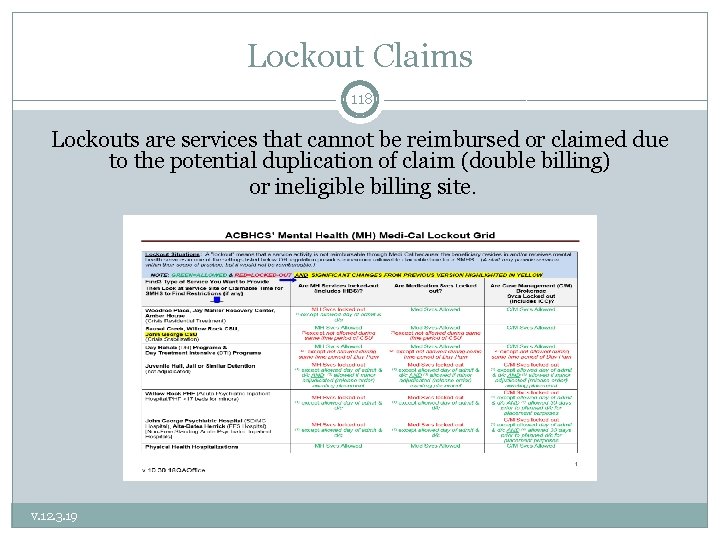
Lockout Claims 118 Lockouts are services that cannot be reimbursed or claimed due to the potential duplication of claim (double billing) or ineligible billing site. v. 12. 3. 19
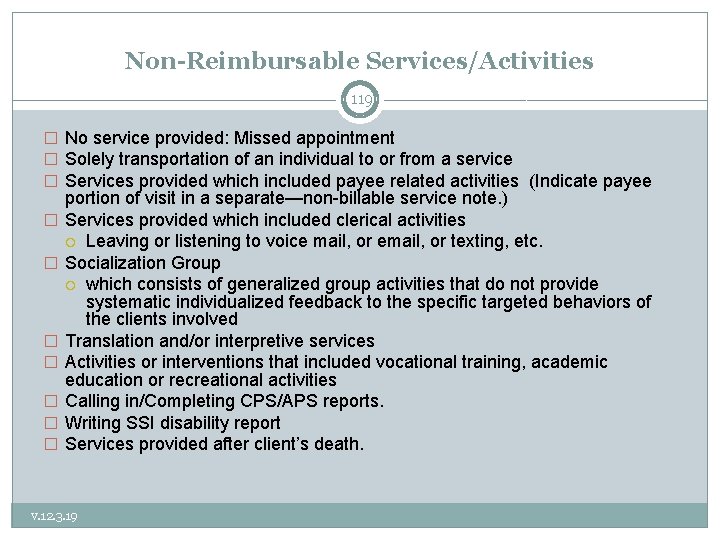
Non-Reimbursable Services/Activities 119 � No service provided: Missed appointment � Solely transportation of an individual to or from a service � Services provided which included payee related activities (Indicate payee � � � � portion of visit in a separate—non-billable service note. ) Services provided which included clerical activities Leaving or listening to voice mail, or email, or texting, etc. Socialization Group which consists of generalized group activities that do not provide systematic individualized feedback to the specific targeted behaviors of the clients involved Translation and/or interpretive services Activities or interventions that included vocational training, academic education or recreational activities Calling in/Completing CPS/APS reports. Writing SSI disability report Services provided after client’s death. v. 12. 3. 19
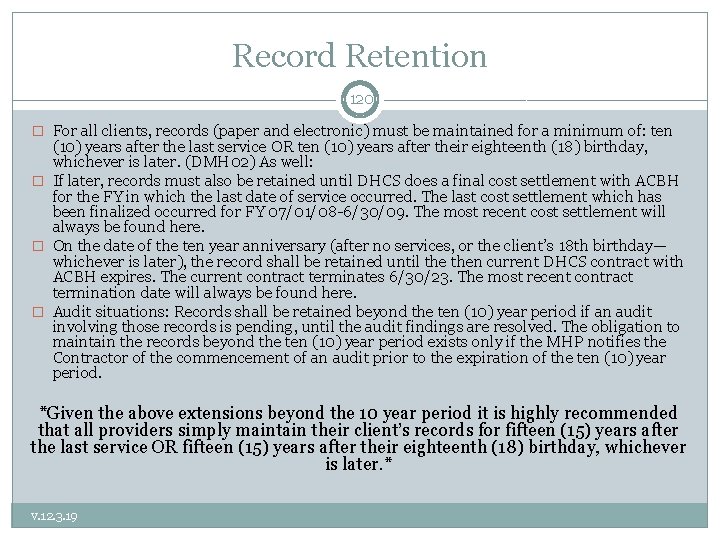
Record Retention 120 � For all clients, records (paper and electronic) must be maintained for a minimum of: ten (10) years after the last service OR ten (10) years after their eighteenth (18) birthday, whichever is later. (DMH 02) As well: � If later, records must also be retained until DHCS does a final cost settlement with ACBH for the FY in which the last date of service occurred. The last cost settlement which has been finalized occurred for FY 07/01/08 -6/30/09. The most recent cost settlement will always be found here. � On the date of the ten year anniversary (after no services, or the client’s 18 th birthday— whichever is later), the record shall be retained until then current DHCS contract with ACBH expires. The current contract terminates 6/30/23. The most recent contract termination date will always be found here. � Audit situations: Records shall be retained beyond the ten (10) year period if an audit involving those records is pending, until the audit findings are resolved. The obligation to maintain the records beyond the ten (10) year period exists only if the MHP notifies the Contractor of the commencement of an audit prior to the expiration of the ten (10) year period. *Given the above extensions beyond the 10 year period it is highly recommended that all providers simply maintain their client’s records for fifteen (15) years after the last service OR fifteen (15) years after their eighteenth (18) birthday, whichever is later. * v. 12. 3. 19
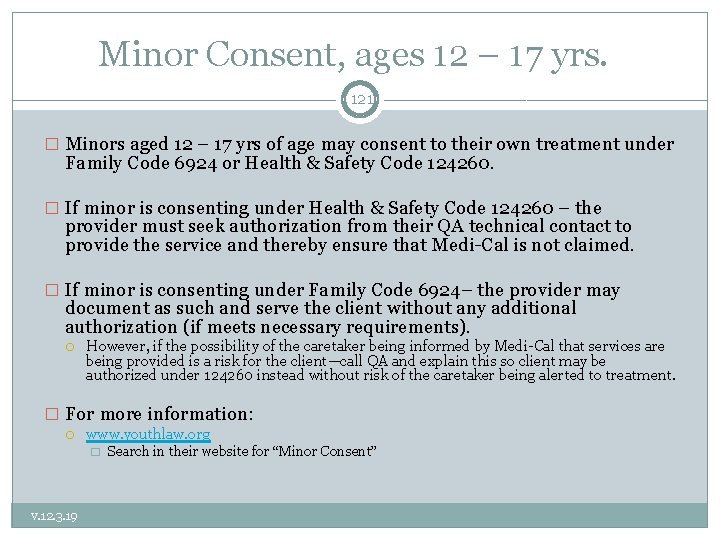
Minor Consent, ages 12 – 17 yrs. 121 � Minors aged 12 – 17 yrs of age may consent to their own treatment under Family Code 6924 or Health & Safety Code 124260. � If minor is consenting under Health & Safety Code 124260 – the provider must seek authorization from their QA technical contact to provide the service and thereby ensure that Medi-Cal is not claimed. � If minor is consenting under Family Code 6924– the provider may document as such and serve the client without any additional authorization (if meets necessary requirements). However, if the possibility of the caretaker being informed by Medi-Cal that services are being provided is a risk for the client—call QA and explain this so client may be authorized under 124260 instead without risk of the caretaker being alerted to treatment. � For more information: www. youthlaw. org � v. 12. 3. 19 Search in their website for “Minor Consent”
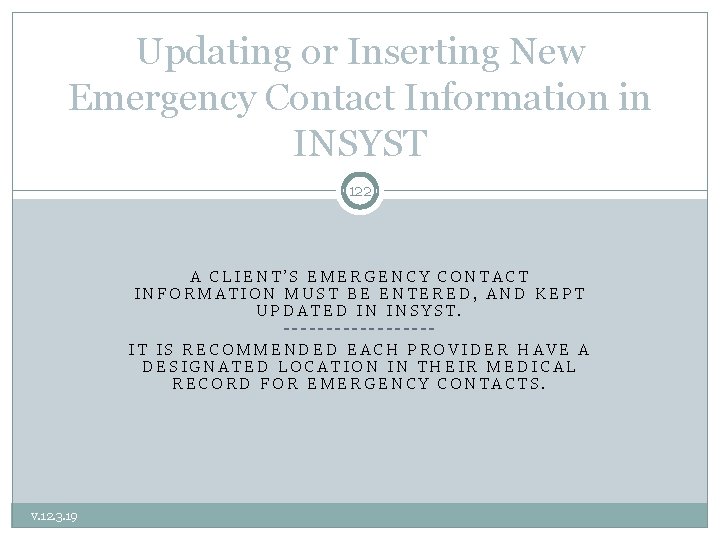
Updating or Inserting New Emergency Contact Information in INSYST 122 A CLIENT’S EMERGENCY CONTACT INFORMATION MUST BE ENTERED, AND KEPT UPDATED IN INSYST. ---------IT IS RECOMMENDED EACH PROVIDER HAVE A DESIGNATED LOCATION IN THEIR MEDICAL RECORD FOR EMERGENCY CONTACTS. v. 12. 3. 19
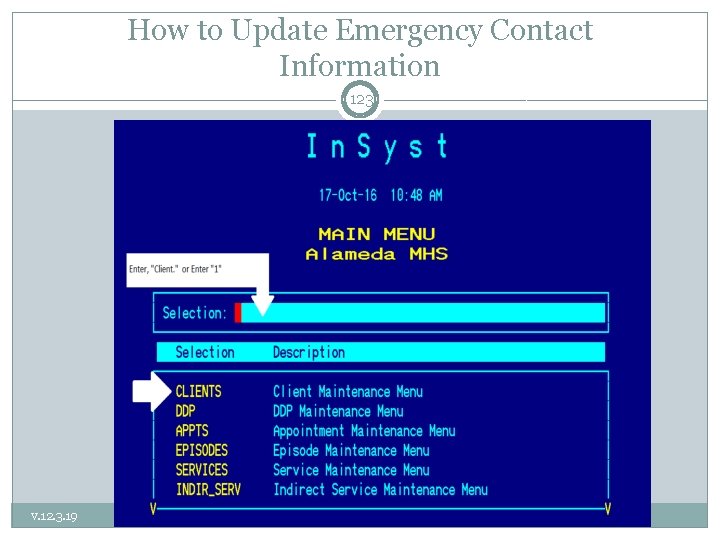
How to Update Emergency Contact Information 123 v. 12. 3. 19
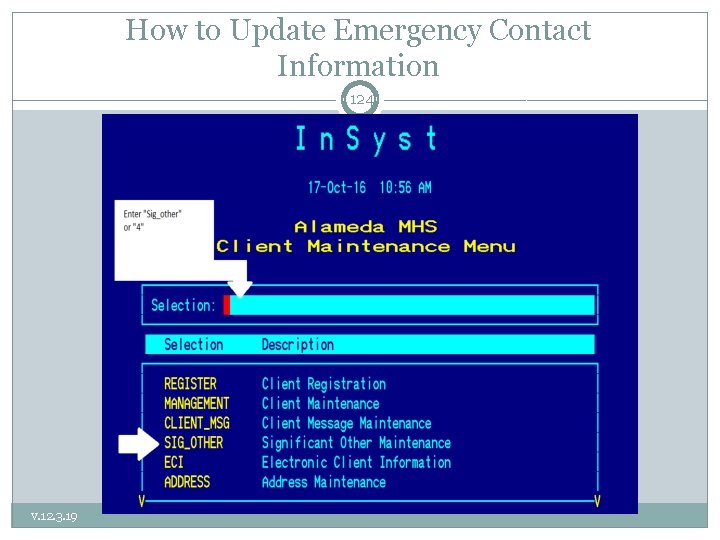
How to Update Emergency Contact Information 124 v. 12. 3. 19
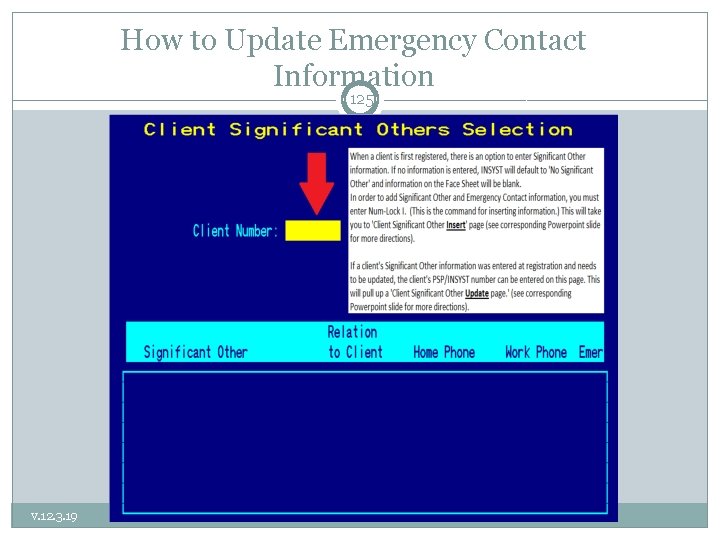
How to Update Emergency Contact Information 125 v. 12. 3. 19
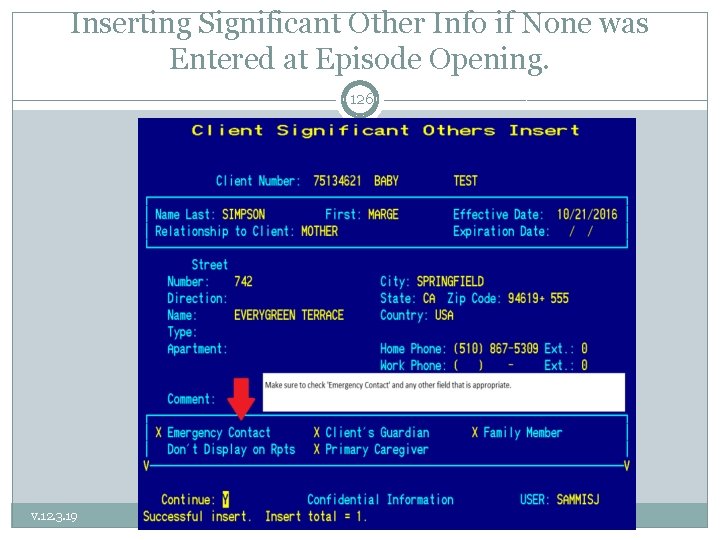
Inserting Significant Other Info if None was Entered at Episode Opening. 126 v. 12. 3. 19
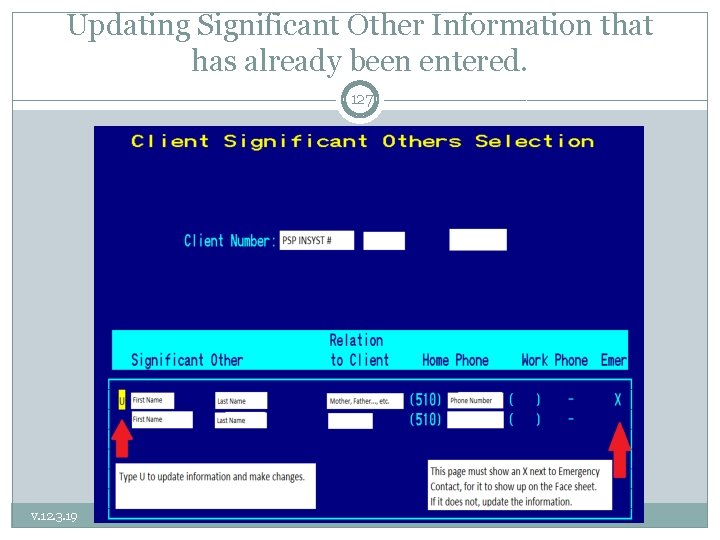
Updating Significant Other Information that has already been entered. 127 v. 12. 3. 19
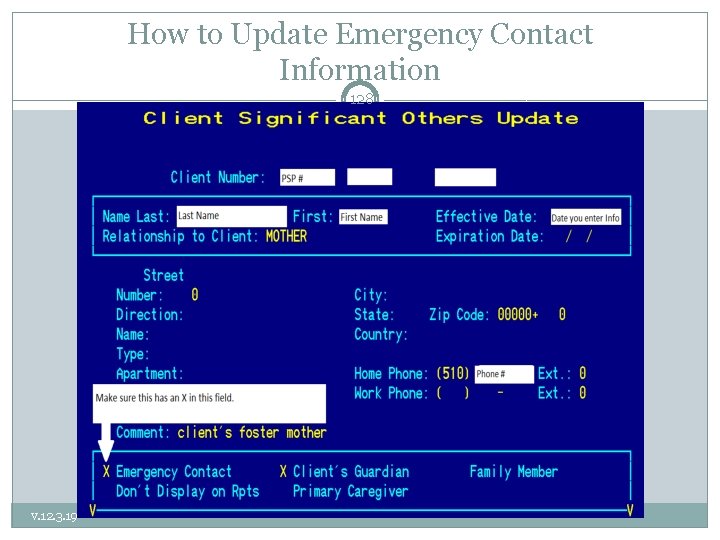
How to Update Emergency Contact Information 128 v. 12. 3. 19
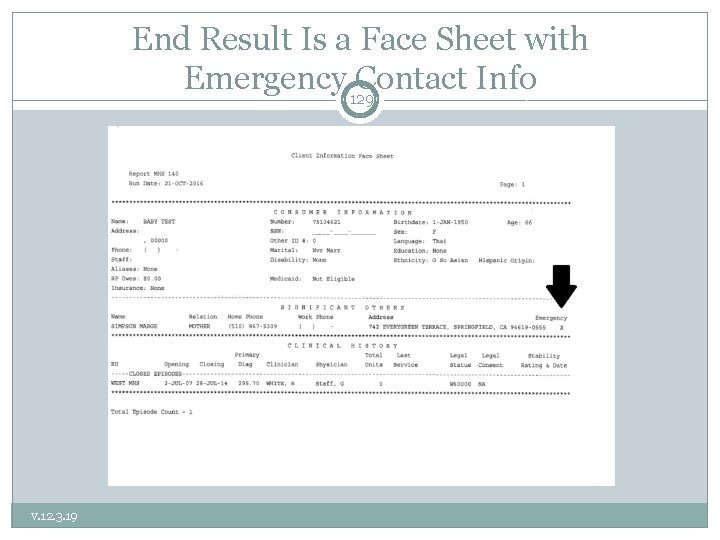
End Result Is a Face Sheet with Emergency Contact Info 129 v. 12. 3. 19
Client Messages 130 �The Client Messages screens allow staff to view and write messages pertaining to clients. �The messages are noted on the Locator and Client Message screens, and active Client Messages can be displayed on Morning Report, Report MHS 120 etc. v. 12. 3. 19
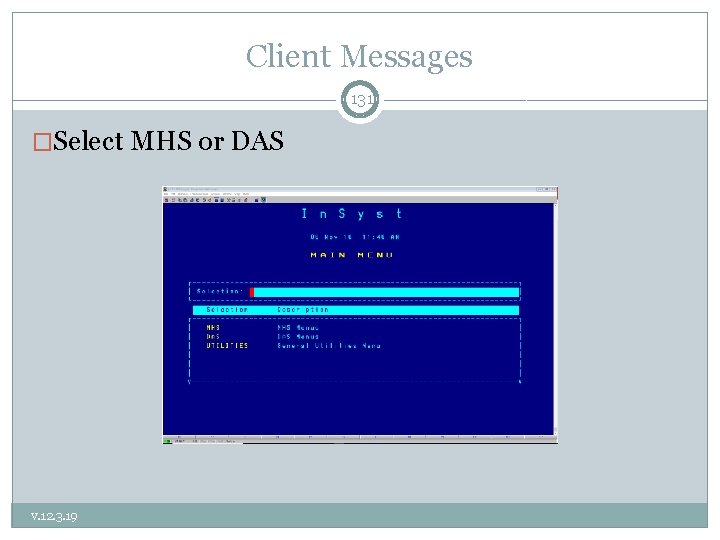
Client Messages 131 �Select MHS or DAS v. 12. 3. 19
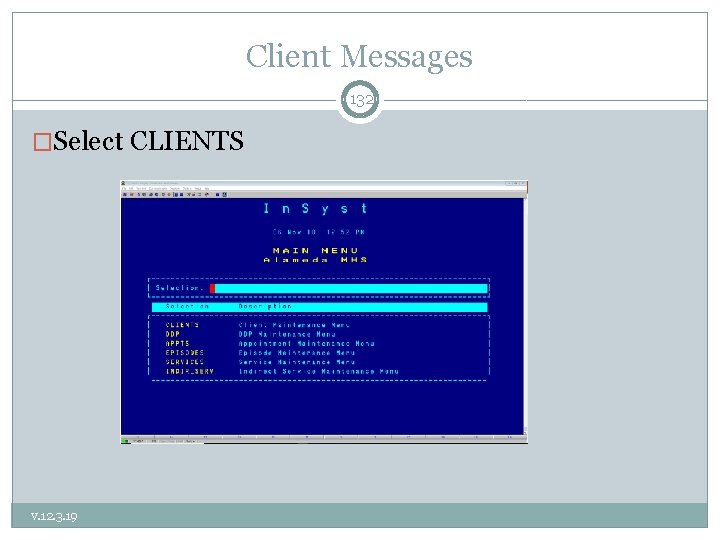
Client Messages 132 �Select CLIENTS v. 12. 3. 19
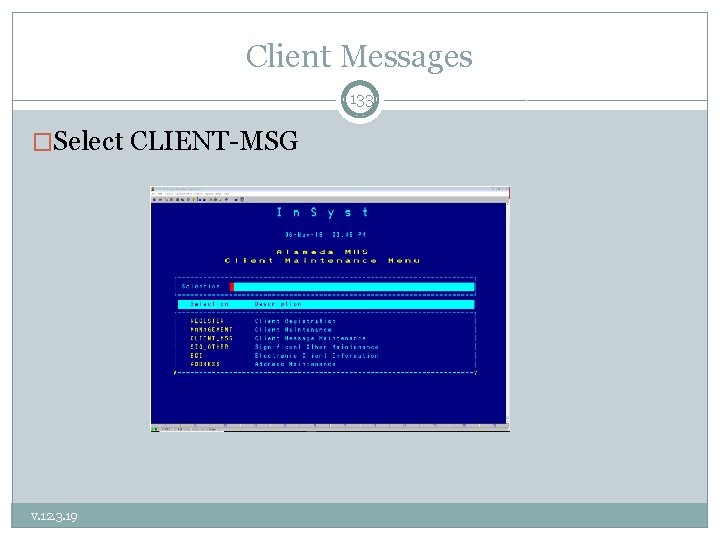
Client Messages 133 �Select CLIENT-MSG v. 12. 3. 19
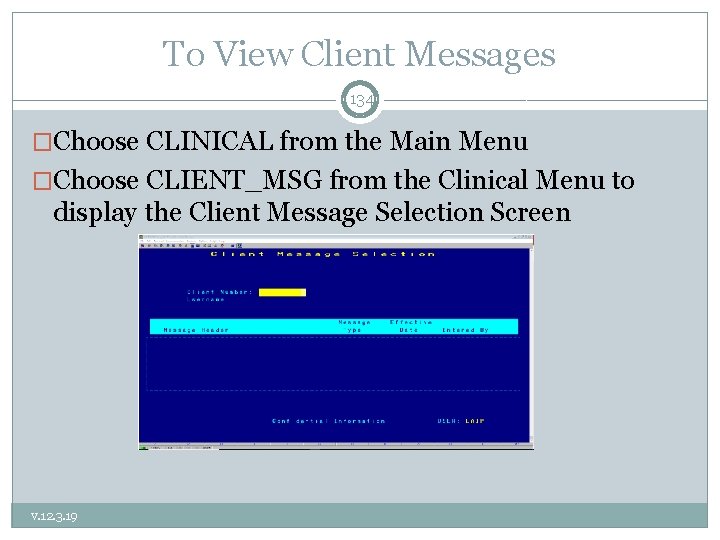
To View Client Messages 134 �Choose CLINICAL from the Main Menu �Choose CLIENT_MSG from the Clinical Menu to display the Client Message Selection Screen v. 12. 3. 19
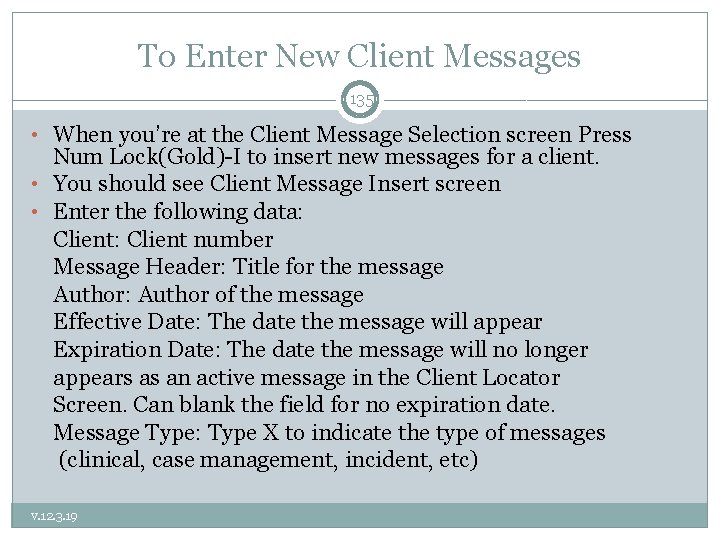
To Enter New Client Messages 135 • When you’re at the Client Message Selection screen Press Num Lock(Gold)-I to insert new messages for a client. • You should see Client Message Insert screen • Enter the following data: Client: Client number Message Header: Title for the message Author: Author of the message Effective Date: The date the message will appear Expiration Date: The date the message will no longer appears as an active message in the Client Locator Screen. Can blank the field for no expiration date. Message Type: Type X to indicate the type of messages (clinical, case management, incident, etc) v. 12. 3. 19
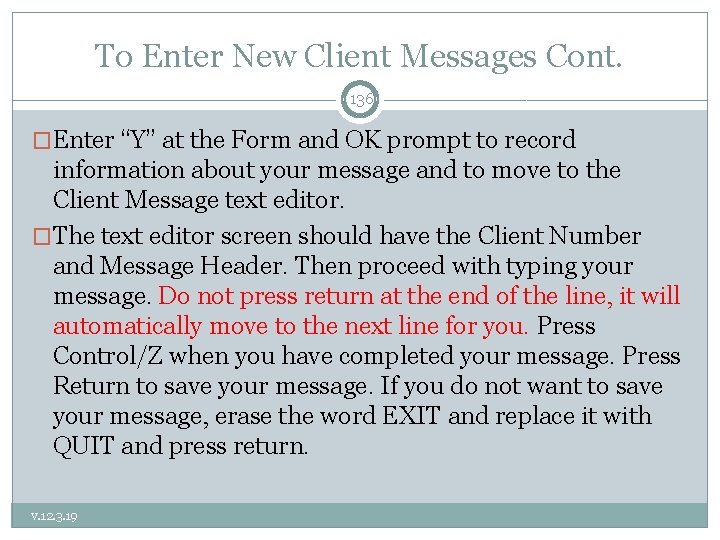
To Enter New Client Messages Cont. 136 �Enter “Y” at the Form and OK prompt to record information about your message and to move to the Client Message text editor. �The text editor screen should have the Client Number and Message Header. Then proceed with typing your message. Do not press return at the end of the line, it will automatically move to the next line for you. Press Control/Z when you have completed your message. Press Return to save your message. If you do not want to save your message, erase the word EXIT and replace it with QUIT and press return. v. 12. 3. 19
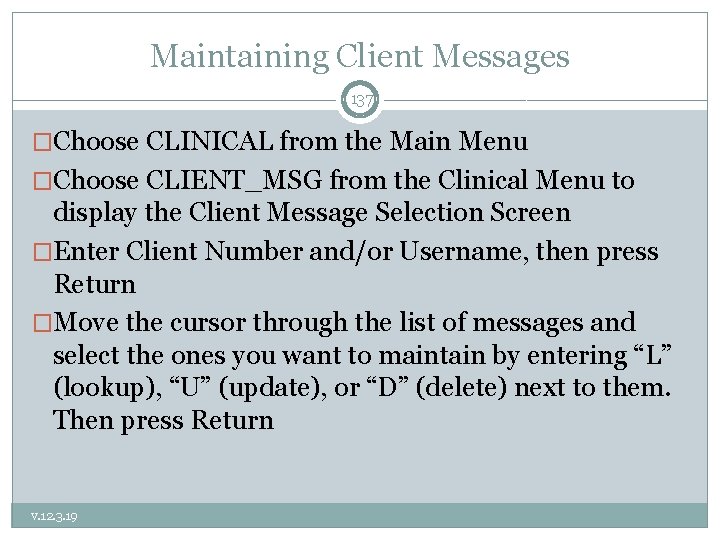
Maintaining Client Messages 137 �Choose CLINICAL from the Main Menu �Choose CLIENT_MSG from the Clinical Menu to display the Client Message Selection Screen �Enter Client Number and/or Username, then press Return �Move the cursor through the list of messages and select the ones you want to maintain by entering “L” (lookup), “U” (update), or “D” (delete) next to them. Then press Return v. 12. 3. 19
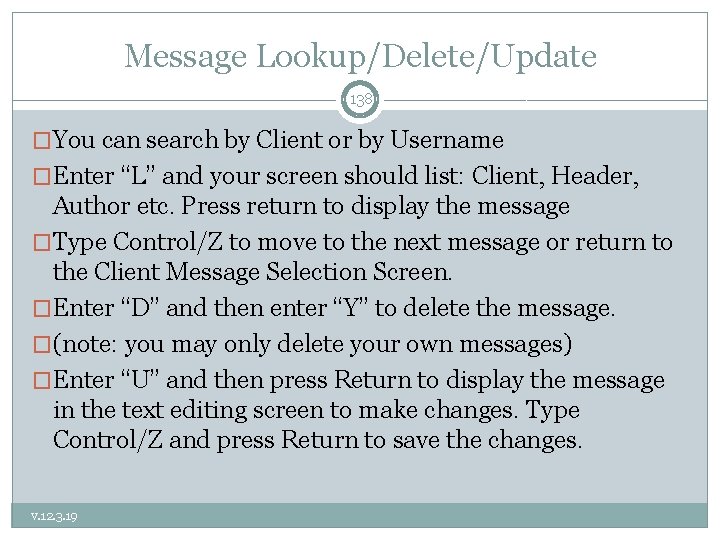
Message Lookup/Delete/Update 138 �You can search by Client or by Username �Enter “L” and your screen should list: Client, Header, Author etc. Press return to display the message �Type Control/Z to move to the next message or return to the Client Message Selection Screen. �Enter “D” and then enter “Y” to delete the message. �(note: you may only delete your own messages) �Enter “U” and then press Return to display the message in the text editing screen to make changes. Type Control/Z and press Return to save the changes. v. 12. 3. 19
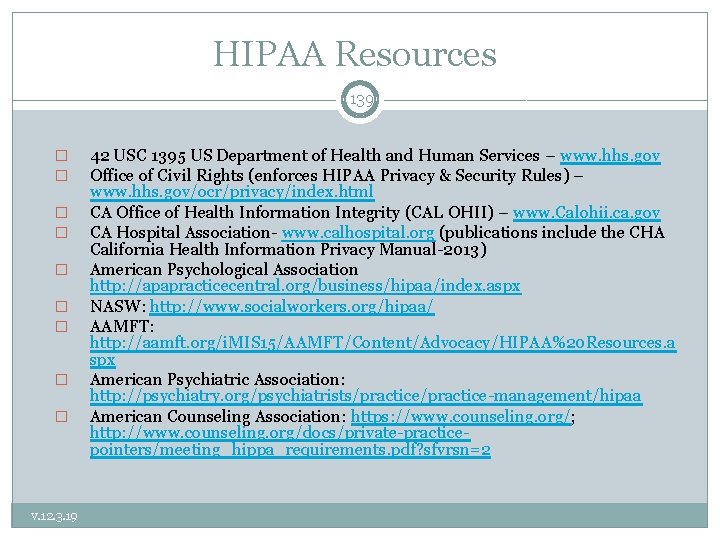
HIPAA Resources 139 � � � � � v. 12. 3. 19 42 USC 1395 US Department of Health and Human Services – www. hhs. gov Office of Civil Rights (enforces HIPAA Privacy & Security Rules) – www. hhs. gov/ocr/privacy/index. html CA Office of Health Information Integrity (CAL OHII) – www. Calohii. ca. gov CA Hospital Association- www. calhospital. org (publications include the CHA California Health Information Privacy Manual-2013) American Psychological Association http: //apapracticecentral. org/business/hipaa/index. aspx NASW: http: //www. socialworkers. org/hipaa/ AAMFT: http: //aamft. org/i. MIS 15/AAMFT/Content/Advocacy/HIPAA%20 Resources. a spx American Psychiatric Association: http: //psychiatry. org/psychiatrists/practice-management/hipaa American Counseling Association: https: //www. counseling. org/; http: //www. counseling. org/docs/private-practicepointers/meeting_hippa_requirements. pdf? sfvrsn=2
Contact Us: 140 �Contact QA Department at (510)567 - 8105 or QAOffice@acbhcs. org �If you feel that you are missing a procedure code that you are contracted for, that should be included in your RU, please call Jackie Mortensen @ (800)8781313. �For Clinicians Gateway questions, Please contact IS at (510)567 -8181. �For questions regarding your agency contract, please contact the Network Office at (510) 567 -8296 v. 12. 3. 19
141 Procedure Codes v. 12. 3. 19
v. 12. 3. 19 142
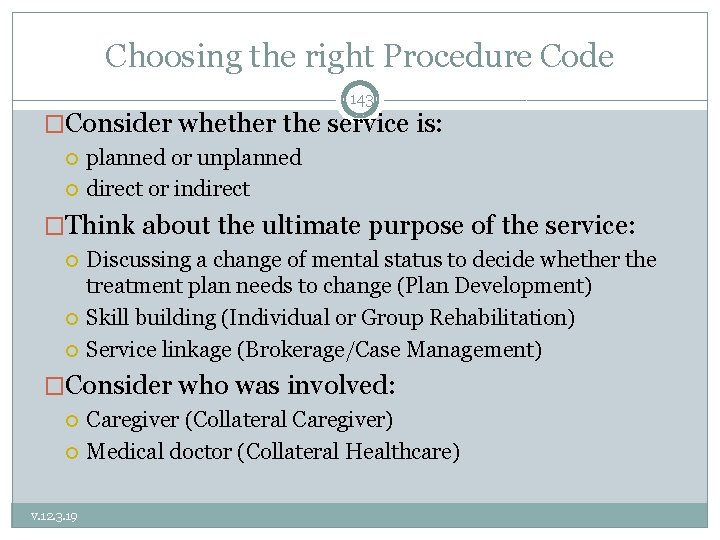
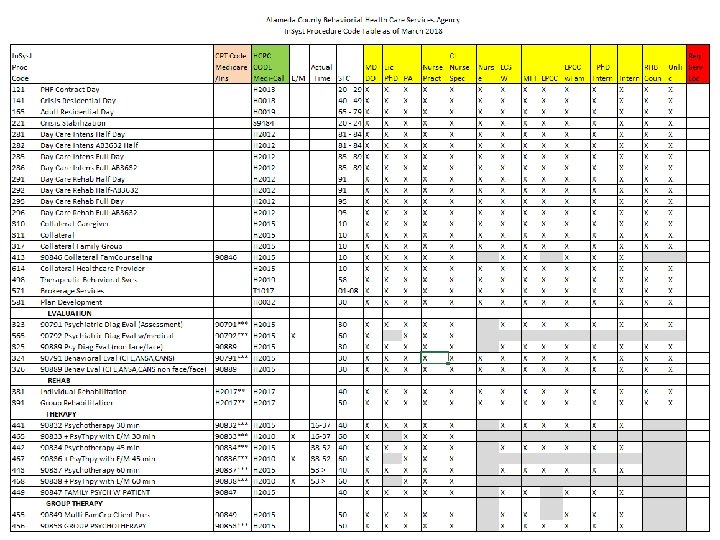
Choosing the right Procedure Code 143 �Consider whether the service is: planned or unplanned direct or indirect �Think about the ultimate purpose of the service: Discussing a change of mental status to decide whether the treatment plan needs to change (Plan Development) Skill building (Individual or Group Rehabilitation) Service linkage (Brokerage/Case Management) �Consider who was involved: v. 12. 3. 19 Caregiver (Collateral Caregiver) Medical doctor (Collateral Healthcare)
Game Time! v. 12. 3. 19 144
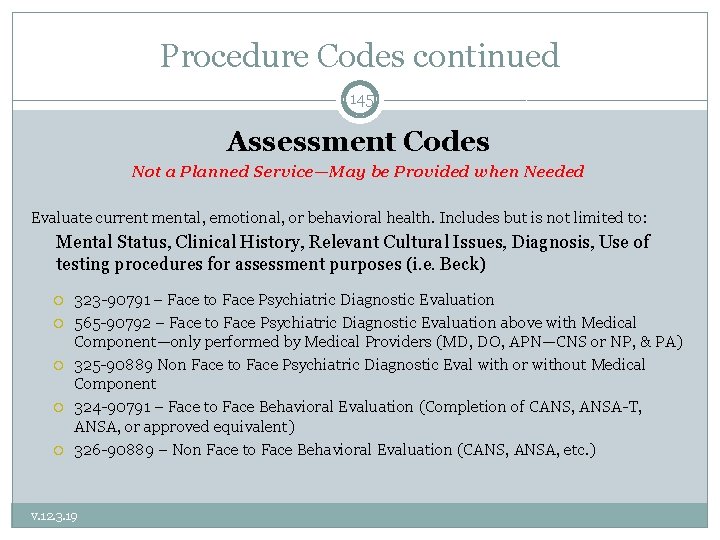
Procedure Codes continued 145 Assessment Codes Not a Planned Service—May be Provided when Needed Evaluate current mental, emotional, or behavioral health. Includes but is not limited to: Mental Status, Clinical History, Relevant Cultural Issues, Diagnosis, Use of testing procedures for assessment purposes (i. e. Beck) 323 -90791 – Face to Face Psychiatric Diagnostic Evaluation 565 -90792 – Face to Face Psychiatric Diagnostic Evaluation above with Medical Component—only performed by Medical Providers (MD, DO, APN—CNS or NP, & PA) 325 -90889 Non Face to Face Psychiatric Diagnostic Eval with or without Medical Component 324 -90791 – Face to Face Behavioral Evaluation (Completion of CANS, ANSA-T, ANSA, or approved equivalent) 326 -90889 – Non Face to Face Behavioral Evaluation (CANS, ANSA, etc. ) v. 12. 3. 19
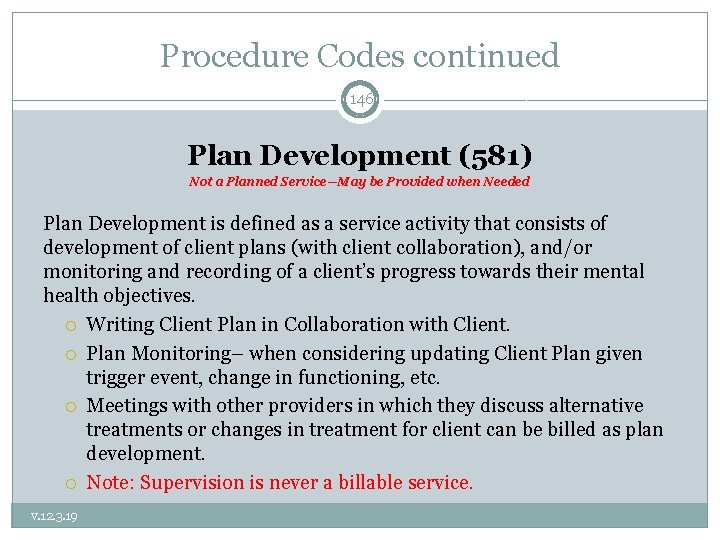
Procedure Codes continued 146 Plan Development (581) Not a Planned Service—May be Provided when Needed Plan Development is defined as a service activity that consists of development of client plans (with client collaboration), and/or monitoring and recording of a client’s progress towards their mental health objectives. Writing Client Plan in Collaboration with Client. Plan Monitoring– when considering updating Client Plan given trigger event, change in functioning, etc. Meetings with other providers in which they discuss alternative treatments or changes in treatment for client can be billed as plan development. Note: Supervision is never a billable service. v. 12. 3. 19
Procedure Codes continued 147 Plan Development (581) Cont. � Intra-agency/clinic Plan Development only occurs when the Plan is being reconsidered and the writer could not obtain the information from the written record. � This is not done routinely in-house such as a Case Manager meeting with the MD after she sees the client, or the clinician meeting with the Family Partner after the Partner sees the client/family. � For example, clinician becomes aware client went off their anti-psychotic medication (historically linked to decompensation and hospitalization) and clinician needs to meet with the psychiatrist to modify the plan to address the issue immediately. Both Staff can bill for the full time for these types of plan development meetings. v. 12. 3. 19
Procedure Codes continued 148 Individual (381) or Group Rehab (391) PLANNED SERVICE—MUST BE IN CLIENT PLAN � Includes Improving, Maintaining, OR Restoring Functional skills, Daily Living skills, Social and Leisure Skills, Grooming and Personal Hygiene Skills, Meal Preparation skills, and Medication Education. The impairments targeted must be a DIRECT result of the included Dx signs, symptoms, or behaviors: � Allowed Example from DHCS: v. 12. 3. 19 “The most common example would be a client with schizophrenia who has social skills deficits which are the direct result of the schizophrenic disorder. Training will focus on social skills development. ” -John Griffith, Ph. D, DHCS Consulting Psychologist, email correspondence of 5/20/15
Procedure Codes continued 149 Individual (381) or Group Rehab (391) Cont. PLANNED SERVICE—MUST BE IN CLIENT PLAN � Disallowed Example from DHCS: Client has Major Depression with symptoms of insomnia, depressed mood, anhedonia, indecisiveness, fatigue, feelings of worthlessness and psychomotor retardation. Clinician wishes to address an identified impairment (or skill deficit) of poor ADL’s. “In this example , the ‘deficit’—i. e. , failure to perform ADLs—is not really a deficit at all. The client KNOWS how to bathe, brush teeth, comb hair, etc. ” -John Griffith, Ph. D, DHCS Consulting Psychologist, email correspondence of 5/20/15 v. 12. 3. 19 Rehab services could be provided to address the deficits of Major Depression in the areas of: interest in life (anhedonia), self-worth (feelings of worthlessness) and energy (fatigue).
Procedure Codes continued 150 Collateral (311) *for family engagement use Code 310 MAY ONLY BE PROVIDED AFTER THE COMPLETION OF THE CLIENT PLAN � Services provided to Significant Support person Consultation, Training and Psychoeducation of significant support person in client’s life where the � Focus is always in achieving mental health Objectives in Client Plan—If Plan is not completed, there is no way to do so. � The provider may be receiving or providing information to the significant support person. � The client may or may not be present for this service activity. � Definition—Supporting Client Plan by: v. 12. 3. 19 Gathering information from, or Explaining results of psychiatric, other medical examinations and procedures, or other accumulated data to family or other responsible persons, or Advising them how to assist clients
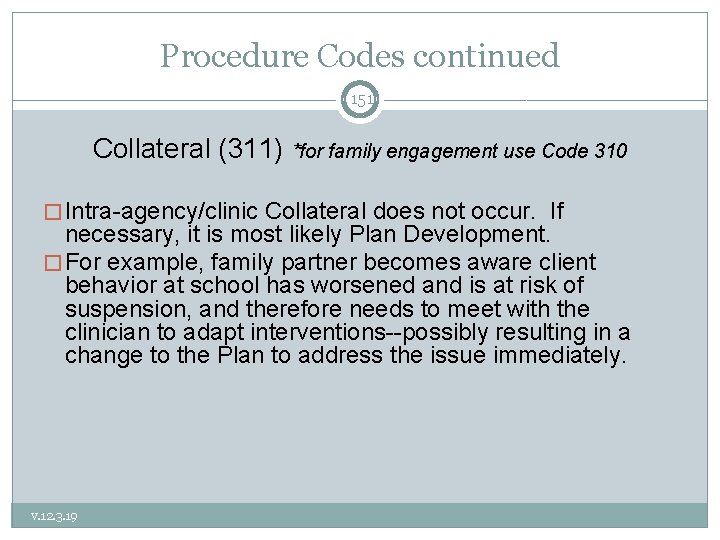
Procedure Codes continued 151 Collateral (311) *for family engagement use Code 310 � Intra-agency/clinic Collateral does not occur. If necessary, it is most likely Plan Development. � For example, family partner becomes aware client behavior at school has worsened and is at risk of suspension, and therefore needs to meet with the clinician to adapt interventions--possibly resulting in a change to the Plan to address the issue immediately. v. 12. 3. 19
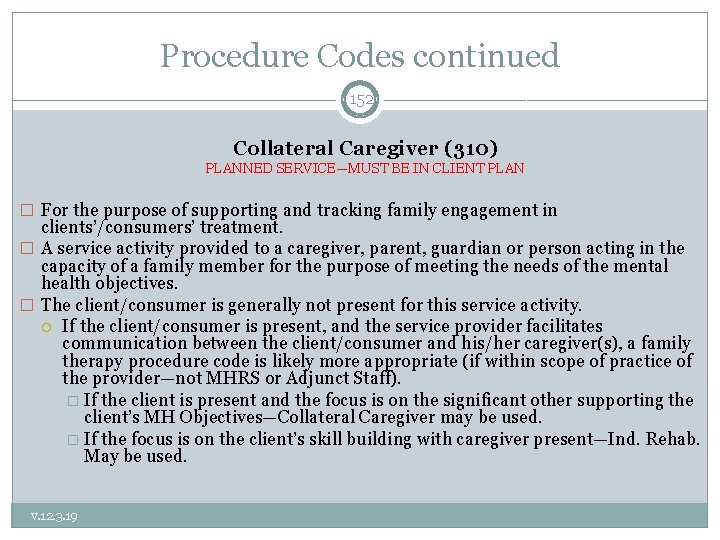
Procedure Codes continued 152 Collateral Caregiver (310) PLANNED SERVICE—MUST BE IN CLIENT PLAN � For the purpose of supporting and tracking family engagement in clients’/consumers’ treatment. � A service activity provided to a caregiver, parent, guardian or person acting in the capacity of a family member for the purpose of meeting the needs of the mental health objectives. � The client/consumer is generally not present for this service activity. If the client/consumer is present, and the service provider facilitates communication between the client/consumer and his/her caregiver(s), a family therapy procedure code is likely more appropriate (if within scope of practice of the provider—not MHRS or Adjunct Staff). � If the client is present and the focus is on the significant other supporting the client’s MH Objectives—Collateral Caregiver may be used. � If the focus is on the client’s skill building with caregiver present—Ind. Rehab. May be used. v. 12. 3. 19
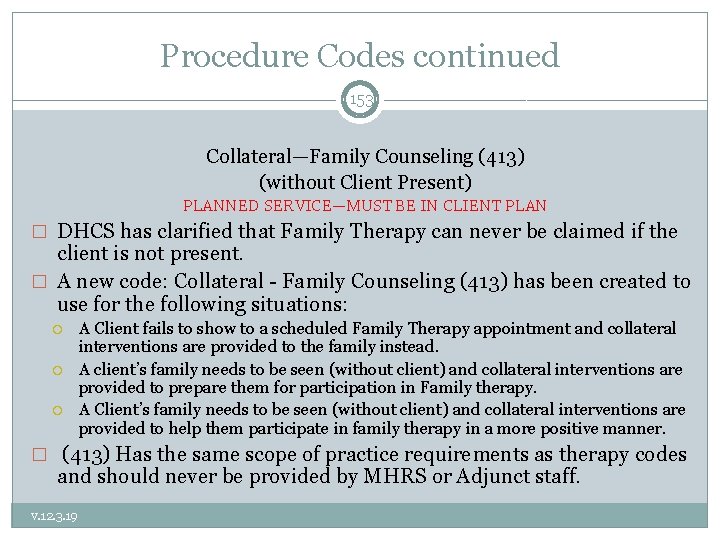
Procedure Codes continued 153 Collateral—Family Counseling (413) (without Client Present) PLANNED SERVICE—MUST BE IN CLIENT PLAN � DHCS has clarified that Family Therapy can never be claimed if the client is not present. � A new code: Collateral - Family Counseling (413) has been created to use for the following situations: A Client fails to show to a scheduled Family Therapy appointment and collateral interventions are provided to the family instead. A client’s family needs to be seen (without client) and collateral interventions are provided to prepare them for participation in Family therapy. A Client’s family needs to be seen (without client) and collateral interventions are provided to help them participate in family therapy in a more positive manner. � (413) Has the same scope of practice requirements as therapy codes and should never be provided by MHRS or Adjunct staff. v. 12. 3. 19
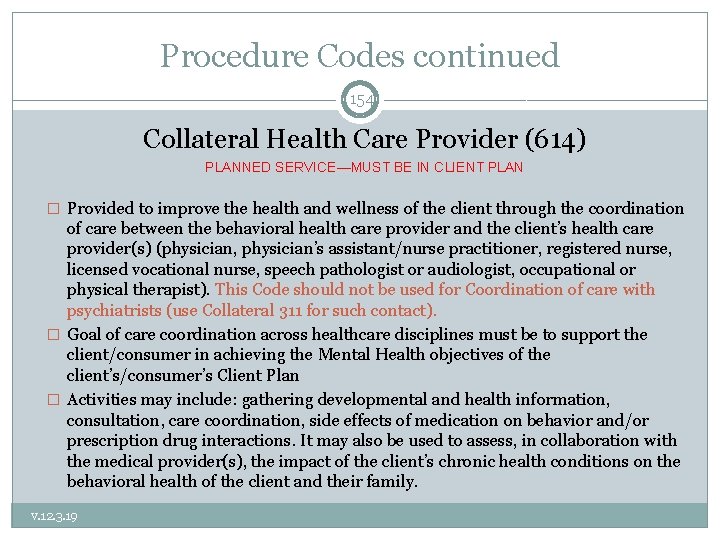
Procedure Codes continued 154 Collateral Health Care Provider (614) PLANNED SERVICE—MUST BE IN CLIENT PLAN � Provided to improve the health and wellness of the client through the coordination of care between the behavioral health care provider and the client’s health care provider(s) (physician, physician’s assistant/nurse practitioner, registered nurse, licensed vocational nurse, speech pathologist or audiologist, occupational or physical therapist). This Code should not be used for Coordination of care with psychiatrists (use Collateral 311 for such contact). � Goal of care coordination across healthcare disciplines must be to support the client/consumer in achieving the Mental Health objectives of the client’s/consumer’s Client Plan � Activities may include: gathering developmental and health information, consultation, care coordination, side effects of medication on behavior and/or prescription drug interactions. It may also be used to assess, in collaboration with the medical provider(s), the impact of the client’s chronic health conditions on the behavioral health of the client and their family. v. 12. 3. 19
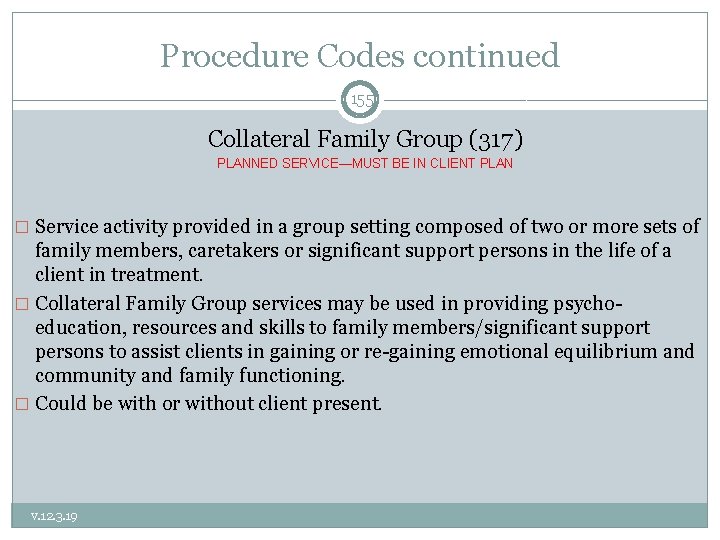
Procedure Codes continued 155 Collateral Family Group (317) PLANNED SERVICE—MUST BE IN CLIENT PLAN � Service activity provided in a group setting composed of two or more sets of family members, caretakers or significant support persons in the life of a client in treatment. � Collateral Family Group services may be used in providing psychoeducation, resources and skills to family members/significant support persons to assist clients in gaining or re-gaining emotional equilibrium and community and family functioning. � Could be with or without client present. v. 12. 3. 19
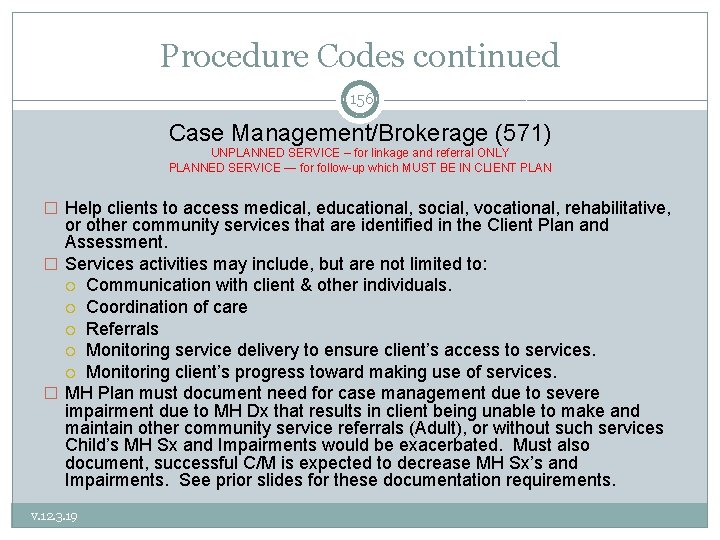
Procedure Codes continued 156 Case Management/Brokerage (571) UNPLANNED SERVICE – for linkage and referral ONLY PLANNED SERVICE — for follow-up which MUST BE IN CLIENT PLAN � Help clients to access medical, educational, social, vocational, rehabilitative, or other community services that are identified in the Client Plan and Assessment. � Services activities may include, but are not limited to: Communication with client & other individuals. Coordination of care Referrals Monitoring service delivery to ensure client’s access to services. Monitoring client’s progress toward making use of services. � MH Plan must document need for case management due to severe impairment due to MH Dx that results in client being unable to make and maintain other community service referrals (Adult), or without such services Child’s MH Sx and Impairments would be exacerbated. Must also document, successful C/M is expected to decrease MH Sx’s and Impairments. See prior slides for these documentation requirements. v. 12. 3. 19
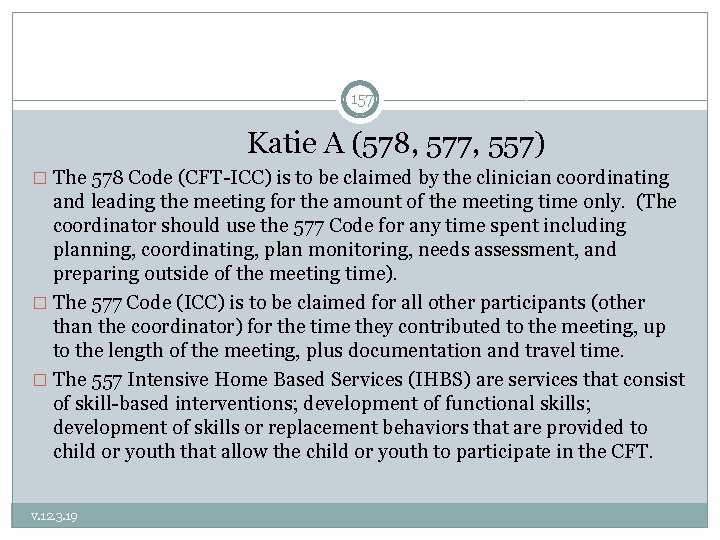
157 Katie A (578, 577, 557) � The 578 Code (CFT-ICC) is to be claimed by the clinician coordinating and leading the meeting for the amount of the meeting time only. (The coordinator should use the 577 Code for any time spent including planning, coordinating, plan monitoring, needs assessment, and preparing outside of the meeting time). � The 577 Code (ICC) is to be claimed for all other participants (other than the coordinator) for the time they contributed to the meeting, up to the length of the meeting, plus documentation and travel time. � The 557 Intensive Home Based Services (IHBS) are services that consist of skill-based interventions; development of functional skills; development of skills or replacement behaviors that are provided to child or youth that allow the child or youth to participate in the CFT. v. 12. 3. 19
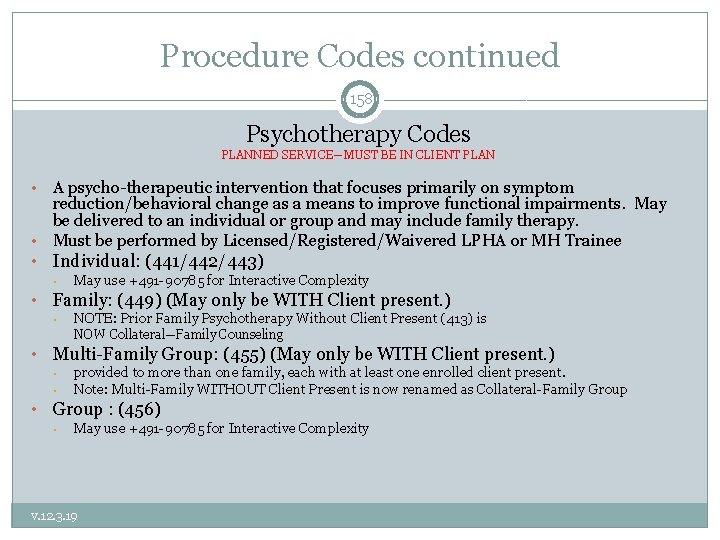
Procedure Codes continued 158 Psychotherapy Codes PLANNED SERVICE—MUST BE IN CLIENT PLAN A psycho-therapeutic intervention that focuses primarily on symptom reduction/behavioral change as a means to improve functional impairments. May be delivered to an individual or group and may include family therapy. • Must be performed by Licensed/Registered/Waivered LPHA or MH Trainee • • Individual: (441/442/443) • • May use +491 -90785 for Interactive Complexity Family: (449) (May only be WITH Client present. ) • NOTE: Prior Family Psychotherapy Without Client Present (413) is NOW Collateral—Family Counseling • Multi-Family Group: (455) (May only be WITH Client present. ) • • • provided to more than one family, each with at least one enrolled client present. Note: Multi-Family WITHOUT Client Present is now renamed as Collateral-Family Group : (456) • May use +491 -90785 for Interactive Complexity v. 12. 3. 19
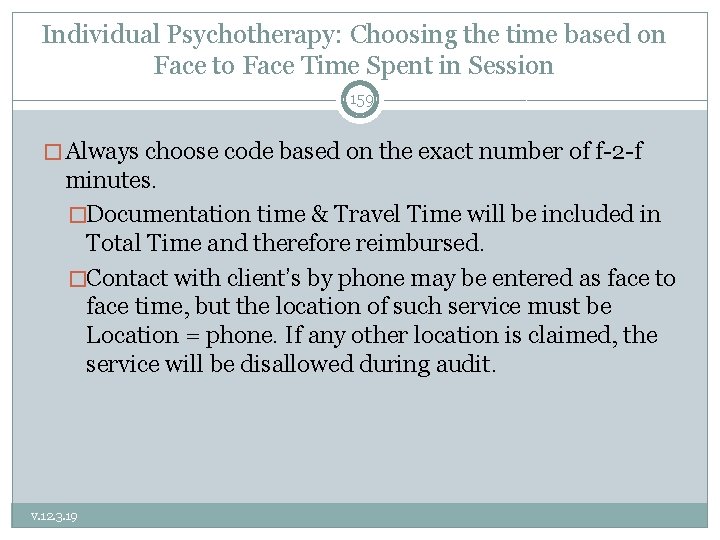
Individual Psychotherapy: Choosing the time based on Face to Face Time Spent in Session 159 � Always choose code based on the exact number of f-2 -f minutes. �Documentation time & Travel Time will be included in Total Time and therefore reimbursed. �Contact with client’s by phone may be entered as face to face time, but the location of such service must be Location = phone. If any other location is claimed, the service will be disallowed during audit. v. 12. 3. 19
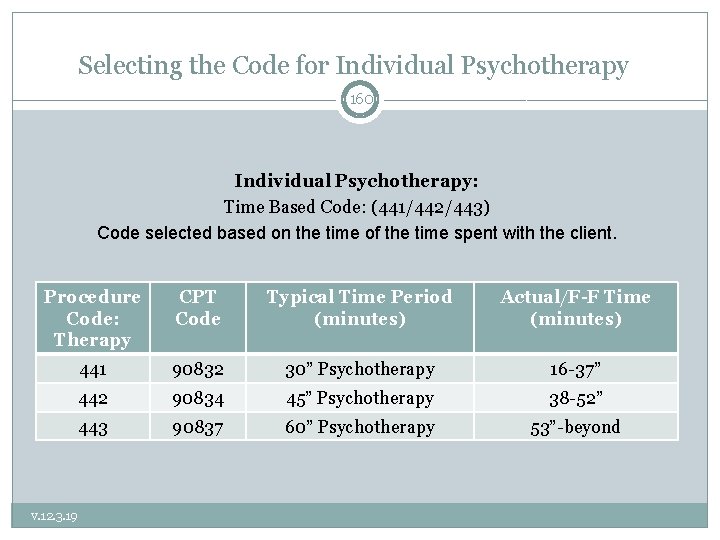
Selecting the Code for Individual Psychotherapy 160 Individual Psychotherapy: Time Based Code: (441/442/443) Code selected based on the time of the time spent with the client. Procedure Code: Therapy CPT Code Typical Time Period (minutes) Actual/F-F Time (minutes) 441 90832 30” Psychotherapy 16 -37” 442 90834 45” Psychotherapy 38 -52” 443 90837 60” Psychotherapy 53”-beyond v. 12. 3. 19
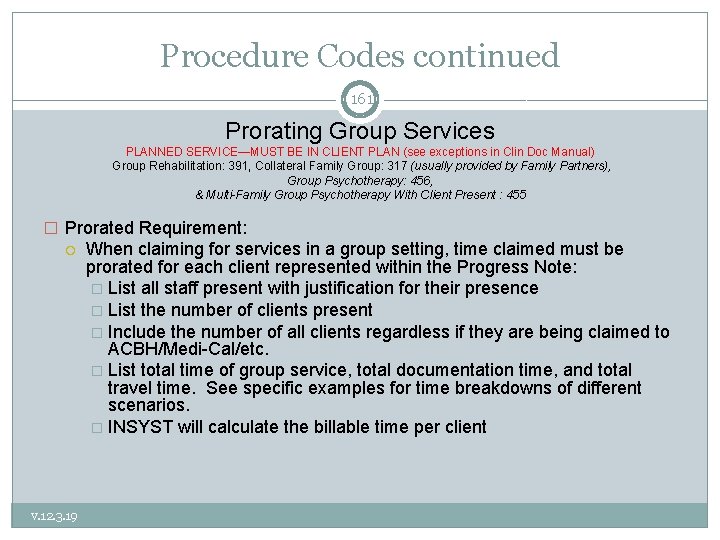
Procedure Codes continued 161 Prorating Group Services PLANNED SERVICE—MUST BE IN CLIENT PLAN (see exceptions in Clin Doc Manual) Group Rehabilitation: 391, Collateral Family Group: 317 (usually provided by Family Partners), Group Psychotherapy: 456, & Multi-Family Group Psychotherapy With Client Present : 455 � Prorated Requirement: v. 12. 3. 19 When claiming for services in a group setting, time claimed must be prorated for each client represented within the Progress Note: � List all staff present with justification for their presence � List the number of clients present � Include the number of all clients regardless if they are being claimed to ACBH/Medi-Cal/etc. � List total time of group service, total documentation time, and total travel time. See specific examples for time breakdowns of different scenarios. � INSYST will calculate the billable time per client
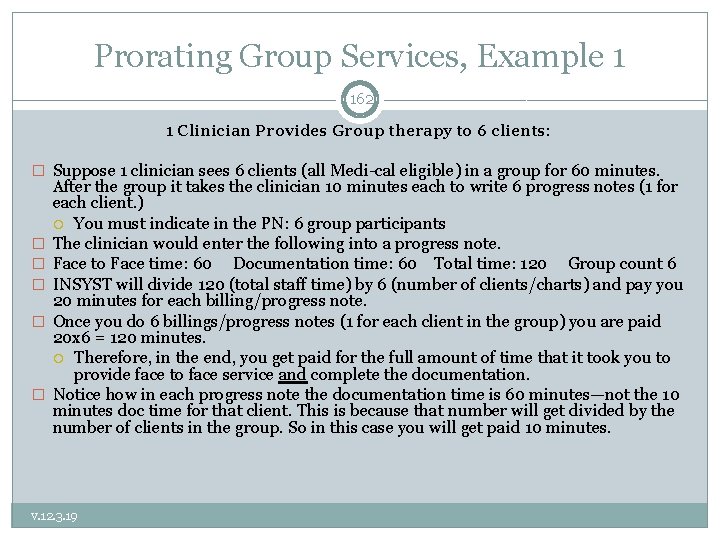
Prorating Group Services, Example 1 162 1 Clinician Provides Group therapy to 6 clients: � Suppose 1 clinician sees 6 clients (all Medi-cal eligible) in a group for 60 minutes. � � � After the group it takes the clinician 10 minutes each to write 6 progress notes (1 for each client. ) You must indicate in the PN: 6 group participants The clinician would enter the following into a progress note. Face to Face time: 60 Documentation time: 60 Total time: 120 Group count 6 INSYST will divide 120 (total staff time) by 6 (number of clients/charts) and pay you 20 minutes for each billing/progress note. Once you do 6 billings/progress notes (1 for each client in the group) you are paid 20 x 6 = 120 minutes. Therefore, in the end, you get paid for the full amount of time that it took you to provide face to face service and complete the documentation. Notice how in each progress note the documentation time is 60 minutes—not the 10 minutes doc time for that client. This is because that number will get divided by the number of clients in the group. So in this case you will get paid 10 minutes. v. 12. 3. 19
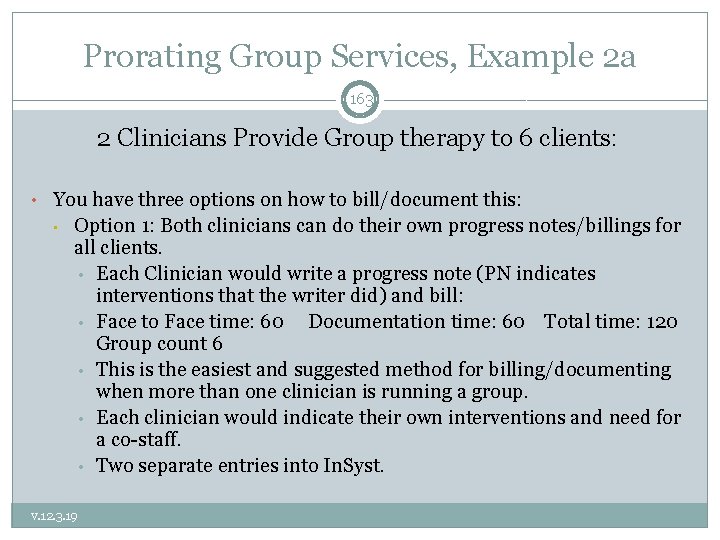
Prorating Group Services, Example 2 a 163 2 Clinicians Provide Group therapy to 6 clients: • You have three options on how to bill/document this: • Option 1: Both clinicians can do their own progress notes/billings for all clients. • Each Clinician would write a progress note (PN indicates interventions that the writer did) and bill: • Face to Face time: 60 Documentation time: 60 Total time: 120 Group count 6 • This is the easiest and suggested method for billing/documenting when more than one clinician is running a group. • Each clinician would indicate their own interventions and need for a co-staff. • Two separate entries into In. Syst. v. 12. 3. 19
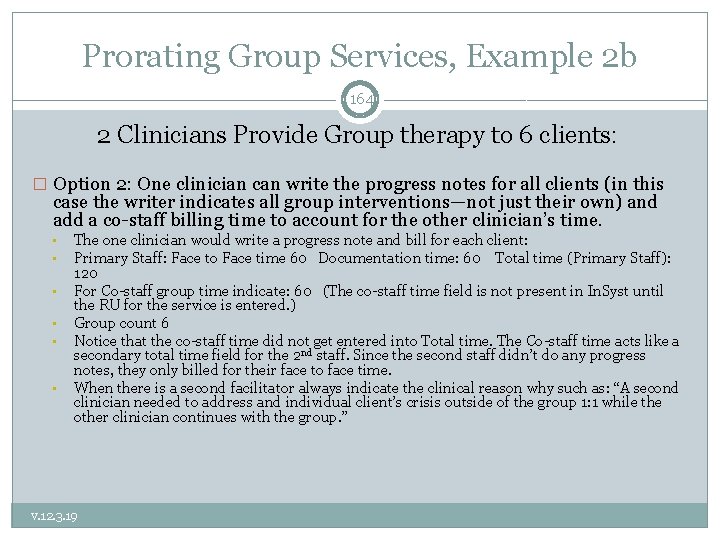
Prorating Group Services, Example 2 b 164 2 Clinicians Provide Group therapy to 6 clients: � Option 2: One clinician can write the progress notes for all clients (in this case the writer indicates all group interventions—not just their own) and add a co-staff billing time to account for the other clinician’s time. • • • The one clinician would write a progress note and bill for each client: Primary Staff: Face to Face time 60 Documentation time: 60 Total time (Primary Staff): 120 For Co-staff group time indicate: 60 (The co-staff time field is not present in In. Syst until the RU for the service is entered. ) Group count 6 Notice that the co-staff time did not get entered into Total time. The Co-staff time acts like a secondary total time field for the 2 nd staff. Since the second staff didn’t do any progress notes, they only billed for their face to face time. When there is a second facilitator always indicate the clinical reason why such as: “A second clinician needed to address and individual client’s crisis outside of the group 1: 1 while the other clinician continues with the group. ” v. 12. 3. 19
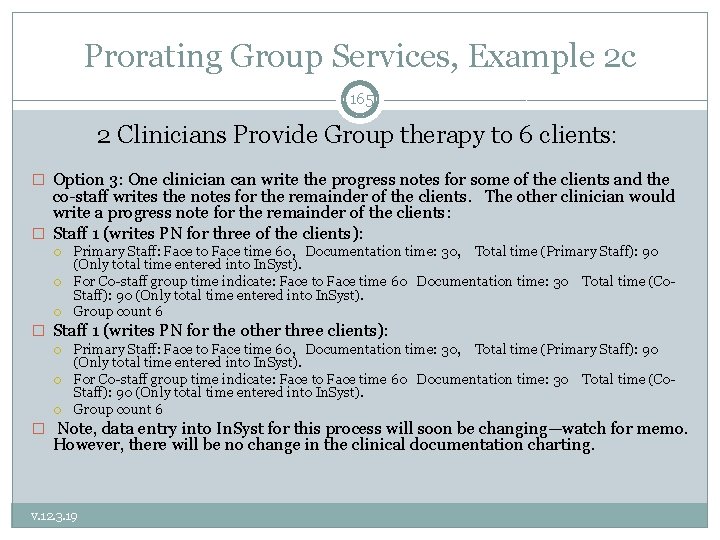
Prorating Group Services, Example 2 c 165 2 Clinicians Provide Group therapy to 6 clients: � Option 3: One clinician can write the progress notes for some of the clients and the co-staff writes the notes for the remainder of the clients. The other clinician would write a progress note for the remainder of the clients: � Staff 1 (writes PN for three of the clients): Primary Staff: Face to Face time 60, Documentation time: 30, Total time (Primary Staff): 90 (Only total time entered into In. Syst). For Co-staff group time indicate: Face to Face time 60 Documentation time: 30 Total time (Co. Staff): 90 (Only total time entered into In. Syst). Group count 6 � Staff 1 (writes PN for the other three clients): Primary Staff: Face to Face time 60, Documentation time: 30, Total time (Primary Staff): 90 (Only total time entered into In. Syst). For Co-staff group time indicate: Face to Face time 60 Documentation time: 30 Total time (Co. Staff): 90 (Only total time entered into In. Syst). Group count 6 � Note, data entry into In. Syst for this process will soon be changing—watch for memo. However, there will be no change in the clinical documentation charting. v. 12. 3. 19
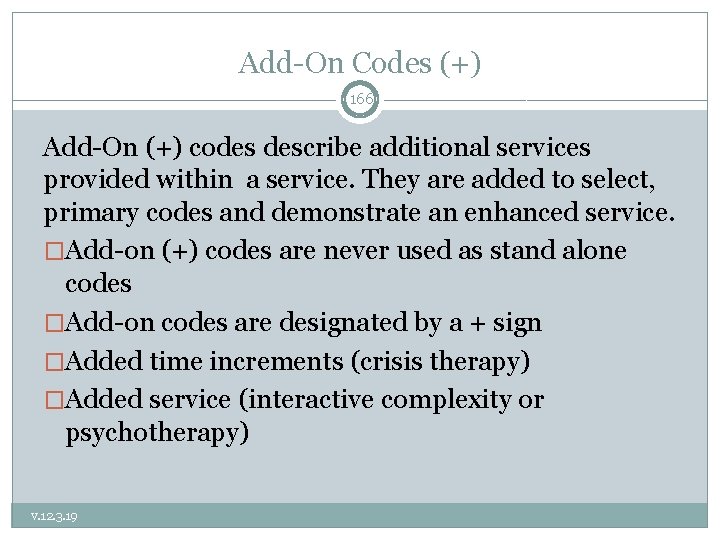
Add-On Codes (+) 166 Add-On (+) codes describe additional services provided within a service. They are added to select, primary codes and demonstrate an enhanced service. �Add-on (+) codes are never used as stand alone codes �Add-on codes are designated by a + sign �Added time increments (crisis therapy) �Added service (interactive complexity or psychotherapy) v. 12. 3. 19
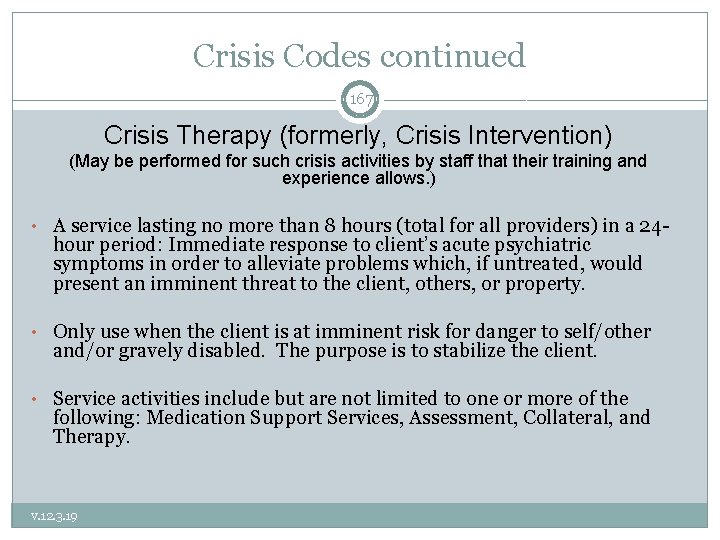
Crisis Codes continued 167 Crisis Therapy (formerly, Crisis Intervention) (May be performed for such crisis activities by staff that their training and experience allows. ) • A service lasting no more than 8 hours (total for all providers) in a 24 - hour period: Immediate response to client’s acute psychiatric symptoms in order to alleviate problems which, if untreated, would present an imminent threat to the client, others, or property. • Only use when the client is at imminent risk for danger to self/other and/or gravely disabled. The purpose is to stabilize the client. • Service activities include but are not limited to one or more of the following: Medication Support Services, Assessment, Collateral, and Therapy. v. 12. 3. 19
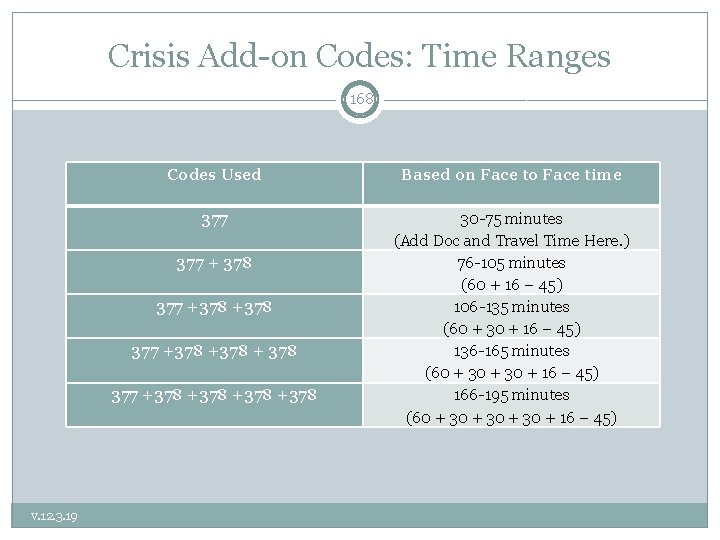
Crisis Add-on Codes: Time Ranges 168 Codes Used Based on Face to Face time 377 30 -75 minutes (Add Doc and Travel Time Here. ) 76 -105 minutes (60 + 16 – 45) 106 -135 minutes (60 + 30 + 16 – 45) 136 -165 minutes (60 + 30 + 16 – 45) 166 -195 minutes (60 + 30 + 16 – 45) 377 + 378 377 +378 +378 v. 12. 3. 19
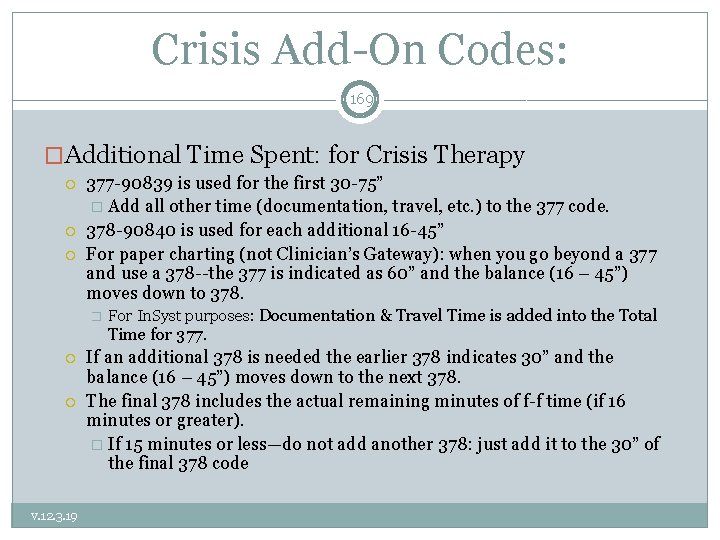
Crisis Add-On Codes: 169 �Additional Time Spent: for Crisis Therapy 377 -90839 is used for the first 30 -75” � Add all other time (documentation, travel, etc. ) to the 377 code. 378 -90840 is used for each additional 16 -45” For paper charting (not Clinician’s Gateway): when you go beyond a 377 and use a 378 --the 377 is indicated as 60” and the balance (16 – 45”) moves down to 378. � For In. Syst purposes: Documentation & Travel Time is added into the Total Time for 377. v. 12. 3. 19 If an additional 378 is needed the earlier 378 indicates 30” and the balance (16 – 45”) moves down to the next 378. The final 378 includes the actual remaining minutes of f-f time (if 16 minutes or greater). � If 15 minutes or less—do not add another 378: just add it to the 30” of the final 378 code
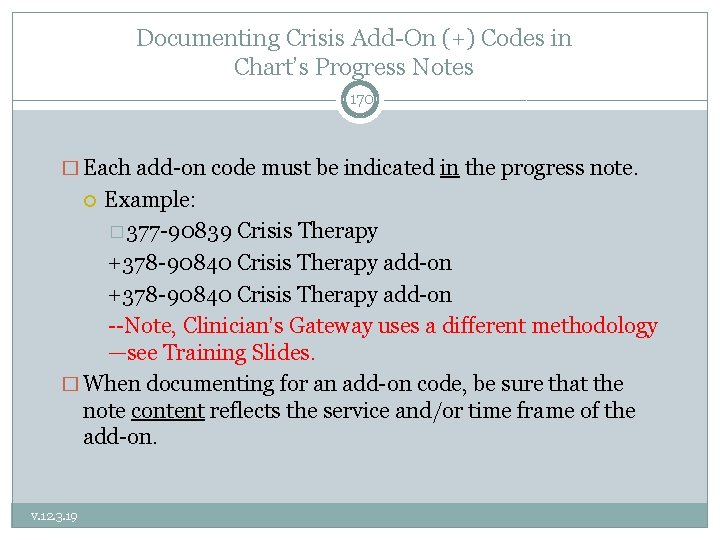
Documenting Crisis Add-On (+) Codes in Chart’s Progress Notes 170 � Each add-on code must be indicated in the progress note. Example: � 377 -90839 Crisis Therapy +378 -90840 Crisis Therapy add-on --Note, Clinician’s Gateway uses a different methodology —see Training Slides. � When documenting for an add-on code, be sure that the note content reflects the service and/or time frame of the add-on. v. 12. 3. 19
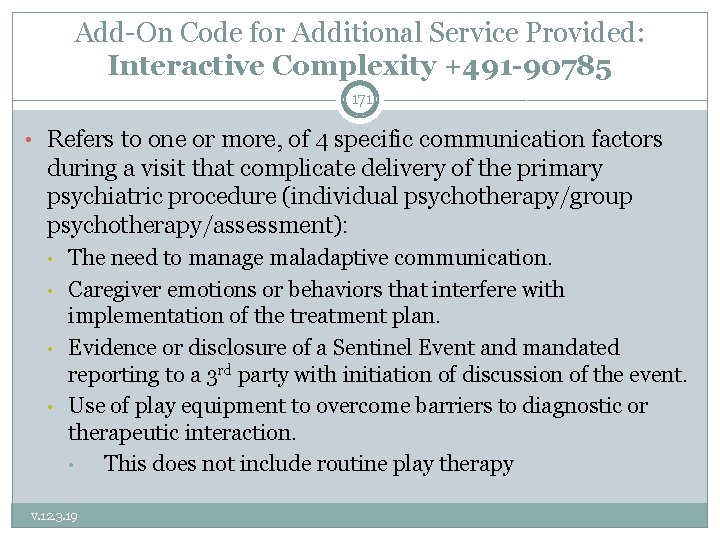
Add-On Code for Additional Service Provided: Interactive Complexity +491 -90785 171 • Refers to one or more, of 4 specific communication factors during a visit that complicate delivery of the primary psychiatric procedure (individual psychotherapy/group psychotherapy/assessment): • • The need to manage maladaptive communication. Caregiver emotions or behaviors that interfere with implementation of the treatment plan. Evidence or disclosure of a Sentinel Event and mandated reporting to a 3 rd party with initiation of discussion of the event. Use of play equipment to overcome barriers to diagnostic or therapeutic interaction. • This does not include routine play therapy v. 12. 3. 19
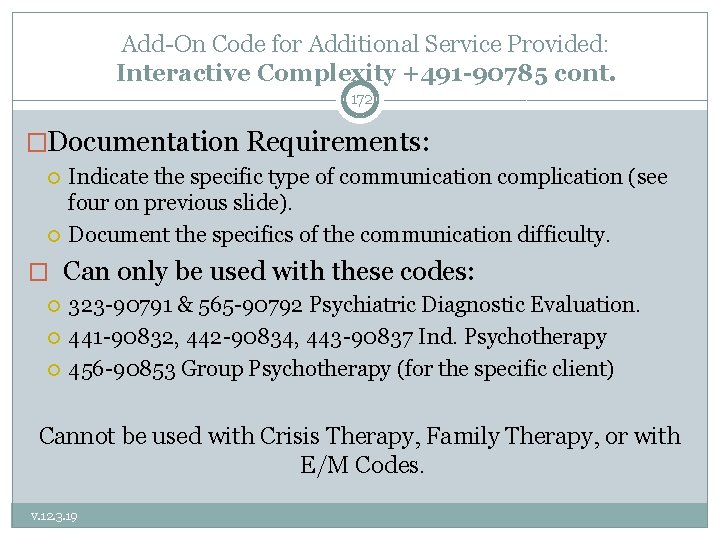
Add-On Code for Additional Service Provided: Interactive Complexity +491 -90785 cont. 172 �Documentation Requirements: Indicate the specific type of communication complication (see four on previous slide). Document the specifics of the communication difficulty. � Can only be used with these codes: 323 -90791 & 565 -90792 Psychiatric Diagnostic Evaluation. 441 -90832, 442 -90834, 443 -90837 Ind. Psychotherapy 456 -90853 Group Psychotherapy (for the specific client) Cannot be used with Crisis Therapy, Family Therapy, or with E/M Codes. v. 12. 3. 19
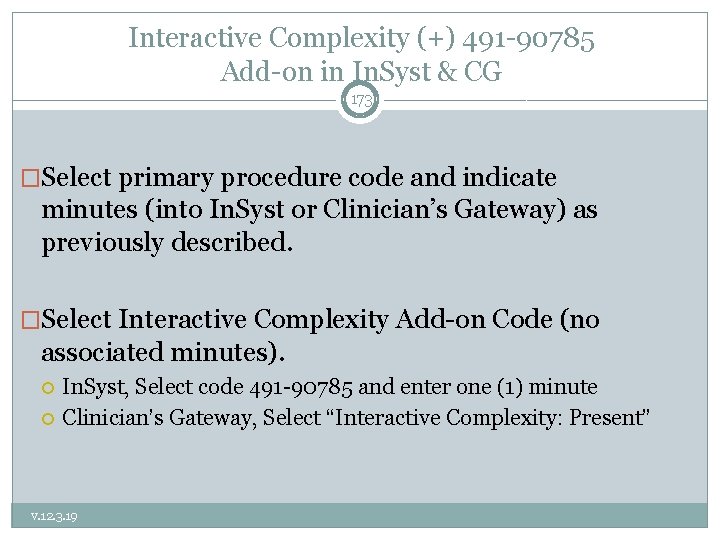
Interactive Complexity (+) 491 -90785 Add-on in In. Syst & CG 173 �Select primary procedure code and indicate minutes (into In. Syst or Clinician’s Gateway) as previously described. �Select Interactive Complexity Add-on Code (no associated minutes). In. Syst, Select code 491 -90785 and enter one (1) minute Clinician’s Gateway, Select “Interactive Complexity: Present” v. 12. 3. 19
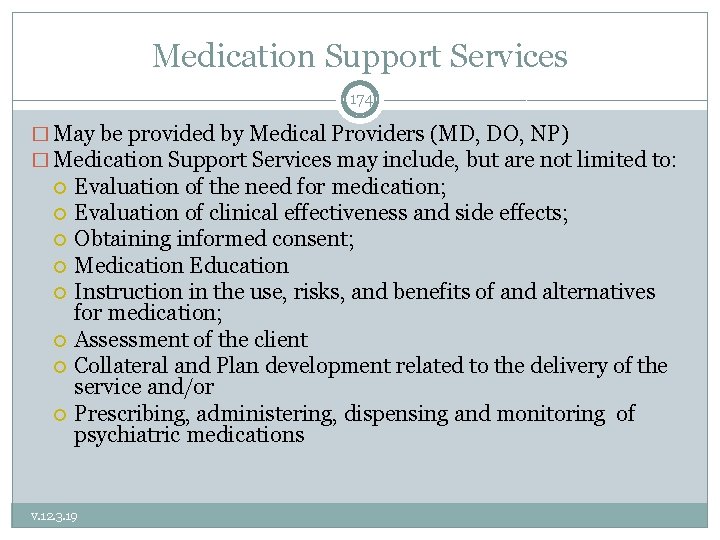
Medication Support Services 174 � May be provided by Medical Providers (MD, DO, NP) � Medication Support Services may include, but are not limited to: Evaluation of the need for medication; Evaluation of clinical effectiveness and side effects; Obtaining informed consent; Medication Education Instruction in the use, risks, and benefits of and alternatives for medication; Assessment of the client Collateral and Plan development related to the delivery of the service and/or Prescribing, administering, dispensing and monitoring of psychiatric medications v. 12. 3. 19
Medication Support Services cont. 175 � Contact and Site Requirements Medication Support Services may be either face-to-face or by telephone with the client or with significant support person(s) May be provided anywhere in the community 469 -90862 for Medication Management has been eliminated. v. 12. 3. 19
Evaluation and Management (E/M) Codes: 99### 176 � Two Methodologies for charting: Coding by the Elements—see QA Training Website for resources. Counseling and Coordination of Care: � Make up the great majority of client medication support services in Community Mental Health. � See slides below and QA Training Website for additional resources. v. 12. 3. 19
Evaluation and Management (E/M) Codes 177 � When “Counseling & Coordination of Care” exceeds 50% of face-to- face time, the E/M Code is selected on the basis of the face-to-face service time. � If “Counseling & Coordination of Care” was less than 50% of the face- to-face time, the E/M Code must be selected based on the complexity of the visit. Refer to E/M Clinical Documentation Training E/M Training Materials: � http: //www. acbhcs. org/providers/QA/training. htm � Scroll down to “Training Handouts & Resources” v. 12. 3. 19
E/M Codes: when >50% of f-f time is Counseling & Coordination of Care 178 � The majority of E/M services provided in Community Mental Health involve >50% of face-to-face time which is spent performing Counseling (aka in psychiatry as Supportive Psychotherapy) and Coordination of Care services. �Especially extended visits such as 645— 99214 & 646 -99215 � Psychiatrists often label what the CPT defines as “Counseling” as supportive psychotherapy. � The components of “Supportive Psychotherapy” are usually considered as overlapping with “Counseling” (as defined by CPT) and should not be claimed as E/M + Add-on Psychotherapy. � Such interventions are claimed as “Counseling and Coordination of Care” as part of the E/M visit. Claim E/M only. v. 12. 3. 19
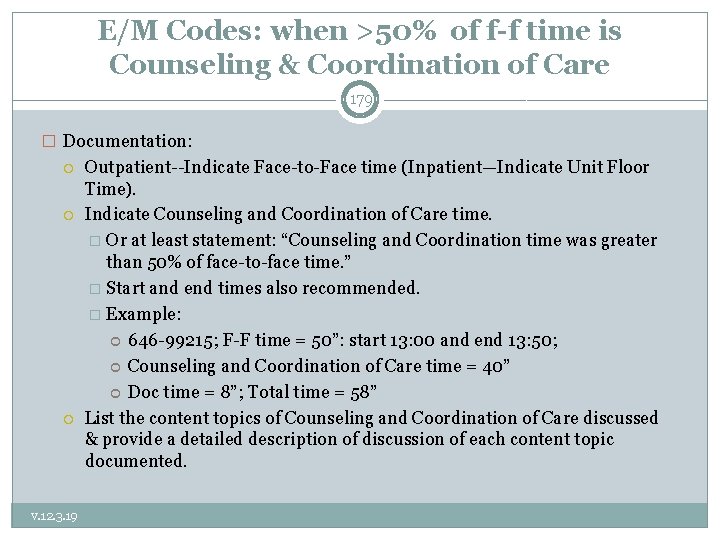
E/M Codes: when >50% of f-f time is Counseling & Coordination of Care 179 � Documentation: v. 12. 3. 19 Outpatient--Indicate Face-to-Face time (Inpatient—Indicate Unit Floor Time). Indicate Counseling and Coordination of Care time. � Or at least statement: “Counseling and Coordination time was greater than 50% of face-to-face time. ” � Start and end times also recommended. � Example: 646 -99215; F-F time = 50”: start 13: 00 and end 13: 50; Counseling and Coordination of Care time = 40” Doc time = 8”; Total time = 58” List the content topics of Counseling and Coordination of Care discussed & provide a detailed description of discussion of each content topic documented.
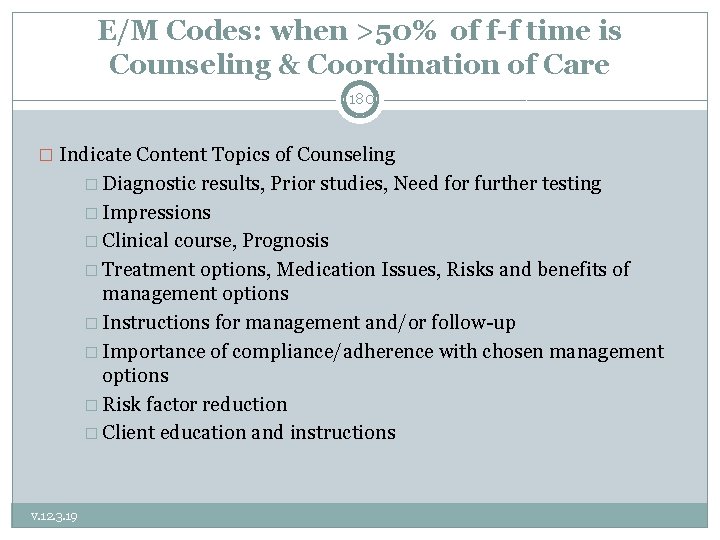
E/M Codes: when >50% of f-f time is Counseling & Coordination of Care 180 � Indicate Content Topics of Counseling � Diagnostic results, Prior studies, Need for further testing � Impressions � Clinical course, Prognosis � Treatment options, Medication Issues, Risks and benefits of management options � Instructions for management and/or follow-up � Importance of compliance/adherence with chosen management options � Risk factor reduction � Client education and instructions v. 12. 3. 19
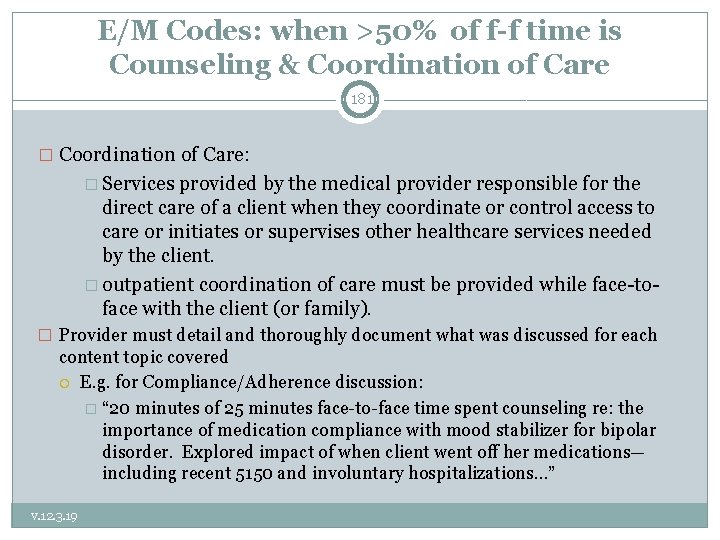
E/M Codes: when >50% of f-f time is Counseling & Coordination of Care 181 � Coordination of Care: � Services provided by the medical provider responsible for the direct care of a client when they coordinate or control access to care or initiates or supervises other healthcare services needed by the client. � outpatient coordination of care must be provided while face-toface with the client (or family). � Provider must detail and thoroughly document what was discussed for each content topic covered E. g. for Compliance/Adherence discussion: � “ 20 minutes of 25 minutes face-to-face time spent counseling re: the importance of medication compliance with mood stabilizer for bipolar disorder. Explored impact of when client went off her medications— including recent 5150 and involuntary hospitalizations…” v. 12. 3. 19
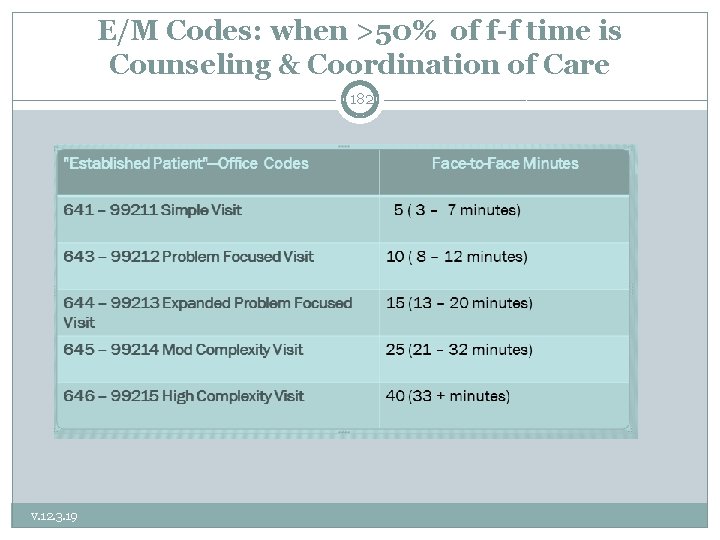
E/M Codes: when >50% of f-f time is Counseling & Coordination of Care 182 v. 12. 3. 19
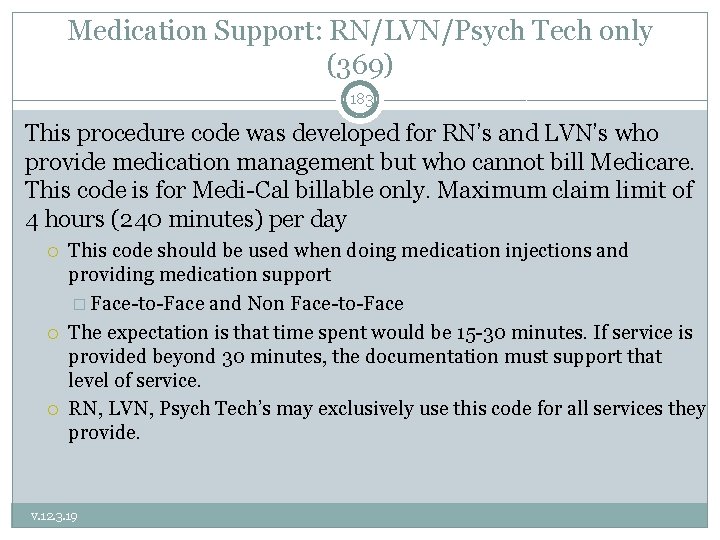
Medication Support: RN/LVN/Psych Tech only (369) 183 This procedure code was developed for RN’s and LVN’s who provide medication management but who cannot bill Medicare. This code is for Medi-Cal billable only. Maximum claim limit of 4 hours (240 minutes) per day This code should be used when doing medication injections and providing medication support � Face-to-Face and Non Face-to-Face The expectation is that time spent would be 15 -30 minutes. If service is provided beyond 30 minutes, the documentation must support that level of service. RN, LVN, Psych Tech’s may exclusively use this code for all services they provide. v. 12. 3. 19
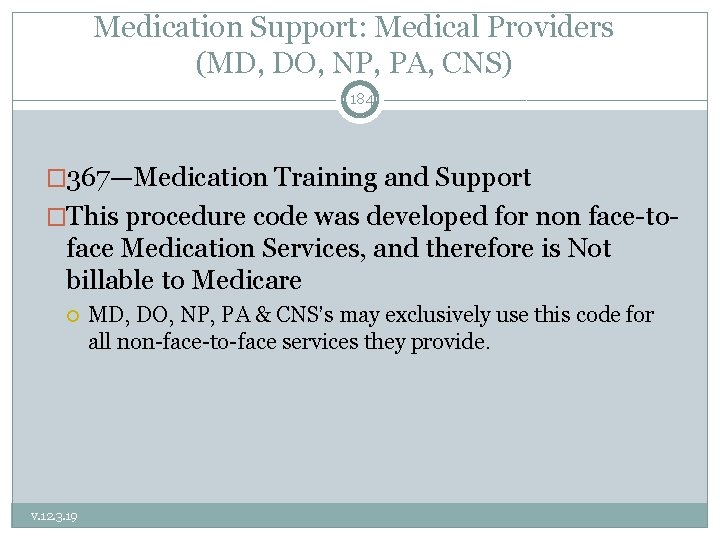
Medication Support: Medical Providers (MD, DO, NP, PA, CNS) 184 � 367—Medication Training and Support �This procedure code was developed for non face-to- face Medication Services, and therefore is Not billable to Medicare v. 12. 3. 19 MD, DO, NP, PA & CNS’s may exclusively use this code for all non-face-to-face services they provide.
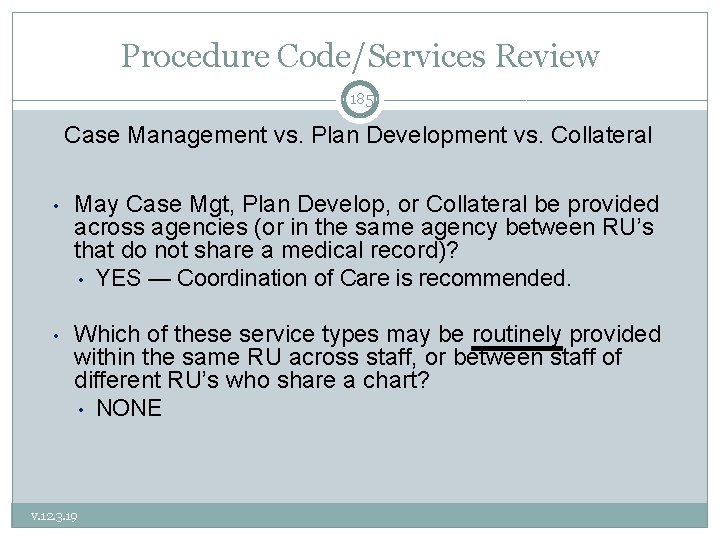
Procedure Code/Services Review 185 Case Management vs. Plan Development vs. Collateral • May Case Mgt, Plan Develop, or Collateral be provided across agencies (or in the same agency between RU’s that do not share a medical record)? • YES — Coordination of Care is recommended. • Which of these service types may be routinely provided within the same RU across staff, or between staff of different RU’s who share a chart? • NONE v. 12. 3. 19
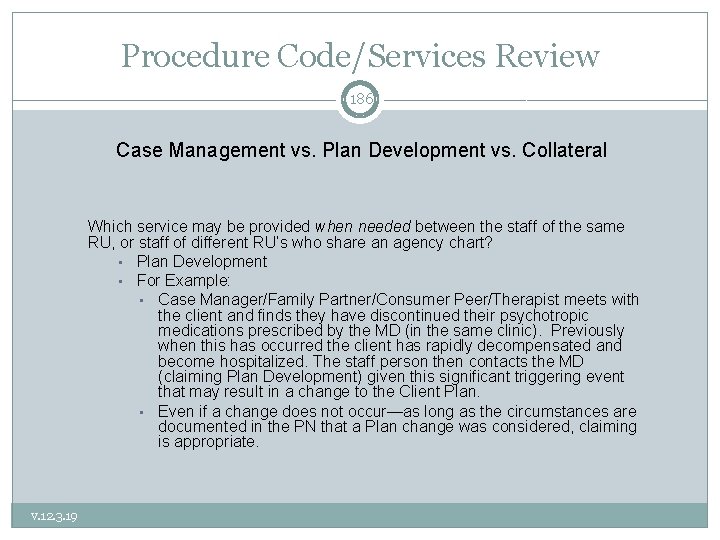
Procedure Code/Services Review 186 Case Management vs. Plan Development vs. Collateral Which service may be provided when needed between the staff of the same RU, or staff of different RU’s who share an agency chart? • Plan Development • For Example: • Case Manager/Family Partner/Consumer Peer/Therapist meets with the client and finds they have discontinued their psychotropic medications prescribed by the MD (in the same clinic). Previously when this has occurred the client has rapidly decompensated and become hospitalized. The staff person then contacts the MD (claiming Plan Development) given this significant triggering event that may result in a change to the Client Plan. • Even if a change does not occur—as long as the circumstances are documented in the PN that a Plan change was considered, claiming is appropriate. v. 12. 3. 19
Procedure Code/Services 187 Case Management vs. Plan Development vs. Collateral Another example of billable intra-agency Plan Development: • The clinician writing an annual plan has read the medical record on an on-going basis. The clinician believes that coordinating with the MD and Family Partner to finalize the plan will facilitate the creation of MH Objectives that each of the providers are focusing on with the client. v. 12. 3. 19
Procedure Code/Services 188 Case Management vs. Plan Development vs. Collateral Examples of incorrectly claimed intra-agency activities as Plan Development. • MH Trainee writes up monthly summary of client’s progress in psychotherapy and in a meeting distinct from weekly supervision shares this with the LPHA for collaboration and monitoring of client’s success towards meeting MH Objectives. • Meeting with one’s clinical supervisor (such as when collecting hours toward licensure) for any activity may never be claimed. • Meeting with an outside therapist around how to best proceed — with an eating disorders case you rarely have the opportunity to treat — is a consultation for professional development and never claimed. v. 12. 3. 19
Procedure Code/Services 189 Case Management vs. Plan Development vs. Collateral When is intra-agency staff claiming not allowed? • When one provider may simply read the medical record without there being an unnecessary delay in treatment services. • For example: • • v. 12. 3. 19 In preparation for meeting with a client, that staff person reads the medical record entries from other staff since their last client intervention. Then they are up to date with the current status of the client’s MH Objectives.
Procedure Code/Services 190 Case Management vs. Plan Development vs. Collateral Examples of incorrectly claimed intra-agency activities as Collateral: • Clinician meets weekly with family partner after the home visits with parents of a child client to coordinate their services to better meet the client’s MH Objectives. • In non-urgent situations, reading each others’ Progress Notes should be adequate. The above example is more like supervision. • Case Manager accompanies client to psychiatrist appointment to communicate updates in client’s progress with a medication trial. • Again, reading each other’s notes is adequate unless an urgent matter arises that needs to be discussed promptly. v. 12. 3. 19
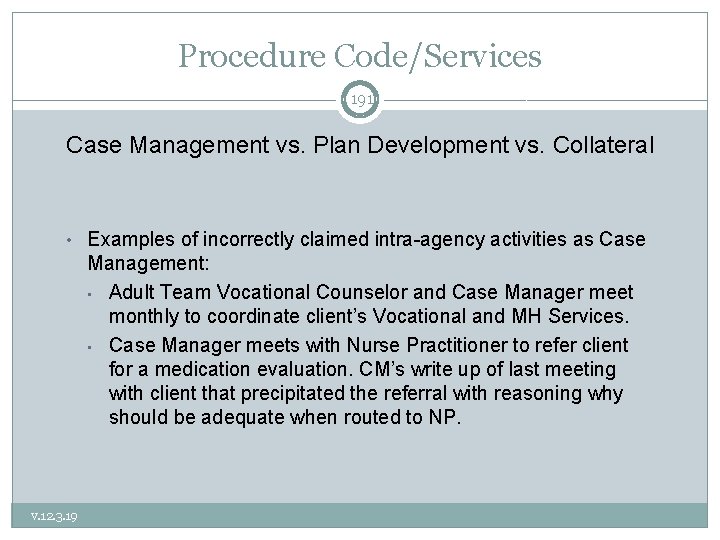
Procedure Code/Services 191 Case Management vs. Plan Development vs. Collateral • Examples of incorrectly claimed intra-agency activities as Case Management: • Adult Team Vocational Counselor and Case Manager meet monthly to coordinate client’s Vocational and MH Services. • Case Manager meets with Nurse Practitioner to refer client for a medication evaluation. CM’s write up of last meeting with client that precipitated the referral with reasoning why should be adequate when routed to NP. v. 12. 3. 19
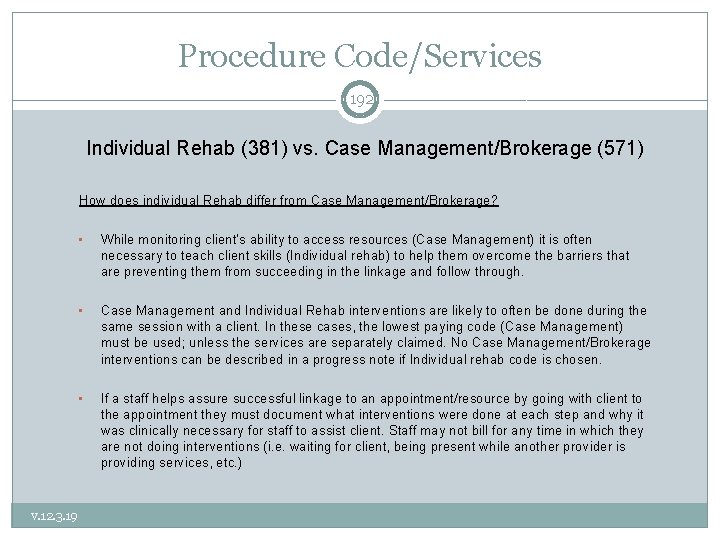
Procedure Code/Services 192 Individual Rehab (381) vs. Case Management/Brokerage (571) How does individual Rehab differ from Case Management/Brokerage? v. 12. 3. 19 • While monitoring client’s ability to access resources (Case Management) it is often necessary to teach client skills (Individual rehab) to help them overcome the barriers that are preventing them from succeeding in the linkage and follow through. • Case Management and Individual Rehab interventions are likely to often be done during the same session with a client. In these cases, the lowest paying code (Case Management) must be used; unless the services are separately claimed. No Case Management/Brokerage interventions can be described in a progress note if Individual rehab code is chosen. • If a staff helps assure successful linkage to an appointment/resource by going with client to the appointment they must document what interventions were done at each step and why it was clinically necessary for staff to assist client. Staff may not bill for any time in which they are not doing interventions (i. e. waiting for client, being present while another provider is providing services, etc. )
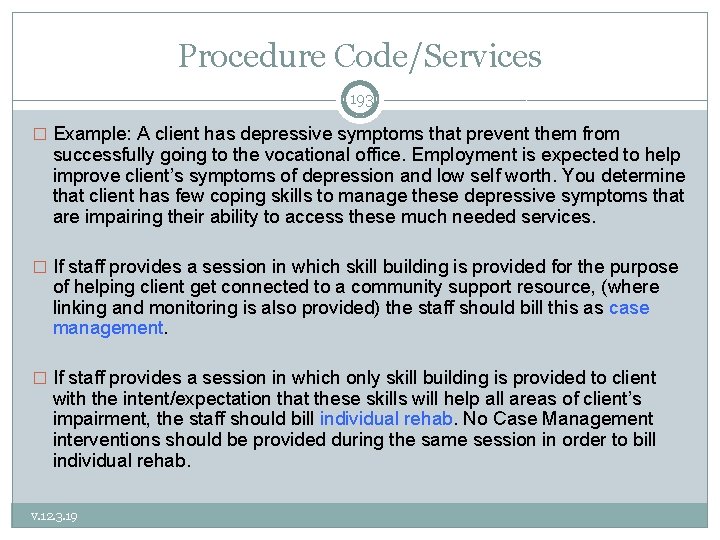
Procedure Code/Services 193 � Example: A client has depressive symptoms that prevent them from successfully going to the vocational office. Employment is expected to help improve client’s symptoms of depression and low self worth. You determine that client has few coping skills to manage these depressive symptoms that are impairing their ability to access these much needed services. � If staff provides a session in which skill building is provided for the purpose of helping client get connected to a community support resource, (where linking and monitoring is also provided) the staff should bill this as case management. � If staff provides a session in which only skill building is provided to client with the intent/expectation that these skills will help all areas of client’s impairment, the staff should bill individual rehab. No Case Management interventions should be provided during the same session in order to bill individual rehab. v. 12. 3. 19

v. 12. 3. 19 194
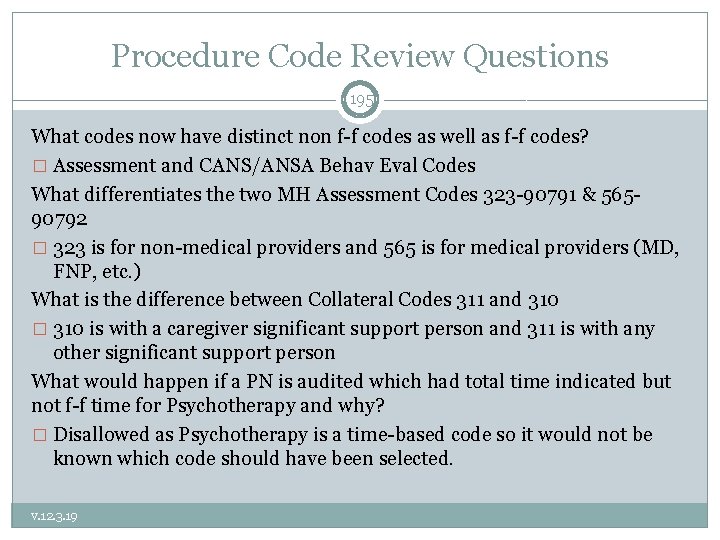
Procedure Code Review Questions 195 What codes now have distinct non f-f codes as well as f-f codes? � Assessment and CANS/ANSA Behav Eval Codes What differentiates the two MH Assessment Codes 323 -90791 & 56590792 � 323 is for non-medical providers and 565 is for medical providers (MD, FNP, etc. ) What is the difference between Collateral Codes 311 and 310 � 310 is with a caregiver significant support person and 311 is with any other significant support person What would happen if a PN is audited which had total time indicated but not f-f time for Psychotherapy and why? � Disallowed as Psychotherapy is a time-based code so it would not be known which code should have been selected. v. 12. 3. 19
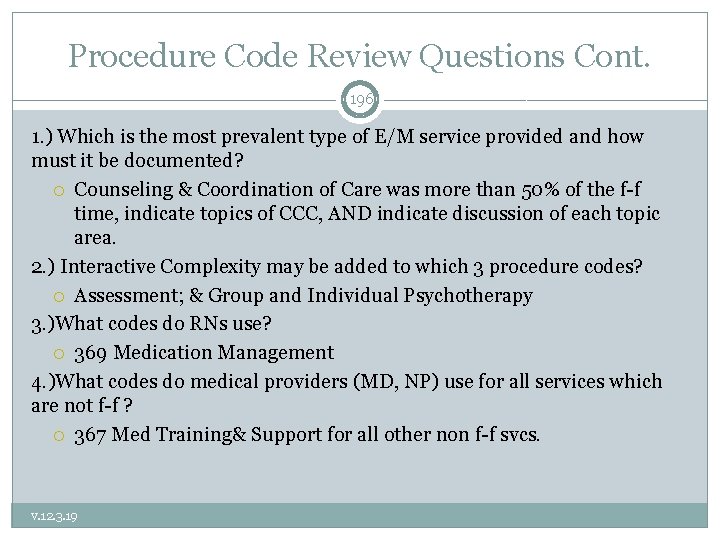
Procedure Code Review Questions Cont. 196 1. ) Which is the most prevalent type of E/M service provided and how must it be documented? Counseling & Coordination of Care was more than 50% of the f-f time, indicate topics of CCC, AND indicate discussion of each topic area. 2. ) Interactive Complexity may be added to which 3 procedure codes? Assessment; & Group and Individual Psychotherapy 3. )What codes do RNs use? 369 Medication Management 4. )What codes do medical providers (MD, NP) use for all services which are not f-f ? 367 Med Training& Support for all other non f-f svcs. v. 12. 3. 19
Sign-up for QA Provider Website Updates 197 v. 12. 3. 19
198 with v. 12. 3. 19
- Slides: 198