
Academy for Faculty Advancement Personality Factors Career Development
- Slides: 21
Academy for Faculty Advancement: Personality Factors & Career Development Stephen Brady, Ph. D. Director, Mental Health Counseling and Behavioral Medicine Associate Professor of Psychiatry BUSM
Objectives � To discuss the results of the Sixteen Personality Factor Questionnaire (16 PF) � To understand how these personality factors and emotional intelligence impact career development � To brainstorm ideas for career advancement which utilize personality strengths and minimize challenges
The Sixteen Personality Factor Questionnaire (16 PF) � Factor Analysis of primary components of personality (Raymond Cattell) � Copyright 1993 by the Institute for Personality and Ability Testing � 185 Items with 16 primary personality variables � Psychometric properties include; internal reliability averages. 76 with a range of. 68 to. 87, test-retest at. 80 for 2 weeks and. 70 for 2 months
The Sixteen Personality Factor Questionnaire (16 PF) � Global ◦ ◦ ◦ Factor Scale Descriptors Extraversion Anxiety Tough-Mindedness Independence Self-Control
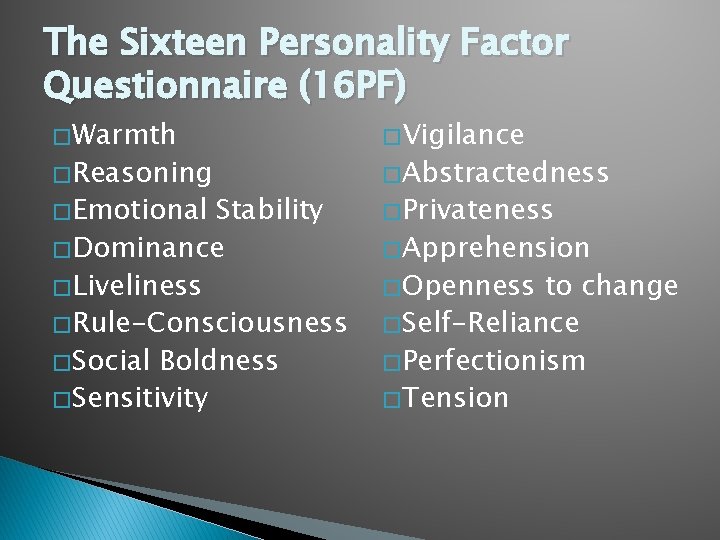
The Sixteen Personality Factor Questionnaire (16 PF) � Warmth � Vigilance � Emotional � Privateness � Reasoning Stability � Dominance � Liveliness � Rule-Consciousness � Social Boldness � Sensitivity � Abstractedness � Apprehension � Openness to change � Self-Reliance � Perfectionism � Tension
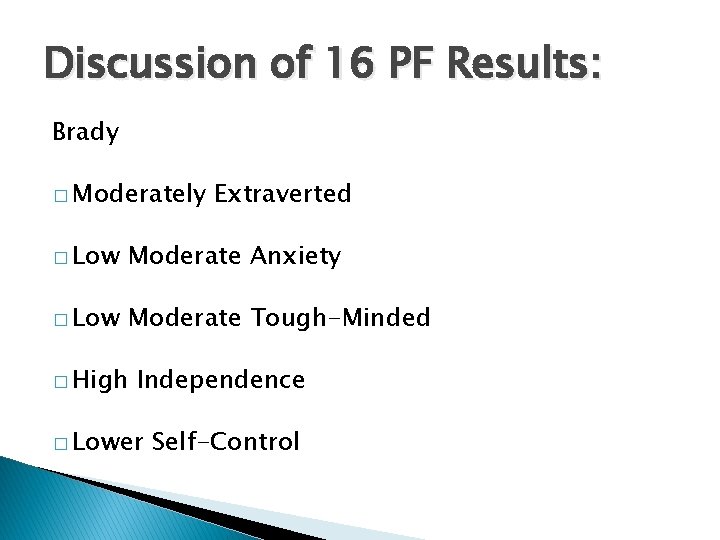
Discussion of 16 PF Results: Brady � Moderately Extraverted � Low Moderate Anxiety � Low Moderate Tough-Minded � High Independence � Lower Self-Control
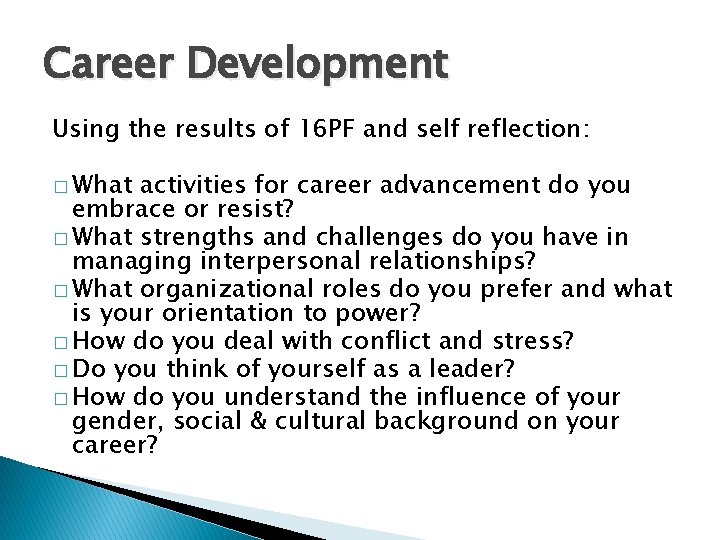
Career Development Using the results of 16 PF and self reflection: � What activities for career advancement do you embrace or resist? � What strengths and challenges do you have in managing interpersonal relationships? � What organizational roles do you prefer and what is your orientation to power? � How do you deal with conflict and stress? � Do you think of yourself as a leader? � How do you understand the influence of your gender, social & cultural background on your career?
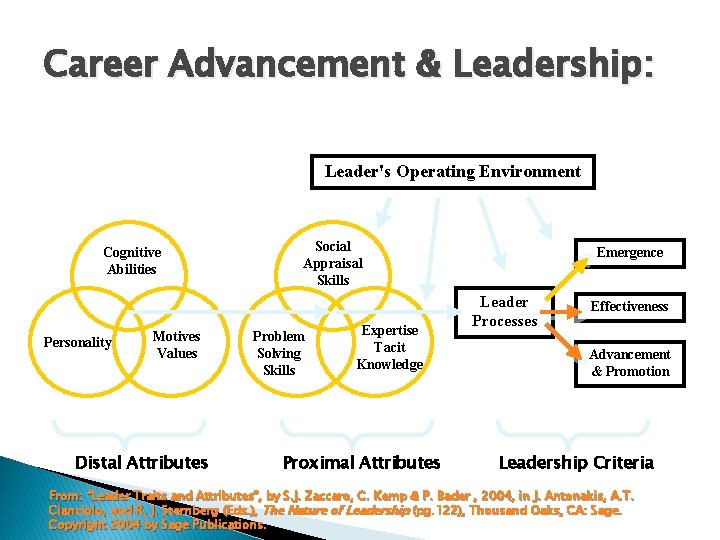
Career Advancement & Leadership: Leader's Operating Environment Cognitive Abilities Personality Motives Values Distal Attributes Social Appraisal Skills Problem Solving Skills Expertise Tacit Knowledge Proximal Attributes Emergence Leader Processes Effectiveness Advancement & Promotion Leadership Criteria From: “Leader Traits and Attributes”, by S. J. Zaccaro, C. Kemp & P. Bader , 2004, in J. Antonakis, A. T. Cianciolo, and R. J. Sternberg (Eds. ), The Nature of Leadership (pg. 122), Thousand Oaks, CA: Sage. Copyright 2004 by Sage Publications.
Distal Attributes: Personality & Emotional Intelligence � Being aware of emotions � Identifying your own emotions � Identifying others emotions � Managing your own emotions � Managing others emotions � Using emotions to problem solve � Expressing emotions adaptively
Distal Attributes: Cognitive Ability & Motives � No more than moderate relationship between intelligence and leadership ability. Smart people tend to overestimate its importance. Practical Intelligence is key (Riggio, Murphy & Pirozzolo, 2002; Spreitzer, Mc. Call & Mahoney, 1997)…. � Motives and Values: Do you seek power for its own sake or to get something done? Wisdom from a Patient….
Characteristics of Intelligence which Promote Change and Adaptation � Cognitive complexity & flexibility � Social intelligence � Emotional intelligence � Adaptability � Openness � Tolerance for ambiguity (Zacarro, 2007)
Proximal Attributes: Systems Model of Leadership � How one formulates, makes and acts on decisions � Synthesis of wisdom, intelligence and creativity (WICS) � Some aspects of these traits may be modifiable, flexible and dynamic (Sternberg, American Psychologist, 2007)
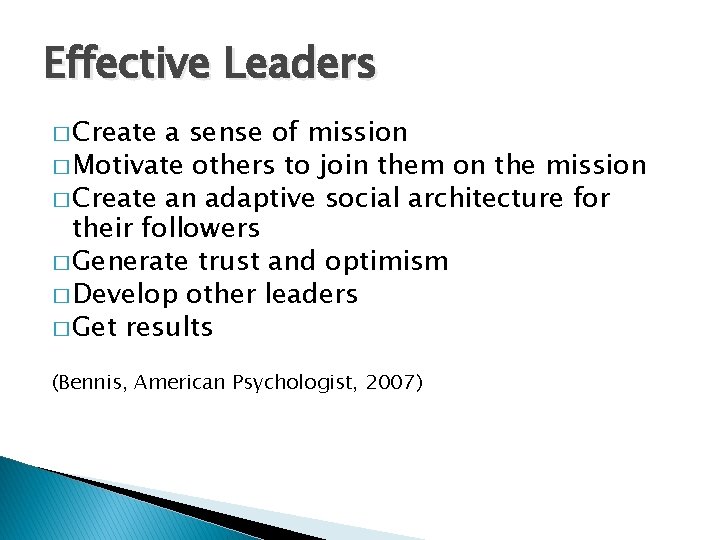
Effective Leaders � Create a sense of mission � Motivate others to join them on the mission � Create an adaptive social architecture for their followers � Generate trust and optimism � Develop other leaders � Get results (Bennis, American Psychologist, 2007)
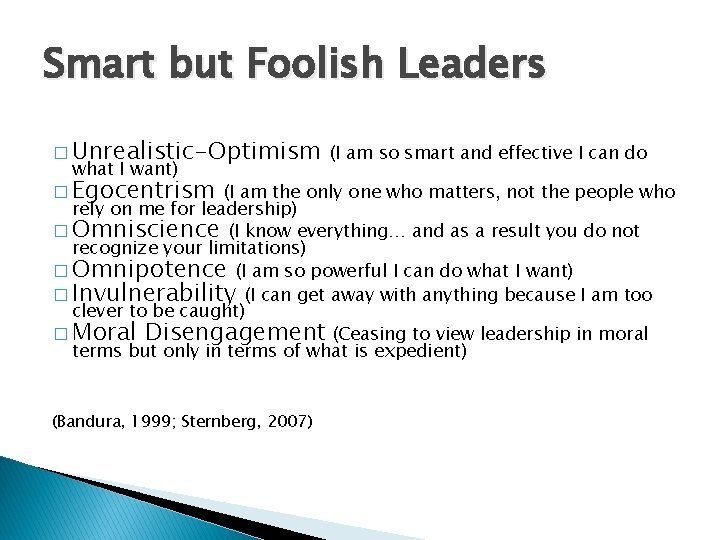
Smart but Foolish Leaders � Unrealistic-Optimism (I am so smart and effective I can do what I want) � Egocentrism (I am the only one who matters, not the people who rely on me for leadership) � Omniscience (I know everything… and as a result you do not recognize your limitations) � Omnipotence (I am so powerful I can do what I want) � Invulnerability (I can get away with anything because I am too clever to be caught) � Moral Disengagement (Ceasing to view leadership in moral terms but only in terms of what is expedient) (Bandura, 1999; Sternberg, 2007)
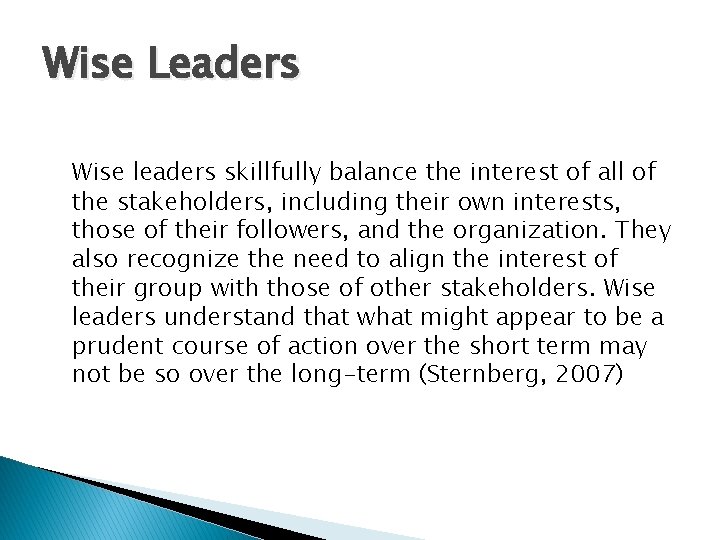
Wise Leaders Wise leaders skillfully balance the interest of all of the stakeholders, including their own interests, those of their followers, and the organization. They also recognize the need to align the interest of their group with those of other stakeholders. Wise leaders understand that what might appear to be a prudent course of action over the short term may not be so over the long-term (Sternberg, 2007)
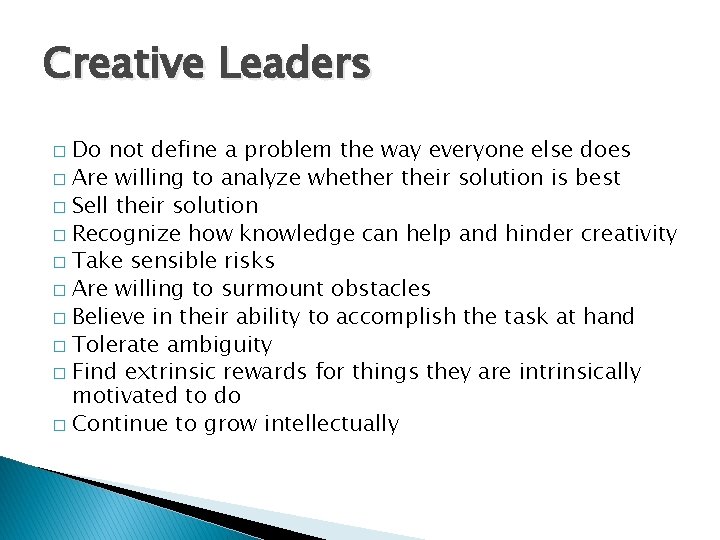
Creative Leaders Do not define a problem the way everyone else does � Are willing to analyze whether their solution is best � Sell their solution � Recognize how knowledge can help and hinder creativity � Take sensible risks � Are willing to surmount obstacles � Believe in their ability to accomplish the task at hand � Tolerate ambiguity � Find extrinsic rewards for things they are intrinsically motivated to do � Continue to grow intellectually �
The Role of Situation in Leadership � Effectiveness is impacted by situational factors not under leader control � Situations shape how leaders behave � Situations influence the consequences of leader behavior (an effective leadership style in one situation may not be in another)
The Role of Situation in Leadership (Vroom and Jago, 2007) � Leadership depends upon the situation � Leadership is a process not a person � The process involves motivating others � Incentives…both intrinsic and extrinsic matter � Collaboration in pursuit of a goal � “Great Things” are in the minds of leaders and followers and may not be desired by all
The Role of Followers � Followers play an active role in constructing leadership relationships � Empowering the leader and influencing behavior � Determining the consequences of the leadership relationship � Successful leadership may be understood as the fit or match between a leaders traits, style and orientation and follower maturity and situational challenges (Avolio, 2007)
What kind of leader are you? � Briefly describe your leadership style � What could get in the way of you being a wise leader? � What is one concern you have about being a leader. � What do you want feedback about?
Academy for Faculty Development: Personality Factors & Career Development Stephen Brady, Ph. D. Director, Mental Health Counseling and Behavioral Medicine Associate Professor of Psychiatry, BUSM sbrady@bu. edu