
Academy Digitizing Books in Preservation Quality Comparison between
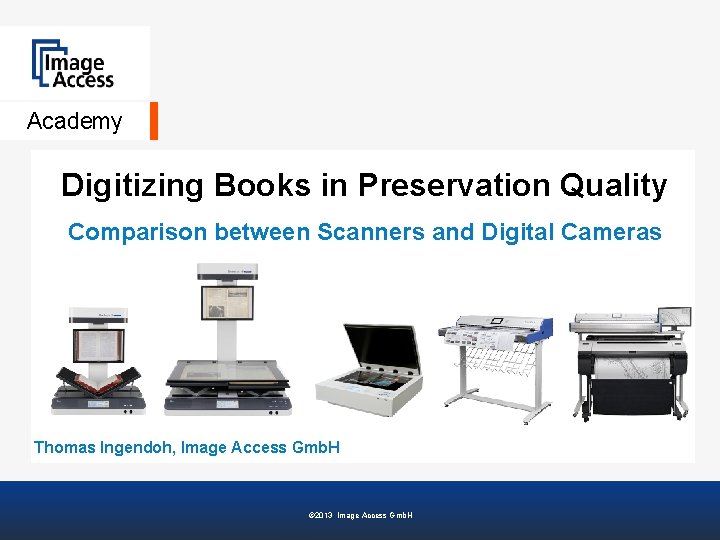
Academy Digitizing Books in Preservation Quality Comparison between Scanners and Digital Cameras Thomas Ingendoh, Image Access Gmb. H © 2013 Image Access Gmb. H
Definition of Terms Merriam-Webster Definition Scan or picture? • Scan|ner: a device that scans a document line by line especially for use or storage on a computer. • Di|gi|tal cam|er|a: a camera that records images as digital data instead of on analog film. 14. 12. 2021 © 2013 Image Access Gmb. H 2
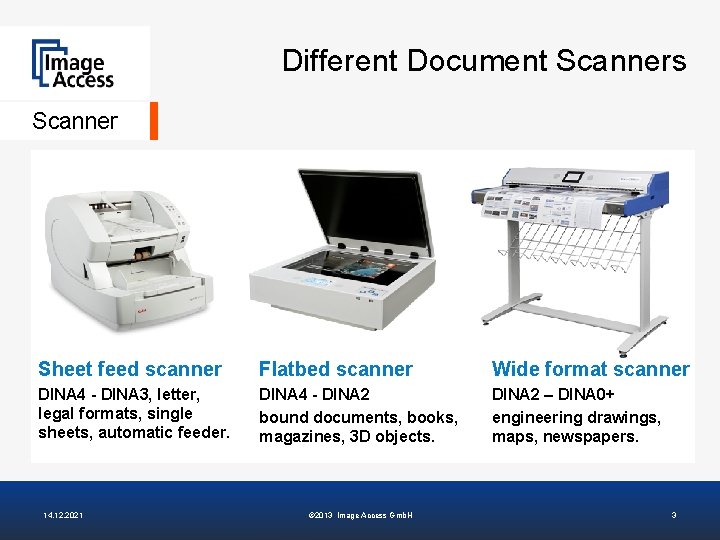
Different Document Scanners Scanner Sheet feed scanner Flatbed scanner Wide format scanner DINA 4 - DINA 3, letter, legal formats, single sheets, automatic feeder. DINA 4 - DINA 2 bound documents, books, magazines, 3 D objects. DINA 2 – DINA 0+ engineering drawings, maps, newspapers. 14. 12. 2021 © 2013 Image Access Gmb. H 3
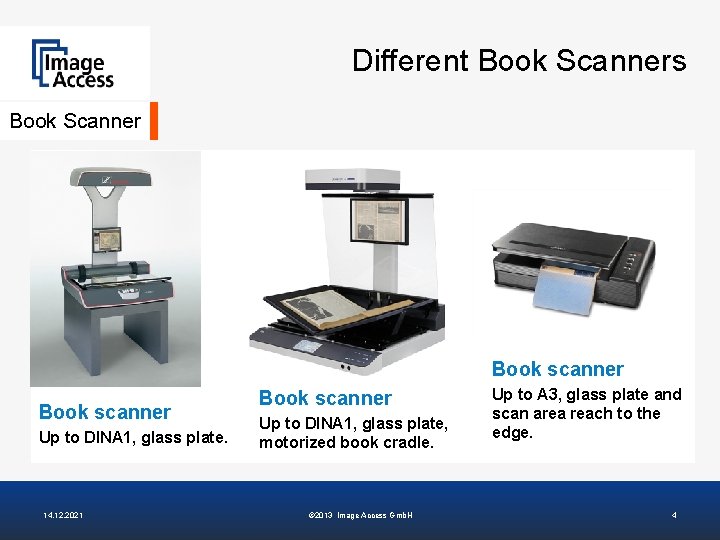
Different Book Scanners Book Scanner Book scanner Up to DINA 1, glass plate. 14. 12. 2021 Book scanner Up to DINA 1, glass plate, motorized book cradle. © 2013 Image Access Gmb. H Up to A 3, glass plate and scan area reach to the edge. 4
CCD Image Sensor Technology Line sensor versa area sensor! • All manufacturers of scanners use line sensors to capture documents line per line, which is called scanning. • These are well known companies like Avision, Canon, Contex, Colortrac, Epson, Fujitsu, Kip, Kodak, Microtek, Panasonic, Zeutschel and others. • Line sensors and area sensors use the CCD technology. 14. 12. 2021 © 2013 Image Access Gmb. H same 5
CCD Image Sensor Technology Line sensor versa area sensor! • Line cameras have higher resolution, better color fidelity, less noise and no pixel defects. This is why all scanner vendors use the same well established technology. • A few companies use digital cameras to take pictures of documents. • A picture of a document is no substitute for a scan of a document. 14. 12. 2021 © 2013 Image Access Gmb. H 6
Technology Advantages of Line Sensors for Book Scanning • • Real RGB pixels instead of Bayer pattern artifacts. • • Larger pixel size means less noise. • Dynamically changing focus to follow the curvature of an open book is impossible with area sensors. Significantly higher system resolution. Entry level book scanners can have 200 megapixels (Mp) compared to 50 Mp currently available on the most expensive digital cameras. Concentrated, high power illumination of only the scanning area reduces the influence of ambient light. 14. 12. 2021 © 2013 Image Access Gmb. H 7
Technology Advantages of Area Sensors for Book Scanning • • Price? • • 80 Megapixel digital cameras sell for $ 20, 000 and more. • Do the camera systems, that claim to be book “scanners“, always ship with the megapixels listed in their brochures? The 50 Mp chip KAF 50100 made by True. Sense (formerly Kodak) has a price tag of $ 3, 600 in quantities of >10. This does not include the necessary electronic components and the PCB. A huge price reduction is very unlikely due to the large amount of silicon necessary. 14. 12. 2021 © 2013 Image Access Gmb. H 8
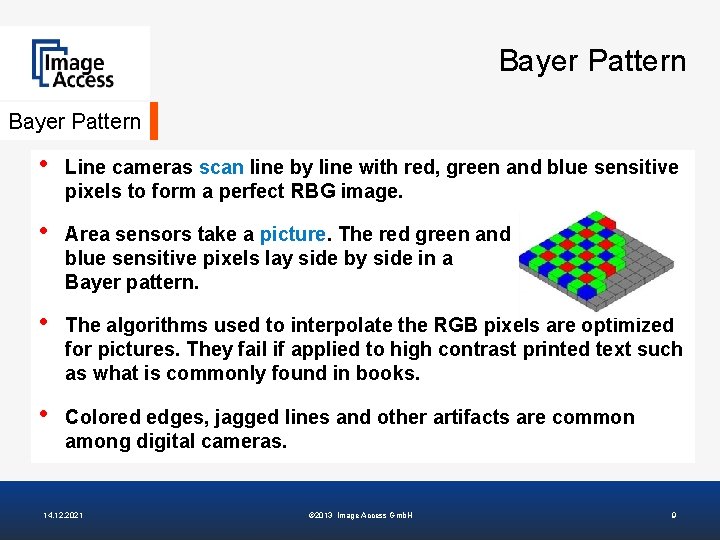
Bayer Pattern • Line cameras scan line by line with red, green and blue sensitive pixels to form a perfect RBG image. • Area sensors take a picture. The red green and blue sensitive pixels lay side by side in a Bayer pattern. • The algorithms used to interpolate the RGB pixels are optimized for pictures. They fail if applied to high contrast printed text such as what is commonly found in books. • Colored edges, jagged lines and other artifacts are common among digital cameras. 14. 12. 2021 © 2013 Image Access Gmb. H 9
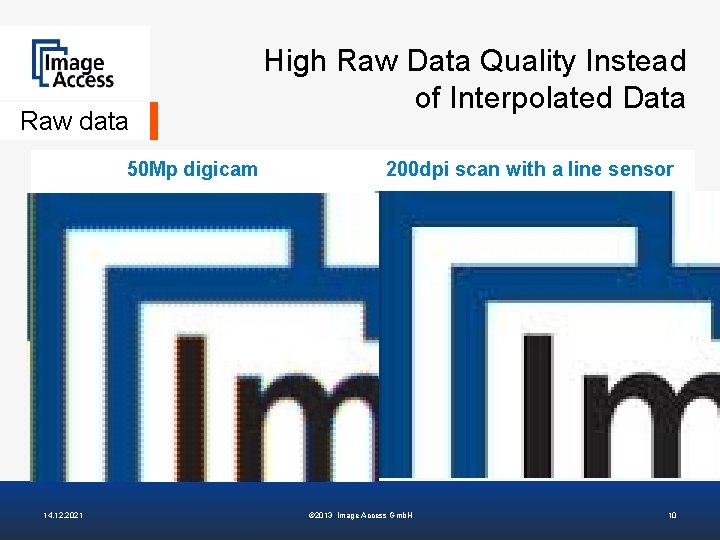
Raw data 50 Mp digicam 14. 12. 2021 High Raw Data Quality Instead of Interpolated Data 200 dpi scan with a line sensor © 2013 Image Access Gmb. H 10
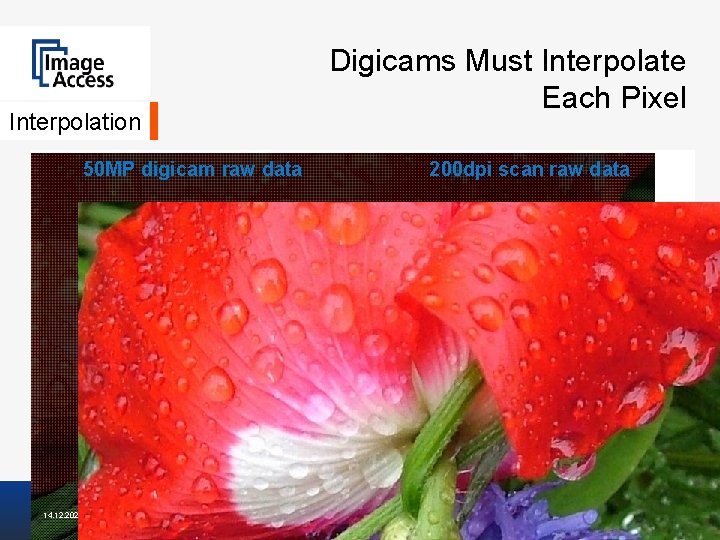
Interpolation Digicams Must Interpolate Each Pixel 200 dpi scan raw data 50 MP digicam raw data 14. 12. 2021 © 2013 Image Access Gmb. H 11
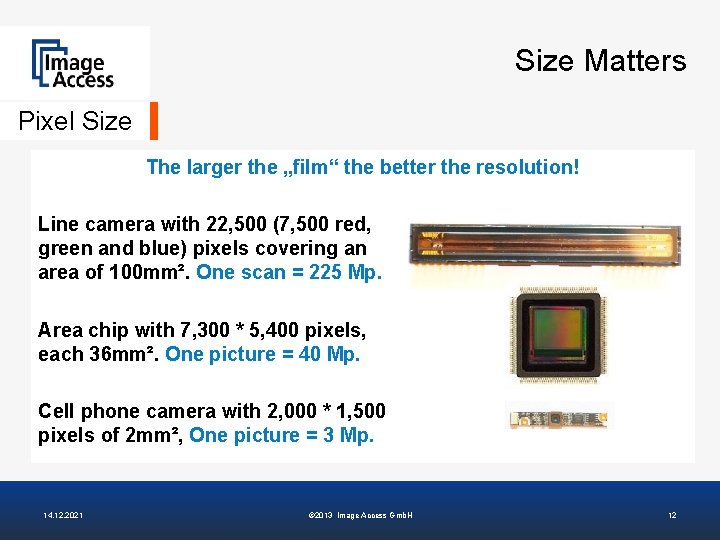
Size Matters Pixel Size The larger the „film“ the better the resolution! Line camera with 22, 500 (7, 500 red, green and blue) pixels covering an area of 100 mm². One scan = 225 Mp. Area chip with 7, 300 * 5, 400 pixels, each 36 mm². One picture = 40 Mp. Cell phone camera with 2, 000 * 1, 500 pixels of 2 mm², One picture = 3 Mp. 14. 12. 2021 © 2013 Image Access Gmb. H 12
Noise Reduces Resolution Pixel Size Larger pixels collect more photons • Digital cameras with their small pixel size can collect fewer photons than line scanner cameras. • Photon noise is cut in half if the pixel size (edge length) doubles. The recommended pixel size for preservation quality scanning is 8 x 8µm minimum. • Noise always reduces resolution. Digicams reduce noise via clever software algorithms at the expense of resolution. 14. 12. 2021 © 2013 Image Access Gmb. H 13
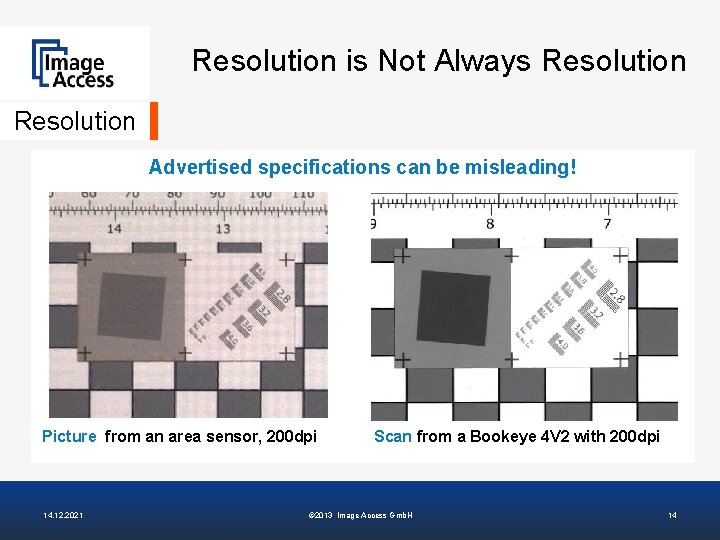
Resolution is Not Always Resolution Advertised specifications can be misleading! Picture from an area sensor, 200 dpi 14. 12. 2021 Scan from a Bookeye 4 V 2 with 200 dpi © 2013 Image Access Gmb. H 14
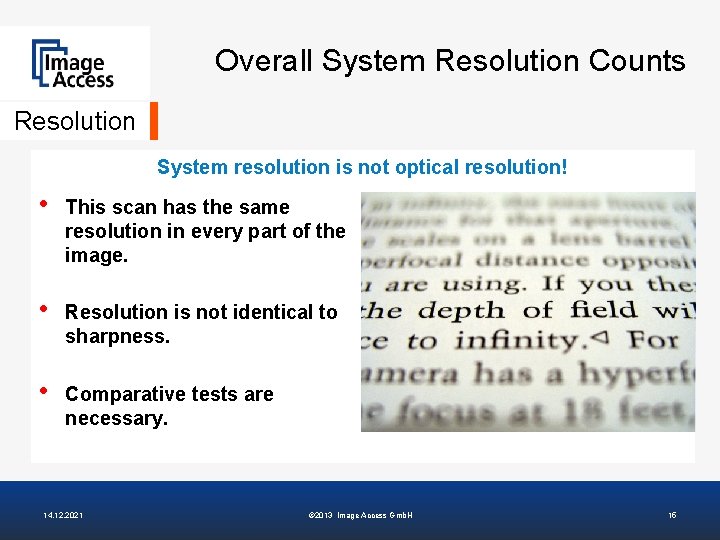
Overall System Resolution Counts Resolution System resolution is not optical resolution! • This scan has the same resolution in every part of the image. • Resolution is not identical to sharpness. • Comparative tests are necessary. 14. 12. 2021 © 2013 Image Access Gmb. H 15
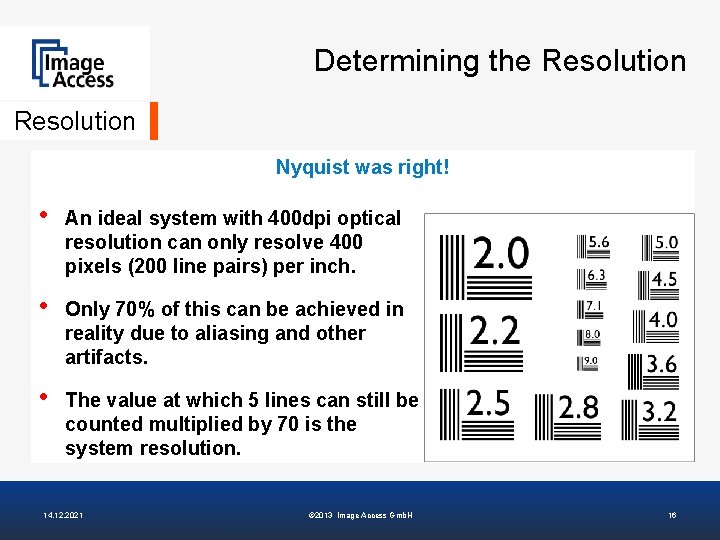
Determining the Resolution Nyquist was right! • An ideal system with 400 dpi optical resolution can only resolve 400 pixels (200 line pairs) per inch. • Only 70% of this can be achieved in reality due to aliasing and other artifacts. • The value at which 5 lines can still be counted multiplied by 70 is the system resolution. 14. 12. 2021 © 2013 Image Access Gmb. H 16
Controlled Light, Good Results Light No movie set without lighting! • Book scanners are open systems and thus need a high intensity light source of good quality to overcome the influence of uncontrolled ambient light. • All book scanners move a light bar synchronously to the line sensor, either from left to right or top to bottom. • The exposure time per scan line is < 1/1000 of a second. Digicams operate at exposure times up to 1 s. -> Camera shake • Book camera systems either do not have a light source at all or only a weak one which illuminates the whole scanning area. 14. 12. 2021 © 2013 Image Access Gmb. H 17
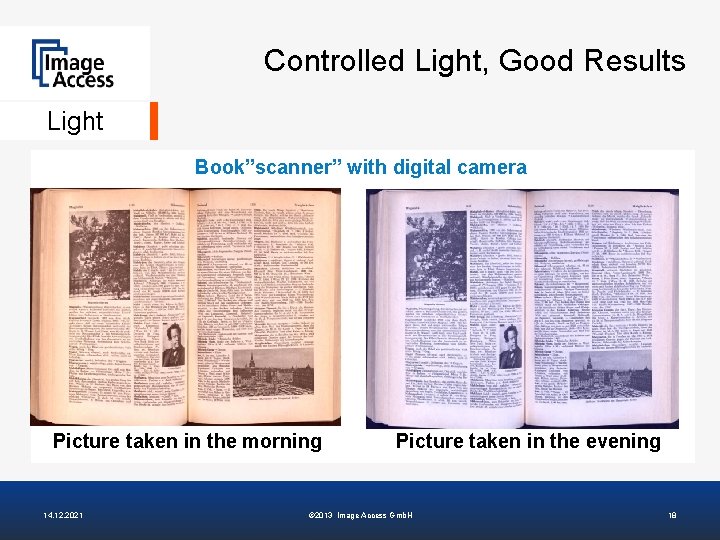
Controlled Light, Good Results Light Book”scanner” with digital camera Picture taken in the morning 14. 12. 2021 Picture taken in the evening © 2013 Image Access Gmb. H 18
Controlled Light, Good Results Light Minimum requirements for a professional digitization project • • External light level should be kept below 500 lux. • Scanning light should come from high quality LEDs and should be above 5, 000 lux in the scanning region. • A white balance must be performed at the final destination of the scanner. No direct sunlight, no light from spotlights, flood lights or other high intensity light sources allowed on the scanning bed. 14. 12. 2021 © 2013 Image Access Gmb. H 19
Dynamic Focus, Best Results Depth of Field Depth of field • The depth of field is the variation of the distance to the scanned object, in which the image appears equally sharp or in focus. • The lower the overall system resolution, the larger the depth of field. • • Fixed or autofocus digital cameras have a small depth of field. If scanning books, a dynamically adjusted focal system yields the best results. 14. 12. 2021 © 2013 Image Access Gmb. H 20
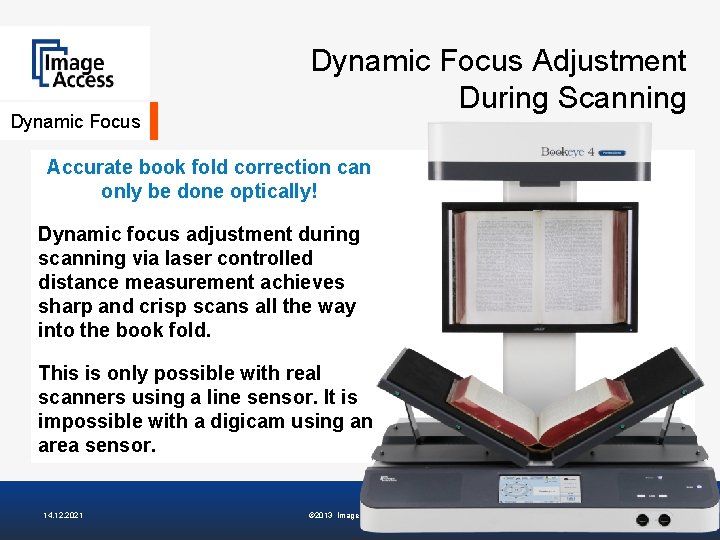
Dynamic Focus Adjustment During Scanning Accurate book fold correction can only be done optically! Dynamic focus adjustment during scanning via laser controlled distance measurement achieves sharp and crisp scans all the way into the book fold. This is only possible with real scanners using a line sensor. It is impossible with a digicam using an area sensor. 14. 12. 2021 © 2013 Image Access Gmb. H 21
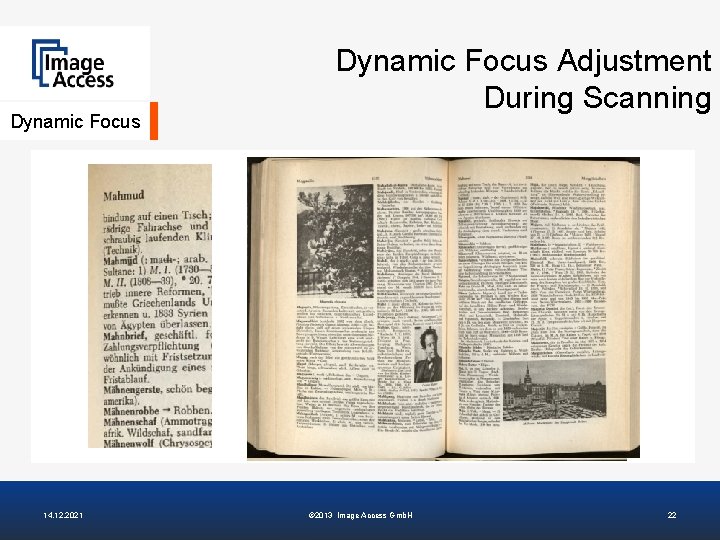
Dynamic Focus 14. 12. 2021 Dynamic Focus Adjustment During Scanning © 2013 Image Access Gmb. H 22
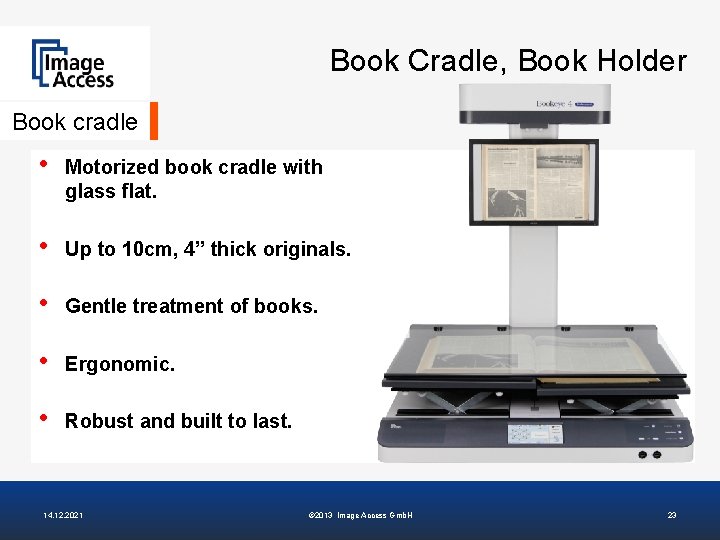
Book Cradle, Book Holder Book cradle • Motorized book cradle with glass flat. • Up to 10 cm, 4” thick originals. • Gentle treatment of books. • Ergonomic. • Robust and built to last. 14. 12. 2021 © 2013 Image Access Gmb. H 23
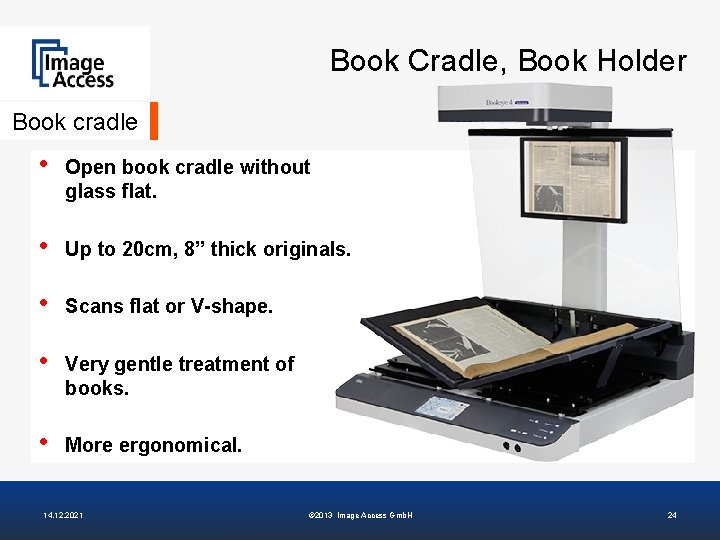
Book Cradle, Book Holder Book cradle • Open book cradle without glass flat. • Up to 20 cm, 8” thick originals. • Scans flat or V-shape. • Very gentle treatment of books. • More ergonomical. 14. 12. 2021 © 2013 Image Access Gmb. H 24
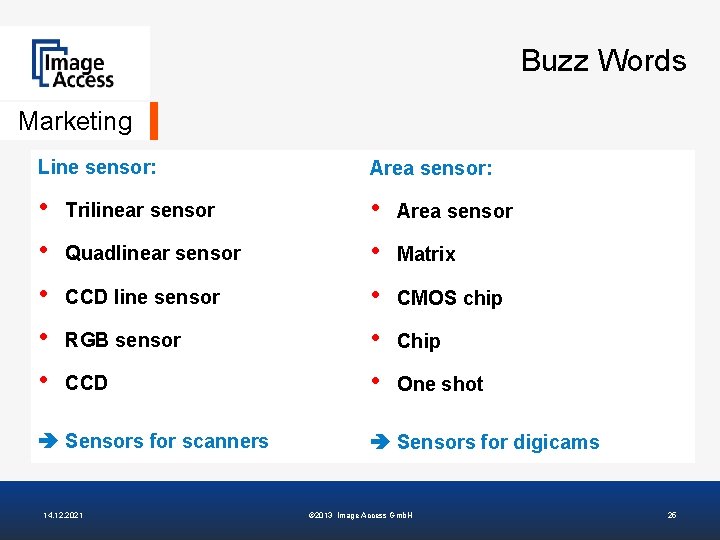
Buzz Words Marketing Line sensor: Area sensor: • • • Trilinear sensor Quadlinear sensor CCD line sensor RGB sensor CCD Sensors for scanners 14. 12. 2021 Area sensor Matrix CMOS chip Chip One shot Sensors for digicams © 2013 Image Access Gmb. H 25
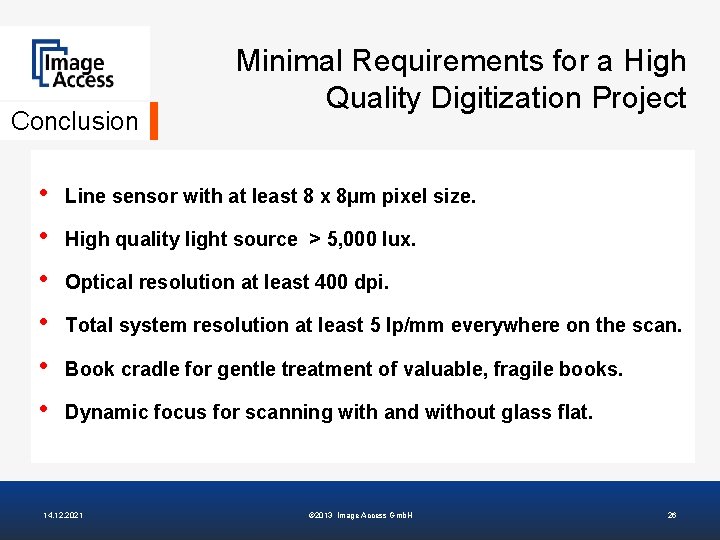
Conclusion • • • Minimal Requirements for a High Quality Digitization Project Line sensor with at least 8 x 8µm pixel size. High quality light source > 5, 000 lux. Optical resolution at least 400 dpi. Total system resolution at least 5 lp/mm everywhere on the scan. Book cradle for gentle treatment of valuable, fragile books. Dynamic focus for scanning with and without glass flat. 14. 12. 2021 © 2013 Image Access Gmb. H 26

Digitizing Books in Preservation Quality Thank you very much for your attention! Thomas Ingendoh, CEO Image Access Gmb. H Learn more at www. imageaccess. de www. imageaccess. us 14. 12. 2021 © 2013 Image Access Gmb. H 27
- Slides: 27