
Academic Writing for Graduate Students Instructor Sonja Follett




- Slides: 17
Academic Writing for Graduate Students Instructor: Sonja Follett November 18, 2009
Questions: ¡What do you find difficult about Academic Writing? ¡What do you know about writing in your field? ¡What do you need to know? Please take a couple of minutes to discuss with your neighbors and then share… Source: Swales and Feak (2009) Academic Writing For Graduate Students. Ann Arbor: University of Michigan Press.
Structure and Language in Academic Writing ¡Writing Introductions - the CARS Model ¡Writing Abstracts ¡Writing Resources Source: Swales and Feak (2009) Academic Writing For Graduate Students. Ann Arbor: University of Michigan Press
I. The CARS Model ¡The Introduction section of research papers typically follows a specific pattern ¡This rhetorical pattern is referred to as the create-a-research-space (CARS) Model ¡In this model, the work of others and/or what is known about the topic is primary and your own work is secondary ¡This is also called a background/foreground relationship Source: Swales and Feak (2009) Academic Writing For Graduate Students. Ann Arbor: University of Michigan Press
3 Moves ¡The CARS model has 3 rhetorical moves: • Move 1: Establishing a research territory • Move 2: Establishing a niche • Move 3: Occupying the niche Source: Swales and Feak (2009) Academic Writing For Graduate Students. Ann Arbor: University of Michigan Press
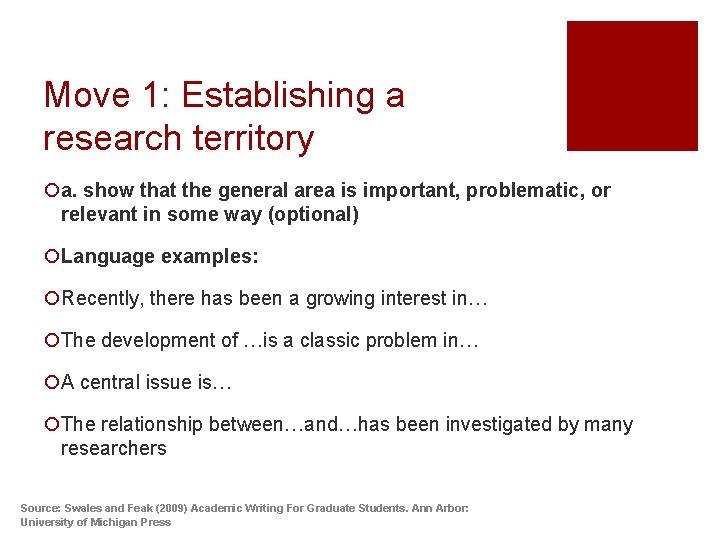
Move 1: Establishing a research territory ¡a. show that the general area is important, problematic, or relevant in some way (optional) ¡Language examples: ¡Recently, there has been a growing interest in… ¡The development of …is a classic problem in… ¡A central issue is… ¡The relationship between…and…has been investigated by many researchers Source: Swales and Feak (2009) Academic Writing For Graduate Students. Ann Arbor: University of Michigan Press
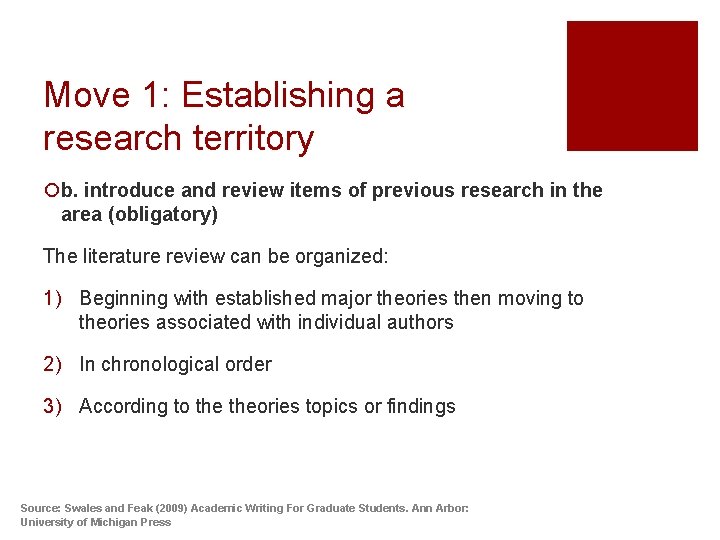
Move 1: Establishing a research territory ¡b. introduce and review items of previous research in the area (obligatory) The literature review can be organized: 1) Beginning with established major theories then moving to theories associated with individual authors 2) In chronological order 3) According to theories topics or findings Source: Swales and Feak (2009) Academic Writing For Graduate Students. Ann Arbor: University of Michigan Press
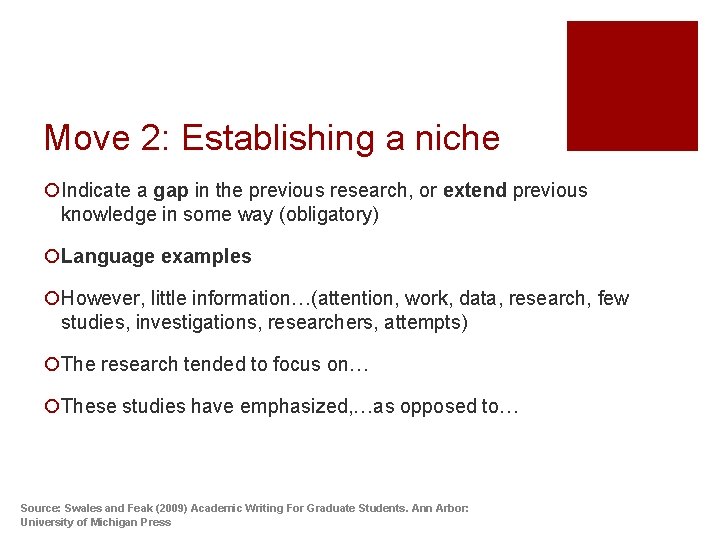
Move 2: Establishing a niche ¡Indicate a gap in the previous research, or extend previous knowledge in some way (obligatory) ¡Language examples ¡However, little information…(attention, work, data, research, few studies, investigations, researchers, attempts) ¡The research tended to focus on… ¡These studies have emphasized, …as opposed to… Source: Swales and Feak (2009) Academic Writing For Graduate Students. Ann Arbor: University of Michigan Press
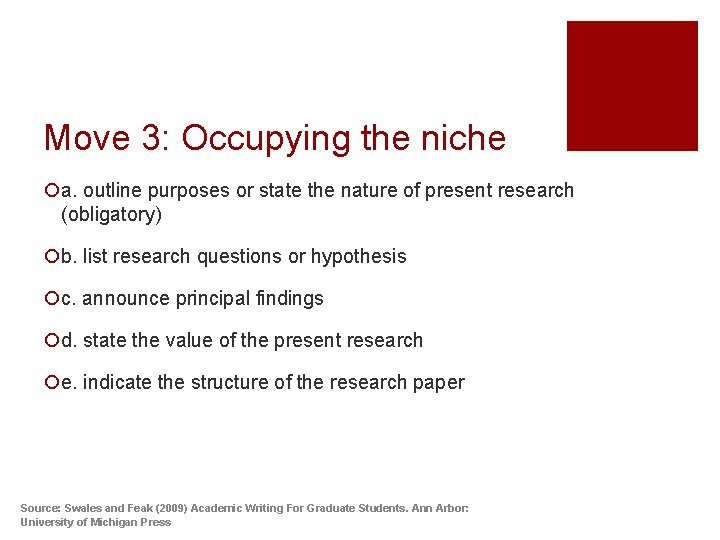
Move 3: Occupying the niche ¡a. outline purposes or state the nature of present research (obligatory) ¡b. list research questions or hypothesis ¡c. announce principal findings ¡d. state the value of the present research ¡e. indicate the structure of the research paper Source: Swales and Feak (2009) Academic Writing For Graduate Students. Ann Arbor: University of Michigan Press
Practice! ¡Please look at the introductions I’ve handed out. ¡With a partner, please review the introduction and try to identify the 3 Moves. ¡What language and content indicated a rhetorical shift? Source: Swales and Feak (2009) Academic Writing For Graduate Students. Ann Arbor: University of Michigan Press
II. Abstracts ¡Two main approaches: • Results-driven Abstracts • Research paper summary Abstract Note: the structured abstract used in the medical field has been spreading as well… Source: Swales and Feak (2009) Academic Writing For Graduate Students. Ann Arbor: University of Michigan Press
Results-Driven Abstracts ¡This type of abstract concentrates on: • the research findings • what might be concluded from the research findings Source: Swales and Feak (2009) Academic Writing For Graduate Students. Ann Arbor: University of Michigan Press
Research Paper Summary Abstracts ¡This type of abstract: • provides a one or two sentence synopses of each of your paper’s sections • is informative rather than indicative (includes main findings) • includes the content of the paper rather than simply outlining what you did • Note: an indicative style may be used for complex, theoretical papers Source: Swales and Feak (2009) Academic Writing For Graduate Students. Ann Arbor: University of Michigan Press
Practice! ¡Please look at the abstract from the Lagarias, Reeds, Wright and Wright article. ¡Read each sentence and analyze the content ¡Next, identify which section each sentence summarizes. Source: Swales and Feak (2009) Academic Writing For Graduate Students. Ann Arbor: University of Michigan Press
III. Writing Resources ¡English Language Center (writing advisors, writing course: ELC 061) ¡Writing Center (UMBC library) ¡Graduate Student Association (writing advisor) ¡OWLS (Online Writing Labs – Purdue University) ¡Texts – “Academic Writing for Graduate Students” ¡Peers and Colleagues (create writing groups) Source: Swales and Feak (2009) Academic Writing For Graduate Students. Ann Arbor: University of Michigan Press
Questions? Source: Swales and Feak (2009) Academic Writing For Graduate Students. Ann Arbor: University of Michigan Press
Works Cited ¡Swales, John M. and Christine B. Feak. 2007. Academic Writing for Graduate Students 2 nd ed. Ann Arbor: Univ. of Michigan Press. Source: Swales and Feak (2009) Academic Writing For Graduate Students. Ann Arbor: University of Michigan Press