
Academic Writing An Overview Whether you knew it
- Slides: 14
Academic Writing: An Overview
“Whether you knew it or not when you started, conducting research is the defining feature of your graduate career. If you plan to stay in academe, it will be the defining feature of your academic life. ” --Lesli Mitchell The Ultimate Grad School Survival Guide
The genre of research n What it’s not: n n What it’s not only: n n A loose collection of anecdotal information Reporting of others’ knowledge What it is: Creation of knowledge n Added security of academic support n Contribution to a larger academic discussion n Problems and solutions n
Before you write: Read sources critically n Read studies similar to what you want to write n Professional journals, master’s theses, Google scholar Abstracts n Literature Reviews n Conclusions/Discussion n Recommendations for Future Study Take notes (don’t highlight!) n Summarize/paraphrase passages
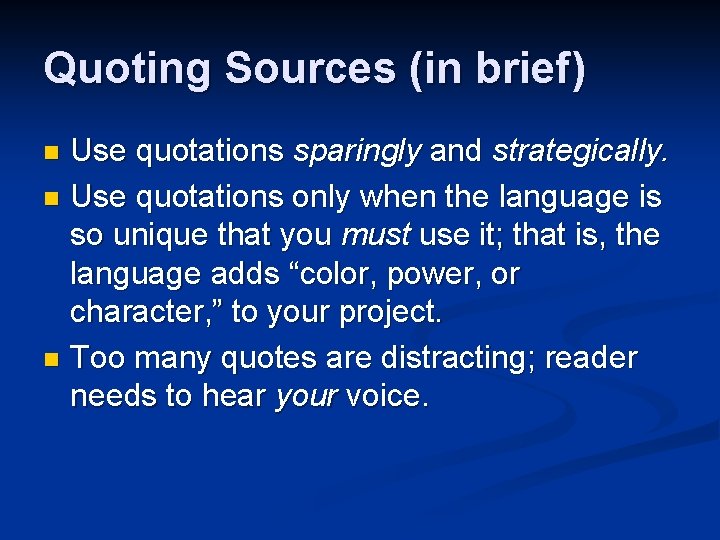
Quoting Sources (in brief) Use quotations sparingly and strategically. n Use quotations only when the language is so unique that you must use it; that is, the language adds “color, power, or character, ” to your project. n Too many quotes are distracting; reader needs to hear your voice. n
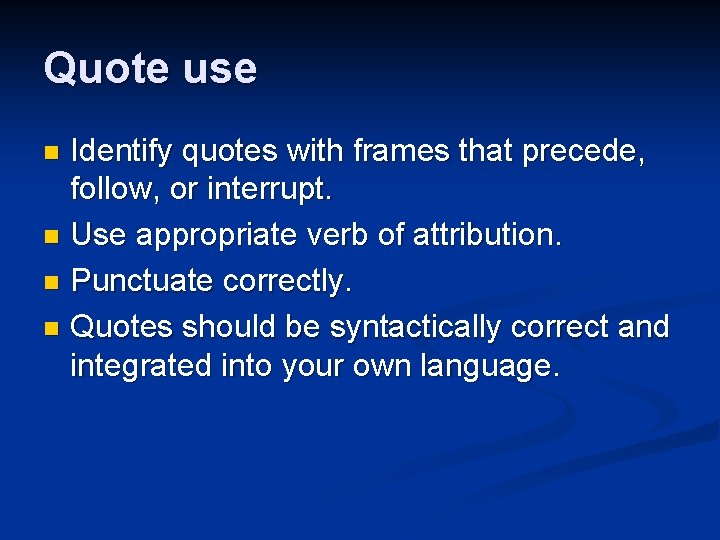
Quote use Identify quotes with frames that precede, follow, or interrupt. n Use appropriate verb of attribution. n Punctuate correctly. n Quotes should be syntactically correct and integrated into your own language. n
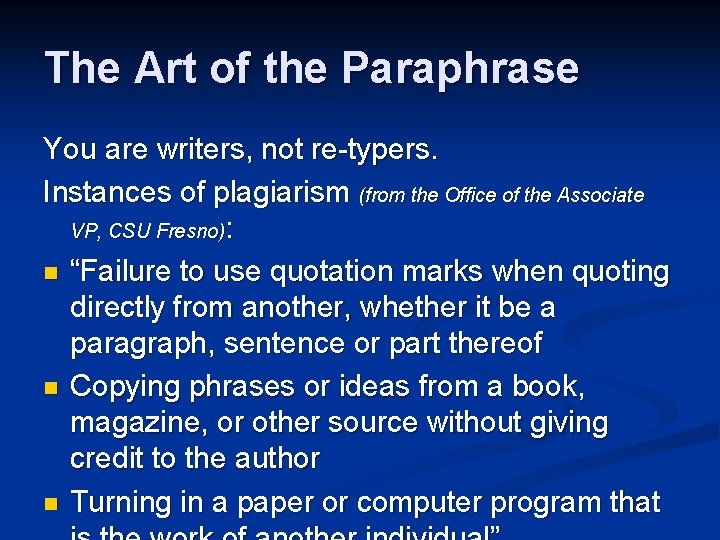
The Art of the Paraphrase You are writers, not re-typers. Instances of plagiarism (from the Office of the Associate VP, CSU Fresno): n “Failure to use quotation marks when quoting directly from another, whether it be a paragraph, sentence or part thereof n Copying phrases or ideas from a book, magazine, or other source without giving credit to the author n Turning in a paper or computer program that
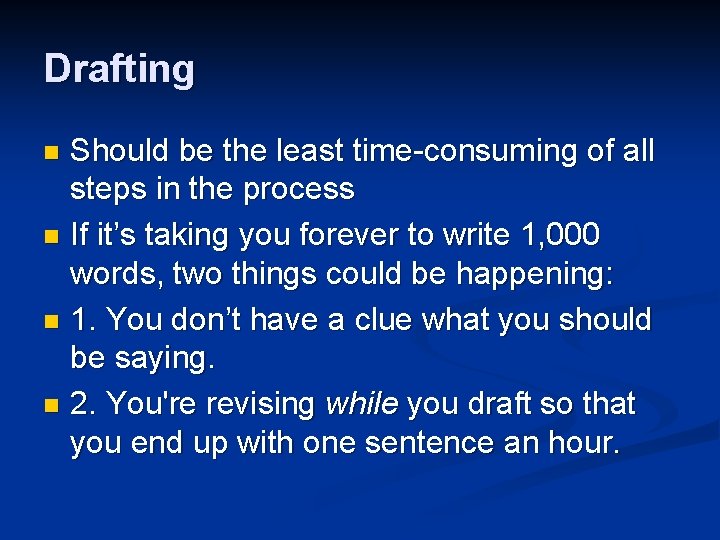
Drafting Should be the least time-consuming of all steps in the process n If it’s taking you forever to write 1, 000 words, two things could be happening: n 1. You don’t have a clue what you should be saying. n 2. You're revising while you draft so that you end up with one sentence an hour. n
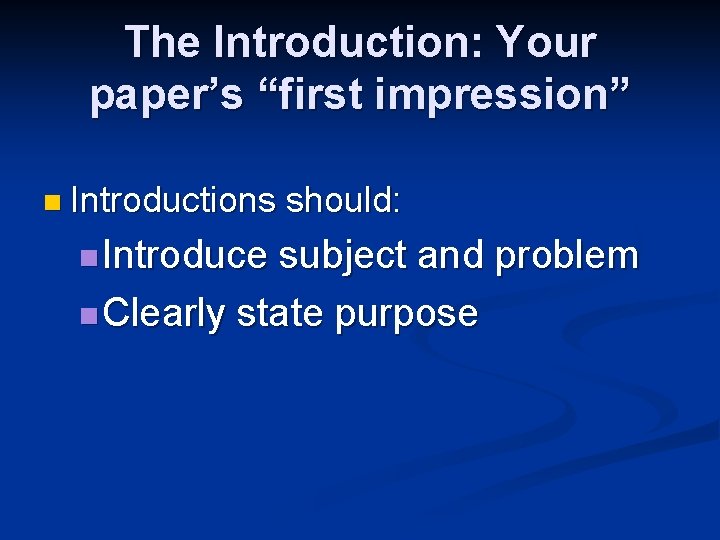
The Introduction: Your paper’s “first impression” n Introductions n Introduce should: subject and problem n Clearly state purpose
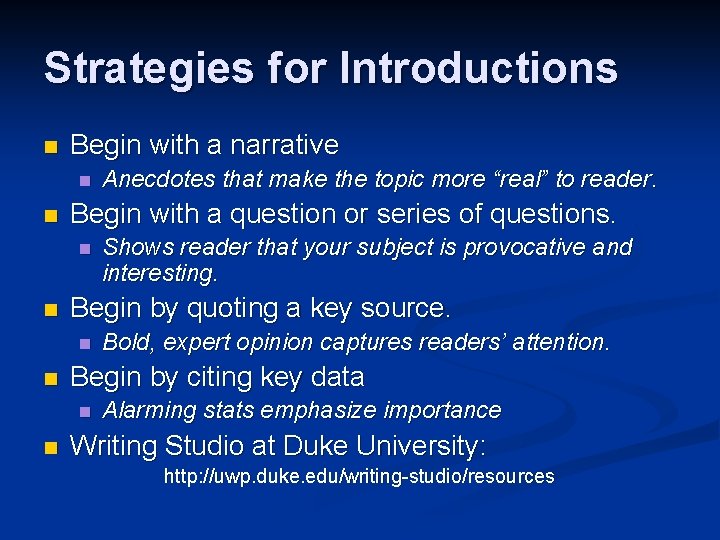
Strategies for Introductions n Begin with a narrative n n Begin with a question or series of questions. n n Bold, expert opinion captures readers’ attention. Begin by citing key data n n Shows reader that your subject is provocative and interesting. Begin by quoting a key source. n n Anecdotes that make the topic more “real” to reader. Alarming stats emphasize importance Writing Studio at Duke University: http: //uwp. duke. edu/writing-studio/resources
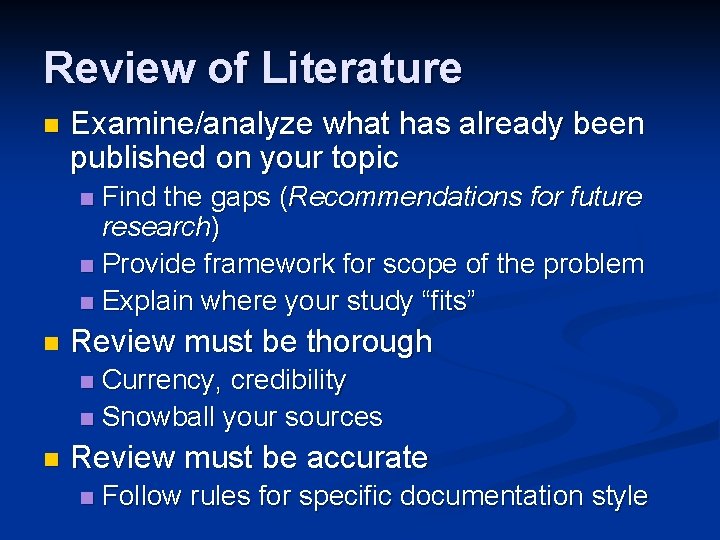
Review of Literature n Examine/analyze what has already been published on your topic Find the gaps (Recommendations for future research) n Provide framework for scope of the problem n Explain where your study “fits” n n Review must be thorough Currency, credibility n Snowball your sources n n Review must be accurate n Follow rules for specific documentation style
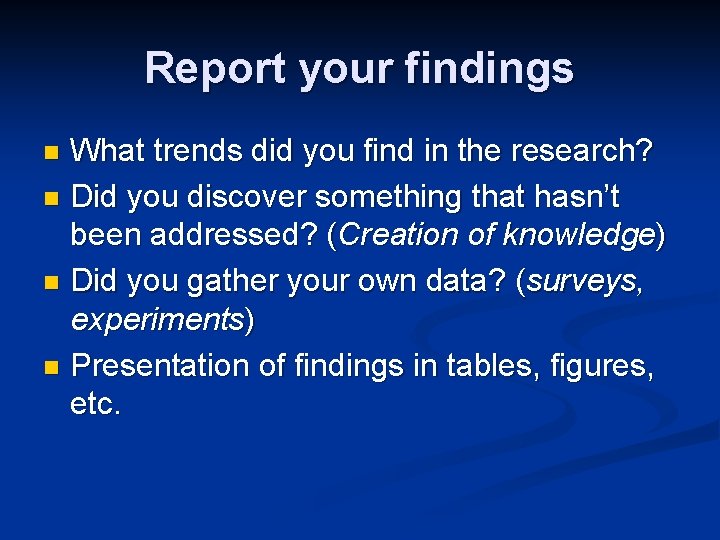
Report your findings What trends did you find in the research? n Did you discover something that hasn’t been addressed? (Creation of knowledge) n Did you gather your own data? (surveys, experiments) n Presentation of findings in tables, figures, etc. n
Conclusions n n n Place the paper in a larger context Convince readers that what they read was meaningful. Go beyond mere summary and avoid repeating word-for-word a statement you wrote earlier in the paper. Answers the question, “Where could we go from here? ” Makes suggestions or calls to action
You are the author Paper should be predominately your ideas and opinions. n Show your critical thinking skills. n A paper with patched together summaries and paraphrases, even if they’re in your own words, will not succeed. n