
Academic vs Creative Titles The following Power Point


- Slides: 13
Academic vs. Creative Titles The following Power. Point is about the 3 basic types of titles. Type #1 needs to be eliminated from this point forward. They are vague, require little thought, and aren’t very helpful. They are neither academic nor creative. Sample titles that are not acceptable: Summer Paper Research Paper The Handgun Debate Mark Twain (nothing)
Creative Titles Of the two acceptable types of titles (creative and academic), creative ones reference the piece in question, and they highlight the most important and/or poignant part— the essence, if you will — of the piece. And they also sound super cool. We will not be using creative titles formal papers. Sample titles that are creative: The Filth and the Fury Lonesome Dove Born to Run Murder on the Orient Express Death Before Dishonor There’s no shame in asking your teacher: a) Do we need a title for this assignment? b) b) Should it be creative or academic?
Academic Titles You see, a title like “The American Dream” tells us nothing in an academic paper. It is too vague and actually damages your essay by confusing the reader. What about the American Dream? More effective academic titles are really a mini-thesis. Your essay will already sound more mature, and the reader has a clearer vision of what is coming. Academic titles use this format: 1) a short quote* from your paper that works as a symbol to 2) encapsulate the whole paper. 3) *this can be slightly grammatically modified to fit your purpose… but, if at all, only slightly (examples to come) 2) a colon 3) your thesis, usually with language like “Why, ” “How, ” or “The case for…” in front of it* *As an option, you can add what author and text you are writing about. But if it’s too cumbersome, this can be swapped with the overall time period.
Academic Titles Students tend to understand parts 2 and 3, but stumble on the first part. Check out some successful titles that recently published authors have used, followed by some from a handful of homegrown CDHS sophomores. Ideally, your quote snippet in part 1 sums up all of your points that you’re trying to make in the whole paper. Like the creative title, the goal of this part of the academic title is to highlight the most important and/or poignant part— the essence, if you will— of the piece…
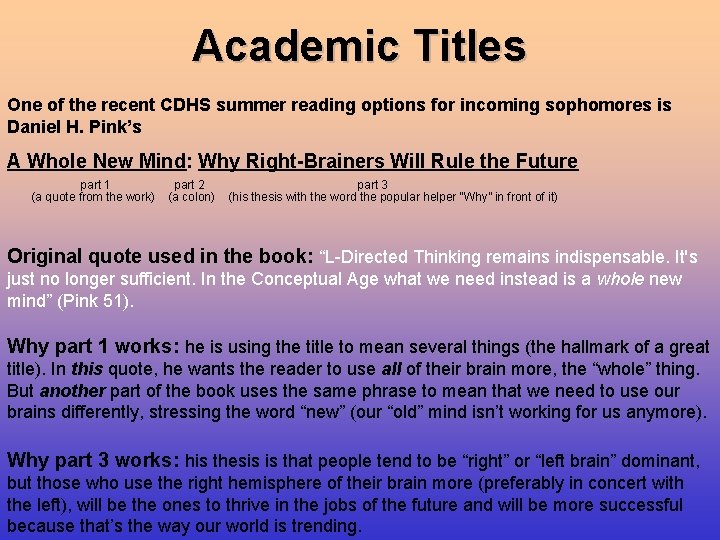
Academic Titles One of the recent CDHS summer reading options for incoming sophomores is Daniel H. Pink’s A Whole New Mind: Why Right-Brainers Will Rule the Future part 1 (a quote from the work) part 2 (a colon) part 3 (his thesis with the word the popular helper “Why” in front of it) Original quote used in the book: “L-Directed Thinking remains indispensable. It's just no longer sufficient. In the Conceptual Age what we need instead is a whole new mind” (Pink 51). Why part 1 works: he is using the title to mean several things (the hallmark of a great title). In this quote, he wants the reader to use all of their brain more, the “whole” thing. But another part of the book uses the same phrase to mean that we need to use our brains differently, stressing the word “new” (our “old” mind isn’t working for us anymore). Why part 3 works: his thesis is that people tend to be “right” or “left brain” dominant, but those who use the right hemisphere of their brain more (preferably in concert with the left), will be the ones to thrive in the jobs of the future and will be more successful because that’s the way our world is trending.
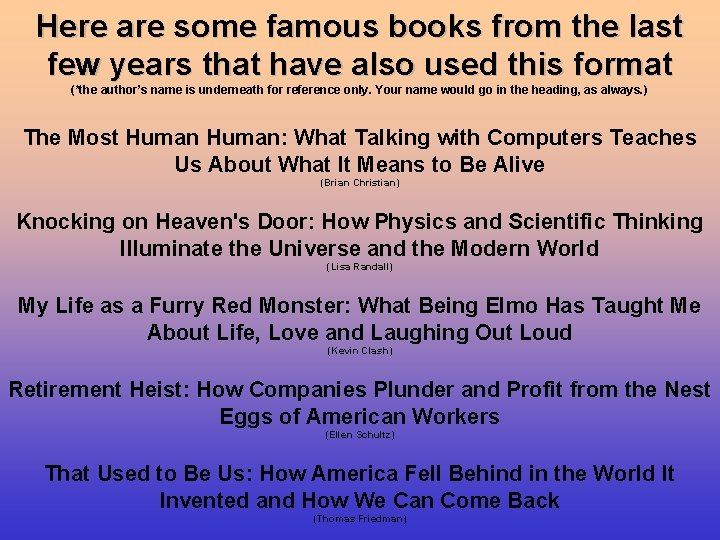
Here are some famous books from the last few years that have also used this format (*the author’s name is underneath for reference only. Your name would go in the heading, as always. ) The Most Human: What Talking with Computers Teaches Us About What It Means to Be Alive (Brian Christian) Knocking on Heaven's Door: How Physics and Scientific Thinking Illuminate the Universe and the Modern World (Lisa Randall) My Life as a Furry Red Monster: What Being Elmo Has Taught Me About Life, Love and Laughing Out Loud (Kevin Clash) Retirement Heist: How Companies Plunder and Profit from the Nest Eggs of American Workers (Ellen Schultz) That Used to Be Us: How America Fell Behind in the World It Invented and How We Can Come Back (Thomas Friedman)
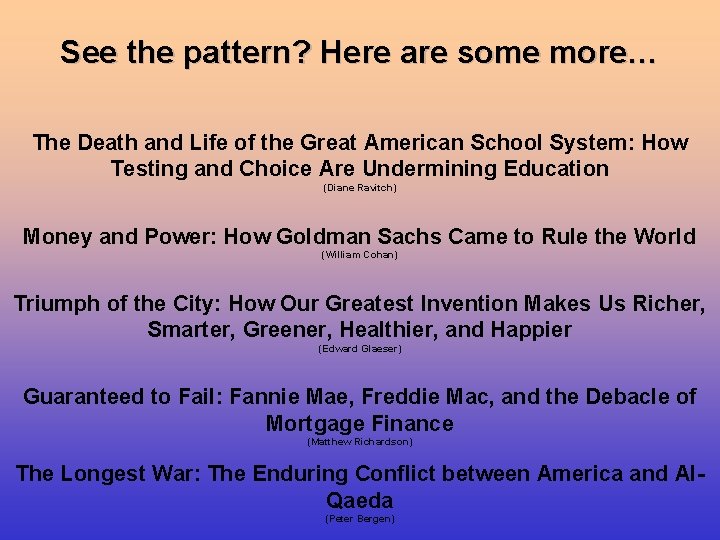
See the pattern? Here are some more… The Death and Life of the Great American School System: How Testing and Choice Are Undermining Education (Diane Ravitch) Money and Power: How Goldman Sachs Came to Rule the World (William Cohan) Triumph of the City: How Our Greatest Invention Makes Us Richer, Smarter, Greener, Healthier, and Happier (Edward Glaeser) Guaranteed to Fail: Fannie Mae, Freddie Mac, and the Debacle of Mortgage Finance (Matthew Richardson) The Longest War: The Enduring Conflict between America and Al. Qaeda (Peter Bergen)
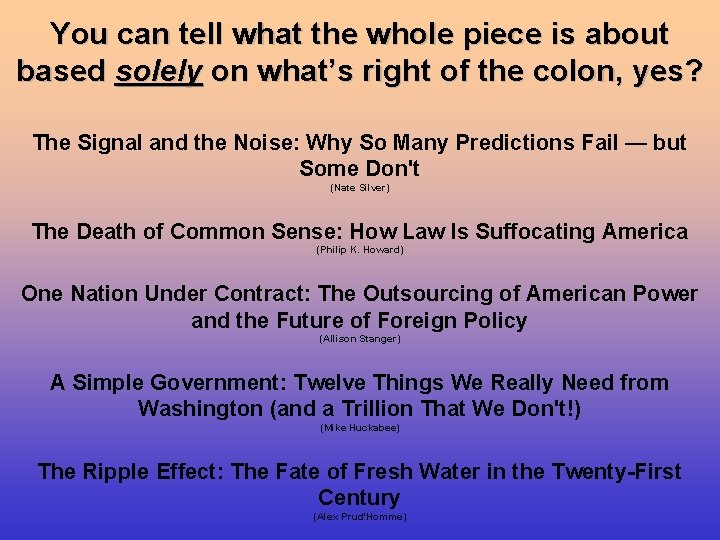
You can tell what the whole piece is about based solely on what’s right of the colon, yes? The Signal and the Noise: Why So Many Predictions Fail — but Some Don't (Nate Silver) The Death of Common Sense: How Law Is Suffocating America (Philip K. Howard) One Nation Under Contract: The Outsourcing of American Power and the Future of Foreign Policy (Allison Stanger) A Simple Government: Twelve Things We Really Need from Washington (and a Trillion That We Don't!) (Mike Huckabee) The Ripple Effect: The Fate of Fresh Water in the Twenty-First Century (Alex Prud'Homme)
Academic Titles Shifting gears, instead of a research paper, let’s say you had a literary one to write and you chose to defend thesis: Modernist men always find a way to squander their prosperity. And let’s say that somewhere in your paper’s body paragraphs, you decided to support your thesis with two quotes from The Great Gatsby and the following dialogue from Death of a Salesman: “…I realized what a ridiculous lie my whole life has been! We’ve been talking in a dream for fifteen years” (Miller 104). How, then, could your title possibly look?
Academic Titles Living Ridiculous Lies: How Modernist Men Always Find a Way to Squander Their Prosperity in Arthur Miller’s Death of a Salesman and F. Scott Fitzgerald’s The Great Gatsby However, if you’re using 2 -3 sources (like in the example above), you are allowed to shorten them in clever, cosmetic ways: Living Ridiculous Lies: How Modernist Men Always Find a Way to Squander Their Prosperity in Modernist Literature Here’s why part 1 (left of the colon) works: first, “life” was moved and changed to “living. ” This is one of those small, cosmetic changes that I said you were allowed to make. Second, all of the discussed characters in this particular paper live false lives and/or their own lies plague their success, and this student had clearly demonstrated that in their essay.
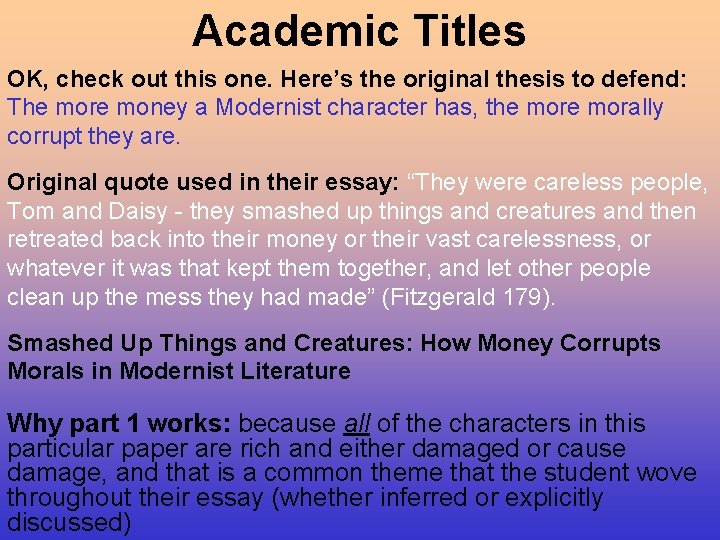
Academic Titles OK, check out this one. Here’s the original thesis to defend: The more money a Modernist character has, the morally corrupt they are. Original quote used in their essay: “They were careless people, Tom and Daisy - they smashed up things and creatures and then retreated back into their money or their vast carelessness, or whatever it was that kept them together, and let other people clean up the mess they had made” (Fitzgerald 179). Smashed Up Things and Creatures: How Money Corrupts Morals in Modernist Literature Why part 1 works: because all of the characters in this particular paper are rich and either damaged or cause damage, and that is a common theme that the student wove throughout their essay (whether inferred or explicitly discussed)
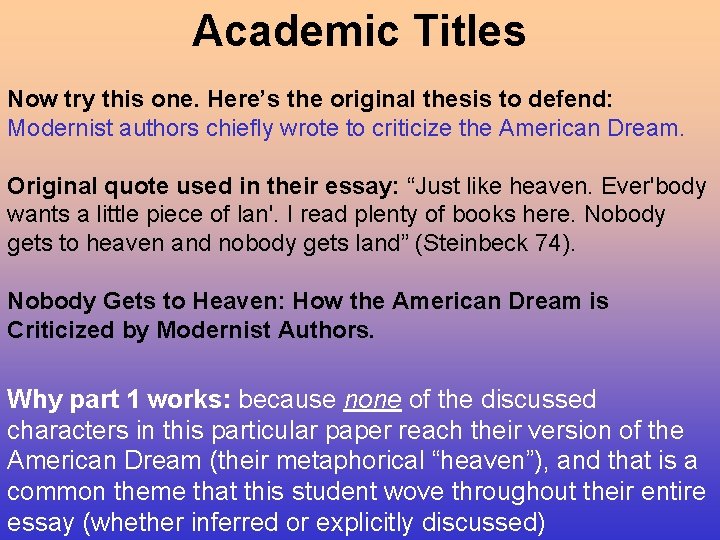
Academic Titles Now try this one. Here’s the original thesis to defend: Modernist authors chiefly wrote to criticize the American Dream. Original quote used in their essay: “Just like heaven. Ever'body wants a little piece of lan'. I read plenty of books here. Nobody gets to heaven and nobody gets land” (Steinbeck 74). Nobody Gets to Heaven: How the American Dream is Criticized by Modernist Authors. Why part 1 works: because none of the discussed characters in this particular paper reach their version of the American Dream (their metaphorical “heaven”), and that is a common theme that this student wove throughout their entire essay (whether inferred or explicitly discussed)
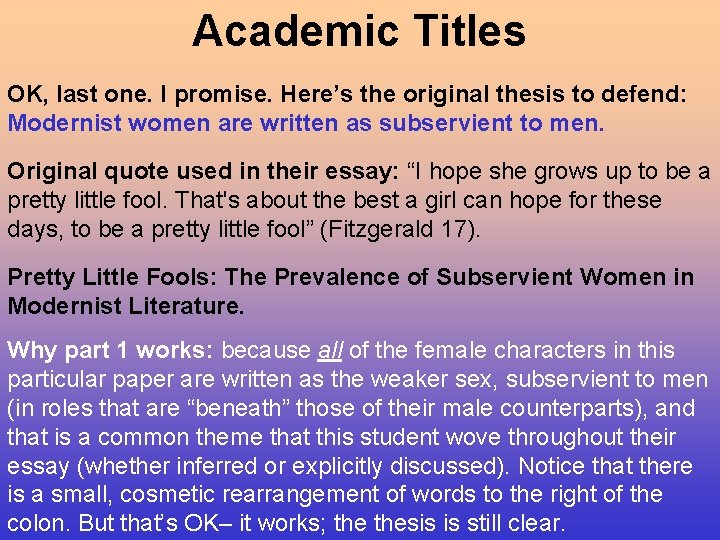
Academic Titles OK, last one. I promise. Here’s the original thesis to defend: Modernist women are written as subservient to men. Original quote used in their essay: “I hope she grows up to be a pretty little fool. That's about the best a girl can hope for these days, to be a pretty little fool” (Fitzgerald 17). Pretty Little Fools: The Prevalence of Subservient Women in Modernist Literature. Why part 1 works: because all of the female characters in this particular paper are written as the weaker sex, subservient to men (in roles that are “beneath” those of their male counterparts), and that is a common theme that this student wove throughout their essay (whether inferred or explicitly discussed). Notice that there is a small, cosmetic rearrangement of words to the right of the colon. But that’s OK– it works; thesis is still clear.