
Academic Success Advisors in the United Arab Emirates

Academic Success Advisors in the United Arab Emirates: A Developmental Approach 1
Introductions • Dr. Roslyn Haley – Director of Student Success & Advising Chair • Dr. Jyoti Grewal – Dean, University College • Mr. Zia Saunders – Assistant Dean, University College • Dr. Patricia Robinson – Professor and Advisor, University College • Ms. Maryam Al Badi – College Academic Advisor 2
Introduction • At the time of the country’s establishment in 1971, a total of 74 schools existed throughout the seven Emirates • In 1977 the United Arab Emirates University (UAEU) was established as the first university in the UAE, followed by Higher Colleges of Technology in 1988 • Zayed University was the third university founded by the federal government in 1998 3
The History of Colloquy The Colloquy Program is Zayed University’s Core Curriculum. 4
Mission To build students’ understanding of their relation to the world. To help students to be successful in their studies, in their profession, in their personal lives. To prepare students to work in their major field of study. 5
University College Four Departments: v Interdisciplinary Studies (Science, Technology, Global Awareness) v Languages v Mathematics v Advising & Academic Development 6
What is Advising & Academic Development ? • Support for learning • Assistance with academic achievement • Training in successful habits
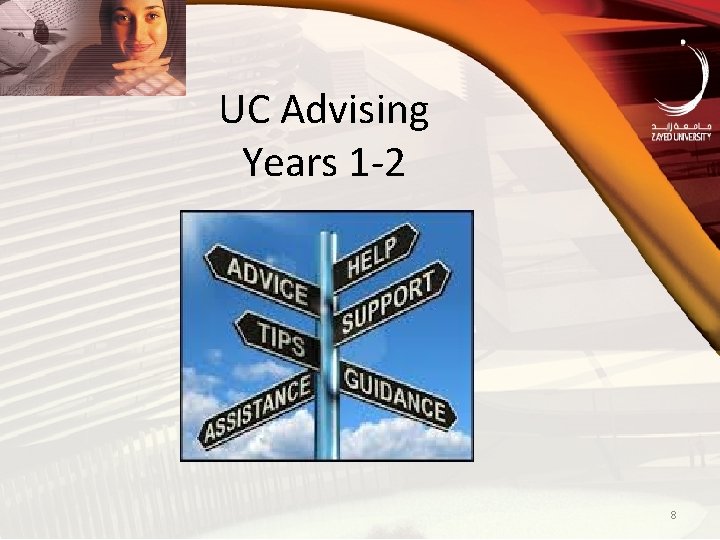
UC Advising Years 1 -2 8
Advising & Academic Development Prepares students for University life by helping them… • Understand ZU’s mission and structure • Realize their role in higher education • Learn University rules and resources • Develop self awareness and self confidence • Find solutions to challenges
Advising and Enrollment Management • • Undergraduate Admission Recruitment New Students Registration Liaison At-Risk Probation Fresh Start 10
Advising and Student Affairs • • Student Careers Family Outreach Leadership Counseling Student Development Students with Special Needs Retention Peer Assistance Leader Support 11
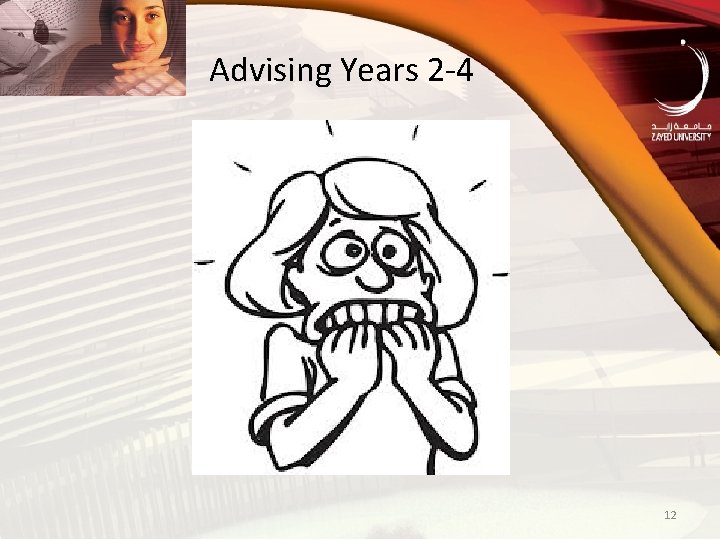
Advising Years 2 -4 12
Problems • No College Advisor • No Major Program Advisor • No formal referral program in the departments • Student Self Service • Administrative Assistants give advice • Courses missing at graduation • Time to degree extended • Transfer credit not documented • Exceptions not documented • Missing records 13
Task Force Recommendations • Establish lines of effective communication • Adherence to policies and procedures • Tracking of degree progress is essential to promote retention to graduation • Advising must be consistent across disciplines and connect university, general education, and major requirements throughout a student’s program of study • Advising at all levels is essential and includes general education advising, college faculty advising, and major/department academic advising 14
The Solution • Create new Academic Advisor Positions • Assign Faculty Advisors in the majors to work with Academic Advisors • Assign UC Department of Advising Faculty as mentors to Academic Advisors • Acquire System of Degree Audit – Degree. Works • Advising Records – Grades. First 15
Key Areas • • Accountability Communication Early alert Retention/graduation Teaching and learning Training Technological support 16
Academic Advisors • • • • Conduct graduation audits Create degree progress reports for faculty advisors Implement faculty recommendations to address remediation Provide support and referrals for a wide range of concerns Provide information and guidance on College and Zayed University resources and administrative processes Advise students regarding registration Issue student registration codes and permission to enroll Coordinate prerequisite overrides Implement faculty advisor recommendations for degree progress Create Study plans for students Monitor and report at-risk students Communicate College/major program approvals to Registrar Monitor Study lists for appropriate registration 17
Faculty Advisors • One-on-one mentoring • Field-specific insights (decision making and career direction) • Guidance on course selection and academic planning (including internships and study abroad) • Suggestions for improving or enhancing student academic performance • Interacting with academic advisors to discuss student advisee progress and suggest remedial solutions for problems that may arise based upon reports provided by the Academic advisor • Interact frequently with at-risk student advisees to discuss ways to move forward and provide feedback to the academic advisors regarding student cases • Review the study plan developed by the Academic advisor for each advisee, reporting any issues to the Academic advisor for action • Refer student advisees to appropriate resources 18
The New Developmental Model Developmental academic advising is defined as a systematic process based on a close student-advisor relationship intended to aid students in achieving educational, career, and personal goals through the utilization of the full range of institutional and community resources. (Winston, et. al. , 1984, 19
GOAL 20
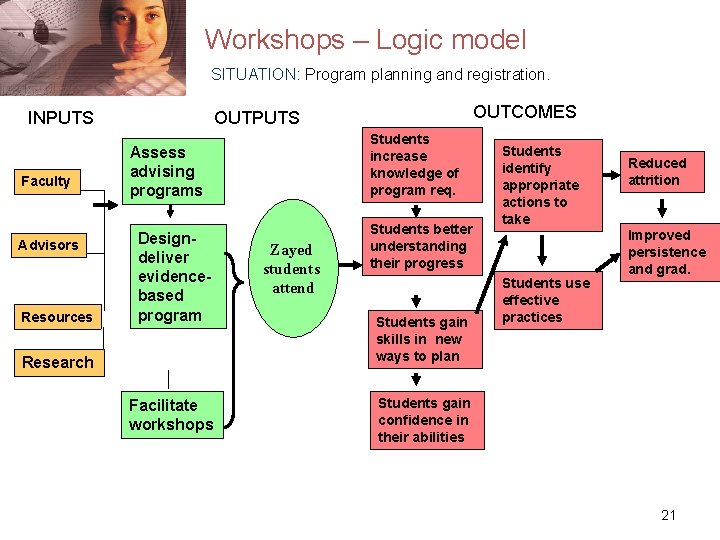
Workshops – Logic model SITUATION: Program planning and registration. INPUTS Faculty Advisors Resources OUTCOMES OUTPUTS Students increase knowledge of program req. Assess advising programs Designdeliver evidencebased program Research Facilitate workshops Zayed students attend Students better understanding their progress Students gain skills in new ways to plan Students identify appropriate actions to take Students use effective practices Reduced attrition Improved persistence and grad. Students gain confidence in their abilities 21
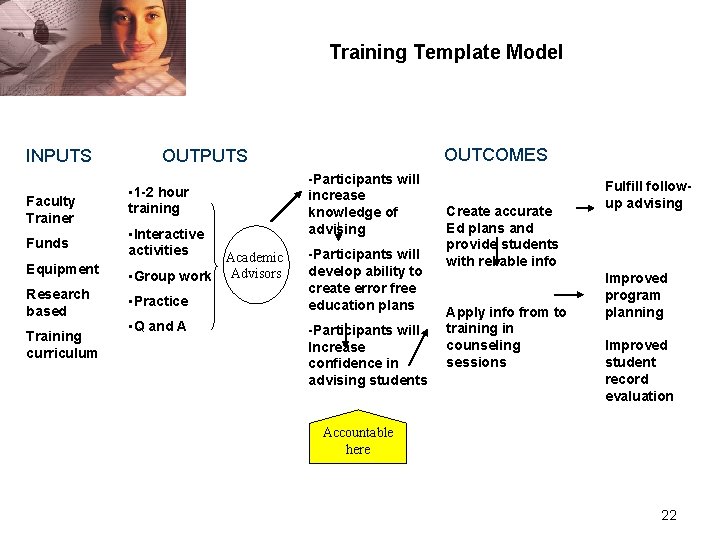
Training Template Model INPUTS Faculty Trainer -Participants will increase knowledge of advising • 1 -2 hour training Funds • Interactive activities Equipment • Group work Research based • Practice Training curriculum OUTCOMES OUTPUTS • Q and A Academic Advisors -Participants will develop ability to create error free education plans -Participants will Increase confidence in advising students Create accurate Ed plans and provide students with reliable info Apply info from to training in counseling sessions Fulfill followup advising Improved program planning Improved student record evaluation Accountable here 22
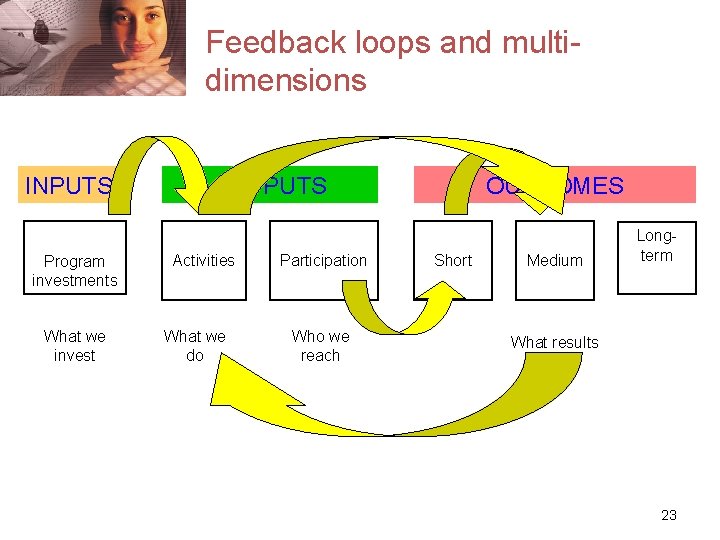
Feedback loops and multidimensions INPUTS Program investments What we invest OUTPUTS Activities What we do Participation Who we reach OUTCOMES Short Medium Longterm What results 23
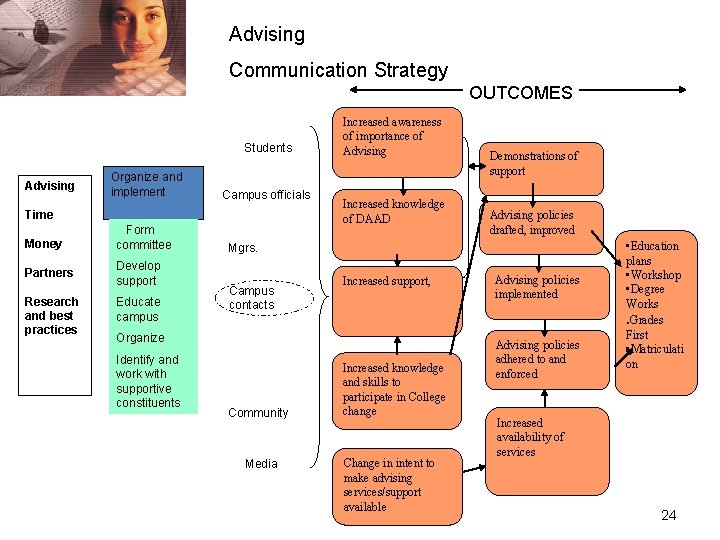
Advising Communication Strategy OUTCOMES Students Advising Organize and implement Campus officials Time Money Partners Research and best practices Form committee Develop support Educate campus Increased awareness of importance of Advising Increased knowledge of DAAD Advising policies drafted, improved Mgrs. Campus contacts Increased support, Organize Identify and work with supportive constituents Demonstrations of support Community Media Increased knowledge and skills to participate in College change Change in intent to make advising services/support available Advising policies implemented Advising policies adhered to and enforced • Education plans • Workshop • Degree Works. Grades First • Matriculati on Increased availability of services 24
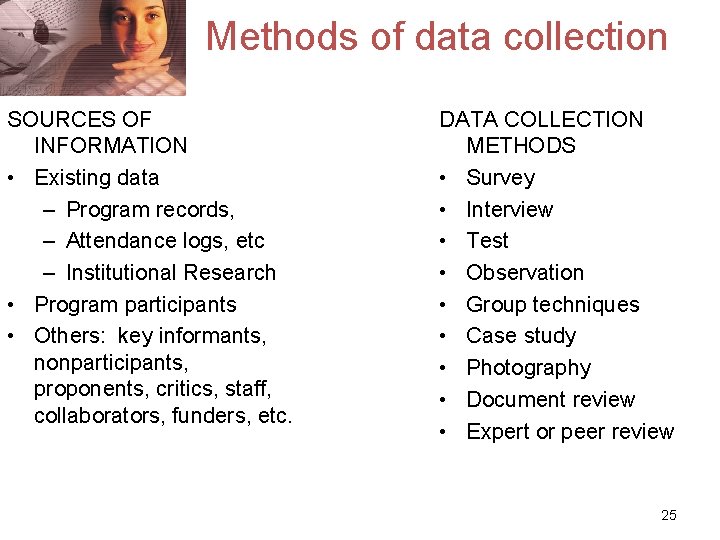
Methods of data collection SOURCES OF INFORMATION • Existing data – Program records, – Attendance logs, etc – Institutional Research • Program participants • Others: key informants, nonparticipants, proponents, critics, staff, collaborators, funders, etc. DATA COLLECTION METHODS • Survey • Interview • Test • Observation • Group techniques • Case study • Photography • Document review • Expert or peer review 25
Thank you Q&A 26
- Slides: 26