
Academic planning writing The outline process What is
- Slides: 21
+ Academic planning & writing The outline process
+ What is an essay § a piece of writing that has a particular structure (e. g. starts with an introduction) and a logical sequence § Godfrey (2009) refers ‘The Diamond’ structure § written in a formalised academic style not in a conversational manner e. g. don’t (more on this later) § usually you will be given the title sometimes referred to as ‘the question’ and it will have a word limit § analogous to a criminal court case Simon Whiffin September 2015 (updated December 2017)
+ Why do we write essays § it is part of the assessment task on the module you are taking § enables you to demonstrate that you have met the learning outcomes for the module § learning and writing is an iterative process that allows a dialogue between you and the tutor. § feedback on your writing is part of the learning process § allows you to develop your writing skills § you can express your own views about the topic and makes links between theory and your practice § engage in critical debates in your subject area (aside Twitter) Simon Whiffin September 2015 (updated December 2017)
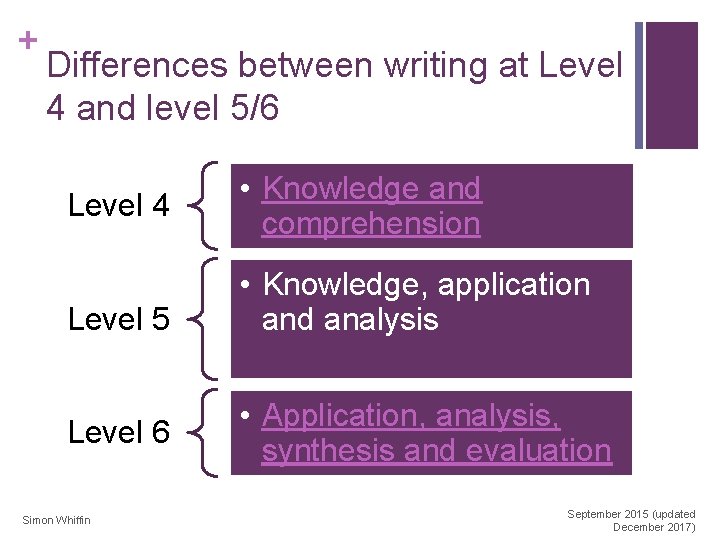
+ Differences between writing at Level 4 and level 5/6 Level 4 Level 5 Level 6 Simon Whiffin • Knowledge and comprehension • Knowledge, application and analysis • Application, analysis, synthesis and evaluation September 2015 (updated December 2017)
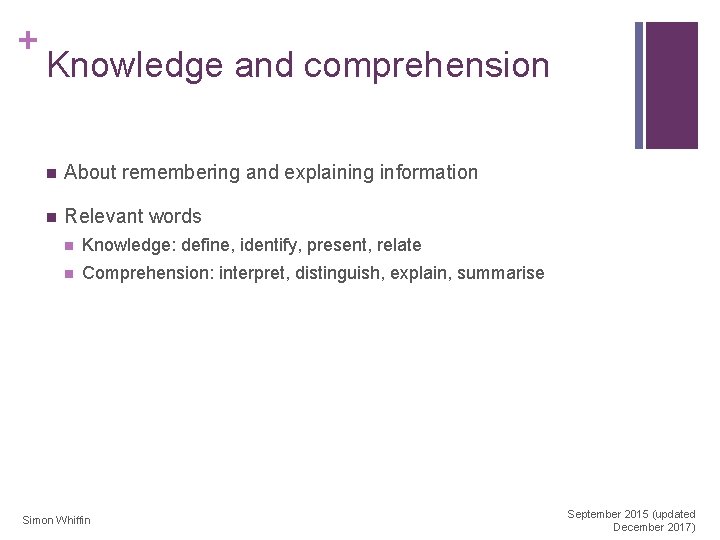
+ Knowledge and comprehension n About remembering and explaining information n Relevant words n Knowledge: define, identify, present, relate n Comprehension: interpret, distinguish, explain, summarise Simon Whiffin September 2015 (updated December 2017)
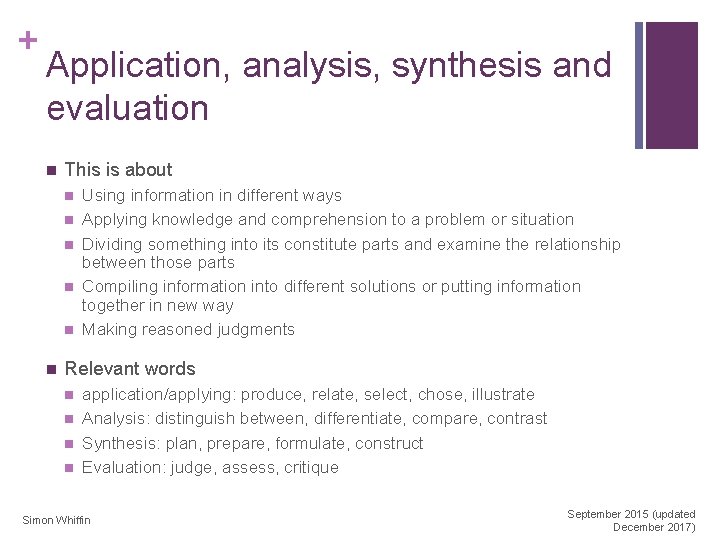
+ Application, analysis, synthesis and evaluation n This is about n n n Using information in different ways Applying knowledge and comprehension to a problem or situation Dividing something into its constitute parts and examine the relationship between those parts Compiling information into different solutions or putting information together in new way Making reasoned judgments Relevant words n n application/applying: produce, relate, select, chose, illustrate Analysis: distinguish between, differentiate, compare, contrast Synthesis: plan, prepare, formulate, construct Evaluation: judge, assess, critique Simon Whiffin September 2015 (updated December 2017)
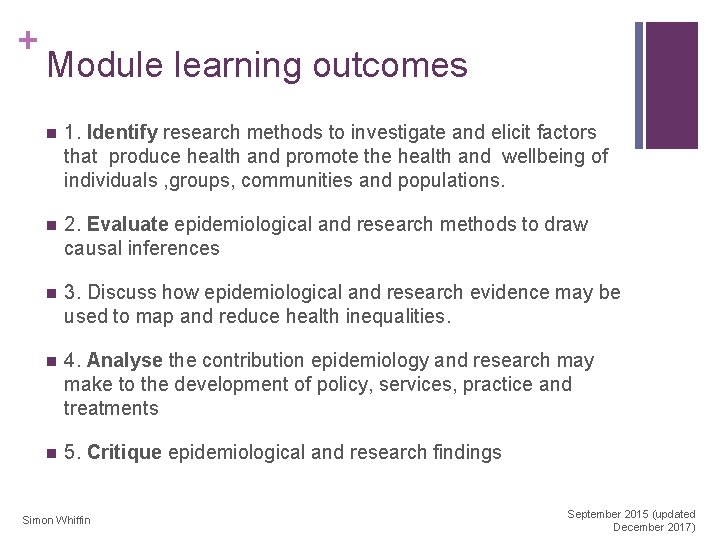
+ Module learning outcomes n 1. Identify research methods to investigate and elicit factors that produce health and promote the health and wellbeing of individuals , groups, communities and populations. n 2. Evaluate epidemiological and research methods to draw causal inferences n 3. Discuss how epidemiological and research evidence may be used to map and reduce health inequalities. n 4. Analyse the contribution epidemiology and research may make to the development of policy, services, practice and treatments n 5. Critique epidemiological and research findings Simon Whiffin September 2015 (updated December 2017)
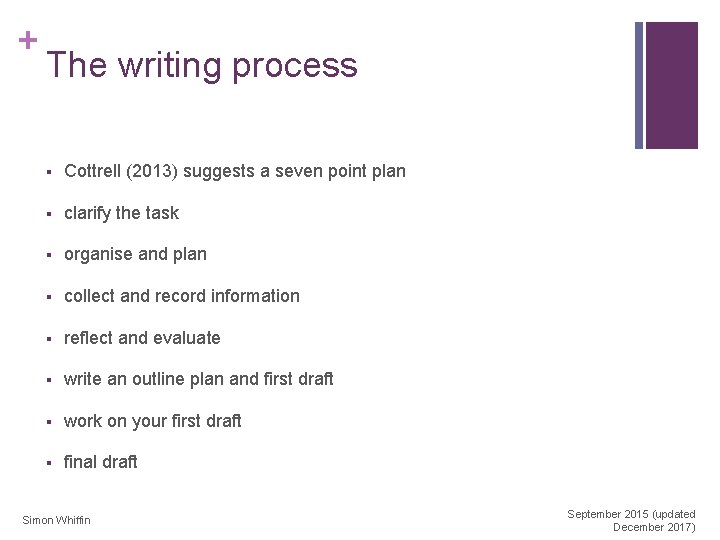
+ The writing process § Cottrell (2013) suggests a seven point plan § clarify the task § organise and plan § collect and record information § reflect and evaluate § write an outline plan and first draft § work on your first draft § final draft Simon Whiffin September 2015 (updated December 2017)
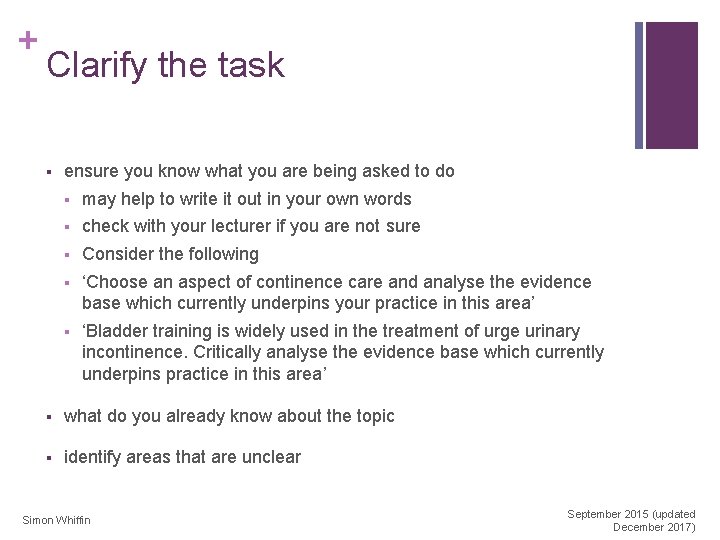
+ Clarify the task § ensure you know what you are being asked to do § may help to write it out in your own words § check with your lecturer if you are not sure § Consider the following § ‘Choose an aspect of continence care and analyse the evidence base which currently underpins your practice in this area’ § ‘Bladder training is widely used in the treatment of urge urinary incontinence. Critically analyse the evidence base which currently underpins practice in this area’ § what do you already know about the topic § identify areas that are unclear Simon Whiffin September 2015 (updated December 2017)
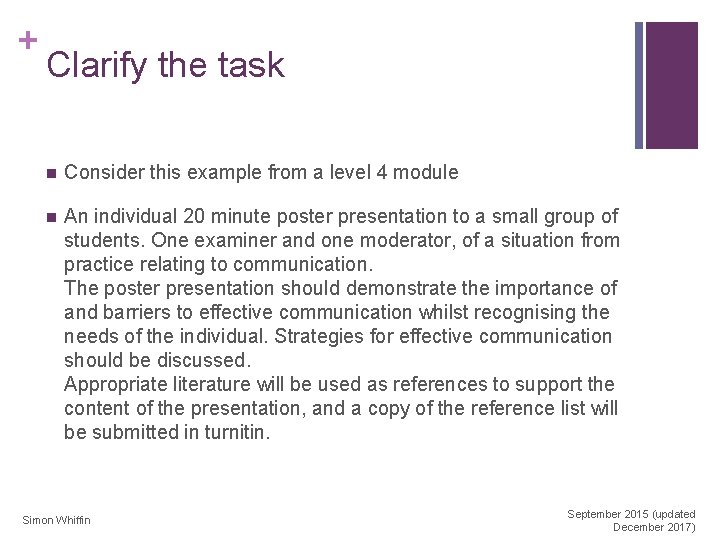
+ Clarify the task n Consider this example from a level 4 module n An individual 20 minute poster presentation to a small group of students. One examiner and one moderator, of a situation from practice relating to communication. The poster presentation should demonstrate the importance of and barriers to effective communication whilst recognising the needs of the individual. Strategies for effective communication should be discussed. Appropriate literature will be used as references to support the content of the presentation, and a copy of the reference list will be submitted in turnitin. Simon Whiffin September 2015 (updated December 2017)
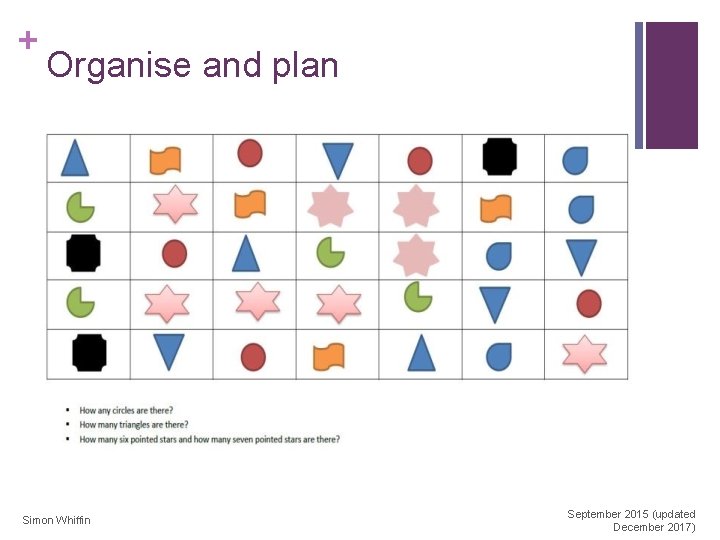
+ Organise and plan Simon Whiffin September 2015 (updated December 2017)
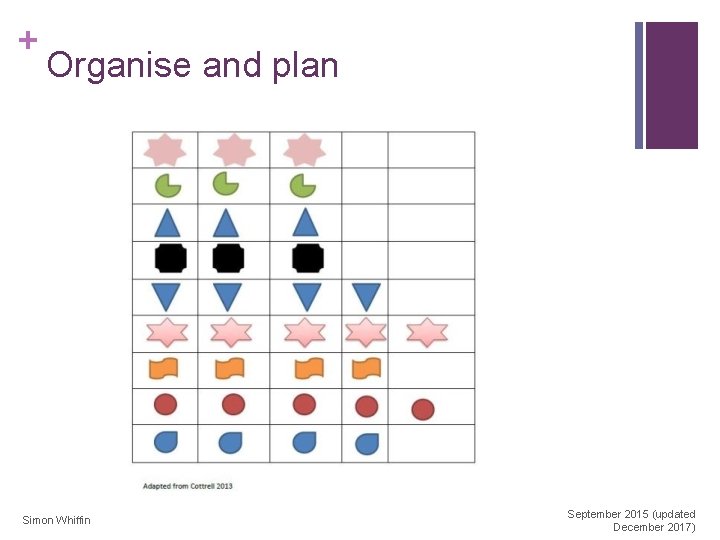
+ Organise and plan Simon Whiffin September 2015 (updated December 2017)
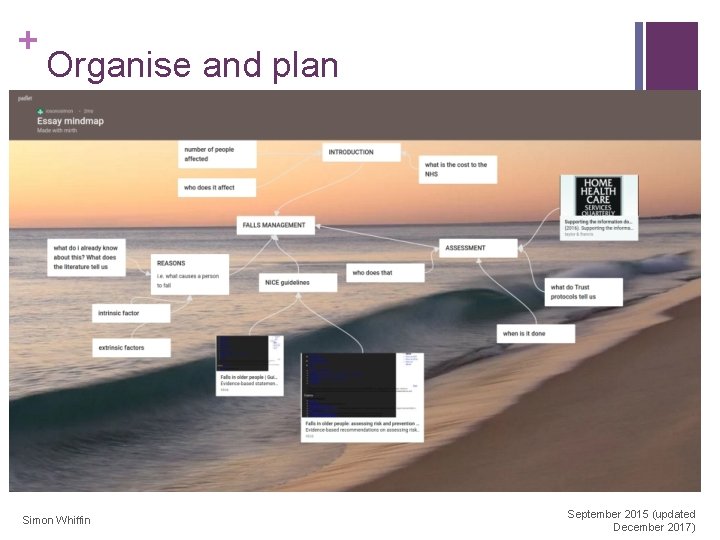
+ Organise and plan n n Organise n use a chart or mind map to link ideas and details this will help with the research stage n or use ‘post-it notes’ to identify areas in the subject you want to address eventually these will map to paragraphs in your essay make a rough essay outline plan as this will help your shape your ideas and provide a focus for your reading n Make sure that you back up your work Plan n review what you are doing to prevent repetition (common mistake) n subject areas in your introduction map to sections in the body of the essay n Manage your time identify time to write but be realistic. little and often n Find a space to study Simon Whiffin September 2015 (updated December 2017)
+ Organise and plan Simon Whiffin September 2015 (updated December 2017)
+ Collect and record information n Research is the building block of any writing n use a wide range of resources n n journals, books, NICE guidelines, Trust policies/protocols n 10 year rule n Think about your sources of information be selective you can’t use everything n 12 -15 references is about right for a 2500 word essay n keep a notebook to hand to jot down ideas n when you’ve read something make a note of where you have found it. use apps like Pocket to save content Simon Whiffin September 2015 (updated December 2017)
+ Collect and record information n framing what you are writing about as a question will help you identify key words and phrases to aid your search for literature n n You might use a framework like SPICE to help you produce a defined question n Setting e. g. community n Perspective e. g. community nursing team n Intervention n Comparison n Evaluation what conclusions can be drawn Does hand washing prevent cross infection? Simon Whiffin September 2015 (updated December 2017)
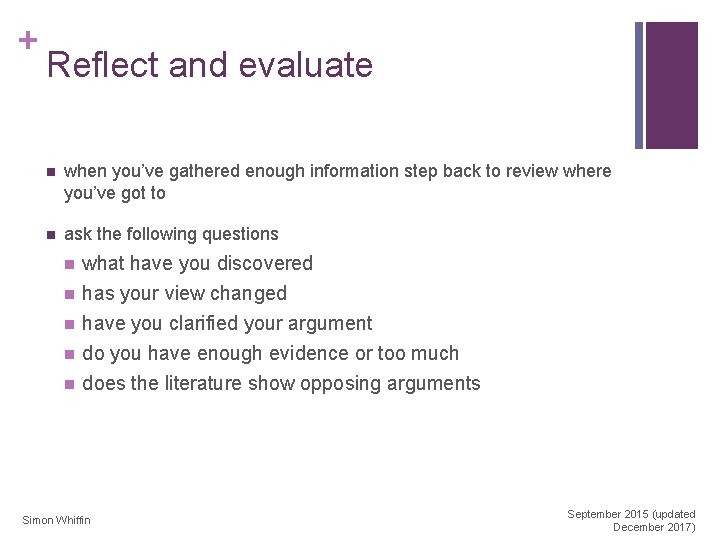
+ Reflect and evaluate n when you’ve gathered enough information step back to review where you’ve got to n ask the following questions n n n what have you discovered has your view changed have you clarified your argument do you have enough evidence or too much does the literature show opposing arguments Simon Whiffin September 2015 (updated December 2017)
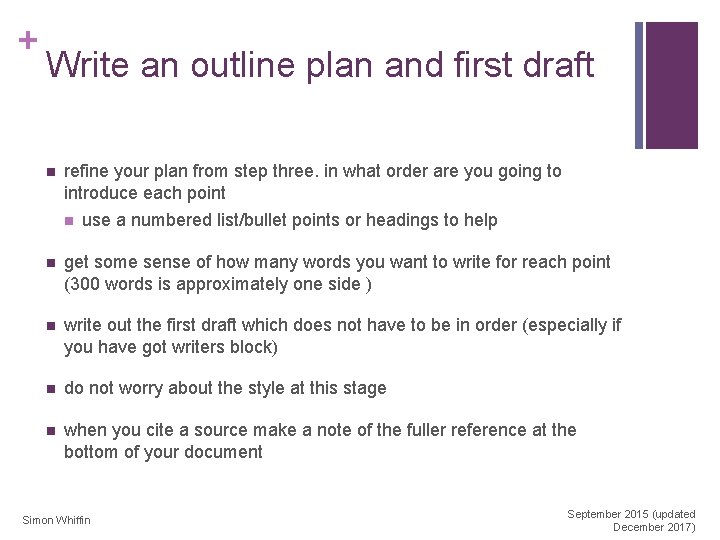
+ Write an outline plan and first draft n refine your plan from step three. in what order are you going to introduce each point n use a numbered list/bullet points or headings to help n get some sense of how many words you want to write for reach point (300 words is approximately one side ) n write out the first draft which does not have to be in order (especially if you have got writers block) n do not worry about the style at this stage n when you cite a source make a note of the fuller reference at the bottom of your document Simon Whiffin September 2015 (updated December 2017)
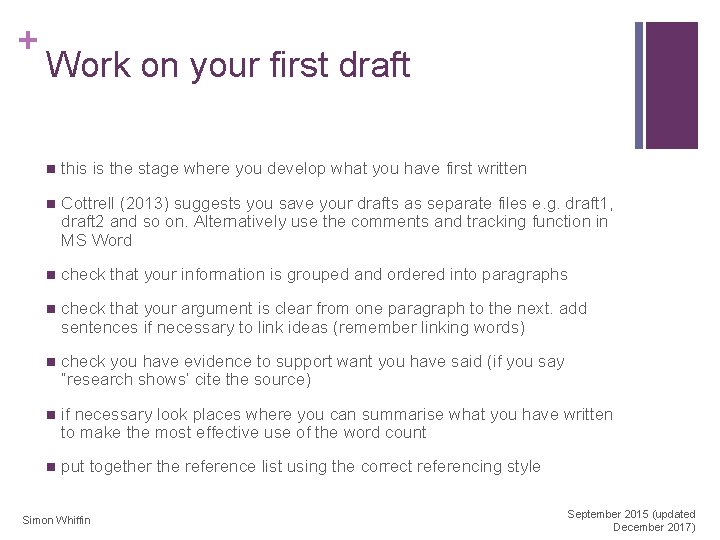
+ Work on your first draft n this is the stage where you develop what you have first written n Cottrell (2013) suggests you save your drafts as separate files e. g. draft 1, draft 2 and so on. Alternatively use the comments and tracking function in MS Word n check that your information is grouped and ordered into paragraphs n check that your argument is clear from one paragraph to the next. add sentences if necessary to link ideas (remember linking words) n check you have evidence to support want you have said (if you say “research shows’ cite the source) n if necessary look places where you can summarise what you have written to make the most effective use of the word count n put together the reference list using the correct referencing style Simon Whiffin September 2015 (updated December 2017)
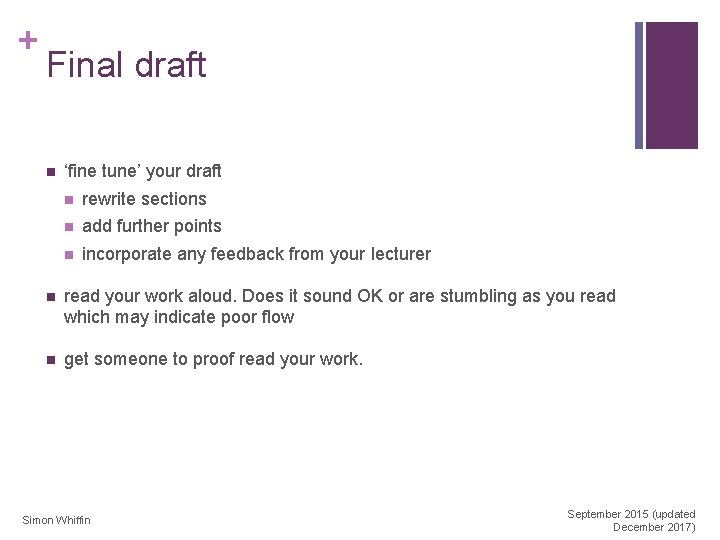
+ Final draft n ‘fine tune’ your draft n rewrite sections n add further points n incorporate any feedback from your lecturer n read your work aloud. Does it sound OK or are stumbling as you read which may indicate poor flow n get someone to proof read your work. Simon Whiffin September 2015 (updated December 2017)
+ References n Cottrell S. 2013 The Study Skills Handbook 4 th Ed Basingstoke: Plagrave Macmillian n Godfrey, J 2009 Writing for University (Pocket Study Skills) Basingstoke: Palgrave Macmillan Simon Whiffin September 2015 (updated December 2017)