
Academic planning writing Structure and nuances of academic


- Slides: 27
+ Academic planning& writing Structure and nuances of academic writing
+ Structure n Notion of a journey or a guided tour n An introduction (the beginning) n The body or middle (where you discuss the topic) n Conclusion (the end of the journey) n Bear in mind that the reader shouldn’t need to seek clarification Simon Whiffin December 2015 (updated June 2017)
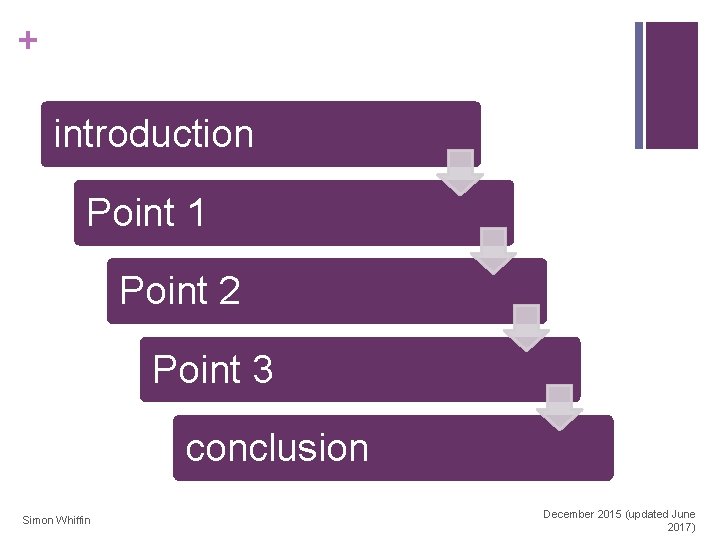
+ introduction Point 1 Point 2 Point 3 conclusion Simon Whiffin December 2015 (updated June 2017)
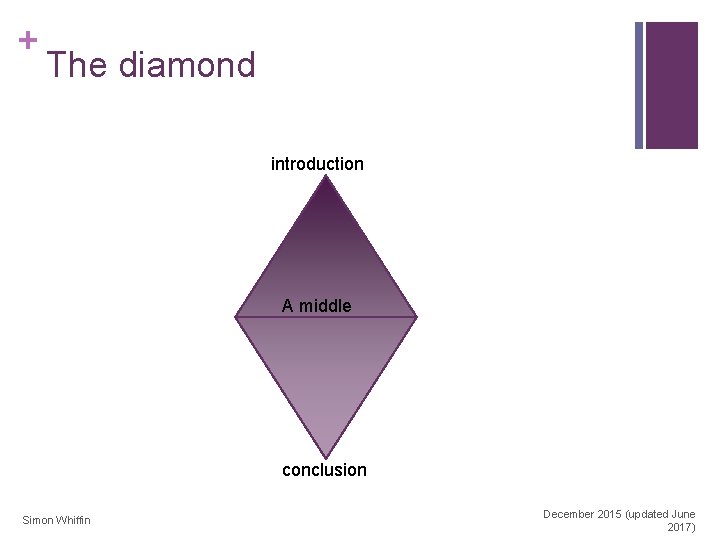
+ The diamond n Godfrey uses the analogy of a diamond to describe the structure of an essay n Whatever points you start you have to finish (drawing the threads together) n Introduction has it’s own structure and is distinct from the main body n The body of the essay approximately (80%) of the overall word count n Divided into paragraphs n Develops your argument into clear sections Simon Whiffin December 2015 (updated June 2017)
+ The diamond introduction A middle conclusion Simon Whiffin December 2015 (updated June 2017)
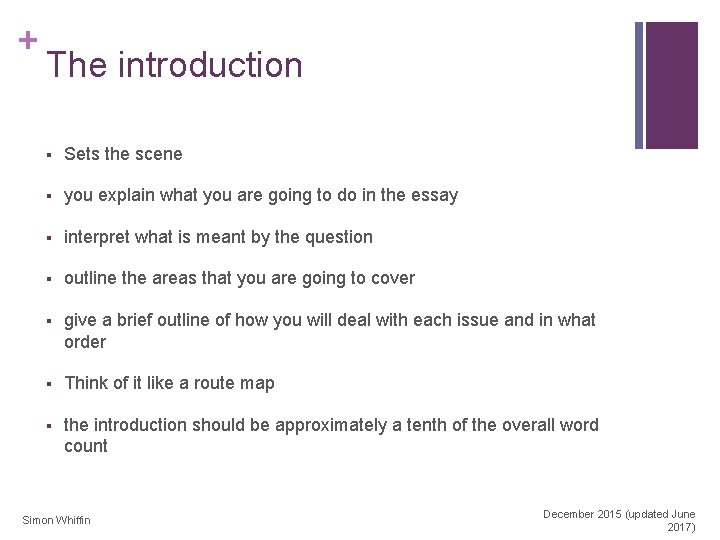
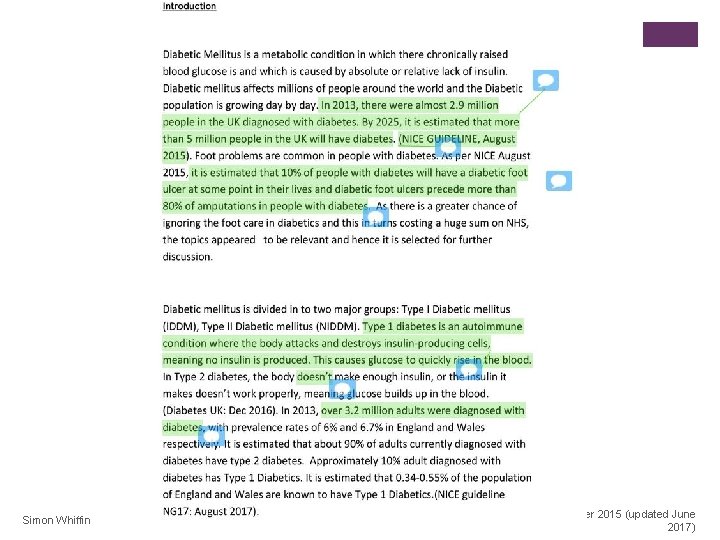
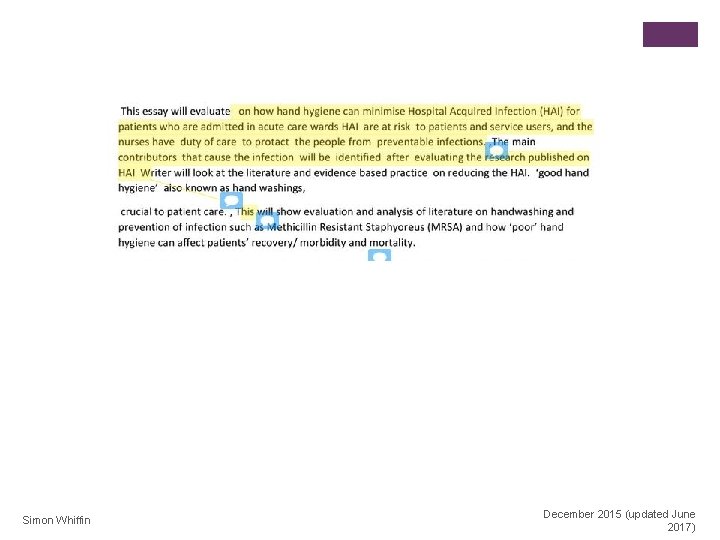
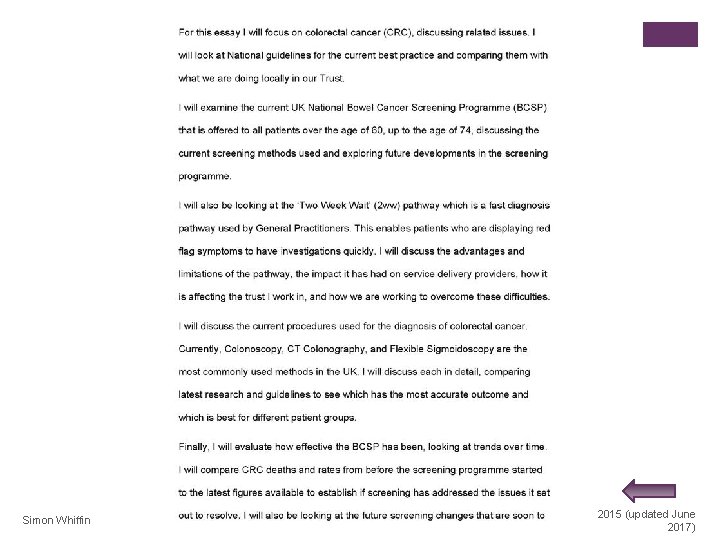
+ The introduction § Sets the scene § you explain what you are going to do in the essay § interpret what is meant by the question § outline the areas that you are going to cover § give a brief outline of how you will deal with each issue and in what order § Think of it like a route map § the introduction should be approximately a tenth of the overall word count Simon Whiffin December 2015 (updated June 2017)
Simon Whiffin December 2015 (updated June 2017)
Simon Whiffin December 2015 (updated June 2017)
Simon Whiffin December 2015 (updated June 2017)
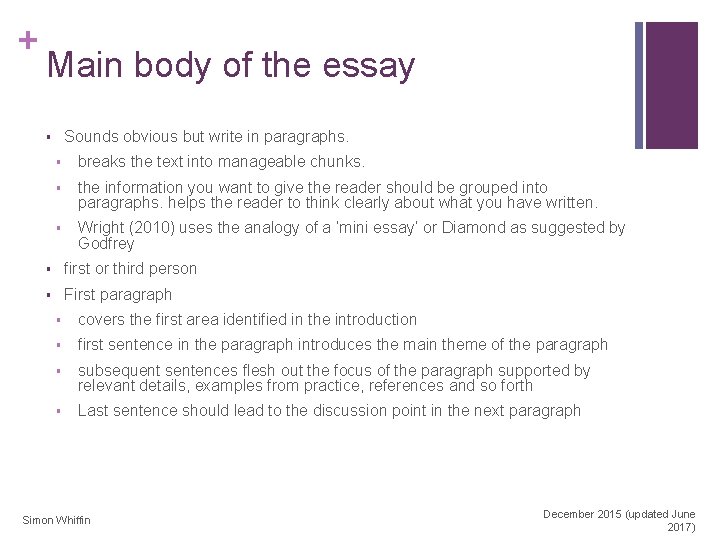
+ Main body of the essay Sounds obvious but write in paragraphs. § § breaks the text into manageable chunks. § the information you want to give the reader should be grouped into paragraphs. helps the reader to think clearly about what you have written. § Wright (2010) uses the analogy of a ‘mini essay’ or Diamond as suggested by Godfrey § first or third person § First paragraph § covers the first area identified in the introduction § first sentence in the paragraph introduces the main theme of the paragraph § subsequent sentences flesh out the focus of the paragraph supported by relevant details, examples from practice, references and so forth § Last sentence should lead to the discussion point in the next paragraph Simon Whiffin December 2015 (updated June 2017)
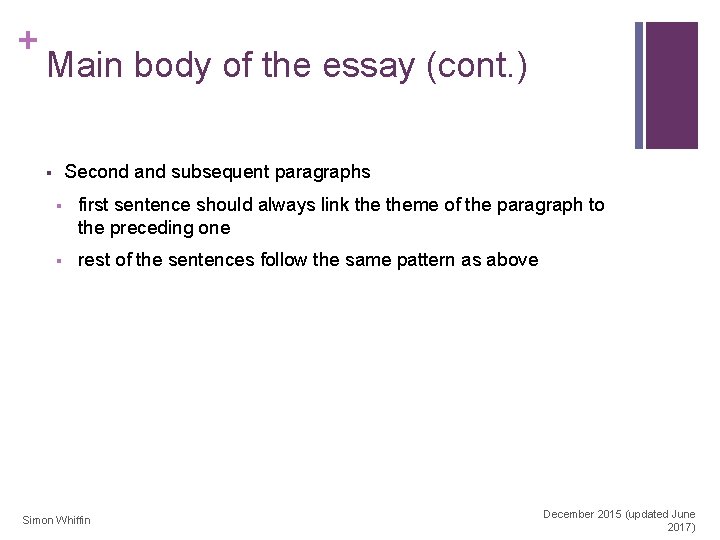
+ Main body of the essay (cont. ) Second and subsequent paragraphs § § first sentence should always link theme of the paragraph to the preceding one § rest of the sentences follow the same pattern as above Simon Whiffin December 2015 (updated June 2017)
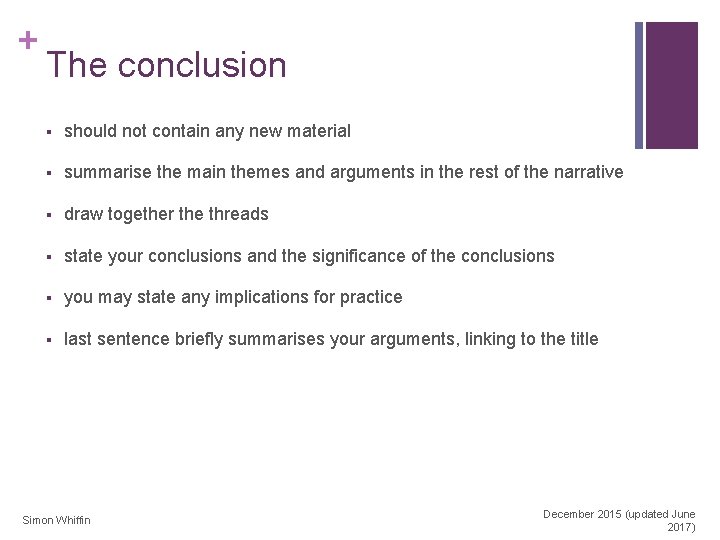
+ The conclusion § should not contain any new material § summarise the main themes and arguments in the rest of the narrative § draw together the threads § state your conclusions and the significance of the conclusions § you may state any implications for practice § last sentence briefly summarises your arguments, linking to the title Simon Whiffin December 2015 (updated June 2017)
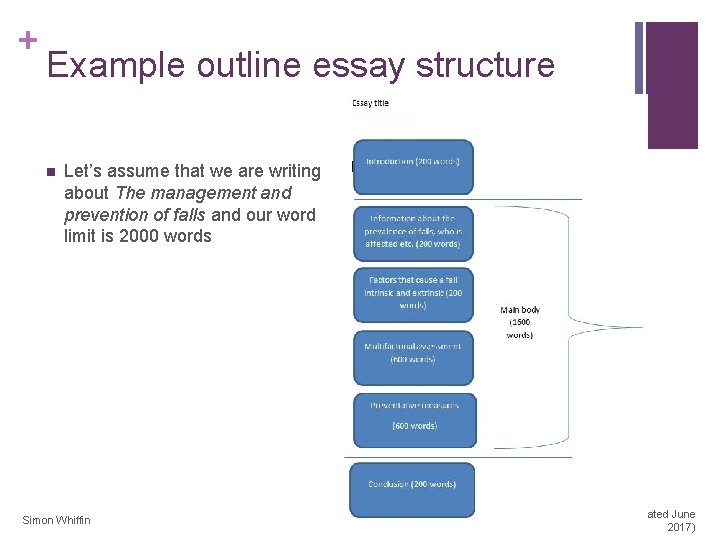
+ Example outline essay structure n Let’s assume that we are writing about The management and prevention of falls and our word limit is 2000 words Simon Whiffin December 2015 (updated June 2017)
+ The evidence n The strength of your argument depends on the evidence you’ve used and how it’s presented n If the main point of a paragraph is that nurses’ numeracy skills are a growing concern you need to justify this Wright (2010) n ‘The so what’ takes your academic writing a step forward Simon Whiffin December 2015 (updated June 2017)
+ So what is the implication of the evidence n n Wright (2010) gives the following example n ‘ 80% of all GP appointments are for people for long term conditions’ n To tease out the relevance Wright (2010) suggests adding the following ‘and this highlights the important of the GP role in the management of long term conditions’ Alternatively n Incidence of wrong site surgery have fallen by 50% within the last ten years n And this highlights the importance of the WHO surgical safety checklist Simon Whiffin December 2015 (updated June 2017)
+ Essential elements of academic writing: Formal language § More formal way of writing but this doesn’t mean using complex sentences , long words or hifalutin language § Avoid using a ‘chatty’ style / colloquial language e. g. words like ‘anyhow’ or phrases such as ‘taken with a pinch of salt’ § Try to avoid using emotive language. § § § Words like wonderful, shocking, worrying Death rates were appalling (significant) The incidence of Type 2 Diabetes has sadly gone up (The incidence of Type 2 Diabetes has increased by 10% since 2000) § Specialist vocabulary. § Avoid using bullet points § Don’t use contractions such as don’t won’t instead write do not § Avoid using abbreviations like e. g. dept and so forth § Acronyms. DN, ITU, SSC provide definition first then use the abbreviated form Simon Whiffin December 2015 (updated June 2017)
+ Formal language § ‘I looked through the literature and found’ § § ‘Of the World Health Organisation Surgical Safety Checklist as this is included in field of work’ § § ‘The literature search revealed’ ‘World Health Organisation Surgical Safety Checklist as this is a fundamental part of my practice’ To conclude, even though there has been much studies done on the importance of repositioning § Simon Whiffin although the importance of repositioning has been widely researched December 2015 (updated June 2017)
+ Essential elements of academic writing § Write in cautious terms. Things are rarely certain use words and phrases like § May § Might § generally § Appears to be § Evidence suggests § Avoid using words like always, never and proves § Misplaced conjunctions. don’t use words like ‘and, ‘or’ ‘but, ‘yet’ at the beginning of a sentence. Simon Whiffin December 2015 (updated June 2017)
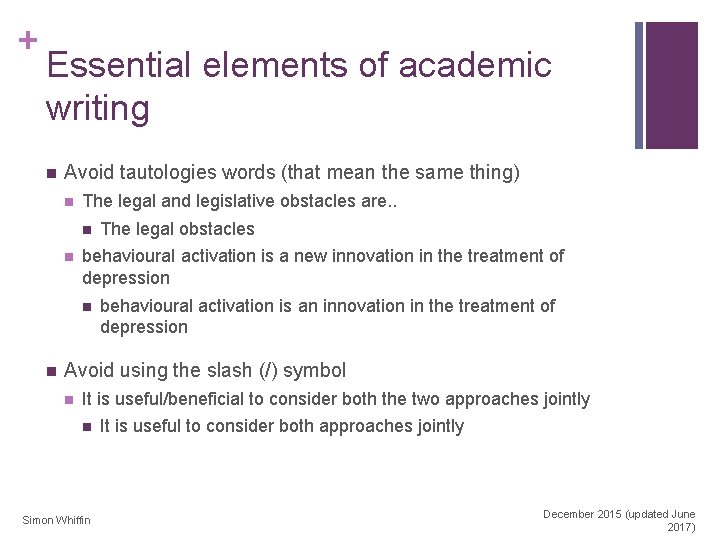
+ Essential elements of academic writing n Avoid tautologies words (that mean the same thing) n The legal and legislative obstacles are. . n n behavioural activation is a new innovation in the treatment of depression n n The legal obstacles behavioural activation is an innovation in the treatment of depression Avoid using the slash (/) symbol n It is useful/beneficial to consider both the two approaches jointly n Simon Whiffin It is useful to consider both approaches jointly December 2015 (updated June 2017)
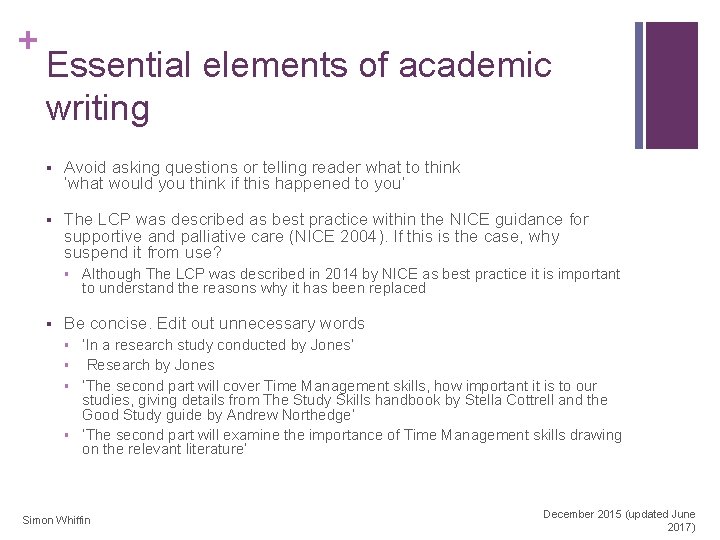
+ Essential elements of academic writing § Avoid asking questions or telling reader what to think ‘what would you think if this happened to you’ § The LCP was described as best practice within the NICE guidance for supportive and palliative care (NICE 2004). If this is the case, why suspend it from use? § § Although The LCP was described in 2014 by NICE as best practice it is important to understand the reasons why it has been replaced Be concise. Edit out unnecessary words § § ‘In a research study conducted by Jones’ Research by Jones ‘The second part will cover Time Management skills, how important it is to our studies, giving details from The Study Skills handbook by Stella Cottrell and the Good Study guide by Andrew Northedge’ ‘The second part will examine the importance of Time Management skills drawing on the relevant literature’ Simon Whiffin December 2015 (updated June 2017)
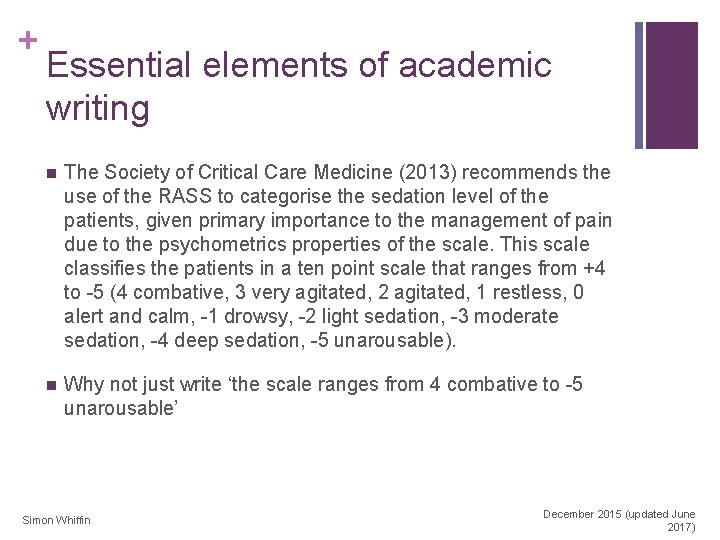
+ Essential elements of academic writing n The Society of Critical Care Medicine (2013) recommends the use of the RASS to categorise the sedation level of the patients, given primary importance to the management of pain due to the psychometrics properties of the scale. This scale classifies the patients in a ten point scale that ranges from +4 to -5 (4 combative, 3 very agitated, 2 agitated, 1 restless, 0 alert and calm, -1 drowsy, -2 light sedation, -3 moderate sedation, -4 deep sedation, -5 unarousable). n Why not just write ‘the scale ranges from 4 combative to -5 unarousable’ Simon Whiffin December 2015 (updated June 2017)
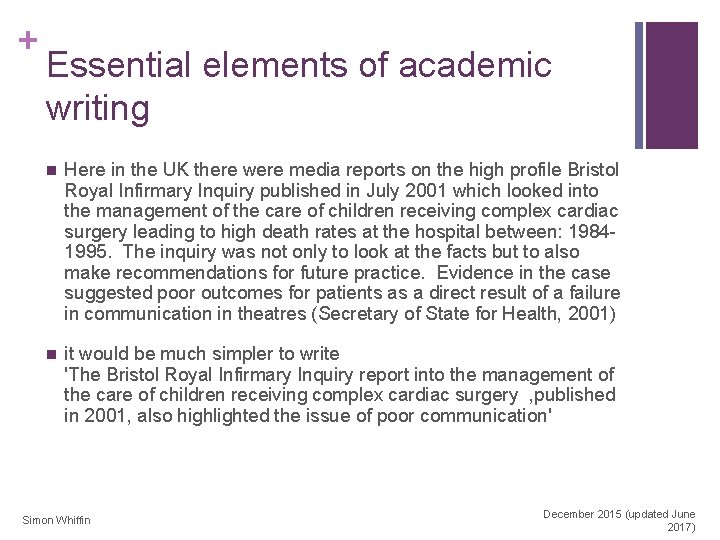
+ Essential elements of academic writing n Here in the UK there were media reports on the high profile Bristol Royal Infirmary Inquiry published in July 2001 which looked into the management of the care of children receiving complex cardiac surgery leading to high death rates at the hospital between: 19841995. The inquiry was not only to look at the facts but to also make recommendations for future practice. Evidence in the case suggested poor outcomes for patients as a direct result of a failure in communication in theatres (Secretary of State for Health, 2001) n it would be much simpler to write 'The Bristol Royal Infirmary Inquiry report into the management of the care of children receiving complex cardiac surgery , published in 2001, also highlighted the issue of poor communication' Simon Whiffin December 2015 (updated June 2017)
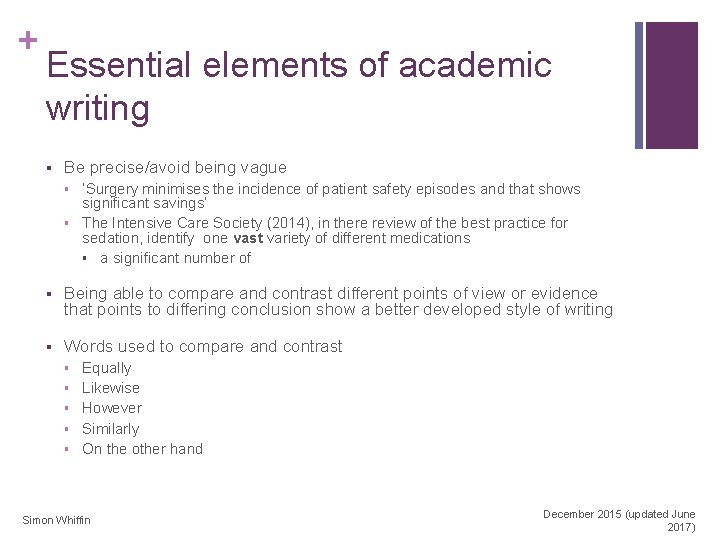
+ Essential elements of academic writing § Be precise/avoid being vague § § ‘Surgery minimises the incidence of patient safety episodes and that shows significant savings’ The Intensive Care Society (2014), in there review of the best practice for sedation, identify one vast variety of different medications § a significant number of § Being able to compare and contrast different points of view or evidence that points to differing conclusion show a better developed style of writing § Words used to compare and contrast § § § Equally Likewise However Similarly On the other hand Simon Whiffin December 2015 (updated June 2017)
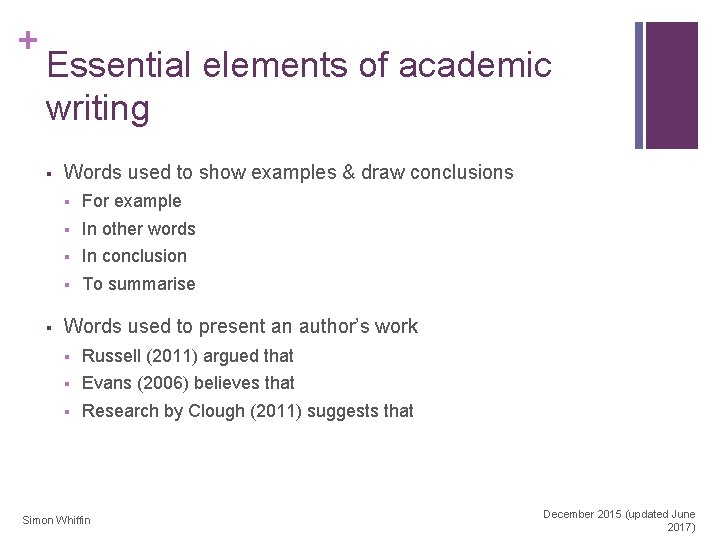
+ Essential elements of academic writing § § Words used to show examples & draw conclusions § For example § In other words § In conclusion § To summarise Words used to present an author’s work § Russell (2011) argued that § Evans (2006) believes that § Research by Clough (2011) suggests that Simon Whiffin December 2015 (updated June 2017)
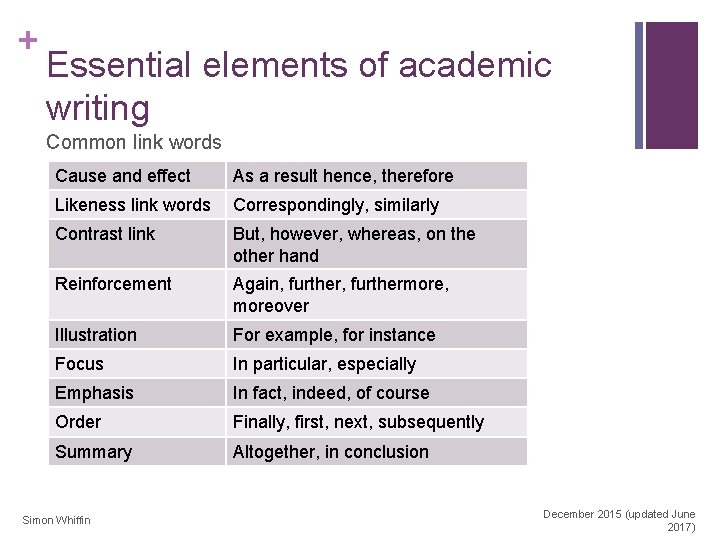
+ Essential elements of academic writing Common link words Cause and effect As a result hence, therefore Likeness link words Correspondingly, similarly Contrast link But, however, whereas, on the other hand Reinforcement Again, furthermore, moreover Illustration For example, for instance Focus In particular, especially Emphasis In fact, indeed, of course Order Finally, first, next, subsequently Summary Altogether, in conclusion Simon Whiffin December 2015 (updated June 2017)
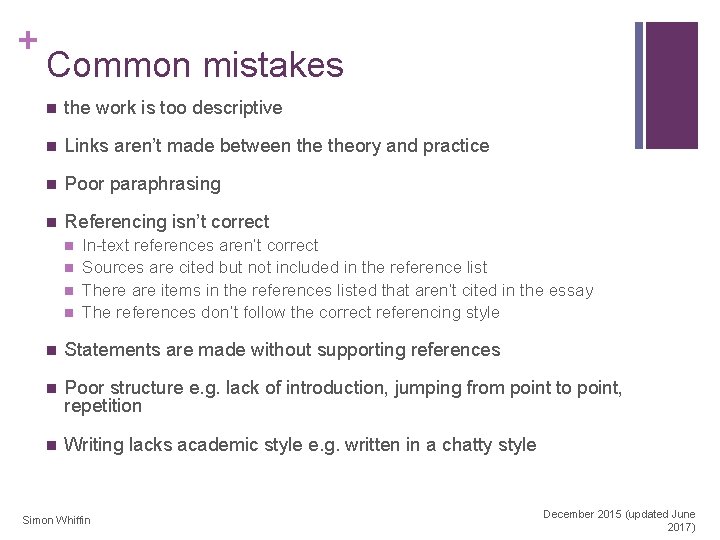
+ Common mistakes n the work is too descriptive n Links aren’t made between theory and practice n Poor paraphrasing n Referencing isn’t correct n n In-text references aren’t correct Sources are cited but not included in the reference list There are items in the references listed that aren’t cited in the essay The references don’t follow the correct referencing style n Statements are made without supporting references n Poor structure e. g. lack of introduction, jumping from point to point, repetition n Writing lacks academic style e. g. written in a chatty style Simon Whiffin December 2015 (updated June 2017)
+ References n Godfrey, J 2009 Writing for University (Pocket Study Skills) Basingstoke: Palgrave Macmillan n Wright K. 2010 Simple writing skills for students, part one: structure and clarity British Journal of Nursing 19 (11) 709 -711 Simon Whiffin December 2015 (updated June 2017)