
Academic Paragraphs By AJ Brown Academic Paragraphs They
Academic Paragraphs By AJ Brown
Academic Paragraphs They are how you will learn most of the information in your classes. (reading) They are also the most common way your teachers will ask you to demonstrate that you’ve learned the material. (writing)
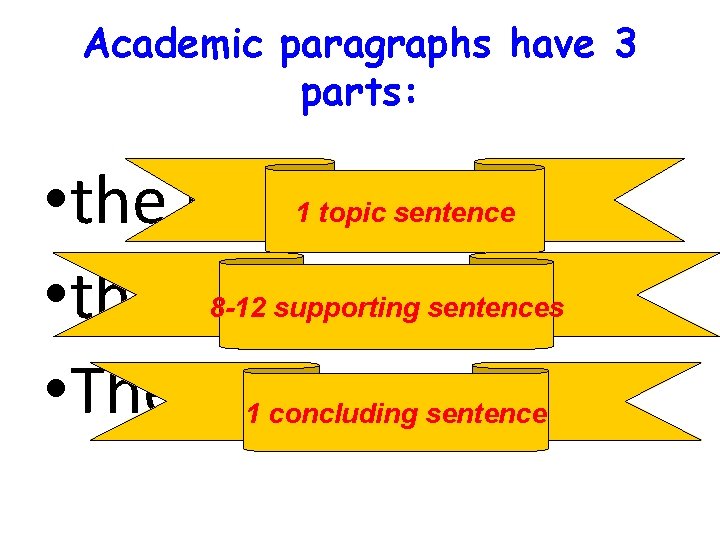
Academic paragraphs have 3 parts: • the beginning • the middle • The end 1 topic sentence 8 -12 supporting sentences 1 concluding sentence
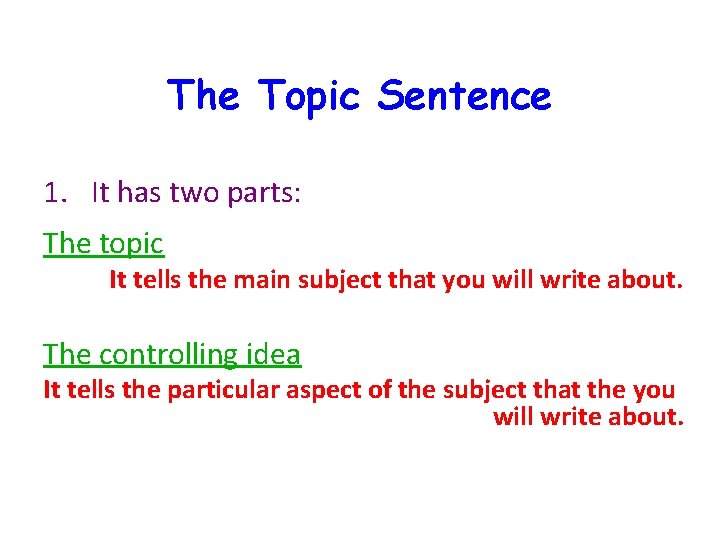
The Topic Sentence 1. It has two parts: The topic It tells the main subject that you will write about. The controlling idea It tells the particular aspect of the subject that the you will write about.
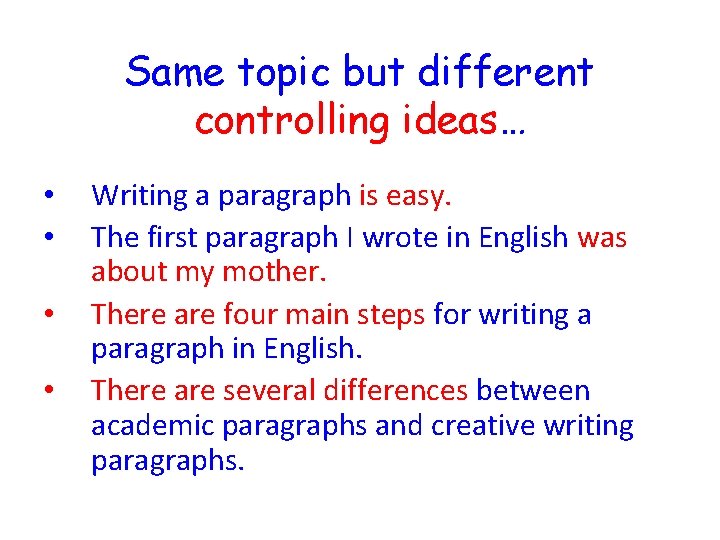
Same topic but different controlling ideas… • • Writing a paragraph is easy. The first paragraph I wrote in English was about my mother. There are four main steps for writing a paragraph in English. There are several differences between academic paragraphs and creative writing paragraphs.
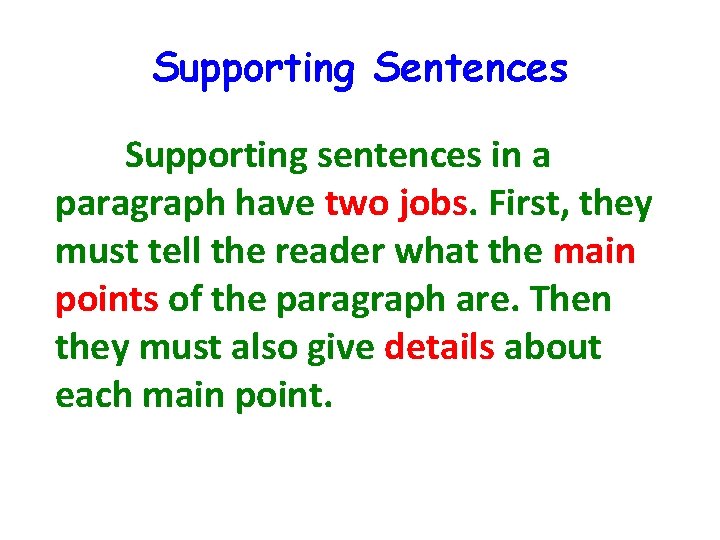
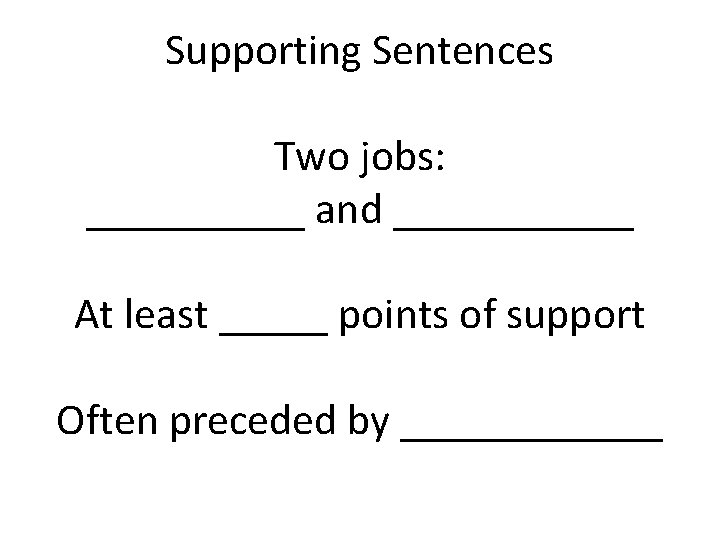
Supporting Sentences Supporting sentences in a paragraph have two jobs. First, they must tell the reader what the main points of the paragraph are. Then they must also give details about each main point.
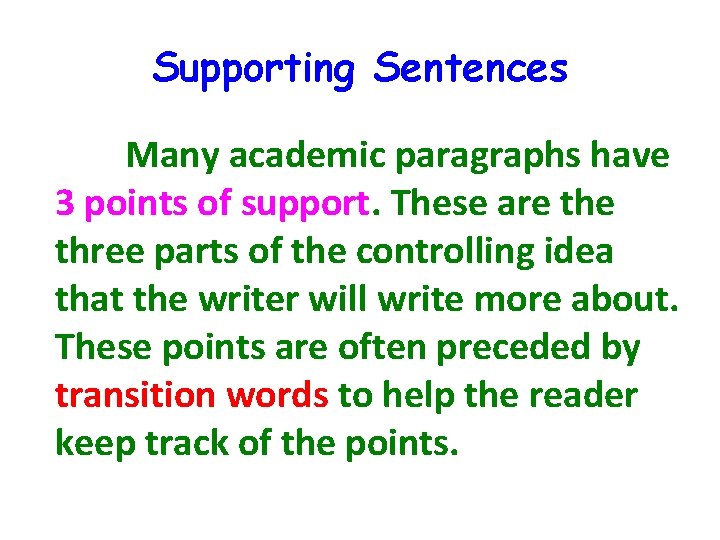
Supporting Sentences Many academic paragraphs have 3 points of support. These are three parts of the controlling idea that the writer will write more about. These points are often preceded by transition words to help the reader keep track of the points.
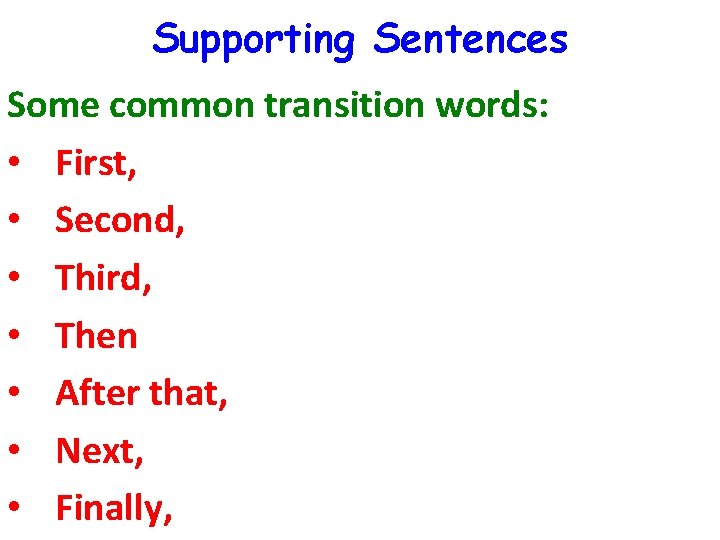
Supporting Sentences Some common transition words: • First, • Second, • Third, • Then • After that, • Next, • Finally,
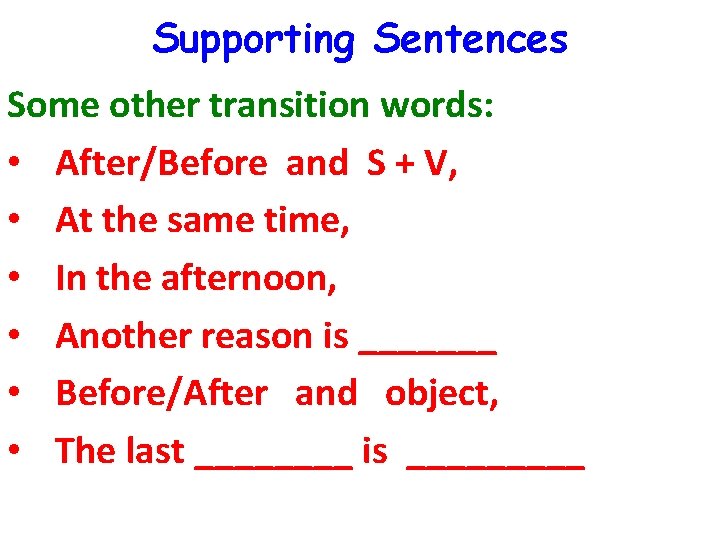
Supporting Sentences Some other transition words: • After/Before and S + V, • At the same time, • In the afternoon, • Another reason is _______ • Before/After and object, • The last ____ is _____
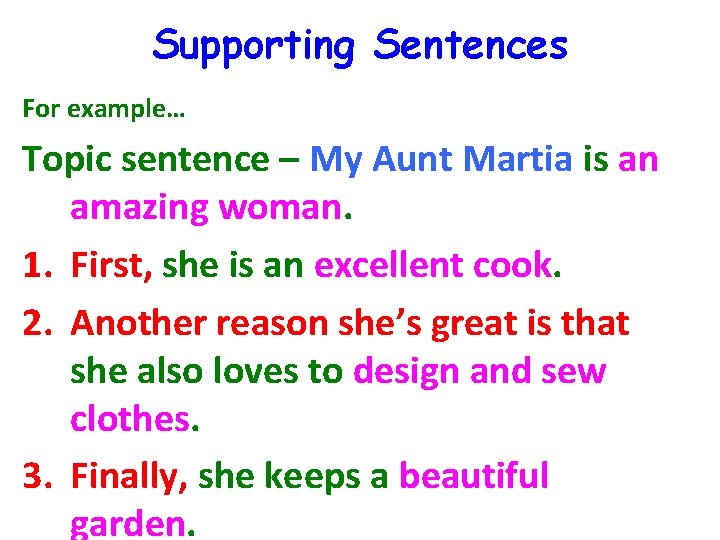
Supporting Sentences For example… Topic sentence – My Aunt Martia is an amazing woman. 1. First, she is an excellent cook. 2. Another reason she’s great is that she also loves to design and sew clothes. 3. Finally, she keeps a beautiful garden.
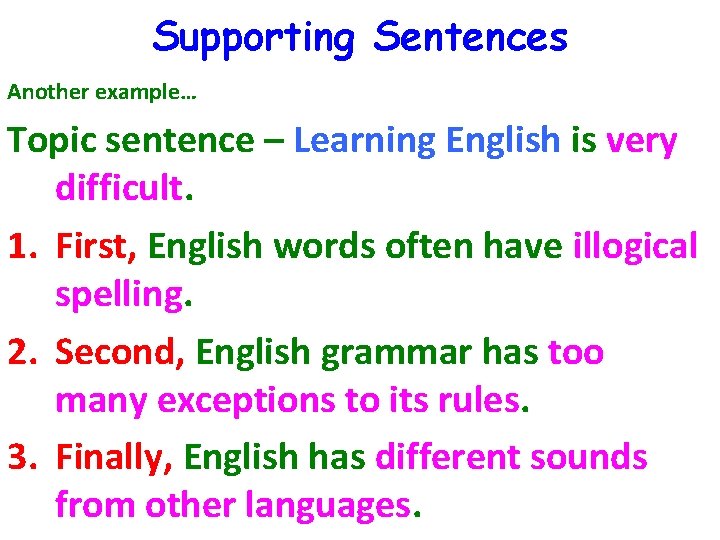
Supporting Sentences Another example… Topic sentence – Learning English is very difficult. 1. First, English words often have illogical spelling. 2. Second, English grammar has too many exceptions to its rules. 3. Finally, English has different sounds from other languages.
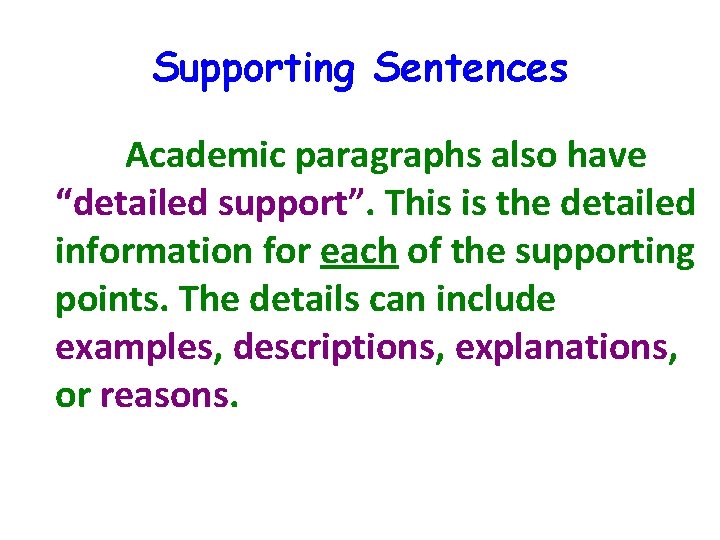
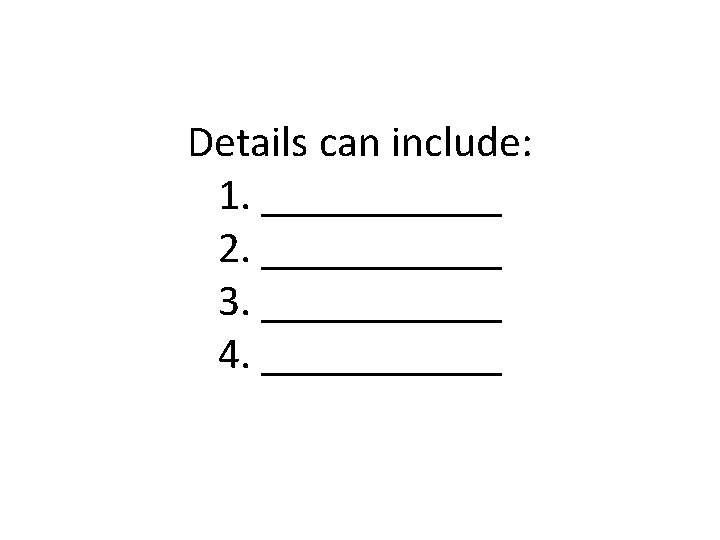
Supporting Sentences Academic paragraphs also have “detailed support”. This is the detailed information for each of the supporting points. The details can include examples, descriptions, explanations, or reasons.
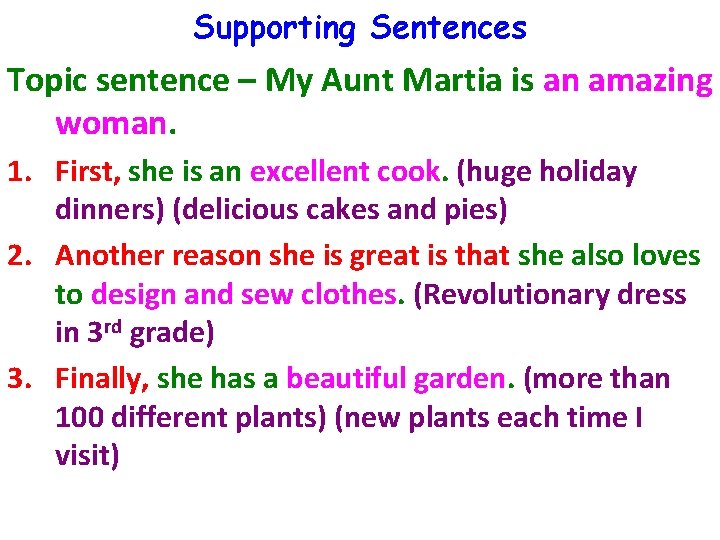
Supporting Sentences Topic sentence – My Aunt Martia is an amazing woman. 1. First, she is an excellent cook. (huge holiday dinners) (delicious cakes and pies) 2. Another reason she is great is that she also loves to design and sew clothes. (Revolutionary dress in 3 rd grade) 3. Finally, she has a beautiful garden. (more than 100 different plants) (new plants each time I visit)
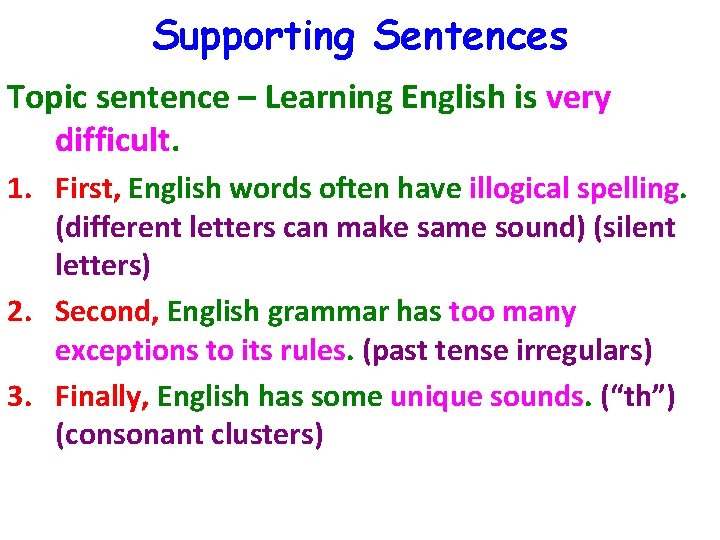
Supporting Sentences Topic sentence – Learning English is very difficult. 1. First, English words often have illogical spelling. (different letters can make same sound) (silent letters) 2. Second, English grammar has too many exceptions to its rules. (past tense irregulars) 3. Finally, English has some unique sounds. (“th”) (consonant clusters)
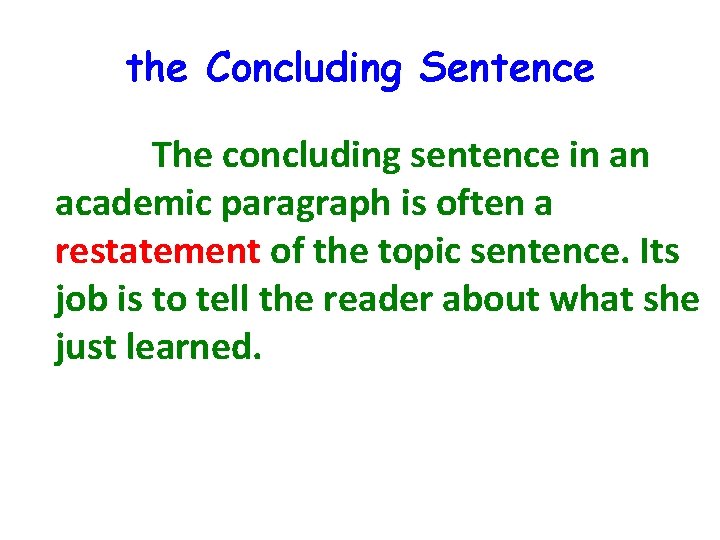
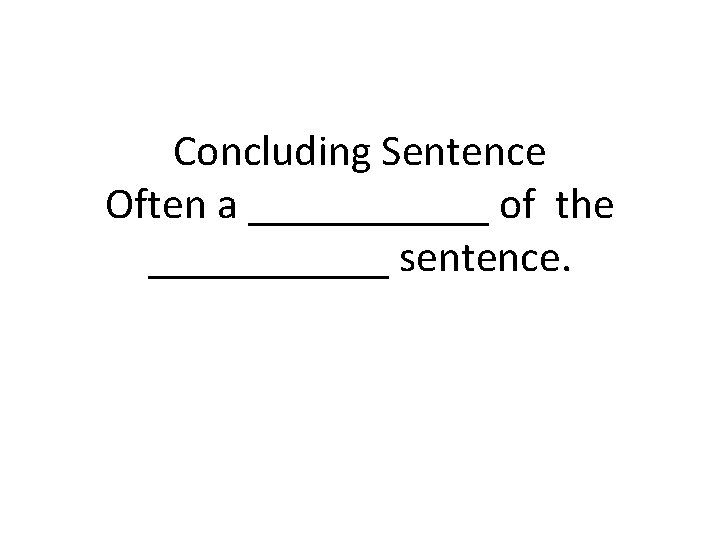
the Concluding Sentence The concluding sentence in an academic paragraph is often a restatement of the topic sentence. Its job is to tell the reader about what she just learned.
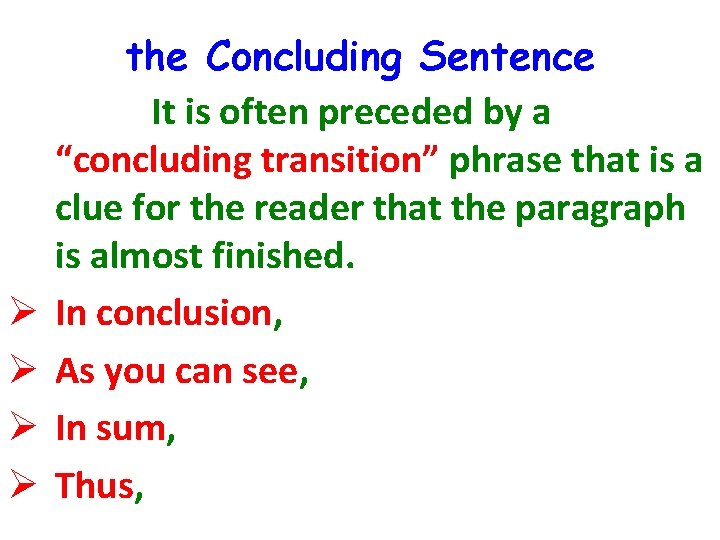
Ø Ø the Concluding Sentence It is often preceded by a “concluding transition” phrase that is a clue for the reader that the paragraph is almost finished. In conclusion, As you can see, In sum, Thus,
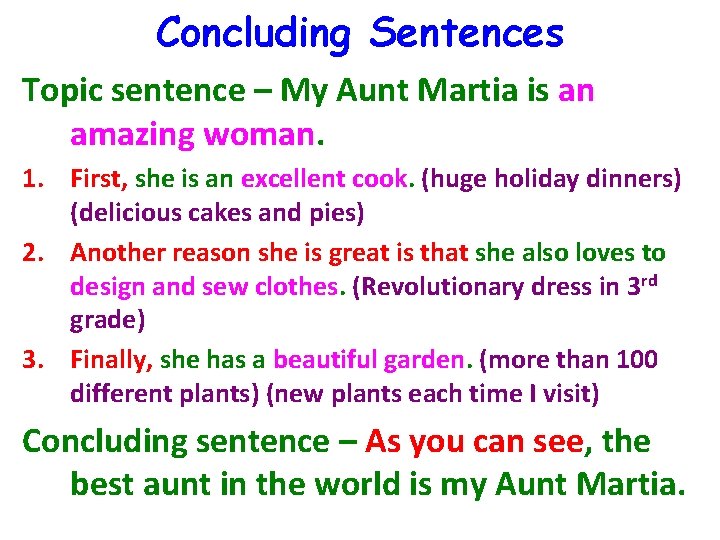
Concluding Sentences Topic sentence – My Aunt Martia is an amazing woman. 1. First, she is an excellent cook. (huge holiday dinners) (delicious cakes and pies) 2. Another reason she is great is that she also loves to design and sew clothes. (Revolutionary dress in 3 rd grade) 3. Finally, she has a beautiful garden. (more than 100 different plants) (new plants each time I visit) Concluding sentence – As you can see, the best aunt in the world is my Aunt Martia.
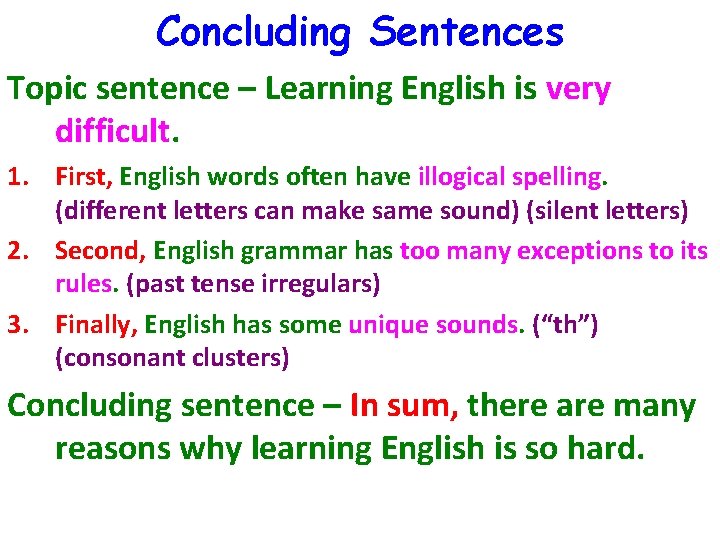
Concluding Sentences Topic sentence – Learning English is very difficult. 1. First, English words often have illogical spelling. (different letters can make same sound) (silent letters) 2. Second, English grammar has too many exceptions to its rules. (past tense irregulars) 3. Finally, English has some unique sounds. (“th”) (consonant clusters) Concluding sentence – In sum, there are many reasons why learning English is so hard.

Put it all together… My Aunt Martia is an amazing woman. She is wonderful for many reasons. First, she is an excellent cook. When I was young, we had huge holiday meals at her house. She also makes delicious cakes and pies. Another reason she is great is that she loves to design and make clothes. When I was eight years old, she made me a “Revolutionary” dress for a Fourth of July parade. It had an old-fashioned bodice and a full skirt with ruffles. I loved that dress, and I still have it today. Finally, she has a beautiful garden. There are more than 100 different plants from all over the world. These days, she gives me plants when I visit, and I am starting my own garden at home. As you can see, the best aunt in the world is my Aunt Martia.
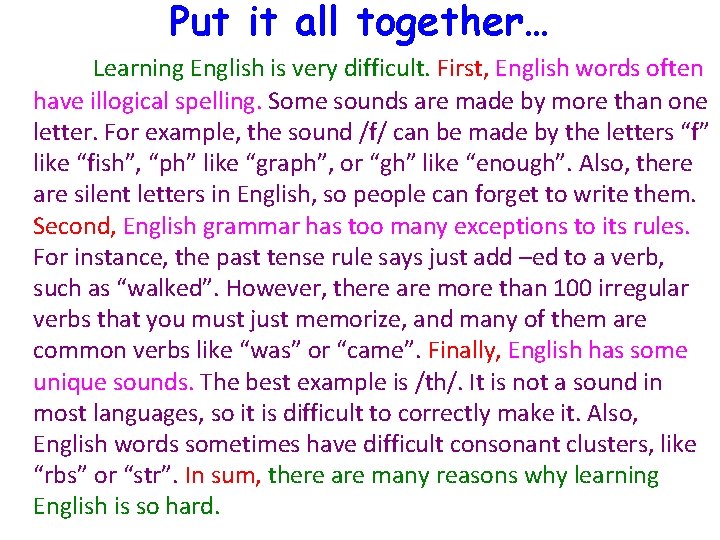
Put it all together… Learning English is very difficult. First, English words often have illogical spelling. Some sounds are made by more than one letter. For example, the sound /f/ can be made by the letters “f” like “fish”, “ph” like “graph”, or “gh” like “enough”. Also, there are silent letters in English, so people can forget to write them. Second, English grammar has too many exceptions to its rules. For instance, the past tense rule says just add –ed to a verb, such as “walked”. However, there are more than 100 irregular verbs that you must just memorize, and many of them are common verbs like “was” or “came”. Finally, English has some unique sounds. The best example is /th/. It is not a sound in most languages, so it is difficult to correctly make it. Also, English words sometimes have difficult consonant clusters, like “rbs” or “str”. In sum, there are many reasons why learning English is so hard.
Review Topic Sentence: ______ and ______
Supporting Sentences Two jobs: _____ and ______ At least _____ points of support Often preceded by ______
Details can include: 1. ______ 2. ______ 3. ______ 4. ______
Concluding Sentence Often a ______ of the ______ sentence.
- Slides: 24