
Academic Literacy for English Learners International Students Long
- Slides: 9
Academic Literacy for English Learners: International Students, Long Term English Learners First Generation Students Maria Timmons Flores TESOL / Bilingual Education
Acquisition & Learning. In L 1, we acquire an understanding of the form and function of language through interaction with others and through exposure to text. If there is match between home and school language, literacy development is facilitated. For those who speak a language other than English or a non academic dialogue of English in the home, then the influences of the first language will be seen in L 2 literacy.
For students who did not acquire academic language in the home, we can accelerate learning through explicit modeling and scaffolding using academic language and literacy. Today I will talk about 3 different types of students • Supporting International Students • Long Term English Learners • First Generation Students
International & Late Arrival Immigrant Students Strong Foundation of Academic Language & Literacy in L 1 History of Academic Success L 1 influences • Linguistic Transfer • Discourse Differences in Speaking and Writing based on Cultural Expectations
Long Term English Learners (First generation students) Fluent in social language Achieving at level & rate of peers after 5 – 10 years in US Public Schools May not have an accent May not speak the heritage language Without explicit attention to developing academic language and literacy, the gap widens through HS and into College
ESL students are disadvantaged in academic achievement, applications, scholarship competition, and in evaluations if they don’t know what English speakers expect.
Think About: Academic Vocabulary Bricks: The language (concepts) specific to the discipline that we often teach explicitly Mortar: The words that hold the bricks together that we often take for granted. Writing Prompts: Specific vocabulary linked to differing analytic responses. Examples: State a position, Use opposing arguments, recognize or address, anticipate reader concerns, explain. Each of these requires the response to be constructed in a unique way in terms of analysis and evidence.
Think about The variety of genre of writing across disciplines that we expect students to know • Descriptive observations, lab reports and research papers • Word problems, explaining procedures, proofs • Expository or persuasive essays • Personal narratives and letters • Literary analysis, creative writing or poetry • Resumes, job applications, forms • Tests (multiple choice, fill in the blank, short answer, matching, essay prompts)
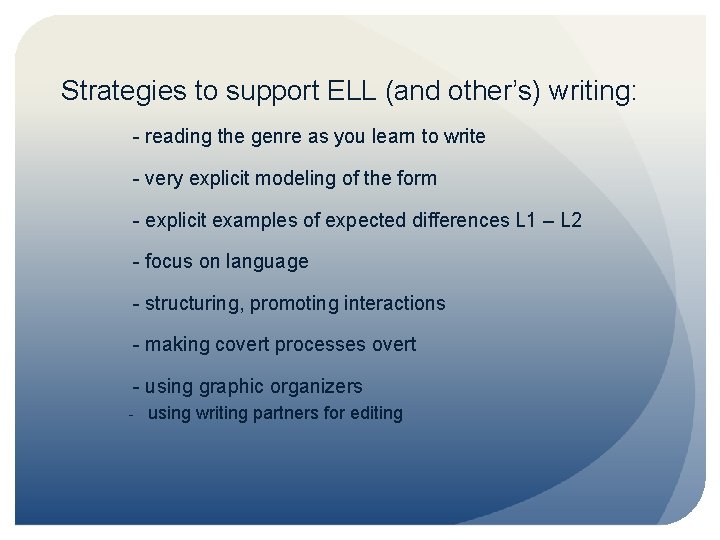
Strategies to support ELL (and other’s) writing: - reading the genre as you learn to write - very explicit modeling of the form - explicit examples of expected differences L 1 – L 2 - focus on language - structuring, promoting interactions - making covert processes overt - using graphic organizers - using writing partners for editing