
Academic Libraries and Students with Autism Spectrum Disorder
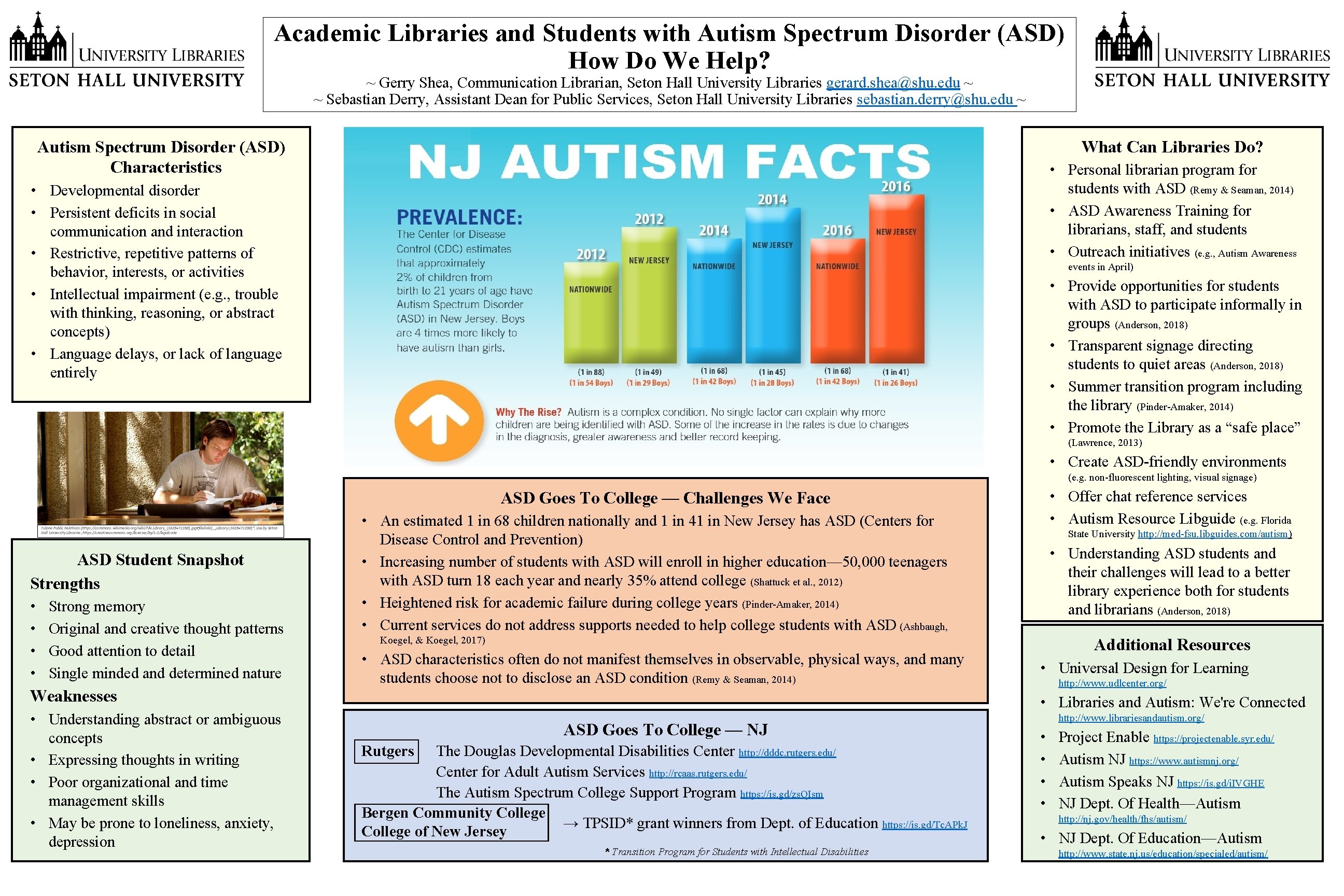
Academic Libraries and Students with Autism Spectrum Disorder (ASD) How Do We Help? ~ Gerry Shea, Communication Librarian, Seton Hall University Libraries gerard. shea@shu. edu ~ ~ Sebastian Derry, Assistant Dean for Public Services, Seton Hall University Libraries sebastian. derry@shu. edu ~ Autism Spectrum Disorder (ASD) Characteristics What Can Libraries Do? • Personal librarian program for students with ASD (Remy & Seaman, 2014) • ASD Awareness Training for librarians, staff, and students • Outreach initiatives (e. g. , Autism Awareness • Developmental disorder • Persistent deficits in social communication and interaction • Restrictive, repetitive patterns of behavior, interests, or activities • Intellectual impairment (e. g. , trouble with thinking, reasoning, or abstract concepts) • Language delays, or lack of language entirely events in April) • Provide opportunities for students with ASD to participate informally in groups (Anderson, 2018) • Transparent signage directing students to quiet areas (Anderson, 2018) • Summer transition program including the library (Pinder-Amaker, 2014) • Promote the Library as a “safe place” (Lawrence, 2013) • Create ASD-friendly environments (e. g. non-fluorescent lighting, visual signage) • Offer chat reference services • Autism Resource Libguide (e. g. Florida ASD Goes To College — Challenges We Face Tulane Public Relations (https: //commons. wikimedia. org/wiki/File: Library_(3639472398). jpg#filelinks), „Library (3639472398)“, size by Seton Hall University Libraries, https: //creativecommons. org/licenses/by/2. 0/legalcode ASD Student Snapshot Strengths • • Strong memory Original and creative thought patterns Good attention to detail Single minded and determined nature Weaknesses • Understanding abstract or ambiguous concepts • Expressing thoughts in writing • Poor organizational and time management skills • May be prone to loneliness, anxiety, depression • An estimated 1 in 68 children nationally and 1 in 41 in New Jersey has ASD (Centers for Disease Control and Prevention) • Increasing number of students with ASD will enroll in higher education— 50, 000 teenagers with ASD turn 18 each year and nearly 35% attend college (Shattuck et al. , 2012) • Heightened risk for academic failure during college years (Pinder-Amaker, 2014) • Current services do not address supports needed to help college students with ASD (Ashbaugh, State University http: //med-fsu. libguides. com/autism) • Understanding ASD students and their challenges will lead to a better library experience both for students and librarians (Anderson, 2018) Koegel, & Koegel, 2017) • ASD characteristics often do not manifest themselves in observable, physical ways, and many students choose not to disclose an ASD condition (Remy & Seaman, 2014) Additional Resources • Universal Design for Learning http: //www. udlcenter. org/ • Libraries and Autism: We're Connected ASD Goes To College — NJ Rutgers The Douglas Developmental Disabilities Center http: //dddc. rutgers. edu/ Center for Adult Autism Services http: //rcaas. rutgers. edu/ The Autism Spectrum College Support Program https: //is. gd/zs. QIsm Bergen Community College → TPSID* grant winners from Dept. of Education https: //is. gd/Tc. APk. J College of New Jersey * Transition Program for Students with Intellectual Disabilities http: //www. librariesandautism. org/ • • Project Enable https: //projectenable. syr. edu/ Autism NJ https: //www. autismnj. org/ Autism Speaks NJ https: //is. gd/i. IVGHE NJ Dept. Of Health—Autism http: //nj. gov/health/fhs/autism/ • NJ Dept. Of Education—Autism http: //www. state. nj. us/education/specialed/autism/
- Slides: 1