
Academic Language Table of Contents Early Experiences Social

Academic Language
Table of Contents • Early Experiences • Social Language and Context • Purposes of Language • • Functions Forms Discourse and Syntax Brick-and-Mortar Words • Strategies
What Is Language? Complete Boxes #1, #2, and #3 on your worksheet
Definitions of Language • Our definitions • Webster’s definition: words, their pronunciation, and the methods used to combine them and be understood by a community

EARLY EXPERIENCES WITH LANGUAGE
• Most children first develop their receptive language and then their expressive language. • Somewhere between the ages of 1 and 2, most young children begin to speak their first words, then phrases, and eventually complete sentences. They mimic the language they hear around them, which is generally produced by family members or caregivers. • The vocabulary they produce, the purposes for speaking, and the frequency of talk are all determined by the social factors of the community in which they are developing.
• “Schools often operate in ways that advantage certain children and disadvantage others, causing distinct outcomes that align with social and political forces in the larger context. Institutional support for the primary language and students who speak it is a prime factor in school success for these students” (Diaz-Rico & Weed, 2006, p. 24). • Students who have interacted with fewer novel vocabulary words struggle with acquiring a broader vocabulary set. This is likely due to their lack of relevant schema, or background knowledge.
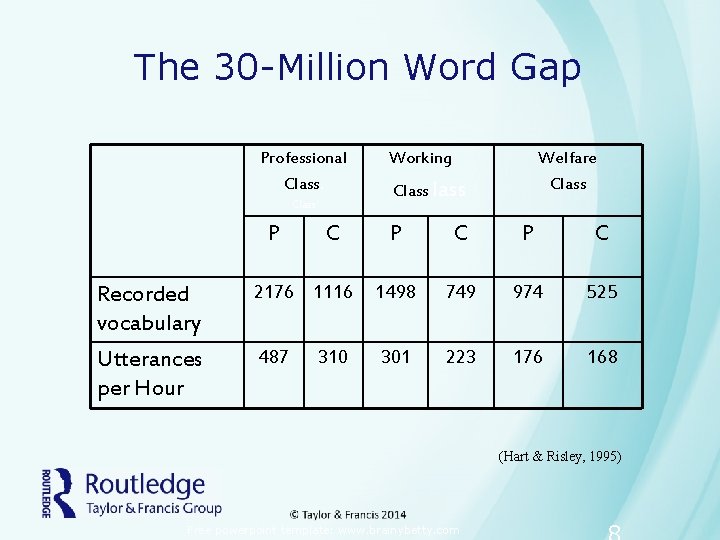
The 30 -Million Word Gap Professional Class P C Working Welfare Class P C Recorded vocabulary 2176 1116 1498 749 974 525 Utterances per Hour 487 301 223 176 168 310 (Hart & Risley, 1995) Free powerpoint template: www. brainybetty. com
So What? • Merely being exposed to, or even engaged in, an activity in English is not sufficient to ensure academic success or English language development (Doughty & Williams, 1998; Scarcella & Oxford, 1998). • Academic language must be intentionally and purposefully taught to K-12 students.
SOCIAL LANGUAGE AND CONTEXT
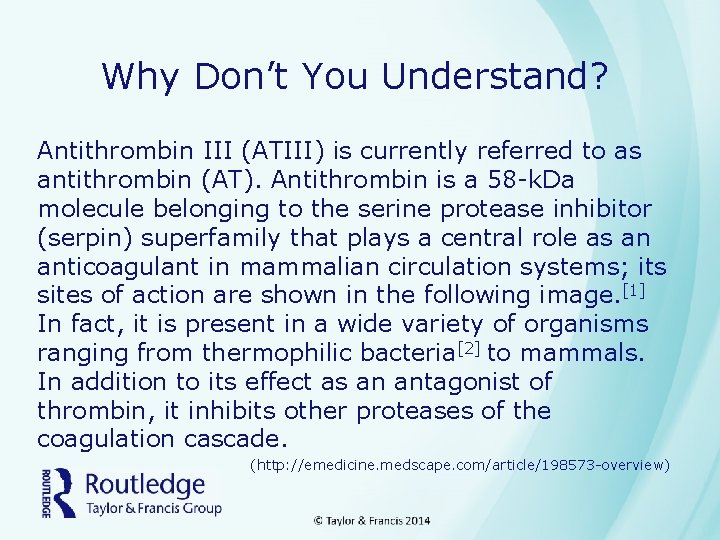
Why Don’t You Understand? Antithrombin III (ATIII) is currently referred to as antithrombin (AT). Antithrombin is a 58 -k. Da molecule belonging to the serine protease inhibitor (serpin) superfamily that plays a central role as an anticoagulant in mammalian circulation systems; its sites of action are shown in the following image. [1] In fact, it is present in a wide variety of organisms ranging from thermophilic bacteria[2] to mammals. In addition to its effect as an antagonist of thrombin, it inhibits other proteases of the coagulation cascade. (http: //emedicine. medscape. com/article/198573 -overview)
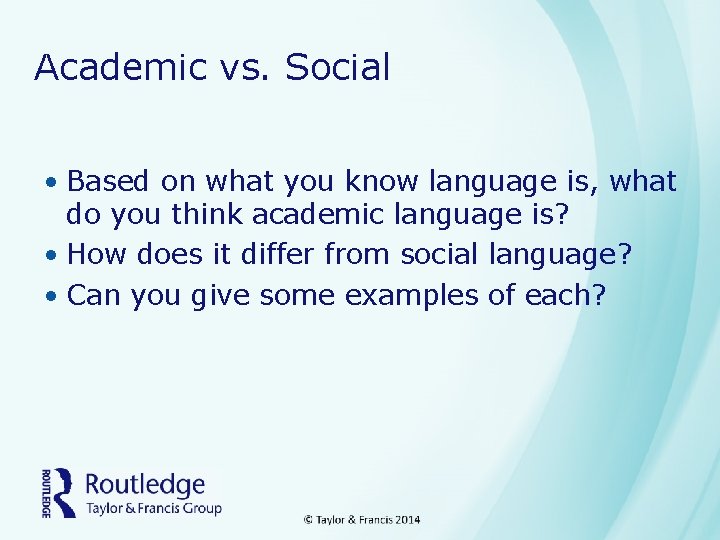
Academic vs. Social • Based on what you know language is, what do you think academic language is? • How does it differ from social language? • Can you give some examples of each?

Academic Language Is. . . • The language workplace • The language used in the classroom and of of text assessments academic success power • Students who master academic language are more likely to be successful in academic and professional settings. • Students who do not learn academic language may struggle academically and be at a higher risk of dropping out of school. (Dutro & Moran, 2003)
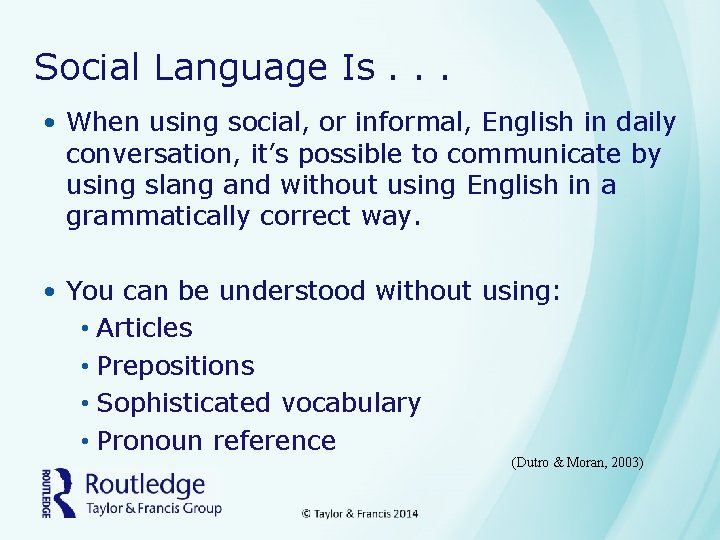
Social Language Is. . . • When using social, or informal, English in daily conversation, it’s possible to communicate by using slang and without using English in a grammatically correct way. • You can be understood without using: • Articles • Prepositions • Sophisticated vocabulary • Pronoun reference (Dutro & Moran, 2003)
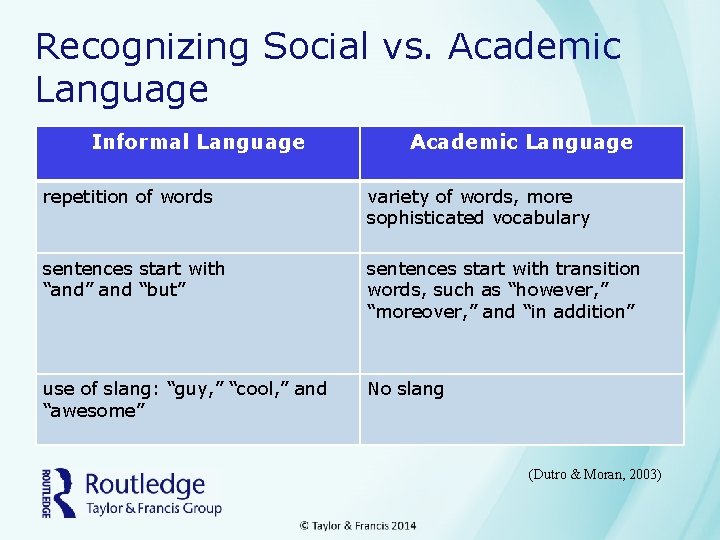
Recognizing Social vs. Academic Language Informal Language Academic Language repetition of words variety of words, more sophisticated vocabulary sentences start with “and” and “but” sentences start with transition words, such as “however, ” “moreover, ” and “in addition” use of slang: “guy, ” “cool, ” and “awesome” No slang (Dutro & Moran, 2003)

PURPOSE OF LANGUAGE
• Remember that academic language is all about providing equity and access for those children who seem destined to fail even before they enter school. • The definition of academic language can be divided into two distinct parts that are connected to one another, but are useful to look at separately before putting them back together when determining how to support these struggling students. • These two parts are the purposes of language (functions) and the structures of language (forms: syntax or discourse).
Developing Functions • Functions (Dutro & Moran, 2003) • The tasks or purposes and uses of language. • We use language to accomplish something in formal or informal settings for social or academic purposes. • Social purposes include exchanging greetings, expressing needs, making jokes, indicating agreement or disagreement, participating in personal conversations, etc.
Examples of Academic Functions • • • Navigating written text Asking/answering informational questions Asking/answering clarifying questions Relating information Comparing and contrasting Explaining cause and effect Justifying and persuading Drawing conclusions Summarizing Evaluating Conducting research (Dutro & Moran, 2003)
Examples of Academic Functions: Comparing/Contrasting • Stage 1: big ocean small lake • Stage 2: An ocean is big. A lake is small. • Stage 3: An ocean is larger than a lake. • Stage 4: An ocean is enormous compared with a lake. • Stage 5: An ocean is vast. Even the largest lake is small by comparison. (Dutro & Moran, 2003)
Forms: Syntax and Discourse • Syntax is the grammatical features and word usage of written or oral communication: the tools necessary for discourse, for reading and writing, for using complex language, and for engaging in cognitive processes (Dutro & Moran, 2003). • Gee (1990) defines discourse as “a socially accepted association among ways of using language, of thinking, feeling, believing, valuing, and acting that can be used to identify oneself as a member of the socially accepted group” (p. 143).
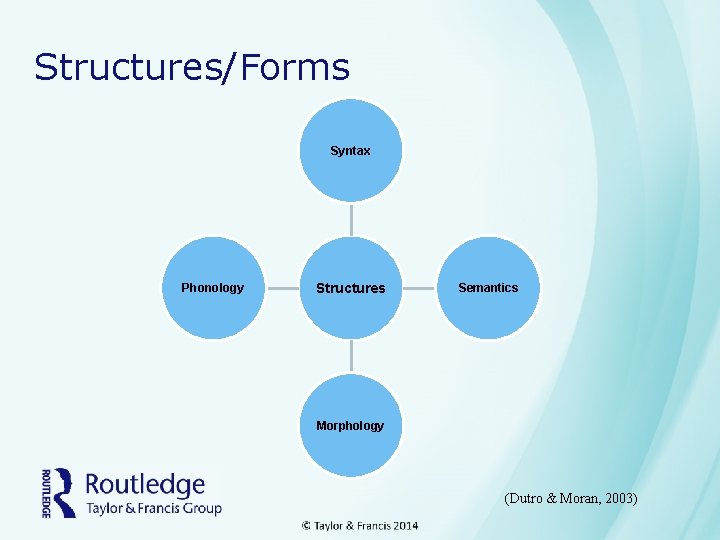
Structures/Forms Syntax Phonology Structures Semantics Morphology (Dutro & Moran, 2003)
Forms Include: • Parts of speech • Verb tenses • Subject/verb agreement • Use of pronouns • Conjunctions • Sentence structure and syntax • Brick-and-mortar words/phrases (Dutro & Moran, 2003)

It’s Just like Star Wars “Much to learn, you still have. ” “So certain are you. Always with you it cannot be done. Hear you nothing that I say? "
Brick and Mortar • “Brick” words are the vocabulary specific to the content and the concepts being taught. • They include such words as government, democracy, line, tone, mitosis, anaphase, metaphor, theme. subjunctive, variable, algorithm, etc. (Dutro & Moran, 2003)
Brick and Mortar • “Mortar” words and phrases are the basic and general utility vocabulary required for constructing sentences. They are words that determine relationships between and among words. They are words that hold our language together and are essential to comprehension (Dutro & Moran, 2003)
Mortar Words and Phrases • Connecting words: because, then, but, sometimes, before, therefore, however, and whereas • Prepositions and prepositional phrases: on, in, under, behind, next to, in front of, between, among, and in the background • Basic regular and irregular verbs: leave, live, eat, use, saw, and went • Pronouns: she, his, their, it, each other, and themselves • Academic vocabulary: notice, think, analyze, plan, compare, proof, and characteristics (Dutro & Moran, 2003)
Brick and Mortar • Sentence Frame: • ____ have _____, whereas____ have _______. • Marine mammals have lungs, whereas ocean fish have gills. • Providing the mortar words will enable students in this example to use language to compare and contrast (Dutro & Moran, 2003)

Strategies to Support Academic Language Acquisition
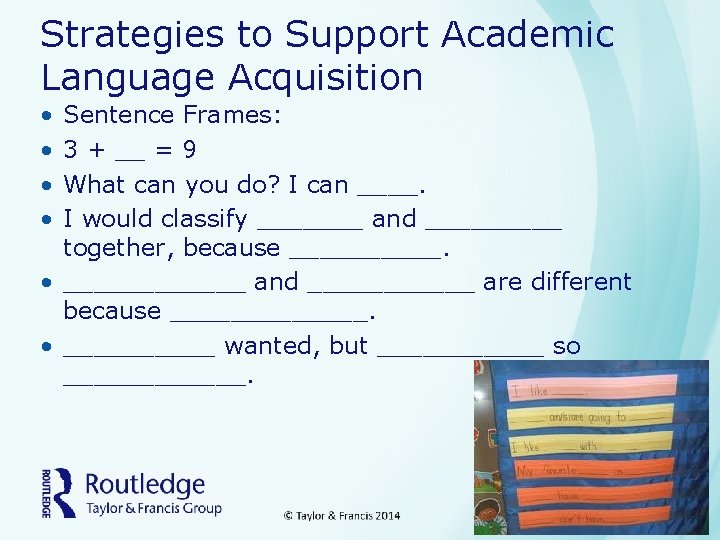
Strategies to Support Academic Language Acquisition • • Sentence Frames: 3 + __ = 9 What can you do? I can ____. I would classify _______ and _____ together, because _____. • ______ and ______ are different because _______. • _____ wanted, but ______ so ______.
You Do • Each group will receive an intermediategrade science or social studies teacher’s edition. • Determine the academic vocabulary and academic demands needed to comprehend the lesson.
A Few Points about Vocabulary to Remember. . . • Students need to be exposed to words auditorily before they can read them or spell them. • There is a difference between sight words and vocabulary words. • State Academic Vocabulary documents are a guide, and the words listed are not necessarily going to be tested on State Standardized Tests. • These words were chosen because of their need for enduring understanding or as a prerequisite for other enduring understanding.
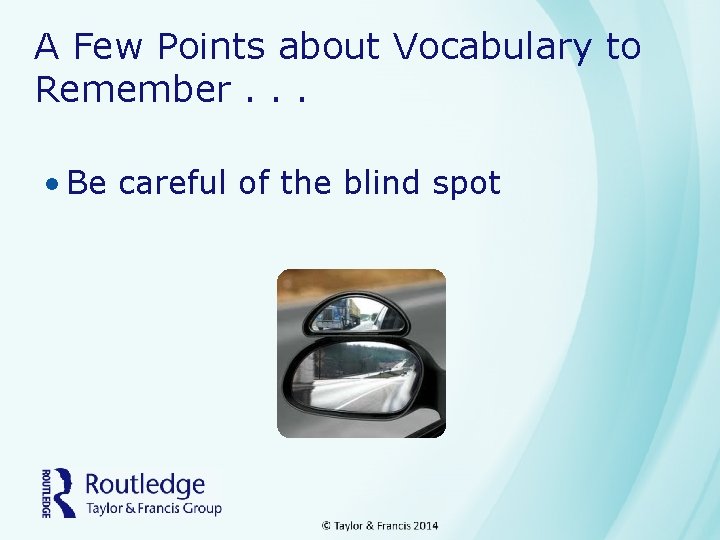
A Few Points about Vocabulary to Remember. . . • Be careful of the blind spot
Summary • As with any robust instruction, the first step is knowing your students and their interests and background knowledge. • Figuring out their individual levels of language proficiency will be fundamental to their success in school and, therefore, beyond school. • Getting a grasp on a students’ vocabulary knowledge can be accomplished through conversation and quick formative assessments.

Exit Ticket Complete Box #4 and turn in your paper
References Diaz-Rico, L. T. , & Weed, K. Z. (2006). Cross cultural, language and academic development handbook: A complete k-12 reference guide (3 rd ed). Boston, MA: Pearson. Doughty, C. & Williams, J. (Eds. ). (1998). Focus on form in classroom second language acquisition. Cambridge, England: Cambridge University Press. Dutro, S. & Moran, C. (2003). Rethinking English language instruction: An architectural approach. In G. Garcia (Ed. ). , English language learners: Reaching the highest level of English literacy. Newark, DE: International Reading Association. Gee, J. P. (1990). Social linguistics and literacies: Ideology in discourses. London, England: Falmer Press. Hart. B & Risley, T. (1995). Meaningful differences in the everyday lives of young American children. Baltimore, MD: Paul H. Brookes. Scarcella, R. C. & Oxford, R. L. (1998). The tapestry of learning: The individual in the communicative classroom. Boston, MA: Heinle & Heinle Publishers.
- Slides: 36