
Academic Integrity Plagiarism in the Digital World The
- Slides: 28
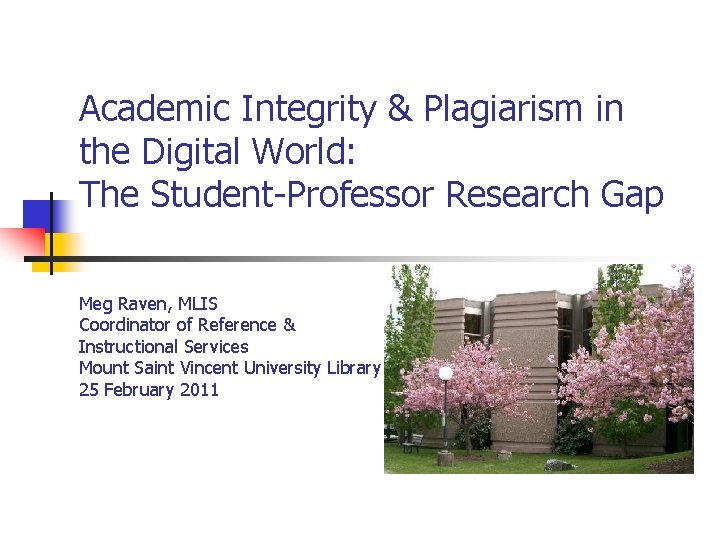
Academic Integrity & Plagiarism in the Digital World: The Student-Professor Research Gap Meg Raven, MLIS Coordinator of Reference & Instructional Services Mount Saint Vincent University Library 25 February 2011
Outline: n n The information and research landscape Citation and plagiarism Differing student-professor research expectations Questions and discussion
The research landscape has changed n n Exponential growth of information Digitization of our whole culture makes it far easier to plagiarize Students may feel there is less need to come up with new ideas Students may find it difficult to be creative or original when faced with so much information
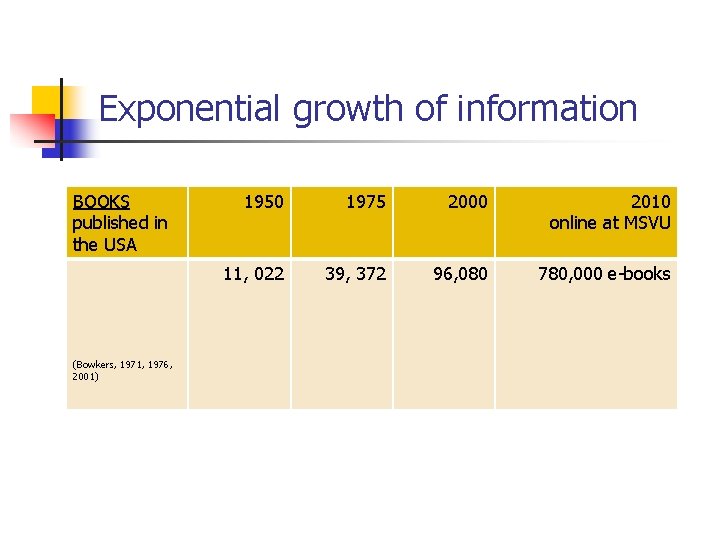
Exponential growth of information BOOKS published in the USA (Bowkers, 1971, 1976, 2001) 1950 1975 2000 2010 online at MSVU 11, 022 39, 372 96, 080 780, 000 e-books
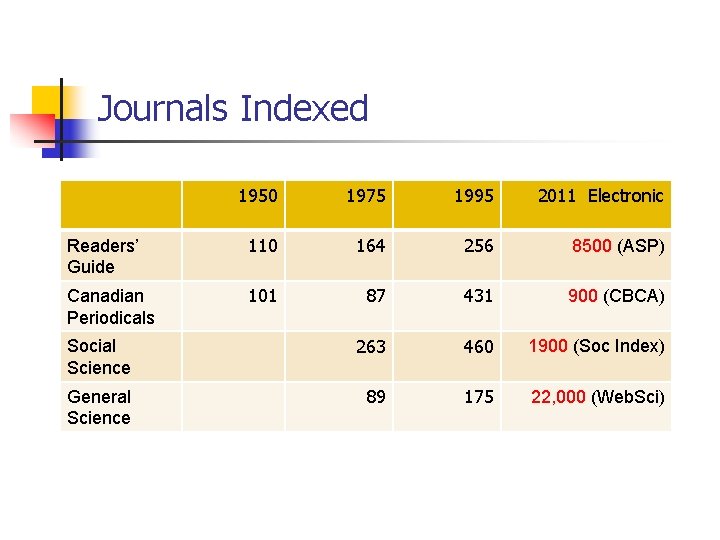
Journals Indexed 1950 1975 1995 2011 Electronic Readers’ Guide 110 164 256 8500 (ASP) Canadian Periodicals 101 87 431 900 (CBCA) Social Science 263 460 1900 (Soc Index) General Science 89 175 22, 000 (Web. Sci)
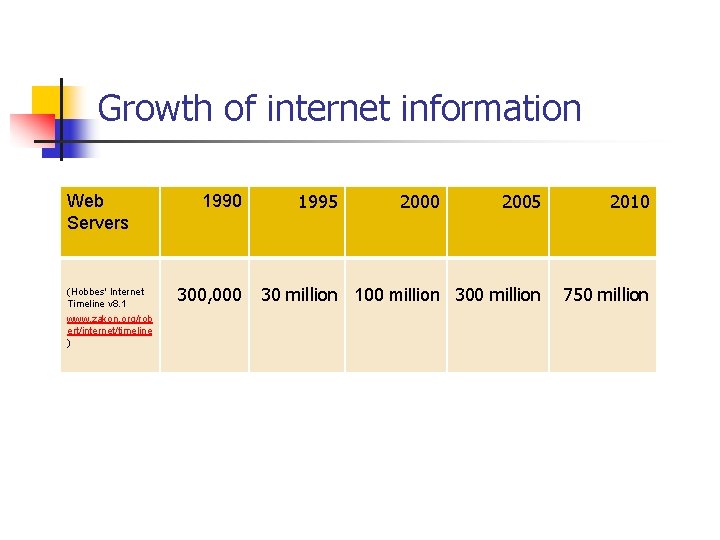
Growth of internet information Web Servers (Hobbes' Internet Timeline v 8. 1 www. zakon. org/rob ert/internet/timeline ) 1990 300, 000 1995 2000 2005 2010 30 million 100 million 300 million 750 million
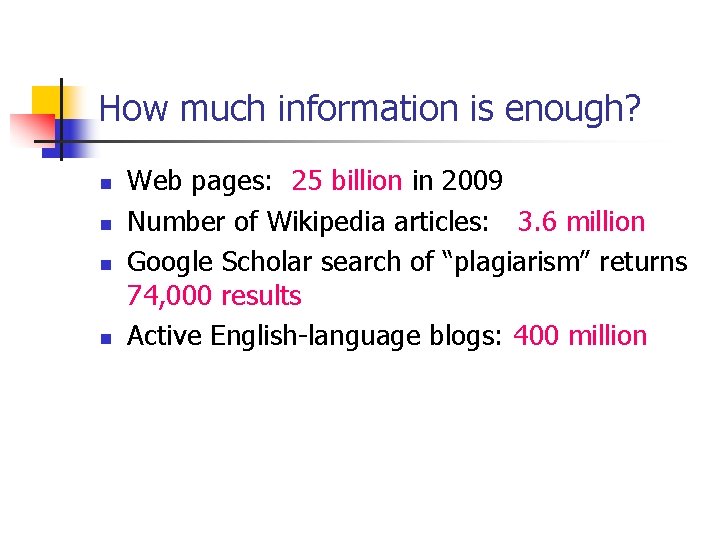
How much information is enough? n n Web pages: 25 billion in 2009 Number of Wikipedia articles: 3. 6 million Google Scholar search of “plagiarism” returns 74, 000 results Active English-language blogs: 400 million
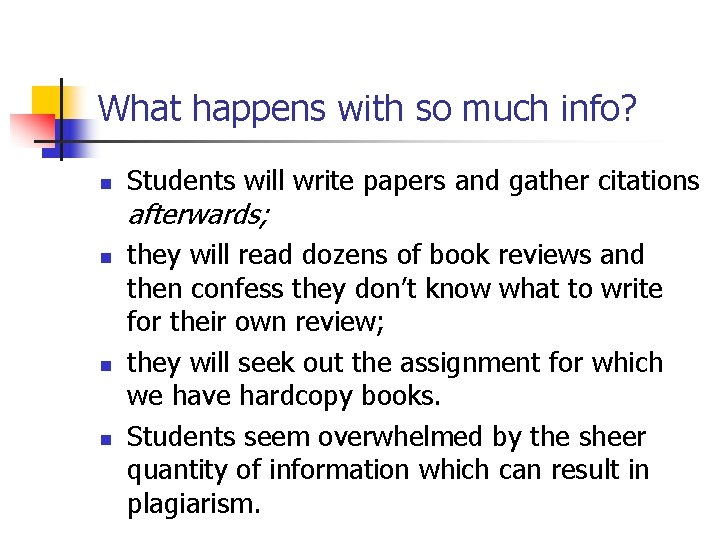
What happens with so much info? n Students will write papers and gather citations afterwards; n n n they will read dozens of book reviews and then confess they don’t know what to write for their own review; they will seek out the assignment for which we have hardcopy books. Students seem overwhelmed by the sheer quantity of information which can result in plagiarism.
Students’ experience of and ideas about citation and plagiarism
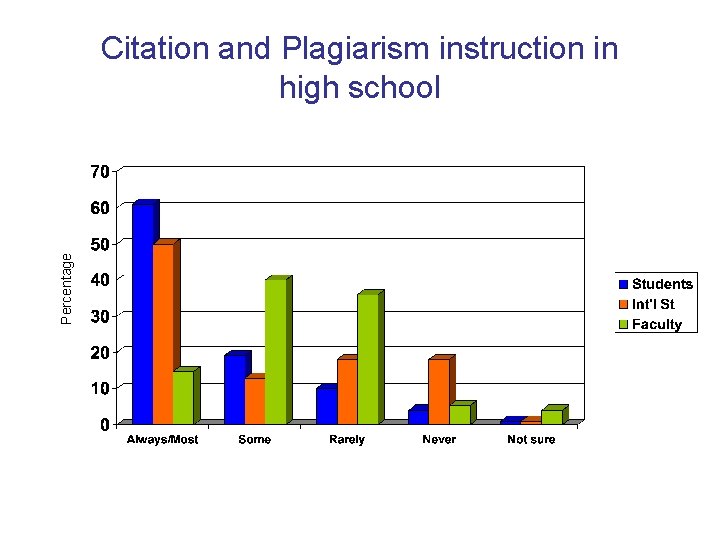
Percentage Citation and Plagiarism instruction in high school
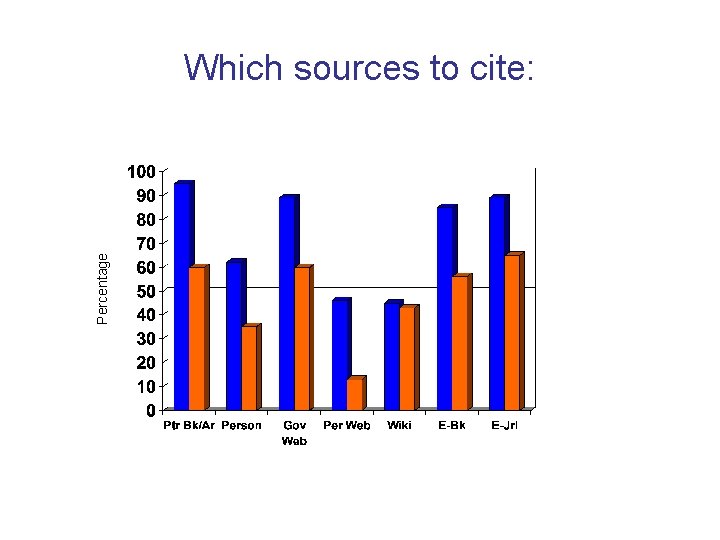
Percentage Which sources to cite:
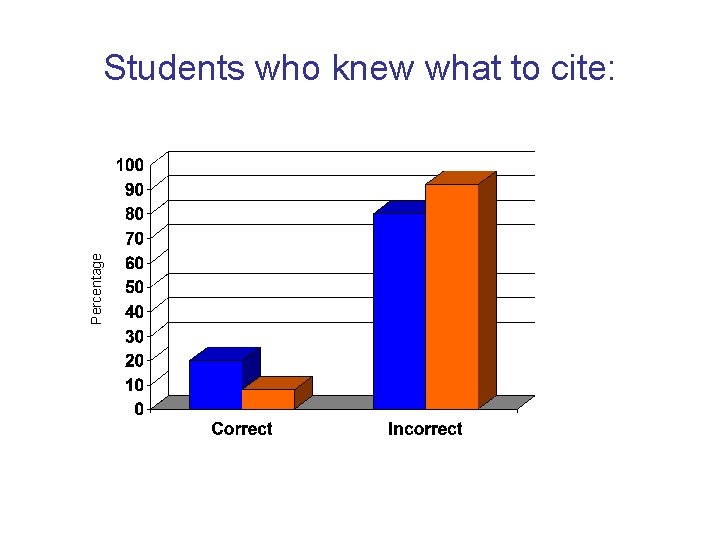
Percentage Students who knew what to cite:
Research and Reading Expectations
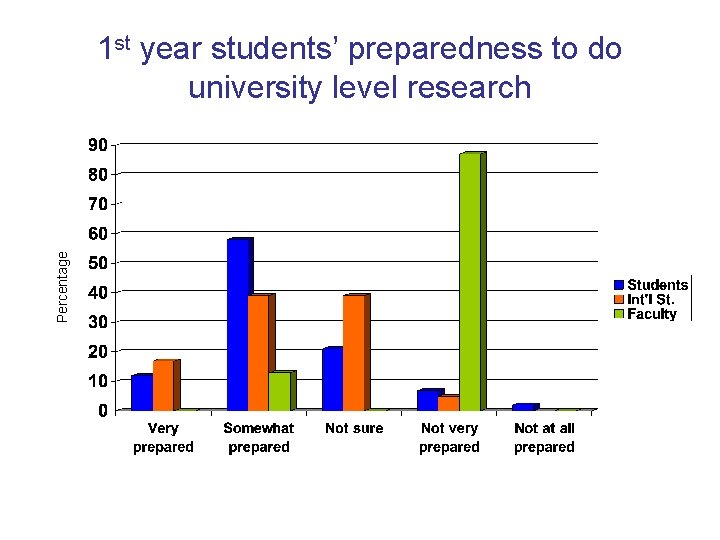
Percentage 1 st year students’ preparedness to do university level research
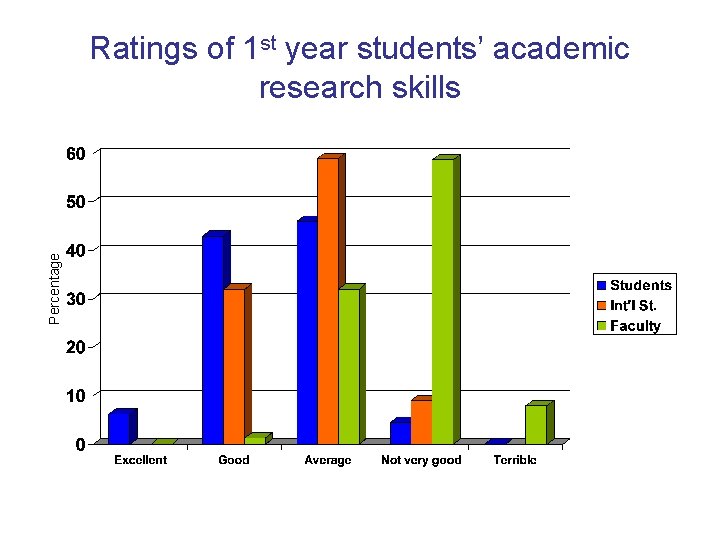
Percentage Ratings of 1 st year students’ academic research skills
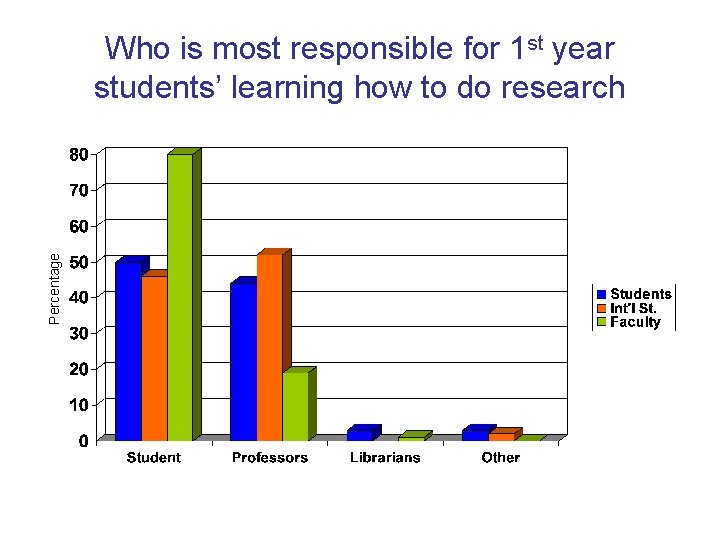
Percentage Who is most responsible for 1 st year students’ learning how to do research
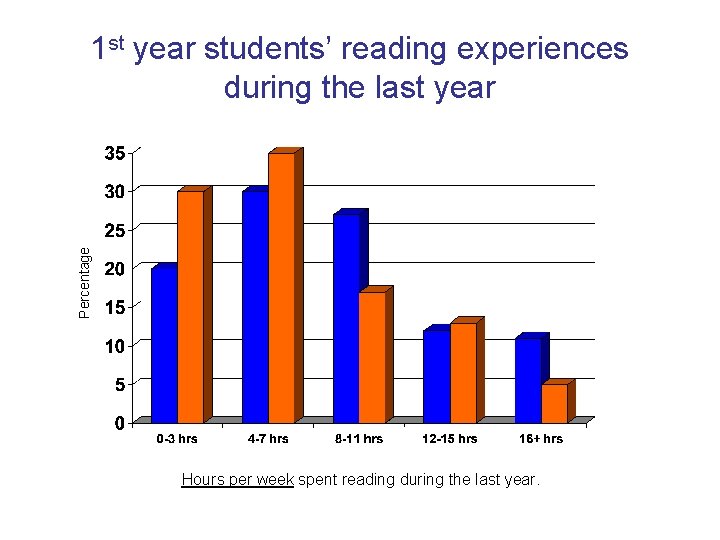
Percentage 1 st year students’ reading experiences during the last year Hours per week spent reading during the last year.
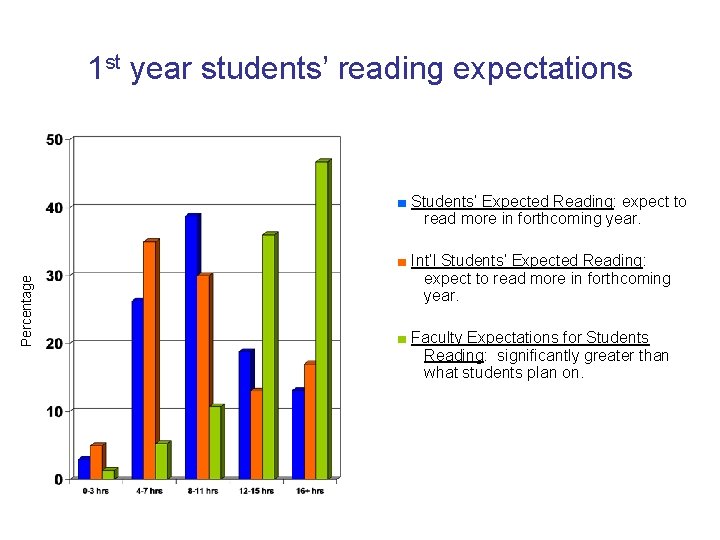
1 st year students’ reading expectations Percentage ■ Students’ Expected Reading: expect to read more in forthcoming year. ■ Int’l Students’ Expected Reading: expect to read more in forthcoming year. ■ Faculty Expectations for Students Reading: significantly greater than what students plan on.
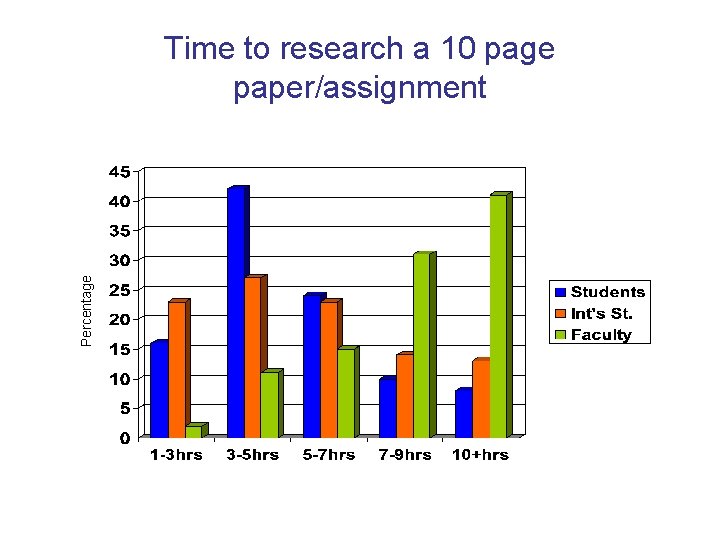
Percentage Time to research a 10 page paper/assignment
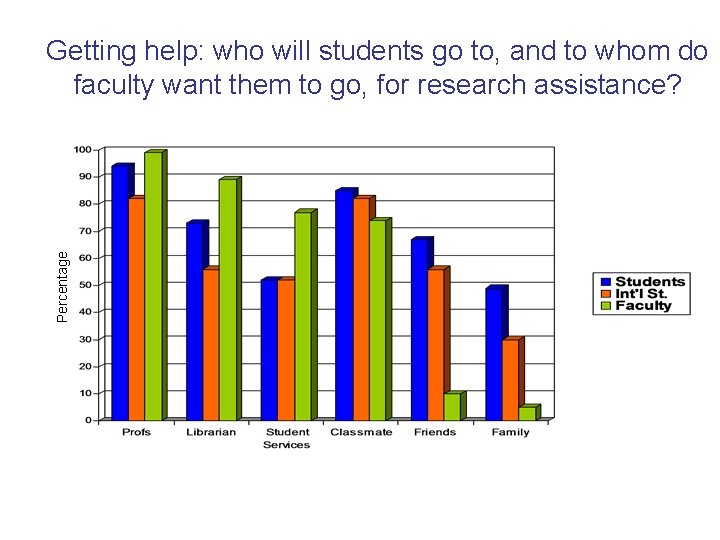
Percentage Getting help: who will students go to, and to whom do faculty want them to go, for research assistance?
Research sources
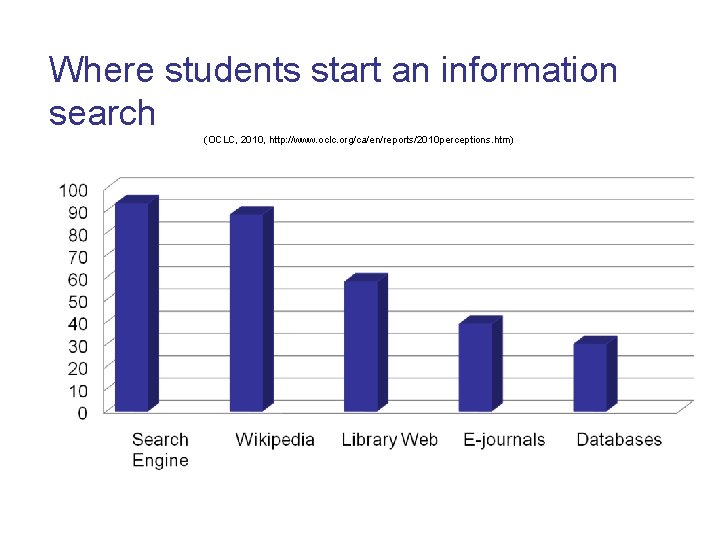
Where students start an information search (OCLC, 2010, http: //www. oclc. org/ca/en/reports/2010 perceptions. htm)
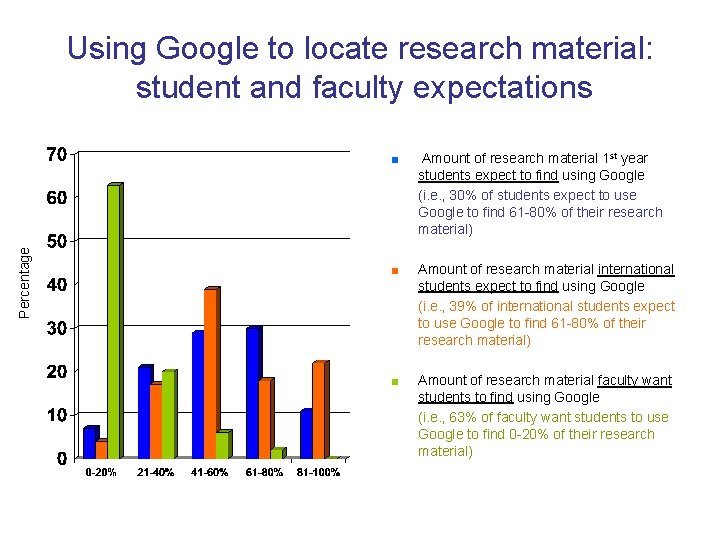
Percentage Using Google to locate research material: student and faculty expectations ■ Amount of research material 1 st year students expect to find using Google (i. e. , 30% of students expect to use Google to find 61 -80% of their research material) ■ Amount of research material international students expect to find using Google (i. e. , 39% of international students expect to use Google to find 61 -80% of their research material) ■ Amount of research material faculty want students to find using Google (i. e. , 63% of faculty want students to use Google to find 0 -20% of their research material)
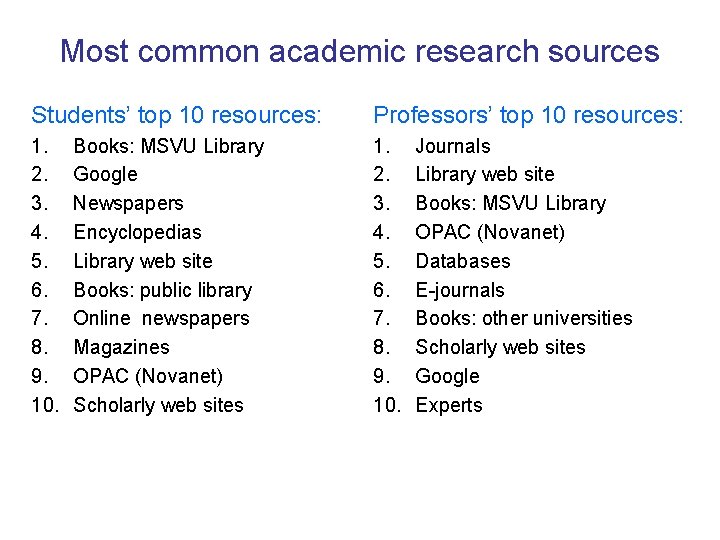
Most common academic research sources Students’ top 10 resources: Professors’ top 10 resources: 1. 2. 3. 4. 5. 6. 7. 8. 9. 10. Books: MSVU Library Google Newspapers Encyclopedias Library web site Books: public library Online newspapers Magazines OPAC (Novanet) Scholarly web sites Journals Library web site Books: MSVU Library OPAC (Novanet) Databases E-journals Books: other universities Scholarly web sites Google Experts
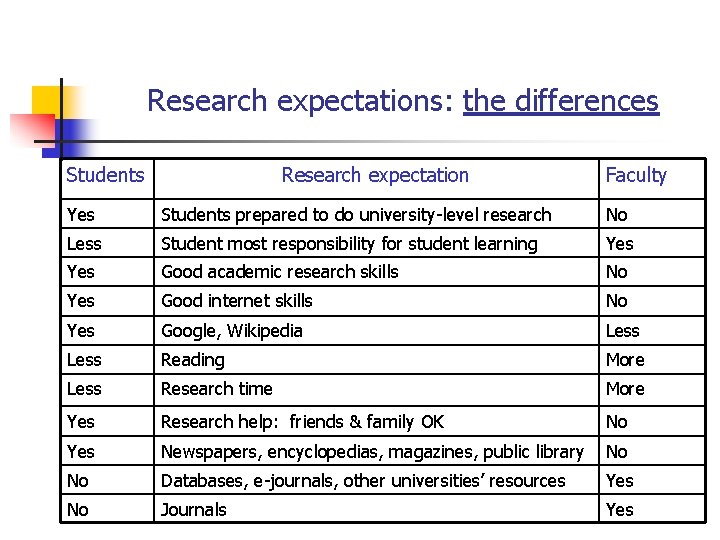
Research expectations: the differences Students Research expectation Faculty Yes Students prepared to do university-level research No Less Student most responsibility for student learning Yes Good academic research skills No Yes Good internet skills No Yes Google, Wikipedia Less Reading More Less Research time More Yes Research help: friends & family OK No Yes Newspapers, encyclopedias, magazines, public library No No Databases, e-journals, other universities’ resources Yes No Journals Yes
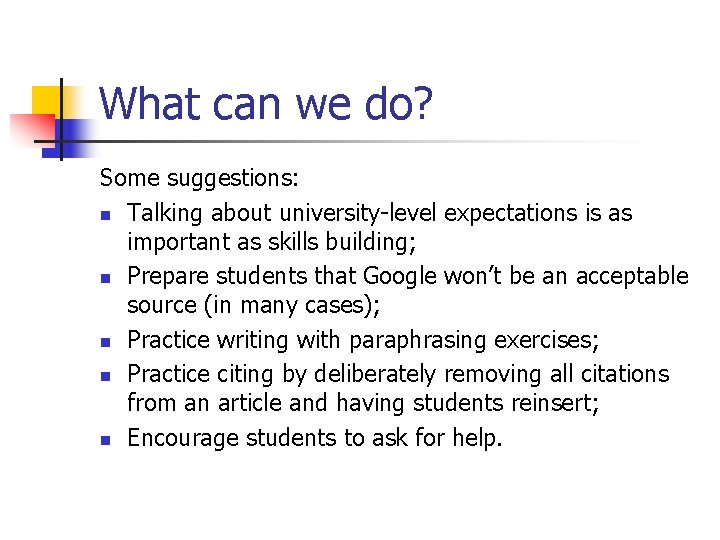
What can we do? Some suggestions: n Talking about university-level expectations is as important as skills building; n Prepare students that Google won’t be an acceptable source (in many cases); n Practice writing with paraphrasing exercises; n Practice citing by deliberately removing all citations from an article and having students reinsert; n Encourage students to ask for help.
Questions or comments?
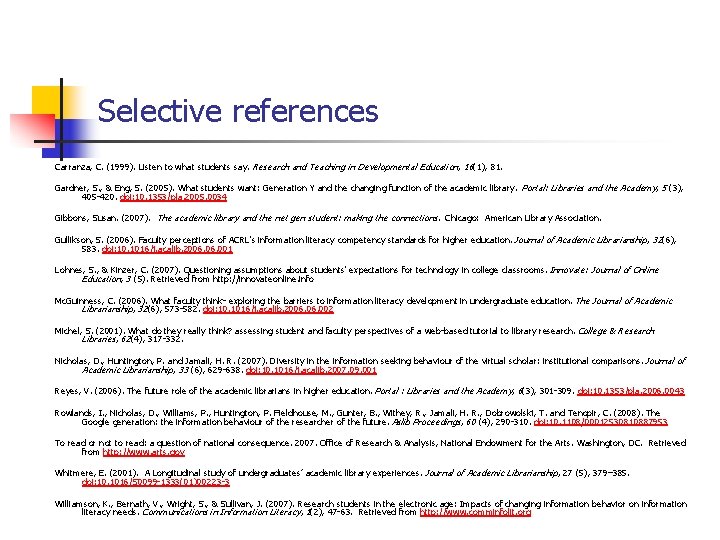
Selective references Carranza, C. (1999). Listen to what students say. Research and Teaching in Developmental Education, 16(1), 81. Gardner, S. , & Eng, S. (2005). What students want: Generation Y and the changing function of the academic library. Portal: Libraries and the Academy, 5 (3), 405 -420. doi: 10. 1353/pla. 2005. 0034 Gibbons, Susan. (2007). The academic library and the net gen student: making the connections. Chicago: American Library Association. Gullikson, S. (2006). Faculty perceptions of ACRL's information literacy competency standards for higher education. Journal of Academic Librarianship, 32(6), 583. doi: 10. 1016/j. acalib. 2006. 001 Lohnes, S. , & Kinzer, C. (2007). Questioning assumptions about students' expectations for technology in college classrooms. Innovate: Journal of Online Education, 3 (5). Retrieved from http: //innovateonline. info Mc. Guinness, C. (2006). What faculty think- exploring the barriers to information literacy development in undergraduate education. The Journal of Academic Librarianship, 32(6), 573 -582. doi: 10. 1016/j. acalib. 2006. 002 Michel, S. (2001). What do they really think? assessing student and faculty perspectives of a web-based tutorial to library research. College & Research Libraries, 62(4), 317 -332. Nicholas, D. , Huntington, P. and Jamali, H. R. (2007). Diversity in the information seeking behaviour of the virtual scholar: institutional comparisons. Journal of Academic Librarianship, 33 (6), 629 -638. doi: 10. 1016/j. acalib. 2007. 09. 001 Reyes, V. (2006). The future role of the academic librarians in higher education. Portal : Libraries and the Academy, 6(3), 301 -309. doi: 10. 1353/pla. 2006. 0043 Rowlands, I. , Nicholas, D. , Williams, P. , Huntington, P. Fieldhouse, M. , Gunter, B. , Withey, R. , Jamali, H. R. , Dobrowolski, T. and Tenopir, C. (2008). The Google generation: the information behaviour of the researcher of the future. Aslib Proceedings, 60 (4), 290 -310. doi: 10. 1108/00012530810887953 To read or not to read: a question of national consequence. 2007. Office of Research & Analysis, National Endowment for the Arts. Washington, DC. Retrieved from http: //www. arts. gov Whitmere, E. (2001). A Longitudinal study of undergraduates’ academic library experiences. Journal of Academic Librarianship, 27 (5), 379– 385. doi: 10. 1016/S 0099 -1333(01)00223 -3 Williamson, K. , Bernath, V. , Wright, S. , & Sullivan, J. (2007). Research students in the electronic age: Impacts of changing information behavior on information literacy needs. Communications in Information Literacy, 1(2), 47 -63. Retrieved from http: //www. comminfolit. org