
ACADEMIC INTEGRITY AND PLAGIARISM Mrs Angela Campbell Instructor
ACADEMIC INTEGRITY AND PLAGIARISM Mrs. Angela Campbell Instructor of Psychology
BARTON COMMUNITY COLLEGE'S ACADEMIC INTEGRITY POLICY
Barton Community College is an academic community with integrity. § Therefore, the college is committed to upholding the following values: § Honesty § Trust § Fairness § Respect § Responsibility. § Honor Code § On all course work, assignments, or examinations undertaken by students at Barton, the following pledge is implied by virtue of enrollment: § On my honor as a student, I have neither given nor received unauthorized aid on this assignment. (Barton Community College, 2009)
“Basic” Violations of Academic Integrity § Consultation of textbooks, library materials, or notes in examination where such materials are not to be used during the test; § Use of “crib sheets” or other hidden notes in such an examination; § Looking at another student’s test paper to copy strategies or answers or allowing another to do so; § Possessing a confederate supply of questions or answers for any assignment or examination; § Deliberate falsification of any graded activity; § Collaboration with others except where such collaboration is permitted or encouraged; § Submission of previously-graded work for a new assignment (without instructor’s consent); § Use (either in part or whole) of documents obtained from internet sources designed to encourage dishonesty and which are not the immediate result of the student’s own academic effort; § Continuing work on an examination or assignment after the allocated time has elapsed; and/or § Plagiarism (in any form) defined as taking of another person’s intellectual work and using it as one’s own. (Barton Community College, 2009)

PLAGIARISM
What is Plagiarism? § Barton explains plagiarism as “any academic endeavors at Barton Community College will not be tolerated. The student is responsible for learning the rules of, and avoiding instances of, intentional or unintentional plagiarism. Information about academic integrity is located in the Student Handbook” located in the syllabus. § “To represent oneself as the author of some work that is in fact the work of someone else is to plagiarize” (Pickering, 2008). § The following 4 slides are quoted directly from The University of Melbourne’s (2017) webpage. § Go to webpage for lecture: http: //academicintegrity. unimelb. edu. au/forms-ofplagiarism
Types of Plagiarism § Copying § Verbatim copying / Direct copying / Uncited quote § This is copying directly from paragraphs, sentences, a single sentence or significant parts of a sentence without acknowledging the source. This is plagiarism. § Mosaic copying / Scaffolding § Where the key points and structure of another person's work have been used as a scaffold (framework) for your own work, without acknowledging the source. This is plagiarism. § Recycling § This is sometimes called self-plagiarism or multiple submission. You cannot re-use work that you have submitted for assessment in any course at any university. Copying from your own work is the same as copying from someone else's work. It is plagiarism. (The University of Melbourne, 2017).
Types of Plagiarism § Paraphrasing § Inadequate paraphrasing § This happens when you try to explain another author's ideas in your own words, but your wording remains too close to the original text. This is poor scholarship and amounts to plagiarism. § Uncited paraphrase § This is when you paraphrase another person's work but do not acknowledge the source. This is plagiarism. (The University of Melbourne, 2017).
Types of Plagiarism § MISREPRESENTING AND MISQUOTING § When you cite a source correctly but misrepresent what that source claimed. You may have not understood the original source and have inadvertently misrepresented the author's ideas. This is poor scholarship. Alternatively, you may have deliberately taken the words or ideas of an author out of context to support your argument. This is extremely poor scholarship and could constitute academic misconduct. § OVER RELIANCE ON A SOURCE § When a large proportion of your work is based on a single source or author, it may be that you have not read widely enough or considered other viewpoints on the topic. This is poor scholarship. § GHOST WRITING § By another person § Having someone else knowingly write or produce any work (paid or unpaid) that you submit for your assessment is deliberate cheating and is considered to be academic misconduct. § For another person § Writing or producing any work for another student to submit as their original work is deliberate academic misconduct. (The University of Melbourne, (2017)
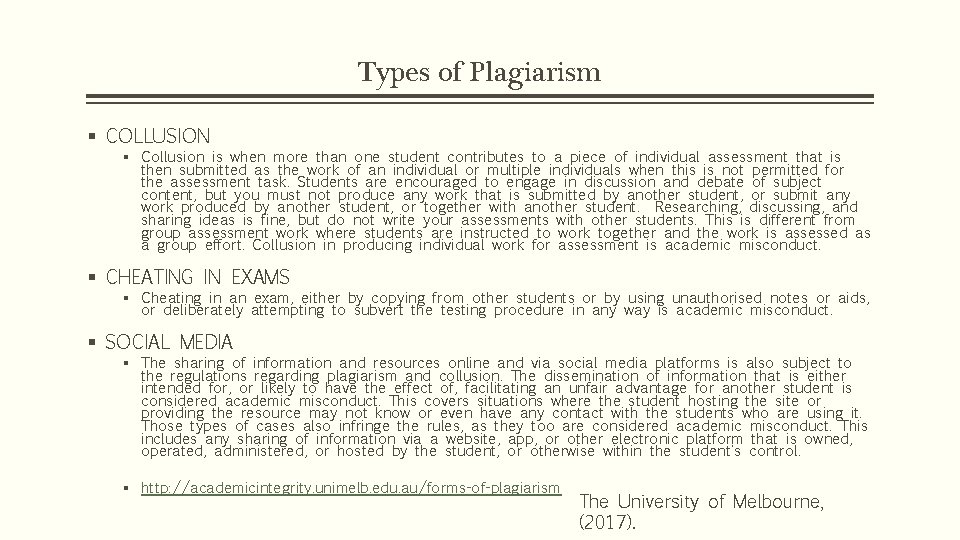
Types of Plagiarism § COLLUSION § Collusion is when more than one student contributes to a piece of individual assessment that is then submitted as the work of an individual or multiple individuals when this is not permitted for the assessment task. Students are encouraged to engage in discussion and debate of subject content, but you must not produce any work that is submitted by another student, or submit any work produced by another student, or together with another student. Researching, discussing, and sharing ideas is fine, but do not write your assessments with other students. This is different from group assessment work where students are instructed to work together and the work is assessed as a group effort. Collusion in producing individual work for assessment is academic misconduct. § CHEATING IN EXAMS § Cheating in an exam, either by copying from other students or by using unauthorised notes or aids, or deliberately attempting to subvert the testing procedure in any way is academic misconduct. § SOCIAL MEDIA § The sharing of information and resources online and via social media platforms is also subject to the regulations regarding plagiarism and collusion. The dissemination of information that is either intended for, or likely to have the effect of, facilitating an unfair advantage for another student is considered academic misconduct. This covers situations where the student hosting the site or providing the resource may not know or even have any contact with the students who are using it. Those types of cases also infringe the rules, as they too are considered academic misconduct. This includes any sharing of information via a website, app, or other electronic platform that is owned, operated, administered, or hosted by the student, or otherwise within the student's control. § http: //academicintegrity. unimelb. edu. au/forms-of-plagiarism The University of Melbourne, (2017).
References Barton Community College. (2009, February 23). Academic Integrity-2502. Retrieved February 21, 2017, from http: //docs. bartonccc. edu/procedures/2502 -academicintegrity. pdf Pickering, J. W. (2008). Plagiarism. In V. N. Parrillo, Encyclopedia of social problems. Thousand Oaks, CA: Sage Publications. Retrieved from http: //search. credoreference. com/content/entry/sagesocprob/plagiarism/0? institution. Id=5947 The University of Melbourne. (2017). Good scholarship and avoiding plagiarism. Retrieved February 21, 2017, from http: //academicintegrity. unimelb. edu. au/forms-of-plagiarism
- Slides: 11