
Academic Conversation in Wonders Target Review essential components

- Slides: 23
Academic Conversation in Wonders
Target • Review essential components of academic conversation • Develop a map for build academic conversations from Wonders lessons Success Criterion • Conversation plans completed for as many lessons as possible in the time we have today
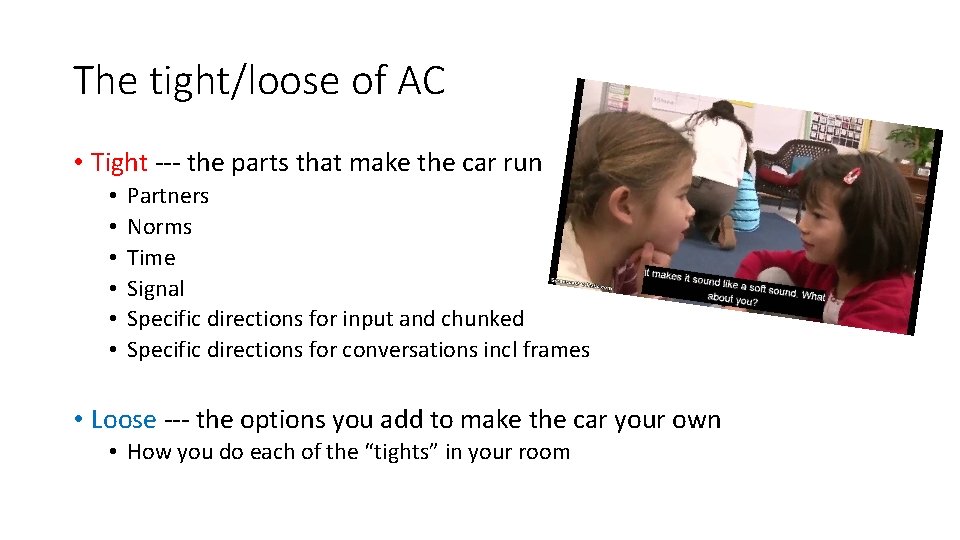
The tight/loose of AC • Tight --- the parts that make the car run • • • Partners Norms Time Signal Specific directions for input and chunked Specific directions for conversations incl frames • Loose --- the options you add to make the car your own • How you do each of the “tights” in your room
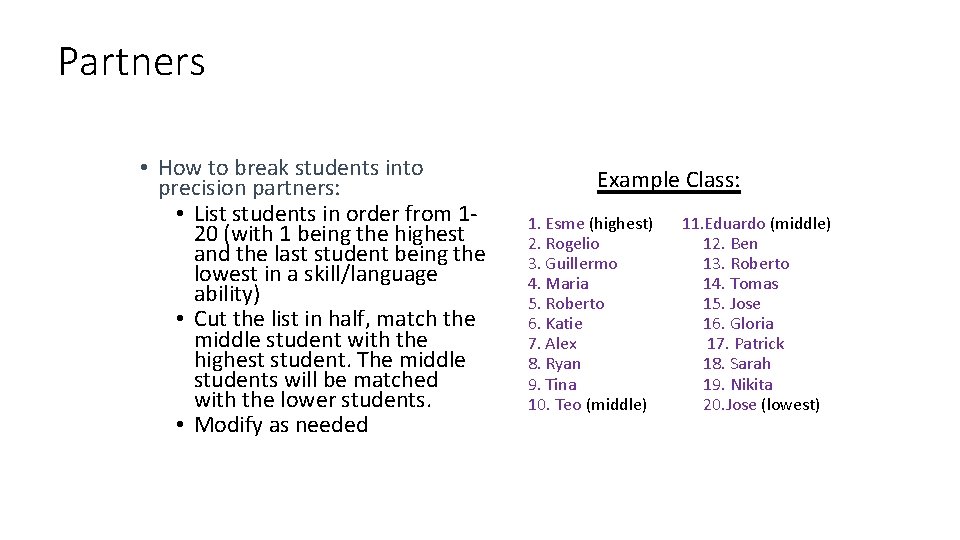
Partners • How to break students into precision partners: • List students in order from 120 (with 1 being the highest and the last student being the lowest in a skill/language ability) • Cut the list in half, match the middle student with the highest student. The middle students will be matched with the lower students. • Modify as needed Example Class: 1. Esme (highest) 2. Rogelio 3. Guillermo 4. Maria 5. Roberto 6. Katie 7. Alex 8. Ryan 9. Tina 10. Teo (middle) 11. Eduardo (middle) 12. Ben 13. Roberto 14. Tomas 15. Jose 16. Gloria 17. Patrick 18. Sarah 19. Nikita 20. Jose (lowest)
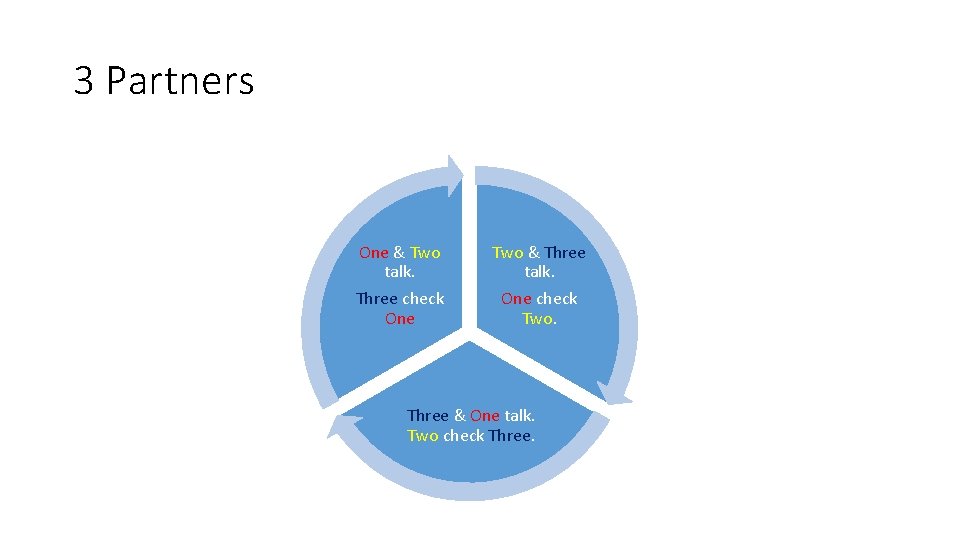
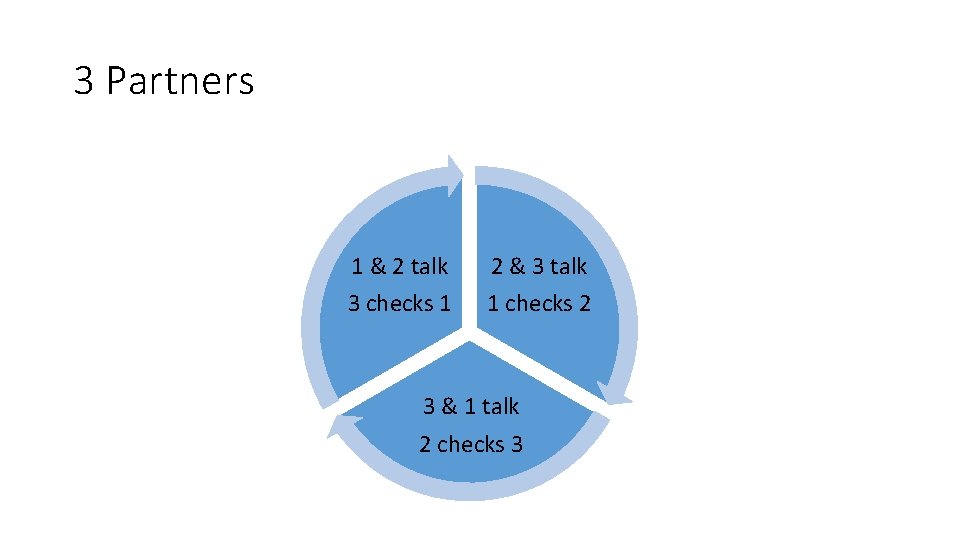
3 Partners One & Two talk. Three check One Two & Three talk. One check Two. Three & One talk. Two check Three.
3 Partners 1 & 2 talk 3 checks 1 2 & 3 talk 1 checks 2 3 & 1 talk 2 checks 3
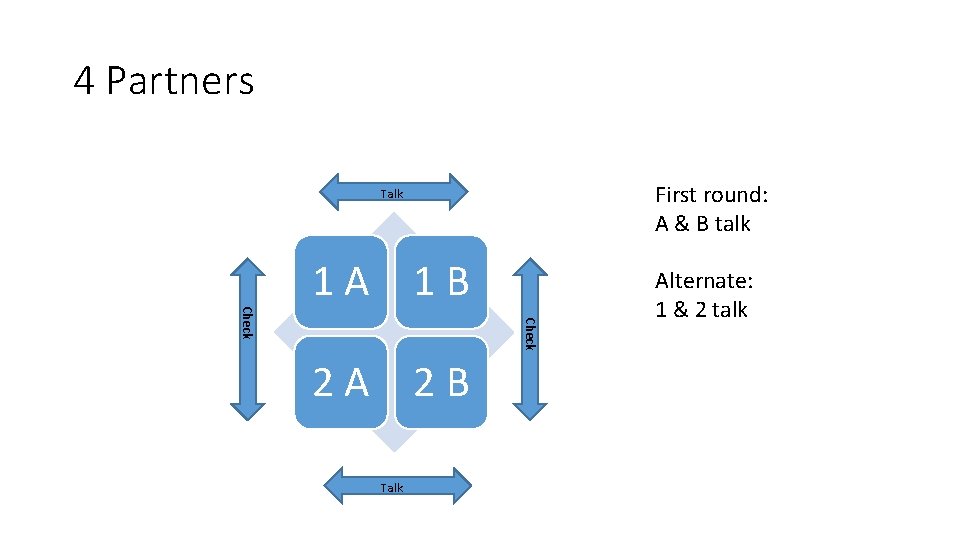
4 Partners First round: A & B talk Talk Check 1 A 1 B 2 A 2 B Talk Alternate: 1 & 2 talk
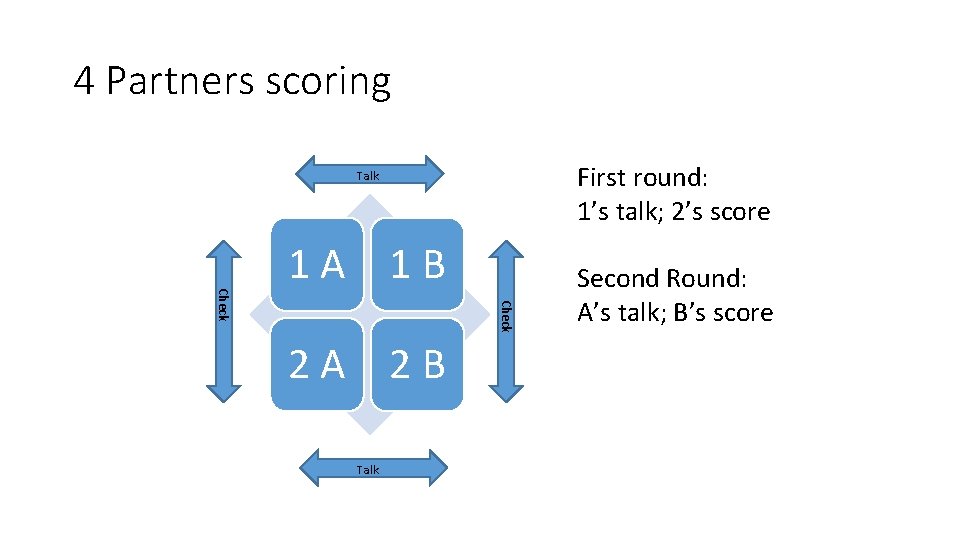
4 Partners scoring First round: 1’s talk; 2’s score Talk Check 1 A 1 B 2 A 2 B Talk Second Round: A’s talk; B’s score
Norms • We listen to each other • We share our own ideas and explain them • We respect another’s ideas, even if they are different • We let others finish explaining an idea without interrupting • We take turns and share air time Signal
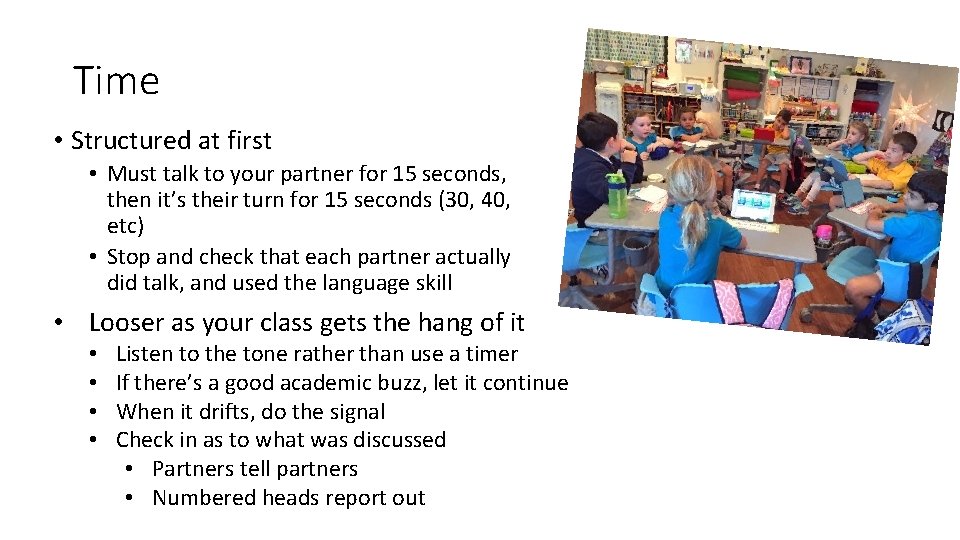
Time • Structured at first • Must talk to your partner for 15 seconds, then it’s their turn for 15 seconds (30, 40, etc) • Stop and check that each partner actually did talk, and used the language skill • Looser as your class gets the hang of it • • Listen to the tone rather than use a timer If there’s a good academic buzz, let it continue When it drifts, do the signal Check in as to what was discussed • Partners tell partners • Numbered heads report out
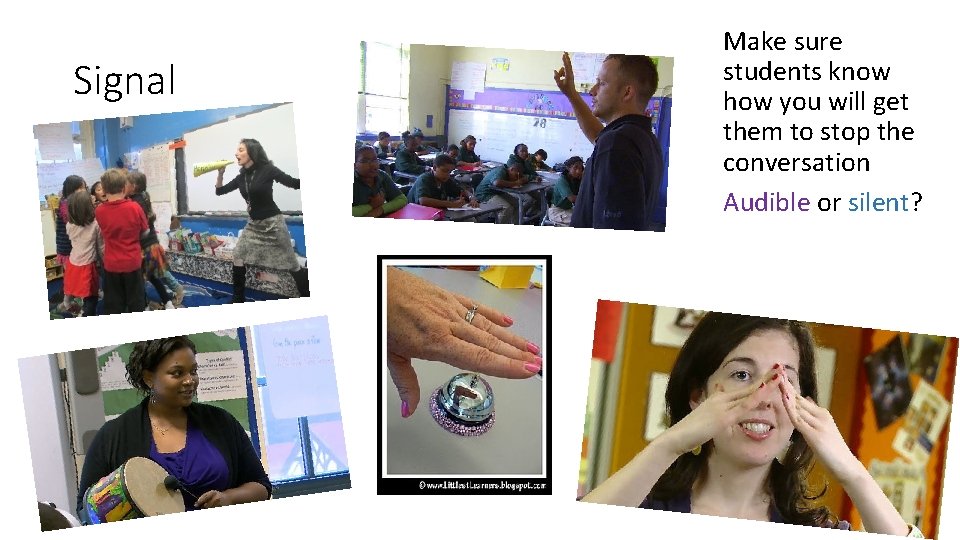
Signal Make sure students know how you will get them to stop the conversation Audible or silent?
Chunks • Measure the input • Reading • Draw lines, mentally or physically, at sentences or paragraphs • Visual • Stop the video at key points • Oral • Plan your oral presentations to students with specific stop and talk points with questions • GLAD 10/2 • no more than 10 minutes input, 2 minutes conversation
Frames • Language skills are taught through practice • Language learners need to practice the skills with specific language at first • Post them somehow • Tents available at www. langdevopps. com/resource • 27 versions • Download/modify for your own use • Frames match the lesson you’re teaching • You’ll have to make your own Be creative!
Wonders 3 rd grade Unit 3 Week 5 Before Reading Page T 274 Objectives: SL 3. 1 c Engage effectively in a range of conversations… building on others’ ideas & expressing their own… ask questions… stay on topic… link comments to others’
Before Reading Cont. Talk about It Page T 275 Think about a time in history when people moved from one place to another. Talk with a friend about. Can your students do this? Alternative: Look at the ships. Tell your partner three things you see. Where are they going? I think they are going to …. because…
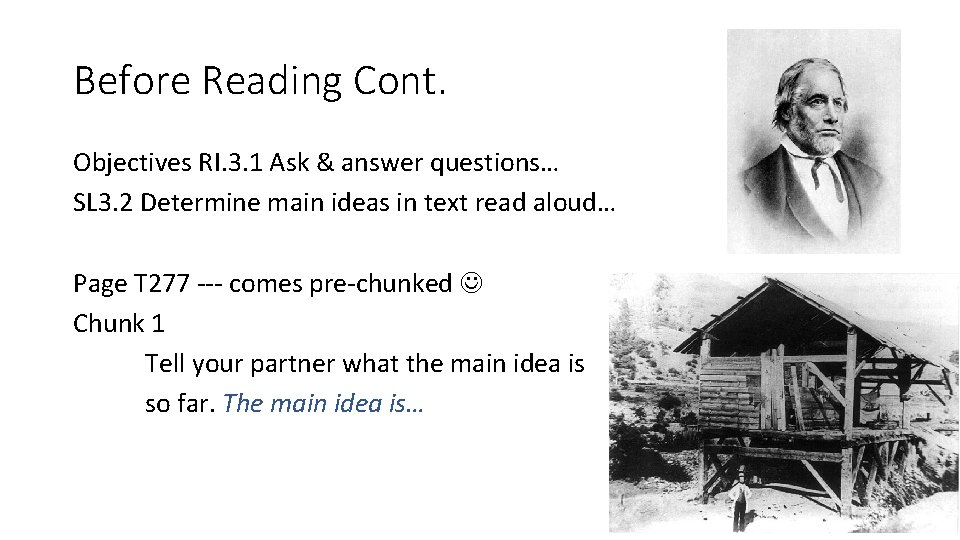
Before Reading Cont. Objectives RI. 3. 1 Ask & answer questions… SL 3. 2 Determine main ideas in text read aloud… Page T 277 --- comes pre-chunked Chunk 1 Tell your partner what the main idea is so far. The main idea is…
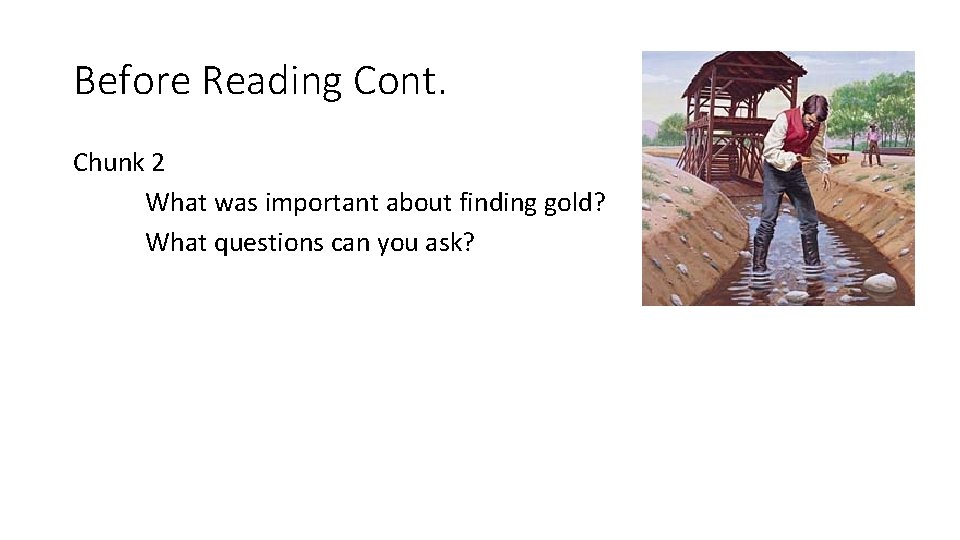
Before Reading Cont. Chunk 2 What was important about finding gold? What questions can you ask?
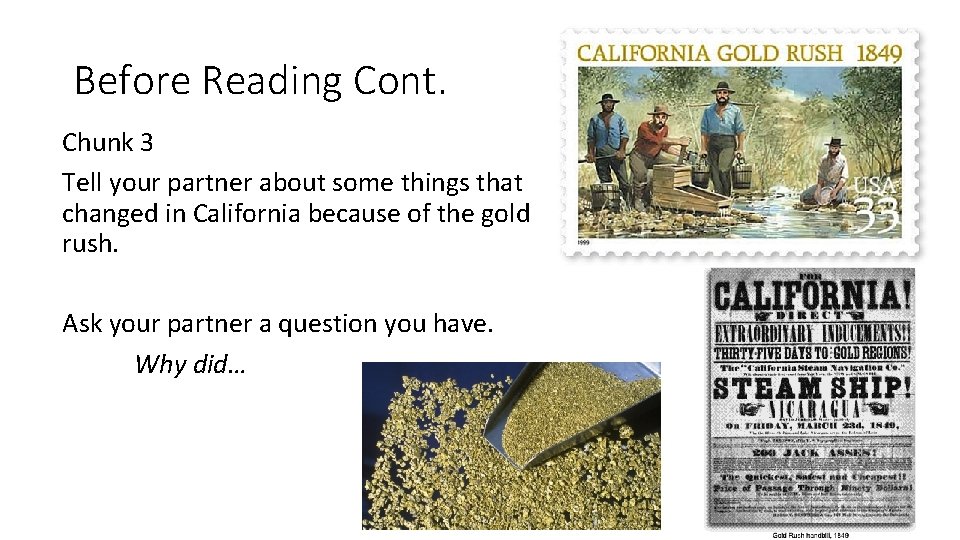
Before Reading Cont. Chunk 3 Tell your partner about some things that changed in California because of the gold rush. Ask your partner a question you have. Why did…
What steps are needed to “conversationize” the Before Reading section?
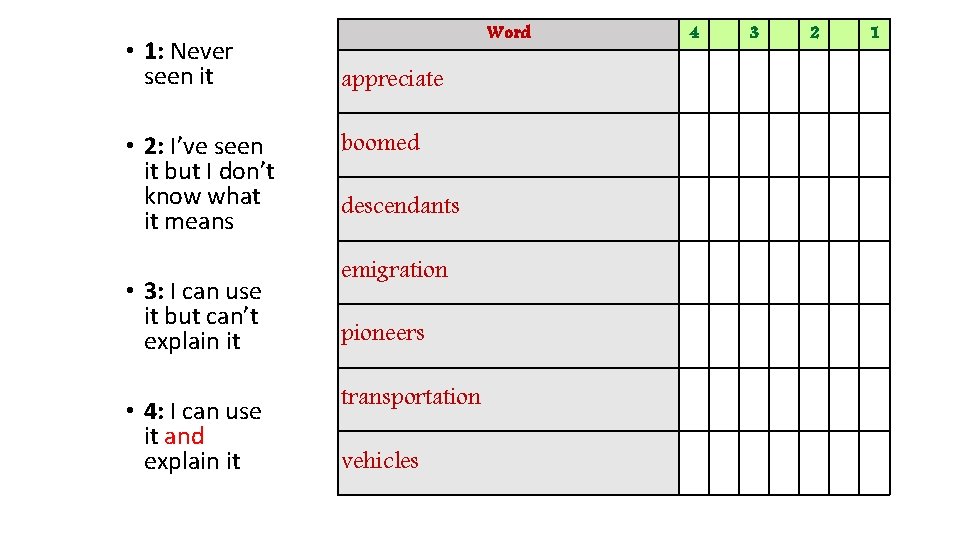
Vocabulary Page T 278 Objective RI. 3. 4 Determine the meaning of. . . words Has good ideas, consider adding pre- post- assessment tool Dale Scale
• 1: Never seen it • 2: I’ve seen it but I don’t know what it means • 3: I can use it but can’t explain it • 4: I can use it and explain it Word appreciate boomed descendants emigration pioneers transportation vehicles 4 3 2 1
During Reading Page T 280 Objectives RI. 3. 1 Ask & answer questions… SL 3. 2 Determine main ideas in text read aloud… Chunks are provided, concepts are provided, frames are not 1) Tell your partner the main idea and some details in the first paragraph. I think the main idea is … because…. You think the main idea is… 2) Tell your partner why people wanted to move to Oregon. People wanted to move to Oregon because…. It was also because… (linking) 3) How did people prepare for the trip? People needed to pack…. They also needed to… 4) Find and tell your partner the sequence words in this section. The sequence words are… 5) What happened to the pioneers when the got to Oregon?
Good news… it’s pretty well set up already • Wonder. Works worktexts – AC for each lesson is spelled out • http: //ecommerceprod. mheducation. com. s 3. amazonaws. com/unitas/school/explore/si tes/readingwonders/samples/wonder_works_intervention/companion_worktext /WW-Companion-Worktext-Grade-3/index. html#/16