
AC Power 1 AC Power As in the


- Slides: 37
AC Power 1
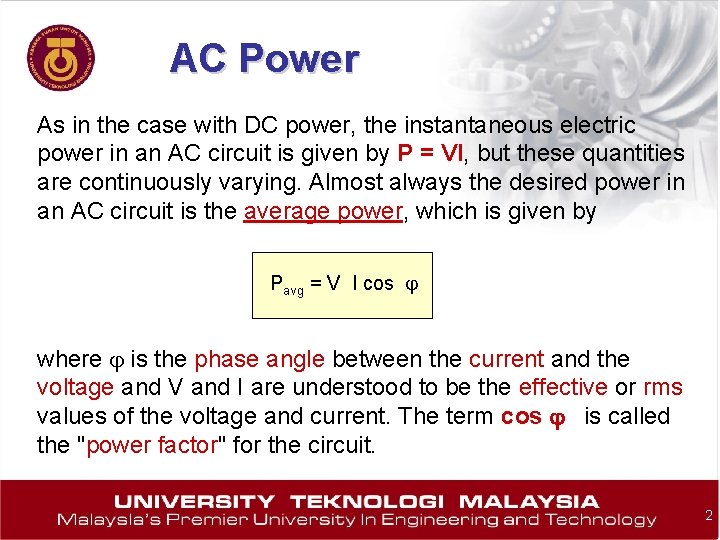
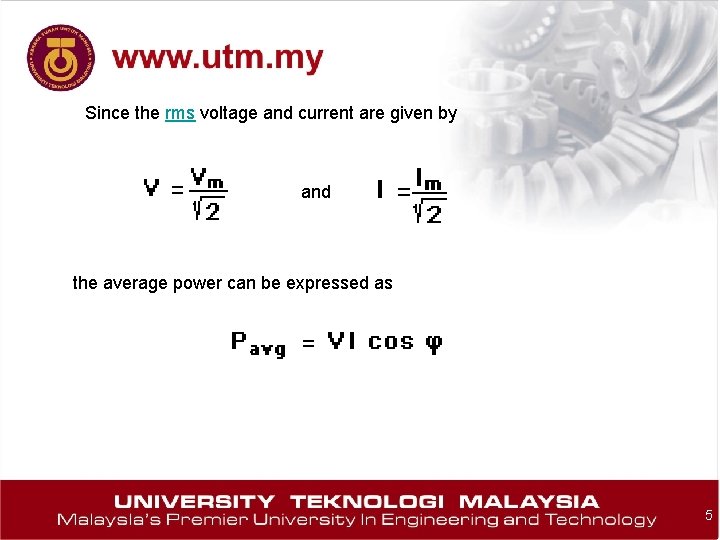
AC Power As in the case with DC power, the instantaneous electric power in an AC circuit is given by P = VI, but these quantities are continuously varying. Almost always the desired power in an AC circuit is the average power, which is given by Pavg = V I cos where is the phase angle between the current and the voltage and V and I are understood to be the effective or rms values of the voltage and current. The term cos is called the "power factor" for the circuit. 2
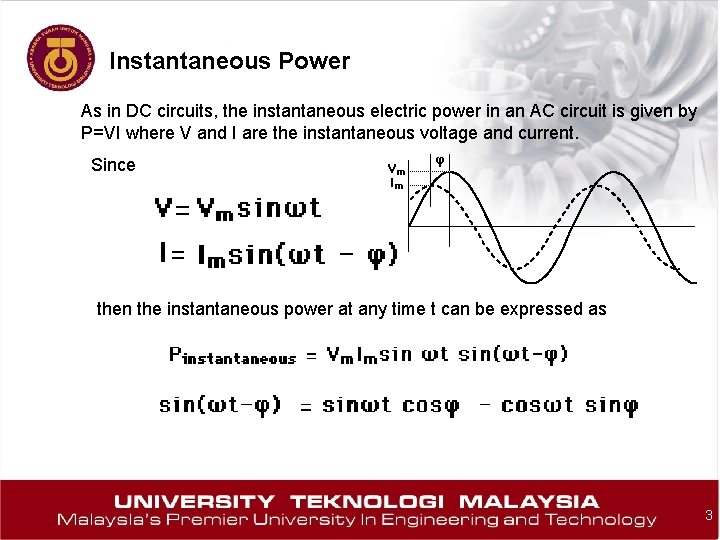
Instantaneous Power As in DC circuits, the instantaneous electric power in an AC circuit is given by P=VI where V and I are the instantaneous voltage and current. Since then the instantaneous power at any time t can be expressed as 3
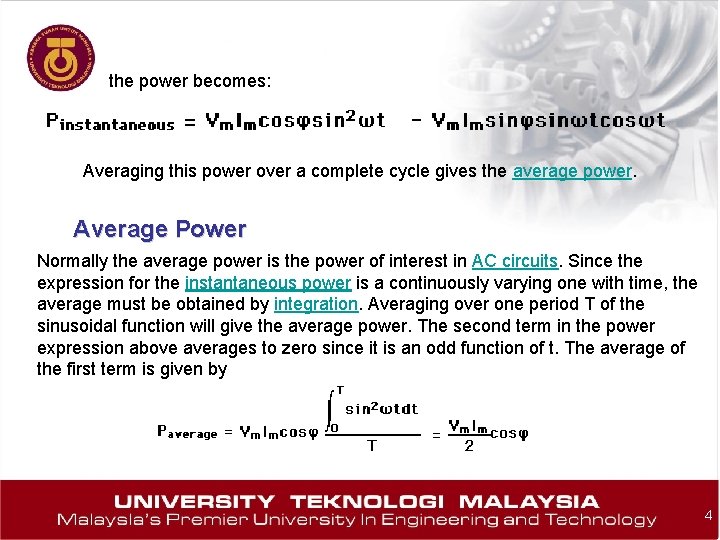
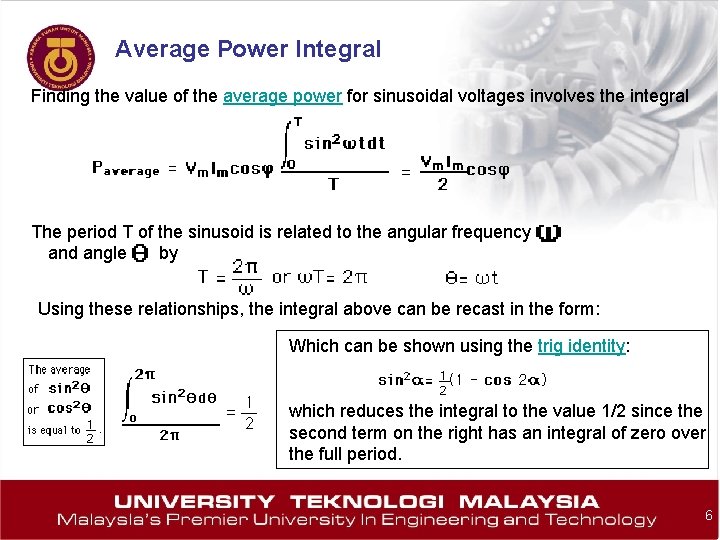
the power becomes: Averaging this power over a complete cycle gives the average power. Average Power Normally the average power is the power of interest in AC circuits. Since the expression for the instantaneous power is a continuously varying one with time, the average must be obtained by integration. Averaging over one period T of the sinusoidal function will give the average power. The second term in the power expression above averages to zero since it is an odd function of t. The average of the first term is given by 4
Since the rms voltage and current are given by and the average power can be expressed as 5
Average Power Integral Finding the value of the average power for sinusoidal voltages involves the integral The period T of the sinusoid is related to the angular frequency and angle by Using these relationships, the integral above can be recast in the form: Which can be shown using the trig identity: which reduces the integral to the value 1/2 since the second term on the right has an integral of zero over the full period. 6
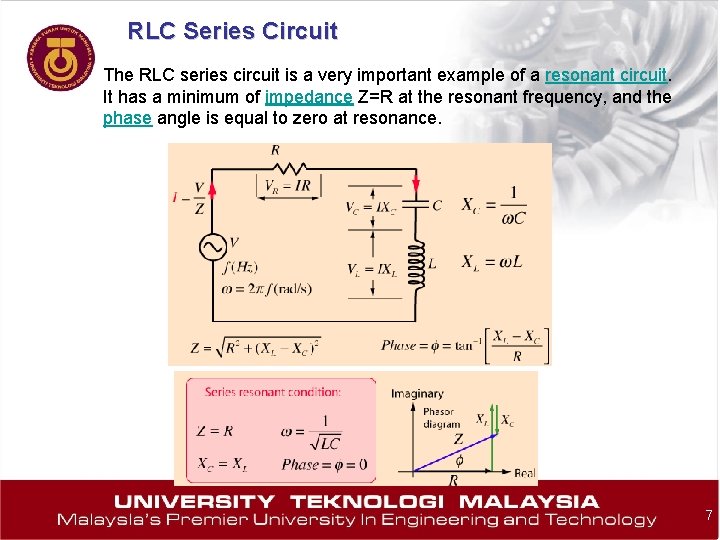
RLC Series Circuit The RLC series circuit is a very important example of a resonant circuit. It has a minimum of impedance Z=R at the resonant frequency, and the phase angle is equal to zero at resonance. 7
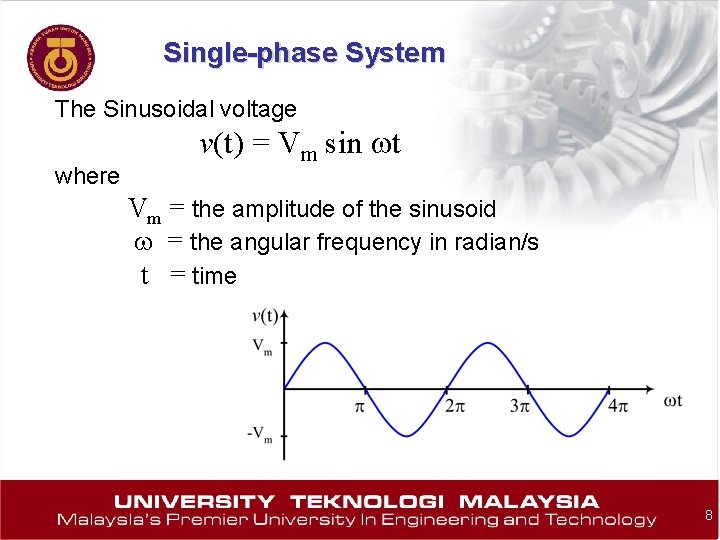
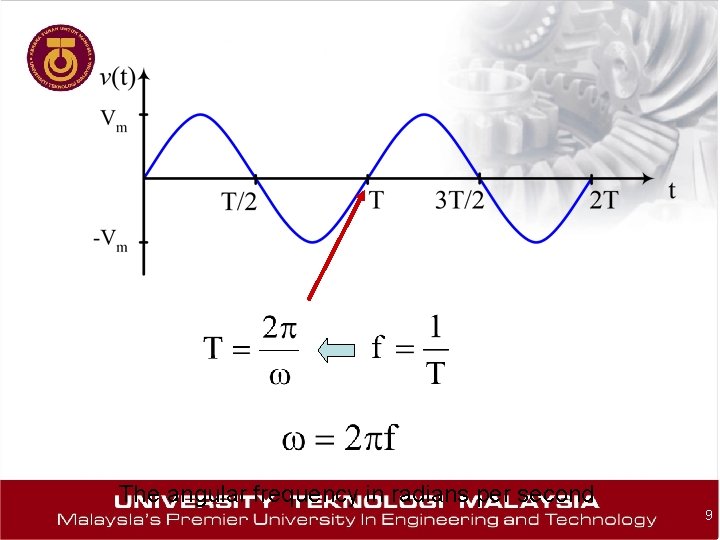
Single-phase System The Sinusoidal voltage where v(t) = Vm sin wt Vm = the amplitude of the sinusoid w = the angular frequency in radian/s t = time 8
The angular frequency in radians per second 9
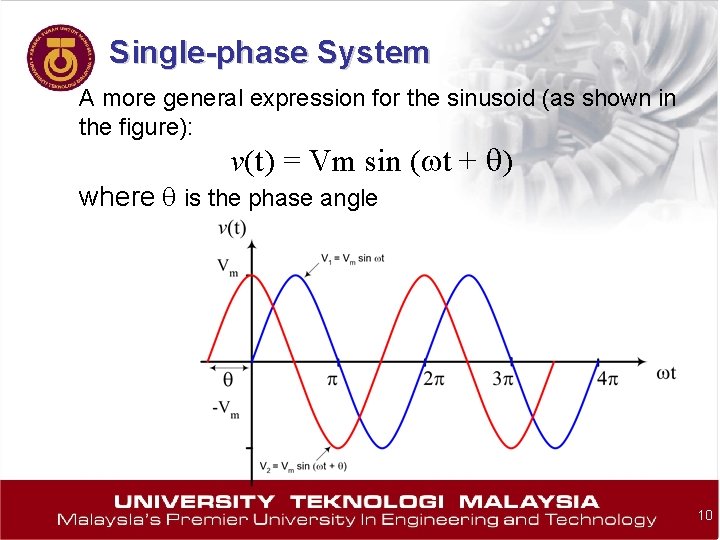
Single-phase System A more general expression for the sinusoid (as shown in the figure): v(t) = Vm sin (wt + q) where q is the phase angle 10
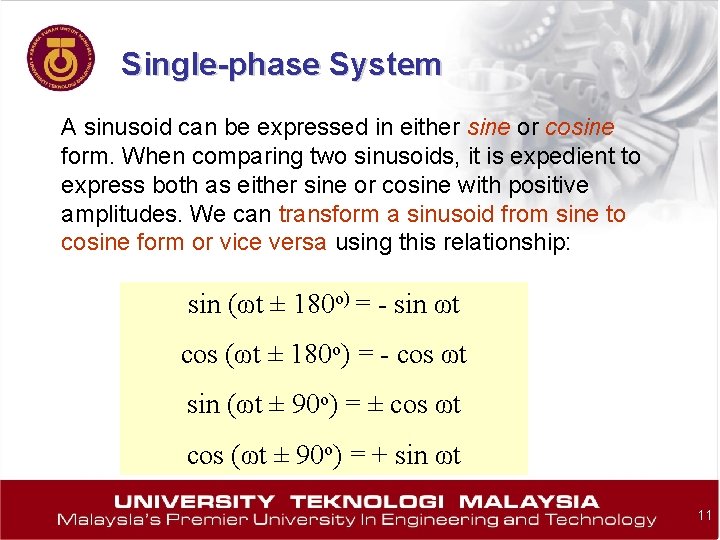
Single-phase System A sinusoid can be expressed in either sine or cosine form. When comparing two sinusoids, it is expedient to express both as either sine or cosine with positive amplitudes. We can transform a sinusoid from sine to cosine form or vice versa using this relationship: sin (ωt ± 180 o) = - sin ωt cos (ωt ± 180 o) = - cos ωt sin (ωt ± 90 o) = ± cos ωt cos (ωt ± 90 o) = + sin ωt 11
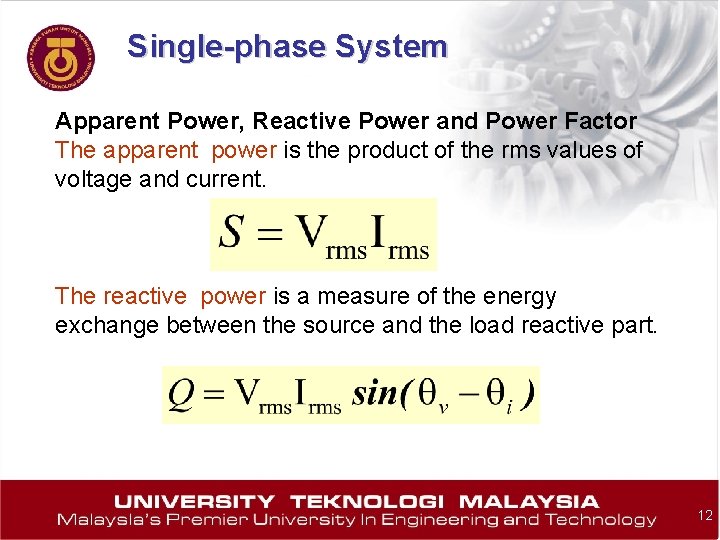
Single-phase System Apparent Power, Reactive Power and Power Factor The apparent power is the product of the rms values of voltage and current. The reactive power is a measure of the energy exchange between the source and the load reactive part. 12
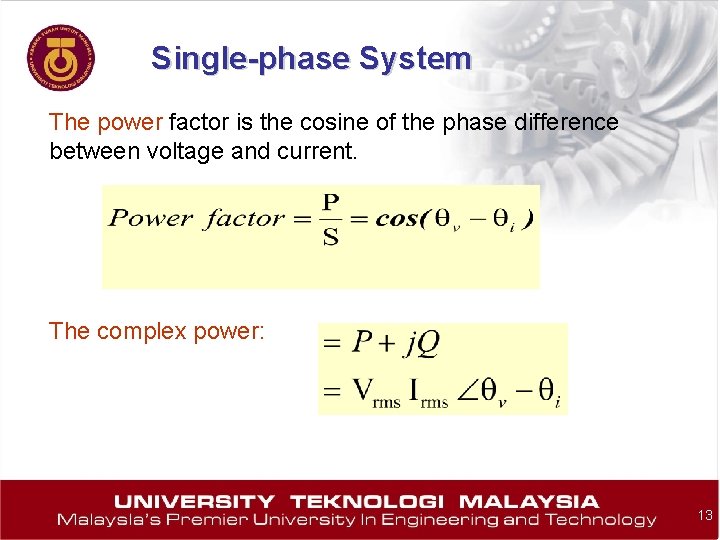
Single-phase System The power factor is the cosine of the phase difference between voltage and current. The complex power: 13
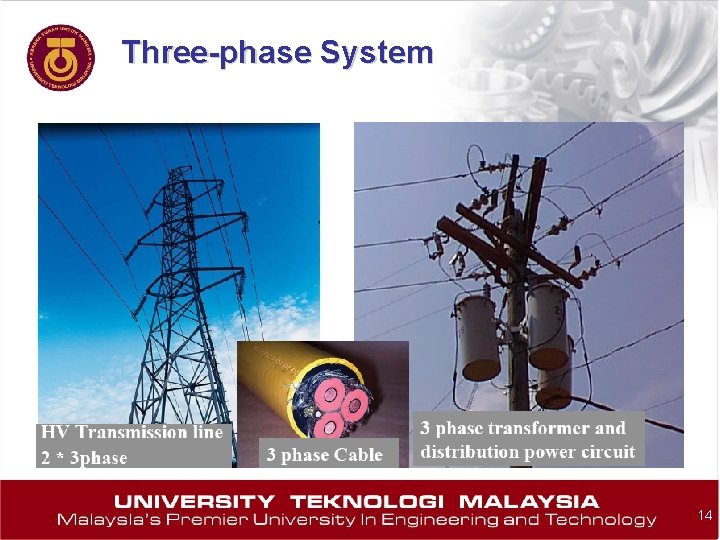
Three-phase System 14
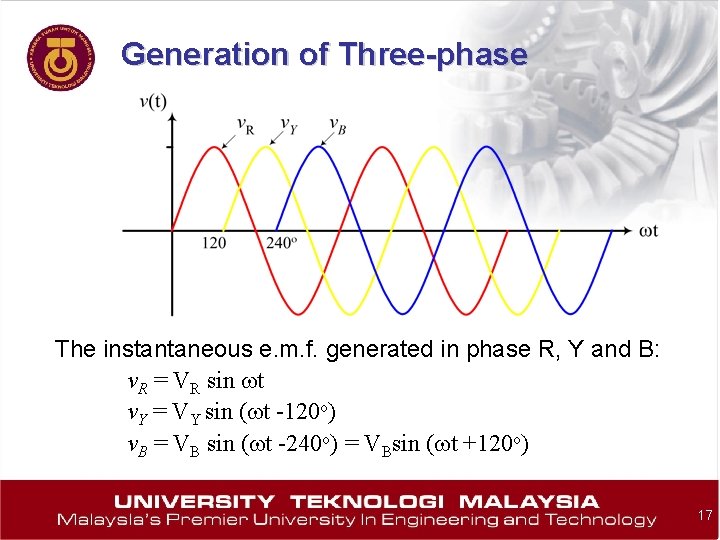
Generation of Three-phase In a three phase system the source consists of three sinusoidal voltages. For a balanced source, the three sources have equal magnitudes and are phase displaced from one another by 120 electrical degrees. A three-phase system is superior economically and advantage, and for an operating of view, to a singlephase system. In a balanced three phase system the power delivered to the load is constant at all times, whereas in a single-phase system the power pulsates with time. 15
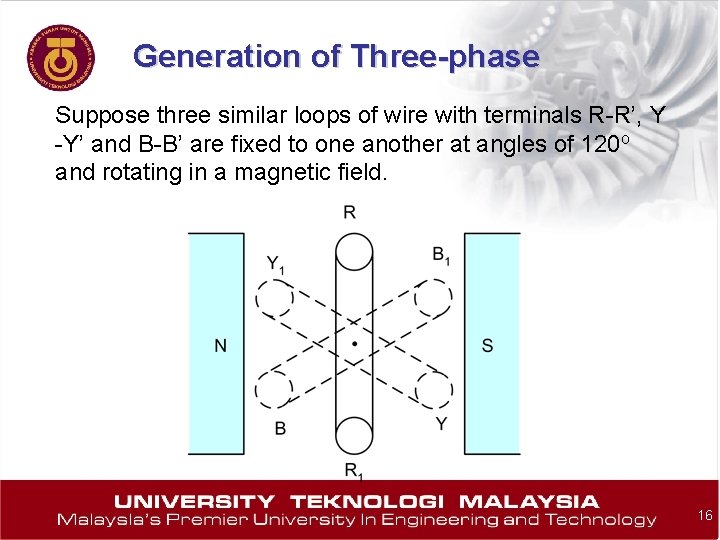
Generation of Three-phase Suppose three similar loops of wire with terminals R-R’, Y -Y’ and B-B’ are fixed to one another at angles of 120 o and rotating in a magnetic field. 16
Generation of Three-phase The instantaneous e. m. f. generated in phase R, Y and B: v. R = VR sin wt v. Y = VY sin (wt -120 o) v. B = VB sin (wt -240 o) = VBsin (wt +120 o) 17
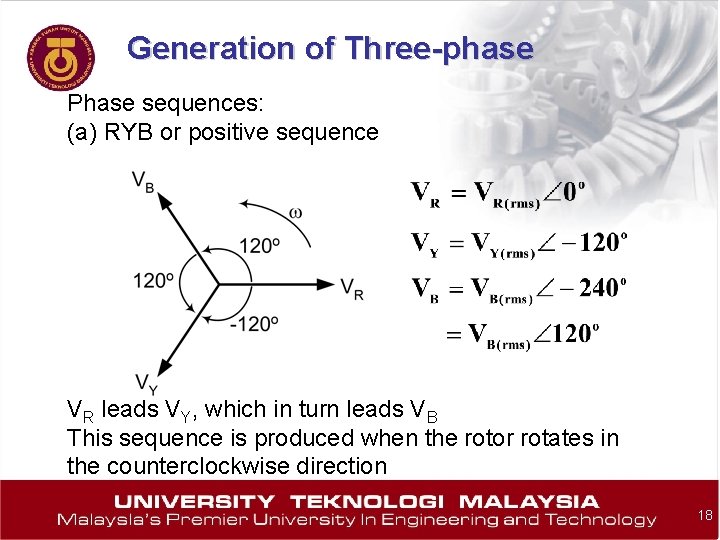
Generation of Three-phase Phase sequences: (a) RYB or positive sequence VR leads VY, which in turn leads VB This sequence is produced when the rotor rotates in the counterclockwise direction 18
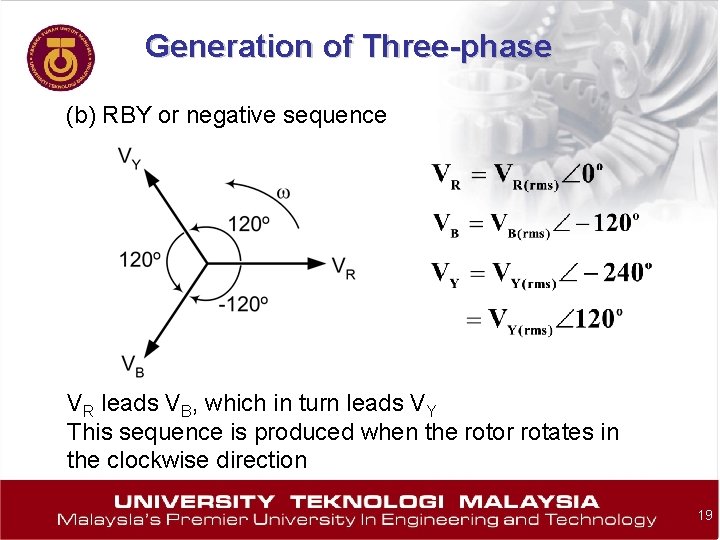
Generation of Three-phase (b) RBY or negative sequence VR leads VB, which in turn leads VY This sequence is produced when the rotor rotates in the clockwise direction 19
Star and Delta Connection 20
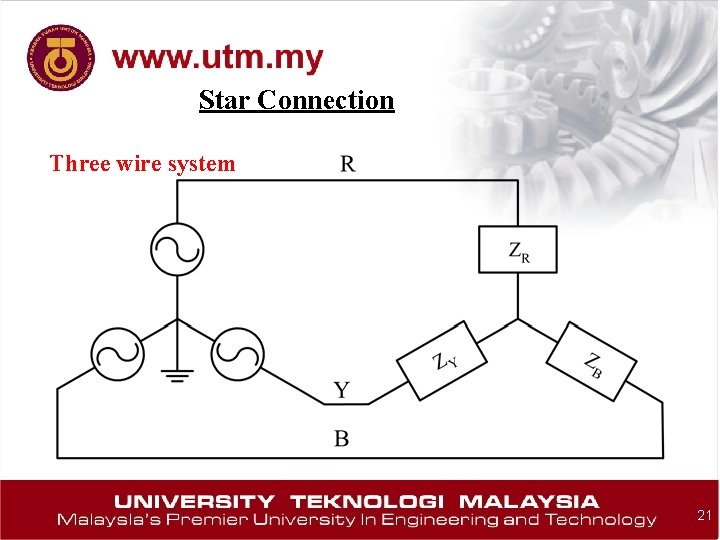
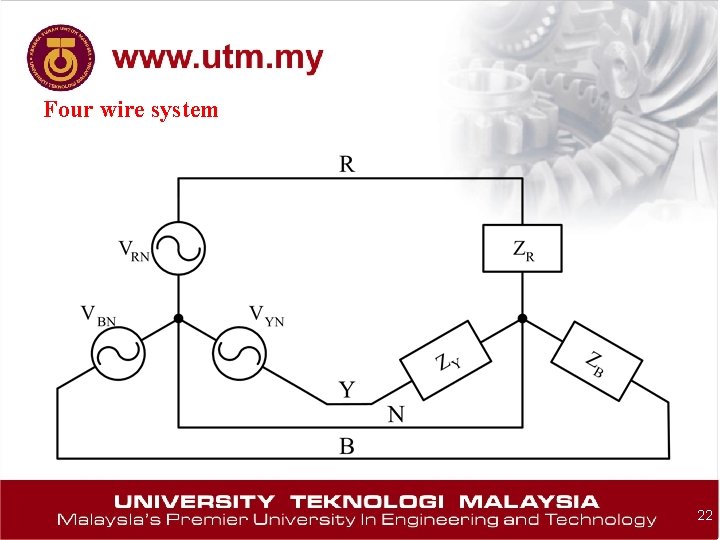
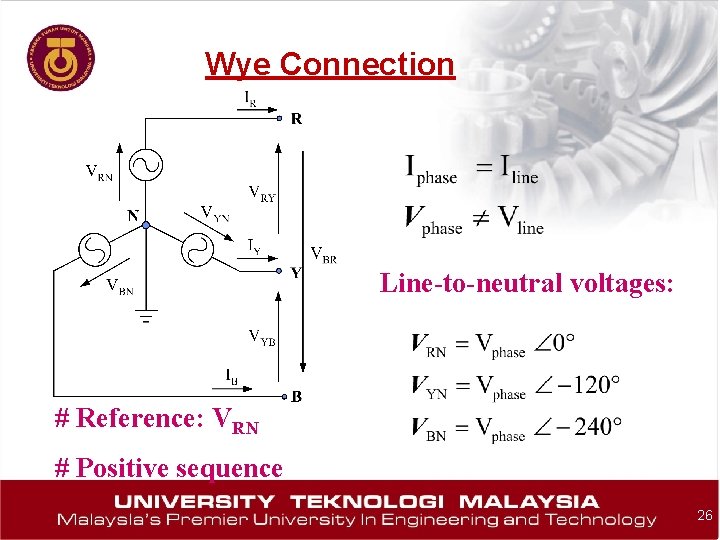
Star Connection Three wire system 21
Four wire system 22
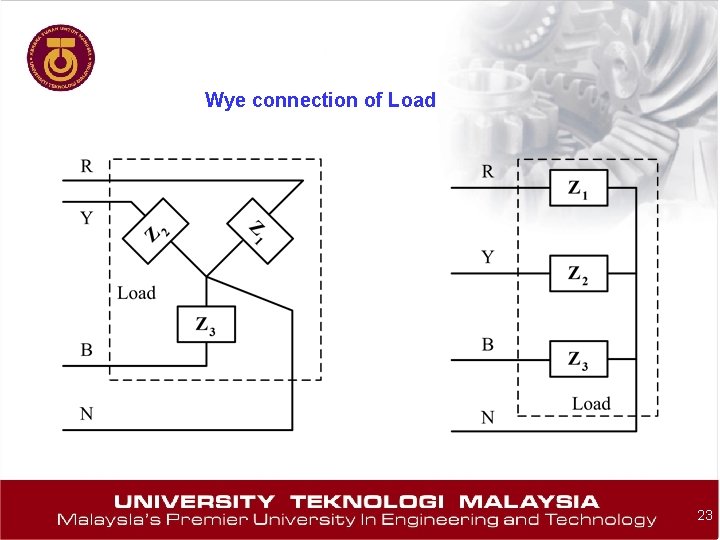
Wye connection of Load 23
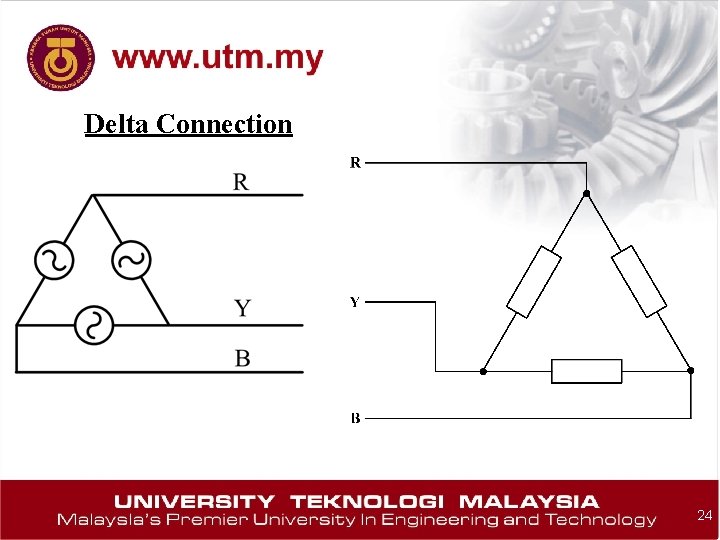
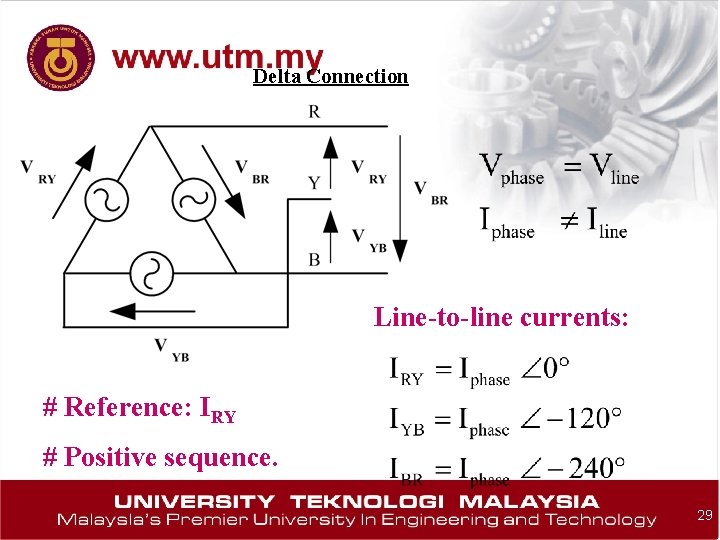
Delta Connection 24
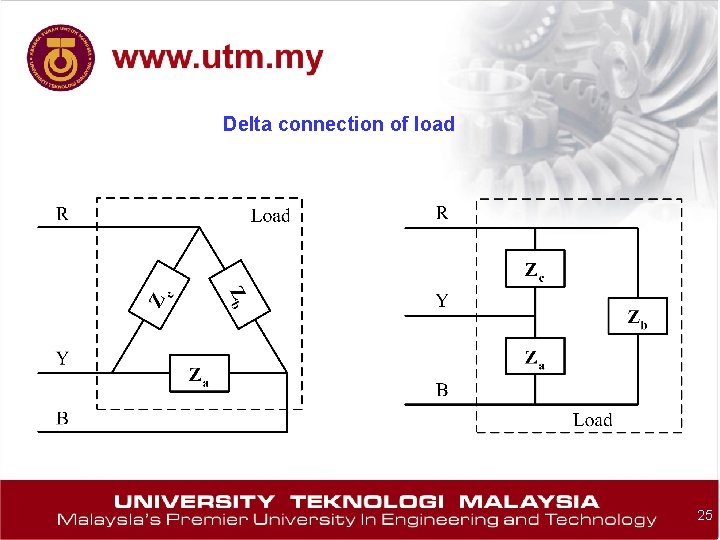
Delta connection of load 25
Wye Connection Line-to-neutral voltages: # Reference: VRN # Positive sequence 26
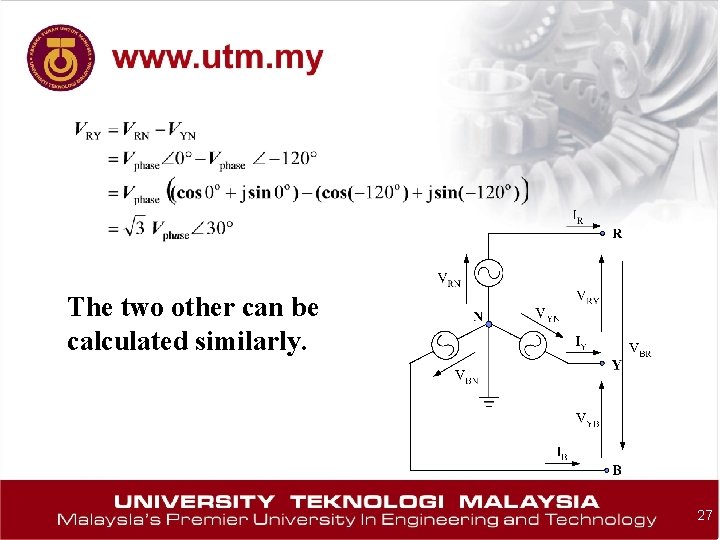
The two other can be calculated similarly. 27
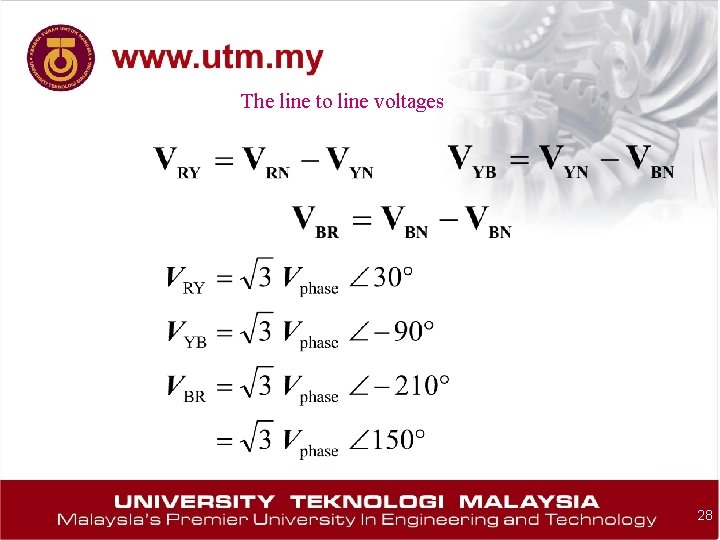
The line to line voltages 28
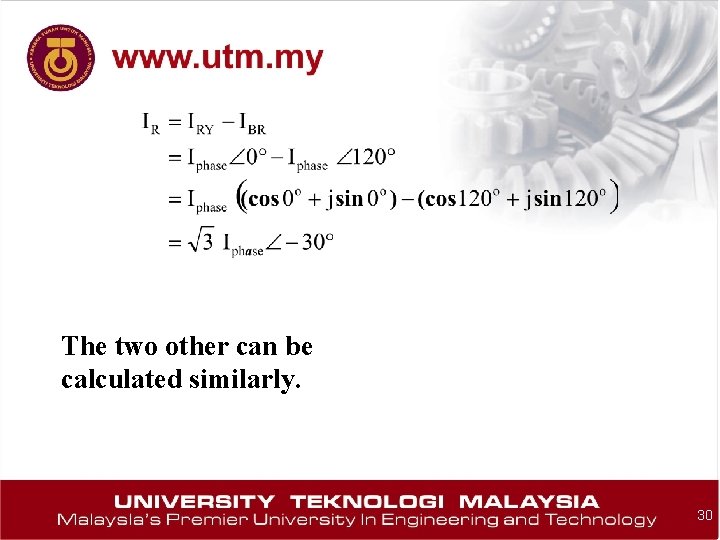
Delta Connection Line-to-line currents: # Reference: IRY # Positive sequence. 29
The two other can be calculated similarly. 30
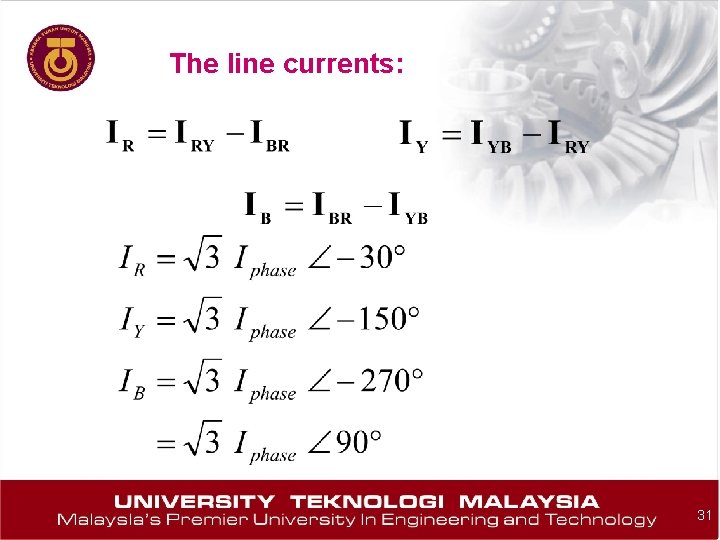
The line currents: 31
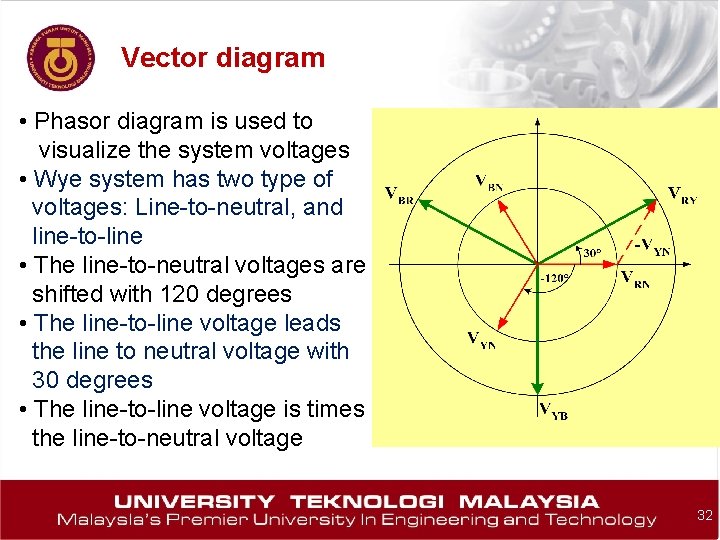
Vector diagram • Phasor diagram is used to visualize the system voltages • Wye system has two type of voltages: Line-to-neutral, and line-to-line • The line-to-neutral voltages are shifted with 120 degrees • The line-to-line voltage leads the line to neutral voltage with 30 degrees • The line-to-line voltage is times the line-to-neutral voltage 32
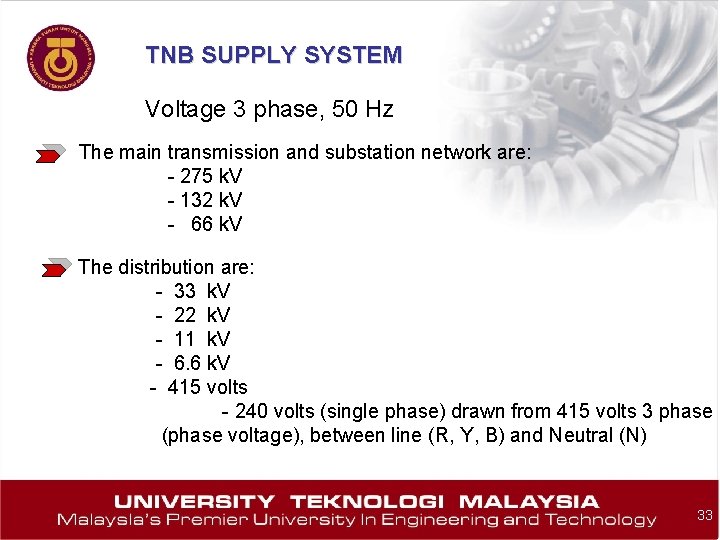
TNB SUPPLY SYSTEM Voltage 3 phase, 50 Hz The main transmission and substation network are: - 275 k. V - 132 k. V - 66 k. V The distribution are: - 33 k. V - 22 k. V - 11 k. V - 6. 6 k. V - 415 volts - 240 volts (single phase) drawn from 415 volts 3 phase (phase voltage), between line (R, Y, B) and Neutral (N) 33
SYSTEM The low voltage system (415/240 V) is 3 -phase four wire. The low voltage system is a mixture of overhead lines and under ground cables. The high voltage and extra high voltage system is 3 -phase three wire Configuration. Overhead line and under ground cable system are used. Supply Method (two types of premises) 1. Single consumer such as private dwelling house, workshop, factory, etc a. Single phase, two wire, 240 V, up to 12 k. VA max demand b. Three phase, four wire, 415 V, up to 45 k. VA max demand c. Three phase, four wire, C. T. metered 415 V, up to 1, 500 k. VA max demand 34
2. Multi tenanted premises, such as high rises flats, commercial, office blocks, etc - Low Voltage Three phase, four wire, C. T. metered 415 V, up to 1, 500 k. VA max demand - High Voltage and Extra High Voltage a. Three phase, three wires, 6, 600 and 11, 000 V for load of 1, 500 k. VA max demand above, whichever voltage is available b. Three phase, three wires, 22, 000 and 33, 000 V for load of 5, 000 k. VA max demand above, whichever voltage is available c. Three phase, three wires, 66, 000 V, 132, 000 V and 275, 000 for exceptionally large load of above 20 MVA max demand 35
Standby Supply Standby generator(s) to be used by the consumer in his premises, in accordance with the relevant by-laws, may be provided by the consumer The generator(s) shall remain a separate system from the TNB’s Distribution system and should be certified and registered by Suruhanjaya Tenaga (formerly JBE) This may be used in place of the TNB’s supply source through a suitable, Approved change over facility under emergency conditions. 36
Beban Berubah setiap masa, hari, minggu dan bulan. Beban mempengaruhi penjanaan tenaga. Penjanaan tenaga berdasarkan permintaan beban yang lepas. Lengkuk beban berubah dalam sehari. 37