
AC Meters Part 2 Outline dArsonval MM with
- Slides: 21
AC Meters Part 2
Outline d’Arsonval MM with Full Wave Rectification. Electro-dynamometer Movement Iron-vane meter movement. Loading effects of AC Voltmeters.
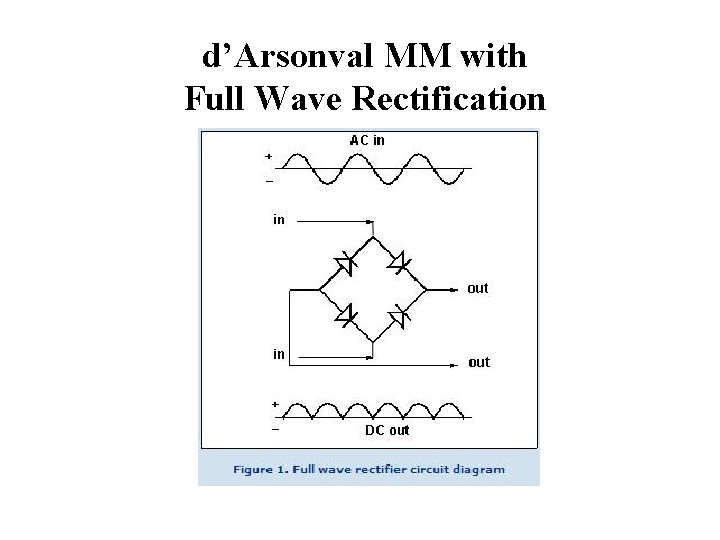
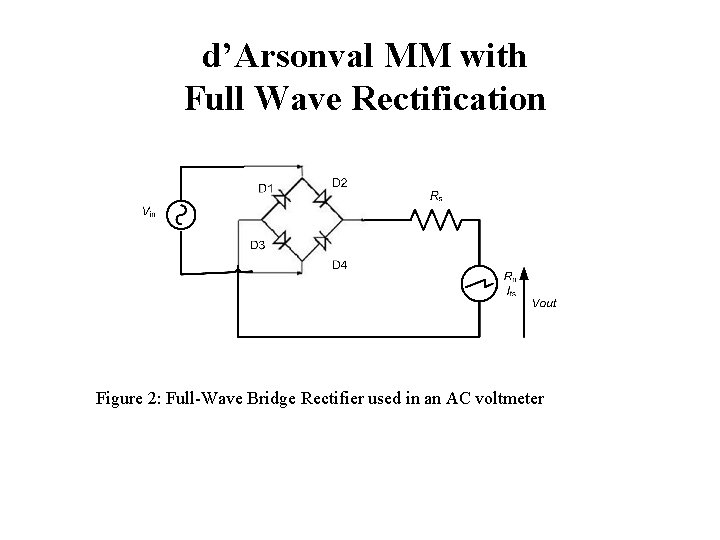
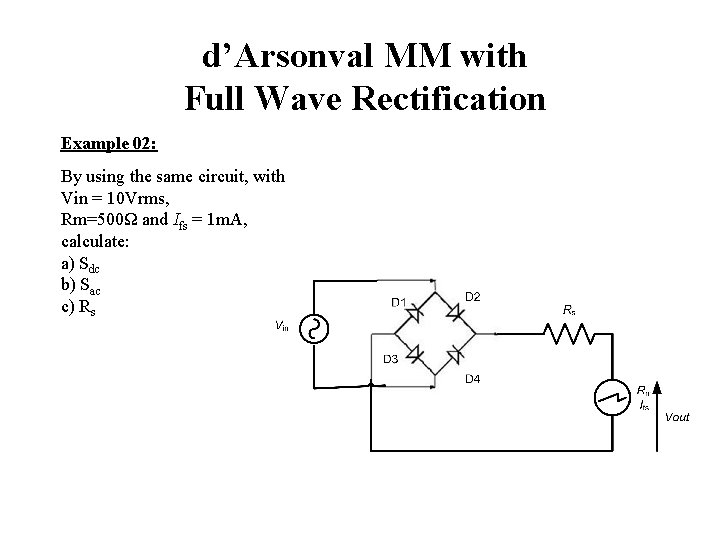
d’Arsonval MM with Full Wave Rectification Frequently, it is more desirable to use a full-wave rectifier in AC voltmeters because it shows higher sensitivity rating compared to ½ wave rectifier. The most frequently used circuit for full-wave rectification is the bridge-type rectifier, as shown in the next figure.
d’Arsonval MM with Full Wave Rectification
d’Arsonval MM with Full Wave Rectification Figure 2: Full-Wave Bridge Rectifier used in an AC voltmeter
d’Arsonval MM with Full Wave Rectification Positive ½ cycle Current flows from Vi n through D 2, through the MM from positive to negative, then trough D 3. Negative ½ cycle Current flows from Vi n through D 4, trough the MM from positive to negative, then trough D 1.
d’Arsonval MM with Full Wave Rectification • Even though the polarity of Vin changes in every ½ cycle, the direction of current that flows through MM does not change. • Since current flows through MM on both ½ cycles, then the deflection of MM will be greater compared to ½ wave rectification.
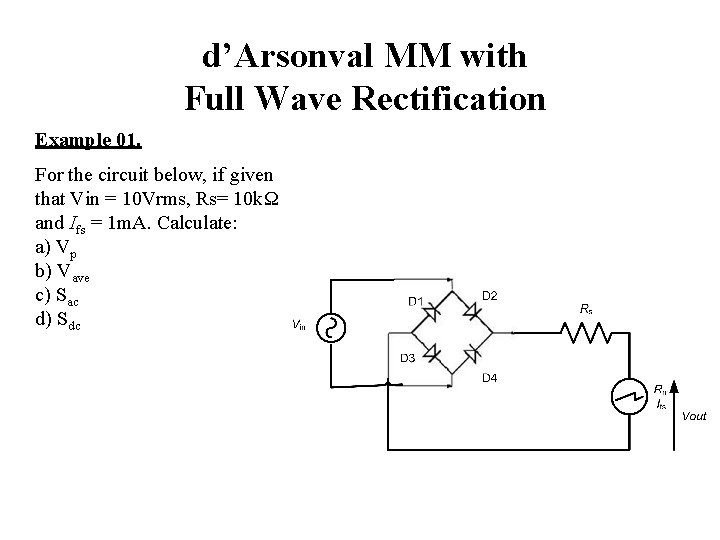
d’Arsonval MM with Full Wave Rectification Example 01. For the circuit below, if given that Vin = 10 Vrms, Rs= 10 kΩ and Ifs = 1 m. A. Calculate: a) Vp b) Vave c) Sac d) Sdc
d’Arsonval MM with Full Wave Rectification Example 02: By using the same circuit, with Vin = 10 Vrms, Rm=500Ω and Ifs = 1 m. A, calculate: a) Sdc b) Sac c) Rs
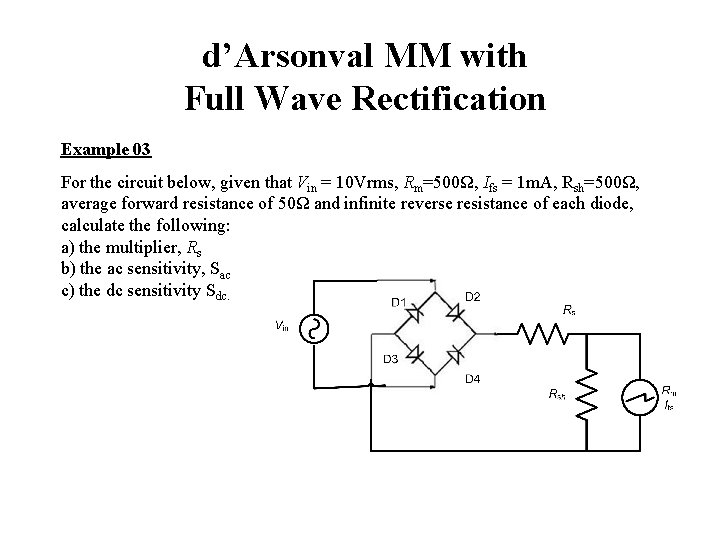
d’Arsonval MM with Full Wave Rectification Example 03 For the circuit below, given that Vin = 10 Vrms, Rm=500Ω, Ifs = 1 m. A, Rsh=500Ω, average forward resistance of 50Ω and infinite reverse resistance of each diode, calculate the following: a) the multiplier, Rs b) the ac sensitivity, Sac c) the dc sensitivity Sdc.
d’Arsonval MM with Full Wave Rectification It is one of the most fundamental meters that is widely used today. It is a current –sensitive device: similar to the D’Arsonval MM, which uses essentially the same principle of movement. Remember that the D’Arsonval movement is a DC device and can only measure DC current or AC current rectified to DC.
The Electro-Dynamometer Movement
The Electro-Dynamometer Movement
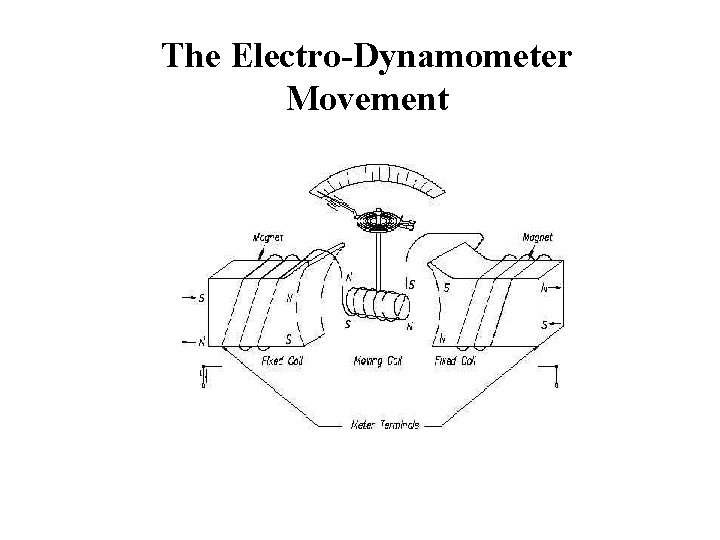
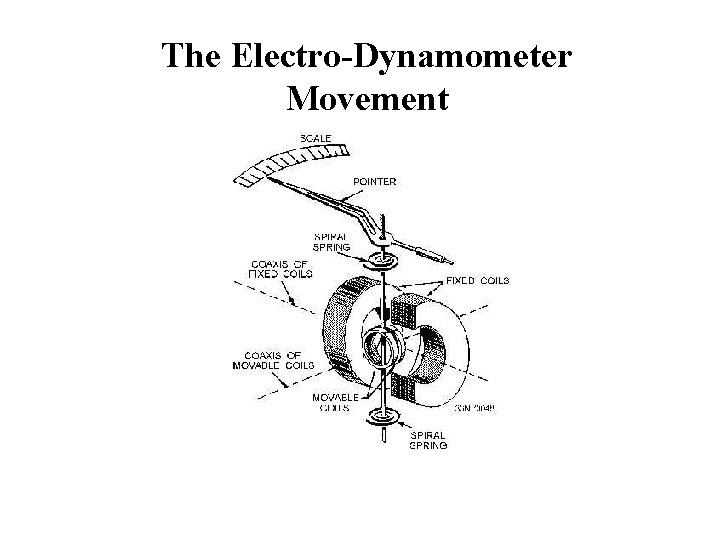
The Electro-Dynamometer Movement • The Electrodynamometer movement has the same basic operating principle as the D’Arsonval meter movement, except that the permanent magnet is replaced by fixed coils. • The moving coil and pointer, which are attached to the coil, are suspended between and connected in series with the two field coils.
The Electro-Dynamometer Movement • The two field coils and moving coil are connected in series such that the same current flows through each coil. • Current flow through the three coils in either direction causes a magnetic field to be produced between the field coils. • The same current flow through the moving coil causes it to act as a magnet exerting a force against the spring.
The Electro-Dynamometer Movement • If the current is reversed, the field polarity and the polarity of the moving coil reverse, and the force continues in the same direction. • Due to this characteristic of the Electro-dynamometer movement, it can be used in both AC and DC systems to measure current. • Some voltmeters and ammeters use the electrodynamometer. • However, its most important use is in the wattmeter.
The Electro-Dynamometer Movement • The basic EDMM is capable of handling much more current than a d’Arsonval could handle. • However, it has much less Sensitivity rating compared to d’Arsonval MM, which ranges about 20Ω/V up to only 100Ω/V.
The Electro-Dynamometer Movement Example 04 An EDMM that has a full scale deflection current rating of 10 m. A is to be used in a voltmeter circuit. Calculate the value of the multiplier for a 10 -V range if Rm = 50Ω.
The Electro-Dynamometer Movement Example 05 An EDMM with a full scale deflection rating of 10 m. A is to be used as a 1 -m. A ammeter. If the resistance of the moving coil is 40Ω, what is the value of the shunt resistor, Rsh?
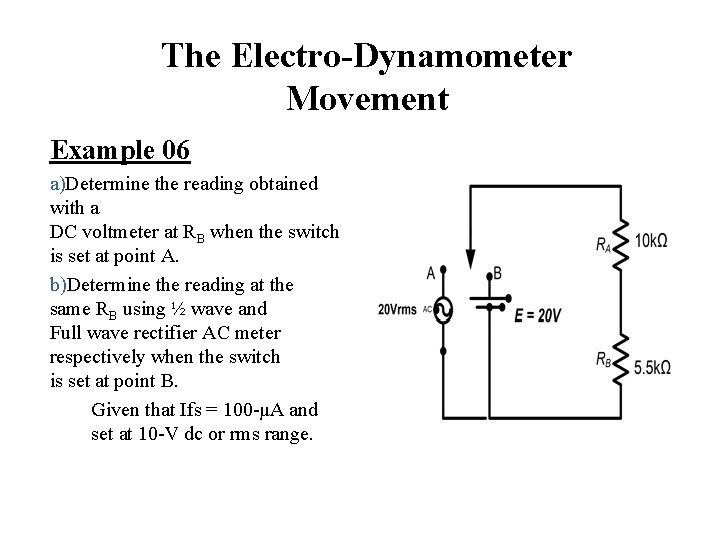
Loading Effects of AC Voltmeters • As already being discussed, the sensitivity of AC Voltmeters, using either ½ wave or Full wave rectification, is always less than the sensitivity of the DC Voltmeters. • Therefore, the loading effect of an AC Voltmeter is always greater than that of a DC Voltmeter.
The Electro-Dynamometer Movement Example 06 a)Determine the reading obtained with a DC voltmeter at RB when the switch is set at point A. b)Determine the reading at the same RB using ½ wave and Full wave rectifier AC meter respectively when the switch is set at point B. Given that Ifs = 100 -μA and set at 10 -V dc or rms range.