
AC Meters Chapter 03 Objectives q At the
AC Meters Chapter 03
Objectives q At the end of this chapter, the student should be able to: Describe the operation of a half-wave rectifier circuit. q Trace the current path in a full-wave bridge rectifier circuit. q Calculate ac sensitivity and the value of multiplier resistors for half-wave and full-wave rectification. q 2
Outline • Introduction: What is AC? • d’Arsonval with Half-wave Rectification • d’Arsonval with Full-wave Rectification 3
Outline • Electrodynamometer movement. • Loading effects of AC Voltmeters • Summary 4

Introduction § Several types of meter movements maybe used to measure AC current or voltage. § The five principal meter movements used in ac instruments are listed in the table below: 5

Introduction No Meter Movement DC Use Applications 1 Electrodynamometer YES Standard meter, Wattmeter, etc… 2 Iron-Vane YES Indicator applications, etc… 3 Electro-static YES High voltage measurement. 4 Thermocouple YES Radio freq measurement 5 D’Arsonval YES-w/ Voltage, currents, rectifiers resistance, etc… 6
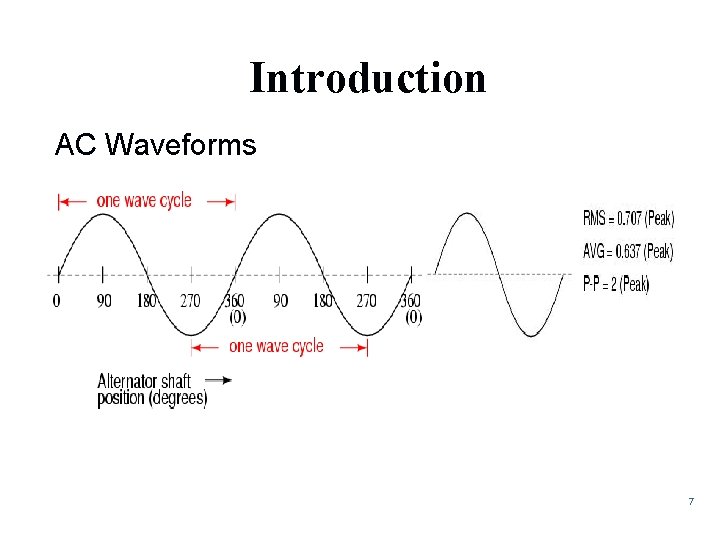
Introduction AC Waveforms 7
d’Arsonval MM with ½ Wave Rectification • In the previous chapter, we have discussed in detail d’Arsonval MM (PMMC) and its applications in Ammeter, Voltmeter and Ohmmeters. • Now, we’ll learn about using the same MM to measure ac current or voltages. 8
d’Arsonval MM with ½ Wave Rectification • In order to measure ac with d’Arsonval MM, we must first rectify the ac current by use of a diode rectifier. • This process will produce uni-directional current flow. • Several types of diode rectifiers are available: copper oxide, vacuum diode, semiconductor diode etc. 9
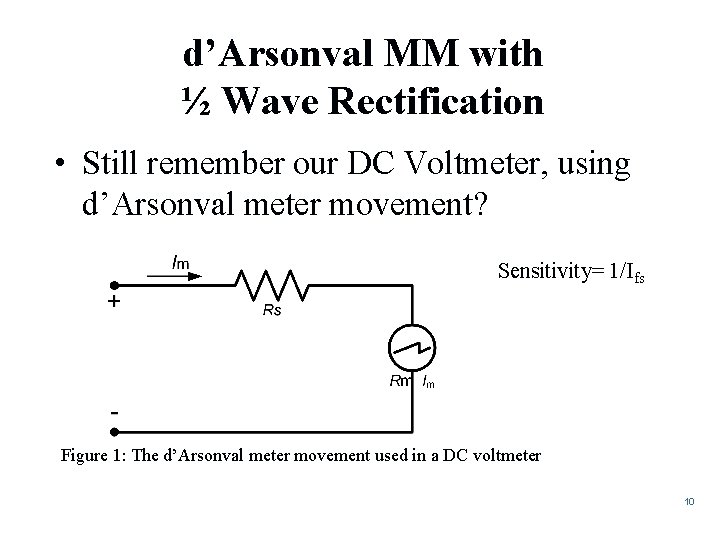
d’Arsonval MM with ½ Wave Rectification • Still remember our DC Voltmeter, using d’Arsonval meter movement? Sensitivity= 1/Ifs Figure 1: The d’Arsonval meter movement used in a DC voltmeter 10
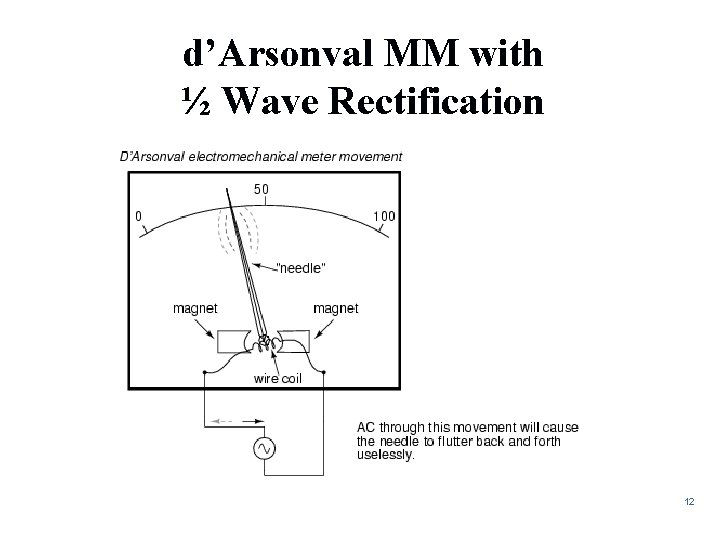
d’Arsonval MM with ½ Wave Rectification • PMMC meter movements will not work correctly if directly connected to alternating current, because the direction of needle movement will change with each half-cycle of the AC. • Permanent-magnet meter movements, like permanent-magnet motors, are devices whose motion depends on the polarity of the applied voltage. 11
d’Arsonval MM with ½ Wave Rectification 12
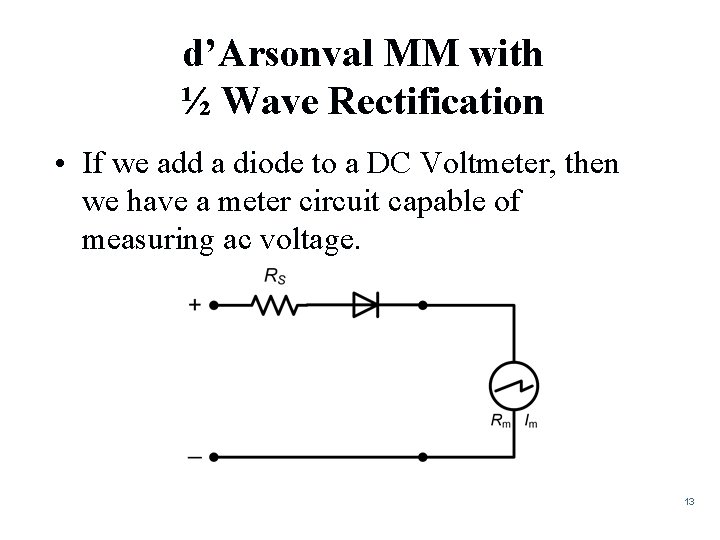
d’Arsonval MM with ½ Wave Rectification • If we add a diode to a DC Voltmeter, then we have a meter circuit capable of measuring ac voltage. 13
d’Arsonval MM with ½ Wave Rectification • The FW biased diode will have no effects in the operations of the circuit. (ideal diode) • Now, suppose we replace the 10 -Vdc with 10 Vrms, what will happen? 14
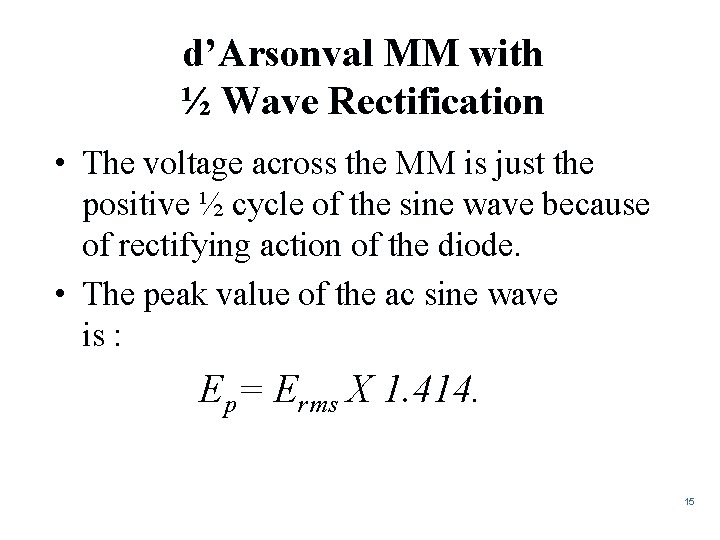
d’Arsonval MM with ½ Wave Rectification • The voltage across the MM is just the positive ½ cycle of the sine wave because of rectifying action of the diode. • The peak value of the ac sine wave is : Ep= Erms X 1. 414. 15
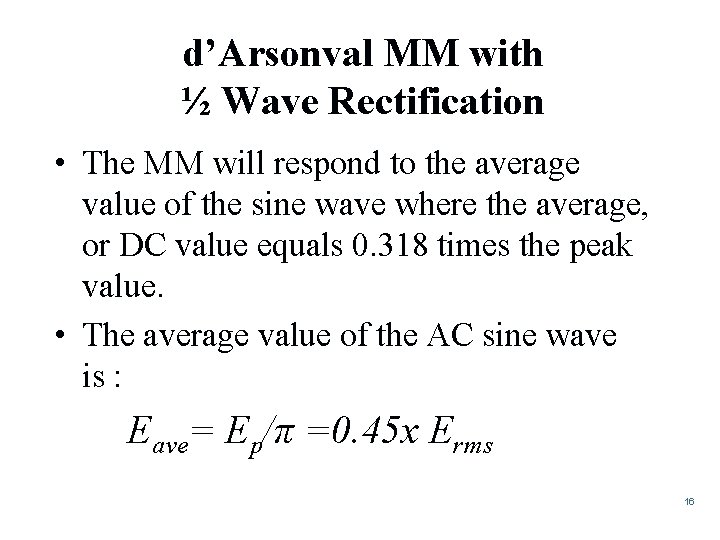
d’Arsonval MM with ½ Wave Rectification • The MM will respond to the average value of the sine wave where the average, or DC value equals 0. 318 times the peak value. • The average value of the AC sine wave is : Eave= Ep/π =0. 45 x Erms 16
d’Arsonval MM with ½ Wave Rectification • The diode action produces an approximately half sine wave across the load resistor. • The average value of this voltage is referred to as the DC voltage, which a DC voltmeter connected across a load resistor will respond to. 17
d’Arsonval MM with ½ Wave Rectification • Therefore, we can see that the pointer that deflected full scale when a 10 -V DC signal was applied, deflects to only 4. 5 V when we apply a 10 -Vrms sine AC waveforms. • Thus, an AC Voltmeter using ½ wave rectification is only approximately 45% sensitive as a DC Voltmeter. 18
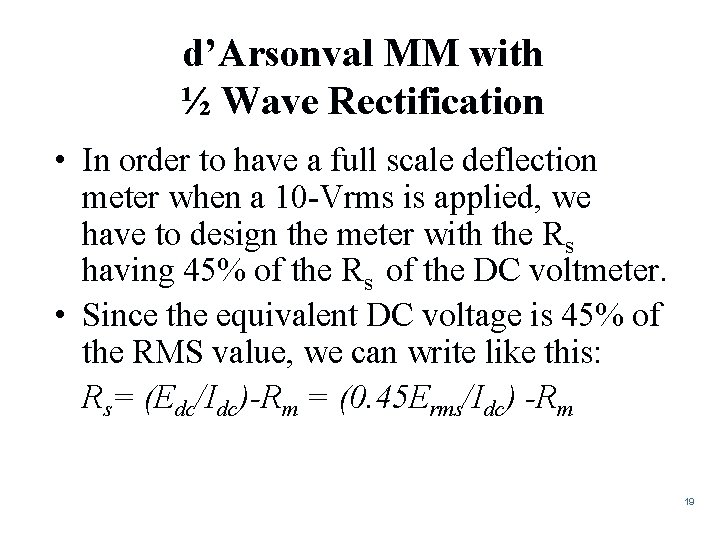
d’Arsonval MM with ½ Wave Rectification • In order to have a full scale deflection meter when a 10 -Vrms is applied, we have to design the meter with the Rs having 45% of the Rs of the DC voltmeter. • Since the equivalent DC voltage is 45% of the RMS value, we can write like this: Rs= (Edc/Idc)-Rm = (0. 45 Erms/Idc) -Rm 19
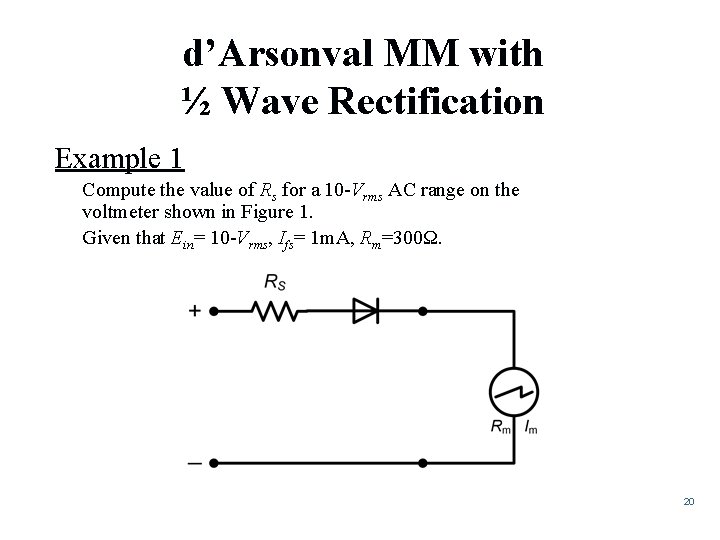
d’Arsonval MM with ½ Wave Rectification Example 1 Compute the value of Rs for a 10 -Vrms AC range on the voltmeter shown in Figure 1. Given that Ein= 10 -Vrms, Ifs= 1 m. A, Rm=300Ω. 20
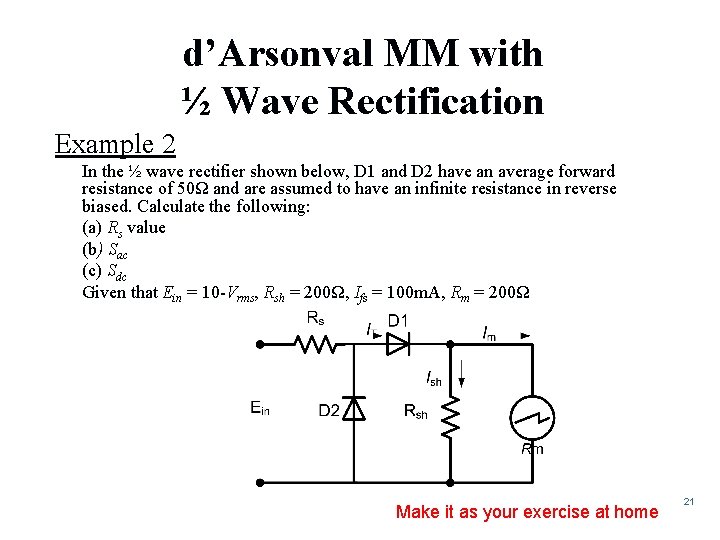
d’Arsonval MM with ½ Wave Rectification Example 2 In the ½ wave rectifier shown below, D 1 and D 2 have an average forward resistance of 50Ω and are assumed to have an infinite resistance in reverse biased. Calculate the following: (a) Rs value (b) Sac (c) Sdc Given that Ein = 10 -Vrms, Rsh = 200Ω, Ifs = 100 m. A, Rm = 200Ω Make it as your exercise at home 21
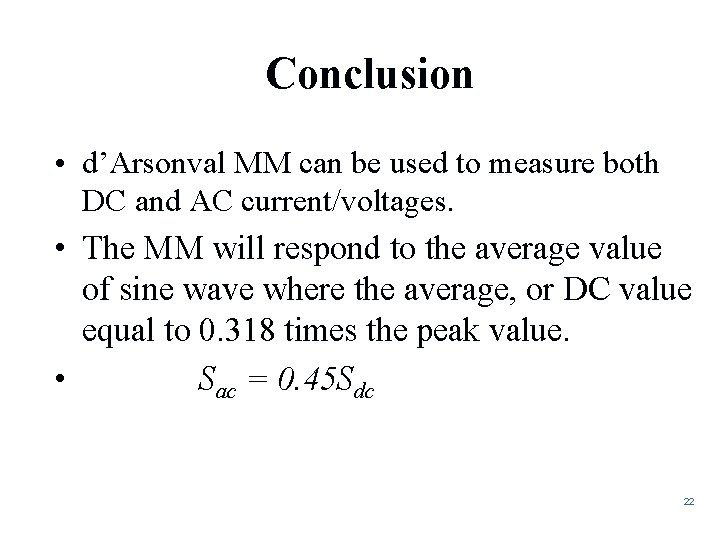
Conclusion • d’Arsonval MM can be used to measure both DC and AC current/voltages. • The MM will respond to the average value of sine wave where the average, or DC value equal to 0. 318 times the peak value. • Sac = 0. 45 Sdc 22
- Slides: 22