
Abu Dhabi Oil Refining Company TAKREER PREPARED BY

Abu Dhabi Oil Refining Company (TAKREER)
PREPARED BY Ramy S. Elreqib Wesam Abusalah Faisal Alobeidli 201370492 201370515 200101313 SUPERVISED BY Dr. Ananth Chiravuri

Introduction: Abu Dhabi Oil Refining Company (TAKREER) was established in 1999 to take over the responsibilities of refining operations from Abu Dhabi National Oil Company (ADNOC). This covers the crude oil and condensate refining, supply of petroleum products and production of granulated Sulphur. Takreer’s main objective is to develop the refining industry in the UAE which started with the inauguration of Abu Dhabi Refinery (ex. Umm Al Nar) in 1976 and Ruwais Refinery in 1982. Takreer is considered a prominent oil refining company regionally and internationally contributing to oil markets and to the rapid growth of UAE economy. Since our inception, Takreer maintained its position as a leading refining company, thanks to the high standard and efficient refining operations consistent with sound health, safety and environment practices as well as the world standard performance of both operations and employees.

Crude Oil Refining A refinery process can be divided into three parts: crude oil operations, production and product blending. Distillation Illustration of. Oil a standard refinery system
What is Naphtha? Naphtha is a complex mixture of hydrocarbons with boiling range of 38 to 205°C, which corresponds to carbon numbers of C 5 to C 14. Naphtha is produced from petroleum crude oil by fractionation at crude distillation tower working under atmospheric pressure. Treated Naphtha is sent for further processing by splitting it into: • Light Naphtha that consists of C 5 and C 6, that passes to isomerization unit • Heavy Naphtha with carbon number of C 7 to C 14, that passes to a catalytic reforming unit. After that both resulting streams are being blended together in a process called gasoline blending, to produce gasoline fuel as a final product. What is Kerosene? Kerosene is an intermediate product which is treated to produce Jet fuel used is aircrafts.
Takreer Business Model Business Strategy: They strive to be a good neighbor by providing sustainable benefits to local communities, and by incorporating economic, environmental and social codes of conduct into their business strategy. They strive to foster a responsive, diverse organization that is highly-motivated, team-oriented, and dedicated to innovative solutions and open communication. Capabilities : They owned skilled resources with qualifications and experience. The potential value of the company's size, however, is the knowledge held by more than 1, 800 of the region's brightest people. The Ruwais and Abu Dhabi Refineries produce over 23 million tons per year of products for the local and export markets. Value : The construction of a carbon black delayed coker (CBDC) at the Ruwais Industrial Complex to produce higher value added products such as synthetic rubber and resins from the crude oil refining and heavy residual oil recycling. This carbon black delayed coker project reflects the $10 billion refinery expansion planned in Ruwais Industrial City.
Dimensions of innovation (4 Ps Model) Product useful petroleum products like; Gas, Diesel, (What Takreer offer) Naphtha, kerosene, etc. Process Purchasing the crude from ADCO & GASCO and use (How Takreer Create and deliver their own refinery process divided into three parts: offering crude oil operations, production and product blending to produce useful petroleum then distribute to customers Position Supply to petrol Stations, airports, houses by ADNOC (Where Takreer Target that offering) Locally and Gulf region. And working on internationally supply. Paradigm Construction of a carbon black delayed Coker (CBDC) (How Takreer Frame what she do) at the Ruwais Industrial Complex to produce higher value added products such as synthetic rubber and resins
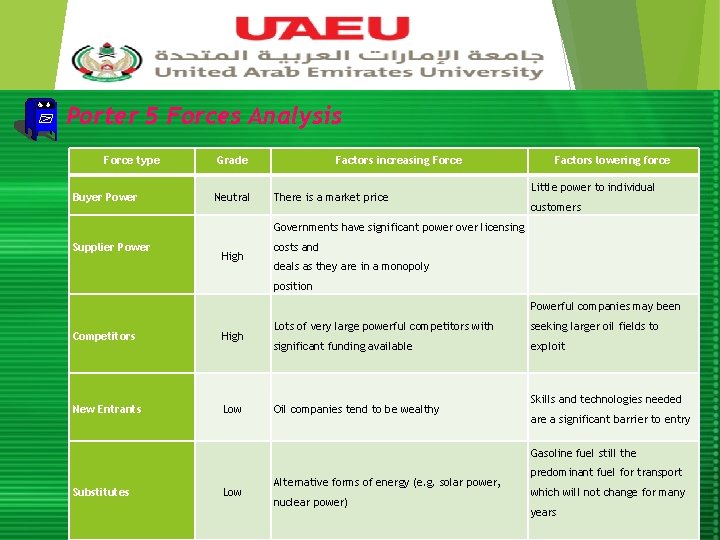
Porter 5 Forces Analysis Force type Buyer Power Grade Neutral Factors increasing Force There is a market price Factors lowering force Little power to individual customers Governments have significant power over licensing Supplier Power High costs and deals as they are in a monopoly position Powerful companies may been Competitors High Lots of very large powerful competitors with seeking larger oil fields to significant funding available exploit New Entrants Low Oil companies tend to be wealthy Skills and technologies needed are a significant barrier to entry Gasoline fuel still the Substitutes Low Alternative forms of energy (e. g. solar power, nuclear power) predominant fuel for transport which will not change for many years
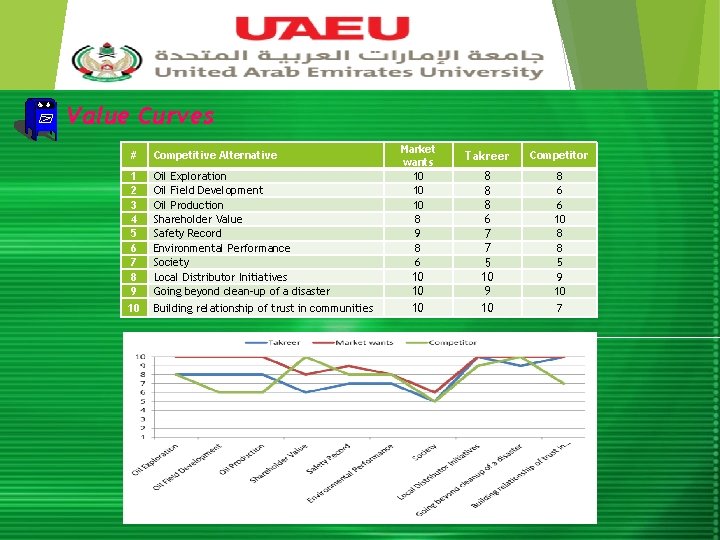
Value Curves # Competitive Alternative 1 2 3 4 5 6 7 8 9 Oil Exploration Oil Field Development Oil Production Shareholder Value Safety Record Environmental Performance Society Local Distributor Initiatives Going beyond clean-up of a disaster 10 Building relationship of trust in communities Market wants 10 10 10 8 9 8 6 10 10 10 Takreer Competitor 8 8 8 6 7 7 5 10 9 10 8 6 6 10 8 8 5 9 10 7
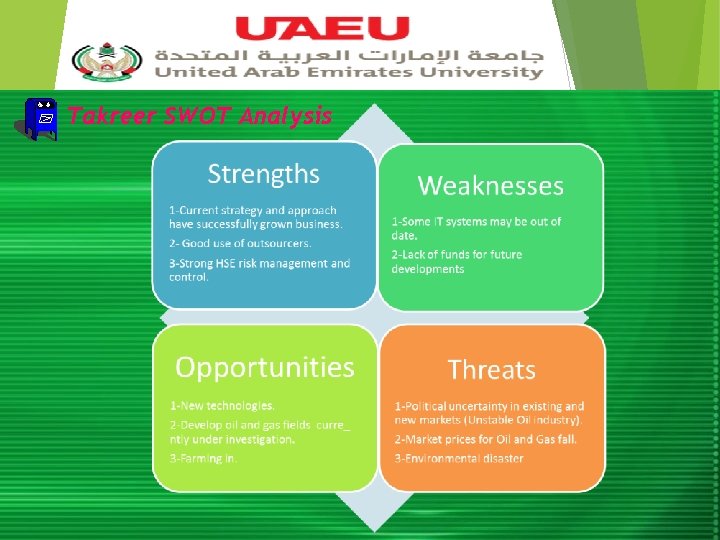
Takreer SWOT Analysis
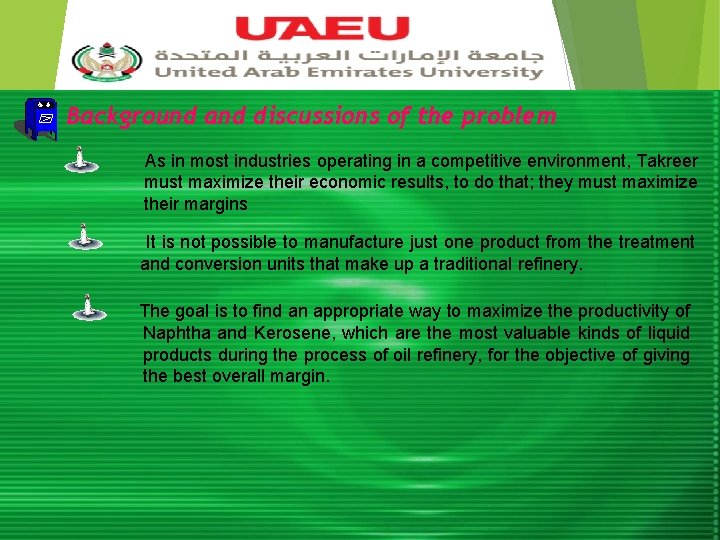
Background and discussions of the problem As in most industries operating in a competitive environment, Takreer must maximize their economic results, to do that; they must maximize their margins It is not possible to manufacture just one product from the treatment and conversion units that make up a traditional refinery. The goal is to find an appropriate way to maximize the productivity of Naphtha and Kerosene, which are the most valuable kinds of liquid products during the process of oil refinery, for the objective of giving the best overall margin.
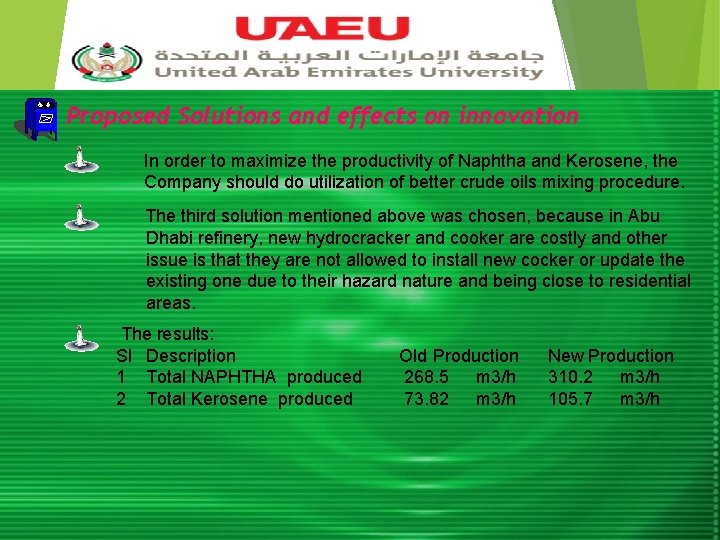
Proposed Solutions and effects on innovation In order to maximize the productivity of Naphtha and Kerosene, the Company should do utilization of better crude oils mixing procedure. The third solution mentioned above was chosen, because in Abu Dhabi refinery, new hydrocracker and cooker are costly and other issue is that they are not allowed to install new cocker or update the existing one due to their hazard nature and being close to residential areas. The results: SI Description Old Production 1 Total NAPHTHA produced 268. 5 m 3/h 2 Total Kerosene produced 73. 82 m 3/h New Production 310. 2 m 3/h 105. 7 m 3/h

- Slides: 13